Yoma 13a: Talmud study for Daf Yomi
Daf Yomi is the daily study of one Talmud folio. Explore 37 tractates with scans, Hebrew text, Sefaria English and AI-generated French translations where annotated.
Passage selection and English or AI-generated French translation are available where the scan has annotations. Daf Study is independent of Torah-Box and Sefaria.
Browse Yoma · יומא · All tractatesYoma 13a text and translations
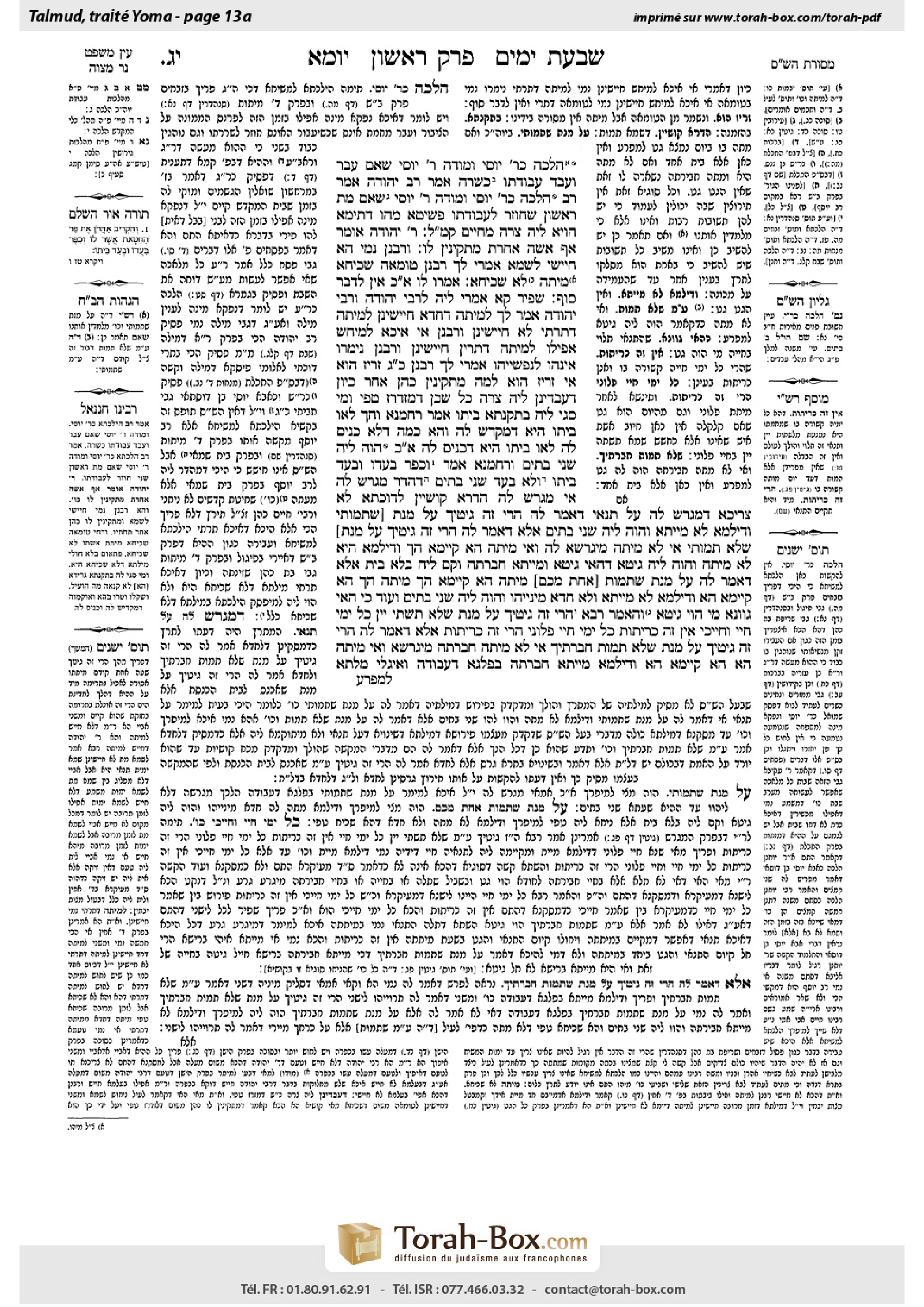
This page of Yoma includes the Aramaic text, an English translation and an AI-generated French translation, alongside the scan above.
יומא י״ג א · Aramaic and Hebrew text
הֲלָכָה כְּרַבִּי יוֹסֵי, וּמוֹדֶה רַבִּי יוֹסֵי שֶׁאִם עָבַר וְעָבַד — עֲבוֹדָתוֹ כְּשֵׁרָה. אָמַר רַב יְהוּדָה אָמַר רַב: הֲלָכָה כְּרַבִּי יוֹסֵי, וּמוֹדֶה רַבִּי יוֹסֵי שֶׁאִם מֵת רִאשׁוֹן, שֶׁחוֹזֵר לַעֲבוֹדָתוֹ.
פְּשִׁיטָא! מַהוּ דְּתֵימָא, הָוְיָא לֵיהּ צָרָה מֵחַיִּים. קָא מַשְׁמַע לַן.
רַבִּי יְהוּדָה אוֹמֵר: אַף אִשָּׁה אַחֶרֶת מַתְקִינִין לוֹ. וְרַבָּנַן נָמֵי, הָא חָיְישִׁי לְשֶׁמָּא? אָמְרִי לָךְ רַבָּנַן: טוּמְאָה שְׁכִיחָא, מִיתָה לָא שְׁכִיחָא.
אָמְרוּ לוֹ: אִם כֵּן, אֵין לַדָּבָר סוֹף. שַׁפִּיר קָא אָמְרִי לֵיהּ לְרַבִּי יְהוּדָה! וְרַבִּי יְהוּדָה — אָמַר לָךְ: לְמִיתָה דַחֲדָא — חָיְישִׁינַן. לְמִיתָה דְתַרְתֵּי — לָא חָיְישִׁינַן. וְרַבָּנַן? אִי אִיכָּא לְמֵיחַשׁ — אֲפִילּוּ לְמִיתָה דִּתְרֵין חָיְישִׁינַן.
וְרַבָּנַן, נֵימְרוּ אִינְהוּ לְנַפְשַׁיְיהוּ! אָמְרִי לָךְ רַבָּנַן: כֹּהֵן גָּדוֹל זָרִיז הוּא. אִי זָרִיז הוּא, לָמָּה מַתְקִינִין כֹּהֵן אַחֵר? כֵּיוָן דְּעָבְדִינַן לֵיהּ צָרָה, כׇּל שֶׁכֵּן דְּמִזְדָּרַז טְפֵי.
וּמִי סַגִּי לֵיהּ בְּתַקַּנְתָּא? ״בֵּיתוֹ״ אָמַר רַחֲמָנָא, וְהָךְ לָאו בֵּיתוֹ הִיא! דִּמְקַדֵּשׁ לַהּ. וְהָא כַּמָּה דְּלָא כָּנֵיס לַהּ — לָאו בֵּיתוֹ הִיא! דְּכָנֵיס לָהּ. אִם כֵּן, הָוֵה לֵיהּ שְׁנֵי בָתִּים, וְרַחֲמָנָא אָמַר: ״וְכִפֶּר בַּעֲדוֹ וּבְעַד בֵּיתוֹ״, וְלֹא בְּעַד שְׁנֵי בָתִּים!
דַּהֲדַר מְגָרֵשׁ לַהּ. אִי מְגָרֵשׁ לַהּ, הָדְרָא קוּשְׁיַין לְדוּכְתָּא! לָא צְרִיכָא, דִּמְגָרֵשׁ לַהּ עַל תְּנַאי. דְּאָמַר לַהּ: הֲרֵי זֶה גִּיטֵּיךְ עַל מְנָת [שֶׁתָּמוּתִי. וְדִילְמָא לָא מָיְיתָא, וְהָוֵה לֵיהּ שְׁנֵי בָתִּים!
אֶלָּא דְּאָמַר לַהּ: הֲרֵי זֶה גִּיטֵּיךְ עַל מְנָת] שֶׁלֹּא תָּמוּתִי. אִי לָא מָיְתָה — מִיגָּרְשָׁא לַהּ. וְאִי מָיְתָה הָא — קָיְימָא הָךְ. וְדִילְמָא הִיא לָא מָיְתָה, וְהָוֵה לֵיהּ גִּיטָּא דְּהַאי גִּיטָּא, וּמָיְיתָא חֲבֶרְתַּהּ, וְקָם לֵיהּ בְּלֹא בַּיִת!
אֶלָּא, דְּאָמַר לַהּ: עַל מְנָת שֶׁתָּמוּת [אַחַת מִכֶּם]. מָיְתָה הָא — קָיְימָא הָךְ, מָיְתָה הָךְ — הָא קָיְימָא הָא. וְדִילְמָא לָא מָיְיתָא וְלָא חֲדָא מִינַּיְיהוּ, וְהָוֵה לֵיהּ שְׁנֵי בָתִּים?
וְעוֹד: כִּי הַאי גַּוְונָא מִי הָוֵי גִּיטָּא? וְהָאָמַר רָבָא: ״הֲרֵי זֶה גִּיטֵּיךְ עַל מְנָת שֶׁלֹּא תִּשְׁתִּי יַיִן כׇּל יְמֵי חַיַּי וְחַיַּיְכִי״ — אֵין זֶה כְּרִיתוּת.
כׇּל יְמֵי חַיַּי פְּלוֹנִי — הֲרֵי זֶה כְּרִיתוּת!
אֶלָּא, דְּאָמַר לַהּ: הֲרֵי זֶה גִּיטֵּיךְ עַל מְנָת שֶׁלֹּא תָּמוּת חֲבֶרְתִּיךְ. אִי לָא מָיְתָה חֲבֶרְתַּהּ — מִיגָּרְשָׁא, וְאִי מָיְתָה הָא — הָא קָיְימָא הָא. וְדִילְמָא מָיְיתָא חֲבֶרְתַּהּ בְּפַלְגָא דַעֲבוֹדָה, וְאִיגַּלַּי מִלְּתָא
Yoma 13a · English translation
The halakha is in accordance with the opinion of Rabbi Yosei that the original High Priest returns to his service, while the second is fit to serve neither as High Priest nor as a common priest. And Rabbi Yosei concedes that if the second priest violated this provision and served as High Priest wearing eight garments, his service is valid. Rav Yehuda said that Rav said: The halakha is in accordance with the opinion of Rabbi Yosei, and Rabbi Yosei conceded that if the original High Priest dies, the second returns to his service as High Priest.
The Gemara asks: That is obvious. Clearly, the second priest may serve as High Priest after the first one dies without concern that their rivalry will generate hatred between them. The Gemara answers: Lest you say that the mere knowledge that another priest is in waiting to replace him is enough to generate hatred, and would be for him like a woman whose husband has taken a rival wife in her lifetime; therefore, Rav teaches us that this is not a concern.
§ It was taught in the mishna that Rabbi Yehuda says: The Sages would even designate another wife for the High Priest lest his wife die. The Rabbis say: There is no concern lest his wife die, and therefore the Sages did not designate another wife for him. The Gemara asks with regard to the Rabbis: Aren’t they concerned lest he become impure, which is why the Sages designate a replacement High Priest? Why then, are they not concerned lest his wife die? The Gemara answers that the Rabbis could have said to you: Impurity is common, as it is not unusual for the High Priest to become impure either due to secretions from his body or from an external source. Death is not common, and therefore there is no concern lest his wife die.
It was taught in the mishna that the Rabbis said to Rabbi Yehuda: If so, that you are concerned lest his wife die, there is no end to the matter. You should also be concerned lest the second wife die, requiring designation of a third and even a fourth wife. The Gemara comments: The Rabbis spoke well to Rabbi Yehuda, making a good point. What can Rabbi Yehuda respond? Rabbi Yehuda could have said to you: For the potential death of one wife, we are concerned; for the potential death of two wives, we are not concerned, as the likelihood of that happening is negligible. The Gemara asks: And what would the Rabbis respond to that contention? They would say: If there is reason to be concerned for a potential death, then even for the potential death of two wives, we are concerned.
The Gemara suggests: If according to the Rabbis there is no distinction between concern that one wife might die and concern that two wives might die, let them say the same with regard to their own opinion. Just as they designate a replacement lest the High Priest become impure, they should designate a second replacement lest the first replacement also become impure. The Gemara answers that the Rabbis could have said to you: The High Priest is vigilant in avoiding impurity. No amount of vigilance can prevent death. The Gemara asks: If he is vigilant in avoiding impurity, then why do the Sages designate another priest in his stead? The reason for the designation of the replacement is that once we establish a replacement as a rival, all the more so will the High Priest be even more vigilant in avoiding impurity to maintain his position.
§ The Gemara asks with regard to Rabbi Yehuda’s opinion: And is designation of a second wife sufficient for him? The Merciful One stated in the Torah: “And he shall make atonement for himself and for his house” (Leviticus 16:11). House means wife; and this designated woman is not his wife as they are not yet married. What purpose does designation serve if his wife dies on Yom Kippur? The Gemara answers: He betroths her before Yom Kippur. The Gemara asks: But that does not solve the problem. As long as he has not married her, she is not yet his house, i.e., his wife. The Gemara answers: Rabbi Yehuda says that not only is a replacement wife designated, but he actually marries her. If so, another problem arises. The High Priest has two houses, and the Merciful One said: “And he shall make atonement for himself and for his house” (Leviticus 16:11). He atones for one house and not for two houses.
The Gemara answers: Rabbi Yehuda says that after marrying the second wife, he then divorces her. The Gemara asks: If he divorces her, our difficulty is restored to its original place. There is no point in designating a second wife, as if the first wife dies, the second woman is not married to him. The Gemara responds: No, it is necessary in a case where he marries her and divorces her provisionally, as he says to her: This is your bill of divorce on condition that you die on Yom Kippur. If she dies on Yom Kippur, then she was divorced retroactively and he has only one wife; if she does not die but the original wife dies, her divorce does not take effect and the second wife is married to the High Priest. In either case, the High Priest has only one wife. The Gemara asks: And perhaps neither she nor the original wife will die, and the High Priest then has two houses on Yom Kippur.
Rather, it is a case where the High Priest said to her, the woman designated: This is your bill of divorce on condition that you will not die on Yom Kippur. If she does not die, then she is divorced and he remains married to the original wife; if she dies, isn’t that original wife alive and he remains married to her alone? The Gemara asks: And perhaps the second one will not die and her bill of divorce will be a valid bill of divorce, meaning she is not his wife, but her counterpart might die, leaving the High Priest without a wife at all on Yom Kippur.
Rather, it is a case where the High Priest said to her: This is your bill of divorce on condition that one of you dies. If this one dies, that one is alive, and if that one dies, isn’t this one alive? The Gemara asks: And perhaps neither one of them will die, and he will then have two houses.
And furthermore, the question arises: Is a document of that sort a valid bill of divorce? Does a condition of that sort take effect? But didn’t Rava say: If a man says to his wife: This is your bill of divorce on condition that you will not drink wine for all the days of my life and your life, that is not severance. The bill of divorce in the Torah is called a bill of severance, meaning that for the document to be valid all connections between the husband and wife must be severed. If there is a provision in the document that maintains a permanent connection between the spouses, e.g., not to drink wine for all of her life, the document does not effect a valid divorce.
However, if one said to his wife: This is your bill of divorce on condition that you will not drink wine during all the days of the life of so-and-so; that is severance. Since the condition is not dependent on her and him but on the life of a third party, it is like any other condition in a divorce. Therefore, in the case of the High Priest, since the divorce takes effect only if neither of the women dies, that is a condition that maintains a relationship between the husband and wife for as long as she lives, which invalidates the divorce.
Rather, it is a case where the High Priest said to the second wife: This is your bill of divorce on condition that your counterpart, the other wife, will not die. If her counterpart, the first woman, does not die, the second woman is divorced; and if the first woman dies, isn’t the second woman alive and not divorced? The Gemara asks: And perhaps her counterpart will die in the middle of the Yom Kippur service, and it will become clear
Yoma 13a · Traduction française (IA)
La halakha suit l’avis de Rabbi Yossei : le grand prêtre initial reprend son service, tandis que le second n’est apte à servir ni comme grand prêtre ni comme prêtre ordinaire. Rabbi Yossei reconnaît toutefois que si le second prêtre a enfreint cette disposition et a servi comme grand prêtre en portant les huit vêtements, son service est valide. Rav Yehouda a dit au nom de Rav : la halakha suit l’avis de Rabbi Yossei, et Rabbi Yossei reconnaît que si le grand prêtre initial meurt, le second reprend son service comme grand prêtre.
La Guemara demande : cela va de soi. Il est clair que le second prêtre peut servir comme grand prêtre après la mort du premier, sans craindre que leur rivalité n’engendre de la haine entre eux. La Guemara répond : de peur que tu ne dises que le simple fait de savoir qu’un autre prêtre attend pour le remplacer suffit à engendrer de la haine, et que cette situation serait pour lui comme celle d’une femme dont le mari a pris une rivale de son vivant ; Rav nous enseigne donc que cela n’est pas à craindre.
§ Il a été enseigné dans la Michna que Rabbi Yehouda dit : les Sages désignaient même une autre épouse pour le grand prêtre, de peur que sa femme ne meure. Les Rabbins disent : il n’y a pas lieu de craindre que sa femme meure ; les Sages ne lui désignaient donc pas une autre épouse. La Guemara interroge les Rabbins : ne craignent-ils pas qu’il devienne impur, raison pour laquelle les Sages désignent un grand prêtre remplaçant ? Pourquoi ne craignent-ils donc pas que sa femme meure ? La Guemara répond que les Rabbins auraient pu te dire : l’impureté est fréquente, car il n’est pas inhabituel que le grand prêtre devienne impur, soit à cause d’écoulements provenant de son corps, soit d’une source extérieure. La mort, elle, n’est pas fréquente ; il n’y a donc pas lieu de craindre que sa femme meure.
Il a été enseigné dans la Michna que les Rabbins ont dit à Rabbi Yehouda : si tel est le cas, si tu crains que sa femme ne meure, la question n’a pas de fin. Tu devrais aussi craindre que la seconde épouse ne meure, ce qui obligerait à en désigner une troisième, voire une quatrième. La Guemara commente : les Rabbins ont bien argumenté contre Rabbi Yehouda ; leur remarque est pertinente. Que peut répondre Rabbi Yehouda ? Il aurait pu te dire : nous craignons la mort éventuelle d’une épouse, mais nous ne craignons pas celle de deux épouses, car la probabilité que cela arrive est négligeable. La Guemara demande : et que répondraient les Rabbins à cet argument ? Ils diraient : s’il y a lieu de craindre une mort éventuelle, alors nous craignons aussi la mort éventuelle de deux épouses.
La Guemara suggère : si, selon les Rabbins, il n’y a aucune différence entre craindre la mort éventuelle d’une épouse et celle de deux épouses, qu’ils disent la même chose au sujet de leur propre opinion. De même qu’ils désignent un remplaçant de peur que le grand prêtre ne devienne impur, ils devraient désigner un second remplaçant, de peur que le premier remplaçant ne devienne lui aussi impur. La Guemara répond que les Rabbins auraient pu te dire : le grand prêtre veille à éviter l’impureté. Aucune vigilance ne peut empêcher la mort. La Guemara demande : s’il veille à éviter l’impureté, pourquoi les Sages désignent-ils un autre prêtre à sa place ? La raison de cette désignation est que, dès lors que nous lui désignons un rival, le grand prêtre veillera d’autant plus à éviter l’impureté afin de conserver sa position.
§ La Guemara interroge au sujet de l’avis de Rabbi Yehouda : la désignation d’une seconde épouse lui suffit-elle ? Le Miséricordieux a déclaré dans la Torah : « Il fera l’expiation pour lui-même et pour sa maison » (Lévitique 16,11). La maison désigne l’épouse ; or cette femme désignée n’est pas son épouse, puisqu’ils ne sont pas encore mariés. À quoi sert cette désignation si sa femme meurt le jour de Yom Kippour ? La Guemara répond : il la fiance avant Yom Kippour. La Guemara demande : cela ne résout pourtant pas le problème. Tant qu’il ne l’a pas épousée, elle n’est pas encore sa maison, c’est-à-dire son épouse. La Guemara répond : selon Rabbi Yehouda, non seulement on désigne une épouse de remplacement, mais il l’épouse effectivement. Dans ce cas, un autre problème se pose. Le grand prêtre a deux maisons, alors que le Miséricordieux a dit : « Il fera l’expiation pour lui-même et pour sa maison » (Lévitique 16,11). Il fait l’expiation pour une maison et non pour deux.
La Guemara répond : selon Rabbi Yehouda, après avoir épousé la seconde femme, il divorce d’elle. La Guemara demande : s’il divorce d’elle, notre difficulté initiale réapparaît. Il ne sert à rien de désigner une seconde épouse, car si la première femme meurt, la seconde n’est pas mariée à lui. La Guemara répond : non, cela est nécessaire dans le cas où il l’épouse puis divorce d’elle sous condition, en lui disant : « Voici ton acte de divorce, à condition que tu meures le jour de Yom Kippour. » Si elle meurt le jour de Yom Kippour, elle a alors été divorcée rétroactivement et il n’a qu’une seule épouse ; si elle ne meurt pas, mais que l’épouse initiale meurt, son divorce ne prend pas effet et la seconde épouse est mariée au grand prêtre. Dans les deux cas, le grand prêtre n’a qu’une seule épouse. La Guemara demande : et peut-être ni elle ni l’épouse initiale ne mourront, auquel cas le grand prêtre aura deux maisons le jour de Yom Kippour.
Il s’agit plutôt d’un cas où le grand prêtre dit à la femme désignée : « Voici ton acte de divorce, à condition que tu ne meures pas le jour de Yom Kippour. » Si elle ne meurt pas, elle est divorcée et il reste marié à son épouse initiale ; si elle meurt, l’épouse initiale n’est-elle pas vivante, de sorte qu’il reste marié à elle seule ? La Guemara demande : et peut-être que la seconde ne mourra pas et que son acte de divorce sera valide, ce qui signifie qu’elle n’est pas son épouse, mais que son homologue mourra, laissant le grand prêtre sans épouse du tout le jour de Yom Kippour.
Il s’agit plutôt d’un cas où le grand prêtre lui dit : « Voici ton acte de divorce, à condition que l’une de vous deux meure. » Si celle-ci meurt, l’autre est vivante ; et si l’autre meurt, celle-ci n’est-elle pas vivante ? La Guemara demande : et peut-être qu’aucune des deux ne mourra, auquel cas il aura deux maisons.
De plus, une question se pose : un document de cette sorte constitue-t-il un acte de divorce valide ? Une condition de cette sorte prend-elle effet ? Rava n’a-t-il pas dit : si un homme dit à sa femme : « Voici ton acte de divorce, à condition que tu ne boives pas de vin pendant tous les jours de ma vie et de la tienne », cela ne constitue pas une séparation. Dans la Torah, l’acte de divorce est appelé acte de séparation, ce qui signifie que, pour que le document soit valide, tous les liens entre le mari et la femme doivent être rompus. Si le document comporte une clause qui maintient un lien permanent entre les époux — par exemple, l’obligation de ne pas boire de vin durant toute sa vie —, il ne produit pas un divorce valide.
En revanche, si quelqu’un dit à sa femme : « Voici ton acte de divorce, à condition que tu ne boives pas de vin pendant tous les jours de la vie d’untel », cela constitue une séparation. Puisque la condition ne dépend ni d’elle ni de lui, mais de la vie d’une tierce personne, elle est comme toute autre condition d’un divorce. Par conséquent, dans le cas du grand prêtre, puisque le divorce ne prend effet que si aucune des deux femmes ne meurt, cette condition maintient un lien entre le mari et sa femme aussi longtemps qu’elle est en vie, ce qui invalide le divorce.
Il s’agit plutôt d’un cas où le grand prêtre dit à la seconde épouse : « Voici ton acte de divorce, à condition que ton homologue, l’autre épouse, ne meure pas. » Si son homologue, la première femme, ne meurt pas, la seconde est divorcée ; et si la première femme meurt, la seconde n’est-elle pas vivante et non divorcée ? La Guemara demande : et peut-être que son homologue mourra au milieu du service de Yom Kippour, et il apparaîtra
Traduction française générée par IA à partir de l’édition anglaise de Sefaria. Vérifie toujours un passage avec le texte source.
Text from Sefaria: William Davidson Edition - Vocalized Aramaic (CC BY NC); William Davidson Edition - English (CC BY NC).