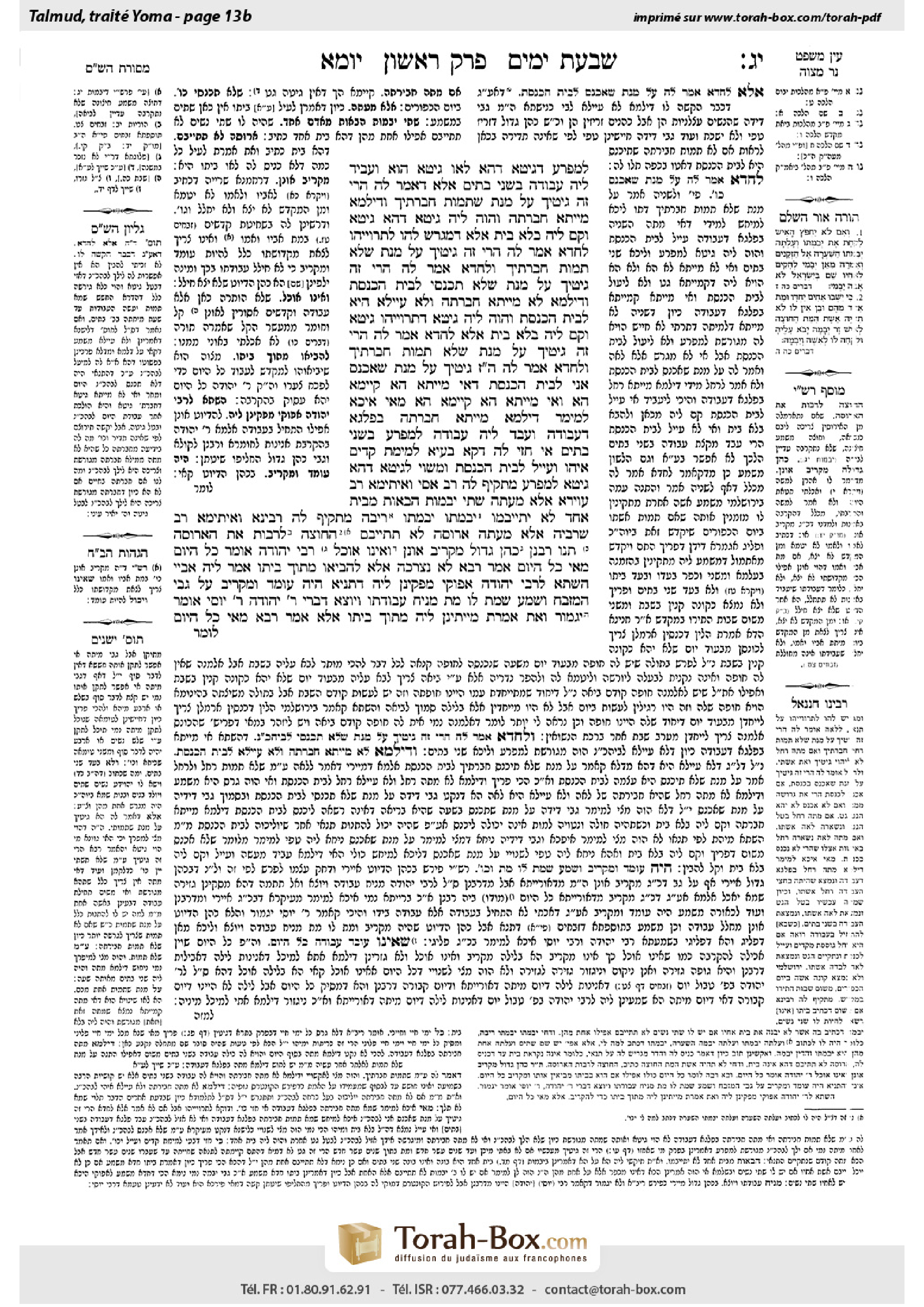
Yoma 13b: Talmud study for Daf Yomi
Daf Yomi is the daily study of one Talmud folio. Explore 37 tractates with scans, Hebrew text, Sefaria English and AI-generated French translations where annotated.
Passage selection and English or AI-generated French translation are available where the scan has annotations. Daf Study is independent of Torah-Box and Sefaria.
Browse Yoma · יומא · All tractatesYoma 13b text and translations
This page of Yoma includes the Aramaic text, an English translation and an AI-generated French translation, alongside the scan above.
יומא י״ג ב · Aramaic and Hebrew text
לְמַפְרֵעַ דְּגִיטָּא דְּהָא לָאו גִּיטָּא הוּא, וְעָבֵיד לֵיהּ עֲבוֹדָה בִּשְׁנֵי בָתִּים! אֶלָּא, דְּאָמַר לַהּ: הֲרֵי זֶה גִּיטֵּיךְ עַל מְנָת שֶׁתָּמוּת חֲבֶרְתִּיךְ. וְדִילְמָא מָיְיתָא חֲבֶרְתַּהּ, וְהָוֵה לֵיהּ גִּיטָּא דְּהָא גִּיטָּא, וְקָם לֵיהּ בְּלֹא בַּיִת!
אֶלָּא, דִּמְגָרֵשׁ לְהוּ לְתַרְוַיְיהוּ. לַחֲדָא אָמַר לַהּ: הֲרֵי זֶה גִּיטֵּיךְ עַל מְנָת שֶׁלֹּא תָּמוּת חֲבֶרְתִּיךְ, וְלַחֲדָא אָמַר לַהּ: הֲרֵי זֶה גִּיטֵּיךְ עַל מְנָת שֶׁלֹּא תִּכָּנְסִי לְבֵית הַכְּנֶסֶת. וְדִילְמָא לָא מָיְיתָא חֲבֶרְתַּהּ, וְלָא עָיְילָא הִיא לְבֵית הַכְּנֶסֶת, וְהָוֵה לֵיהּ גִּיטָּא דְתַרְוַיְיהוּ גִּיטָּא, וְקָם לֵיהּ בְּלֹא בַּיִת!
אֶלָּא, לַחֲדָא אָמַר לַהּ: הֲרֵי זֶה גִּיטֵּיךְ עַל מְנָת שֶׁלֹּא תָּמוּת חֲבֶרְתִּיךְ. וְלַחֲדָא אָמַר לַהּ: הֲרֵי זֶה גִּיטֵּיךְ עַל מְנָת שֶׁאֶכָּנֵס אֲנִי לְבֵית הַכְּנֶסֶת. דְּאִי מָיְיתָא הָא — קָיְימָא הָא, וְאִי מָיְיתָא הָא — קָיְימָא הָא. מַאי אִיכָּא לְמֵימַר? דִּילְמָא מָיְיתָא חֲבֶרְתַּהּ בְּפַלְגָא דַעֲבוֹדָה, וְעָבֵד לֵיהּ עֲבוֹדָה לְמַפְרֵעַ בִּשְׁנֵי בָתִּים? אִי חָזֵי לַהּ דְּקָא בָּעֲיָא לְמֵימַת — קָדֵים אִיהוּ וְעָיֵיל לְבֵית הַכְּנֶסֶת, וּמְשַׁוֵּי לְגִיטָּא דְּהָא גִּיטָּא לְמַפְרֵעַ.
מַתְקֵיף לַהּ רַב אַסִּי, וְאִיתֵּימָא רַב עַוִּירָא: אֶלָּא מֵעַתָּה, שְׁתֵּי יְבָמוֹת הַבָּאוֹת מִבַּיִת אֶחָד, לֹא יִתְיַיבְּמוּ! ״יְבִמְתּוֹ״ ״יְבִמְתּוֹ״ רִיבָּה.
מַתְקֵיף לַהּ רָבִינָא, וְאִיתֵּימָא רַב שֵׁרֵבְיָה: אֶלָּא מֵעַתָּה אֲרוּסָה לֹא תִּתְיַיבֵּם? ״הַחוּצָה״, לְרַבּוֹת אֶת הָאֲרוּסָה.
תָּנוּ רַבָּנַן: כֹּהֵן גָּדוֹל מַקְרִיב אוֹנֵן, וְאֵינוֹ אוֹכֵל. רַבִּי יְהוּדָה אוֹמֵר: כׇּל הַיּוֹם. מַאי ״כׇּל הַיּוֹם״? אָמַר רָבָא: לֹא נִצְרְכָה אֶלָּא לַהֲבִיאוֹ מִתּוֹךְ בֵּיתוֹ.
אֲמַר לֵיהּ אַבָּיֵי: הַשְׁתָּא לְרַבִּי יְהוּדָה אַפּוֹקֵי מַפְּקִינַן לֵיהּ, דְּתַנְיָא: הָיָה עוֹמֵד וּמַקְרִיב עַל גַּבֵּי הַמִּזְבֵּחַ וְשָׁמַע שֶׁמֵּת לוֹ מֵת, מַנִּיחַ עֲבוֹדָתוֹ וְיוֹצֵא, דִּבְרֵי רַבִּי יְהוּדָה. רַבִּי יוֹסֵי אוֹמֵר: יִגְמוֹר. וְאַתְּ אָמְרַתְּ מַיְיתִינַן לֵיהּ מִתּוֹךְ בֵּיתוֹ?
אֶלָּא אָמַר רָבָא: מַאי ״כׇּל הַיּוֹם״ —
Yoma 13b · English translation
retroactively that the bill of divorce of this second woman is not a valid bill of divorce, since the first wife died. In that case, it turns out retroactively that he performed part of the service with two houses, married to two wives. Rather, it is a case where the High Priest said to the second wife: This is your bill of divorce on condition that your counterpart dies. The Gemara asks: In this case, too, perhaps her counterpart will die and the bill of divorce of this second woman is a valid bill of divorce, and he will remain without a house at all.
Rather, this is a case where he divorces both of them provisionally, with a different stipulation to each woman. To one, he says: This is your bill of divorce on condition that your counterpart will not die. And to the other one, he says: This is your bill of divorce on condition that you will not enter the synagogue on Yom Kippur, cognizant of the fact that she can easily fulfill that condition and thereby effect her divorce. The Gemara asks: And perhaps her counterpart will not die, fulfilling the condition and effecting the divorce of one wife; and she will not enter the synagogue, fulfilling the condition and effecting the divorce of the other wife. In that case the bill of divorce of both women is a valid bill of divorce and he remains without a wife.
Rather, it is a case where to one of the women, the High Priest says: This is your bill of divorce on condition that your counterpart does not die. And to the other one of the women he says: This is your bill of divorce on condition that I will enter the synagogue. If this wife dies, that other one is alive; and if that other one dies, this one is alive. What is there to say in refuting this possibility? Perhaps her counterpart will die in the middle of the service, and it will turn out retroactively that he performed part of the service with two houses, married to two wives. If he sees that she seeks, i.e., she is about to die, he will then preemptively enter the synagogue, rendering the bill of divorce of the dying wife a valid bill of divorce retroactively. He will then be married to only one woman. In that way, a second wife can be designated for the High Priest without him being married to two women on Yom Kippur.
Rav Asi, and some say it was Rav Avira, strongly objects to that conclusion: However, if that is so, that from the term: His house, in the singular, one derives one wife and not two, then two widows of a brother who died without a child [yevamot] who come from one house, i.e., they were married to the same man, should not be obligated to marry his brother in levirate marriage. In addressing levirate marriage, the Torah says: “So shall it be done to the man that does not build his brother’s house” (Deuteronomy 25:9). One may derive from this: One house, i.e., wife, and not two. The Gemara responds that when the Torah says: “Then his yevama shall go up to the gate” (Deuteronomy 25:7), “and his yevama will draw nigh to him” (Deuteronomy 25:9), twice, it comes to include a situation where the deceased had two wives; in that case one of them is required to marry his brother in levirate marriage.
Ravina, and some say it was Rav Sherevya, strongly objects to this: It was stated above that a woman betrothed to the High Priest is not considered his house, i.e., his wife. However, if that is so, a betrothed woman whose betrothed passed away should not be obligated to marry his brother in levirate marriage, since the term: House, appears in that context as well. In practice, that is not the halakha. The Gemara answers that the Torah says: “The wife of the dead shall not be married outside to one not of his kin” (Deuteronomy 25:5). The superfluous term: Outside, comes to include the betrothed woman. Although she is technically still outside the family, the brother of the deceased must either marry her in levirate marriage or perform ḥalitza.
§ Apropos the death of the wife of the High Priest, the Gemara cites an additional baraita. The Sages taught: A High Priest sacrifices offerings when he is an acute mourner, on the day of a relative’s death, but does not eat from those offerings. Rabbi Yehuda says: The entire day. The Gemara asks: What is the meaning of the phrase: The entire day? Rava said: This phrase is necessary only to bring him from his house. Not only is it permitted for the High Priest to serve in the Temple when he is an acute mourner, but it is a mitzva to bring him from his house to serve in the Temple for the entire day to help ease his pain.
Abaye said to him: Now, according to the opinion of Rabbi Yehuda, we remove the High Priest from the Temple when he is an acute mourner, as it was taught in a baraita: If a common priest was standing and sacrificing an offering on top of the altar and heard that a relative of his died, he leaves his service in the middle and exits the Temple; this is the statement of Rabbi Yehuda. Rabbi Yosei says: He completes the service and then leaves. Rabbi Yehuda rules stringently in the case of a priest who is an acute mourner sacrificing an offering. Even though the baraita is referring to a common priest, it is reasonable to say that the same is true with regard to a High Priest as well. Rabbi Yehuda says that a High Priest who becomes an acute mourner exits the Temple, and you say we bring the High Priest who is an acute mourner from his house to serve?
Rather, Rava said: The initial interpretation must be rejected. What is the meaning of the phrase: The entire day?
Yoma 13b · Traduction française (IA)
… rétroactivement, l’acte de divorce de cette seconde femme n’est pas valide, puisque la première épouse est morte. Dans ce cas, il s’avère rétroactivement qu’il a accompli une partie du service alors qu’il avait deux foyers, c’est-à-dire qu’il était marié à deux femmes. Il s’agit plutôt d’un cas où le grand prêtre a dit à la seconde épouse : « Voici ton acte de divorce, à condition que ta rivale meure. » La Guemara demande : dans ce cas également, peut-être sa rivale mourra-t-elle, et l’acte de divorce de cette seconde femme sera valide ; il se retrouvera alors sans épouse.
Il s’agit plutôt d’un cas où il divorce les deux femmes sous condition, en formulant une condition différente pour chacune. À l’une, il dit : « Voici ton acte de divorce, à condition que ta rivale ne meure pas. » À l’autre, il dit : « Voici ton acte de divorce, à condition que tu n’entres pas dans la synagogue le jour de Yom Kippour », sachant qu’elle peut facilement remplir cette condition et ainsi rendre son divorce effectif. La Guemara demande : et peut-être sa rivale ne mourra-t-elle pas, ce qui remplira la condition et rendra effectif le divorce de l’une des épouses, tandis qu’elle n’entrera pas dans la synagogue, ce qui remplira la condition et rendra effectif le divorce de l’autre épouse. Dans ce cas, les actes de divorce des deux femmes seront valides et il se retrouvera sans épouse.
Il s’agit plutôt d’un cas où le grand prêtre dit à l’une des femmes : « Voici ton acte de divorce, à condition que ta rivale ne meure pas. » À l’autre, il dit : « Voici ton acte de divorce, à condition que j’entre dans la synagogue. » Si cette épouse meurt, l’autre reste en vie ; et si l’autre meurt, celle-ci reste en vie. Que peut-on répondre pour réfuter cette possibilité ? Peut-être sa rivale mourra-t-elle au milieu du service, et il s’avérera rétroactivement qu’il a accompli une partie du service alors qu’il avait deux foyers, c’est-à-dire qu’il était marié à deux femmes. S’il voit qu’elle va mal, c’est-à-dire qu’elle est sur le point de mourir, il entrera alors préventivement dans la synagogue, ce qui rendra rétroactivement valide l’acte de divorce de l’épouse mourante. Il ne sera alors marié qu’à une seule femme. Ainsi, une seconde épouse peut être désignée pour le grand prêtre sans qu’il soit marié à deux femmes le jour de Yom Kippour.
Rav Assi, et certains disent que c’était Rav Avira, objecte vivement à cette conclusion : toutefois, si tel est le cas, si l’on déduit du terme « sa maison », au singulier, qu’il s’agit d’une épouse et non de deux, alors deux veuves d’un frère mort sans enfant [yevamot], issues d’un même foyer, c’est-à-dire mariées au même homme, ne devraient pas être tenues d’épouser son frère dans le cadre du mariage léviratique. À propos du mariage léviratique, la Torah dit : « Ainsi sera-t-il fait à l’homme qui ne bâtit pas la maison de son frère » (Deutéronome 25,9). On peut en déduire : une maison, c’est-à-dire une épouse, et non deux. La Guemara répond que lorsque la Torah dit : « Alors sa yevama montera à la porte » (Deutéronome 25,7), puis « et sa yevama s’approchera de lui » (Deutéronome 25,9), ces deux mentions viennent inclure le cas où le défunt avait deux épouses ; dans ce cas, l’une d’elles doit épouser son frère dans le cadre du mariage léviratique.
Ravina, et certains disent que c’était Rav Sherevya, objecte vivement : il a été dit plus haut qu’une femme fiancée au grand prêtre n’est pas considérée comme son foyer, c’est-à-dire son épouse. Toutefois, si tel est le cas, une femme fiancée dont le fiancé est mort ne devrait pas être tenue d’épouser son frère dans le cadre du mariage léviratique, puisque le terme « maison » apparaît également dans ce contexte. En pratique, telle n’est pas la halakha. La Guemara répond que la Torah dit : « La femme du défunt ne sera pas mariée au-dehors à un homme qui ne lui est pas apparenté » (Deutéronome 25,5). Le terme superflu « au-dehors » vient inclure la femme fiancée. Bien qu’elle soit techniquement encore extérieure à la famille, le frère du défunt doit soit l’épouser dans le cadre du mariage léviratique, soit accomplir la ḥalitsa.
§ À propos de la mort de l’épouse du grand prêtre, la Guemara cite une autre baraïta. Les Sages ont enseigné : un grand prêtre offre des sacrifices lorsqu’il est en deuil aigu, le jour de la mort d’un proche, mais il ne mange pas de ces sacrifices. Rabbi Yehouda dit : « Toute la journée. » La Guemara demande : que signifie l’expression « toute la journée » ? Rava a dit : cette précision est nécessaire uniquement pour indiquer qu’on le fait venir de chez lui. Non seulement il est permis au grand prêtre d’officier dans le Temple lorsqu’il est en deuil aigu, mais c’est une mitsva de le faire venir de chez lui pour qu’il y officie toute la journée, afin de contribuer à apaiser sa douleur.
Abayé lui dit : or, selon l’opinion de Rabbi Yehouda, on fait sortir le grand prêtre du Temple lorsqu’il est en deuil aigu, comme cela a été enseigné dans une baraïta : si un prêtre ordinaire se tient près de l’autel et offre un sacrifice, puis apprend qu’un de ses proches est mort, il interrompt son service et sort du Temple ; telle est la déclaration de Rabbi Yehouda. Rabbi Yossi dit : il achève le service, puis sort. Rabbi Yehouda statue avec rigueur dans le cas d’un prêtre en deuil aigu qui offre un sacrifice. Bien que la baraïta parle d’un prêtre ordinaire, il est raisonnable de dire qu’il en va de même pour le grand prêtre. Rabbi Yehouda dit qu’un grand prêtre qui entre en deuil aigu sort du Temple, et toi, tu dis qu’on fait venir de chez lui le grand prêtre en deuil aigu pour qu’il officie ?
Rava a plutôt dit : il faut rejeter l’interprétation initiale. Que signifie l’expression « toute la journée » ?
Traduction française générée par IA à partir de l’édition anglaise de Sefaria. Vérifie toujours un passage avec le texte source.
Text from Sefaria: William Davidson Edition - Vocalized Aramaic (CC BY NC); William Davidson Edition - English (CC BY NC).