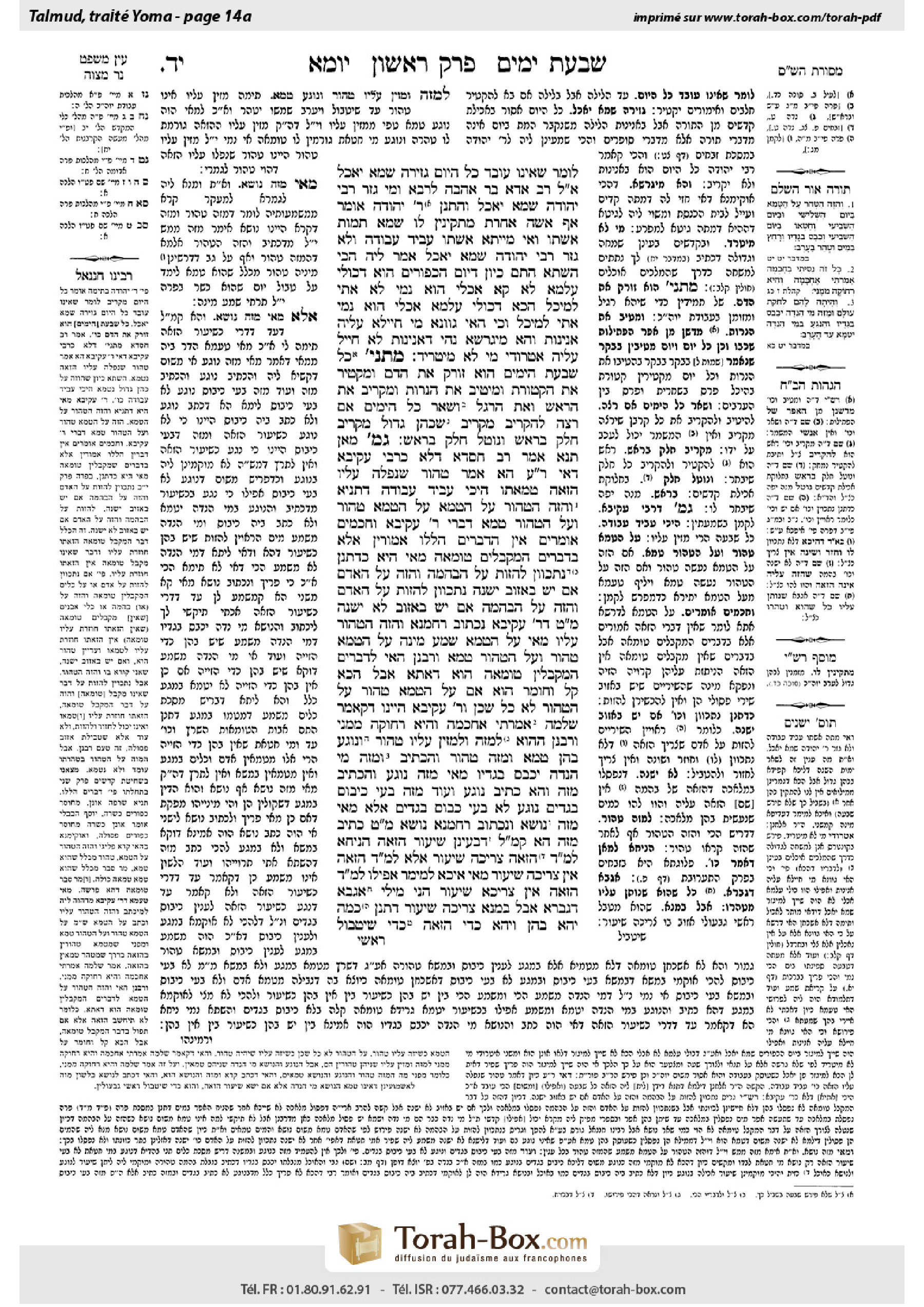
Yoma 14a: Talmud study for Daf Yomi
Daf Yomi is the daily study of one Talmud folio. Explore 37 tractates with scans, Hebrew text, Sefaria English and AI-generated French translations where annotated.
Passage selection and English or AI-generated French translation are available where the scan has annotations. Daf Study is independent of Torah-Box and Sefaria.
Browse Yoma · יומא · All tractatesYoma 14a text and translations
This page of Yoma includes the Aramaic text, an English translation and an AI-generated French translation, alongside the scan above.
יומא י״ד א · Aramaic and Hebrew text
לוֹמַר שֶׁאֵינוֹ עוֹבֵד כׇּל הַיּוֹם, גְּזֵירָה שֶׁמָּא יֹאכַל. אֲמַר לֵיהּ רַב אַדָּא בַּר אַהֲבָה לְרָבָא: וּמִי גָּזַר רַבִּי יְהוּדָה שֶׁמָּא יֹאכַל? וְהָתְנַן, רַבִּי יְהוּדָה אוֹמֵר: אַף אִשָּׁה אַחֶרֶת מַתְקִינִין לוֹ, שֶׁמָּא תָּמוּת אִשְׁתּוֹ. וְאִי מָיְיתָא אִשְׁתּוֹ עָבֵיד עֲבוֹדָה, וְלָא גָּזַר רַבִּי יְהוּדָה שֶׁמָּא יֹאכַל! אֲמַר לֵיהּ: הָכִי הַשְׁתָּא?! הָתָם, כֵּיוָן דְּיוֹם הַכִּפּוּרִים הוּא, דְּכוּלֵּי עָלְמָא לָא קָא אָכְלִי, הוּא נָמֵי לָא אָתֵי לְמֵיכַל, הָכָא, דְּכוּלֵּי עָלְמָא אָכְלִי — הוּא נָמֵי אָתֵי לְמֵיכַל.
וְכִי הַאי גַּוְונָא מִי חָיְילָא עֲלֵיהּ אֲנִינוּת? וְהָא מִיגָּרְשָׁא! נְהִי דַּאֲנִינוּת לָא חָיְילָא עֲלֵיהּ, אִטְּרוֹדֵי מִי לָא מִיטְּרִיד?
מַתְנִי׳ כׇּל שִׁבְעַת הַיָּמִים הוּא זוֹרֵק אֶת הַדָּם, וּמַקְטִיר אֶת הַקְּטוֹרֶת, וּמֵיטִיב אֶת הַנֵּרוֹת, וּמַקְרִיב אֶת הָרֹאשׁ וְאֶת הָרֶגֶל. וּשְׁאָר כׇּל הַיָּמִים אִם רָצָה לְהַקְרִיב — מַקְרִיב, שֶׁכֹּהֵן גָּדוֹל מַקְרִיב חֵלֶק בָּרֹאשׁ, וְנוֹטֵל חֵלֶק בָּרֹאשׁ.
גְּמָ׳ מַאן תַּנָּא? אָמַר רַב חִסְדָּא, דְּלָא כְּרַבִּי עֲקִיבָא. דְּאִי רַבִּי עֲקִיבָא, הָא אָמַר: טָהוֹר שֶׁנָּפְלָה עָלָיו הַזָּאָה טִמְּאַתּוּ, הֵיכִי עָבֵיד עֲבוֹדָה!
דְּתַנְיָא: ״וְהִזָּה הַטָּהוֹר עַל הַטָּמֵא״. עַל הַטָּמֵא — טָהוֹר, וְעַל הַטָּהוֹר — טָמֵא, דִּבְרֵי רַבִּי עֲקִיבָא. וַחֲכָמִים אוֹמְרִים: אֵין הַדְּבָרִים הַלָּלוּ אֲמוּרִין אֶלָּא בִּדְבָרִים הַמְקַבְּלִים טוּמְאָה.
מַאי הִיא — כְּדִתְנַן: נִתְכַּוֵּון לְהַזּוֹת עַל הַבְּהֵמָה וְהִזָּה עַל הָאָדָם, אִם יֵשׁ בָּאֵזוֹב — יִשְׁנֶה. נִתְכַּוֵּון לְהַזּוֹת עַל הָאָדָם וְהִזָּה עַל הַבְּהֵמָה, אִם יֵשׁ בָּאֵזוֹב — לֹא יִשְׁנֶה.
מַאי טַעְמָא דְּרַבִּי עֲקִיבָא? נִכְתּוֹב רַחֲמָנָא: ״וְהִזָּה הַטָּהוֹר עָלָיו״, מַאי ״עַל הַטָּמֵא״? שְׁמַע מִינַּהּ עַל הַטָּמֵא — טָהוֹר, וְעַל הַטָּהוֹר — טָמֵא. וְרַבָּנַן: הַאי לִדְבָרִים הַמְּקַבְּלִין טוּמְאָה הוּא דַּאֲתָא. אֲבָל הָכָא, קַל וָחוֹמֶר הוּא: אִם עַל הַטָּמֵא — טָהוֹר, עַל הַטָּהוֹר — לֹא כׇּל שֶׁכֵּן!
וְרַבִּי עֲקִיבָא? הַיְינוּ דְּקָאָמַר שְׁלֹמֹה ״אָמַרְתִּי אֶחְכָּמָה וְהִיא רְחוֹקָה מִמֶּנִּי״. וְרַבָּנַן? הַהוּא לַמַּזֶּה וְלַמַּזִּין עָלָיו — טָהוֹר, וְנוֹגֵעַ בָּהֶן — טָמֵא.
וּמַזֶּה טָהוֹר? וְהָכְתִיב: ״וּמַזֵּה מֵי הַנִּדָּה יְכַבֵּס בְּגָדָיו״. מַאי ״מַזֶּה״ — נוֹגֵעַ. וְהָכְתִיב ״מַזֶּה״, וְהָא כְּתִיב ״נוֹגֵעַ״? וְעוֹד: מַזֶּה בָּעֵי כִּיבּוּס בְּגָדִים, נוֹגֵעַ לָא בָּעֵי כִּבּוּס בְּגָדִים!
אֶלָּא: מַאי ״מַזֶּה״ — נוֹשֵׂא. וְנִכְתּוֹב רַחֲמָנָא ״נוֹשֵׂא״, מַאי טַעְמָא כְּתִיב ״מַזֶּה״? הָא קָא מַשְׁמַע לַן דְּבָעֵינַן שִׁיעוּר הַזָּאָה.
הָנִיחָא לְמַאן דְּאָמַר: הַזָּאָה צְרִיכָה שִׁיעוּר. אֶלָּא לְמַאן דְּאָמַר: הַזָּאָה אֵין צְרִיכָה שִׁיעוּר, מַאי אִיכָּא לְמֵימַר! אֲפִילּוּ לְמַאן דְּאָמַר הַזָּאָה אֵין צְרִיכָא שִׁיעוּר, הָנֵי מִילֵּי אַגַּבָּא דְגַבְרָא, אֲבָל בְּמָנָא — צְרִיכָה שִׁיעוּר. דִּתְנַן: כַּמָּה יְהֵא בָּהֶן וִיהֵא כְּדֵי הַזָּאָה — כְּדֵי שֶׁיִּטְבּוֹל
Yoma 14a · English translation
Rabbi Yehuda means to say that the High Priest does not serve for the entire day even though the Torah allows him to do so, due to a rabbinic decree lest he forget that he is an acute mourner and eat consecrated food forbidden to him. Rav Adda bar Ahava said to Rava: And did Rabbi Yehuda issue a decree lest he eat? But didn’t we learn in the mishna that Rabbi Yehuda says: The Sages would even designate another wife for him lest his wife die? And if his wife dies, he nevertheless performs the Temple service, and Rabbi Yehuda did not issue a decree lest he eat. That contradicts the other statement by Rabbi Yehuda that a High Priest may not serve for the entire day that he is an acute mourner. Rava said to him: How can these cases be compared? There, in the mishna, since it is Yom Kippur, when everyone does not eat, he too will not come to eat. However, here, during the rest of the year, when everyone eats, he too will come to eat. Therefore, a decree was issued.
The Gemara raises a question from a different perspective: And in a case like this, would the halakhic status of acute mourning take effect on him, considering that she is divorced? According to Rabbi Yehuda, the High Priest must give his wife a provisional divorce in which case she is no longer his wife and if she dies he is no longer obligated to mourn her. The Gemara answers: Although the status of acute mourning does not take effect on him, is he not troubled over the death of his wife? Therefore, according to Rabbi Yehuda, it is appropriate to prohibit his performance of the service on that day.
MISHNA: During all seven days of the High Priest’s sequestering before Yom Kippur, he sprinkles the blood of the daily burnt-offering, and he burns the incense, and he removes the ashes of the lamps of the candelabrum, and he sacrifices the head and the hind leg of the daily offering. The High Priest performs these tasks in order to grow accustomed to the services that he will perform on Yom Kippur. On all the other days of the year, if the High Priest wishes to sacrifice any of the offerings, he sacrifices them, as the High Priest sacrifices any portion that he chooses first and takes any portion that he chooses first.
GEMARA: The Gemara asks: Who is the tanna who taught this mishna? Rav Ḥisda said: This mishna is not in accordance with the opinion of Rabbi Akiva, as if it were in accordance with the opinion of Rabbi Akiva, it is difficult. Didn’t Rabbi Akiva say: With regard to a ritually pure person upon whom a sprinkling of purification water fell, it renders him impure? This is based on the enigmatic principle with regard to the water of the red heifer: It purifies the ritually impure and renders impure the ritually pure. If so, how can the High Priest perform the Temple service? The High Priest is sprinkled with purification water on each of the seven days of his sequestering due to the possibility that he was impure with impurity imparted by a corpse. However, it is possible that he is ritually pure. If he is ritually pure, the sprinkling will render him impure.
As it was taught in a baraita that it is written: “And the pure person will sprinkle it upon the impure person” (Numbers 19:19); this emphasis that he sprinkles the water upon the impure person comes to teach that if he sprinkled on the ritually impure person, that person becomes pure; but if he sprinkled on the pure person, that person becomes ritually impure. This is the statement of Rabbi Akiva. And the Rabbis say: These matters are stated to teach that it is considered sprinkling only if it is performed on items susceptible to impurity, whereas if the water was sprinkled on items not susceptible to impurity, it is not considered sprinkling.
What is the halakhic implication of that statement? It is as we learned in a mishna: With regard to one who mistakenly intended to sprinkle purification water on an animal, which does not become impure when alive, but happened to sprinkle it upon an impure person, if water remains on the hyssop that he used to sprinkle the water, he should repeat the action and sprinkle the purification water on the person to purify him. Since the first sprinkling was onto a person, who can become impure, the water remaining on the hyssop may be reused, and it is not disqualified by improper use. However, with regard to one who intended to sprinkle purification water on a person but happened to sprinkle it upon an animal, even if water remains on the hyssop, he should not repeat the action. Since the first sprinkling was onto an animal, which cannot become impure, the water is disqualified by improper use, and may not be used in a second sprinkling.
The Gemara analyzes the basis of the dispute: What is the reason for the opinion of Rabbi Akiva? Instead of writing: And the pure person will sprinkle it upon the impure person, let the Merciful One write in the Torah: And the pure person will sprinkle it upon him, and it would be clear that it is upon the aforementioned impure person. What is taught by the phrase: Upon the impure person? Learn from it that if he sprinkled on the impure person, that person becomes pure; but if he sprinkled on the pure person, that person becomes impure. And the Rabbis say with regard to that phrase: It comes to teach that it is only considered sprinkling if it is performed on items susceptible to impurity. However, here, with regard to sprinkling purification water on a pure person, it is derived through an a fortiori inference that he remains ritually pure: If the water falls on the impure person, he is pure; if the water falls on the pure person, all the more so is it not clear that he remains pure?
And Rabbi Akiva would respond to that a fortiori inference: That is what King Solomon said: “I said I would become wise, but it eludes me” (Ecclesiastes 7:23). According to tradition, even Solomon in his great wisdom could not understand the contradictory nature of the sprinkling of purification water that purifies an impure person and impurifies a pure person. And the Rabbis ascribe Solomon’s bewilderment to a different aspect of the halakha: The one who sprinkles the water and the one upon whom one sprinkles the water are pure; but one who touches the water unrelated to sprinkling is impure.
The Gemara asks: Is the one who sprinkles the water actually pure? Isn’t it written: “He who sprinkles the purification waters will wash his clothes, and he who touches the purification waters will be unclean until evening” (Numbers 19:21)? The Gemara responds: What is the meaning of the term: He who sprinkles? It means: He who touches. But isn’t it written: He who sprinkles? And isn’t it written in the same verse: And he who touches? And furthermore, in that verse, one who sprinkles requires washing of his clothes, indicating a more severe level of impurity, whereas one who touches does not require washing of his clothes. Apparently, when it is written: He who sprinkles, it is not referring to one who touches.
Rather, the Rabbis assert: What is the meaning of: He who sprinkles? It refers to one who carries the purification water. The Gemara asks: But if so, let the Merciful One write: One who carries; what is the reason that he who sprinkles is written if the reference is to carrying? The Gemara answers: This use of the term sprinkling to depict carrying teaches us that in order to become impure from carrying purification water, one must carry the measure required for sprinkling.
The Gemara asks: This works out well according to the one who said that sprinkling requires a minimum measure of water, as then the concept of a measure required for sprinkling has meaning. However, according to the one who said that sprinkling does not require a minimum measure of water, what can be said? There is no concept of a measure required for sprinkling. The Gemara answers: Even according to the one who said that sprinkling does not require a minimum measure of water, that applies only to the measure of purification water that must be sprinkled on the back of the impure man; any amount will suffice. However, in the vessel into which one dips the hyssop in order to sprinkle the water, a certain measure of water is required, as we learned in a mishna: How much water should be in the vessel so that it will be equivalent to the measure required for sprinkling? It must be equivalent to the measure required to dip
Yoma 14a · Traduction française (IA)
Rabbi Yehuda veut dire que le Grand Prêtre ne sert pas pendant toute la journée, bien que la Torah le lui permette, en raison d’un décret rabbinique, de peur qu’il oublie qu’il est en deuil immédiat et mange des aliments consacrés qui lui sont interdits. Rav Adda bar Ahava dit à Rava : Rabbi Yehuda a-t-il donc décrété de peur qu’il mange ? N’avons-nous pas appris dans la Michna que Rabbi Yehuda dit : « Les Sages lui désignaient même une autre épouse, de peur que sa femme ne meure » ? Si sa femme meurt, il accomplit néanmoins le service du Temple, et Rabbi Yehuda n’a pas décrété de peur qu’il mange. Cela contredit l’autre déclaration de Rabbi Yehuda, selon laquelle un Grand Prêtre en deuil immédiat ne peut pas servir pendant toute la journée. Rava lui dit : Comment comparer ces cas ? Là, dans la Michna, puisque c’est Yom Kippour, jour où personne ne mange, lui non plus ne se mettra pas à manger. En revanche, ici, pendant le reste de l’année, puisque tout le monde mange, lui aussi se mettra à manger. C’est pourquoi un décret a été institué.
La Guemara pose une question sous un autre angle : Dans un cas comme celui-ci, le statut de deuil immédiat s’appliquerait-il à lui, puisqu’elle est divorcée ? Selon Rabbi Yehuda, le Grand Prêtre doit donner à sa femme un divorce provisoire ; elle n’est donc plus son épouse et, si elle meurt, il n’est plus tenu de porter son deuil. La Guemara répond : Même si le statut de deuil immédiat ne s’applique pas à lui, n’est-il pas affligé par la mort de sa femme ? Par conséquent, selon Rabbi Yehuda, il convient de lui interdire d’accomplir le service ce jour-là.
MICHNA : Pendant les sept jours où le Grand Prêtre est mis à l’écart avant Yom Kippour, il asperge du sang de l’holocauste quotidien, brûle l’encens, retire les cendres des lampes du candélabre et offre la tête et la patte arrière de l’offrande quotidienne. Le Grand Prêtre accomplit ces tâches afin de se familiariser avec les services qu’il accomplira à Yom Kippour. Tous les autres jours de l’année, si le Grand Prêtre souhaite offrir l’une des offrandes, il l’offre, car il peut offrir en premier la partie qu’il choisit et prendre en premier la partie qu’il choisit.
GUEMARA : La Guemara demande : Qui est le tanna qui a enseigné cette Michna ? Rav Ḥisda dit : Cette Michna n’est pas conforme à l’opinion de Rabbi Akiva, car si elle l’était, une difficulté se poserait. Rabbi Akiva n’a-t-il pas dit qu’une personne rituellement pure sur laquelle tombe l’eau d’aspersion devient impure ? Cela repose sur le principe énigmatique relatif à l’eau de la vache rousse : elle purifie la personne rituellement impure et rend impure la personne rituellement pure. Dans ce cas, comment le Grand Prêtre peut-il accomplir le service du Temple ? On asperge le Grand Prêtre d’eau d’aspersion chacun des sept jours où il est mis à l’écart, en raison de la possibilité qu’il ait contracté une impureté transmise par un cadavre. Il est toutefois possible qu’il soit rituellement pur. S’il est rituellement pur, l’aspersion le rendra impur.
Car il a été enseigné dans une baraïta qu’il est écrit : « La personne pure l’aspergera sur la personne impure » (Nombres 19,19). Cette précision, selon laquelle elle asperge l’eau sur la personne impure, vient enseigner que si elle asperge la personne rituellement impure, celle-ci devient pure ; mais si elle asperge la personne pure, celle-ci devient rituellement impure. Telle est la déclaration de Rabbi Akiva. Et les Sages disent : Ces règles viennent enseigner que l’aspersion n’est considérée comme telle que si elle est effectuée sur des objets susceptibles de contracter l’impureté ; si l’eau est aspergée sur des objets qui ne sont pas susceptibles de contracter l’impureté, cela n’est pas considéré comme une aspersion.
Quelle est la conséquence halakhique de cette déclaration ? C’est ce que nous avons appris dans une Michna : Celui qui, par erreur, avait l’intention d’asperger de l’eau d’aspersion un animal, qui ne devient pas impur tant qu’il est vivant, mais l’a aspergée par hasard sur une personne impure, doit répéter l’action et asperger la personne d’eau d’aspersion pour la purifier, s’il reste de l’eau sur l’hysope dont il s’est servi. Puisque la première aspersion a été faite sur une personne, qui peut devenir impure, l’eau qui reste sur l’hysope peut être réutilisée et n’est pas invalidée par un usage inapproprié. En revanche, celui qui avait l’intention d’asperger de l’eau d’aspersion une personne, mais l’a aspergée par hasard sur un animal, ne doit pas répéter l’action, même s’il reste de l’eau sur l’hysope. Puisque la première aspersion a été faite sur un animal, qui ne peut pas devenir impur, l’eau est invalidée par cet usage inapproprié et ne peut pas servir à une seconde aspersion.
La Guemara analyse le fondement de la controverse : Quelle est la raison de l’opinion de Rabbi Akiva ? Au lieu d’écrire : « La personne pure l’aspergera sur la personne impure », que le Miséricordieux écrive dans la Torah : « La personne pure l’aspergera sur lui » ; il serait alors évident que cela vise la personne impure mentionnée précédemment. Que vient donc enseigner l’expression « sur la personne impure » ? Apprends-en que si elle asperge la personne impure, celle-ci devient pure ; mais si elle asperge la personne pure, celle-ci devient impure. Et les Sages disent au sujet de cette expression : elle vient enseigner que l’aspersion n’est considérée comme telle que si elle est effectuée sur des objets susceptibles de contracter l’impureté. Toutefois, ici, concernant l’aspersion d’eau d’aspersion sur une personne pure, on déduit par raisonnement a fortiori qu’elle reste rituellement pure : si l’eau tombe sur la personne impure, elle devient pure ; si elle tombe sur la personne pure, à plus forte raison est-il évident qu’elle reste pure ?
Et Rabbi Akiva répondrait à ce raisonnement a fortiori : C’est ce que le roi Salomon a dit : « J’ai dit : je deviendrai sage, mais cela m’a échappé » (Ecclésiaste 7,23). Selon la tradition, même Salomon, dans sa grande sagesse, ne pouvait comprendre la nature contradictoire de l’aspersion d’eau d’aspersion, qui purifie une personne impure et rend impure une personne pure. Les Sages attribuent la perplexité de Salomon à un autre aspect de la halakha : celui qui asperge l’eau et celui sur qui on l’asperge sont purs ; mais celui qui touche l’eau sans qu’il s’agisse d’une aspersion est impur.
La Guemara demande : Celui qui asperge l’eau est-il réellement pur ? N’est-il pas écrit : « Celui qui asperge les eaux d’aspersion lavera ses vêtements, et celui qui touche les eaux d’aspersion sera impur jusqu’au soir » (Nombres 19,21) ? La Guemara répond : Que signifie le terme « celui qui asperge » ? Il désigne celui qui touche. Mais n’est-il pas écrit « celui qui asperge » ? Et le même verset ne dit-il pas aussi « celui qui touche » ? En outre, dans ce verset, celui qui asperge doit laver ses vêtements, ce qui indique un degré d’impureté plus sévère, tandis que celui qui touche n’a pas à laver ses vêtements. Il apparaît donc que, lorsque le texte dit « celui qui asperge », il ne désigne pas celui qui touche.
Les Sages affirment plutôt : Que signifie « celui qui asperge » ? Cela désigne celui qui transporte l’eau d’aspersion. La Guemara demande : Dans ce cas, que le Miséricordieux écrive « celui qui transporte » ; pourquoi est-il écrit « celui qui asperge », si le texte se rapporte au transport ? La Guemara répond : Cet emploi du terme « aspersion » pour désigner le transport nous enseigne que, pour devenir impur en transportant l’eau d’aspersion, il faut en transporter la quantité nécessaire à l’aspersion.
La Guemara demande : Cela convient selon celui qui dit que l’aspersion exige une quantité minimale d’eau, car la notion de quantité nécessaire à l’aspersion a alors un sens. Mais que peut-on répondre selon celui qui dit que l’aspersion n’exige pas de quantité minimale d’eau ? Il n’y a alors aucune notion de quantité nécessaire à l’aspersion. La Guemara répond : Même selon celui qui dit que l’aspersion n’exige pas de quantité minimale d’eau, cela ne concerne que la quantité d’eau d’aspersion à asperger sur le dos de l’homme impur : n’importe quelle quantité suffit. Toutefois, le récipient dans lequel on trempe l’hysope pour asperger l’eau doit contenir une certaine quantité, comme nous l’avons appris dans une Michna : Quelle quantité d’eau le récipient doit-il contenir pour équivaloir à la quantité nécessaire à l’aspersion ? Il doit en contenir l’équivalent de la quantité nécessaire pour y tremper
Traduction française générée par IA à partir de l’édition anglaise de Sefaria. Vérifie toujours un passage avec le texte source.
Text from Sefaria: William Davidson Edition - Vocalized Aramaic (CC BY NC); William Davidson Edition - English (CC BY NC).