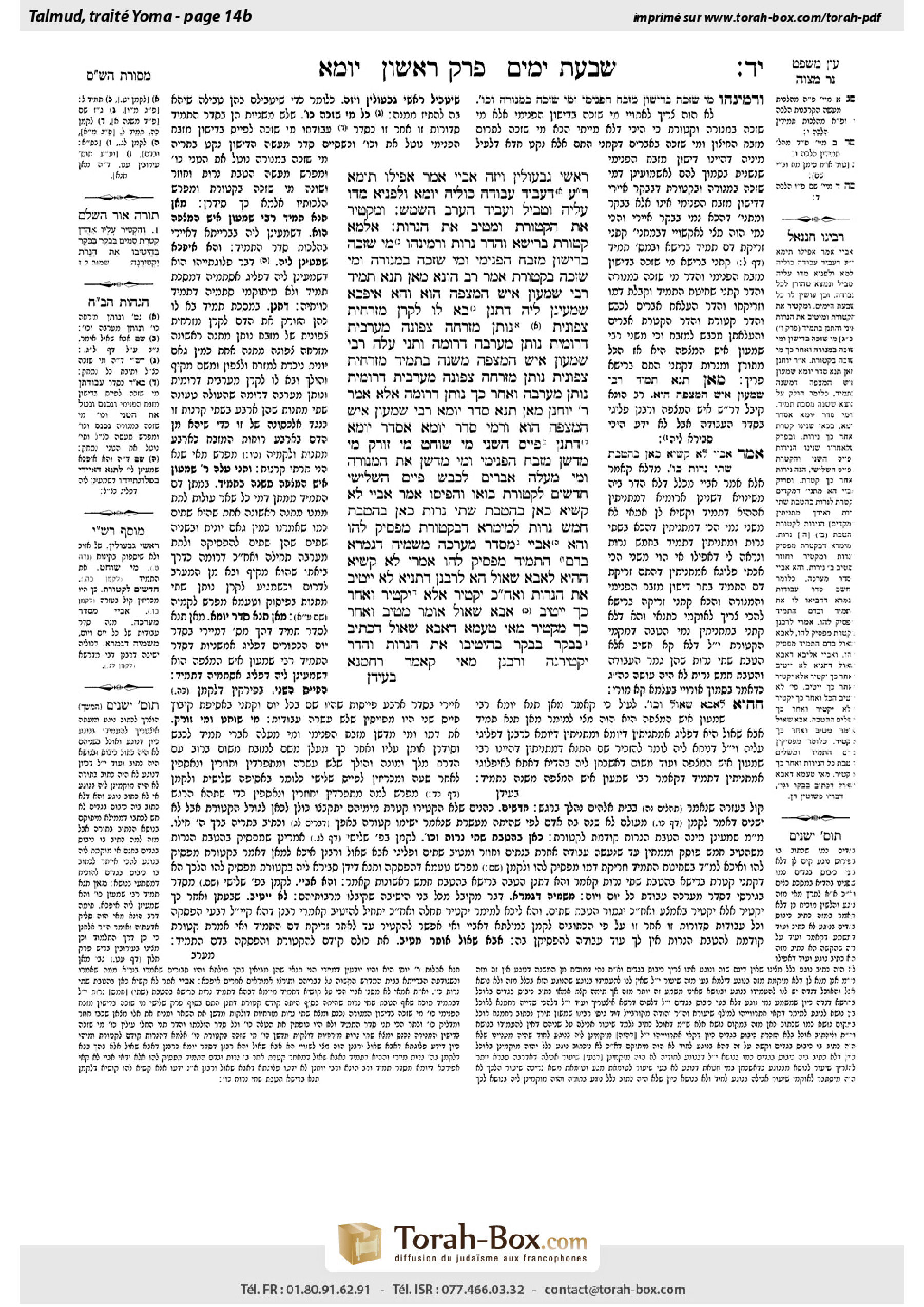
Yoma 14b: Talmud study for Daf Yomi
Daf Yomi is the daily study of one Talmud folio. Explore 37 tractates with scans, Hebrew text, Sefaria English and AI-generated French translations where annotated.
Passage selection and English or AI-generated French translation are available where the scan has annotations. Daf Study is independent of Torah-Box and Sefaria.
Browse Yoma · יומא · All tractatesYoma 14b text and translations
This page of Yoma includes the Aramaic text, an English translation and an AI-generated French translation, alongside the scan above.
יומא י״ד ב · Aramaic and Hebrew text
רָאשֵׁי גִבְעוֹלִין וְיַזֶּה. אַבָּיֵי אָמַר: אֲפִילּוּ תֵּימָא רַבִּי עֲקִיבָא, דְּעָבֵיד עֲבוֹדָה כּוּלֵּיהּ יוֹמָא, וּלְפַנְיָא מַדּוּ עֲלֵיהּ, וְטָבֵיל וְעָבֵיד הֶעֱרֵב הַשֶּׁמֶשׁ.
וּמַקְטִיר אֶת הַקְּטוֹרֶת וּמֵטִיב אֶת הַנֵּרוֹת. אַלְמָא קְטוֹרֶת בְּרֵישָׁא וַהֲדַר נֵרוֹת. וּרְמִינְהוּ: מִי שֶׁזָּכָה בְּדִישּׁוּן מִזְבֵּחַ הַפְּנִימִי, וּמִי שֶׁזָּכָה בַּמְּנוֹרָה, וּמִי שֶׁזָּכָה בַּקְּטוֹרֶת!
אָמַר רַב הוּנָא: מַאן תָּנָא תָּמִיד, רַבִּי שִׁמְעוֹן אִישׁ הַמִּצְפָּה הוּא. וְהָא אִיפְּכָא שָׁמְעִינַן לֵיהּ, דִּתְנַן: בָּא לוֹ לְקֶרֶן מִזְרָחִית צְפוֹנִית — נוֹתֵן מִזְרָחָה צָפוֹנָה, מַעֲרָבִית דְּרוֹמִית — נוֹתֵן מַעֲרָבָה דָּרוֹמָה.
וְתָנֵי עֲלַהּ, רַבִּי שִׁמְעוֹן אִישׁ הַמִּצְפָּה מְשַׁנֶּה בַּתָּמִיד: מִזְרָחִית צְפוֹנִית — נוֹתֵן מִזְרָחָה צָפוֹנָה. מַעֲרָבִית דְּרוֹמִית — נוֹתֵן מַעֲרָבָה, וְאַחַר כָּךְ נוֹתֵן דָּרוֹמָה.
אֶלָּא אָמַר רַבִּי יוֹחָנָן: מַאן תְּנָא סֵדֶר יוֹמָא — רַבִּי שִׁמְעוֹן אִישׁ הַמִּצְפָּה הוּא.
וּרְמִי סֵדֶר יוֹמָא אַסֵּדֶר יוֹמָא, דִּתְנַן: פַּיִיס הַשֵּׁנִי — מִי שׁוֹחֵט, מִי זוֹרֵק, מִי מְדַשֵּׁן מִזְבֵּחַ הַפְּנִימִי, וּמִי מְדַשֵּׁן אֶת הַמְנוֹרָה, וּמִי מַעֲלֶה אֵבָרִים לַכֶּבֶשׁ. פַּיִיס הַשְּׁלִישִׁי — חֲדָשִׁים לַקְּטוֹרֶת בּוֹאוּ וְהָפִיסוּ!
אָמַר אַבָּיֵי, לָא קַשְׁיָא: כָּאן בַּהֲטָבַת שְׁתֵּי נֵרוֹת, כָּאן בַּהֲטָבַת חָמֵשׁ נֵרוֹת.
לְמֵימְרָא דְּבִקְטוֹרֶת מַפְסֵיק לְהוּ? וְהָא אַבָּיֵי מְסַדֵּר מַעֲרָכָה מִשְּׁמֵיהּ דִּגְמָרָא, בְּדַם הַתָּמִיד מַפְסֵיק לְהוּ! אָמְרִי, לָא קַשְׁיָא: הָהִיא לְאַבָּא שָׁאוּל, הָא לְרַבָּנַן. דְּתַנְיָא: לֹא יֵיטִיב אֶת הַנֵּרוֹת וְאַחַר כָּךְ יַקְטִיר, אֶלָּא יַקְטִיר וְאַחַר כָּךְ יֵיטִיב. אַבָּא שָׁאוּל אוֹמֵר: מֵטִיב, וְאַחַר כָּךְ מַקְטִיר.
מַאי טַעְמָא דְּאַבָּא שָׁאוּל? דִּכְתִיב: ״בַּבֹּקֶר בַּבֹּקֶר בְּהֵיטִיבוֹ אֶת הַנֵּרוֹת״, וַהֲדַר ״יַקְטִירֶנָּה״. וְרַבָּנַן? מַאי קָאָמַר רַחֲמָנָא:
Yoma 14b · English translation
the tops of the stems of the hyssop branch into the water and sprinkle it. Apparently, even according to the one who said that there is no minimum measure of water for sprinkling there is a minimum measure of water that must be in the vessel. Abaye said: Even if you say that the mishna is in accordance with the opinion of Rabbi Akiva, who said that the purification water impurifies the pure, the difficulty can be resolved: The High Priest performs the Temple service for the entire day on each of the seven days of sequestering, and toward the evening the priests sprinkle the purification water upon him. Even if he was pure and the sprinkling rendered him impure, he immerses immediately and observes the requirement to wait until sunset, at which point he is purified and prepared to serve the next day.
§ The mishna teaches that on each of the seven days the High Priest burns the incense and removes the ashes from the lamps. Apparently, incense is burned first, and then the lamps are cleaned. And the Gemara raises a contradiction from a mishna in tractate Tamid that discusses the lottery in which the priests performing the various tasks that constitute the morning Temple service are selected. That mishna first mentions the one who was privileged to be selected to perform removal of the ashes from the inner altar, and then the one who was privileged to be selected to remove the ashes from the lamps of the candelabrum, and only then does it deal with the one who is privileged to be selected to burn the incense. According to that mishna, removing ashes from the candelabrum precedes the burning of the incense.
Rav Huna said: Who is the tanna who taught the mishnayot in tractate Tamid? It is Rabbi Shimon Ish HaMitzpa, who disagrees with the tanna of the mishna here. The Gemara asks: But didn’t we learn the opposite, as we learned in the mishna in tractate Tamid: The priest sprinkles the blood of the daily offering on the altar. He comes to the northeast corner of the altar and sprinkles once on the northeast corner. From there he proceeds to the southwest corner and sprinkles once on the southwest corner.
And it was taught in the Tosefta concerning this mishna: Rabbi Shimon Ish HaMitzpa changes the sprinkling of the blood of the daily offering relative to the sprinkling of blood of all other burnt-offerings. He agrees with the first tanna with regard to the first sprinkling of the blood; the priest comes to the northeast corner and sprinkles once on the northeast corner. However, when he proceeds to the southwest corner he does not sprinkle once as he would when offering a burnt-offering; rather, he sprinkles on the west side of the altar and then sprinkles on the south side. Since the disputing opinion is that of Rabbi Shimon Ish HaMitzpa, apparently the unattributed opinions in the mishnayot in tractate Tamid are not the opinions of Rabbi Shimon Ish HaMitzpa.
Rather, there must be a different resolution to the contradiction between the mishna here and the one in tractate Tamid. Rabbi Yoḥanan said: Who is the tanna who taught the Yom Kippur service in tractate Yoma? It is Rabbi Shimon Ish HaMitzpa, and tractate Tamid is in accordance with the opinion of the Rabbis who disagree with him.
The Gemara raises a contradiction from one mishna in tractate Yoma against another mishna in tractate Yoma, as we learned in a mishna: The second lottery conducted daily among the priests determined the following: Who slaughters the daily morning offering; who sprinkles its blood; who removes the ashes from the inner altar; and who removes the ashes and burnt wicks from the candelabrum; and who takes the limbs of the daily offering up to the ramp to be burned later. Following the second lottery the priests dispersed, and they later reconvened for the third lottery. Before the third lottery, the appointee declared: Let only those priests who are new to offering the incense come and participate in the lottery for the incense. Apparently, removing the ashes from the lamps of the candelabrum preceded the burning of the incense, which contradicts the mishna here.
Abaye said: This is not difficult. Here, the mishna is discussing the removal of the ashes from two lamps, which is performed after the burning of the incense; there, the mishna of the lotteries is discussing the removal of the ashes from five lamps, which precedes the burning of the incense. As will be explained, the priest attends to five lamps first, and after a break, he attends to the final two lamps.
The Gemara asks: Is that to say that the burning of the incense interposes between attending to the first five lamps and attending the last two? But when Abaye related the order of the daily priestly functions in the name of tradition, didn’t he state that it was the sprinkling of the blood of the daily offering that interposed between the five lamps and the two, not the burning of the incense? The Sages say in response: This is not difficult. That sequence cited by Abaye is in accordance with the opinion of Abba Shaul, whereas this sequence cited in the mishna is in accordance with the opinion of the Rabbis, as it was taught in a baraita: One should not remove the ashes from the lamps and then burn the incense; rather one should burn the incense and then remove the ashes from the lamps. Abba Shaul says: One removes the ashes from the lamps and then burns the incense. The different sources reflect the dispute cited in the baraita.
The Gemara asks: What is the rationale for the opinion of Abba Shaul? It is as it is written: “Every morning when he removes the ashes from the lamps, he shall burn it” (Exodus 30:7), and then it is written: “He shall burn it” (Exodus 30:8). First the lamps are cleaned, and only then is the incense burned. And how do the Rabbis, who hold that the incense was burned first, interpret this verse? They say: What is the Merciful One saying?
Yoma 14b · Traduction française (IA)
les extrémités des tiges de la branche d’hysope dans l’eau, puis on l’asperge. Il apparaît donc que même selon celui qui affirme qu’il n’y a pas de quantité minimale d’eau requise pour l’aspersion, une quantité minimale d’eau doit se trouver dans le récipient. Abayé a dit : Même si tu dis que la Michna suit l’opinion de Rabbi Akiva, selon laquelle l’eau de purification rend impur celui qui est pur, on peut résoudre la difficulté ainsi : le grand prêtre accomplit le service du Temple toute la journée, chacun des sept jours de mise à l’écart, et, vers le soir, les prêtres l’aspergent avec l’eau de purification. Même s’il était pur et que l’aspersion l’a rendu impur, il s’immerge immédiatement et attend le coucher du soleil, conformément à l’obligation ; à ce moment-là, il est purifié et prêt à servir le lendemain.
§ La Michna enseigne que, chacun des sept jours, le grand prêtre brûle l’encens et retire les cendres des lampes. Il semble donc que l’encens soit brûlé d’abord, puis que les lampes soient nettoyées. La Guemara soulève une contradiction à partir d’une Michna du traité Tamid, qui traite du tirage au sort désignant les prêtres chargés des différentes tâches constituant le service matinal au Temple. Cette Michna mentionne d’abord celui qui a été désigné pour retirer les cendres de l’autel intérieur, puis celui qui a été désigné pour retirer les cendres des lampes de la ménorah, et ce n’est qu’ensuite qu’elle traite de celui qui est désigné pour brûler l’encens. Selon cette Michna, le retrait des cendres de la ménorah précède la combustion de l’encens.
Rav Houna a dit : Quel est le tanna qui a enseigné les Michnayot du traité Tamid ? C’est Rabbi Chimon Ich HaMitséfa, qui est en désaccord avec le tanna de la Michna ici. La Guemara demande : Mais n’avons-nous pas appris le contraire ? En effet, nous avons appris dans la Michna du traité Tamid : Le prêtre asperge l’autel du sang du sacrifice quotidien. Il se rend à l’angle nord-est de l’autel et y asperge une fois. De là, il se rend à l’angle sud-ouest et y asperge une fois.
Et il a été enseigné dans la Tossefta, à propos de cette Michna : Rabbi Chimon Ich HaMitséfa modifie l’ordre de l’aspersion du sang du sacrifice quotidien par rapport à celui de l’aspersion du sang de tous les autres holocaustes. Il est d’accord avec le premier tanna concernant la première aspersion du sang : le prêtre se rend à l’angle nord-est et y asperge une fois. Toutefois, lorsqu’il se rend à l’angle sud-ouest, il n’y asperge pas une fois comme il le ferait lors de l’offrande d’un holocauste ; il asperge plutôt le côté ouest de l’autel, puis son côté sud. Puisque l’opinion divergente est celle de Rabbi Chimon Ich HaMitséfa, il semble que les opinions anonymes des Michnayot du traité Tamid ne soient pas celles de Rabbi Chimon Ich HaMitséfa.
Il faut donc apporter une autre réponse à la contradiction entre la Michna ici et celle du traité Tamid. Rabbi Yoḥanan a dit : Quel est le tanna qui a enseigné le service de Yom Kippour dans le traité Yoma ? C’est Rabbi Chimon Ich HaMitséfa, tandis que le traité Tamid suit l’opinion des Rabbins, qui sont en désaccord avec lui.
La Guemara soulève une contradiction entre une Michna du traité Yoma et une autre Michna du traité Yoma, car nous avons appris dans une Michna : Le deuxième tirage au sort, effectué chaque jour parmi les prêtres, déterminait les tâches suivantes : qui égorge le sacrifice quotidien du matin ; qui en asperge le sang ; qui retire les cendres de l’autel intérieur ; qui retire les cendres et les mèches consumées de la ménorah ; et qui porte les membres du sacrifice quotidien jusqu’à la rampe, afin qu’ils y soient brûlés plus tard. Après le deuxième tirage au sort, les prêtres se dispersaient, puis se réunissaient de nouveau pour le troisième tirage au sort. Avant ce troisième tirage au sort, le responsable proclamait : Que seuls les prêtres qui n’ont encore jamais brûlé l’encens viennent participer au tirage au sort pour l’encens. Il semble donc que le retrait des cendres des lampes de la ménorah précédait la combustion de l’encens, ce qui contredit la Michna ici.
Abayé a dit : Il n’y a pas de difficulté. Ici, la Michna traite du retrait des cendres de deux lampes, qui a lieu après la combustion de l’encens ; là, la Michna sur les tirages au sort traite du retrait des cendres de cinq lampes, qui précède la combustion de l’encens. Comme cela sera expliqué, le prêtre s’occupe d’abord de cinq lampes, puis, après une interruption, des deux dernières.
La Guemara demande : Faut-il en déduire que la combustion de l’encens s’intercale entre les soins apportés aux cinq premières lampes et ceux apportés aux deux dernières ? Or, lorsque Abayé a rapporté, au nom de la tradition, l’ordre des fonctions quotidiennes des prêtres, n’a-t-il pas dit que c’était l’aspersion du sang du sacrifice quotidien qui s’intercalait entre les cinq lampes et les deux, et non la combustion de l’encens ? Les Sages répondent : Il n’y a pas de difficulté. La séquence rapportée par Abayé suit l’opinion d’Abba Chaoul, tandis que la séquence citée dans la Michna suit l’opinion des Rabbins, comme il a été enseigné dans une baraïta : On ne doit pas retirer les cendres des lampes puis brûler l’encens ; il faut plutôt brûler l’encens puis retirer les cendres des lampes. Abba Chaoul dit : On retire les cendres des lampes, puis on brûle l’encens. Les différentes sources reflètent le désaccord rapporté dans la baraïta.
La Guemara demande : Quel est le raisonnement d’Abba Chaoul ? Il s’appuie sur ce qui est écrit : « Chaque matin, lorsqu’il retire les cendres des lampes, il le brûlera » (Exode 30, 7), puis sur ce qui est écrit : « Il le brûlera » (Exode 30, 8). Les lampes sont d’abord nettoyées, et l’encens n’est brûlé qu’ensuite. Et comment les Rabbins, qui soutiennent que l’encens était brûlé d’abord, interprètent-ils ce verset ? Ils disent : Que dit le Miséricordieux ?
Traduction française générée par IA à partir de l’édition anglaise de Sefaria. Vérifie toujours un passage avec le texte source.
Text from Sefaria: William Davidson Edition - Vocalized Aramaic (CC BY NC); William Davidson Edition - English (CC BY NC).