Yoma 15a: Talmud study for Daf Yomi
Daf Yomi is the daily study of one Talmud folio. Explore 37 tractates with scans, Hebrew text, Sefaria English and AI-generated French translations where annotated.
Passage selection and English or AI-generated French translation are available where the scan has annotations. Daf Study is independent of Torah-Box and Sefaria.
Browse Yoma · יומא · All tractatesYoma 15a text and translations
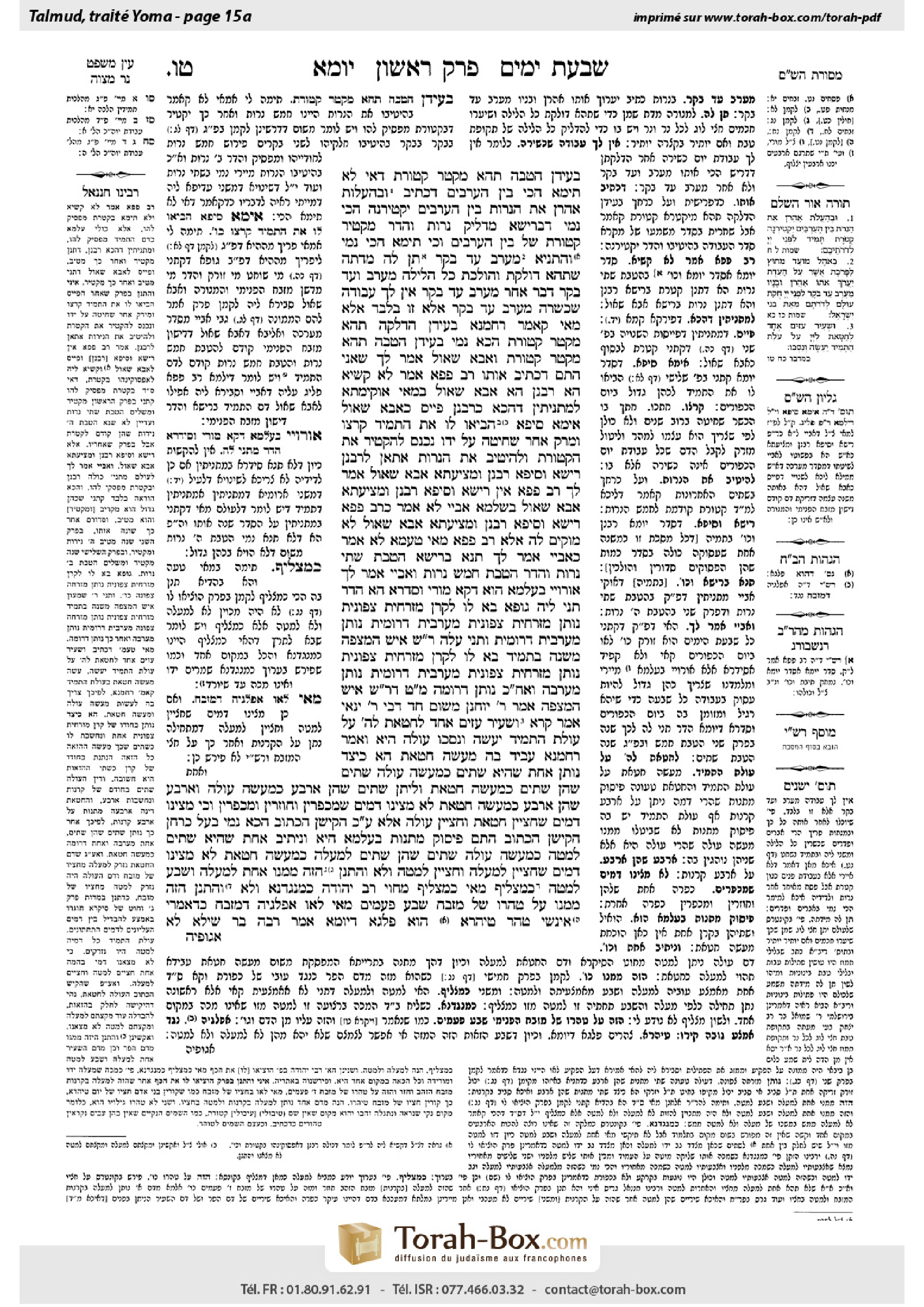
This page of Yoma includes the Aramaic text, an English translation and an AI-generated French translation, alongside the scan above.
יומא י״ה א · Aramaic and Hebrew text
בְּעִידָּן הֲטָבָה תְּהֵא מִקְּטַר קְטוֹרֶת. דְּאִי לָא תֵּימָא הָכִי, בֵּין הָעַרְבַּיִם, דִּכְתִיב: ״וּבְהַעֲלוֹת אַהֲרֹן אֶת הַנֵּרֹת בֵּין הָעַרְבַּיִם יַקְטִירֶנָּה״, הָכִי נָמֵי דִּבְרֵישָׁא מַדְלִיק נֵרוֹת וַהֲדַר מַקְטִיר קְטוֹרֶת שֶׁל בֵּין הָעַרְבָּיִם?! וְכִי תֵּימָא הָכִי נָמֵי, וְהָתַנְיָא: ״מֵעֶרֶב עַד בֹּקֶר״,
תֵּן לָהּ מִדָּתָהּ, שֶׁתְּהֵא דּוֹלֶקֶת וְהוֹלֶכֶת כׇּל הַלַּיְלָה מֵעֶרֶב וְעַד בֹּקֶר. דָּבָר אַחֵר: ״מֵעֶרֶב עַד בֹּקֶר״, אֵין לְךָ עֲבוֹדָה שֶׁכְּשֵׁרָה מֵעֶרֶב עַד בֹּקֶר אֶלָּא זוֹ בִּלְבַד. אֶלָּא מַאי קָאָמַר רַחֲמָנָא — בְּעִידָּן הַדְלָקָה תְּהֵא מִקְּטַר קְטוֹרֶת, הָכָא נָמֵי: בְּעִידָּן הֲטָבָה תְּהֵא מִקְּטַר קְטוֹרֶת.
וְאַבָּא שָׁאוּל אָמַר לָךְ: שָׁאנֵי הָתָם דִּכְתִיב: ״אוֹתוֹ״.
רַב פָּפָּא אָמַר: לָא קַשְׁיָא, הָא — רַבָּנַן, הָא — אַבָּא שָׁאוּל. בְּמַאי אוֹקֵימְתָּא לְמַתְנִיתִין דְּהָכָא — כְּרַבָּנַן, פַּיִיס — כְּאַבָּא שָׁאוּל,
אֵימָא סֵיפָא: הֵבִיאוּ לוֹ אֶת הַתָּמִיד, קְרָצוֹ וּמֵרַק אַחֵר שְׁחִיטָה עַל יָדוֹ, נִכְנַס לְהַקְטִיר אֶת הַקְּטוֹרֶת וּלְהֵיטִיב אֶת הַנֵּרוֹת — אֲתָאן לְרַבָּנַן. רֵישָׁא וְסֵיפָא רַבָּנַן, וּמְצִיעֲתָא אַבָּא שָׁאוּל! אָמַר לְךָ רַב פָּפָּא: אִין, רֵישָׁא וְסֵיפָא רַבָּנַן, וּמְצִיעֲתָא אַבָּא שָׁאוּל.
בִּשְׁלָמָא אַבָּיֵי לָא אָמַר כְּרַב פָּפָּא, רֵישָׁא וְסֵיפָא רַבָּנַן וּמְצִיעֲתָא אַבָּא שָׁאוּל לָא מוֹקֵים לַהּ. אֶלָּא רַב פָּפָּא, מַאי טַעְמָא לָא אָמַר כְּאַבַּיֵּי? אָמַר לָךְ: תְּנָא בְּרֵישָׁא הֲטָבַת שְׁתֵּי נֵרוֹת, וַהֲדַר הֲטָבַת חָמֵשׁ נֵרוֹת?
וְאַבָּיֵי אָמַר לָךְ: אוֹרוֹיֵי בְּעָלְמָא הוּא דְּקָא מוֹרֵי, וְסִדְרָא הָא הֲדַר תָּנֵי לֵיהּ.
גּוּפָא: בָּא לוֹ לְקֶרֶן מִזְרָחִית צְפוֹנִית — נוֹתֵן מִזְרָחִית צְפוֹנִית, מַעֲרָבִית דְּרוֹמִית — נוֹתֵן מַעֲרָבִית דְּרוֹמִית. וְתָנֵי עֲלַהּ: רַבִּי שִׁמְעוֹן אִישׁ הַמִּצְפָּה מְשַׁנֶּה בַּתָּמִיד, בָּא לוֹ לְקֶרֶן מִזְרָחִית צְפוֹנִית — נוֹתֵן מִזְרָחִית צְפוֹנִית, מַעֲרָבִית דְּרוֹמִית — נוֹתֵן מַעֲרָבָה וְאַחַר כָּךְ נוֹתֵן דָּרוֹמָה. מַאי טַעְמָא דְּרַבִּי שִׁמְעוֹן אִישׁ הַמִּצְפָּה?
אָמַר רַבִּי יוֹחָנָן מִשּׁוּם חַד דְּבֵי רַבִּי יַנַּאי, אָמַר קְרָא: ״וּשְׂעִיר עִזִּים אֶחָד לְחַטָּאת לַה׳ עַל עוֹלַת הַתָּמִיד יֵעָשֶׂה וְנִסְכּוֹ״, עוֹלָה הִיא, וְאָמַר רַחֲמָנָא: עֲבֵיד בַּהּ מַעֲשֵׂה חַטָּאת.
הָא כֵּיצַד? נוֹתֵן אַחַת שֶׁהִיא שְׁתַּיִם כְּמַעֲשֵׂה עוֹלָה, שְׁתַּיִם שֶׁהֵן שְׁתַּיִם כְּמַעֲשֵׂה חַטָּאת. וְלִיתֵּן שְׁתַּיִם שֶׁהֵן אַרְבַּע כְּמַעֲשֵׂה עוֹלָה, וְאַרְבַּע שֶׁהֵן אַרְבַּע כְּמַעֲשֵׂה חַטָּאת!
לֹא מָצִינוּ דָּמִים שֶׁמְּכַפְּרִין וְחוֹזְרִין וּמְכַפְּרִין. וְכִי מָצִינוּ דָּמִים שֶׁחֶצְיָין חַטָּאת וְחֶצְיָין עוֹלָה? אֶלָּא עַל כׇּרְחָן הַקִּישָׁן הַכָּתוּב. הָכָא נָמֵי: בְּעַל כׇּרְחָן הַקִּישָׁן הַכָּתוּב.
הָתָם פִּיסּוּק מַתָּנוֹת בְּעָלְמָא הִיא. וְנִיתֵּיב אַחַת שֶׁהִיא שְׁתַּיִם לְמַטָּה, כְּמַעֲשֵׂה עוֹלָה, שְׁתַּיִם שֶׁהֵן שְׁתַּיִם לְמַעְלָה, כְּמַעֲשֵׂה חַטָּאת!
לֹא מָצִינוּ דָּמִים שֶׁחֶצְיָין לְמַעְלָה וְחֶצְיָין לְמַטָּה. וְלָא? וְהָתְנַן: הִזָּה מִמֶּנּוּ אַחַת לְמַעְלָה וְשֶׁבַע לְמַטָּה.
כְּמַצְלִיף. מַאי ״כְּמַצְלִיף״ — מַחְוֵי רַב יְהוּדָה, כִּמְנַגְּדָנָא.
וְלָא? וְהָתְנַן: הִזָּה מִמֶּנּוּ עַל טׇהֳרוֹ שֶׁל מִזְבֵּחַ שֶׁבַע פְּעָמִים. מַאי לָאו, אַפַּלְגֵיהּ דְּמִזְבֵּחַ, כִּדְאָמְרִי אִינָשֵׁי: טְהַר טִיהֲרָא הוּא פַּלְגָא דְּיוֹמָא!
אָמַר רַבָּה בַּר שֵׁילָא: לָא,
Yoma 15a · English translation
It means: At the time of the removal of the ashes you shall burn the incense, and no later. As, if you do not say so but explain that the phrase: He shall burn the incense, at the end of the verse means after cleaning the lamps, then with regard to the burning of the afternoon incense, with regard to which it is written: “And when Aaron lights the lamps in the afternoon he shall burn it” (Exodus 30:8), in this case too, does it mean that initially the priest lights the lamps and only then burns the afternoon incense? And if you say indeed, that is so, wasn’t the following taught in a baraita with regard to the verse: “Aaron and his sons will set it in order to burn from evening until morning before the Lord; it shall be a statute forever throughout their generations on behalf of the children of Israel” (Exodus 27:21)?
And the baraita explains: Give the candelabrum its measure of oil so that it will continue to burn all night from evening until morning. Alternatively, the phrase: From evening to morning, teaches that you have only this service that is valid when performed from evening to morning. Apparently, lighting the candelabrum is the final daily Temple service and the incense is not burned after the lamps are lit. Rather, what is the Merciful One saying in the phrase: “And when Aaron lights the lamps in the afternoon he shall burn it.” This teaches that at the time of the lighting of the lamps you shall burn the incense, and no later. If so, here too, in the morning, at the time of the removal of the ashes you shall burn the incense, and no later. This is the rationale for the opinion of the Rabbis.
And Abba Shaul could have said to you in response: It is different there, with regard to the burning of the afternoon incense, as it is written: “Aaron and his sons will set it [oto] in order.” The term oto is exclusionary: Only in the afternoon is it critical that the lighting of the lamps be the last service performed and that it follow the burning of the incense. However, in the morning, where there is no exclusionary term, the sequence of the verse is observed: First attending to the candelabrum and then burning the incense.
Rav Pappa said a different resolution to the contradiction between the mishnayot. This is not difficult, because each mishna is in accordance with the opinion of a different tanna. This mishna, in which the burning of the incense is first, is in accordance with the opinion of the Rabbis; and that mishna, in which the lighting of the lamps is first, is in accordance with the opinion of Abba Shaul. The Gemara questions Rav Pappa’s resolution: In accordance with the opinion of which tanna is the mishna here established? It is in accordance with the opinion of the Rabbis. The sequence in the mishna where the lottery is discussed is in accordance with the opinion of Abba Shaul.
Say the latter clause of that mishna as follows: They brought him the sheep for the daily morning offering that he slaughtered by cutting most of the way through the gullet and the windpipe. And a different priest completed the slaughter on his behalf. And then he entered the Sanctuary to burn the morning incense and to remove the ashes from the lamps of the candelabrum. If so, we have again arrived at the opinion of the Rabbis that burning the incense precedes attending to the lamps, which leads to the difficult conclusion: The first clause and the last clause of the mishna in tractate Yoma are in accordance with the opinion of the Rabbis, and the middle clause is in accordance with the opinion of Abba Shaul. Rav Pappa could have said to you: Indeed, the first clause and the last clause are in accordance with the opinion of the Rabbis, and the middle clause is in accordance with the opinion of Abba Shaul. Although this is not common, because these mishnayot are not directly juxtaposed, it is possible.
The Gemara asks: Granted, Abaye does not say in accordance with the opinion of Rav Pappa, as he is not willing to establish the first clause and the last clause in accordance with the opinion of the Rabbis and the middle clause in accordance with the opinion of Abba Shaul. However, with regard to Rav Pappa, what is the reason that he did not say in accordance with the opinion of Abaye and instead prefers an uncommon and difficult resolution? Rav Pappa could have said to you that the resolution proposed by Abaye is difficult as well, as according to Abaye in the first clause of the mishna it was taught with regard to the removal of the ashes from two lamps, which is performed later, and only then taught the removal of the ashes from five lamps, which is performed before the ashes of the two lamps are cleared. Therefore, Rav Pappa prefers to establish that the mishnayot reflect a tannaitic dispute rather than to accept this reversal of the order.
And Abaye holds that this is not difficult and could have said to you that the first mishna, which describes the routine of the High Priest during his seven days of separation, teaches a general directive describing the services with which the High Priest must be familiarized prior to Yom Kippur, without concern for the sequence. And in terms of the sequence, the mishna then teaches it in the context of the actual performance of the services.
§ The Gemara cites a dispute between the Rabbis and Rabbi Shimon Ish HaMitzpa. The Gemara proceeds to analyze the matter itself: The priest comes to the northeast corner of the altar and sprinkles once on the northeast corner. From there he proceeds to the southwest corner and sprinkles once on the southwest corner. And it was taught in the Tosefta concerning this mishna: Rabbi Shimon Ish HaMitzpa changes the sprinkling of the blood of the daily offering vis-à-vis the sprinkling of blood of all other burnt-offerings. The priest comes to the northeast corner and sprinkles once on the northeast corner. However, when he proceeds to the southwest corner, he sprinkles on the west side of the altar and then sprinkles on the south side. The Gemara asks: What is the rationale for the opinion of Rabbi Shimon Ish HaMitzpa, who changes the sprinkling of the blood of the daily offering vis-à-vis the sprinkling of blood of all other burnt-offerings?
Rabbi Yoḥanan said in the name of one of the Sages of the school of Rabbi Yannai that the verse states: “And one goat as a sin-offering to the Lord; it shall be offered aside from the daily burnt-offering and its libation” (Numbers 28:15). From the phrase: Beside the daily burnt-offering, it is derived that the daily offering is a burnt-offering, and from the juxtaposition of the sacrifice of the sin-offering to the daily offering, the Merciful One said: Perform with it the procedure of a sin-offering.
And how can this be accomplished? It can be accomplished by performing half of the sprinklings according to the procedure of a burnt-offering, and half according to the procedure of a sin-offering. One sprinkles one sprinkling that is two, i.e., one sprinkles the blood on the corner of the altar so that the blood is divided between the two sides, in accordance with the procedure of a standard burnt-offering. Then he sprinkles two sprinklings that are two, in accordance with the procedure of a sin-offering. The blood of a sin-offering is sprinkled in four separate actions, one on each of the four corners of the altar. The Gemara asks: And if the objective is to have the daily offering sacrificed like a sin-offering, let him sprinkle the blood in a manner that will accomplish both: First, two sprinklings that are four in accordance with the procedure of a standard burnt-offering, and then four sprinklings that are four in accordance with the procedure of a sin-offering.
The Gemara rejects that proposal: We did not find a case of blood that atones and then again atones. Once the blood was sprinkled and brought atonement by following the procedure of the burnt-offering, one cannot then begin the rite of atonement of a sin-offering. The Gemara asks: And did we find the blood of an offering, half of which is sprinkled as a sin-offering and half of which is sprinkled as a burnt-offering? Rather, perforce, say that the verse juxtaposes them and commands that the blood of the daily offering be offered half as a burnt-offering and half as a sin-offering. Here too, perforce, say that the verse juxtaposes them and commands two separate sprinklings: The sprinkling of a burnt-offering followed by the sprinkling of a sin-offering.
The Gemara responds: The two suggestions are different. There, in the statement of Rabbi Shimon Ish HaMitzpa, there is no radical divergence from the standard burnt-offering; it is merely dividing the sprinklings. Instead of sprinkling the blood on the corner so that it falls on two sides of the altar, one sprinkles the blood on each of the two sides separately. In contrast, performing two independent acts of sprinkling is a radical divergence. And the Gemara suggests an alternative manner in which the daily offering could be offered like a sin-offering. Let us sprinkle one sprinkling that is two below the red line painted halfway up the altar, in accordance with the procedure of a standard burnt-offering, and sprinkle another two sprinklings that are two above the red line on the upper half of the altar in accordance with the procedure of a sin-offering.
The Gemara rejects this: We did not find a case of blood half of which is sprinkled above the red line and half of which is sprinkled below the red line. One either sprinkles all the blood on the lower half of the altar, as in the case of most offerings, or entirely on the upper half of the altar, as in the case of sin-offerings. The Gemara asks: And is there really no case of that sort? Didn’t we learn in a mishna: The High Priest took the blood of the bull into the Holy of Holies and sprinkled from the blood one time upward and then seven times downward? Apparently, the blood of an offering can be sprinkled part upward, toward the upper part of the thickness of the Ark cover, and part downward, toward the lower part of the thickness of the Ark cover.
The Gemara rejects this: That is not a case of half the blood sprinkled upward and half sprinkled downward. Instead, that sprinkling was like a matzlif; the sprinklings were not performed one above the other, but rather one beneath the other, and all were sprinkled in a row on the Ark cover. The Gemara explains: What is the meaning of like a matzlif? Rav Yehuda demonstrated with his hand; it means like one who whips. One who whips another does not strike in one place but directs one lash beneath another.
The Gemara asks: And is there really no case of that sort? Didn’t we learn in a mishna with regard to the sprinkling of blood on the incense altar: He sprinkled seven times from the blood on tohoro of the altar. What, is it not referring to the middle of the side of the altar, as people say: Clear noon [tihara], that is the middle of the day? In other words, tohoro refers to halfway up the altar. Now, since the blood was sprinkled on the altar seven times, inevitably some of the blood landed above the midpoint and some of it landed below the midpoint.
Rabba bar Sheila said: No, that is not the meaning of tohoro.
Yoma 15a · Traduction française (IA)
Cela signifie : au moment du retrait des cendres, tu brûleras l’encens, et pas plus tard. En effet, si tu ne dis pas cela et que tu expliques que l’expression « il brûlera l’encens », à la fin du verset, signifie après le nettoyage des lampes, alors, pour la combustion de l’encens de l’après-midi, à propos de laquelle il est écrit : « Quand Aaron allumera les lampes dans l’après-midi, il le brûlera » (Exode 30, 8), cela signifierait également que le prêtre allume d’abord les lampes et ne brûle l’encens de l’après-midi qu’ensuite. Et si tu dis que c’est bien le cas, n’a-t-on pas enseigné dans une baraïta à propos du verset : « Aaron et ses fils le disposeront pour qu’il brûle du soir au matin devant le Seigneur ; ce sera un statut perpétuel pour leurs générations, pour les enfants d’Israël » (Exode 27, 21) ?
Et la baraïta explique : donne au candélabre sa mesure d’huile, afin qu’il continue de brûler toute la nuit, du soir au matin. Autre interprétation : l’expression « du soir au matin » enseigne que seul ce service est valable lorsqu’il est accompli du soir au matin. Apparemment, l’allumage du candélabre est le dernier service quotidien du Temple, et l’encens n’est pas brûlé après l’allumage des lampes. Mais que dit donc le Miséricordieux dans l’expression : « Quand Aaron allumera les lampes dans l’après-midi, il le brûlera » ? Cela enseigne qu’au moment de l’allumage des lampes, tu brûleras l’encens, et pas plus tard. Si tel est le cas, ici aussi, le matin, au moment du retrait des cendres, tu brûleras l’encens, et pas plus tard. Telle est la raison de l’avis des Rabbins.
Et Abba Shaoul aurait pu te répondre : dans le cas de la combustion de l’encens de l’après-midi, c’est différent, car il est écrit : « Aaron et ses fils le disposeront [oto]. » Le terme oto est restrictif : ce n’est que l’après-midi qu’il est essentiel que l’allumage des lampes soit le dernier service accompli et qu’il suive la combustion de l’encens. Le matin, en revanche, en l’absence de terme restrictif, on suit l’ordre du verset : on s’occupe d’abord du candélabre, puis on brûle l’encens.
Rav Pappa proposa une autre manière de résoudre la contradiction entre les Michnayot. Il n’y a pas de difficulté, car chacune suit l’avis d’un tanna différent. Cette Michna, où la combustion de l’encens vient en premier, suit l’avis des Rabbins ; et cette Michna, où l’allumage des lampes vient en premier, suit l’avis d’Abba Shaoul. La Guemara met en question la résolution de Rav Pappa : de quel tanna relève la Michna ici ? Elle relève de l’avis des Rabbins. L’ordre présenté dans la Michna où il est question du tirage au sort relève de l’avis d’Abba Shaoul.
Dis plutôt que la dernière partie de cette Michna se lit ainsi : on lui amenait le mouton destiné à l’offrande quotidienne du matin ; il l’égorgeait en tranchant la gorge et la trachée presque entièrement, puis un autre prêtre achevait l’égorgement à sa place. Ensuite, il entrait dans le Sanctuaire pour brûler l’encens du matin et retirer les cendres des lampes du candélabre. Si tel est le cas, nous en revenons à l’avis des Rabbins, selon lequel la combustion de l’encens précède les soins apportés aux lampes. Cela conduit à la conclusion difficile que la première partie et la dernière partie de la Michna du traité Yoma relèvent de l’avis des Rabbins, tandis que la partie médiane relève de l’avis d’Abba Shaoul. Rav Pappa aurait pu te répondre : en effet, la première partie et la dernière partie relèvent de l’avis des Rabbins, et la partie médiane de l’avis d’Abba Shaoul. Bien que cela soit inhabituel, puisque ces Michnayot ne se suivent pas directement, c’est possible.
La Guemara demande : il est compréhensible qu’Abayé ne suive pas l’avis de Rav Pappa, puisqu’il refuse d’attribuer la première partie et la dernière partie à l’avis des Rabbins, et la partie médiane à celui d’Abba Shaoul. Mais, en ce qui concerne Rav Pappa, pourquoi n’a-t-il pas suivi l’avis d’Abayé et préfère-t-il une résolution inhabituelle et difficile ? Rav Pappa aurait pu te répondre que la résolution proposée par Abayé est elle aussi difficile : selon Abayé, dans la première partie de la Michna, on enseigne d’abord le retrait des cendres de deux lampes, opération effectuée plus tard, puis seulement ensuite le retrait des cendres de cinq lampes, opération effectuée avant que les cendres des deux lampes ne soient retirées. Rav Pappa préfère donc considérer que les Michnayot reflètent un désaccord entre tanaïm plutôt que d’accepter cette inversion de l’ordre.
Et Abayé considère que cela ne présente pas de difficulté. Il aurait pu te répondre que la première Michna, qui décrit les habitudes du Grand Prêtre pendant ses sept jours de séparation, donne une directive générale décrivant les services auxquels le Grand Prêtre doit être familiarisé avant Yom Kippour, sans tenir compte de leur ordre. Quant à l’ordre, la Michna l’enseigne ensuite dans le contexte de l’accomplissement effectif des services.
§ La Guemara rapporte un désaccord entre les Rabbins et Rabbi Shimon Ish HaMitzpa, puis examine le sujet lui-même : le prêtre se rend à l’angle nord-est de l’autel et y fait une aspersion. De là, il se rend à l’angle sud-ouest et y fait une aspersion. Or, il a été enseigné dans la Tossefta, à propos de cette Michna, que Rabbi Shimon Ish HaMitzpa modifie, pour l’aspersion du sang de l’offrande quotidienne, la procédure suivie pour le sang de tous les autres holocaustes. Le prêtre se rend à l’angle nord-est et y fait une aspersion. Mais, lorsqu’il se rend à l’angle sud-ouest, il asperge d’abord le côté ouest de l’autel, puis le côté sud. La Guemara demande : quelle est la raison de l’avis de Rabbi Shimon Ish HaMitzpa, qui modifie, pour l’aspersion du sang de l’offrande quotidienne, la procédure suivie pour le sang de tous les autres holocaustes ?
Rabbi Yoḥanan a dit au nom de l’un des Sages de l’école de Rabbi Yannai que le verset dit : « Et un bouc en sacrifice expiatoire pour le Seigneur ; il sera offert en plus de l’holocauste quotidien et de sa libation » (Nombres 28, 15). De l’expression « en plus de l’holocauste quotidien », on déduit que l’offrande quotidienne est un holocauste ; et, du rapprochement du sacrifice expiatoire avec l’offrande quotidienne, le Miséricordieux a dit : accomplis pour elle le rite d’un sacrifice expiatoire.
Et comment cela peut-il se faire ? En accomplissant la moitié des aspersions selon le rite d’un holocauste et l’autre moitié selon le rite d’un sacrifice expiatoire. On fait une aspersion qui en vaut deux, c’est-à-dire qu’on asperge le sang sur l’angle de l’autel de manière à le répartir sur les deux côtés, conformément au rite d’un holocauste ordinaire. Puis on fait deux aspersions qui en valent deux, conformément au rite d’un sacrifice expiatoire. Le sang d’un sacrifice expiatoire est aspergé en quatre gestes distincts, un sur chacun des quatre angles de l’autel. La Guemara demande : si l’objectif est que l’offrande quotidienne soit sacrifiée comme un sacrifice expiatoire, qu’il asperge le sang de manière à accomplir les deux rites : d’abord, deux aspersions qui en valent quatre, conformément au rite d’un holocauste ordinaire, puis quatre aspersions qui en valent quatre, conformément au rite d’un sacrifice expiatoire.
La Guemara rejette cette proposition : nous n’avons pas trouvé de cas où le sang expie une première fois, puis une seconde fois. Une fois que le sang a été aspergé et a apporté l’expiation selon le rite de l’holocauste, on ne peut pas ensuite commencer le rite d’expiation d’un sacrifice expiatoire. La Guemara demande : avons-nous trouvé le sang d’une offrande dont la moitié est aspergée selon le rite d’un sacrifice expiatoire et l’autre moitié selon celui d’un holocauste ? Il faut donc nécessairement dire que le verset les rapproche et ordonne que le sang de l’offrande quotidienne soit offert pour moitié comme un holocauste et pour moitié comme un sacrifice expiatoire. Ici aussi, il faut nécessairement dire que le verset les rapproche et ordonne deux aspersions distinctes : l’aspersion selon le rite d’un holocauste, suivie de l’aspersion selon celui d’un sacrifice expiatoire.
La Guemara répond : les deux propositions sont différentes. Dans le cas de l’énoncé de Rabbi Shimon Ish HaMitzpa, il n’y a pas d’écart radical par rapport au rite de l’holocauste ordinaire ; il s’agit simplement de répartir les aspersions. Au lieu d’asperger le sang sur l’angle de manière à ce qu’il atteigne les deux côtés de l’autel, on asperge séparément chacun des deux côtés. En revanche, accomplir deux actes d’aspersion indépendants constitue un écart radical. La Guemara propose une autre manière d’offrir l’offrande quotidienne comme un sacrifice expiatoire : aspergeons une fois le sang de manière à atteindre deux côtés, au-dessous de la ligne rouge tracée à mi-hauteur de l’autel, conformément au rite d’un holocauste ordinaire, puis faisons deux autres aspersions qui en valent deux au-dessus de la ligne rouge, sur la partie supérieure de l’autel, conformément au rite d’un sacrifice expiatoire.
La Guemara rejette cette proposition : nous n’avons pas trouvé de cas où la moitié du sang est aspergée au-dessus de la ligne rouge et l’autre moitié au-dessous. On asperge soit tout le sang sur la partie inférieure de l’autel, comme pour la plupart des offrandes, soit entièrement sur sa partie supérieure, comme pour les sacrifices expiatoires. La Guemara demande : n’existe-t-il vraiment aucun cas de ce genre ? N’a-t-on pas appris dans une Michna : le Grand Prêtre prit le sang du taureau dans le Saint des Saints et en fit une aspersion vers le haut, puis sept aspersions vers le bas ? Apparemment, le sang d’une offrande peut être aspergé en partie vers le haut, vers la partie supérieure de l’épaisseur du couvercle de l’Arche, et en partie vers le bas, vers sa partie inférieure.
La Guemara rejette cette proposition : il ne s’agit pas d’un cas où la moitié du sang est aspergée vers le haut et l’autre moitié vers le bas. Cette aspersion était plutôt comme un matzlif : les aspersions n’étaient pas faites l’une au-dessus de l’autre, mais l’une au-dessous de l’autre, toutes alignées sur le couvercle de l’Arche. La Guemara explique : que signifie « comme un matzlif » ? Rav Yehuda le montra de la main : cela signifie comme quelqu’un qui fouette. Celui qui fouette une autre personne ne frappe pas au même endroit, mais donne chaque coup sous le précédent.
La Guemara demande : n’existe-t-il vraiment aucun cas de ce genre ? N’a-t-on pas appris dans une Michna, à propos de l’aspersion du sang sur l’autel de l’encens : il aspergea sept fois le sang sur le tohoro de l’autel. Ne s’agit-il pas du milieu du côté de l’autel, comme le disent les gens : « le clair midi » [tihara], c’est le milieu de la journée ? Autrement dit, tohoro désigne la mi-hauteur de l’autel. Or, puisque le sang était aspergé sept fois sur l’autel, une partie du sang est nécessairement tombée au-dessus du milieu et une autre au-dessous.
Rabba bar Sheila dit : non, ce n’est pas là le sens de tohoro.
Traduction française générée par IA à partir de l’édition anglaise de Sefaria. Vérifie toujours un passage avec le texte source.
Text from Sefaria: William Davidson Edition - Vocalized Aramaic (CC BY NC); William Davidson Edition - English (CC BY NC).