Yoma 17a: Talmud study for Daf Yomi
Daf Yomi is the daily study of one Talmud folio. Explore 37 tractates with scans, Hebrew text, Sefaria English and AI-generated French translations where annotated.
Passage selection and English or AI-generated French translation are available where the scan has annotations. Daf Study is independent of Torah-Box and Sefaria.
Browse Yoma · יומא · All tractatesYoma 17a text and translations
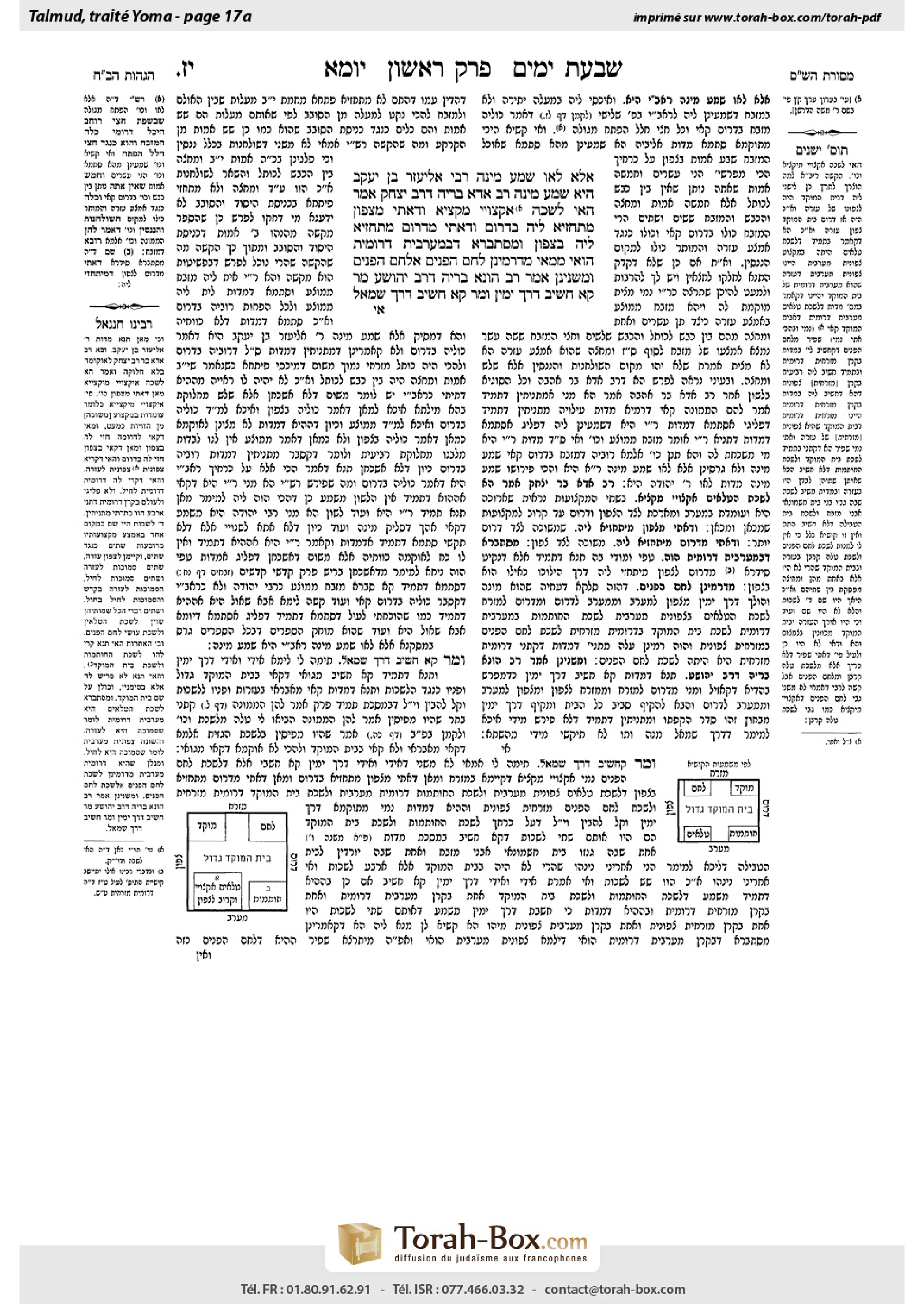
This page of Yoma includes the Aramaic text, an English translation and an AI-generated French translation, alongside the scan above.
יומא י״ז א · Aramaic and Hebrew text
אֶלָּא לָאו שְׁמַע מִינַּהּ, רַבִּי אֱלִיעֶזֶר בֶּן יַעֲקֹב הִיא. שְׁמַע מִינַּהּ.
רַב אַדָּא בְּרֵיהּ דְּרַב יִצְחָק אָמַר: הַאי לִשְׁכָּה אַקְצוֹיֵי מַקְצְיָא, וּדְאָתֵי מִצָּפוֹן מִתְחַזְיָא לֵיהּ בְּדָרוֹם, וּדְאָתֵי מִדָּרוֹם מִתְחַזְיָא לֵיהּ בְּצָפוֹן.
וּמִסְתַּבְּרָא דִּבְמַעֲרָבִית דְּרוֹמִית הֲוַאי. מִמַּאי — מִדְּרָמֵינַן לֶחֶם הַפָּנִים אַלֶּחֶם הַפָּנִים,
וּמְשַׁנֵּינַן, אָמַר רַב הוּנָא בְּרֵיהּ דְּרַב יְהוֹשֻׁעַ: מָר קָא חָשֵׁיב דֶּרֶךְ יָמִין, וּמָר קָא חָשֵׁיב דֶּרֶךְ שְׂמֹאל.
Yoma 17a · English translation
Rather, must one not conclude from it that that the mishnayot in tractate Middot are in accordance with the opinion of Rabbi Eliezer ben Ya’akov? The Gemara concludes: Indeed, conclude from it that this is so.
§ In an additional attempt to resolve the contradiction with regard to the Chamber of the Lambs, Rav Adda, son of Rav Yitzḥak, said: This chamber was removed from the corner, as it was not actually in the corner of the Hall of the Hearth but was located along the middle of the western side of the hall. And therefore, for one who comes from the north, the chamber appears to him to be in the south of the hall; and for one who comes from the south, the chamber appears to him to be in the north of the hall.
The Gemara comments: In any event, it is reasonable to say that this chamber was closer to the southwest corner than it was to the northwest corner. From where does one arrive at that conclusion? From the fact that we raise a contradiction between the mishna in tractate Tamid, where we learned that the chamber in which the shewbread was prepared stood in the northeast corner, and the mishna in tractate Middot, where we learned that the chamber in which the shewbread was prepared stood in the southeast corner.
And we resolve the contradiction based on what Rav Huna, son of Rav Yehoshua, said: The Master in tractate Middot envisions the chambers as one coming via the right, from the south to the east, then to the north and then to the west. And the Master in tractate Tamid envisions the chambers as one coming via the left, from the south to the west, then to the north and then to the east. Both agree with regard to the location of the chamber in which the shewbread was prepared; they merely describe that location from different perspectives.
Yoma 17a · Traduction française (IA)
Au contraire, ne faut-il pas en conclure que les Michnayot du traité Middot suivent l’opinion de Rabbi Eliezer ben Ya’akov ? La Guemara conclut : En effet, conclus-en qu’il en est bien ainsi.
§ Dans une nouvelle tentative de résoudre la contradiction concernant la Chambre des agneaux, Rav Adda, fils de Rav Yitzḥak, dit : Cette chambre était éloignée de l’angle, car elle ne se trouvait pas réellement dans l’angle de la Salle du foyer, mais au milieu du côté ouest de la salle. Par conséquent, pour celui qui vient du nord, la chambre semble se trouver au sud de la salle ; et pour celui qui vient du sud, elle semble se trouver au nord de la salle.
La Guemara fait remarquer : Quoi qu’il en soit, il est raisonnable de dire que cette chambre était plus proche de l’angle sud-ouest que de l’angle nord-ouest. D’où tire-t-on cette conclusion ? Du fait que nous soulevons une contradiction entre la Michna du traité Tamid, où nous avons appris que la chambre dans laquelle on préparait les pains de proposition se trouvait dans l’angle nord-est, et la Michna du traité Middot, où nous avons appris que la chambre dans laquelle on préparait les pains de proposition se trouvait dans l’angle sud-est.
Et nous résolvons la contradiction en nous fondant sur ce que Rav Huna, fils de Rav Yehoshua, a dit : Le Maître, dans le traité Middot, se représente les chambres en partant de la droite, du sud vers l’est, puis vers le nord et enfin vers l’ouest. Le Maître, dans le traité Tamid, se représente les chambres en partant de la gauche, du sud vers l’ouest, puis vers le nord et enfin vers l’est. Tous deux s’accordent quant à l’emplacement de la chambre dans laquelle on préparait les pains de proposition ; ils décrivent simplement cet emplacement selon des perspectives différentes.
Traduction française générée par IA à partir de l’édition anglaise de Sefaria. Vérifie toujours un passage avec le texte source.
Text from Sefaria: William Davidson Edition - Vocalized Aramaic (CC BY NC); William Davidson Edition - English (CC BY NC).