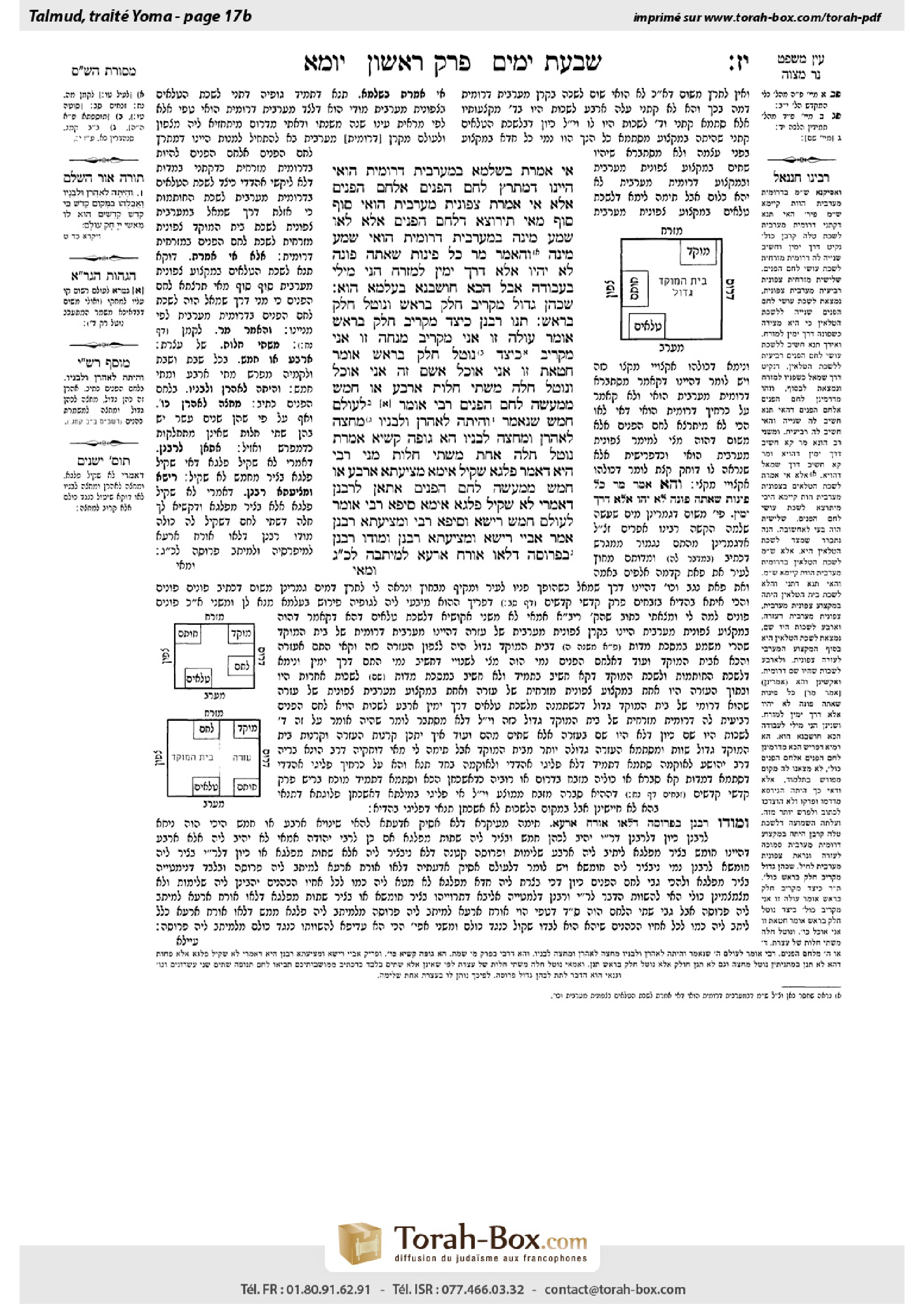
Yoma 17b: Talmud study for Daf Yomi
Daf Yomi is the daily study of one Talmud folio. Explore 37 tractates with scans, Hebrew text, Sefaria English and AI-generated French translations where annotated.
Passage selection and English or AI-generated French translation are available where the scan has annotations. Daf Study is independent of Torah-Box and Sefaria.
Browse Yoma · יומא · All tractatesYoma 17b text and translations
This page of Yoma includes the Aramaic text, an English translation and an AI-generated French translation, alongside the scan above.
יומא י״ז ב · Aramaic and Hebrew text
אִי אָמְרַתְּ בִּשְׁלָמָא בְּמַעֲרָבִית דְּרוֹמִית הֲוַאי, הַיְינוּ דִּמְתָרֵץ לֶחֶם הַפָּנִים אַלֶּחֶם הַפָּנִים. אֶלָּא אִי אָמְרַתְּ צְפוֹנִית מַעֲרָבִית הֲוַאי, סוֹף סוֹף מַאי תֵּירוּצָא דְּלֶחֶם הַפָּנִים! אֶלָּא לָאו שְׁמַע מִינַּהּ, בְּמַעֲרָבִית דְּרוֹמִית הֲוַאי. שְׁמַע מִינַּהּ.
וְהָאָמַר מָר: כׇּל פִּינּוֹת שֶׁאַתָּה פּוֹנֶה לֹא יִהְיוּ אֶלָּא דֶּרֶךְ יָמִין לַמִּזְרָח? הָנֵי מִילֵּי בַּעֲבוֹדָה. אֲבָל הָכָא — חוּשְׁבָּנָא בְּעָלְמָא הוּא.
שֶׁכֹּהֵן גָּדוֹל מַקְרִיב חֵלֶק בָּרֹאשׁ וְנוֹטֵל חֵלֶק בָּרֹאשׁ. תָּנוּ רַבָּנַן: כֵּיצַד מַקְרִיב חֵלֶק בָּרֹאשׁ? אוֹמֵר: עוֹלָה זוֹ אֲנִי מַקְרִיב, מִנְחָה זוֹ אֲנִי מַקְרִיב.
כֵּיצַד נוֹטֵל חֵלֶק בָּרֹאשׁ? אוֹמֵר: חַטָּאת זוֹ אֲנִי אוֹכֵל, אָשָׁם זֶה אֲנִי אוֹכֵל. וְנוֹטֵל חַלָּה מִשְׁתֵּי חַלּוֹת, אַרְבַּע אוֹ חָמֵשׁ מִמַּעֲשֵׂה לֶחֶם הַפָּנִים. רַבִּי אוֹמֵר: לְעוֹלָם חָמֵשׁ, שֶׁנֶּאֱמַר: ״וְהָיְתָה לְאַהֲרֹן וּלְבָנָיו״ — מֶחֱצָה לְאַהֲרֹן וּמֶחֱצָה לְבָנָיו.
הָא גּוּפַהּ קַשְׁיָא: אָמְרַתְּ נוֹטֵל חַלָּה אַחַת מִשְׁתֵּי חַלּוֹת, מַנִּי — רַבִּי הִיא, דְּאָמַר פַּלְגָא שָׁקֵיל. אֵימָא מְצִיעֲתָא: אַרְבַּע אוֹ חָמֵשׁ מִמַּעֲשֵׂה לֶחֶם הַפָּנִים, אֲתָאן לְרַבָּנַן, דְּאָמְרִי: לָא שָׁקֵיל פַּלְגָא. אֵימָא סֵיפָא, רַבִּי אוֹמֵר: לְעוֹלָם חָמֵשׁ. רֵישָׁא וְסֵיפָא רַבִּי, וּמְצִיעֲתָא רַבָּנַן?
אָמַר אַבָּיֵי: רֵישָׁא וּמְצִיעֲתָא רַבָּנַן — וּמוֹדוּ רַבָּנַן בִּפְרוּסָה, דְּלָאו אוֹרַח אַרְעָא לְמִיתְּבַהּ לְכֹהֵן גָּדוֹל.
Yoma 17b · English translation
Granted, if you say that the Chamber of the Lambs was actually closer to the southwest corner, that is how Rav Huna resolves the contradiction between one mishna discussing the shewbread and the other mishna discussing the shewbread. However, if you say that the Chamber of the Lambs was in the northwest corner, ultimately, what is the resolution with regard to the shewbread? Even if you envision the path from the other direction, the Chamber of the Seals interposes between the Chamber of the Lambs and the chamber where the shewbread is prepared. Rather, must one not conclude from it that the Chamber of the Lambs was indeed in the southwest? The Gemara concludes: Indeed, conclude from it that this is so.
The Gemara questions the assertion that one tanna envisions the chambers as one coming via the left. But didn’t the Master say: All turns that you turn should be only to the right, which in certain cases is to the east? Here the turns are to the left. The Gemara answers: This restriction applies only in the course of performing the Temple service; however, here, it is a mere reckoning, and no priest actually proceeded that way from one chamber to the other.
§ It was taught in the mishna: As the High Priest sacrifices any portion that he chooses first and takes any portion that he chooses first. The Sages taught in a baraita: How does the High Priest sacrifice any portion that he chooses first? If the High Priest so desires, he says: This burnt-offering, I am sacrificing, or: This meal-offering, I am sacrificing. That is sufficient, and the High Priest does not participate in a lottery.
How does the High Priest take any portion that he chooses first? The High Priest says: This sin-offering, I am eating, or: This guilt-offering, I am eating. And he may even take one loaf of the two loaves offered on the festival of Shavuot. He may take four or five of the twelve shewbread loaves that are distributed to the priests every Shabbat. Rabbi Yehuda HaNasi says: The High Priest always takes five of the twelve shewbread loaves, as it is stated: “It shall be for Aaron and his sons and they shall eat it in a sacred place” (Leviticus 24:9). From the fact that Aaron and his sons are listed separately, it is derived that half of the loaves were given to Aaron, or the High Priests who succeeded him, and half were given to his sons. Since, as explained below, only ten of the loaves were actually distributed, the High Priest received five.
This baraita is itself difficult, as it is self-contradictory. First you said: He takes one loaf of the two loaves offered on the festival of Shavuot. Whose opinion is this? It is the opinion of Rabbi Yehuda HaNasi, who said that the High Priest takes half. Say the middle clause of the baraita as follows: The High Priest takes four or five of the twelve shewbread loaves; we have come to the opinion of the Rabbis, who say that the High Priest does not take half but takes less than half. Say the last clause of the baraita as follows: Rabbi Yehuda HaNasi says that the High Priest always takes five. The Gemara asks: Is that to say that the first clause and the last clause of the baraita are in accordance with the opinion of Rabbi Yehuda HaNasi, and the middle clause is in accordance with the opinion of the Rabbis? That conclusion is difficult.
Abaye said: The first clause and the middle clause of the baraita are in accordance with the opinion of the Rabbis, and in the case of the two loaves, the Rabbis concede with regard to a piece of a loaf that it is inappropriate to give it to the High Priest. According to the Rabbis, the High Priest should actually receive less than one loaf, as in their opinion he is entitled to less than half; however, since it is inappropriate to give him a piece of the loaf, he takes an entire loaf as his portion.
Yoma 17b · Traduction française (IA)
Admettons que la Chambre des agneaux se soit trouvée en réalité plus près de l’angle sud-ouest : Rav Houna résout ainsi la contradiction entre une Michna qui traite des pains de proposition et une autre Michna qui traite également des pains de proposition. Mais si l’on dit que la Chambre des agneaux se trouvait à l’angle nord-ouest, comment résoudre, en définitive, la question des pains de proposition ? Même si l’on imagine le trajet dans l’autre sens, la Chambre des sceaux s’interpose entre la Chambre des agneaux et la chambre où l’on prépare les pains de proposition. Ne faut-il donc pas en conclure que la Chambre des agneaux se trouvait bien au sud-ouest ? La Guemara conclut : en effet, déduis-en que c’est bien le cas.
La Guemara met en question l’affirmation selon laquelle un tanna se représente les chambres en arrivant par la gauche. Mais le Maître n’a-t-il pas dit : « Tous les virages que tu prends, tu dois les prendre à droite », ce qui, dans certains cas, signifie vers l’est ? Ici, les virages se font à gauche. La Guemara répond : cette restriction ne s’applique que pendant l’accomplissement du service du Temple ; ici, il ne s’agit que d’un calcul, et aucun prêtre ne s’est réellement déplacé ainsi d’une chambre à l’autre.
§ La Michna enseignait : Le Grand Prêtre offre d’abord la portion de son choix et prend d’abord la portion de son choix. Les Sages ont enseigné dans une baraïta : Comment le Grand Prêtre offre-t-il d’abord la portion de son choix ? S’il le souhaite, il dit : « C’est cet holocauste que j’offre », ou : « C’est cette offrande végétale que j’offre. » Cela suffit : le Grand Prêtre ne participe pas à un tirage au sort.
Comment le Grand Prêtre prend-il d’abord la portion de son choix ? Il dit : « C’est ce sacrifice expiatoire que je mange », ou : « C’est ce sacrifice de culpabilité que je mange. » Il peut même prendre un pain parmi les deux pains offerts lors de la fête de Chavouot. Il peut prendre quatre ou cinq des douze pains de proposition distribués aux prêtres chaque Chabbat. Rabbi Yehouda HaNassi dit : le Grand Prêtre prend toujours cinq des douze pains de proposition, comme il est dit : « Cela appartiendra à Aaron et à ses fils, et ils le mangeront dans un lieu saint » (Lévitique 24:9). Du fait qu’Aaron et ses fils sont mentionnés séparément, on déduit que la moitié des pains était donnée à Aaron, ou aux Grands Prêtres qui lui ont succédé, et l’autre moitié à ses fils. Puisque, comme cela sera expliqué plus loin, seuls dix pains étaient effectivement distribués, le Grand Prêtre en recevait cinq.
Cette baraïta pose elle-même problème, car elle se contredit. Tu as d’abord dit : il prend un pain parmi les deux pains offerts lors de la fête de Chavouot. De qui est-ce l’opinion ? De Rabbi Yehouda HaNassi, qui dit que le Grand Prêtre prend la moitié. Il faut comprendre ainsi la clause intermédiaire de la baraïta : le Grand Prêtre prend quatre ou cinq des douze pains de proposition ; nous en sommes venus à l’opinion des Rabbins, qui disent que le Grand Prêtre ne prend pas la moitié, mais moins de la moitié. Il faut comprendre ainsi la dernière clause de la baraïta : Rabbi Yehouda HaNassi dit que le Grand Prêtre en prend toujours cinq. La Guemara demande : Cela signifie-t-il que la première et la dernière clauses de la baraïta suivent l’opinion de Rabbi Yehouda HaNassi, tandis que la clause intermédiaire suit celle des Rabbins ? Cette conclusion est difficile.
Abayé dit : la première et la clause intermédiaire de la baraïta suivent l’opinion des Rabbins ; dans le cas des deux pains, les Rabbins concèdent qu’il ne convient pas de donner au Grand Prêtre une fraction de pain. Selon les Rabbins, le Grand Prêtre devrait en réalité recevoir moins d’un pain, puisqu’à leur avis il a droit à moins de la moitié ; toutefois, comme il ne convient pas de lui donner une fraction de pain, il prend un pain entier comme portion.
Traduction française générée par IA à partir de l’édition anglaise de Sefaria. Vérifie toujours un passage avec le texte source.
Text from Sefaria: William Davidson Edition - Vocalized Aramaic (CC BY NC); William Davidson Edition - English (CC BY NC).