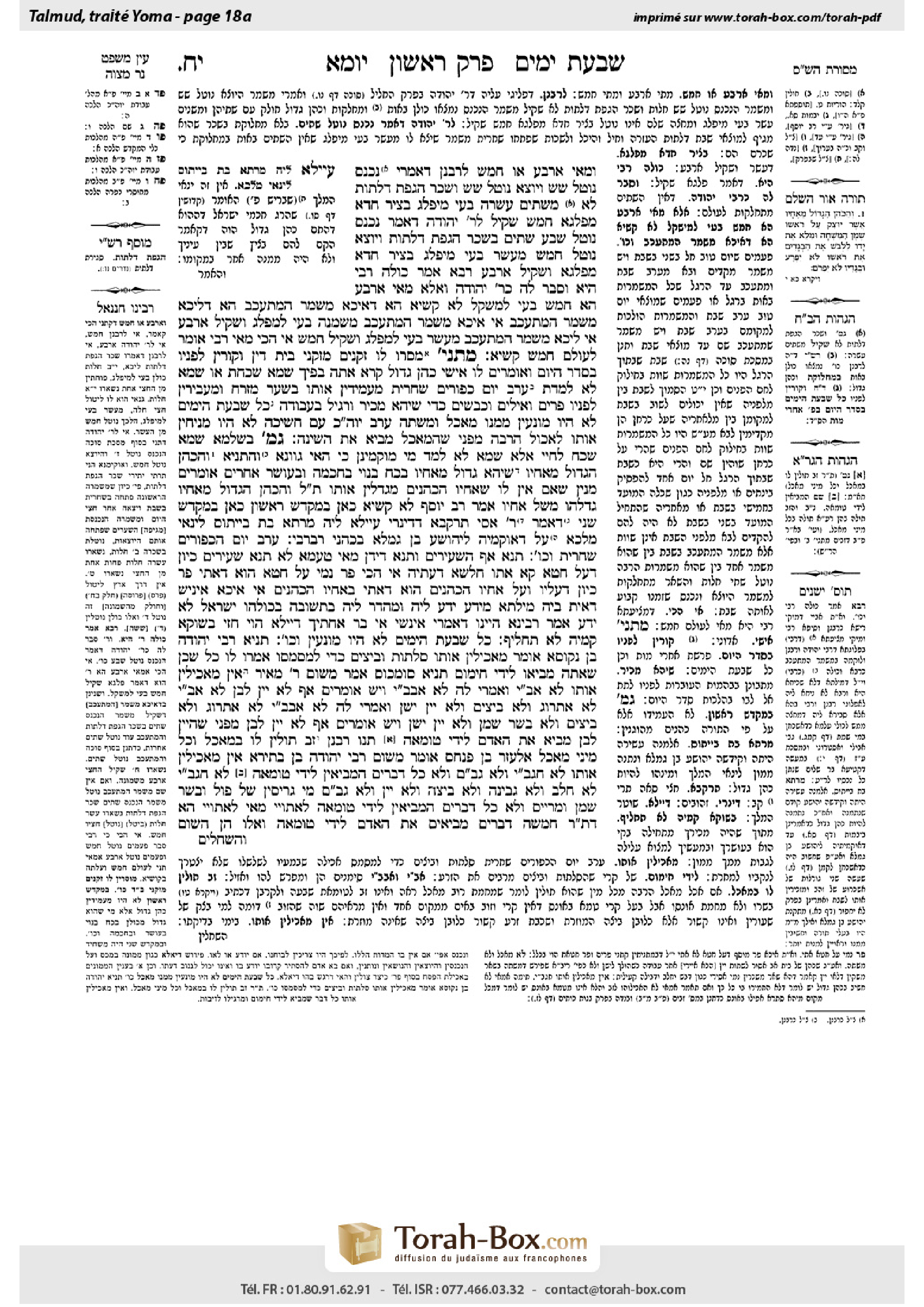
Yoma 18a: Talmud study for Daf Yomi
Daf Yomi is the daily study of one Talmud folio. Explore 37 tractates with scans, Hebrew text, Sefaria English and AI-generated French translations where annotated.
Passage selection and English or AI-generated French translation are available where the scan has annotations. Daf Study is independent of Torah-Box and Sefaria.
Browse Yoma · יומא · All tractatesYoma 18a text and translations
This page of Yoma includes the Aramaic text, an English translation and an AI-generated French translation, alongside the scan above.
יומא י״ח א · Aramaic and Hebrew text
וּמַאי אַרְבַּע אוֹ חָמֵשׁ? לְרַבָּנַן דְּאָמְרִי נִכְנָס נוֹטֵל שֵׁשׁ, וְיוֹצֵא נוֹטֵל שֵׁשׁ, וּשְׂכַר הַגָּפַת דְּלָתוֹת לָא, מִשְׁתֵּים עֶשְׂרֵה בָּעֵי מִיפְלַג. בַּצֵּיר חֲדָא מִפַּלְגָא, חָמֵשׁ שָׁקֵיל.
לְרַבִּי יְהוּדָה, דְּאָמַר: נִכְנָס נוֹטֵל שֶׁבַע, שְׁתַּיִם בִּשְׂכַר הַגָּפַת דְּלָתוֹת, וְיוֹצֵא נוֹטֵל חָמֵשׁ, מֵעֶשֶׂר בָּעֵי מִיפְלַג. בַּצֵּיר חֲדָא מִפַּלְגָא, וְשָׁקֵיל אַרְבַּע.
רָבָא אָמַר: כּוּלָּהּ רַבִּי הִיא, וְסָבַר לַהּ כְּרַבִּי יְהוּדָה. וְאֶלָּא מַאי אַרְבַּע? הָא חָמֵשׁ בָּעֵי לְמִשְׁקַל!
לָא קַשְׁיָא: הָא דְּאִיכָּא מִשְׁמָר הַמִּתְעַכֵּב, הָא דְּלֵיכָּא מִשְׁמָר הַמִּתְעַכֵּב.
אִי אִיכָּא מִשְׁמָר הַמִּתְעַכֵּב — מִשְּׁמֹנֶה בָּעֵי לְמִפְלַג, וְשָׁקֵיל אַרְבַּע. אִי לֵיכָּא מִשְׁמָר הַמִּתְעַכֵּב — מֵעֶשֶׂר בָּעֵי לְמִפְלַג, וְשָׁקֵיל חָמֵשׁ.
אִי הָכִי, מַאי רַבִּי אוֹמֵר: לְעוֹלָם חָמֵשׁ? קַשְׁיָא.
מַתְנִי׳ מָסְרוּ לוֹ זְקֵנִים מִזִּקְנֵי בֵּית דִּין, וְקוֹרִין לְפָנָיו בְּסֵדֶר הַיּוֹם, וְאוֹמְרִים לוֹ: אִישִׁי כֹּהֵן גָּדוֹל! קְרָא אַתָּה בְּפִיךְ, שֶׁמָּא שָׁכַחְתָּ אוֹ שֶׁמָּא לֹא לָמַדְתָּ. עֶרֶב יוֹם כִּפּוּרִים שַׁחֲרִית מַעֲמִידִין אוֹתוֹ בְּשַׁעַר מִזְרָח, וּמַעֲבִירִין לְפָנָיו פָּרִים וְאֵילִים וּכְבָשִׂים כְּדֵי שֶׁיְּהֵא מַכִּיר וְרָגִיל בַּעֲבוֹדָה. כׇּל שִׁבְעַת הַיָּמִים לֹא הָיוּ מוֹנְעִין מִמֶּנּוּ מַאֲכָל וּמִשְׁתֶּה, עֶרֶב יוֹם הַכִּפּוּרִים עִם חֲשֵׁיכָה לֹא הָיוּ מַנִּיחִין אוֹתוֹ לֶאֱכוֹל הַרְבֵּה, מִפְּנֵי שֶׁהַמַּאֲכָל מֵבִיא אֶת הַשֵּׁינָה.
גְּמָ׳ בִּשְׁלָמָא שֶׁמָּא שָׁכַח — לְחַיֵּי. אֶלָּא שֶׁמָּא לֹא לָמַד — מִי מוֹקְמִינַן כִּי הַאי גַוְונָא?
וְהָתַנְיָא: ״וְהַכֹּהֵן הַגָּדוֹל מֵאֶחָיו״, שֶׁיְּהֵא גָּדוֹל מֵאֶחָיו בְּכֹחַ, בְּנוֹי, בְּחָכְמָה, וּבְעוֹשֶׁר. אֲחֵרִים אוֹמְרִים: מִנַּיִן שֶׁאִם אֵין לוֹ, שֶׁאֶחָיו הַכֹּהֲנִים מְגַדְּלִין אוֹתוֹ — תַּלְמוּד לוֹמַר: ״וְהַכֹּהֵן הַגָּדוֹל מֵאֶחָיו״ — גַּדְּלֵהוּ מִשֶּׁל אֶחָיו.
אָמַר רַב יוֹסֵף: לָא קַשְׁיָא, כָּאן בְּמִקְדָּשׁ רִאשׁוֹן, כָּאן בְּמִקְדָּשׁ שֵׁנִי. דְּאָמַר רַב אַסִּי: תַּרְקַבָּא דְּדִינָרֵי עַיִּילָא לֵיהּ מָרְתָּא בַּת בַּיְיתּוֹס לְיַנַּאי מַלְכָּא עַל דְּאוֹקְמֵיהּ לִיהוֹשֻׁעַ בֶּן גַּמְלָא בְּכָהֲנֵי רַבְרְבֵי.
עֶרֶב יוֹם הַכִּפּוּרִים שַׁחֲרִית וְכוּ׳. תָּנָא: אַף הַשְּׂעִירִים. וְתַנָּא דִּידַן מַאי טַעְמָא לָא תְּנָא שְׂעִירִים? כֵּיוָן דְּעַל חֵטְא קָא אָתוּ — חָלְשָׁא דַּעְתֵּיהּ.
אִי הָכִי, פַּר נָמֵי עַל חֵטְא הוּא דְּאָתֵי! פַּר, כֵּיוָן דְּעָלָיו וְעַל אֶחָיו הַכֹּהֲנִים הוּא דְּאָתֵי, בְּאֶחָיו הַכֹּהֲנִים, אִי אִיכָּא אִינִישׁ דְּאִית בֵּיהּ מִילְּתָא — מִידָּע יָדַע לֵיהּ וּמַהְדַּר לֵיהּ בִּתְשׁוּבָה. בְּכוּלְּהוּ יִשְׂרָאֵל — לָא יָדַע.
אָמַר רָבִינָא, הַיְינוּ דְּאָמְרִי אִינָשֵׁי: אִי בַּר אֲחָתָיךְ דַּיָּילָא הָוֵי חֲזִי, בְּשׁוּקָא קַמֵּיהּ לָא תַּחְלֵיף.
כׇּל שִׁבְעַת הַיָּמִים לָא הָיוּ מוֹנְעִין וְכוּ׳. תַּנְיָא, רַבִּי יְהוּדָה בֶּן נָקוֹסָא אוֹמֵר: מַאֲכִילִין אוֹתוֹ סְלָתוֹת וּבֵיצִים כְּדֵי לְמַסְמְסוֹ. אָמְרוּ לוֹ: כׇּל שֶׁכֵּן שֶׁאַתָּה מְבִיאוֹ לִידֵי חִימּוּם.
תַּנְיָא סוֹמְכוֹס אָמַר מִשּׁוּם רַבִּי מֵאִיר: אֵין מַאֲכִילִין אוֹתוֹ לֹא ״אב״י״, וְאָמְרִי לַהּ: לֹא ״אבב״י״, וְיֵשׁ אוֹמְרִים: אַף לֹא יַיִן לָבָן. לֹא ״אב״י״ — לֹא אֶתְרוֹג, וְלֹא בֵּיצִים, וְלֹא יַיִן יָשָׁן. וְאָמְרִי לַהּ לֹא ״אבב״י״ — לֹא אֶתְרוֹג, וְלֹא בֵּיצִים, וְלֹא בָּשָׂר שָׁמֵן, וְלֹא יַיִן יָשָׁן. וְיֵשׁ אוֹמְרִים: אַף לֹא יַיִן לָבָן, מִפְּנֵי שֶׁהַיַּיִן לָבָן מֵבִיא אֶת הָאָדָם לִידֵי טוּמְאָה.
תָּנוּ רַבָּנַן: זָב תּוֹלִין לוֹ בְּמַאֲכָל, וְכׇל מִינֵי מַאֲכָל. אֶלְעָזָר בֶּן פִּנְחָס אוֹמֵר מִשּׁוּם רַבִּי יְהוּדָה בֶּן בְּתֵירָא: אֵין מַאֲכִילִין אוֹתוֹ לֹא ״חגב״י״ וְלֹא ״גב״ם״, וְלֹא כׇּל דְּבָרִים הַמְּבִיאִין לִידֵי טוּמְאָה. לֹא ״חגב״י״ — לֹא חָלָב, וְלֹא גְּבִינָה, וְלֹא בֵּיצָה, וְלֹא יַיִן. וְלֹא ״גב״ם״ — מֵי גְרִיסִין שֶׁל פּוֹל, וּבָשָׂר שָׁמֵן, וּמֻרְיָיס.
וְלֹא כׇּל דְּבָרִים הַמְּבִיאִין לִידֵי טוּמְאָה, לְאֵתוֹיֵי מַאי? לְאֵתוֹיֵי הָא דְּתָנוּ רַבָּנַן: חֲמִשָּׁה דְּבָרִים מְבִיאִים אֶת הָאָדָם לִידֵי טוּמְאָה, וְאֵלּוּ הֵן: הַשּׁוּם
Yoma 18a · English translation
And what is the meaning of four or five; i.e., when does the High Priest take four loaves and when does he take five? According to the Rabbis, who say: The priestly watch that is incoming on Shabbat takes six of the loaves, and the outgoing watch takes six, and the incoming watch receives no greater portion as payment for closing the doors, it is from twelve loaves that the High Priest must divide and take his share, but he receives half of the loaves less one, meaning that he takes five. According to the Rabbis, the High Priest receives less than half; however, since it is inappropriate to give him a piece of a loaf, less than half is five whole loaves.
According to Rabbi Yehuda, who said: The priestly watch that is incoming on Shabbat takes seven of the loaves, two of which are payment for closing the doors; and the outgoing watch takes five loaves, it is from ten that he must divide the loaves. Those two of the twelve loaves are a separate payment and are not factored into the tally of those designated for distribution. Subtract one from half of that total, as subtracting less than one loaf would lead to a situation where the High Priest receives a piece of a loaf, which is inappropriate. And therefore, the High Priest takes four.
Rava said that the baraita should be explained differently. The entire baraita is in accordance with the opinion of Rabbi Yehuda HaNasi, and he holds in accordance with the opinion of Rabbi Yehuda that only ten loaves are divided. Rather, what then is the meaning of the statement that the High Priest takes four loaves? According to Rabbi Yehuda HaNasi, doesn’t he need to take five?
The Gemara answers: This is not difficult. This halakha that the High Priest takes four loaves is in a case where there is a watch that is detained. When the start of a Festival occurs on a Sunday night and one of the priestly watches was forced to arrive before Shabbat to ensure that they would arrive in time for the Festival; or, alternatively, if the Festival ended on a Thursday and one of the priestly watches was detained until the conclusion of Shabbat and only then departed, that priestly watch takes two loaves. That halakha that the High Priest takes five loaves is in a case where there is not a watch that is detained, and the shewbread in divided only between the watch that concludes its service that Shabbat and the watch that begins its service that Shabbat.
If there is a watch that is detained, that detained watch takes two loaves, and the outgoing watch takes two loaves as payment for closing the doors. Therefore, it is from eight that the High Priest must divide the loaves, and he takes four. If there is not a watch that is detained, it is from ten that he must divide the loaves and the High Priest takes five.
The Gemara asks: If so, that even the middle statement of the baraita is attributed to Rabbi Yehuda HaNasi and it is referring to a watch that is detained, what is the meaning of the last clause in the baraita: Rabbi Yehuda HaNasi says: The High Priest always takes five loaves? That statement indicates that Rabbi Yehuda HaNasi disagrees with the middle clause, while according to Rava’s interpretation Rabbi Yehuda HaNasi concedes that in certain circumstances the High Priest takes only four loaves. The Gemara concludes: Indeed, it is difficult to reconcile Rava’s interpretation with the language of the baraita.
MISHNA: The Sages provided the High Priest with Elders selected from the Elders of the court, and they would read before him the order of the service of the day of Yom Kippur. And they would say to him: My Master, High Priest. Read the order of the service with your own mouth, as perhaps you forgot this reading or perhaps you did not learn to read. On Yom Kippur eve in the morning, the Elders stand him at the eastern gate of the courtyard and pass before him bulls and rams and sheep so that he will be familiar with the animals and grow accustomed to the service, as these were the animals sacrificed on Yom Kippur. Throughout all the seven days that the High Priest was in the Parhedrin chamber, they would not withhold from him any food or drink that he desired. However, on Yom Kippur eve at nightfall, they would not allow him to eat a great deal because food induces sleep and they did not allow him to sleep, as will be explained.
GEMARA: The Gemara wonders about the depiction in the mishna of the Elders questioning the High Priest as to whether he forgot this reading or perhaps did not learn to read. Granted, perhaps he forgot, that is fine, as it is conceivable that he is not accustomed to reading the Torah and might have forgotten this portion. However, is it conceivable that perhaps the High Priest did not learn to read? Do we appoint a High Priest of that sort who never learned the Bible?
But wasn’t it taught in a baraita that it is stated: “And the priest who is greater than his brethren” (Leviticus 21:10); this teaches that he must be greater than his priestly brethren in strength, in beauty, in wisdom, and in wealth. Aḥerim say: Wealth is not a prerequisite for selecting a High Priest, but from where is it derived that if he does not have property of his own that his brethren the priests elevate him and render him wealthy from their own property? The verse states: “And the priest who is greater [haggadol] than his brethren”; elevate him [gaddelehu] from the property of his brethren. In any event, there is a consensus that wisdom is a prerequisite for his selection.
Rav Yosef said: This is not difficult. There, the baraita that lists wisdom among the attributes of the High Priest is referring to the First Temple, where this halakha was observed and the High Priests possessed those attributes listed. Here, the mishna is referring to the Second Temple, where this halakha was not observed, so a situation where the High Priest was not well-versed in the Bible was conceivable. As Rav Asi said: The wealthy Marta, daughter of Baitos, brought a half-se’a of dinars in to King Yannai for the fact that he appointed Yehoshua ben Gamla as High Priest. This is an example of the appointment of High Priests by means of bribery and gifts. Since that was the practice, a totally ignorant High Priest could have been appointed.
§ It was taught in the mishna: On Yom Kippur eve in the morning, the elders pass different animals before the High Priest. A tanna taught in the Tosefta: Even goats were brought before him. The Gemara asks: And the tanna of our mishna, what is the reason that he did not teach that goats were among the animals that passed before the High Priest? The Gemara answers: Since goats come as atonement for sins, passing them before the High Priest will evoke transgressions and he will become distraught.
The Gemara asks: If so, a bull should not be passed before him, as it too comes to atone for sin. The Gemara answers that there is a difference in the case of a bull, since it is to atone for his sins and for the sins of his brethren the priests that it comes; among his brethren the priests, if there is a person who has a sinful matter, the High Priest would know about it and lead him back to the path of righteousness through repentance. Therefore, passing a bull before the High Priest will not render him distraught, as it will merely remind him of his responsibility toward his priestly brethren. On the other hand, with regard to the entire Jewish people, he does not know of their sinful matters and is unable to facilitate their repentance. Passing goats before the High Priest will evoke their sins as well as his inability to correct the situation, leaving him distraught.
Apropos the High Priest being privy to the sinful behavior of his fellow priests, Ravina said that this explains the folk saying that people say: If the beloved son of your beloved sister becomes a policeman [dayyala], see to it that in the marketplace you do not pass before him. Be wary of him because he knows your sins.
§ We learned in the mishna: Throughout all the seven days that the High Priest was in the Parhedrin chamber, they would not withhold from him any food or drink that he desired. It was taught in a baraita: Rabbi Yehuda ben Nekosa says: On Yom Kippur eve they feed him fine flour and eggs in order to loosen his bowels, so that he will not need to relieve himself on Yom Kippur. They said to Rabbi Yehuda ben Nekosa: In feeding him those foods, all the more so that you bring him to a state of arousal. Feeding him those foods is antithetical to the efforts to prevent the High Priest from becoming impure, as they are liable to cause him to experience a seminal emission.
It was taught in a baraita that Sumakhos said in the name of Rabbi Meir: One does not feed him foods represented by the acrostic: Alef, beit, yod; and some say that one does not feed him foods represented by the acrostic: Alef, beit, beit, yod; and some say neither does one feed him white wine. The Gemara elaborates: Not alef, beit, yod means neither etrog, nor eggs [beitzim], nor old wine [yayin]. And some say: Not alef, beit, beit, yod means neither etrog, nor eggs [beitzim], nor fatty meat [basar], nor old wine [yayin]. And some say neither does one feed him white wine because white wine brings a man to the impurity of a seminal emission.
Similarly, the Sages taught: If a man experienced an emission that could render him a zav, one attributes the emission not to his being a zav but perhaps to a different cause, e.g., to food, or to all kinds of food, i.e., he may have eaten too much food, which could have caused the emission. Elazar ben Pineḥas says in the name of Rabbi Yehuda ben Beteira: During the days that a zav is examining himself to determine whether or not he is impure, one feeds him neither foods represented by the acrostic: Ḥet, gimmel, beit, yod, nor foods represented by the acrostic: Gimmel, beit, mem, nor any food items that might bring him to impurity caused by an emission. The Gemara explains: Not ḥet, gimmel, beit, yod means neither milk [ḥalav], nor cheese [gevina], nor egg [beitza], nor wine [yayin]. And not gimmel, beit, mem means neither soup of pounded beans [mei gerisin], nor fatty meat [basar], nor small fish pickled in brine [muryas].
The Gemara asks about the phrase: Nor any food items that might bring him to impurity; what does it come to include? It comes to include that which the Sages taught: Five food items bring a man to a state of impurity due to emission. And these are: Garlic,
Yoma 18a · Traduction française (IA)
Que signifie « quatre ou cinq » ? Autrement dit, dans quelles circonstances le grand prêtre prend-il quatre pains, et dans quelles circonstances en prend-il cinq ? Selon les Rabbins, qui disent que la garde sacerdotale qui arrive le Chabbat prend six pains, que celle qui part en prend six, et que la garde entrante ne reçoit aucune part supplémentaire en paiement de la fermeture des portes, le grand prêtre doit partager les douze pains et prendre sa part. Il reçoit toutefois la moitié des pains moins un, c’est-à-dire qu’il en prend cinq. Selon les Rabbins, le grand prêtre reçoit moins de la moitié ; cependant, comme il ne convient pas de lui donner une partie de pain, il reçoit moins de la moitié sous la forme de cinq pains entiers.
Selon Rabbi Yehouda, qui dit que la garde sacerdotale qui arrive le Chabbat prend sept pains, dont deux lui sont versés en paiement de la fermeture des portes, et que la garde qui part en prend cinq, le grand prêtre doit partager dix pains. Ces deux pains sur les douze constituent un paiement distinct et ne sont pas comptés parmi ceux destinés au partage. Il faut retrancher un pain de la moitié de ce total, car retrancher moins d’un pain conduirait à ce que le grand prêtre reçoive une partie de pain, ce qui ne convient pas. Le grand prêtre en prend donc quatre.
Rava dit que la baraïta doit être expliquée autrement. Toute la baraïta est conforme à l’opinion de Rabbi Yehouda HaNassi, lequel suit l’opinion de Rabbi Yehouda selon laquelle seuls dix pains sont partagés. Que signifie donc l’affirmation selon laquelle le grand prêtre prend quatre pains ? Selon Rabbi Yehouda HaNassi, ne devrait-il pas en prendre cinq ?
La Guemara répond : Il n’y a pas de difficulté. La halakha selon laquelle le grand prêtre prend quatre pains concerne le cas où une garde est retenue. Lorsque le début d’une fête tombe un dimanche soir, une des gardes sacerdotales est obligée d’arriver avant le Chabbat afin d’être présente à temps pour la fête ; ou bien, si la fête se termine un jeudi, une des gardes sacerdotales est retenue jusqu’à la fin du Chabbat et ne part qu’alors : cette garde prend deux pains. La halakha selon laquelle le grand prêtre prend cinq pains concerne le cas où aucune garde n’est retenue ; le pain de proposition est alors partagé uniquement entre la garde qui termine son service ce Chabbat et celle qui commence son service ce Chabbat.
Si une garde est retenue, cette garde prend deux pains, et la garde qui part en prend deux en paiement de la fermeture des portes. Le grand prêtre doit donc partager huit pains et en prend quatre. Si aucune garde n’est retenue, il doit partager dix pains, et le grand prêtre en prend cinq.
La Guemara demande : Si tel est le cas, et que même l’affirmation intermédiaire de la baraïta est attribuée à Rabbi Yehouda HaNassi et concerne une garde retenue, que signifie la dernière clause de la baraïta : « Rabbi Yehouda HaNassi dit : Le grand prêtre prend toujours cinq pains » ? Cette affirmation indique que Rabbi Yehouda HaNassi contredit la clause intermédiaire, alors que, selon l’interprétation de Rava, Rabbi Yehouda HaNassi reconnaît que, dans certaines circonstances, le grand prêtre ne prend que quatre pains. La Guemara conclut : En effet, il est difficile de concilier l’interprétation de Rava avec le texte de la baraïta.
MICHNA : Les Sages adjoignirent au grand prêtre des Anciens choisis parmi les Anciens du tribunal, et ceux-ci lui lisaient l’ordre du service du jour de Yom Kippour. Ils lui disaient : « Mon maître, grand prêtre, lisez vous-même l’ordre du service ; peut-être avez-vous oublié ce passage ou peut-être n’avez-vous pas appris à lire. » Le matin de la veille de Yom Kippour, les Anciens le plaçaient à la porte orientale de la cour et faisaient passer devant lui des taureaux, des béliers et des moutons, afin qu’il se familiarise avec les animaux et s’habitue au service, car ce sont les animaux qui étaient sacrifiés à Yom Kippour. Pendant les sept jours où le grand prêtre séjournait dans la chambre des Parhedrin, on ne lui refusait aucun aliment ni aucune boisson qu’il désirait. Cependant, à la tombée de la nuit de la veille de Yom Kippour, on ne le laissait pas manger beaucoup, car la nourriture provoque le sommeil et on ne le laissait pas dormir, comme cela sera expliqué.
GUEMARA : La Guemara s’interroge sur le passage de la Michna où les Anciens demandent au grand prêtre s’il a oublié cette lecture ou s’il n’a peut-être pas appris à lire. Certes, il a pu oublier, cela se comprend, car il est concevable qu’il n’ait pas l’habitude de lire la Torah et qu’il ait pu oublier ce passage. Mais est-il concevable que le grand prêtre n’ait peut-être pas appris à lire ? Nommerait-on un grand prêtre qui n’a jamais appris la Bible ?
Mais n’a-t-on pas enseigné dans une baraïta : « Et le prêtre qui est plus grand que ses frères » (Lévitique 21, 10) ? Cela enseigne qu’il doit être supérieur à ses frères prêtres par la force, la beauté, la sagesse et la richesse. Aḥerim disent : La richesse n’est pas une condition préalable au choix du grand prêtre. Mais d’où déduit-on que, s’il ne possède pas de biens, ses frères prêtres l’élèvent et l’enrichissent avec leurs propres biens ? Le verset dit : « Et le prêtre qui est plus grand [haggadol] que ses frères » ; élevez-le [gaddelehu] grâce aux biens de ses frères. Quoi qu’il en soit, tous s’accordent à dire que la sagesse est une condition préalable à son choix.
Rav Yossef dit : Il n’y a pas de difficulté. Là, la baraïta qui compte la sagesse parmi les qualités du grand prêtre concerne le Premier Temple, où cette halakha était observée et où les grands prêtres possédaient les qualités énumérées. Ici, la Michna concerne le Second Temple, où cette halakha n’était pas observée ; il était donc concevable que le grand prêtre ne connaisse pas bien la Bible. En effet, Rav Assi a dit : Marta la riche, fille de Baitos, apporta au roi Yannai un demi-séa de dinars pour qu’il nomme Yehoshoua ben Gamla grand prêtre. C’est un exemple de nomination de grands prêtres au moyen de pots-de-vin et de cadeaux. Puisque telle était la pratique, un grand prêtre totalement ignorant aurait pu être nommé.
§ Il a été enseigné dans la Michna : Le matin de la veille de Yom Kippour, les Anciens font passer différents animaux devant le grand prêtre. Un tanna a enseigné dans la Tosefta : On amenait également des boucs devant lui. La Guemara demande : Pourquoi le tanna de notre Michna n’a-t-il pas enseigné que des boucs faisaient partie des animaux qui passaient devant le grand prêtre ? La Guemara répond : Comme les boucs sont offerts pour expier les fautes, les faire passer devant le grand prêtre évoquerait des transgressions et le bouleverserait.
La Guemara demande : Si c’est ainsi, on ne devrait pas faire passer de taureau devant lui, puisqu’il vient lui aussi expier une faute. La Guemara répond qu’il y a une différence dans le cas du taureau, car il vient expier ses fautes à lui ainsi que celles de ses frères prêtres. Parmi ses frères prêtres, si quelqu’un a commis une faute, le grand prêtre le saurait et le ramènerait sur le chemin de la justice par le repentir. Faire passer un taureau devant le grand prêtre ne le bouleverserait donc pas, car cela ne ferait que lui rappeler sa responsabilité envers ses frères prêtres. En revanche, il ne connaît pas les fautes de l’ensemble du peuple juif et ne peut pas faciliter son repentir. Faire passer des boucs devant le grand prêtre évoquerait leurs fautes ainsi que son incapacité à remédier à la situation, et le bouleverserait.
À propos du fait que le grand prêtre est au courant du comportement fautif de ses compagnons prêtres, Ravina dit que cela explique le dicton populaire : « Si le fils chéri de ta sœur chérie devient policier [dayyala], veille à ne pas passer devant lui au marché. » Méfie-toi de lui, car il connaît tes fautes.
§ Nous avons appris dans la Michna : Pendant les sept jours où le grand prêtre séjournait dans la chambre des Parhedrin, on ne lui refusait aucun aliment ni aucune boisson qu’il désirait. Il a été enseigné dans une baraïta : Rabbi Yehouda ben Nekosa dit : La veille de Yom Kippour, on lui donne de la farine fine et des œufs afin de lui relâcher les intestins, pour qu’il n’ait pas besoin de se soulager à Yom Kippour. On dit à Rabbi Yehouda ben Nekosa : En lui donnant ces aliments, vous ne faites que l’exciter davantage. Lui donner ces aliments va à l’encontre des efforts visant à empêcher le grand prêtre de devenir impur, car ils risquent de provoquer chez lui une émission séminale.
Il a été enseigné dans une baraïta que Soumakhos a dit au nom de Rabbi Meïr : On ne lui donne pas d’aliments désignés par l’acrostiche alef, beit, yod ; certains disent qu’on ne lui donne pas d’aliments désignés par l’acrostiche alef, beit, beit, yod ; et certains disent qu’on ne lui donne pas non plus de vin blanc. La Guemara précise : « Pas alef, beit, yod » signifie ni cédrat, ni œufs [beitzim], ni vin vieux [yayin]. Certains disent : « Pas alef, beit, beit, yod » signifie ni cédrat, ni œufs [beitzim], ni viande grasse [basar], ni vin vieux [yayin]. Certains disent qu’on ne lui donne pas non plus de vin blanc, car le vin blanc provoque chez l’homme l’impureté due à une émission séminale.
De même, les Sages ont enseigné : Si un homme a eu une émission susceptible de le rendre zav, on attribue cette émission non pas au fait qu’il est zav, mais peut-être à une autre cause, par exemple à la nourriture ou à toutes sortes d’aliments, c’est-à-dire qu’il a peut-être trop mangé, ce qui aurait pu provoquer l’émission. Elazar ben Pineḥas dit au nom de Rabbi Yehouda ben Beteira : Pendant les jours où un zav s’examine pour déterminer s’il est impur ou non, on ne lui donne ni les aliments désignés par l’acrostiche ḥet, gimmel, beit, yod, ni ceux désignés par l’acrostiche gimmel, beit, mem, ni aucun aliment susceptible de provoquer chez lui l’impureté due à une émission. La Guemara explique : « Pas ḥet, gimmel, beit, yod » signifie ni lait [ḥalav], ni fromage [gevina], ni œuf [beitza], ni vin [yayin]. Et « pas gimmel, beit, mem » signifie ni soupe de fèves pilées [mei gerisin], ni viande grasse [basar], ni petits poissons conservés dans la saumure [muryas].
La Guemara s’interroge sur l’expression : « Ni aucun aliment susceptible de le rendre impur » ; qu’est-elle censée inclure ? Elle inclut ce que les Sages ont enseigné : Cinq aliments amènent un homme à un état d’impureté due à une émission. Les voici : l’ail,
Traduction française générée par IA à partir de l’édition anglaise de Sefaria. Vérifie toujours un passage avec le texte source.
Text from Sefaria: William Davidson Edition - Vocalized Aramaic (CC BY NC); William Davidson Edition - English (CC BY NC).