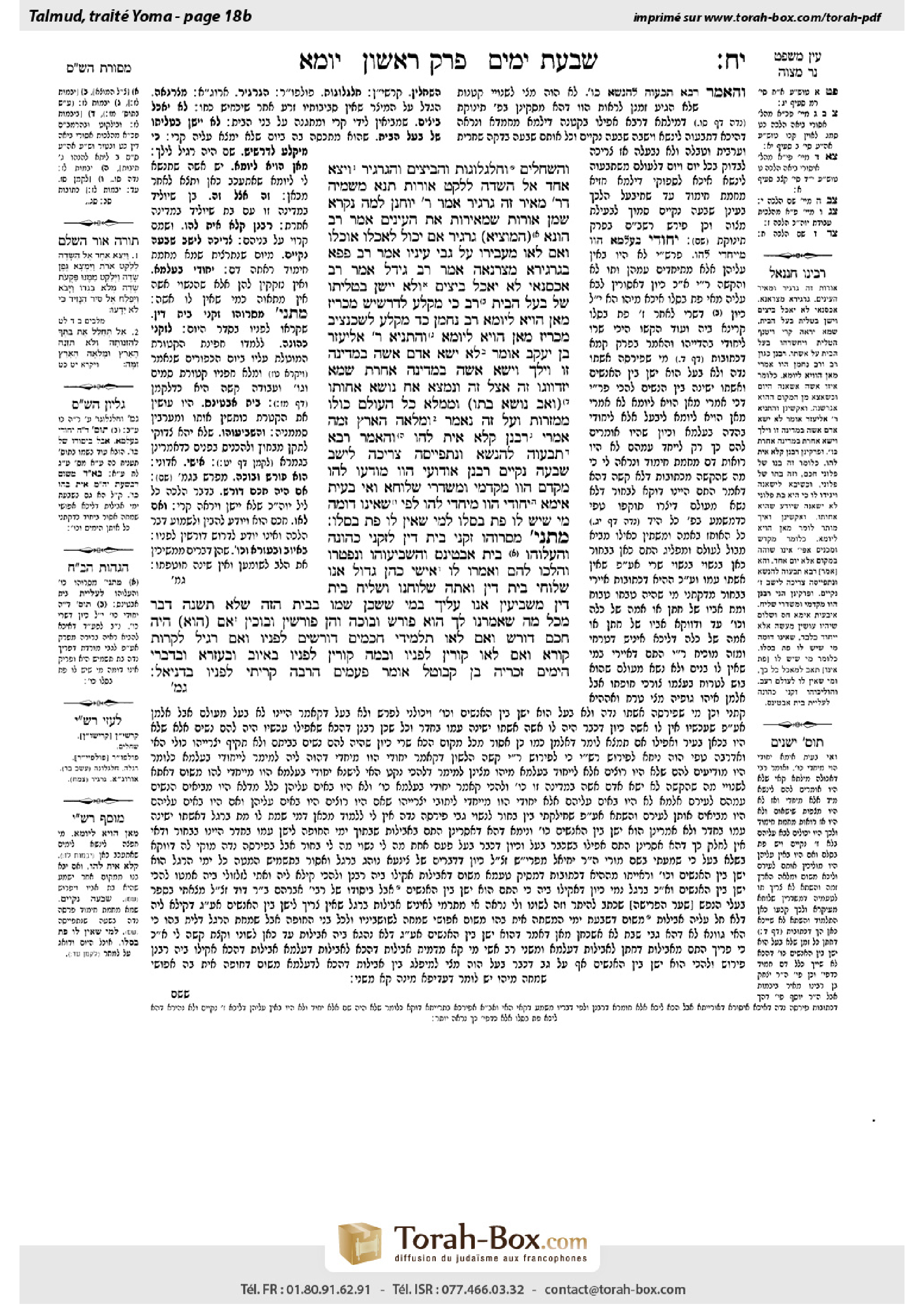
Yoma 18b: Talmud study for Daf Yomi
Daf Yomi is the daily study of one Talmud folio. Explore 37 tractates with scans, Hebrew text, Sefaria English and AI-generated French translations where annotated.
Passage selection and English or AI-generated French translation are available where the scan has annotations. Daf Study is independent of Torah-Box and Sefaria.
Browse Yoma · יומא · All tractatesYoma 18b text and translations
This page of Yoma includes the Aramaic text, an English translation and an AI-generated French translation, alongside the scan above.
יומא י״ח ב · Aramaic and Hebrew text
וְהַשַּׁחֲלַיִם וַחֲלֹגְלוֹגוֹת וְהַבֵּיצִים וְהַגַּרְגִּיר. ״וַיֵּצֵא אֶחָד אֶל הַשָּׂדֶה לְלַקֵּט אוֹרוֹת״, תָּנָא מִשְּׁמֵיהּ דְּרַבִּי מֵאִיר: זֶה גַּרְגִּיר. אָמַר רַבִּי יוֹחָנָן: לָמָּה נִקְרָא שְׁמָן ״אוֹרוֹת״ — שֶׁמְּאִירוֹת אֶת הָעֵינַיִם. אָמַר רַב הוּנָא: הַמּוֹצֵיא גַּרְגִּיר, אִם יָכוֹל לְאׇכְלוֹ אוֹכְלוֹ, וְאִם לָאו — מַעֲבִירוֹ עַל גַּבֵּי עֵינָיו. אָמַר רַב פָּפָּא: בְּגַרְגִּירָא מַצְרָנְאָה.
אָמַר רַב גִּידֵּל אָמַר רַב: אַכְסְנַאי לֹא יֹאכַל בֵּיצִים, וְלֹא יִישַׁן בְּטַלִּיתוֹ שֶׁל בַּעַל הַבַּיִת. רַב כִּי מִקְּלַע לְדַרְשִׁישׁ, מַכְרֵיז: מַאן הָוְיָא לְיוֹמָא. רַב נַחְמָן כַּד מִקְּלַע לְשַׁכְנְצִיב, מַכְרֵיז: מַאן הָוְיָא לְיוֹמָא.
וְהַתַּנְיָא, רַבִּי אֱלִיעֶזֶר בֶּן יַעֲקֹב אוֹמֵר: לֹא יִשָּׂא אָדָם אִשָּׁה בִּמְדִינָה זוֹ, וְיֵלֵךְ וְיִשָּׂא אִשָּׁה בִּמְדִינָה אַחֶרֶת, שֶׁמָּא יִזְדַּוְּוגוּ זֶה אֵצֶל זֶה וְנִמְצָא אָח נוֹשֵׂא אֲחוֹתוֹ (וְאָב נוֹשֵׂא בִּתּוֹ), וּמְמַלֵּא כָּל הָעוֹלָם כּוּלּוֹ מַמְזֵרוּת, וְעַל זֶה נֶאֱמַר: ״וּמָלְאָה הָאָרֶץ זִמָּה״. אָמְרִי: רַבָּנַן — קָלָא אִית לְהוּ.
וְהָאָמַר רָבָא: תְּבָעוּהָ לְהִנָּשֵׂא, וְנִתְפַּיְּיסָה — צְרִיכָה לֵישֵׁב שִׁבְעָה נְקִיִּים? רַבָּנַן אוֹדוֹעֵי הֲווֹ מוֹדְעוּ לְהוּ, מִקְדָּם הֲווֹ קָדְמִי וּמְשַׁדְּרִי שְׁלוּחָא.
וְאִי בָּעֵית אֵימָא יַחוֹדֵי הֲווֹ מְיַחֲדִי לְהוּ, לְפִי שֶׁאֵינוֹ דּוֹמֶה מִי שֶׁיֵּשׁ לוֹ פַּת בְּסַלּוֹ לְמִי שֶׁאֵין לוֹ פַּת בְּסַלּוֹ.
מַתְנִי׳ מְסָרוּהוּ זִקְנֵי בֵית דִּין לְזִקְנֵי כְהוּנָּה וְהֶעֱלוּהוּ בֵּית אַבְטִינָס, וְהִשְׁבִּיעוּהוּ, וְנִפְטְרוּ וְהָלְכוּ לָהֶם. וְאָמְרוּ לוֹ: אִישִׁי כֹּהֵן גָּדוֹל! אָנוּ שְׁלוּחֵי בֵּית דִּין, וְאַתָּה שְׁלוּחֵנוּ וּשְׁלִיחַ בֵּית דִּין. מַשְׁבִּיעִין אָנוּ עָלֶיךָ בְּמִי שֶׁשִּׁכֵּן שְׁמוֹ בַּבַּיִת הַזֶּה שֶׁלֹּא תְּשַׁנֶּה דָּבָר מִכׇּל מַה שֶּׁאָמַרְנוּ לָךְ. הוּא פּוֹרֵשׁ וּבוֹכֶה, וְהֵן פּוֹרְשִׁין וּבוֹכִין.
אִם (הוּא) הָיָה חָכָם — דּוֹרֵשׁ, וְאִם לָאו — תַּלְמִידֵי חֲכָמִים דּוֹרְשִׁים לְפָנָיו. וְאִם רָגִיל לִקְרוֹת — קוֹרֵא, וְאִם לָאו — קוֹרִין לְפָנָיו. וּבַמֶּה קוֹרִין לְפָנָיו: בְּאִיּוֹב וּבְעֶזְרָא וּבְדִבְרֵי הַיָּמִים. זְכַרְיָה בֶּן קְבוּטָל אוֹמֵר: פְּעָמִים הַרְבֵּה קָרִיתִי לְפָנָיו בְּדָנִיֵּאל.
Yoma 18b · English translation
cress, purslane, eggs, and arugula. Apropos the arugula plant, the Gemara cites a verse: “And one of them went out into the fields to collect orot” (II Kings 4:39). It was taught in the name of Rabbi Meir with regard to orot in this verse: This is the plant called arugula. Rabbi Yoḥanan said: Why are these arugula plants called orot? It is because they enlighten [me’irot] the eyes. Rav Huna said: With regard to one who finds arugula, if he can eat it, he eats it, and if not, he passes it over his eyes, as that too is beneficial. Rav Pappa said: Arugula is most effective when it grows on the border of the field, where it is unadulterated by other plants.
Rav Giddel said that Rav said: A guest should neither eat eggs, because they lead to a seminal emission, nor sleep in a garment belonging to the homeowner, his host, because if he experiences a seminal emission and it gets on the garment, he will be diminished in the estimation of his host. Apropos conduct of a guest, the Gemara relates: When Rav would happen to come to Darshish he would declare: Who will be married to me for the day that I am here so that I will not be unwed in this place, after which I will divorce her? Similarly, when Rav Naḥman would come to Shekhantziv he would declare: Who will be married to me for the day that I am here?
But wasn’t it taught in a baraita that Rabbi Eliezer ben Ya’akov says: A man should not marry a woman in one state and go and marry another woman in a different state, lest a match be arranged between the child of this wife with the child of that wife who are unaware of their relationship. This would lead to a brother marrying his sister or a father marrying his daughter, filling the whole world in its entirety with mamzerim. And concerning this it is stated: “And the land became filled with lewdness” (Leviticus 19:29). The Sages say in response: The Sages generate publicity. Since they were well-known, the identity of their children was also undoubtedly known. Therefore, there was no concern that errors of this kind would befall their children.
The Gemara raises a different problem with the practice of Rav and Rav Naḥman. But didn’t Rava say: With regard to one who proposed marriage to a woman and she agreed, she is required to sit seven clean days, as perhaps due to the anticipatory desire she might not notice that she experienced menstrual bleeding and she is therefore impure. How, then, could these amora’im marry a woman on the day that they proposed? The Gemara answers: The Sages would inform them by sending messengers before their arrival. The messenger would announce that the amora sought to marry a local woman. The woman who agreed would in fact wait seven clean days before marrying him.
And if you wish, say instead that these Sages were not actually proposing marriage; rather, they proposed so that they could be in seclusion with the women, without consummating the relationship. Since the women knew that the marriage would not be consummated, they did not experience anticipatory desire. There is no similarity between one who has bread in his basket and one who does not have bread in his basket. One who does not have access to bread experiences hunger more acutely than one for whom bread is available and can eat whenever he chooses. Similarly, an unmarried man experiences a more acute desire. In order to mitigate that desire, these Sages made certain that women would be designated for them.
MISHNA: The Elders of the court who read the order of the service of the day before the High Priest passed him to the Elders of the priesthood, and they took him up to the House of Avtinas. And they administered him an oath and took leave of him and went on their way. When they administered this oath they said to him: My Master, High Priest. We are agents of the court, and you are our agent and the agent of the court. We administer an oath to you in the name of Him who housed His name in this House, that you will not change even one matter from all that we have said to you with regard to the burning of the incense or any other service that you will perform when alone. After this oath, he would leave them and cry, and they would leave him and cry in sorrow that the oath was necessary.
They kept him occupied throughout the night to prevent him from sleeping. If he was a scholar, he would teach Torah. If he was not a scholar, Torah scholars would teach Torah before him. And if he was accustomed to read the Bible, he would read; and if he was not, they would read the Bible before him. And what books would they read before him to pique his interest so that he would not fall asleep? They would read from Job, and from Ezra, and from Chronicles. Zekharya, son of Kevutal, says: Many times I read before him from the book of Daniel.
Yoma 18b · Traduction française (IA)
Cresson, pourpier, œufs et roquette. À propos de la roquette, la Guemara cite un verset : « L’un d’eux sortit dans les champs pour cueillir des orot » (II Rois 4,39). Au sujet des orot mentionnés dans ce verset, il a été enseigné au nom de Rabbi Meïr qu’il s’agit de la plante appelée roquette. Rabbi Yoḥanan dit : Pourquoi ces plants de roquette sont-ils appelés orot ? Parce qu’ils éclairent [me’irot] les yeux. Rav Houna dit : Celui qui trouve de la roquette, s’il peut en manger, en mange ; sinon, il s’en passe sur les yeux, car cela aussi est bénéfique. Rav Pappa dit : La roquette est particulièrement efficace lorsqu’elle pousse à la lisière du champ, où elle n’est pas mêlée à d’autres plantes.
Rav Giddel dit au nom de Rav : Un invité ne doit ni manger d’œufs, car ils provoquent une émission séminale, ni dormir dans un vêtement appartenant à son hôte, car s’il a une émission séminale et tache le vêtement, il sera déconsidéré aux yeux de son hôte. À propos du comportement d’un invité, la Guemara rapporte : Lorsque Rav venait à Darshish, il proclamait : « Qui veut m’épouser pour le jour où je suis ici, afin que je ne sois pas sans épouse en cet endroit, après quoi je divorcerai d’elle ? » De même, lorsque Rav Naḥman venait à Shekhantziv, il proclamait : « Qui veut m’épouser pour le jour où je suis ici ? »
Mais n’a-t-il pas été enseigné dans une baraïta que Rabbi Eliezer ben Ya’akov dit : Un homme ne doit pas épouser une femme dans une localité, puis aller en épouser une autre dans une autre localité, de peur qu’un mariage soit arrangé entre l’enfant de cette femme et l’enfant de l’autre femme, qui ignorent leur lien de parenté. Cela conduirait un frère à épouser sa sœur ou un père à épouser sa fille, et le monde entier se remplirait de mamzerim. À ce sujet, il est dit : « Et le pays se remplit de débauche » (Lévitique 19,29). Les Sages répondent : Les Sages font connaître publiquement leurs affaires. Comme ils étaient connus, l’identité de leurs enfants l’était sans aucun doute aussi. Il n’y avait donc pas à craindre que leurs enfants soient victimes de méprises de ce genre.
La Guemara soulève une autre difficulté concernant la pratique de Rav et de Rav Naḥman. Mais Rava n’a-t-il pas dit : Lorsqu’un homme a demandé une femme en mariage et qu’elle a accepté, elle doit observer sept jours de pureté, car le désir lié à cette attente pourrait l’empêcher de remarquer qu’elle a eu un saignement menstruel, ce qui la rendrait impure. Comment ces amoraïm pouvaient-ils donc épouser une femme le jour même où ils le lui proposaient ? La Guemara répond : Les Sages les en informaient en envoyant des messagers avant leur arrivée. Le messager annonçait que l’amora cherchait à épouser une femme de la localité. La femme qui acceptait observait en réalité sept jours de pureté avant de l’épouser.
Et si tu le souhaites, dis plutôt que ces Sages ne proposaient pas réellement le mariage ; ils faisaient cette proposition afin de pouvoir être seuls avec les femmes, sans consommer l’union. Comme les femmes savaient que le mariage ne serait pas consommé, elles ne ressentaient pas le désir lié à l’attente. Il n’y a pas de comparaison entre celui qui a du pain dans son panier et celui qui n’en a pas. Celui qui n’a pas accès au pain éprouve la faim plus vivement que celui qui en a à sa disposition et peut manger quand il le souhaite. De même, un homme sans épouse ressent un désir plus intense. Pour atténuer ce désir, ces Sages veillaient à ce que des femmes leur soient réservées.
MICHNA : Les anciens du tribunal, qui avaient lu au grand prêtre l’ordre du service du jour, le confièrent aux anciens de la prêtrise, qui le conduisirent à la Maison d’Avtinas. Ils lui firent prêter serment, prirent congé de lui et s’en allèrent. Lorsqu’ils lui firent prêter serment, ils lui dirent : « Mon maître, grand prêtre, nous sommes les délégués du tribunal, et vous êtes notre délégué et celui du tribunal. Nous vous faisons prêter serment au nom de Celui qui a fait résider Son Nom dans cette Maison : vous ne changerez aucun détail de tout ce que nous vous avons dit concernant la combustion de l’encens ou tout autre service que vous accomplirez seul. » Après ce serment, il les quittait et pleurait, et eux le quittaient et pleuraient, affligés que ce serment ait été nécessaire.
Ils le maintenaient occupé toute la nuit afin de l’empêcher de dormir. S’il était un érudit, il enseignait la Torah. S’il ne l’était pas, des érudits de la Torah enseignaient la Torah devant lui. S’il avait l’habitude de lire la Bible, il lisait ; sinon, on lisait la Bible devant lui. Quels livres lui lisaient-ils pour éveiller son intérêt et l’empêcher de s’endormir ? Ils lisaient des passages de Job, d’Esdras et des Chroniques. Zekharya, fils de Kevutal, dit : « Bien des fois, j’ai lu devant lui dans le livre de Daniel. »
Traduction française générée par IA à partir de l’édition anglaise de Sefaria. Vérifie toujours un passage avec le texte source.
Text from Sefaria: William Davidson Edition - Vocalized Aramaic (CC BY NC); William Davidson Edition - English (CC BY NC).