Yoma 19a: Talmud study for Daf Yomi
Daf Yomi is the daily study of one Talmud folio. Explore 37 tractates with scans, Hebrew text, Sefaria English and AI-generated French translations where annotated.
Passage selection and English or AI-generated French translation are available where the scan has annotations. Daf Study is independent of Torah-Box and Sefaria.
Browse Yoma · יומא · All tractatesYoma 19a text and translations
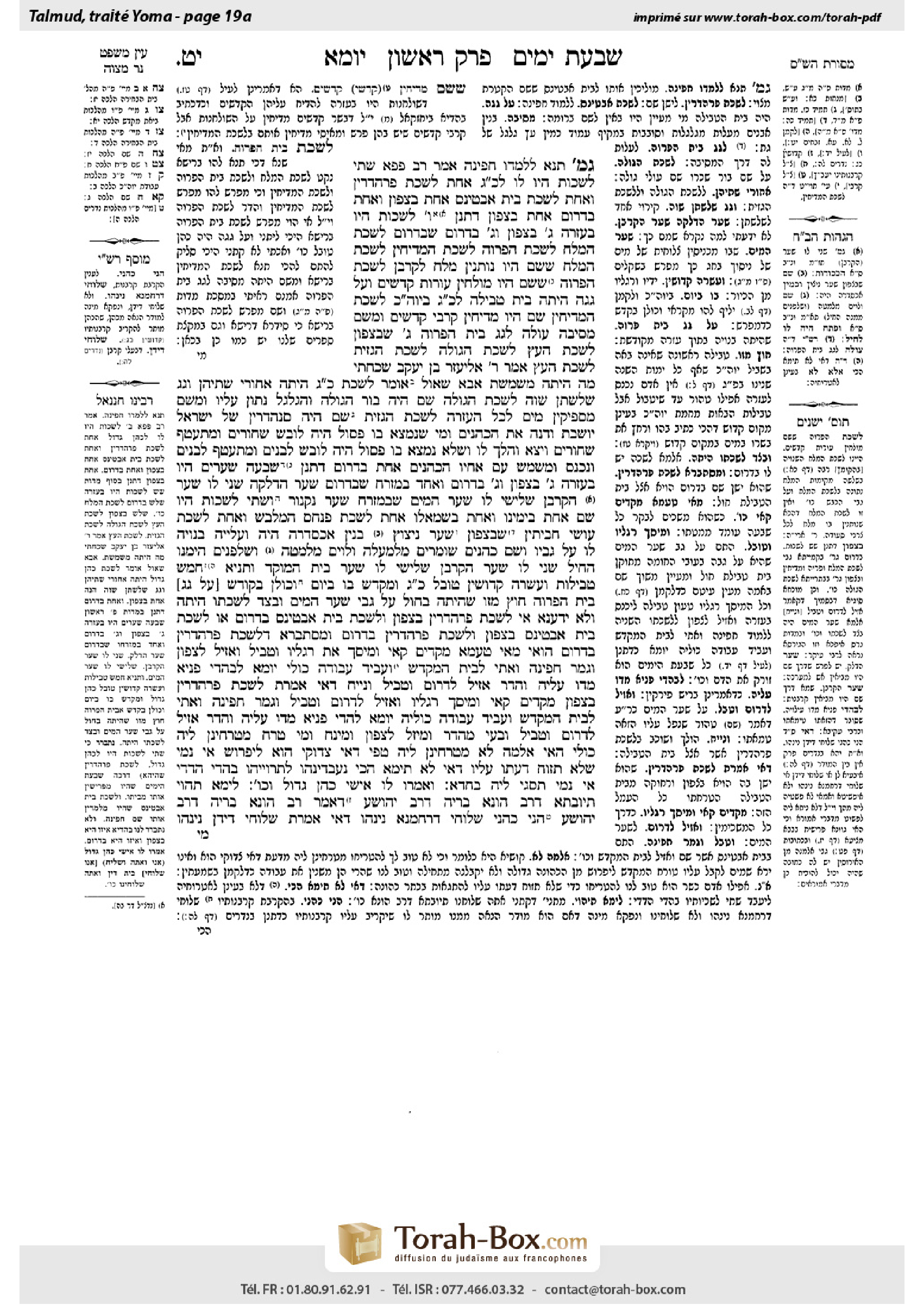
This page of Yoma includes the Aramaic text, an English translation and an AI-generated French translation, alongside the scan above.
יומא י״ט א · Aramaic and Hebrew text
גְּמָ׳ תָּנָא: לְלַמְּדוֹ חֲפִינָה. אָמַר רַב פָּפָּא: שְׁתֵּי לְשָׁכוֹת הָיוּ לוֹ לְכֹהֵן גָּדוֹל, אַחַת לִשְׁכַּת פַּרְהֶדְרִין וְאַחַת לִשְׁכַּת בֵּית אַבְטִינָס. אַחַת בַּצָּפוֹן וְאַחַת בַּדָּרוֹם. אַחַת בַּצָּפוֹן, דִּתְנַן: שֵׁשׁ לְשָׁכוֹת הָיוּ בָּעֲזָרָה, שָׁלֹשׁ בַּצָּפוֹן וְשָׁלֹשׁ בַּדָּרוֹם,
שֶׁבַּדָּרוֹם: לִשְׁכַּת הַמֶּלַח, לִשְׁכַּת הַפַּרְוָה, לִשְׁכַּת הַמְּדִיחִין. לִשְׁכַּת הַמֶּלַח — שֶׁשָּׁם הָיוּ נוֹתְנִין מֶלַח לַקׇּרְבָּן, לִשְׁכַּת הַפַּרְוָה — שֶׁשָּׁם הָיוּ מוֹלְחִין עוֹרוֹת קָדָשִׁים. וְעַל גַּגָּהּ הָיְתָה בֵּית טְבִילָה לְכֹהֵן גָּדוֹל בְּיוֹם הַכִּפּוּרִים. לִשְׁכַּת הַמְּדִיחִין — שָׁם הָיוּ מְדִיחִין קִרְבֵי קָדָשִׁים. וּמִשָּׁם מְסִיבָּה עוֹלֶה לְגַג בֵּית הַפַּרְוָה.
שָׁלֹשׁ שֶׁבַּצָּפוֹן: לִשְׁכַּת הָעֵץ, לִשְׁכַּת הַגּוֹלָה, לִשְׁכַּת הַגָּזִית. לִשְׁכַּת הָעֵץ, אָמַר רַבִּי אֱלִיעֶזֶר בֶּן יַעֲקֹב: שָׁכַחְתִּי מֶה הָיְתָה מְשַׁמֶּשֶׁת. אַבָּא שָׁאוּל אוֹמֵר: לִשְׁכַּת כֹּהֵן גָּדוֹל הָיְתָה אֲחוֹרֵי שְׁתֵּיהֶן, וְגַג שְׁלׇשְׁתָּן שָׁוֶה.
לִשְׁכַּת הַגּוֹלָה — שָׁם הָיָה בּוֹר הַגּוֹלָה, וְהַגַּלְגַּל נָתוּן עָלָיו, וּמִשָּׁם מַסְפִּיקִין מַיִם לְכׇל הָעֲזָרָה. לִשְׁכַּת הַגָּזִית — שָׁם הָיְתָה סַנְהֶדְרִין שֶׁל יִשְׂרָאֵל יוֹשֶׁבֶת וְדָנָה אֶת הַכֹּהֲנִים, וּמִי שֶׁנִּמְצָא בּוֹ פְּסוּל, הָיָה לוֹבֵשׁ שְׁחוֹרִים וּמִתְעַטֵּף שְׁחוֹרִים וְיָצָא וְהָלַךְ לוֹ. וְשֶׁלֹּא נִמְצָא בּוֹ פְּסוּל, הָיָה לוֹבֵשׁ לְבָנִים וּמִתְעַטֵּף לְבָנִים וְנִכְנָס וּמְשַׁמֵּשׁ עִם אֶחָיו הַכֹּהֲנִים.
אַחַת בַּדָּרוֹם, דִּתְנַן: שִׁבְעָה שְׁעָרִים הָיוּ בָּעֲזָרָה, שָׁלֹשׁ בַּצָּפוֹן וְשָׁלֹשׁ בַּדָּרוֹם וְאֶחָד בַּמִּזְרָח. שֶׁבַּדָּרוֹם: שַׁעַר הַדְלָקָה, שֵׁנִי לוֹ — שַׁעַר הַקָּרְבָּן, שְׁלִישִׁי לוֹ — שַׁעַר הַמַּיִם. שֶׁבַּמִּזְרָח: שַׁעַר נִקָּנוֹר, וּשְׁתֵּי לְשָׁכוֹת הָיוּ שָׁם אַחַת בִּימִינוֹ וְאַחַת בִּשְׂמֹאלוֹ, אַחַת לִשְׁכַּת פִּנְחָס הַמַּלְבִּישׁ, וְאַחַת לִשְׁכַּת עוֹשֵׂי חֲבִיתִּין.
שֶׁבַּצָּפוֹן: שַׁעַר נִיצוֹץ, בִּנְיַן אַכְסַדְרָה הָיָה, וַעֲלִיָּיה בְּנוּיָה לוֹ עַל גַּבָּיו, וְשָׁם כֹּהֲנִים שׁוֹמְרִים מִלְמַעְלָה, וּלְוִיִּם מִלְּמַטָּה. וְשֶׁלִּפְנִים הֵימֶנּוּ הַחֵיל. שֵׁנִי לוֹ — שַׁעַר הַקָּרְבָּן, שְׁלִישִׁי לוֹ — שַׁעַר בֵּית הַמּוֹקֵד.
וְתַנְיָא: חָמֵשׁ טְבִילוֹת וַעֲשָׂרָה קִדּוּשִׁין טוֹבֵל כֹּהֵן גָּדוֹל וּמְקַדֵּשׁ בּוֹ בַּיּוֹם, וְכוּלָּן בַּקּוֹדֶשׁ, [עַל גַּג] בֵּית הַפַּרְוָה. חוּץ מִזּוֹ שֶׁהָיְתָה בַּחוֹל, עַל גַּבֵּי שַׁעַר הַמַּיִם, וּבְצַד לִשְׁכָּתוֹ הָיְתָה.
וְלָא יָדַעְנָא אִי לִשְׁכַּת פַּרְהֶדְרִין בַּצָּפוֹן וְלִשְׁכַּת בֵּית אַבְטִינָס בַּדָּרוֹם, אוֹ לִשְׁכַּת בֵּית אַבְטִינָס בַּצָּפוֹן וְלִשְׁכַּת פַּרְהֶדְרִין בַּדָּרוֹם. וּמִסְתַּבְּרָא דְּלִשְׁכַּת פַּרְהֶדְרִין בַּדָּרוֹם הֲוַאי.
מַאי טַעְמָא? מַקְדֵּים קָאֵי וּמֵיסֵךְ אֶת רַגְלָיו וְטָבֵיל, וְאָזֵיל לַצָּפוֹן וְגָמַר חֲפִינָה וְאָתֵי לְבֵית הַמִּקְדָּשׁ וְעָבֵיד עֲבוֹדָה כּוּלֵּי יוֹמָא. לְבַהֲדֵי פַּנְיָא מַדּוּ עֲלֵיהּ, וַהֲדַר אָזֵיל לַדָּרוֹם וְטָבֵיל וְנָיַיח.
דְּאִי אָמְרַתְּ לִשְׁכַּת פַּרְהֶדְרִין בַּצָּפוֹן. מַקְדֵּים קָאֵי וּמֵיסֵךְ רַגְלָיו, וְאָזֵיל לַדָּרוֹם וְטָבֵיל וְגָמַר חֲפִינָה וְאָתֵי לְבֵית הַמִּקְדָּשׁ וְעָבֵיד עֲבוֹדָה כּוּלֵּיהּ יוֹמָא, לַהֲדֵי פַּנְיָא מַדּוּ עֲלֵיהּ, וַהֲדַר אָזֵיל לַדָּרוֹם וְטָבֵיל, וּבָעֵי מֶהְדַּר וּמֵיזַל לַצָּפוֹן וּמֵינַח — וּמִי (טָרַח) מַטְרְחִינַן לֵיהּ כּוּלֵּי הַאי?
אַלְּמָה לָא? מַטְרְחִינַן לֵיהּ טְפֵי, דְּאִי צַדּוּקִי הוּא לִיפְרוֹשׁ.
אִי נָמֵי, שֶׁלֹּא תָּזוּחַ דַּעְתּוֹ עָלָיו. דְּאִי לָא תֵּימָא הָכִי, נַעְבְּדִינְהוּ לְתַרְוַיְיהוּ בַּהֲדֵי הֲדָדֵי, אִי נָמֵי תִּסְגֵּי לֵיהּ בַּחֲדָא.
וְאָמְרוּ לוֹ אִישִׁי כֹּהֵן גָּדוֹל וְכוּ׳. לֵימָא תִּהְוֵי תְּיוּבְתָּא דְּרַב הוּנָא בְּרֵיהּ דְּרַב יְהוֹשֻׁעַ. דְּאָמַר רַב הוּנָא בְּרֵיהּ דְּרַב יְהוֹשֻׁעַ: הָנֵי כָּהֲנֵי — שְׁלוּחֵי דְרַחֲמָנָא נִינְהוּ, דְּאִי אָמְרַתְּ שְׁלוּחֵי דִידַן נִינְהוּ
Yoma 19a · English translation
GEMARA: A tanna taught: The Sages took the High Priest to the House of Avtinas, where the incense was prepared, to teach him the method of taking handfuls of incense, which is a difficult and complex skill. Rav Pappa said: The High Priest had two chambers. One was the Parhedrin chamber and one was the Chamber of the House of Avtinas. One of them was in the north of the courtyard, and one was in the south. The Gemara explains: One was in the north, as we learned in the mishna: There were six chambers in the Israelite courtyard, three in the north and three in the south.
The chambers in the south were the Chamber of the Salt, the Chamber of the Parva, and the Chamber of the Rinsers. The Gemara explains the function performed in each chamber. The Chamber of the Salt was where the priests would place the salt for the offering in storage The Chamber of the Parva, the hides, was where they salted the consecrated hides that belonged to the priests, to prevent them from spoiling. And on the roof of that chamber was the Hall of Immersion for the High Priest for Yom Kippur. The Chamber of the Rinsers was where they would rinse the innards of consecrated animals, which were not taken up to the altar while dirty or with undigested food remaining in them. From there a circular staircase ascended to the roof of the Chamber of the Parva.
The three chambers in the north of the courtyard were the Chamber of the Wood, the Chamber of the Exile, and the Chamber of Hewn Stone. With regard to the Chamber of the Wood, Rabbi Eliezer ben Ya’akov, who is the tanna of the mishnayot in tractate Middot in which this mishna appears, said: I forgot what purpose that chamber would serve. Abba Shaul says: The High Priest’s chamber was behind the two chambers, the Chamber of the Exile and the Chamber of Hewn Stone, and the roofs of all three of them were level. As the three were attached, they shared a roof.
In the Chamber of the Exile there was the well excavated by those returning from exile, for which the chamber was named, and the wheel with which water was drawn was positioned over it. And from there, they would supply water for use in the entire Temple courtyard for washing and rinsing. In the Chamber of Hewn Stone, there the great Sanhedrin of Israel convened and judged whether the priests were fit for service. A priest in whom a disqualification was detected due to a blemish or lineage would wear black and would wrap himself in black in a display of sorrow and mourning and would emerge from the Temple and go on his way, because he was not fit for service as a priest. And any priest in whom a disqualification was not found would wear white and wrap himself in white in a display of joy and would enter and serve with his fellow priests.
In any event, it was taught that there was a chamber of the High Priest in the north of the courtyard, and there is proof that he also had one chamber in the south of the courtyard, as we learned in a mishna: Seven gates were in the Temple courtyard, three in the north and three in the south and one in the east. The gates in the south were the Gate of Fire; second to it was the Gate of the Offering; third to it was the Gate of the Water. The gate that was in the east was called the Gate of Nicanor, and two chambers were there next to the Gate of Nicanor, one to its right and one to its left. One was the Chamber of Pineḥas the Dresser, where the priestly vestments were stored, and one was the Chamber of the Preparers of the Griddle-Cake Offering, where the daily griddle-cake offering was prepared on behalf of the High Priest.
The gates that were in the north: The first was the Gate of the Spark, which was a portico building, meaning it had a roof but was not completely closed on every side. And there was a second story built atop it, and there the honor guard of the Temple stood, with the priests guarding from above and the Levites from below. Inside of this gate was the rampart, and an opening led from the gate to the rampart. Second to this gate was the Gate of the Offering; third to it was the Gate of the Hall of the Hearth.
And it was taught in a baraita: The High Priest would perform five immersions and ten sanctifications of his hands and feet on that day, Yom Kippur. And each of these was performed in the sacred area of the courtyard, on the roof of the Hall of the Parva, except for this first immersion, which was performed in the non-sacred area outside the courtyard. The first immersion was not unique to Yom Kippur but was performed every day by any priest entering the Temple. That immersion was performed on the roof of the Gate of the Water, and that gate was alongside his chamber. Apparently, the High Priest had a chamber next to the Gate of the Water, which was in the south of the courtyard.
The High Priest had use of two chambers, but we do not know whether the Parhedrin chamber was in the north and the Chamber of the House of Avtinas was in the south, or the Chamber of the House of Avtinas was in the north and the Parhedrin chamber was in the south. And, however, it is reasonable to say that the Parhedrin chamber was in the south and the High Priest slept there.
What is the reason for that assumption? Because if that is the case, the High Priest arises early every morning of the seven days of sequestering and he covers his legs, a euphemism for defecating, and immerses alongside his chamber, which was in the south. And then he walks to the north of the courtyard to the second chamber, which is the Chamber of the House of Avtinas, and learns there the method of taking handfuls. And then he comes to the Temple and performs the service for the entire day. Toward the evening they sprinkle purification water upon him, and he then walks back to the south and immerses again alongside his chamber and rests in his chamber.
As, if you say that the Chamber of Parhedrin was in the north, this would mean that the High Priest would be forced to exert himself and walk significant distances. According to this understanding, he arises early, and he covers his legs. However, since it was taught in the baraita that the place of his immersion was in the south, he then walks to the south and immerses. And then he learns the method of taking handfuls. And then he comes to the Temple and performs the service for the entire day. Toward the evening they sprinkle purification water upon him, and he then walks back to the south and immerses, and then he needs to walk back to the north and rest. Do we impose upon him to that extent? Rather, it is reasonable to say that the Parhedrin chamber, the High Priest’s private chamber, was in the south, which would limit the distance that he needed to walk.
The Gemara rejects this reasoning: Why not impose upon him? On the contrary, we impose upon him even more, so that if he is a Sadducee, he will retire. As he is not a God-fearing person, he would prefer to walk away rather than subject himself to that added exertion. That is a desirable result, ridding the High Priesthood of a Sadducee.
Or, alternatively, there is even value in imposing on a God-fearing Pharisee High Priest, in order that he will not become haughty in his lofty position. Since he is occupied in performing his task, he does not have leisure to be impressed with his elevated status. As, if you do not say that it is an intentional attempt to impose upon him, let us establish both of the chambers of the High Priest next to one another; or, alternatively, one chamber would be sufficient for him. From the fact that neither of these alternatives is adopted, it is apparently an intentional attempt to impose upon him, and there is no proof as to the location of either of the chambers of the High Priest.
§ It was taught in the mishna that the Elders said to him: My Master, High Priest. We are agents of the court, and you are our agent and the agent of the court. The Gemara suggests: Let us say that this is a conclusive refutation of the opinion of Rav Huna, son of Rav Yehoshua, as Rav Huna, son of Rav Yehoshua, said: These priests who sacrifice the offerings are the agents of the Merciful One. They are not agents representing the Jewish people but are agents representing God, as He commanded them to perform the service. Proof is cited for this opinion: As, if you say they are our agents,
Yoma 19a · Traduction française (IA)
GUEMARA : Un tanna a enseigné : Les Sages conduisirent le grand prêtre à la Maison d’Avtinas, où l’on préparait l’encens, afin de lui enseigner la technique consistant à en prendre une poignée, une opération difficile et complexe. Rav Pappa dit : Le grand prêtre disposait de deux chambres. L’une était la chambre de Parhedrin et l’autre, la chambre de la Maison d’Avtinas. L’une se trouvait au nord de la cour et l’autre au sud. La Guemara explique : L’une se trouvait au nord, comme nous l’avons appris dans la Michna : Il y avait six chambres dans la cour des Israélites, trois au nord et trois au sud.
Les chambres du sud étaient la chambre du Sel, la chambre de Parva et la chambre des Rinceurs. La Guemara explique la fonction de chacune. Dans la chambre du Sel, les prêtres entreposaient le sel destiné aux offrandes. Dans la chambre de Parva, celle des peaux, ils salaient les peaux consacrées qui revenaient aux prêtres, afin d’éviter qu’elles ne s’abîment. Sur le toit de cette chambre se trouvait la salle d’immersion du grand prêtre pour Yom Kippour. Dans la chambre des Rinceurs, on rinçait les entrailles des animaux consacrés, que l’on ne portait pas sur l’autel lorsqu’elles étaient sales ou contenaient encore des aliments non digérés. De là, un escalier en colimaçon montait sur le toit de la chambre de Parva.
Les trois chambres au nord de la cour étaient la chambre du Bois, la chambre de l’Exil et la chambre de Pierre de taille. À propos de la chambre du Bois, Rabbi Eliezer ben Ya’akov, le tanna des Michnayot du traité Middot où figure cette Michna, dit : « J’ai oublié à quoi servait cette chambre. » Abba Shaul dit : « La chambre du grand prêtre se trouvait derrière les deux chambres, celle de l’Exil et celle de Pierre de taille, et les toits des trois étaient au même niveau. » Comme elles étaient contiguës, elles partageaient un toit.
Dans la chambre de l’Exil se trouvait le puits creusé par ceux qui étaient revenus de l’exil, qui avait donné son nom à la chambre, et la roue servant à puiser l’eau était installée au-dessus. De là, on fournissait l’eau nécessaire à toute la cour du Temple pour les lavages et les rinçages. Dans la chambre de Pierre de taille, le grand Sanhédrin d’Israël se réunissait et jugeait si les prêtres étaient aptes au service. Un prêtre chez qui on décelait une inaptitude en raison d’un défaut physique ou de sa lignée revêtait des vêtements noirs et s’en enveloppait, en signe de tristesse et de deuil, puis sortait du Temple et s’en allait, car il n’était pas apte au service sacerdotal. Tout prêtre chez qui aucune inaptitude n’était décelée revêtait des vêtements blancs et s’en enveloppait, en signe de joie, puis entrait et officiait avec ses compagnons prêtres.
Quoi qu’il en soit, il a été enseigné qu’il y avait une chambre du grand prêtre au nord de la cour, et il est établi qu’il en avait également une au sud de la cour, comme nous l’avons appris dans une Michna : Il y avait sept portes dans la cour du Temple, trois au nord, trois au sud et une à l’est. Les portes du sud étaient la porte du Feu ; la deuxième était la porte de l’Offrande ; la troisième était la porte de l’Eau. La porte qui se trouvait à l’est s’appelait la porte de Nicanor, et deux chambres se trouvaient à côté de la porte de Nicanor, l’une à sa droite et l’autre à sa gauche. L’une était la chambre de Pineḥas le Dresseur, où l’on entreposait les vêtements sacerdotaux ; l’autre était la chambre des préparateurs de l’offrande de galettes à la poêle, où l’on préparait, pour le grand prêtre, l’offrande quotidienne de galettes à la poêle.
Les portes qui se trouvaient au nord : la première était la porte de l’Étincelle, un édifice à portique, c’est-à-dire qu’il avait un toit, mais n’était pas entièrement fermé de tous côtés. Un étage supérieur avait été construit au-dessus ; la garde d’honneur du Temple s’y tenait, les prêtres montant la garde en haut et les lévites en bas. À l’intérieur de cette porte se trouvait le rempart, et une ouverture menait de la porte au rempart. La deuxième était la porte de l’Offrande ; la troisième était la porte de la salle du Foyer.
Et une baraïta a enseigné : Ce jour-là, Yom Kippour, le grand prêtre effectuait cinq immersions et dix sanctifications des mains et des pieds. Chacune avait lieu dans la partie sacrée de la cour, sur le toit de la salle de Parva, à l’exception de la première immersion, qui avait lieu dans la partie non sacrée, à l’extérieur de la cour. Cette première immersion n’était pas propre à Yom Kippour : tout prêtre entrant dans le Temple l’effectuait chaque jour. Elle avait lieu sur le toit de la porte de l’Eau, et cette porte se trouvait près de sa chambre. Il semble donc que le grand prêtre avait une chambre près de la porte de l’Eau, située au sud de la cour.
Le grand prêtre disposait de deux chambres, mais nous ne savons pas si la chambre de Parhedrin se trouvait au nord et la chambre de la Maison d’Avtinas au sud, ou si la chambre de la Maison d’Avtinas se trouvait au nord et celle de Parhedrin au sud. Toutefois, il est raisonnable de dire que la chambre de Parhedrin se trouvait au sud et que le grand prêtre y dormait.
Pourquoi cette supposition ? Si tel est le cas, le grand prêtre se levait tôt chaque matin pendant les sept jours de son isolement, puis se couvrait les jambes — euphémisme désignant le fait de se soulager — et s’immergeait près de sa chambre, qui se trouvait au sud. Ensuite, il se rendait au nord de la cour, à la seconde chambre, celle de la Maison d’Avtinas, et y apprenait la technique consistant à prendre une poignée. Puis il se rendait au Temple et accomplissait le service pendant toute la journée. Vers le soir, on l’aspergeait d’eau de purification ; il retournait alors au sud, s’immergeait de nouveau près de sa chambre et s’y reposait.
Car si tu dis que la chambre de Parhedrin se trouvait au nord, cela signifierait que le grand prêtre devait se fatiguer en parcourant de longues distances. Selon cette hypothèse, il se levait tôt et se couvrait les jambes. Cependant, puisque la baraïta enseigne que le lieu de son immersion se trouvait au sud, il s’y rendait ensuite pour s’immerger. Puis il apprenait la technique consistant à prendre une poignée. Ensuite, il se rendait au Temple et accomplissait le service pendant toute la journée. Vers le soir, on l’aspergeait d’eau de purification ; il retournait alors au sud et s’immergeait, puis devait repartir au nord pour se reposer. Lui imposerait-on un tel effort ? Il est donc raisonnable de dire que la chambre de Parhedrin, la chambre privée du grand prêtre, se trouvait au sud, ce qui limitait la distance qu’il devait parcourir.
La Guemara rejette ce raisonnement : Pourquoi ne pas le lui imposer ? Au contraire, on lui impose même davantage, afin que, s’il est sadducéen, il renonce à sa fonction. Comme il ne craint pas Dieu, il préférerait s’en aller plutôt que de se soumettre à cet effort supplémentaire. Ce serait un résultat souhaitable : débarrasser la grande prêtrise d’un sadducéen.
Ou bien, imposer davantage d’efforts à un grand prêtre pharisien craignant Dieu présente même un avantage : cela l’empêche de s’enorgueillir de sa haute fonction. Occupé à accomplir sa tâche, il n’a pas le loisir de se laisser impressionner par son statut élevé. En effet, si l’on ne suppose pas qu’il s’agit d’une volonté délibérée de lui imposer des efforts, installons les deux chambres du grand prêtre l’une à côté de l’autre ; ou bien, une seule chambre lui suffirait. Puisque ni l’une ni l’autre de ces solutions n’a été adoptée, il semble que l’on ait délibérément voulu lui imposer des efforts, et rien ne permet de prouver où se trouvait l’une ou l’autre des chambres du grand prêtre.
§ Il a été enseigné dans la Michna que les Anciens lui dirent : « Mon maître, grand prêtre, nous sommes les délégués du tribunal, et tu es notre délégué ainsi que celui du tribunal. » La Guemara propose : Disons que cela constitue une réfutation concluante de l’opinion de Rav Houna, fils de Rav Yehoshoua, car Rav Houna, fils de Rav Yehoshoua, a dit : « Ces prêtres qui offrent les sacrifices sont les délégués du Miséricordieux. » Ils ne sont pas les délégués du peuple juif, mais ceux de Dieu, puisqu’Il leur a ordonné d’accomplir le service. Une preuve est apportée à cette opinion : car, si tu dis qu’ils sont nos délégués,
Traduction française générée par IA à partir de l’édition anglaise de Sefaria. Vérifie toujours un passage avec le texte source.
Text from Sefaria: William Davidson Edition - Vocalized Aramaic (CC BY NC); William Davidson Edition - English (CC BY NC).