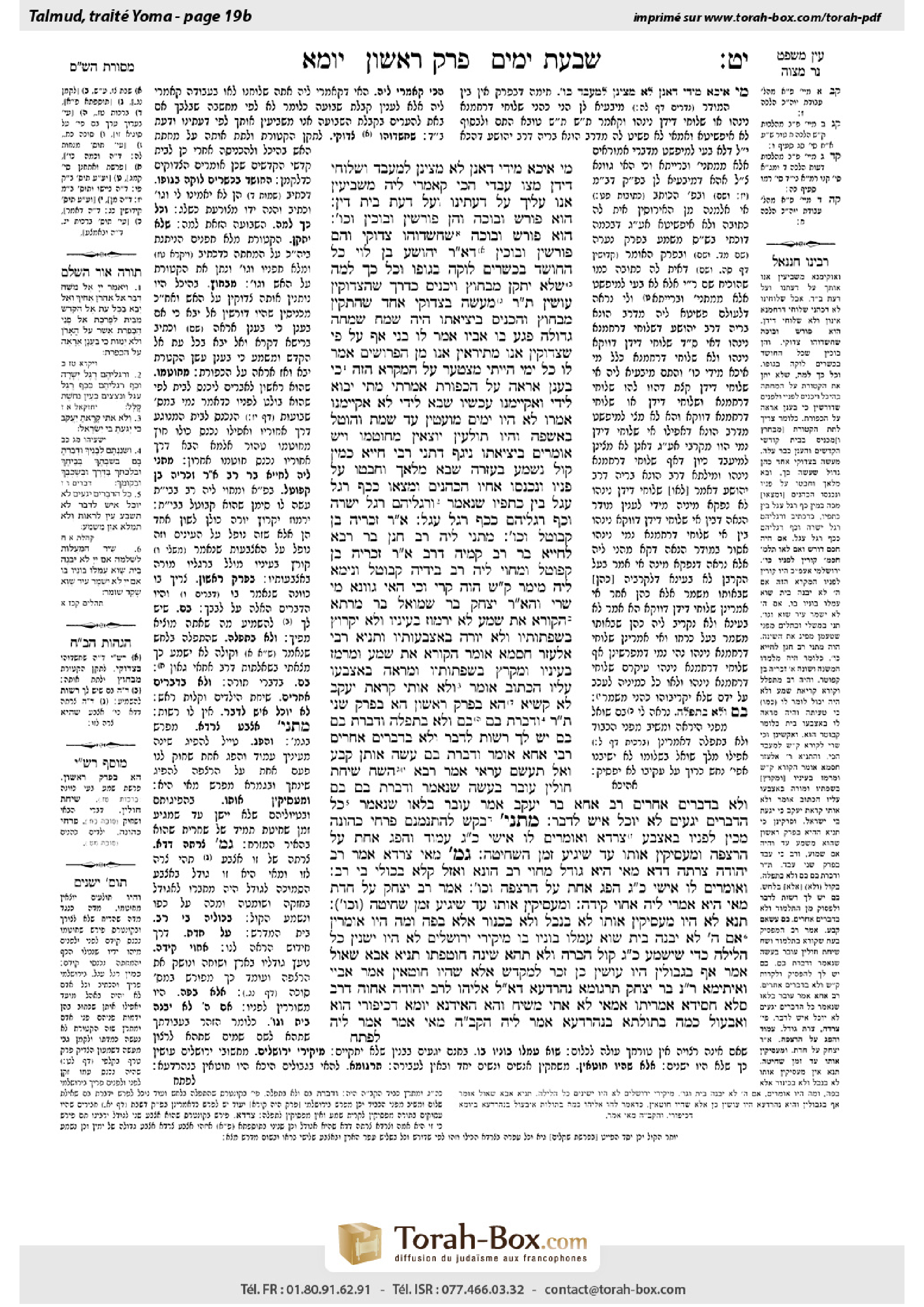
Yoma 19b: Talmud study for Daf Yomi
Daf Yomi is the daily study of one Talmud folio. Explore 37 tractates with scans, Hebrew text, Sefaria English and AI-generated French translations where annotated.
Passage selection and English or AI-generated French translation are available where the scan has annotations. Daf Study is independent of Torah-Box and Sefaria.
Browse Yoma · יומא · All tractatesYoma 19b text and translations
This page of Yoma includes the Aramaic text, an English translation and an AI-generated French translation, alongside the scan above.
יומא י״ט ב · Aramaic and Hebrew text
מִי אִיכָּא מִידֵּי דַּאֲנַן לָא מָצֵינַן לְמֶעְבַּד, וּשְׁלוּחֵי דִידַן מָצוּ עָבְדִי? הָכִי קָאָמְרִי לֵיהּ: מַשְׁבִּיעִין אָנוּ עָלֶיךָ עַל דַּעְתֵּינוּ וְעַל דַּעַת בֵּית דִּין.
הוּא פּוֹרֵשׁ וּבוֹכֶה וְהֵן פּוֹרְשִׁין וּבוֹכִין וְכוּ׳. הוּא פּוֹרֵשׁ וּבוֹכֶה — שֶׁחֲשָׁדוּהוּ צַדּוּקִי, וְהֵם פּוֹרְשִׁין וּבוֹכִין — דְּאָמַר רַבִּי יְהוֹשֻׁעַ בֶּן לֵוִי: כׇּל הַחוֹשֵׁד בִּכְשֵׁרִים לוֹקֶה בְּגוּפוֹ.
וְכׇל כָּךְ לָמָּה? שֶׁלֹּא יְתַקֵּן מִבַּחוּץ וְיַכְנִיס, כְּדֶרֶךְ שֶׁהַצַּדּוּקִין עוֹשִׂין.
תָּנוּ רַבָּנַן: מַעֲשֶׂה בְּצַדּוּקִי אֶחָד שֶׁהִתְקִין מִבַּחוּץ וְהִכְנִיס. בִּיצִיאָתוֹ הָיָה שָׂמֵחַ שִׂמְחָה גְּדוֹלָה. פָּגַע בּוֹ אָבִיו, אָמַר לוֹ: בְּנִי, אַף עַל פִּי שֶׁצַּדּוּקִין אָנוּ, מִתְיָרְאִין אָנוּ מִן הַפְּרוּשִׁים. אָמַר לוֹ: כׇּל יָמַי הָיִיתִי מִצְטַעֵר עַל הַמִּקְרָא הַזֶּה: ״כִּי בֶּעָנָן אֵרָאֶה עַל הַכַּפּוֹרֶת״, אָמַרְתִּי: מָתַי יָבוֹא לְיָדִי וַאֲקַיְּימֶנּוּ, עַכְשָׁיו שֶׁבָּא לְיָדִי — לֹא אֲקַיְּימֶנּוּ?!
אָמְרוּ: לֹא הָיוּ יָמִים מוּעָטִין עַד שֶׁמֵּת וְהוּטַל בָּאַשְׁפָּה, וְהָיוּ תּוֹלָעִין יוֹצְאִין מֵחוֹטְמוֹ. וְיֵשׁ אוֹמְרִים: בִּיצִיאָתוֹ נִיגַּף, דְּתָנֵי רַבִּי חִיָּיא: כְּמִין קוֹל נִשְׁמַע בַּעֲזָרָה שֶׁבָּא מַלְאָךְ וַחֲבָטוֹ עַל פָּנָיו. וְנִכְנְסוּ אֶחָיו הַכֹּהֲנִים וּמָצְאוּ כְּכַף רֶגֶל עֵגֶל בֵּין כְּתֵפָיו, שֶׁנֶּאֱמַר: ״וְרַגְלֵיהֶם רֶגֶל יְשָׁרָה וְכַף רַגְלֵיהֶם כְּכַף רֶגֶל עֵגֶל״.
אָמַר רַבִּי זְכַרְיָה בֶּן קְבוּטָל וְכוּ׳. מַתְנֵי לֵיהּ רַב חָנָן בַּר רָבָא לְחִיָּיא בַּר רַב קַמֵּיהּ דְּרַב ״אָמַר רַבִּי זְכַרְיָה בֶּן קְפוּטָל״, וּמַחְוֵי לֵיהּ רַב בִּידֵיהּ ״קְבוּטָל״. וְנֵימָא לֵיהּ מֵימָר! קְרִיאַת שְׁמַע הֲוָה קָרֵי.
וְכִי הַאי גַּוְונָא מִי שְׁרֵי? וְהָא אָמַר רַבִּי יִצְחָק בַּר שְׁמוּאֵל בַּר מָרְתָּא: הַקּוֹרֵא אֶת שְׁמַע לֹא יִרְמוֹז בְּעֵינָיו, וְלֹא יִקְרוֹץ בְּשִׂפְתוֹתָיו, וְלֹא יוֹרֶה בְּאֶצְבְּעוֹתָיו. וְתַנְיָא, רַבִּי אֶלְעָזָר חַסָּמָא אוֹמֵר: הַקּוֹרֵא אֶת שְׁמַע וּמְרַמֵּז בְּעֵינָיו, וּמְקָרֵץ בְּשִׂפְתוֹתָיו, וּמַרְאֶה בְּאֶצְבָּעוֹ — עָלָיו הַכָּתוּב אוֹמֵר: ״וְלֹא אוֹתִי קָרָאתָ יַעֲקֹב״!
לָא קַשְׁיָא: הָא בְּפֶרֶק רִאשׁוֹן, הָא בְּפֶרֶק שֵׁנִי.
תָּנוּ רַבָּנַן: ״וְדִבַּרְתָּ בָּם״, בָּם — וְלֹא בִּתְפִלָּה. ״וְדִבַּרְתָּ בָּם״, בָּם יֵשׁ לְךָ רְשׁוּת לְדַבֵּר, וְלֹא בִּדְבָרִים אֲחֵרִים.
רַבִּי אַחָא אוֹמֵר: ״וְדִבַּרְתָּ בָּם״, עֲשֵׂה אוֹתָן קֶבַע וְאַל תַּעֲשֵׂם עֲרַאי. אָמַר רָבָא: הַשָּׂח שִׂיחַת חוּלִּין — עוֹבֵר בַּעֲשֵׂה, שֶׁנֶּאֱמַר: ״וְדִבַּרְתָּ בָּם״, בָּם — וְלֹא בִּדְבָרִים אֲחֵרִים. רַב אַחָא בַּר יַעֲקֹב אָמַר: עוֹבֵר בְּלָאו, שֶׁנֶּאֱמַר: ״כׇּל הַדְּבָרִים יְגֵעִים לֹא יוּכַל אִישׁ לְדַבֵּר״.
מַתְנִי׳ בִּקֵּשׁ לְהִתְנַמְנֵם, פִּרְחֵי כְהוּנָּה מַכִּין לְפָנָיו בְּאֶצְבַּע צְרָדָא, וְאוֹמְרִים לוֹ: אִישִׁי כֹּהֵן גָּדוֹל! עֲמוֹד וְהָפֵג אַחַת עַל הָרִצְפָּה. וּמַעֲסִיקִין אוֹתוֹ עַד שֶׁיַּגִּיעַ זְמַן הַשְּׁחִיטָה.
גְּמָ׳ מַאי צְרָדָא? אָמַר רַב יְהוּדָה: צָרָתַהּ דְּדָא, מַאי הִיא — גּוּדָל. מַחְוֵי רַב הוּנָא וְאָזֵל קָלָא בְּכוּלֵּי בֵּי רַב.
וְאוֹמְרִים לוֹ אִישִׁי כֹּהֵן גָּדוֹל הָפֵג אַחַת עַל הָרִצְפָּה וְכוּ׳. אָמַר רַב יִצְחָק: עַל חֲדַת. מַאי הִיא? אָמְרִי לֵיהּ: אַחְוִי קִידָּה.
וּמַעֲסִיקִין אוֹתוֹ עַד שֶׁיַּגִּיעַ זְמַן שְׁחִיטָה (וְכוּ׳). תָּנָא: לֹא הָיוּ מַעֲסִיקִין אוֹתוֹ לֹא בְּנֵבֶל וְלֹא בְּכִנּוֹר, אֶלָּא בַּפֶּה. וּמָה הָיוּ אוֹמְרִין — ״אִם ה׳ לֹא יִבְנֶה בַיִת שָׁוְא עָמְלוּ בוֹנָיו בּוֹ״.
מִיַּקִּירֵי יְרוּשָׁלַיִם לֹא הָיוּ יְשֵׁנִין כׇּל הַלַּיְלָה, כְּדֵי שֶׁיִּשְׁמַע כֹּהֵן גָּדוֹל קוֹל הֲבָרָה וְלֹא תְּהֵא שֵׁינָה חוֹטַפְתּוֹ. תַּנְיָא, אַבָּא שָׁאוּל אָמַר: אַף בִּגְבוּלִין הָיוּ עוֹשִׂין כֵּן זֵכֶר לַמִּקְדָּשׁ, אֶלָּא שֶׁהָיוּ חוֹטְאִין.
אָמַר אַבָּיֵי וְאִיתֵּימָא רַב נַחְמָן בַּר יִצְחָק: תַּרְגּוּמָא, נְהַרְדְּעָא. דַּאֲמַר לֵיהּ אֵלִיָּהוּ לְרַב יְהוּדָה אֲחוּהּ דְּרַב סַלָּא חֲסִידָא, אָמְרִיתוּ: ״אַמַּאי לָא אָתֵי מָשִׁיחַ״? וְהָא הָאִידָּנָא יוֹמָא דְכִיפּוּרֵי הוּא וְאִבְּעוּל כַּמָּה בְּתוּלָתָא בִּנְהַרְדְּעָא. אֲמַר לֵיהּ: הַקָּדוֹשׁ בָּרוּךְ הוּא מַאי אָמַר? אֲמַר לֵיהּ:
Yoma 19b · English translation
is there any matter that we are unable to perform and our agents are able to perform? The role of the agent is to perform a task on behalf of the one who commissioned him. The agent cannot perform a task that the one who commissioned him is unable to perform. Since it is prohibited for Israelites to enter the priests’ courtyard and to perform the sacrificial rites, clearly the priests are not agents representing the Israelites. The language of the mishna in which the court Elders address the High Priest as their agent apparently contradicts that understanding. The Gemara answers: This is what they say to him: We administer an oath to you according to our understanding and the understanding of the court, cautioning him that he cannot rationalize violating the oath by claiming that he took the oath based on his own interpretation. He is bound by the understanding of the court. The mishna does not address the nature of the High Priest’s agency.
§ The mishna continues: After this oath, he would leave them and cry and they would leave him and cry. The Gemara explains: He turned aside and cried due to the indignity that they suspected him of being a Sadducee; and they turned aside and cried, as Rabbi Yehoshua ben Levi said: One who suspects the innocent of indiscretion is afflicted in his body. The High Priest might in fact be beyond reproach and they may have suspected him falsely.
The Gemara asks: And why were the Elders so insistent that the High Priest take an oath? The Gemara explains: So that he would not prepare the incense and light it outside in the Sanctuary, before entering the Holy of Holies, and bring the coal pan with the incense already burning on it into the Holy of Holies in the manner that the Sadducees did. Since the High Priest is alone inside the Sanctuary and there is no way to ascertain whether he is in fact performing the service in the proper manner, the Elders insisted that he take an oath to perform it according to their instructions.
The Sages taught in the Tosefta: There was an incident involving a certain Sadducee who was appointed as High Priest, who prepared the incense outside and then brought it into the Holy of Holies. Upon his emergence he was overjoyed that he had succeeded. The father of that Sadducee met him and said to him: My son, although we are Sadducees and you performed the service in accordance with our opinion, we fear the Pharisees and do not actually implement that procedure in practice. The son said to his father: All my days I have been troubled over this verse: “For I will appear in the cloud above the Ark cover” (Leviticus 16:2). The Sadducees interpreted this verse to mean that God will appear above the Ark cover, i.e., will enter the Holy of Holies, only after the incense cloud is already there. I said: When will the opportunity become available to me, and I will fulfill it according to the Sadducee interpretation? Now that the opportunity has become available to me, will I not fulfill it?
The Sages said: Not even a few days passed until he died and was laid out in the garbage dump, and worms were coming out of his nose in punishment for his actions. And some say that he was struck as soon as he emerged from the Holy of Holies, as Rabbi Ḥiyya taught: A type of sound was heard in the Temple courtyard, as an angel came and struck him in the face. And his fellow priests came in to remove him from there and they found the likeness of a footprint of a calf between his shoulders. That is the mark left by an angel striking, as it is stated with regard to angels: “And their feet were straight feet, and the sole of their feet was like the sole of a calf’s foot” (Ezekiel 1:7).
§ It was taught in the mishna that Rabbi Zekharya ben Kevutal says: Many times I read before the High Priest from the book of Daniel. Rav Ḥanan bar Rava taught this to Ḥiyya bar Rav before Rav in the following manner: Rabbi Zekharya bar Kefutal said, and Rav demonstrated with his hand that the name should be pronounced Kevutal. The Gemara asks: Why did Rav demonstrate his point with a gesture? Let him simply say it. The Gemara answers: Rav was reciting Shema at that moment and could not interrupt Shema by speaking.
The Gemara asks: And is interrupting in a manner of that sort, by gesturing, permitted during Shema? Didn’t Rabbi Yitzḥak bar Shmuel bar Marta say: One who is reciting Shema should neither make allusions with his eyes, nor open and close his mouth with his lips to convey a message, nor gesture with his fingers? And it was taught in a baraita that Rabbi Elazar Ḥisma says: Concerning one who recites Shema and makes allusions with his eyes, or opens and closes his mouth with his lips, or gestures with his fingers, the verse says: “And you did not call out to Me, O Jacob” (Isaiah 43:22). By signaling while reciting Shema he behaves contemptuously toward God, and it is tantamount to not having recited Shema before Him. How, then, could Rav gesture while reading Shema?
The Gemara answers: This is not difficult. This prohibition to interrupt one’s recitation of Shema with a gesture applies in the course of reciting the first paragraph of Shema, which is more fundamental; that case where Rav gestured was in the course of reciting the second paragraph of Shema, where gesturing to convey a significant message is permitted.
Apropos interruptions in the course of reciting Shema, the Gemara cites a baraita in which the Sages taught: “And these words, which I command you this day, shall be upon your heart; and you shall teach them diligently unto your children, and you shall talk of them when you sit in your house, and when you walk by the way, and when you lie down, and when you arise” (Deuteronomy 6:6–7). This means that in the course of reciting them, the study of Torah and the recitation of Shema, it is permitted to interrupt to state a significant matter, but not in the course of reciting the Amida prayer, which may not be interrupted for any kind of speech. Another interpretation of the verse is: And you shall talk of them is to emphasize that it is permitted to interrupt Shema to speak these matters of Torah, but not to speak other matters that may lead to levity.
Rabbi Aḥa says: Talk of them means one must render them, the words of Torah, a permanent fixture, and not render them a temporary exercise. Rava said: One who engages in idle chatter without Torah or any particular purpose violates a positive commandment, as it is stated: And you shall talk of them; talk of them and not of other matters. Rav Aḥa bar Ya’akov said: Furthermore, one even violates a negative commandment, as it is stated: “All these matters are wearisome; no man can ever state them” (Ecclesiastes 1:8). The phrase: No man can ever state them, is understood as a prohibition against engaging in idle chatter.
MISHNA: If the High Priest sought to sleep at night, the young priests would snap the middle [tzerada] finger against the thumb before him, and they would say to him every so often: My Master, High Priest. Stand from your bed and chill yourself once on the floor and overcome your drowsiness. And they would engage him in various ways until the time would arrive to slaughter the daily offering.
GEMARA: The Gemara asks: What is the tzerada finger mentioned in the mishna? Rav Yehuda said: It is the rival [tzara] of that [da] one. Which finger is it? Tzerada is the rival of the thumb; it is the middle finger. The middle finger would be strongly positioned against the thumb, and when one separates them, the finger hits the palm, creating a sound. Rav Huna demonstrated the loud noise that could be achieved by snapping with the middle finger, and the sound traveled throughout Rav’s study hall. The sound created was loud enough to keep the High Priest awake.
It was taught in the mishna that they said to him: My Master, High Priest. Stand from your bed and chill yourself once on the floor and overcome your drowsiness. Rav Yitzḥak said that they said to the High Priest: Introduce something new. The Gemara asks: What is it that they asked him to introduce? They say to him: Demonstrate how to perform the ceremonial bowing [kidda]. This was a form of bowing that was difficult to perform, in which the High Priest was expert. The thought was that the exercise would keep him awake.
The mishna continues: And they would engage him in different ways until the time to slaughter the daily offering would arrive. It was taught: They would not occupy him with a harp or a lyre, which may not be played on a Festival, but would sing with their mouths. And what would they say? They would say this verse: “Unless the Lord builds the house, its builders labor in vain on it; unless the Lord watches over the city, the watchman keeps vigil in vain” (Psalms 127:1). The message to the High Priest was that his service must be performed for the sake of Heaven for it to be accepted by God; otherwise his efforts would be in vain.
The Gemara relates that the prominent men of Jerusalem would not sleep the entire night but instead engaged in Torah study, so that the High Priest would hear the sound of noise in the city and sleep would not overcome him in the silence of the sleeping city. It was taught in a baraita that Abba Shaul said: They would do so even in the outlying areas and stay awake all night in acknowledgment of the Temple; however, the result was that they would sin, as the men and women would participate in games together to pass the time, leading to transgression.
Abaye said, and some say it was Rav Naḥman bar Yitzḥak who said: Interpret that statement as referring to Neharde’a, as Elijah the Prophet said to Rav Yehuda, brother of Rav Salla Ḥasida: You have said and wondered: Why has the Messiah not come? Why is that surprising? Isn’t today Yom Kippur, and relations were had with several virgins in Neharde’a, as the men and women stayed awake all night and that led to promiscuity? Rav Yehuda said to him: What did the Holy One, Blessed be He, say about those sins committed by the Jewish people? He said: This is what God said:
Yoma 19b · Traduction française (IA)
Existe-t-il une chose que nous ne pouvons pas accomplir, mais que nos mandataires peuvent accomplir ? Le rôle du mandataire est d’effectuer une tâche au nom de celui qui l’a mandaté. Un mandataire ne peut pas effectuer une tâche que son mandant est incapable d’accomplir. Puisqu’il est interdit aux Israélites d’entrer dans la cour des prêtres et d’accomplir les rites sacrificiels, il est clair que les prêtres ne sont pas les mandataires des Israélites. La formulation de la Michna, où les Anciens du tribunal s’adressent au Grand Prêtre comme à leur mandataire, semble contredire cette compréhension. La Guemara répond : Voici ce qu’ils lui disent : « Nous te faisons prêter serment selon notre compréhension et celle du tribunal », afin de le mettre en garde : il ne peut pas justifier la violation de son serment en prétendant l’avoir prêté selon sa propre interprétation. Il est lié par la compréhension du tribunal. La Michna ne traite pas de la nature du mandat du Grand Prêtre.
§ La Michna poursuit : Après ce serment, il les quittait en pleurant, et eux le quittaient en pleurant. La Guemara explique : Il se retirait et pleurait parce qu’il était indigné qu’on le soupçonne d’être sadducéen ; eux se retiraient et pleuraient, car Rabbi Yehoshua ben Levi a dit : « Celui qui soupçonne à tort un innocent est frappé dans son corps. » En effet, le Grand Prêtre pouvait être irréprochable et ils avaient pu le soupçonner à tort.
La Guemara demande : Pourquoi les Anciens tenaient-ils tant à ce que le Grand Prêtre prête serment ? La Guemara explique : Pour qu’il ne prépare pas l’encens et ne l’allume pas à l’extérieur, dans le Sanctuaire, avant d’entrer dans le Saint des Saints, puis n’y apporte pas la pelle à braises avec l’encens déjà allumé, comme le faisaient les sadducéens. Puisque le Grand Prêtre est seul dans le Sanctuaire et qu’il n’y a aucun moyen de vérifier s’il accomplit effectivement le service comme il convient, les Anciens insistaient pour qu’il prête serment de l’accomplir conformément à leurs instructions.
Les Sages enseignèrent dans la Tossefta : Il arriva qu’un certain sadducéen fut nommé Grand Prêtre. Il prépara l’encens à l’extérieur, puis l’apporta dans le Saint des Saints. Lorsqu’il en sortit, il était tout heureux d’avoir réussi. Le père de ce sadducéen le rencontra et lui dit : « Mon fils, bien que nous soyons sadducéens et que tu aies accompli le service conformément à notre opinion, nous craignons les Pharisiens et ne mettons pas réellement cette procédure en pratique. » Le fils dit à son père : « Tous les jours, ce verset m’a préoccupé : “Car j’apparaîtrai dans la nuée au-dessus du propitiatoire” (Lévitique 16, 2). » Les sadducéens interprétaient ce verset comme signifiant que Dieu apparaîtrait au-dessus du propitiatoire, c’est-à-dire entrerait dans le Saint des Saints, seulement après que la nuée d’encens s’y serait déjà formée. « Je me disais : Quand cette occasion se présentera-t-elle à moi, pour que j’accomplisse le rite selon l’interprétation sadducéenne ? Maintenant que l’occasion s’est présentée, n’allais-je pas l’accomplir ? »
Les Sages dirent : Quelques jours à peine s’écoulèrent avant qu’il ne meure et qu’on ne le dépose à la décharge ; des vers sortaient de son nez en punition de ses actes. D’autres disent qu’il fut frappé dès qu’il sortit du Saint des Saints, car Rabbi Ḥiyya enseigna : Un certain bruit se fit entendre dans la cour du Temple, lorsqu’un ange vint le frapper au visage. Ses confrères prêtres entrèrent pour l’en retirer et trouvèrent entre ses épaules une marque semblable à l’empreinte d’un sabot de veau. C’est la marque laissée par le coup d’un ange, comme il est dit à propos des anges : « Leurs pieds étaient des pieds droits, et la plante de leurs pieds était comme celle d’un pied de veau » (Ézéchiel 1, 7).
§ La Michna rapportait que Rabbi Zekharya ben Kevutal disait : « Bien des fois, j’ai lu devant le Grand Prêtre dans le livre de Daniel. » Rav Ḥanan bar Rava enseigna cette parole à Ḥiyya bar Rav, devant Rav, de la manière suivante : « Rabbi Zekharya bar Kefutal a dit » — et Rav indiqua de la main que le nom devait se prononcer Kevutal. La Guemara demande : Pourquoi Rav indiqua-t-il son propos par un geste ? Qu’il le dise simplement. La Guemara répond : Rav récitait alors le Chéma et ne pouvait pas interrompre sa récitation pour parler.
La Guemara demande : Est-il permis d’interrompre le Chéma de cette manière, par un geste ? Rabbi Yitzḥak bar Shmuel bar Marta n’a-t-il pas dit : « Celui qui récite le Chéma ne doit ni faire de signes des yeux, ni ouvrir et fermer les lèvres pour transmettre un message, ni faire de gestes avec les doigts » ? Et une baraïta enseigne que Rabbi Elazar Ḥisma dit : « Au sujet de celui qui récite le Chéma et fait des signes des yeux, ou ouvre et ferme les lèvres, ou fait des gestes avec les doigts, le verset dit : “Et tu ne m’as pas invoqué, ô Jacob” » (Isaïe 43, 22). En faisant des signes pendant le Chéma, il se comporte avec mépris envers Dieu, ce qui équivaut à ne pas avoir récité le Chéma devant Lui. Comment Rav pouvait-il donc faire un geste pendant qu’il récitait le Chéma ?
La Guemara répond : Il n’y a pas de difficulté. L’interdiction d’interrompre la récitation du Chéma par un geste s’applique pendant la récitation du premier paragraphe du Chéma, qui est plus fondamental ; Rav fit son geste pendant la récitation du deuxième paragraphe du Chéma, où il est permis de faire un geste pour transmettre un message important.
À propos des interruptions pendant la récitation du Chéma, la Guemara cite une baraïta dans laquelle les Sages enseignent : « Ces paroles que je t’ordonne aujourd’hui seront dans ton cœur ; tu les enseigneras avec soin à tes enfants et tu en parleras quand tu seras dans ta maison, quand tu iras en chemin, quand tu te coucheras et quand tu te lèveras » (Deutéronome 6, 6-7). Cela signifie que, pendant la récitation de ces paroles — l’étude de la Torah et la récitation du Chéma —, il est permis de s’interrompre pour dire quelque chose d’important, mais pas pendant la récitation de la prière de la Amida, qui ne peut être interrompue par aucune parole. Une autre interprétation du verset est la suivante : « Tu en parleras » souligne qu’il est permis d’interrompre le Chéma pour parler de sujets de Torah, mais non d’autres sujets susceptibles de conduire à la légèreté.
Rabbi Aḥa dit : « Tu en parleras » signifie qu’il faut faire des paroles de Torah une occupation permanente et non un exercice temporaire. Rava dit : Celui qui se livre à des bavardages futiles, sans Torah ni but particulier, transgresse un commandement positif, comme il est dit : « Tu en parleras » — de ces paroles, et non d’autres sujets. Rav Aḥa bar Ya’akov dit : De plus, on transgresse même un commandement négatif, comme il est dit : « Toutes ces choses sont fatigantes ; nul ne peut jamais les exprimer » (Ecclésiaste 1, 8). L’expression « nul ne peut jamais les exprimer » est comprise comme une interdiction de se livrer à des bavardages futiles.
MICHNA : Si le Grand Prêtre voulait dormir pendant la nuit, les jeunes prêtres faisaient claquer devant lui le doigt du milieu [tzerada] contre le pouce et lui disaient de temps à autre : « Mon maître, Grand Prêtre, lève-toi de ton lit, rafraîchis-toi une fois sur le sol et lutte contre ta somnolence. » Ils le tenaient éveillé de diverses façons jusqu’à l’heure de l’abattage de l’offrande quotidienne.
GUEMARA : La Guemara demande : Quel est le doigt tzerada mentionné dans la Michna ? Rav Yehuda dit : C’est le rival [tzara] de celui-là [da]. De quel doigt s’agit-il ? Le tzerada est le rival du pouce : c’est le doigt du milieu. Le doigt du milieu était fermement placé contre le pouce et, lorsqu’on les séparait, il frappait la paume, produisant un son. Rav Huna montra le bruit puissant qu’on pouvait produire en faisant claquer le doigt du milieu ; le son résonna dans toute la maison d’étude de Rav. Le bruit était assez fort pour tenir le Grand Prêtre éveillé.
La Michna rapportait qu’ils lui disaient : « Mon maître, Grand Prêtre, lève-toi de ton lit, rafraîchis-toi une fois sur le sol et lutte contre ta somnolence. » Rav Yitzḥak dit qu’ils demandaient au Grand Prêtre d’innover. La Guemara demande : Que lui demandaient-ils d’innover ? Ils lui disaient : « Montre-nous comment exécuter la prosternation cérémonielle [kidda]. » C’était une forme de prosternation difficile à accomplir, que le Grand Prêtre maîtrisait. On pensait que cet exercice le maintiendrait éveillé.
La Michna poursuit : Ils le tenaient éveillé de diverses façons jusqu’à l’heure de l’abattage de l’offrande quotidienne. Il a été enseigné qu’ils ne l’occupaient pas avec une harpe ou une lyre, dont il est interdit de jouer un jour de fête, mais qu’ils chantaient de vive voix. Et que chantaient-ils ? Ils disaient ce verset : « Si l’Éternel ne bâtit la maison, ses bâtisseurs travaillent en vain ; si l’Éternel ne garde la ville, le gardien veille en vain » (Psaumes 127, 1). Le message adressé au Grand Prêtre était que son service devait être accompli pour l’amour du Ciel afin d’être agréé par Dieu ; sinon, ses efforts seraient vains.
La Guemara rapporte que les notables de Jérusalem ne dormaient pas de toute la nuit ; ils étudiaient plutôt la Torah, afin que le Grand Prêtre entende le bruit de la ville et que le sommeil ne le gagne pas dans le silence d’une ville endormie. Une baraïta enseigne qu’Abba Shaul disait : Ils faisaient de même jusque dans les localités périphériques et veillaient toute la nuit en l’honneur du Temple ; cependant, cela les conduisait au péché, car les hommes et les femmes participaient ensemble à des jeux pour passer le temps, ce qui menait à la transgression.
Abaye dit — et certains disent que c’est Rav Naḥman bar Yitzḥak qui le dit : Interprète cette déclaration comme se rapportant à Neharde’a, car Élie le Prophète dit à Rav Yehuda, frère de Rav Salla Ḥasida : « Tu as demandé, perplexe : “Pourquoi le Messie n’est-il pas venu ?” Pourquoi t’en étonner ? N’est-ce pas aujourd’hui Yom Kippour, et des relations n’ont-elles pas été entretenues avec plusieurs vierges à Neharde’a, puisque les hommes et les femmes sont restés éveillés toute la nuit, ce qui a conduit à la débauche ? » Rav Yehuda lui dit : « Qu’a dit le Saint, béni soit-Il, au sujet des péchés commis par le peuple juif ? » Il répondit : « Voici ce que Dieu a dit : »
Traduction française générée par IA à partir de l’édition anglaise de Sefaria. Vérifie toujours un passage avec le texte source.
Text from Sefaria: William Davidson Edition - Vocalized Aramaic (CC BY NC); William Davidson Edition - English (CC BY NC).