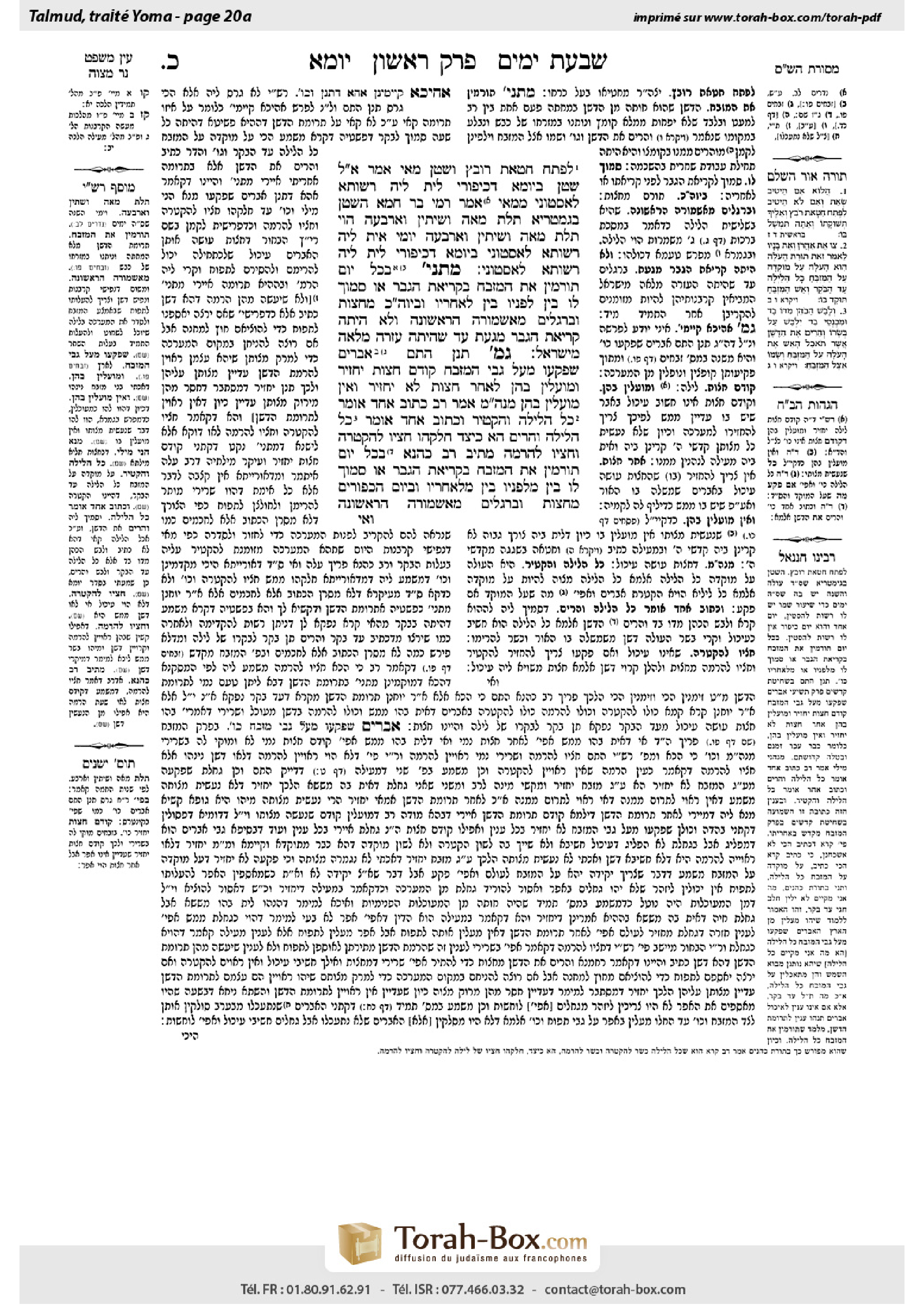
Yoma 20a: Talmud study for Daf Yomi
Daf Yomi is the daily study of one Talmud folio. Explore 37 tractates with scans, Hebrew text, Sefaria English and AI-generated French translations where annotated.
Passage selection and English or AI-generated French translation are available where the scan has annotations. Daf Study is independent of Torah-Box and Sefaria.
Browse Yoma · יומא · All tractatesYoma 20a text and translations
This page of Yoma includes the Aramaic text, an English translation and an AI-generated French translation, alongside the scan above.
יומא כ׳ א · Aramaic and Hebrew text
״לַפֶּתַח חַטָּאת רוֹבֵץ״. וְשָׂטָן מַאי אֲמַר? אֲמַר לֵיהּ: שָׂטָן בְּיוֹמָא דְכִיפּוּרֵי — לֵית לֵיהּ רְשׁוּתָא לְאַסְטוֹנֵי. מִמַּאי? אָמַר רָמֵי בַּר חָמָא: ״הַשָּׂטָן״ בְּגִמַטְרִיָּא תְּלָת מְאָה וְשִׁיתִּין וְאַרְבְּעָה הָוֵי. תְּלָת מְאָה וְשִׁיתִּין וְאַרְבְּעָה יוֹמֵי — אִית לֵיהּ רְשׁוּתָא לְאַסְטוֹנֵי. בְּיוֹמָא דְכִיפּוּרֵי — לֵית לֵיהּ רְשׁוּתָא לְאַסְטוֹנֵי.
מַתְנִי׳ בְּכׇל יוֹם תּוֹרְמִין אֶת הַמִּזְבֵּחַ בִּקְרִיאַת הַגֶּבֶר אוֹ סָמוּךְ לוֹ, בֵּין לְפָנָיו בֵּין לְאַחֲרָיו, וּבְיוֹם הַכִּפּוּרִים מֵחֲצוֹת, וּבָרְגָלִים מֵאַשְׁמוּרָה הָרִאשׁוֹנָה. וְלֹא הָיְתָה קְרִיאַת הַגֶּבֶר מַגַּעַת עַד שֶׁהָיְתָה עֲזָרָה מְלֵאָה מִיִּשְׂרָאֵל.
גְּמָ׳ תְּנַן הָתָם: אֵבָרִים שֶׁפָּקְעוּ מֵעַל גַּבֵּי הַמִּזְבֵּחַ, קוֹדֶם חֲצוֹת — יַחְזִיר, וּמוֹעֲלִין בָּהֶן, לְאַחַר חֲצוֹת — לֹא יַחְזִיר, וְאֵין מוֹעֲלִין בָּהֶן.
מְנָא הָנֵי מִילֵּי? אָמַר רַב, כָּתוּב אֶחָד אוֹמֵר: ״כׇּל הַלַּיְלָה ... וְהִקְטִיר״, וְכָתוּב אֶחָד אוֹמֵר: ״כׇּל הַלַּיְלָה ... וְהֵרִים״, הָא כֵּיצַד? חַלְּקֵהוּ — חֶצְיוֹ לְהַקְטָרָה, וְחֶצְיוֹ לַהֲרָמָה.
מֵתִיב רַב כָּהֲנָא: בְּכׇל יוֹם תּוֹרְמִין אֶת הַמִּזְבֵּחַ בִּקְרִיאַת הַגֶּבֶר אוֹ סָמוּךְ לוֹ, בֵּין מִלְּפָנָיו בֵּין מִלְּאַחֲרָיו, וּבְיוֹם הַכִּפּוּרִים מֵחֲצוֹת, וּבָרְגָלִים מֵאַשְׁמוּרָה הָרִאשׁוֹנָה,
Yoma 20a · English translation
“Sin lies in waiting at the door” (Genesis 4:7), and it is no wonder that men sin. He asked him: And what did Satan the prosecutor say about their sinning? Elijah said to him: Satan, on Yom Kippur, has no license to prosecute. From where is that idea derived? Rami bar Ḥama said: The numerological value of the letters that constitute the word HaSatan is three hundred and sixty four: Heh has a value of five, sin has a value of three hundred, tet has a value of nine, and nun has a value of fifty. Three hundred and sixty-four days of the solar year, which is three hundred and sixty-five days long, Satan has license to prosecute. On the remaining day, Yom Kippur, he has no license to prosecute. Since that day is exalted above all others, there is no room for the accusations of Satan.
MISHNA: Every day the priests would remove the ashes from the altar and place them on the east side of the ramp at the crow of the rooster or adjacent to it, whether before it or after it, as there was no insistence on a precise time. And on Yom Kippur they would remove the ashes earlier, from midnight onward. And on the Festivals, the ashes were removed even earlier, at the end of the first watch. And the call of the rooster would not arrive on Festivals until the Temple courtyard was full with the Jewish people who vowed to bring offerings and would fulfill their obligations on the Festivals. Those offerings were sacrificed immediately following the daily offering.
GEMARA: We learned in a mishna there, in tractate Zevaḥim: With regard to limbs from offerings that were forced off the altar by the heat of the fire, if they fell before midnight, these limbs remain sacred; the priest should return them to the fire, and one is liable for misuse of consecrated property for deriving benefit from them. If they fell after midnight, the priest should not return them to the fire, and one is not liable for misuse of consecrated property for deriving benefit from them; they are considered like ashes.
The Gemara asks: From where are these matters derived that midnight determines the end of the burning period for limbs, after which they assume the legal status of ashes? Rav said: One verse says: “It is the burnt-offering that goes up on its firewood upon the altar all night until morning” (Leviticus 6:2) and he shall burn it, indicating that the sacrificial limbs may be burned throughout the night. And one verse says: “All night…and he shall remove the ashes” (Leviticus 6:2–3), meaning that the ashes may be removed throughout the night. How can these texts be reconciled? Rather, divide the night into two sections: Half of it for burning the limbs, and half of it for removal of the ashes.
Rav Kahana raised an objection. It was taught in the mishna: Every day the priests would remove the ashes from the altar at the crow of the rooster or adjacent to it, whether before it or after it, and on Yom Kippur from midnight, and on the Festivals from the end of the first watch.
Yoma 20a · Traduction française (IA)
« Le péché est tapi à la porte » (Genèse 4,7), et il n’est pas étonnant que les hommes pèchent. Il lui demanda : « Et que disait Satan, l’accusateur, au sujet de leurs péchés ? » Élie lui répondit : « À Yom Kippour, Satan n’a pas le droit d’accuser. » D’où tire-t-on cette idée ? Rami bar Ḥama dit : La valeur numérique des lettres qui composent le mot HaSatan est de trois cent soixante-quatre : he a pour valeur cinq, shin trois cents, tet neuf et noun cinquante. Satan a le droit d’accuser pendant trois cent soixante-quatre jours de l’année solaire, qui en compte trois cent soixante-cinq. Le jour restant, Yom Kippour, il n’a pas le droit d’accuser. Puisque ce jour est supérieur à tous les autres, il n’y a pas de place pour les accusations de Satan.
MICHNA : Chaque jour, les prêtres retiraient les cendres de l’autel et les déposaient du côté est de la rampe, au chant du coq ou à peu près à ce moment-là, avant ou après, car aucune heure précise n’était imposée. À Yom Kippour, ils retiraient les cendres plus tôt, à partir de minuit. Les jours de fête, ils les retiraient encore plus tôt, à la fin de la première veille. Les jours de fête, le chant du coq ne se faisait entendre qu’une fois le parvis du Temple rempli du peuple juif qui avait fait vœu d’apporter des sacrifices et venait s’acquitter de ses obligations à l’occasion des fêtes. Ces sacrifices étaient offerts immédiatement après le sacrifice quotidien.
GUEMARA : Nous avons appris dans une Michna du traité Zevaḥim : Si la chaleur du feu avait projeté des membres de sacrifices hors de l’autel et qu’ils étaient tombés avant minuit, ils conservaient leur sainteté ; le prêtre devait les remettre dans le feu, et quiconque en tirait profit était passible pour usage profane de biens consacrés. S’ils étaient tombés après minuit, le prêtre ne devait pas les remettre dans le feu, et quiconque en tirait profit n’était pas passible pour usage profane de biens consacrés ; ils étaient considérés comme des cendres.
La Guemara demande : D’où tire-t-on que minuit détermine la fin de la période de combustion des membres, après laquelle ils acquièrent le statut juridique de cendres ? Rav dit : Un verset dit : « C’est l’holocauste qui brûle sur son bois, sur l’autel, toute la nuit jusqu’au matin » (Lévitique 6,2), et qu’il le brûlera, ce qui indique que les membres du sacrifice peuvent brûler toute la nuit. Un autre verset dit : « Toute la nuit… et il retirera les cendres » (Lévitique 6,2-3), ce qui signifie que les cendres peuvent être retirées toute la nuit. Comment concilier ces textes ? Il faut plutôt diviser la nuit en deux parties : la moitié pour la combustion des membres et la moitié pour le retrait des cendres.
Rav Kahana souleva une objection. Il est enseigné dans la Michna : Chaque jour, les prêtres retiraient les cendres de l’autel au chant du coq ou à peu près à ce moment-là, avant ou après ; à Yom Kippour, ils les retiraient à partir de minuit, et les jours de fête, à partir de la fin de la première veille.
Traduction française générée par IA à partir de l’édition anglaise de Sefaria. Vérifie toujours un passage avec le texte source.
Text from Sefaria: William Davidson Edition - Vocalized Aramaic (CC BY NC); William Davidson Edition - English (CC BY NC).