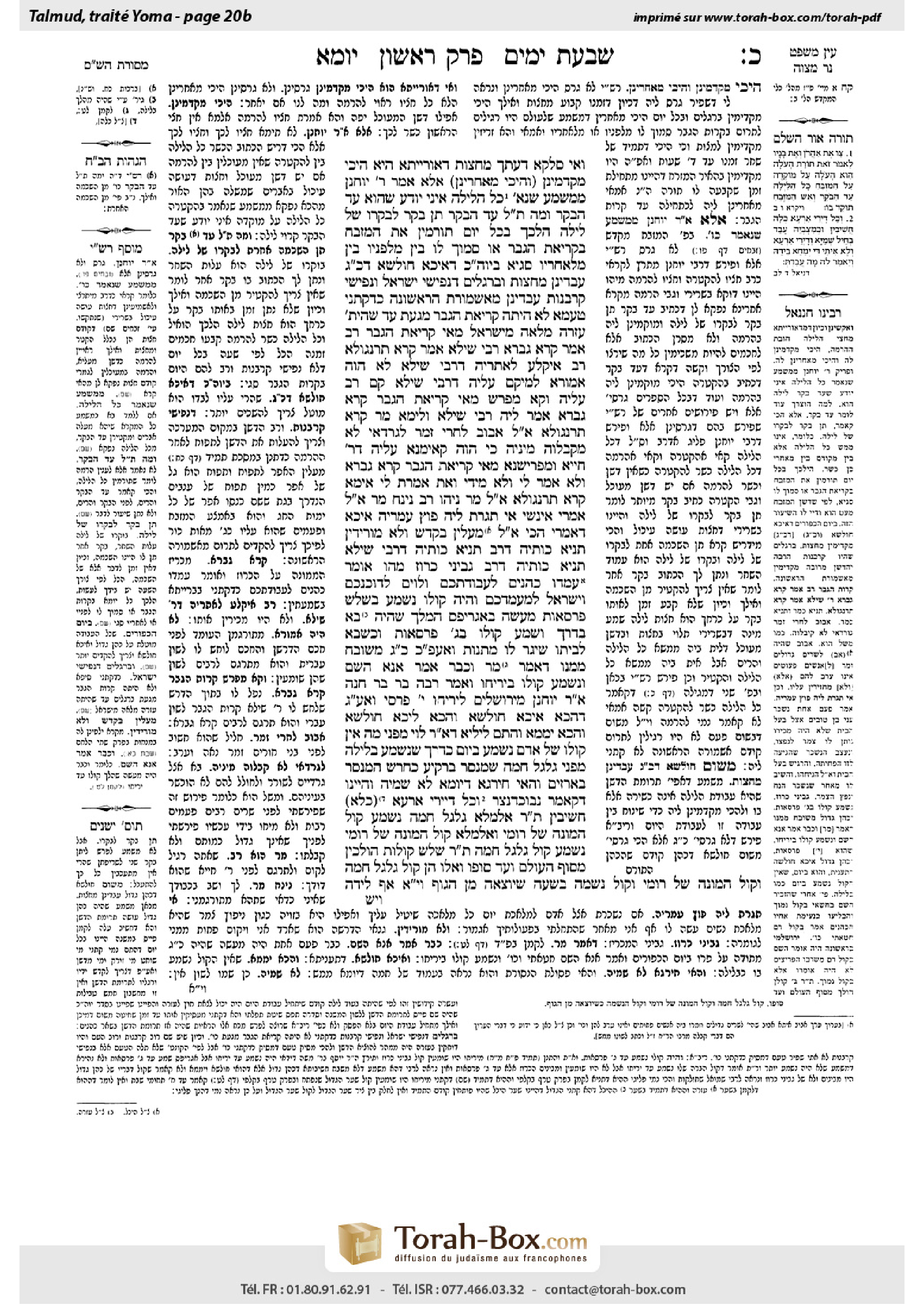
Yoma 20b: Talmud study for Daf Yomi
Daf Yomi is the daily study of one Talmud folio. Explore 37 tractates with scans, Hebrew text, Sefaria English and AI-generated French translations where annotated.
Passage selection and English or AI-generated French translation are available where the scan has annotations. Daf Study is independent of Torah-Box and Sefaria.
Browse Yoma · יומא · All tractatesYoma 20b text and translations
This page of Yoma includes the Aramaic text, an English translation and an AI-generated French translation, alongside the scan above.
יומא כ׳ ב · Aramaic and Hebrew text
וְאִי סָלְקָא דַעְתָּךְ מֵחֲצוֹת דְּאוֹרָיְיתָא הִיא, הֵיכִי מַקְדְּמִינַן (וְהֵיכִי מְאַחֲרִינַן)?
אֶלָּא אָמַר רַבִּי יוֹחָנָן: מִמַּשְׁמַע שֶׁנֶּאֱמַר: ״כׇּל הַלַּיְלָה״, אֵינִי יוֹדֵעַ שֶׁהוּא עַד הַבֹּקֶר? וּמָה תַּלְמוּד לוֹמַר ״עַד הַבֹּקֶר״ — תֵּן בֹּקֶר לְבׇקְרוֹ שֶׁל לַיְלָה.
הִלְכָּךְ, בְּכׇל יוֹם תּוֹרְמִין אֶת הַמִּזְבֵּחַ בִּקְרִיאַת הַגֶּבֶר אוֹ סָמוּךְ לוֹ, בֵּין מִלְּפָנָיו בֵּין מִלְּאַחֲרָיו — סַגִּיא. בְּיוֹם הַכִּפּוּרִים, דְּאִיכָּא חוּלְשָׁא דְּכֹהֵן גָּדוֹל — עָבְדִינַן מֵחֲצוֹת. וּבִרְגָלִים, דִּנְפִישִׁי יִשְׂרָאֵל וּנְפִישִׁי קׇרְבָּנוֹת — עָבְדִינַן מֵאַשְׁמוֹרֶת הָרִאשׁוֹנָה. כִּדְקָתָנֵי טַעְמָא: לֹא הָיְתָה קְרִיאַת הַגֶּבֶר מַגַּעַת עַד שֶׁהָיְתָה עֲזָרָה מְלֵאָה מִיִּשְׂרָאֵל.
מַאי: ״קְרִיאַת הַגֶּבֶר״? רַב אָמַר: קְרָא גַּבְרָא. רַבִּי שֵׁילָא אָמַר: קְרָא תַּרְנְגוֹלָא.
רַב אִיקְּלַע לְאַתְרֵיהּ דְּרַבִּי שֵׁילָא. לָא הֲוָה אָמוֹרָא לְמֵיקַם עֲלֵיהּ דְּרַבִּי שֵׁילָא, קָם רַב עֲלֵיהּ, וְקָא מְפָרֵשׁ: מַאי ״קְרִיאַת הַגֶּבֶר״ — קְרָא גַּבְרָא. אֲמַר לֵיהּ רַבִּי שֵׁילָא, וְלֵימָא מָר: ״קְרָא תַּרְנְגוֹלָא״? אֲמַר לֵיהּ: ״אַבּוּב לְחָרֵי — זָמַר, לְגַרְדָּאֵי — לָא מְקַבְּלוּהּ מִינֵּיהּ״.
כִּי הֲוָה קָאֵימְנָא עֲלֵיהּ דְּרַבִּי חִיָּיא וּמְפָרֵישְׁנָא: מַאי ״קְרִיאַת הַגֶּבֶר״ — קְרָא גַּבְרָא, וְלָא אֲמַר לִי וְלָא מִידֵּי. וְאַתְּ אָמְרַתְּ לִי, אֵימָא: ״קְרָא תַּרְנְגוֹלָא״. אֲמַר לֵיהּ: מָר נִיהוּ רַב? נִינַח מָר. אֲמַר לֵיהּ, אָמְרִי אִינָשֵׁי: ״אִיתְּגַרְתְּ — לֵיהּ פּוּץ עַמְרֵיהּ״. אִיכָּא דְּאָמְרִי, הָכִי אֲמַר לֵיהּ: ״מַעֲלִין בַּקֹּדֶשׁ, וְלֹא מוֹרִידִין״.
תַּנְיָא כְּוָתֵיהּ דְּרַב, תַּנְיָא כְּוָתֵיהּ דְּרַבִּי שֵׁילָא. תַּנְיָא כְּוָתֵיהּ דְּרַב: גְּבִינִי כָּרוֹז מַהוּ אוֹמֵר: ״עִמְדוּ כֹּהֲנִים לַעֲבוֹדַתְכֶם, וּלְוִיִּם לְדוּכַנְכֶם, וְיִשְׂרָאֵל לְמַעֲמַדְכֶם״. וְהָיָה קוֹלוֹ נִשְׁמָע בְּשָׁלֹשׁ פַּרְסָאוֹת.
מַעֲשֶׂה בְּאַגְרִיפַּס הַמֶּלֶךְ שֶׁהָיָה בָּא בַּדֶּרֶךְ, וְשָׁמַע קוֹלוֹ בְּשָׁלֹשׁ פַּרְסָאוֹת, וּכְשֶׁבָּא לְבֵיתוֹ שִׁיגֵּר לוֹ מַתָּנוֹת. וְאַף עַל פִּי כֵן, כֹּהֵן גָּדוֹל מְשׁוּבָּח מִמֶּנּוּ. דְּאָמַר מָר: וּכְבָר אָמַר ״אָנָא הַשֵּׁם״ וְנִשְׁמַע קוֹלוֹ בִּירִיחוֹ. וְאָמַר רַבָּה בַּר בַּר חָנָה אָמַר רַבִּי יוֹחָנָן: מִירוּשָׁלַיִם לִירִיחוֹ עֲשַׂר פַּרְסֵי.
וְאַף עַל גַּב דְּהָכָא אִיכָּא חוּלְשָׁא, וְהָכָא לֵיכָּא חוּלְשָׁא. וְהָכָא יְמָמָא, וְהָתָם לֵילְיָא.
דְּאָמַר רַבִּי לֵוִי: מִפְּנֵי מָה אֵין קוֹלוֹ שֶׁל אָדָם נִשְׁמָע בַּיּוֹם כְּדֶרֶךְ שֶׁנִּשְׁמָע בַּלַּיְלָה? מִפְּנֵי גַּלְגַּל חַמָּה שֶׁמְּנַסֵּר בָּרָקִיעַ כְּחָרָשׁ הַמְנַסֵּר בַּאֲרָזִים. וְהַאי חִירְגָּא דְיוֹמָא ״לָא״ שְׁמֵיהּ. וְהַיְינוּ דְּקָאָמַר נְבוּכַדְנֶצַּר: ״וְכׇל דָּיְירֵי אַרְעָא (כְּלָא) חֲשִׁיבִין״.
תָּנוּ רַבָּנַן: אִלְמָלֵא גַּלְגַּל חַמָּה, נִשְׁמָע קוֹל הֲמוֹנָהּ שֶׁל רוֹמִי. וְאִלְמָלֵא קוֹל הֲמוֹנָהּ שֶׁל רוֹמִי, נִשְׁמָע קוֹל גַּלְגַּל חַמָּה. תָּנוּ רַבָּנַן: שָׁלֹשׁ קוֹלוֹת הוֹלְכִין מִסּוֹף הָעוֹלָם וְעַד סוֹפוֹ, וְאֵלּוּ הֵן: קוֹל גַּלְגַּל חַמָּה, וְקוֹל הֲמוֹנָהּ שֶׁל רוֹמִי, וְקוֹל נְשָׁמָה בְּשָׁעָה שֶׁיּוֹצְאָה מִן הַגּוּף, וְיֵשׁ אוֹמְרִים: אַף לֵידָה,
Yoma 20b · English translation
And if it enters your mind to say that the time for removal of the ashes is from midnight by Torah law, how do we perform it earlier and how do we perform it later than the time established by Torah law?
Rather, Rabbi Yoḥanan said: The fact that midnight is the deadline after which the limbs may not be burned is derived from a different source. From the fact that it is stated with regard to the burning of the limbs: All night, don’t I know that it means until morning? And for what purpose, then, does the verse state: Until morning? It means: Add another morning to the morning of the night. Arise before dawn, and that is the time for removal of the ashes. Nevertheless, there is no specific hour fixed for performing this removal, and how much earlier than dawn it is performed depends on the need.
Therefore, every day the priests remove the ashes from the altar at the crow of the rooster or adjacent to it, whether before it or after it, as on a typical day removing the ashes just before dawn is sufficient. On Yom Kippur, when, due to the fact that he performs the entire day’s service, there is an issue of the weakness of the High Priest, the ashes are removed earlier and we do so from midnight. And on the Festivals, when the Jewish people in Jerusalem are numerous and the offerings that they bring to sacrifice during the Festival are numerous, the ashes are removed even earlier, and we do so from the first watch, in accordance with the reason that is taught in the mishna: And the call of the rooster would not arrive on Festivals until the Temple courtyard was full with the Jewish people.
§ The term keriat hagever, translated above as the call of the rooster, is mentioned in the mishna as an indication of a certain time. The Gemara asks: What is the meaning of the phrase keriat hagever? Rav said: It is the call of the man; the priest appointed for this task proclaimed that it was time for the priests to report for service. Rabbi Sheila said: It is the call of the rooster, which is also called gever.
Rav happened to come to the place where Rabbi Sheila was the most prominent local Torah scholar and Rav was not yet known. There was no disseminator to stand before Rabbi Sheila to disseminate his lecture to the public. Rav stood before him to disseminate the lecture, in the course of which Rabbi Sheila mentioned keriat hagever. Rav interpreted the concept for the audience and said: What is the meaning of keriat hagever? It means the call of the man. Rabbi Sheila said to him: And let the Master say it is the call of the rooster. Rav said to him, quoting a folk saying: A flute played for noblemen is music, but when played for weavers, they receive no pleasure from it, due to their lack of sophistication. Similarly, the interpretation that I disseminated was accepted by Torah scholars greater than you. You, who lack their sophistication, cannot appreciate it.
When I stood before Rabbi Ḥiyya and interpreted: What is the meaning of keriat hagever? It means the call of the man, he did not say anything to me in response, and you, Rabbi Sheila, say to me: Say it is the call of the rooster. As soon as Rabbi Sheila heard that, he knew at once who had been disseminating his lecture. He said to him: Is the Master Rav? Let the Master rest and cease disseminating my lecture, as it is beneath your dignity to serve as my assistant. Rav said to him: People say this aphorism: If you hired yourself to him, comb his wool. Once one agrees to perform a task, he should bear its less pleasing aspects and complete the job. Some say, this is what Rav said to him: One elevates to a higher level in matters of sanctity and one does not downgrade. Since the task of interpreting was undertaken by a man of my stature, it is not fitting that a lesser man will replace me. That would be a display of contempt for the Torah.
The Gemara comments: A baraita was taught in accordance with the opinion of Rav, and a baraita was taught in accordance with the opinion of Rabbi Sheila. The Gemara elaborates: A baraita was taught in accordance with the opinion of Rav: What did Gevini the Crier, who was an appointee in the Temple, say in his proclamation? Arise, priests, to your service, and Levites to your platform, and Israelites to your non-priestly watch. And the Gemara relates: His voice was so strong that it could be heard at a distance of three parasangs, slightly more than eight miles.
There was an incident involving King Agrippa, who was coming down the road and heard Gevini the Crier’s voice at a distance of three parasangs. And when the king came to his house he sent gifts to him, since he was so impressed with the man’s voice. The Gemara notes: And even so, the voice of the High Priest was stronger and superior to his, as the Master said: And there already was an incident where the High Priest recited, in his confession that accompanied the placing of hands on his bull on Yom Kippur: Please God, and his voice was heard in Jericho. And Rabba bar bar Ḥana said that Rabbi Yoḥanan said: The distance from Jerusalem to Jericho is ten parasangs.
And not only was the distance greater in the case of the High Priest than in the case of Gevini the Crier, here, there is the issue of the weakness of the High Priest due to the fast and his obligation to perform the entire service, while there, there is no issue of the weakness of Gevini. And in addition, here it was during the day, when sound does not travel as well, that the High Priest recited his confession; and there it was during the night when Gevini called the priests, Levites, and Israelites.
As Rabbi Levi said: Why is a person’s voice not heard during the day in the manner that it is during the night? It is due to the fact that the sound of the sphere of the sun traversing the sky generates noise like the noise generated by a carpenter sawing cedars, and that noise drowns out other sounds. And that sawdust that is visible during the day in the rays of the sun, la is its name. This is what Nebuchadnezzar said: “And all the inhabitants of the world are considered like la” (Daniel 4:32), i.e., all inhabitants of the earth are equivalent to specks of dust.
Apropos sounds, the Gemara cites that the Sages taught: Were it not for the sound of the sphere of the sun, the sound of the bustle of the crowds of Rome would be heard throughout the world; and were it not for the sound of the bustle of the crowds of Rome, the sound of the sun’s sphere would be heard throughout the world. And the Sages taught: Three sounds travel from the end of the world to its other end, and these are: The sound of the sphere of the sun, and the sound of the bustle of the crowds of Rome, and the sound of the soul at the moment that it leaves the body, which should be audible throughout the world. And some say: Even the sound of a woman giving birth.
Yoma 20b · Traduction française (IA)
Et si l’on envisage que, selon la Torah, le moment du retrait des cendres commence à minuit, comment peut-on le faire avant et comment peut-on le faire après l’heure fixée par la Torah ?
Mais Rabbi Yoḥanan a dit : Le fait que minuit soit l’heure limite après laquelle les membres ne peuvent plus être brûlés se déduit d’une autre source. Puisqu’il est dit au sujet de la combustion des membres : « Toute la nuit », ne sais-je pas que cela signifie jusqu’au matin ? Pourquoi le verset précise-t-il alors : « Jusqu’au matin » ? Cela signifie : ajoute un autre matin au matin de la nuit. Lève-toi avant l’aube : c’est l’heure du retrait des cendres. Néanmoins, aucune heure précise n’est fixée pour ce retrait, et le moment où il est effectué avant l’aube dépend des besoins.
C’est pourquoi, chaque jour, les prêtres retirent les cendres de l’autel au chant du coq ou à peu près à ce moment-là, avant ou après : un jour ordinaire, il suffit de retirer les cendres juste avant l’aube. À Yom Kippour, comme le Grand Prêtre accomplit tout le service de la journée et qu’il faut tenir compte de son épuisement, on retire les cendres plus tôt, dès minuit. Lors des fêtes, comme le peuple juif est nombreux à Jérusalem et que les offrandes qu’il apporte pour les sacrifices sont nombreuses, on retire les cendres encore plus tôt, dès la première veille, conformément à la raison enseignée dans la Michna : les jours de fête, le chant du coq ne survenait pas avant que la cour du Temple ne soit pleine du peuple juif.
§ L’expression keriat hagever, traduite plus haut par « le chant du coq », est mentionnée dans la Michna pour indiquer une certaine heure. La Guemara demande : Que signifie l’expression keriat hagever ? Rav dit : C’est l’appel de l’homme ; le prêtre chargé de cette tâche annonçait qu’il était temps pour les prêtres de se présenter pour le service. Rabbi Sheila dit : C’est le chant du coq, qui est également appelé gever.
Rav arriva par hasard dans un lieu où Rabbi Sheila était l’érudit en Torah le plus éminent de la région, tandis que Rav n’y était pas encore connu. Il n’y avait personne pour se tenir devant Rabbi Sheila et transmettre son enseignement au public. Rav se tint devant lui pour le faire. Au cours de son enseignement, Rabbi Sheila mentionna keriat hagever. Rav en expliqua le sens à l’auditoire et demanda : Que signifie keriat hagever ? Cela signifie l’appel de l’homme. Rabbi Sheila lui dit : Pourquoi le Maître ne dit-il pas que c’est le chant du coq ? Rav lui répondit en citant un proverbe populaire : « Une flûte jouée devant des nobles est une musique agréable, mais jouée devant des tisserands, elle ne leur procure aucun plaisir », faute de raffinement. De même, l’interprétation que j’ai transmise a été acceptée par des érudits en Torah plus éminents que toi. Toi, qui manques de leur raffinement, tu ne peux pas l’apprécier.
« Quand je me suis tenu devant Rabbi Ḥiyya et que j’ai interprété l’expression ainsi : “Que signifie keriat hagever ? Cela signifie l’appel de l’homme”, il ne m’a rien répondu. Et toi, Rabbi Sheila, tu me dis : “Dis que c’est le chant du coq” ? » Dès que Rabbi Sheila entendit cela, il comprit aussitôt qui avait transmis son enseignement. Il lui dit : « Le Maître est-il Rav ? Que le Maître se repose et cesse de transmettre mon enseignement, car il est indigne de toi d’être mon assistant. » Rav lui répondit : « On dit ce proverbe : “Si tu t’es engagé à le faire, peigne sa laine.” » Lorsqu’on accepte d’accomplir une tâche, il faut en assumer les aspects moins agréables et la mener à bien. Certains disent que Rav lui répondit ainsi : « En matière de sainteté, on s’élève à un niveau supérieur et l’on ne redescend pas. » Puisqu’un homme de mon rang a entrepris la tâche d’interpréter, il ne convient pas qu’un homme de rang inférieur me remplace. Ce serait témoigner du mépris envers la Torah.
La Guemara fait remarquer : une baraïta a été enseignée conformément à l’avis de Rav, et une autre conformément à celui de Rabbi Sheila. La Guemara précise : une baraïta a été enseignée conformément à l’avis de Rav : qu’a proclamé Gevini le Crieur, qui était chargé de cette fonction au Temple ? « Debout, prêtres, pour votre service ; lévites, pour votre estrade ; et Israélites, pour votre poste de garde non sacerdotal. » La Guemara rapporte aussi que sa voix était si puissante qu’on pouvait l’entendre à une distance de trois parasanges, soit un peu plus de huit milles.
Un jour, le roi Agrippa descendait la route et entendit la voix de Gevini le Crieur à une distance de trois parasanges. Quand le roi rentra chez lui, il lui envoya des cadeaux, tant la voix de cet homme l’avait impressionné. La Guemara fait remarquer que la voix du Grand Prêtre était pourtant encore plus puissante que la sienne, car le Maître a dit qu’il y eut un incident où le Grand Prêtre récita, dans sa confession accompagnant l’imposition des mains sur son taureau à Yom Kippour : « De grâce, ô Dieu ! », et sa voix fut entendue à Jéricho. Rabba bar bar Ḥana a dit au nom de Rabbi Yoḥanan : La distance entre Jérusalem et Jéricho est de dix parasanges.
Non seulement la distance était-elle plus grande dans le cas du Grand Prêtre que dans celui de Gevini le Crieur, mais le Grand Prêtre était en outre épuisé par le jeûne et par son obligation d’accomplir tout le service, tandis que Gevini, lui, ne souffrait d’aucune fatigue. De plus, le Grand Prêtre récita sa confession le jour, lorsque le son porte moins bien, tandis que Gevini appela les prêtres, les lévites et les Israélites pendant la nuit.
Car Rabbi Levi a dit : Pourquoi la voix d’une personne ne s’entend-elle pas le jour comme elle s’entend la nuit ? C’est parce que le bruit de la sphère du soleil qui traverse le ciel produit un son comparable à celui d’un charpentier qui scie des cèdres, et ce bruit couvre les autres sons. La sciure visible le jour dans les rayons du soleil porte le nom de la. C’est ce que dit Nabuchodonosor : « Tous les habitants du monde sont considérés comme la » (Daniel 4:32), c’est-à-dire que tous les habitants de la terre sont semblables à des grains de poussière.
À propos des sons, la Guemara rapporte ce que les Sages ont enseigné : sans le bruit de la sphère du soleil, le vacarme des foules de Rome s’entendrait dans le monde entier ; et sans le vacarme des foules de Rome, le bruit de la sphère du soleil s’entendrait dans le monde entier. Les Sages ont également enseigné : trois sons traversent le monde d’un bout à l’autre : le bruit de la sphère du soleil, le vacarme des foules de Rome et le son de l’âme au moment où elle quitte le corps, qui devrait s’entendre dans le monde entier. Certains disent : même le son d’une femme qui accouche.
Traduction française générée par IA à partir de l’édition anglaise de Sefaria. Vérifie toujours un passage avec le texte source.
Text from Sefaria: William Davidson Edition - Vocalized Aramaic (CC BY NC); William Davidson Edition - English (CC BY NC).