Yoma 21a: Talmud study for Daf Yomi
Daf Yomi is the daily study of one Talmud folio. Explore 37 tractates with scans, Hebrew text, Sefaria English and AI-generated French translations where annotated.
Passage selection and English or AI-generated French translation are available where the scan has annotations. Daf Study is independent of Torah-Box and Sefaria.
Browse Yoma · יומא · All tractatesYoma 21a text and translations
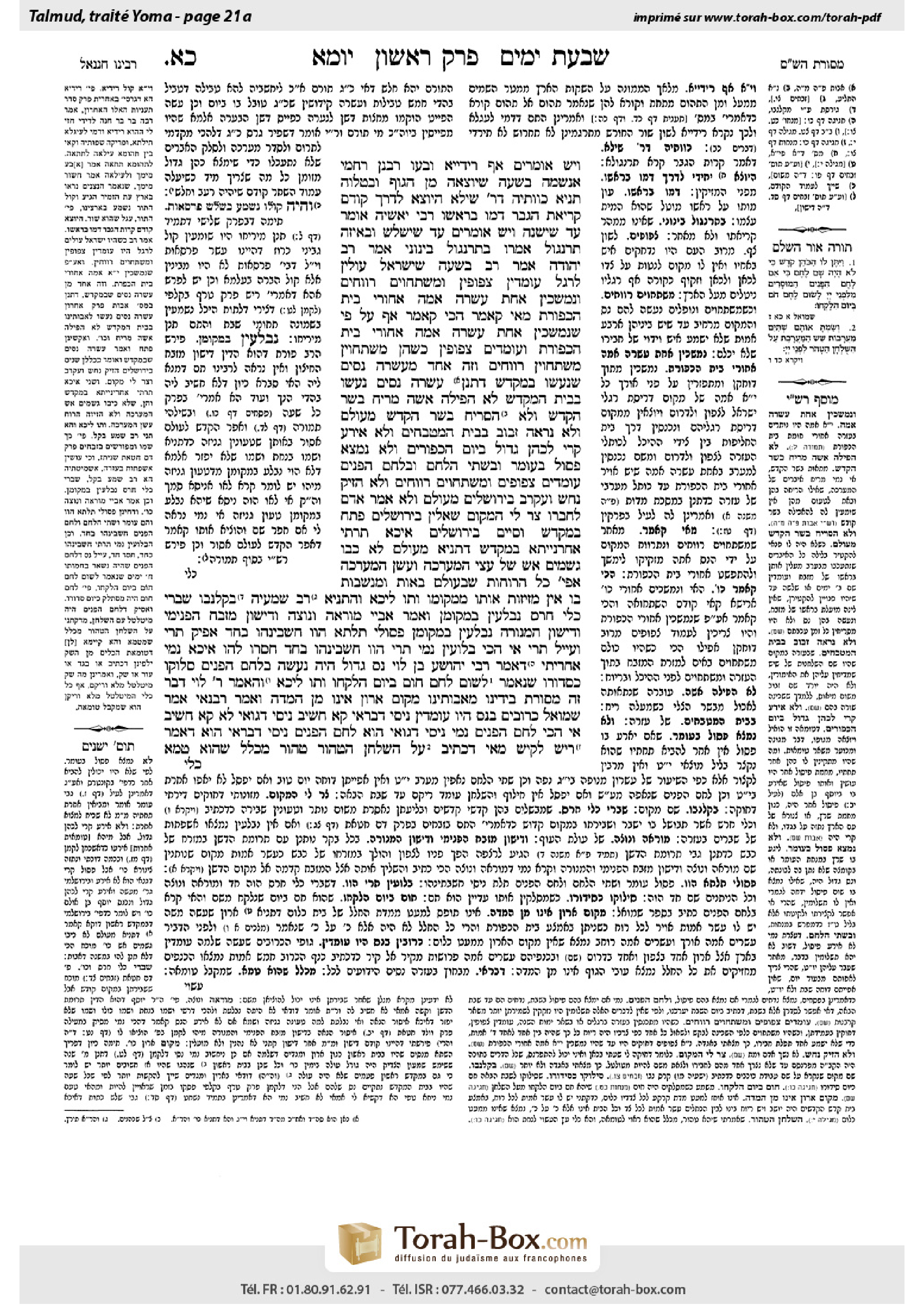
This page of Yoma includes the Aramaic text, an English translation and an AI-generated French translation, alongside the scan above.
יומא כ״א א · Aramaic and Hebrew text
וְיֵשׁ אוֹמְרִים: אַף רִידְיָיא. וּבְעוֹ רַבָּנַן רַחֲמֵי אַנְּשָׁמָה בְּשָׁעָה שֶׁיּוֹצְאָה מִן הַגּוּף, וּבַטְּלוּהּ.
תַּנְיָא כְּווֹתֵיהּ דְּרַבִּי שֵׁילָא: הַיּוֹצֵא לַדֶּרֶךְ קוֹדֶם קְרִיאַת הַגֶּבֶר — דָּמוֹ בְּרֹאשׁוֹ. רַבִּי יֹאשִׁיָּה אוֹמֵר: עַד שֶׁיִּשְׁנֶה, וְיֵשׁ אוֹמְרִים: עַד שֶׁיְּשַׁלֵּשׁ. וּבְאֵיזֶה תַּרְנְגוֹל אָמְרוּ — בְּתַרְנְגוֹל בֵּינוֹנִי.
אָמַר רַב יְהוּדָה אָמַר רַב: בְּשָׁעָה שֶׁיִּשְׂרָאֵל עוֹלִין לָרֶגֶל, עוֹמְדִין צְפוּפִין וּמִשְׁתַּחֲוִים רְווֹחִים, וְנִמְשָׁכִין אַחַת עֶשְׂרֵה אַמָּה אֲחוֹרֵי בֵּית הַכַּפּוֹרֶת. מַאי קָאָמַר? הָכִי קָאָמַר: אַף עַל פִּי שֶׁנִּמְשָׁכִין אַחַת עֶשְׂרֵה אַמָּה אֲחוֹרֵי בֵּית הַכַּפּוֹרֶת, וְעוֹמְדִים צְפוּפִין, כְּשֶׁהֵן מִשְׁתַּחֲוִין — מִשְׁתַּחֲוִין רְווֹחִים, וְזֶה אֶחָד מֵעֲשָׂרָה נִסִּים שֶׁנַּעֲשׂוּ בַּמִּקְדָּשׁ.
דִּתְנַן, עֲשָׂרָה נִסִּים נַעֲשׂוּ בְּבֵית הַמִּקְדָּשׁ: לֹא הִפִּילָה אִשָּׁה מֵרֵיחַ בְּשַׂר הַקֹּדֶשׁ. וְלֹא הִסְרִיחַ בְּשַׂר הַקֹּדֶשׁ מֵעוֹלָם. וְלֹא נִרְאָה זְבוּב בְּבֵית הַמִּטְבָּחַיִם. וְלֹא אֵירַע קֶרִי לְכֹהֵן גָּדוֹל בְּיוֹם הַכִּפּוּרִים. וְלֹא נִמְצָא פְּסוּל בָּעוֹמֶר, וּבִשְׁתֵּי הַלֶּחֶם, וּבְלֶחֶם הַפָּנִים. עוֹמְדִים צְפוּפִים, וּמִשְׁתַּחֲוִים רְווֹחִים. וְלֹא הִזִּיק נָחָשׁ וְעַקְרָב בִּירוּשָׁלַיִם מֵעוֹלָם. וְלֹא אָמַר אָדָם לַחֲבֵרוֹ: צַר לִי הַמָּקוֹם שֶׁאָלִין בִּירוּשָׁלַיִם.
פָּתַח בְּמִקְדָּשׁ, וְסִיֵּים בִּירוּשָׁלַיִם! אִיכָּא תַּרְתֵּי אַחְרָנְיָיתָא בְּמִקְדָּשׁ. דְּתַנְיָא: מֵעוֹלָם לֹא כִּבּוּ גְּשָׁמִים אֵשׁ שֶׁל עֲצֵי הַמַּעֲרָכָה. וַעֲשַׁן הַמַּעֲרָכָה, אֲפִילּוּ כׇּל הָרוּחוֹת שֶׁבָּעוֹלָם בָּאוֹת וּמְנַשְּׁבוֹת בּוֹ — אֵין מְזִיזוֹת אוֹתוֹ מִמְּקוֹמוֹ.
וְתוּ לֵיכָּא? וְהָתַנְיָא רַב שְׁמַעְיָה בְּקַלְנְבוֹ: שִׁבְרֵי כְּלֵי חֶרֶס, נִבְלָעִין בִּמְקוֹמָן, וְאָמַר אַבָּיֵי: מוּרְאָה, וְנוֹצָה, וְדִישּׁוּן מִזְבֵּחַ הַפְּנִימִי, וְדִישּׁוּן הַמְּנוֹרָה — נִבְלָעִין בִּמְקוֹמָן!
פְּסוּלֵי תְּלָתָא הָווּ? חַשְׁבִינְהוּ בְּחַד, אַפֵּיק תְּרֵי וְעַיֵּיל תְּרֵי. אִי הָכִי, בְּלוּעִין נָמֵי תְּרֵי הָווּ? חַשְּׁבִינְהוּ בְּחַד. חָסְרוּ לְהוּ! אִיכָּא נָמֵי אַחֲרִיתִי, דְּאָמַר רַבִּי יְהוֹשֻׁעַ בֶּן לֵוִי: נֵס גָּדוֹל הָיָה נַעֲשָׂה בְּלֶחֶם הַפָּנִים, סִלּוּקוֹ כְּסִדּוּרוֹ, שֶׁנֶּאֱמַר: ״לָשׂוּם לֶחֶם חוֹם בְּיוֹם הִלָּקְחוֹ״.
וְתוּ לֵיכָּא? וְהָאָמַר רַבִּי לֵוִי: דָּבָר זֶה מָסוֹרֶת בְּיָדֵינוּ מֵאֲבוֹתֵינוּ: מְקוֹם אָרוֹן — אֵינוֹ מִן הַמִּדָּה. וְאָמַר רַבְנַאי אָמַר שְׁמוּאֵל: כְּרוּבִים — בְּנֵס הָיוּ עוֹמְדִין!
נִיסֵּי דְבָרַאי — קָא חָשֵׁיב, נִיסֵּי דְגַוַּאי — לָא קָא חָשֵׁיב. אִי הָכִי, לֶחֶם הַפָּנִים נָמֵי נִיסֵּי דְגַוַּאי הוּא! לֶחֶם הַפָּנִים נִיסֵּי דְבָרַאי הוּא, דְּאָמַר רֵישׁ לָקִישׁ: מַאי דִּכְתִיב ״עַל הַשֻּׁלְחָן הַטָּהוֹר״, טָהוֹר — מִכְּלָל שֶׁהוּא טָמֵא,
Yoma 21a · English translation
And some say: The sound of Ridya as well. Ridya is the angel tasked with irrigating the earth, who calls to the heavens and to the aquifers to provide their water. The Gemara comments: And the Sages asked for mercy so that the sound of the soul at the moment that it leaves the body would no longer be heard to that extent, and God eliminated it. In any event, clearly this baraita understands keriat hagever as the proclamation of the Temple crier, in support of the opinion of Rav.
A baraita was taught in accordance with the opinion of Rabbi Sheila: With regard to one who sets out on the path at night before keriat hagever and is killed by demons, his blood is on his own head, i.e., he is at fault. Rabbi Yoshiya says: The prohibition of traveling at night is in effect until the rooster crows twice. And some say: Until he crows three times. And with regard to what rooster did these Sages state this advisory? It is with regard to a rooster of medium size. Clearly, this baraita understands keriat hagever as the crow of the rooster.
§ Rav Yehuda said that Rav said: When the Jewish people ascend to Jerusalem for the pilgrimage Festivals they stand crowded, but when they bow during confession they are spaced so that no one hears the confession of another. And due to the large crowd they extend eleven cubits behind the Hall of the Ark Cover, the Holy of Holies. The Gemara asks: What is he saying in the reference to eleven cubits behind the Holy of Holies? The Gemara explains that this is what he is saying: Even though the crowd is so large that the people extend eleven cubits behind the Hall of the Ark Cover and people stand crowded, still, when they bow, they bow spaced. And that is one of the ten miracles that were performed in the Temple.
As we learned in a mishna: Ten miracles were performed in the Temple. No woman miscarried from the aroma of the sacrificial meat, as a pregnant woman craves various foods and occasionally that craving leads to miscarriage. And the sacrificial meat never putrefied. And no fly was seen in the slaughterhouse, although flies are generally attracted to a place where there is flesh and blood. And a seminal emission did not befall the High Priest on Yom Kippur. And no disqualification was found in the omer or the two loaves, which are communal offerings, or in the shewbread. And the Jewish people stand crowded but bow spaced. And neither a snake nor a scorpion ever harmed anyone in Jerusalem. And a person never said to another: There is no room for me to stay overnight in Jerusalem.
The Gemara notes: This list opened with miracles that occurred in the Temple, and closed with miracles that occurred in Jerusalem. Apparently there were not actually ten miracles performed in the Temple. The Gemara answers: There are two other miracles in the Temple, as it was taught in a baraita: Rain never extinguished the fire of the arrangement of wood on the altar, despite the fact that the altar stood in the courtyard, exposed to the elements. And with regard to the smoke of the arrangement, even if all the winds in the world come and blow it, they do not move it from its place and it rises directly heavenward.
The Gemara asks: And are there no more miracles in the Temple? But didn’t Rav Shemaya teach in a baraita in the city of Kalnevo: Shards of earthenware vessels were swallowed in the earth in their places, and there was no need to dispose of them. The vessels used for cooking the meat of the offerings of the most sacred order absorbed some of the meat. The meat that was absorbed became notar when the period during which the offering may be eaten concludes. One was required to break those vessels in which the meat was absorbed. The shards of those vessels were miraculously swallowed in the earth where they were smashed. And similarly, Abaye said: The crop and feathers of sacrificial birds, and the ashes of the inner altar, and the ashes of the candelabrum, which were not removed to the place of ashes outside the Temple like the ashes of the outer altar, were also swallowed in the earth in their places. Apparently, there were more than ten miracles in the Temple.
The Gemara answers: The disqualifications mentioned that never occurred in the Temple, in the omer, the two loaves, or the shewbread, were three; consider them as one miracle. Eliminate two from the total and introduce these two to complete the list of ten miracles. The Gemara asks: If similar miracles are combined and considered as one, the swallowing of the earthenware, crops, feathers, and ashes are also two similar miracles that should be considered as one, the result being that they are lacking one miracle to complete the total of ten. The Gemara responds: There is also another miracle, as Rabbi Yehoshua ben Levi said: A great miracle was performed with regard to the shewbread in the Temple, that the bread was as hot at its removal on Shabbat, after a week on the table, as it was at its arrangement, as it is stated: “To put out hot bread on the day it was taken away” (I Samuel 21:7).
The Gemara asks: And were there no more miracles in the Temple? But didn’t Rabbi Levi say that this matter is a tradition that we received from our ancestors: The place of the Ark of the Covenant is not included in the measurement of the Holy of Holies. Based on that measurement, the Ark should not have fit inside the hall. The Holy of Holies measured twenty cubits by twenty cubits (see I Kings 6), and a baraita states that there were ten cubits of space on either side of the Ark. Therefore, it was only through a miracle that the Ark fit in the Holy of Holies. And Rabbenai said that Shmuel said: It was through a miracle that the cherubs that Solomon placed in the Holy of Holies would stand. Their wingspan was twenty cubits, and since the length of the chamber was the same, there was no room for the bodies of the cherubs. There were additional miracles performed in the Temple.
The Gemara responds: The tanna counts miracles that were performed outside the Sanctuary and were visible to all, but he does not count miracles that were performed inside the Sanctuary and were not visible to all. The Gemara asks: If so, the shewbread is also a miracle performed on the table inside the Sanctuary and is not visible to all, yet the miracle that the bread’s heat did not dissipate was listed among the miracles. The Gemara answers: The shewbread was a miracle performed outside, as Reish Lakish said: What is the meaning of that which is written: “Place them on the pure table before the Lord in two rows, six to a row” (Leviticus 24:6)? From the emphasis that the Torah places on the fact that the table was ritually pure, it can be learned by inference that it indicates that it could become impure as well.
Yoma 21a · Traduction française (IA)
Et certains disent : le bruit de Ridya également. Ridya est l’ange chargé d’irriguer la terre, qui appelle les cieux et les nappes aquifères à fournir leur eau. La Guemara commente : les Sages implorèrent la miséricorde divine afin que le bruit de l’âme au moment où elle quitte le corps ne soit plus entendu avec une telle intensité, et Dieu le fit disparaître. Quoi qu’il en soit, cette baraïta comprend manifestement keriat hagever comme la proclamation du crieur du Temple, ce qui appuie l’opinion de Rav.
Une baraïta fut enseignée conformément à l’opinion de Rabbi Sheila : celui qui se met en route de nuit, avant keriat hagever, et qui est tué par des démons, n’a qu’à s’en prendre à lui-même, c’est-à-dire qu’il est fautif. Rabbi Yoshiya dit : l’interdiction de voyager de nuit reste en vigueur jusqu’à ce que le coq chante deux fois. Certains disent : jusqu’à ce qu’il chante trois fois. Et à propos de quel coq ces Sages ont-ils formulé cet avis ? D’un coq de taille moyenne. Cette baraïta comprend manifestement keriat hagever comme le chant du coq.
§ Rav Yehouda dit au nom de Rav : lorsque le peuple juif monte à Jérusalem pour les fêtes de pèlerinage, les gens se tiennent serrés les uns contre les autres, mais, lorsqu’ils s’inclinent pendant la confession, ils sont espacés, de sorte que nul n’entende la confession d’autrui. En raison de la foule nombreuse, ils s’étendent sur onze coudées derrière le Hall de l’Arche du Propitiatoire, le Saint des Saints. La Guemara demande : que veut-il dire en mentionnant onze coudées derrière le Saint des Saints ? La Guemara explique que son propos est le suivant : même si la foule est si nombreuse que les gens s’étendent sur onze coudées derrière le Hall de l’Arche du Propitiatoire et se tiennent serrés les uns contre les autres, lorsqu’ils s’inclinent, ils le font néanmoins en étant espacés. Voilà l’un des dix miracles qui se produisaient dans le Temple.
Comme nous l’avons appris dans une Michna : dix miracles se produisaient dans le Temple. Aucune femme ne faisait de fausse couche à cause de l’odeur de la viande des sacrifices, alors qu’une femme enceinte a des envies de divers aliments et que celles-ci peuvent parfois entraîner une fausse couche. La viande des sacrifices ne se putréfiait jamais. Aucune mouche n’était aperçue dans l’abattoir, bien que les mouches soient généralement attirées par les endroits où se trouvent de la chair et du sang. Le Grand Prêtre n’était jamais victime d’une émission séminale à Yom Kippour. Aucun défaut ne rendait impropres l’omer, les deux pains, qui sont des offrandes communautaires, ou les pains de proposition. Le peuple juif se tenait serré, mais s’inclinait en étant espacé. Ni serpent ni scorpion ne blessa jamais personne à Jérusalem. Et personne ne disait jamais à un autre : « Il n’y a pas de place pour que je passe la nuit à Jérusalem. »
La Guemara fait remarquer : cette liste commence par des miracles survenus dans le Temple et s’achève par des miracles survenus à Jérusalem. Apparemment, il ne s’est donc pas produit en réalité dix miracles dans le Temple. La Guemara répond : il y a deux autres miracles dans le Temple, comme l’enseigne une baraïta : la pluie n’éteignait jamais le feu du tas de bois disposé sur l’autel, bien que celui-ci se trouvât dans la cour, exposé aux intempéries. Quant à la fumée du tas de bois, même si tous les vents du monde se levaient et soufflaient, ils ne la déplaçaient pas de son emplacement et elle montait directement vers le ciel.
La Guemara demande : n’y a-t-il pas encore d’autres miracles dans le Temple ? Rav Shemaya n’a-t-il pas enseigné une baraïta dans la ville de Kalnevo : les tessons des récipients en terre cuite étaient engloutis dans le sol à l’endroit même où ils se trouvaient, de sorte qu’il n’était pas nécessaire de s’en débarrasser ? Les récipients utilisés pour cuire la viande des sacrifices de sainteté suprême absorbaient une partie de la viande. La viande ainsi absorbée devenait notar à la fin de la période pendant laquelle le sacrifice pouvait être consommé. Il fallait briser les récipients dans lesquels la viande avait été absorbée. Les tessons de ces récipients étaient miraculeusement engloutis dans le sol à l’endroit où ils étaient brisés. De même, Abaye dit que le jabot et les plumes des oiseaux sacrifiés, ainsi que les cendres de l’autel intérieur et du candélabre — qui n’étaient pas transportées vers le dépôt des cendres à l’extérieur du Temple, contrairement aux cendres de l’autel extérieur — étaient également engloutis dans le sol à l’endroit même où ils se trouvaient. Apparemment, il y avait plus de dix miracles dans le Temple.
La Guemara répond : les défauts dont la liste dit qu’ils ne survenaient jamais dans le Temple — ceux de l’omer, des deux pains ou des pains de proposition — étaient au nombre de trois ; considère-les comme un seul miracle. Retranche-en deux du total et ajoute ces deux autres miracles pour compléter la liste des dix miracles. La Guemara demande : si l’on regroupe des miracles semblables en les considérant comme un seul, l’engloutissement dans le sol des récipients en terre cuite, des jabots, des plumes et des cendres constitue également deux miracles semblables qu’il faut considérer comme un seul ; il manque alors un miracle pour atteindre le total de dix. La Guemara répond : il y a également un autre miracle, car Rabbi Yehoshua ben Levi a dit : un grand miracle se produisait avec les pains de proposition dans le Temple : au moment où on les retirait le Chabbat, après une semaine passée sur la table, ils étaient aussi chauds qu’au moment où on les y avait disposés, comme il est dit : « Pour présenter du pain chaud le jour où on l’emporta » (I Samuel 21:7).
La Guemara demande : n’y avait-il pas encore d’autres miracles dans le Temple ? Rabbi Levi n’a-t-il pas dit qu’il s’agit d’une tradition reçue de nos ancêtres : l’emplacement de l’Arche de l’Alliance n’est pas compris dans les dimensions du Saint des Saints ? D’après ces dimensions, l’Arche n’aurait pas dû pouvoir entrer dans la salle. Le Saint des Saints mesurait vingt coudées sur vingt coudées (voir I Rois 6), et une baraïta enseigne qu’il y avait un espace de dix coudées de chaque côté de l’Arche. Par conséquent, l’Arche n’a pu entrer dans le Saint des Saints que par miracle. Et Rabbenai dit au nom de Shmuel : c’est par miracle que les chérubins placés par Salomon dans le Saint des Saints tenaient debout. L’envergure de leurs ailes était de vingt coudées et, puisque la longueur de la salle était la même, il n’y avait pas de place pour leurs corps. D’autres miracles se produisaient dans le Temple.
La Guemara répond : le tanna compte les miracles qui se produisaient à l’extérieur du Sanctuaire et étaient visibles de tous, mais il ne compte pas ceux qui se produisaient à l’intérieur du Sanctuaire et n’étaient pas visibles de tous. La Guemara demande : dans ce cas, les pains de proposition étaient eux aussi le siège d’un miracle sur la table, à l’intérieur du Sanctuaire, et n’étaient pas visibles de tous ; pourtant, le miracle selon lequel la chaleur du pain ne se dissipait pas figure parmi les miracles. La Guemara répond : le miracle des pains de proposition se produisait à l’extérieur, car Reish Lakish a dit : que signifie ce qui est écrit : « Tu les placeras sur la table pure devant le Seigneur, en deux rangées, six par rangée » (Lévitique 24:6) ? Du fait que la Torah insiste sur la pureté rituelle de la table, on peut déduire qu’elle pouvait également devenir impure.
Traduction française générée par IA à partir de l’édition anglaise de Sefaria. Vérifie toujours un passage avec le texte source.
Text from Sefaria: William Davidson Edition - Vocalized Aramaic (CC BY NC); William Davidson Edition - English (CC BY NC).