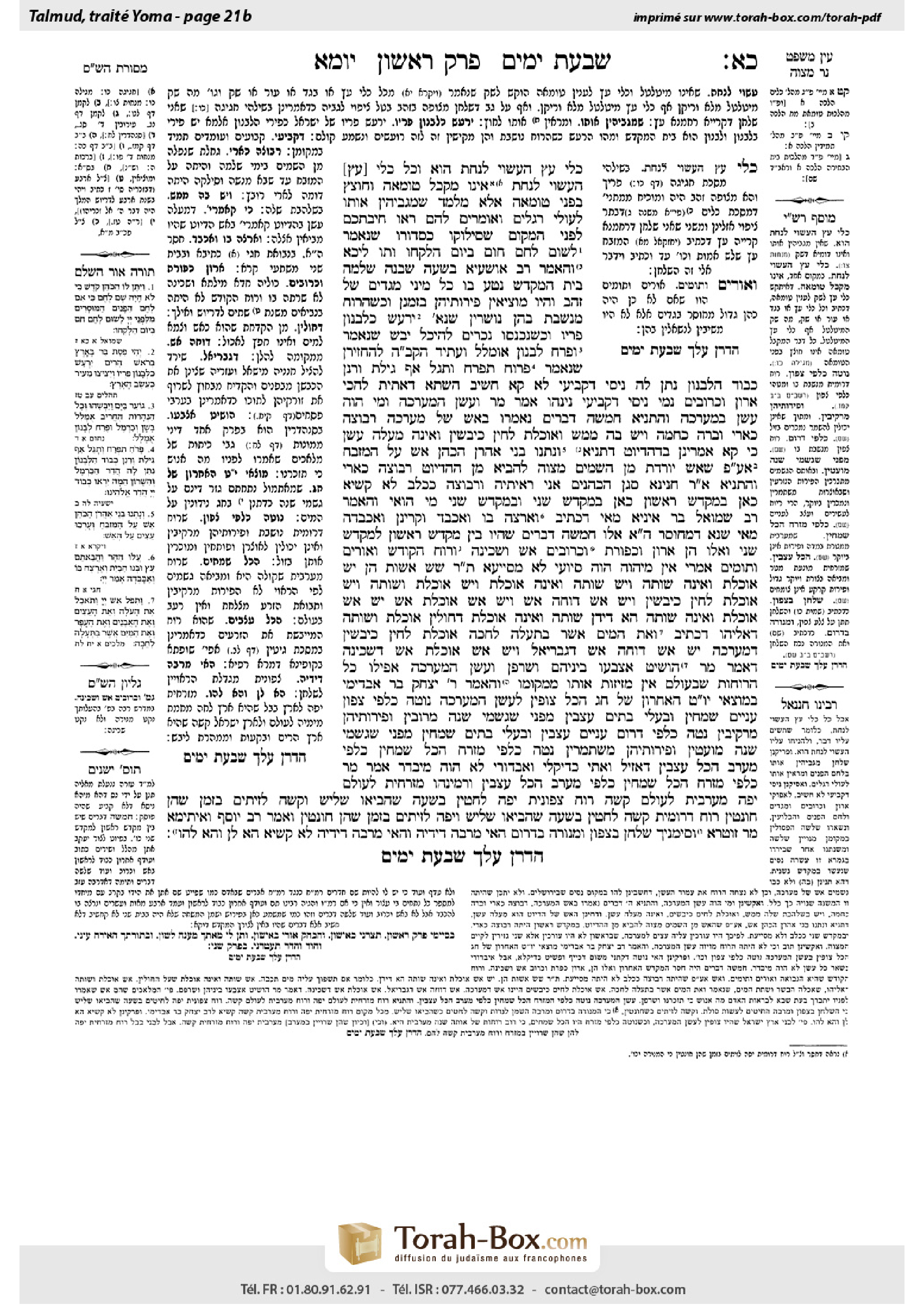
Yoma 21b: Talmud study for Daf Yomi
Daf Yomi is the daily study of one Talmud folio. Explore 37 tractates with scans, Hebrew text, Sefaria English and AI-generated French translations where annotated.
Passage selection and English or AI-generated French translation are available where the scan has annotations. Daf Study is independent of Torah-Box and Sefaria.
Browse Yoma · יומא · All tractatesYoma 21b text and translations
This page of Yoma includes the Aramaic text, an English translation and an AI-generated French translation, alongside the scan above.
יומא כ״א ב · Aramaic and Hebrew text
כְּלִי עֵץ הֶעָשׂוּי לְנַחַת הוּא, וְכׇל כְּלִי [עֵץ] הֶעָשׂוּי לְנַחַת אֵינוֹ מְקַבֵּל טוּמְאָה, וְחוֹצֵץ בִּפְנֵי טוּמְאָה. אֶלָּא מְלַמֵּד שֶׁמַּגְבִּיהִין אוֹתוֹ לְעוֹלֵי רְגָלִים, וְאוֹמְרִים לָהֶם: רְאוּ חִיבַּתְכֶם לִפְנֵי הַמָּקוֹם, שֶׁסִּילּוּקוֹ כְּסִדּוּרוֹ, שֶׁנֶּאֱמַר: ״לָשׂוּם לֶחֶם חוֹם בְּיוֹם הִלָּקְחוֹ״.
וְתוּ לֵיכָּא? וְהָאָמַר רַב אוֹשַׁעְיָא: בְּשָׁעָה שֶׁבָּנָה שְׁלֹמֹה בֵּית הַמִּקְדָּשׁ, נָטַע בּוֹ כׇּל מִינֵי מְגָדִים שֶׁל זָהָב, וְהָיוּ מוֹצִיאִין פֵּירוֹתֵיהֶן בִּזְמַנָּן, וּכְשֶׁהָרוּחַ מְנַשֶּׁבֶת בָּהֶן נוֹשְׁרִין, שֶׁנֶּאֱמַר: ״יִרְעַשׁ כַּלְּבָנוֹן פִּרְיוֹ״. וּכְשֶׁנִּכְנְסוּ גּוֹיִם לַהֵיכָל יָבַשׁ, שֶׁנֶּאֱמַר: ״וּפֶרַח לְבָנוֹן אוּמְלָל״, וְעָתִיד הַקָּדוֹשׁ בָּרוּךְ הוּא לְהַחֲזִירָן, שֶׁנֶּאֱמַר: ״פָּרוֹחַ תִּפְרַח וְתָגֵל אַף גִּילַת וְרַנֵּן כְּבוֹד הַלְּבָנוֹן נִתַּן לָהּ״.
נִיסֵּי דִּקְבִיעִי לָא קָא חָשֵׁיב. הַשְׁתָּא דְּאָתֵית לְהָכִי: אָרוֹן וּכְרוּבִים נָמֵי, נִיסֵּי דִּקְבִיעִי נִינְהוּ.
אָמַר מָר: וַעֲשַׁן הַמַּעֲרָכָה. וּמִי הֲוָה עָשָׁן בְּמַעֲרָכָה? וְהָתַנְיָא: חֲמִשָּׁה דְּבָרִים נֶאֶמְרוּ בָּאֵשׁ שֶׁל מַעֲרָכָה: רְבוּצָה כַּאֲרִי, וּבָרָה כַּחַמָּה, וְיֵשׁ בָּהּ מַמָּשׁ, וְאוֹכֶלֶת לַחִין כִּיבֵשִׁין, וְאֵינָהּ מַעֲלָה עָשָׁן!
כִּי קָא אָמְרִינַן — בִּדְהֶדְיוֹט. דְּתַנְיָא: ״וְנָתְנוּ בְּנֵי אַהֲרֹן הַכֹּהֵן אֵשׁ עַל הַמִּזְבֵּחַ״, אַף עַל פִּי שֶׁאֵשׁ יוֹרֶדֶת מִן הַשָּׁמַיִם, מִצְוָה לְהָבִיא מִן הַהֶדְיוֹט.
רְבוּצָה כַּאֲרִי. וְהַתַּנְיָא, אָמַר רַבִּי חֲנִינָא סְגַן הַכֹּהֲנִים: אֲנִי רְאִיתִיהָ, וּרְבוּצָה כְּכֶלֶב! לָא קַשְׁיָא: כָּאן — בְּמִקְדָּשׁ רִאשׁוֹן, כָּאן — בְּמִקְדָּשׁ שֵׁנִי.
וּבְמִקְדָּשׁ שֵׁנִי מִי הֲוַאי? וְהָאָמַר רַב שְׁמוּאֵל בַּר אִינְיָא: מַאי דִּכְתִיב: ״וְאֶרְצֶה בּוֹ וְאֶכָּבֵד״, וְקָרֵינַן ״וְאֶכָּבְדָה״. מַאי שְׁנָא דִּמְחוּסַּר הֵ״א — אֵלּוּ חֲמִשָּׁה דְּבָרִים שֶׁהָיוּ בֵּין מִקְדָּשׁ רִאשׁוֹן לְמִקְדָּשׁ שֵׁנִי, וְאֵלּוּ הֵן: אָרוֹן וְכַפּוֹרֶת וּכְרוּבִים, אֵשׁ, וּשְׁכִינָה, וְרוּחַ הַקּוֹדֶשׁ, וְאוּרִים וְתוּמִּים. אָמְרִי: אִין, מִיהְוָה הֲוָה, סַיּוֹעֵי לָא מְסַיְּיעָא.
תָּנוּ רַבָּנַן, שֵׁשׁ אִשּׁוֹת הֵן: יֵשׁ אוֹכֶלֶת וְאֵינָהּ שׁוֹתָה, וְיֵשׁ שׁוֹתָה וְאֵינָהּ אוֹכֶלֶת, וְיֵשׁ אוֹכֶלֶת וְשׁוֹתָה, וְיֵשׁ אוֹכֶלֶת לַחִין כִּיבֵשִׁין, וְיֵשׁ אֵשׁ דּוֹחָה אֵשׁ, וְיֵשׁ אֵשׁ אוֹכֶלֶת אֵשׁ.
יֵשׁ אֵשׁ אוֹכֶלֶת וְאֵינָהּ שׁוֹתָה — הָא דִּידַן. שׁוֹתָה וְאֵינָהּ אוֹכֶלֶת — דְּחוֹלִין. אוֹכֶלֶת וְשׁוֹתָה — דְּאֵלִיָּהוּ, דִּכְתִיב: ״וְאֶת הַמַּיִם אֲשֶׁר בַּתְּעָלָה לִחֵכָה״. אוֹכֶלֶת לַחִין כִּיבֵשִׁין — דְּמַעֲרָכָה. יֵשׁ אֵשׁ דּוֹחָה אֵשׁ — דְּגַבְרִיאֵל, וְיֵשׁ אֵשׁ אוֹכֶלֶת אֵשׁ — דִּשְׁכִינָה, דְּאָמַר מָר: הוֹשִׁיט אֶצְבָּעוֹ בֵּינֵיהֶם וּשְׂרָפָן.
וַעֲשַׁן הַמַּעֲרָכָה, אֲפִילּוּ כׇּל הָרוּחוֹת שֶׁבָּעוֹלָם אֵין מְזִיזוֹת אוֹתוֹ מִמְּקוֹמוֹ? וְהָאָמַר רַבִּי יִצְחָק בַּר אַבְדִּימִי: בְּמוֹצָאֵי יוֹם טוֹב הָאַחֲרוֹן שֶׁל חַג הַכֹּל צוֹפִין לַעֲשַׁן הַמַּעֲרָכָה. נוֹטֶה כְּלַפֵּי צָפוֹן — עֲנִיִּים שְׂמֵחִין וּבַעֲלֵי בָתִּים עֲצֵבִין, מִפְּנֵי שֶׁגִּשְׁמֵי שָׁנָה מְרוּבִּין וּפֵירוֹתֵיהֶן מַרְקִיבִין. נָטָה כְּלַפֵּי דָרוֹם — עֲנִיִּים עֲצֵבִין, וּבַעֲלֵי בָתִּים שְׂמֵחִין, מִפְּנֵי שֶׁגִּשְׁמֵי שָׁנָה מוּעָטִין, וּפֵירוֹתֵיהֶן מִשְׁתַּמְּרִין.
נָטָה כְּלַפֵּי מִזְרָח — הַכֹּל שְׂמֵחִין. כְּלַפֵּי מַעֲרָב — הַכֹּל עֲצֵבִין! דְּאָזֵיל וְאָתֵי כְּדִיקְלֵי, וְאִבַּדּוֹרֵי לָא הֲוָה מִיבַּדַּר.
אָמַר מָר: כְּלַפֵּי מִזְרָח — הַכֹּל שְׂמֵחִין, כְּלַפֵּי מַעֲרָב — הַכֹּל עֲצֵבִין. וּרְמִינְהוּ: מִזְרָחִית — לְעוֹלָם יָפָה, מַעֲרָבִית — לְעוֹלָם קָשָׁה, רוּחַ צְפוֹנִית — יָפָה לַחִטִּין בְּשָׁעָה שֶׁהֵבִיאוּ שְׁלִישׁ, וְקָשָׁה לַזֵּיתִים בִּזְמַן שֶׁהֵן חוֹנְטִין, רוּחַ דְּרוֹמִית — קָשָׁה לַחִטִּין בְּשָׁעָה שֶׁהֵבִיאוּ שְׁלִישׁ, וְיָפָה לַזֵּיתִים בִּזְמַן שֶׁהֵן חוֹנְטִין.
וְאָמַר רַב יוֹסֵף, וְאִיתֵּימָא מָר זוּטְרָא: וְסִימָנָיךְ — שֻׁלְחָן בַּצָּפוֹן, וּמְנוֹרָה בַּדָּרוֹם. הַאי מְרַבֵּה דִּידֵיהּ, וְהַאי מְרַבֵּה דִּידֵיהּ!
לָא קַשְׁיָא: הָא — לַן, וְהָא — לְהוּ.
הֲדַרַן עֲלָךְ שִׁבְעַת יָמִים
Yoma 21b · English translation
The Gemara asks: How is that possible? It is a wooden vessel designated to rest in a fixed place and not to be moved. And it was taught: Any wooden vessel designated to rest in a fixed place is not susceptible to ritual impurity, and it serves as a barrier before impurity, preventing its transmission. Rather, the fact that the table is described as pure teaches that the priests lift it in order to display the shewbread to the Festival pilgrims, and they say to them: See how beloved you are before the Omnipresent, as the bread is as hot at its removal on Shabbat, after a week on the table, as it was at its arrangement, as it is stated: “To put out hot bread on the day it was taken away” (I Samuel 21:7). Since the table was moved on occasion, it was not considered a wooden vessel designated to rest and was therefore susceptible to impurity. At the same time, it is clear that the miracle of the shewbread was a miracle performed outside the Sanctuary, as it was visible to all.
The Gemara asks: And are there no more miracles performed in the Temple? But didn’t Rav Oshaya say: When Solomon built the Temple he planted all sorts of precious golden fruits there, and these brought forth their fruit in their appointed season like other trees, and when the wind blew them the fruit would fall, as it is stated: “May his fruits rustle like Lebanon” (Psalms 72:16). This indicates that fruits grew in Lebanon, which the Sages interpreted as a reference to the Temple, which was built with cedar trees from Lebanon. And when the gentiles entered the Sanctuary the golden tree withered, as it stated: “And the blossoms of Lebanon wither” (Nahum 1:4). And the Holy One, Blessed be He, will restore the miraculous trees to Israel in the future, as it is stated: “It shall blossom abundantly, it shall also rejoice and shout, the glory of Lebanon will be given to it” (Isaiah 35:2). Apparently, there were additional miracles in the Temple.
The Gemara responds: The tanna does not count perpetual miracles on the list. The Gemara comments: Now that you have arrived at this solution, it can resolve an earlier difficulty as well: The Ark and the cherubs are also not counted, since they too were perpetual miracles.
§ The Master said in listing the miracles that even strong winds were unable to displace the smoke of the arrangement of wood. The Gemara asks: And did smoke rise from the arrangement of wood on the altar? But wasn’t it taught in a baraita: There were five matters stated with regard to the fire of the arrangement of wood: It crouched above the wood like a lion; and it was as clear as the light of the sun; and it had substance to the extent that it could be felt; it was powerful enough to consume wet wood like dry wood; and it did not raise smoke.
The Gemara answers: When we said that the smoke was not displaced, indicating that the wood produced smoke, that was in reference to the fire brought by a person, as it was taught in a baraita: “And the sons of Aaron the priest shall put fire upon the altar” (Leviticus 1:7), indicating that even though fire descends from the heavens, still there is a special mitzva to bring fire by a person. The fire that the priests brought produced smoke, and the miracle related to that smoke.
The Gemara asks: And was the altar’s fire crouched like a lion? But wasn’t it taught in a baraita: Rabbi Ḥanina, the deputy High Priest, said: I saw the fire in the Temple and it was crouched like a dog and not a lion? The Gemara answers: This is not difficult. Here, where the baraita stated that the fire resembled a lion, it refers to the fire in the First Temple; there, where Rabbi Ḥanina, the deputy High Priest, said that the fire resembled a dog, it refers to the fire in the Second Temple.
The Gemara asks: And was there fire that descended from the heavens in the Second Temple? Didn’t Rav Shmuel bar Inya say: What is the meaning of that which is written with regard to the Second Temple: “Go up to the hills and get wood and build the house; and I will look on it favorably and I will be glorified [ve’ekkaved], said the Lord” (Haggai 1:8)? Even though it is written ve’ekkaved, we read it ve’ikkavda, with an added letter heh. The Gemara explains: What is different that the word is missing the letter heh? This represents five, the numerological value of heh, phenomena that constituted the difference between the First Temple and the Second Temple, in that they were not in the Second Temple. And these are: The Ark of the Covenant, and the Ark cover upon it, and the cherubs that were on the Ark cover; fire; and the Divine Presence; and the Divine Spirit; and the Urim VeTummim. Apparently, there was no fire from heaven in the Second Temple. The Sages say in response: Yes, there was fire from heaven in the Second Temple; however, it did not assist in burning the offerings but was merely visible above the wood.
Apropos the fire on the altar, the Gemara cites a related baraita. The Sages taught that there are six kinds of fire: There is fire that consumes solids and does not consume liquids; and there is fire that consumes liquids and does not consume solids; and there is fire that consumes solids and consumes liquids; and there is fire that consumes wet objects like dry objects; and there is fire that repels other fire; and there is fire that consumes other fire.
The Gemara elaborates: There is fire that consumes solids and does not consume liquids; that is our standard fire that consumes dry items but does not dry liquids.
Fire that consumes liquids and does not consume solids is the fever of the sick that dehydrates the body but does not consume the flesh.
Fire that consumes solids and consumes liquids is the fire of Elijah the Prophet, as it is written: “And fire fell from the sky and consumed the offering and the wood and the stones and the earth, and it licked up the water that was in the trench” (I Kings 18:38).
Fire that consumes wet objects like dry objects is the fire of the arrangement of wood.
There is fire that repels other fire; that is the fire of the angel Gabriel. The book of Daniel relates that Gabriel was an angel of fire who descended to the fiery furnace, repelled the fire, and rescued Hananiah, Mishael, and Azariah, who had been cast inside.
And there is fire that consumes other fire; that is the fire of the Divine Presence, as the Master said in another context: The Holy One, Blessed be He, extended His finger between the angels, who are also made of fire, and burned them. The fire of the Divine Presence consumed the fire of the angels.
§ The Gemara asks: And with regard to the smoke of the arrangement, is it so that even if all the winds in the world come and blow it, they do not move it from its place and it rises directly heavenward? Didn’t Rabbi Yitzḥak bar Avdimi say: At the conclusion of the final day of the festival of Sukkot, everyone looks to the smoke of the arrangement of wood; if the wind blew from the south and the smoke tends toward the north, the poor were glad and the homeowners were sad. This is because it was a sign that the year’s rains would be plentiful, producing an abundant crop on the one hand, but on the other hand, the fruit would rot due to the humidity, rendering it impossible to store the abundant harvest. This forced the landowners to sell quickly at a lower price. And if a northern wind caused the smoke to tend toward the south, the poor were sad and the homeowners were glad, because it was an indication that the year’s rains would be sparse. The yield would be low, and it would be easy to store the fruit and sell it at a higher price.
If a western wind caused the smoke to tend to the east, that was an indication that there would be sufficient rainfall to ensure a substantial crop, and at the same time, it would be possible to store the fruit, and everyone was glad. If an eastern wind caused the smoke to tend to the west that was an indication that there would be a drought because eastern winds do not bring rain, and everyone was sad. Apparently, wind causes the smoke rising from the arrangement of wood to move. The Gemara responds: The smoke comes and goes like a palm tree, swaying in the wind, but it did not disperse.
The Master said: If a western wind caused the pillar of smoke to tend to the east everyone is glad; if an eastern wind caused the smoke to tend to the west everyone was sad. And the Gemara raised a contradiction, as the Sages said: An eastern wind is always good; a western wind is always bad; a northern wind is good for wheat when it has reached one-third of its potential growth, and bad for olives when they are ripening; a southern wind is bad for wheat when it has reached one-third of its potential growth, and good for olives when they are ripening.
And Rav Yosef said, and some say it was Mar Zutra who said it: And your mnemonic for which is good for wheat and which for olives is that in the Temple the table was in the north and the candelabrum was in the south of the Sanctuary. Bread made out of wheat was placed on the table, and oil made out of olives was burned in the candelabrum. The wind coming from this side, the north, increased its own component, wheat; and the wind coming from this side, the south, increased its own component, olives. In any event, there are contradictory opinions with regard to the effect of western and eastern winds.
The Gemara responds: This is not difficult: This opinion that a wind from the east is good is for us, in Babylonia. Babylonia is a land whose water is plentiful, and a dry east wind will not harm the crop at all. This opinion that a wind from the east is harmful is for them, in Eretz Yisrael. That is a land where water is sparse, and the dry east wind will dry the land and ruin the crops.
Yoma 21b · Traduction française (IA)
La Guemara demande : Comment cela est-il possible ? Il s’agit d’un ustensile en bois destiné à rester en place et à ne pas être déplacé. Or, il a été enseigné : Tout ustensile en bois destiné à rester en place n’est pas susceptible de contracter l’impureté rituelle et fait écran à l’impureté, empêchant sa transmission. En réalité, le fait que la table soit décrite comme pure enseigne que les prêtres la soulevaient afin de montrer le pain de proposition aux pèlerins venus pour la fête, et leur disaient : « Voyez combien vous êtes chers aux yeux du Tout-Puissant : le pain est aussi chaud au moment où on le retire le Chabbat, après avoir passé une semaine sur la table, qu’au moment où on le disposait », comme il est dit : « Pour présenter du pain chaud le jour où on l’enleva » (I Samuel 21, 7). Puisque la table était parfois déplacée, elle n’était pas considérée comme un ustensile en bois destiné à rester en place et était donc susceptible de contracter l’impureté. Il est en même temps clair que le miracle du pain de proposition était un miracle accompli hors du Sanctuaire, puisqu’il était visible de tous.
La Guemara demande : N’y avait-il pas d’autres miracles accomplis dans le Temple ? Rav Ochaya n’a-t-il pas dit : Lorsque Salomon construisit le Temple, il y planta toutes sortes d’arbres portant des fruits d’or précieux ; ceux-ci donnaient leurs fruits à la saison voulue, comme les autres arbres, et, lorsque le vent soufflait, les fruits tombaient, comme il est dit : « Que ses fruits bruissent comme le Liban » (Psaumes 72, 16). Cela indique que des fruits poussaient au Liban, ce que les Sages interprétèrent comme une allusion au Temple, construit avec des cèdres du Liban. Lorsque les non-Juifs pénétrèrent dans le Sanctuaire, l’arbre d’or se dessécha, comme il est dit : « Les fleurs du Liban se fanent » (Nahum 1, 4). Et le Saint, béni soit-Il, rendra à Israël ces arbres miraculeux à l’avenir, comme il est dit : « Il fleurira abondamment, il se réjouira et poussera des cris de joie ; la gloire du Liban lui sera donnée » (Isaïe 35, 2). Apparemment, il y avait d’autres miracles dans le Temple.
La Guemara répond : Le tanna ne compte pas les miracles permanents dans la liste. La Guemara fait remarquer : Puisque nous sommes parvenus à cette solution, elle permet également de résoudre une difficulté soulevée plus tôt : l’Arche et les chérubins ne sont pas non plus comptés, car ils étaient eux aussi des miracles permanents.
§ Le Maître a dit, en énumérant les miracles, que même des vents violents ne pouvaient déplacer la fumée de l’arrangement du bois. La Guemara demande : De la fumée s’élevait-elle donc de l’arrangement du bois sur l’autel ? N’a-t-il pas été enseigné dans une baraïta : Cinq caractéristiques ont été énoncées au sujet du feu de l’arrangement du bois : il se tenait accroupi au-dessus du bois comme un lion ; il était aussi éclatant que la lumière du soleil ; il avait une consistance telle qu’on pouvait le toucher ; il était assez puissant pour consumer du bois humide comme du bois sec ; et il ne produisait pas de fumée.
La Guemara répond : Lorsque nous avons dit que la fumée n’était pas déplacée, ce qui indique que le bois produisait de la fumée, il s’agissait du feu apporté par un homme, comme il a été enseigné dans une baraïta : « Les fils d’Aaron, le prêtre, mettront du feu sur l’autel » (Lévitique 1, 7). Cela indique que, même si le feu descend du ciel, il y a néanmoins une mitsva particulière d’apporter du feu par un homme. Le feu apporté par les prêtres produisait de la fumée, et le miracle concernait cette fumée.
La Guemara demande : Le feu de l’autel se tenait-il donc accroupi comme un lion ? N’a-t-il pas été enseigné dans une baraïta : Rabbi Ḥanina, le suppléant du Grand Prêtre, a dit : « J’ai vu le feu dans le Temple, et il se tenait accroupi comme un chien, non comme un lion » ? La Guemara répond : Il n’y a pas de contradiction. Ici, lorsque la baraïta dit que le feu ressemblait à un lion, il s’agit du feu du Premier Temple ; là, lorsque Rabbi Ḥanina, le suppléant du Grand Prêtre, dit que le feu ressemblait à un chien, il s’agit du feu du Second Temple.
La Guemara demande : Y avait-il donc un feu descendu du ciel dans le Second Temple ? Rav Shmuel bar Inya n’a-t-il pas dit : Quel est le sens de ce qui est écrit au sujet du Second Temple : « Montez dans la montagne, apportez du bois et bâtissez la maison ; j’y prendrai plaisir et je serai glorifié [ve’ekkaved], dit le Seigneur » (Aggée 1, 8) ? Bien qu’il soit écrit ve’ekkaved, nous le lisons ve’ikkavda, avec une lettre hé supplémentaire. La Guemara explique : Pourquoi le mot est-il écrit sans la lettre hé ? Cela représente cinq, la valeur numérique de la lettre hé, éléments qui distinguaient le Premier Temple du Second Temple, car ils manquaient dans le Second Temple. Les voici : l’Arche d’alliance, le propitiatoire placé sur elle et les chérubins qui se trouvaient sur le propitiatoire ; le feu ; la Présence divine ; l’Esprit divin ; et les Ourim et Toummim. Apparemment, il n’y avait pas de feu céleste dans le Second Temple. Les Sages répondent : Si, il y avait un feu céleste dans le Second Temple ; toutefois, il ne contribuait pas à consumer les offrandes, mais était simplement visible au-dessus du bois.
À propos du feu sur l’autel, la Guemara cite une baraïta liée au sujet. Les Sages ont enseigné qu’il existe six sortes de feu : un feu qui consume les solides et ne consume pas les liquides ; un feu qui consume les liquides et ne consume pas les solides ; un feu qui consume les solides et les liquides ; un feu qui consume les objets humides comme les objets secs ; un feu qui repousse un autre feu ; et un feu qui consume un autre feu.
La Guemara développe : Le feu qui consume les solides et ne consume pas les liquides, c’est le feu ordinaire, qui consume les choses sèches mais ne dessèche pas les liquides. Le feu qui consume les liquides et ne consume pas les solides, c’est la fièvre des malades, qui déshydrate le corps sans consumer la chair. Le feu qui consume les solides et les liquides, c’est le feu du prophète Élie, comme il est écrit : « Le feu tomba du ciel et consuma l’offrande, le bois, les pierres et la terre, et il absorba l’eau qui était dans le fossé » (I Rois 18, 38). Le feu qui consume les objets humides comme les objets secs, c’est le feu de l’arrangement du bois. Le feu qui repousse un autre feu, c’est le feu de l’ange Gabriel. Le livre de Daniel raconte que Gabriel était un ange de feu qui descendit dans la fournaise ardente, repoussa le feu et sauva Hanania, Mishaël et Azaria, qui y avaient été jetés. Et le feu qui consume un autre feu, c’est le feu de la Présence divine, comme le Maître l’a dit dans un autre contexte : Le Saint, béni soit-Il, tendit son doigt entre les anges, qui sont eux aussi faits de feu, et les brûla. Le feu de la Présence divine consuma le feu des anges.
§ La Guemara demande : Quant à la fumée de l’arrangement du bois, est-il vrai que, même si tous les vents du monde soufflent dessus, ils ne la déplacent pas de sa place et qu’elle monte directement vers le ciel ? Rabbi Yitzḥak bar Avdimi n’a-t-il pas dit : À la fin du dernier jour de la fête de Souccot, tout le monde observe la fumée de l’arrangement du bois ; si le vent souffle du sud et que la fumée se dirige vers le nord, les pauvres se réjouissent et les propriétaires terriens s’attristent. En effet, c’est le signe que les pluies de l’année seront abondantes et produiront une récolte importante, mais que les fruits pourriront à cause de l’humidité, ce qui rendra impossible de conserver cette récolte abondante. Les propriétaires terriens seront alors contraints de vendre rapidement et à bas prix. Et si un vent du nord pousse la fumée vers le sud, les pauvres s’attristent et les propriétaires terriens se réjouissent, car cela indique que les pluies de l’année seront rares. La récolte sera faible, et il sera facile de conserver les fruits et de les vendre à un prix plus élevé.
Si un vent d’ouest poussait la fumée vers l’est, cela indiquait qu’il y aurait suffisamment de pluie pour assurer une récolte importante et que, dans le même temps, il serait possible de conserver les fruits ; tout le monde se réjouissait. Si un vent d’est poussait la fumée vers l’ouest, cela indiquait qu’il y aurait une sécheresse, car les vents d’est n’apportent pas de pluie, et tout le monde s’attristait. Apparemment, le vent déplace la fumée qui s’élève de l’arrangement du bois. La Guemara répond : La fumée va et vient comme un palmier qui se balance sous le vent, mais elle ne se dispersait pas.
Le Maître a dit : Si un vent d’ouest poussait la colonne de fumée vers l’est, tout le monde se réjouissait ; si un vent d’est poussait la fumée vers l’ouest, tout le monde s’attristait. La Guemara soulève une contradiction, car les Sages ont dit : Un vent d’est est toujours favorable ; un vent d’ouest est toujours défavorable ; un vent du nord est favorable au blé lorsqu’il a atteint un tiers de sa croissance potentielle, et défavorable aux olives lorsqu’elles mûrissent ; un vent du sud est défavorable au blé lorsqu’il a atteint un tiers de sa croissance potentielle, et favorable aux olives lorsqu’elles mûrissent.
Rav Yossef a dit, et certains attribuent cette parole à Mar Zutra : Voici un moyen mnémotechnique pour se rappeler quel vent est favorable au blé et lequel l’est aux olives : dans le Temple, la table se trouvait au nord et la ménorah au sud du Sanctuaire. On plaçait sur la table du pain fait de blé, et l’on brûlait dans la ménorah de l’huile faite à partir d’olives. Le vent venant de ce côté, le nord, favorisait ce qui lui était associé, le blé ; et le vent venant de ce côté, le sud, favorisait ce qui lui était associé, les olives. Quoi qu’il en soit, les opinions se contredisent quant à l’effet des vents d’ouest et d’est.
La Guemara répond : Il n’y a pas de contradiction. L’opinion selon laquelle un vent d’est est favorable concerne notre pays, la Babylonie. La Babylonie est une contrée riche en eau, et un vent d’est sec ne nuit nullement aux récoltes. L’opinion selon laquelle un vent d’est est nuisible concerne leur pays, Eretz Israël. C’est une contrée où l’eau est rare, et le vent d’est sec dessèche la terre et détruit les récoltes.
Traduction française générée par IA à partir de l’édition anglaise de Sefaria. Vérifie toujours un passage avec le texte source.
Text from Sefaria: William Davidson Edition - Vocalized Aramaic (CC BY NC); William Davidson Edition - English (CC BY NC).