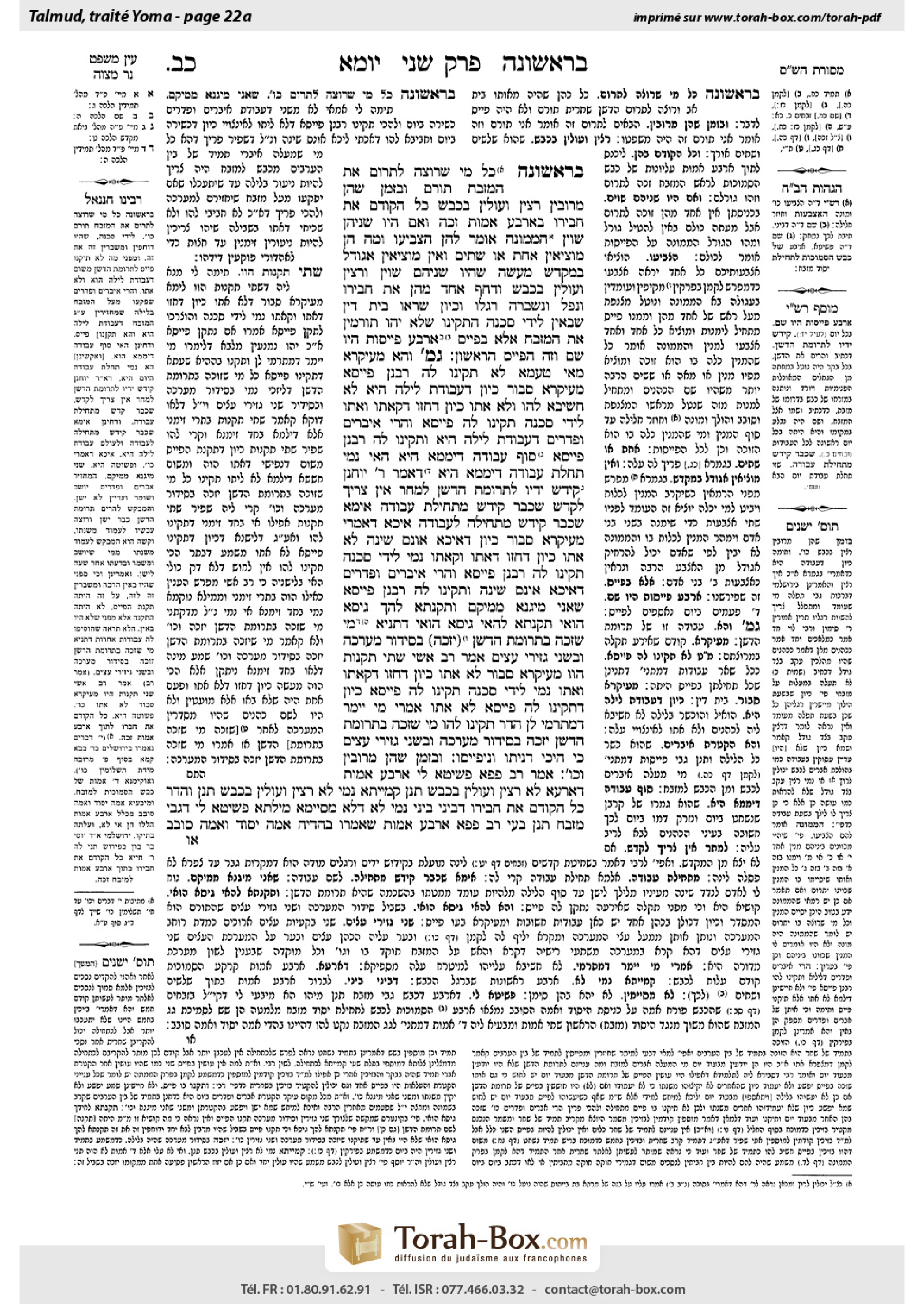
Yoma 22a: Talmud study for Daf Yomi
Daf Yomi is the daily study of one Talmud folio. Explore 37 tractates with scans, Hebrew text, Sefaria English and AI-generated French translations where annotated.
Passage selection and English or AI-generated French translation are available where the scan has annotations. Daf Study is independent of Torah-Box and Sefaria.
Browse Yoma · יומא · All tractatesYoma 22a text and translations
This page of Yoma includes the Aramaic text, an English translation and an AI-generated French translation, alongside the scan above.
יומא כ״ב א · Aramaic and Hebrew text
בָּרִאשׁוֹנָה כׇּל מִי שֶׁרוֹצֶה לִתְרוֹם אֶת הַמִּזְבֵּחַ — תּוֹרֵם. וּבִזְמַן שֶׁהֵן מְרוּבִּין רָצִין וְעוֹלִין בַּכֶּבֶשׁ, כׇּל הַקּוֹדֵם אֶת חֲבֵירוֹ בְּאַרְבַּע אַמּוֹת — זָכָה. וְאִם הָיוּ שְׁנֵיהֶן שָׁוִין, הַמְמוּנֶּה אוֹמֵר לָהֶן: הַצְבִּיעוּ.
וּמָה הֵן מוֹצִיאִין — אַחַת אוֹ שְׁתַּיִם, וְאֵין מוֹצִיאִין אֲגוּדָל בַּמִּקְדָּשׁ.
מַעֲשֶׂה שֶׁהָיוּ שְׁנֵיהֶם שָׁוִין, וְרָצִין וְעוֹלִין בַּכֶּבֶשׁ, וְדָחַף אֶחָד מֵהֶן אֶת חֲבֵירוֹ וְנָפַל וְנִשְׁבְּרָה רַגְלוֹ. וְכֵיוָן שֶׁרָאוּ בֵּית דִּין שֶׁבָּאִין לִידֵי סַכָּנָה, הִתְקִינוּ שֶׁלֹּא יְהוּ תּוֹרְמִין אֶת הַמִּזְבֵּחַ אֶלָּא בְּפַיִיס. אַרְבַּע פְּיָיסוֹת הָיוּ שָׁם, וְזֶה הַפַּיִיס הָרִאשׁוֹן.
גְּמָ׳ וְהָא מֵעִיקָּרָא מַאי טַעְמָא לָא תַּקִּינוּ לַהּ רַבָּנַן פַּיְיסָא? מֵעִיקָּרָא סְבוּר: כֵּיוָן דַּעֲבוֹדַת לַיְלָה הִיא — לָא חֲשִׁיבָא לְהוּ וְלָא אָתוּ. כֵּיוָן דְּחָזוּ דְּקָאָתוּ, וְאָתוּ לִידֵי סַכָּנָה — תַּקִּינוּ לַהּ פַּיְיסָא.
וַהֲרֵי אֵיבָרִים וּפְדָרִים, דַּעֲבוֹדַת לַיְלָה הִיא, וְתַקִּינוּ לַהּ רַבָּנַן פַּיְיסָא! סוֹף עֲבוֹדָה דִימָמָא הִיא.
הַאי נָמֵי תְּחִלַּת עֲבוֹדָה דִימָמָא הִיא, דְּאָמַר רַבִּי יוֹחָנָן: קִידֵּשׁ יָדָיו לִתְרוּמַת הַדֶּשֶׁן, לְמָחָר אֵין צָרִיךְ לְקַדֵּשׁ, שֶׁכְּבָר קִידֵּשׁ מִתְּחִילַּת עֲבוֹדָה!
אֵימָא: שֶׁכְּבָר קִידֵּשׁ מִתְּחִילָּה לָעֲבוֹדָה.
אִיכָּא דְּאָמְרִי: מֵעִיקָּרָא סְבוּר כֵּיוָן דְּאִיכָּא אוֹנֶס שֵׁינָה, לָא אָתוּ. כֵּיוָן דַּחֲזוֹ דְּאָתוּ, וְקָאָתוּ נָמֵי לִידֵי סַכָּנָה — תַּקִּינוּ לַהּ רַבָּנַן פַּיְיסָא. וַהֲרֵי אֵיבָרִים וּפְדָרִים, דְּאִיכָּא אוֹנֶס שֵׁינָה, וְתַקִּינוּ לַהּ רַבָּנַן פַּיְיסָא! שָׁאנֵי מִיגְנֵא מִמֵּיקַם.
וְתַקַּנְתָּא לְהָךְ גִּיסָא הֲוַאי? תַּקַּנְתָּא לְהַאי גִּיסָא הֲוַאי! דְּתַנְיָא: מִי שֶׁזָּכָה בִּתְרוּמַת הַדֶּשֶׁן (יִזְכֶּה) בְּסִידּוּר מַעֲרָכָה וּבִשְׁנֵי גְּזִירִי עֵצִים!
אָמַר רַב אָשֵׁי: שְׁתֵּי תַּקָּנוֹת הֲווֹ. מֵעִיקָּרָא סְבוּר לָא אָתוּ. כֵּיוָן דַּחֲזוּ דְּקָאָתוּ וְאָתוּ נָמֵי לִידֵי סַכָּנָה — תַּקִּינוּ לַהּ פַּיְיסָא, כֵּיוָן דְּתַקִּינוּ לַהּ פַּיְיסָא — לָא אֲתוֹ, אָמְרִי: מִי יֵימַר דְּמִתְרְמֵי לַן? הֲדַר תַּקִּינוּ לְהוּ מִי שֶׁזָּכָה בִּתְרוּמַת הַדֶּשֶׁן יִזְכֶּה בְּסִידּוּר מַעֲרָכָה וּבִשְׁנֵי גְּזִירֵי עֵצִים, כִּי הֵיכִי דְּנֵיתוֹ וְנִיפַיְּיסוֹ.
וּבִזְמַן שֶׁהֵן מְרוּבִּין וְכוּ׳. אָמַר רַב פָּפָּא: פְּשִׁיטָא לִי אַרְבַּע אַמּוֹת דְּאַרְעָא לָא, ״רָצִין וְעוֹלִין בַּכֶּבֶשׁ״ תְּנַן. קַמָּיָיתָא נָמֵי לָא, ״רָצִין וְעוֹלִין בַּכֶּבֶשׁ״ תְּנַן, וַהֲדַר ״כׇּל הַקּוֹדֵם אֶת חֲבֵירוֹ״.
דְּבֵינֵי בֵּינֵי נָמֵי לָא, דְּלָא מְסַיְּימָא מִילְּתָא. פְּשִׁיטָא לִי דְּגַבֵּי מִזְבֵּחַ תְּנַן.
בָּעֵי רַב פָּפָּא: אַרְבַּע אַמּוֹת שֶׁאָמְרוּ, בַּהֲדֵי אַמָּה יְסוֹד וְאַמָּה סוֹבֵב,
Yoma 22a · English translation
MISHNA: Initially, the practice among the priests was that whoever wishes to remove the ashes from the altar removes them. And when there are many priests who wish to perform that task, the privilege to do so is determined by a race: The priests run and ascend on the ramp leading to the top of the altar. Any priest who precedes another and reaches within four cubits of the top of the altar first is privileged to remove the ashes. And if both of them were equal and neither preceded the other, the appointed priest says to all the priests: Extend your fingers, and a lottery was performed, as will be explained.
And what fingers do they extend for the lottery? They may extend one or two fingers, and the priests do not extend a thumb in the Temple. The reason is that the lottery was conducted by the appointee choosing a number and counting the extended fingers of the priests standing in a circle. As the count progressed, a priest could calculate and manipulate the result in his favor by surreptitiously extending his thumb and an additional finger. Since there is separation between the thumb and the forefinger it could appear as though they belonged to two different priests, skewing the results of the lottery.
Initially, that was the procedure; however, an incident occurred where both of them were equal as they were running and ascending on the ramp, and one of them shoved another and he fell and his leg was broken. And once the court saw that people were coming to potential danger, they instituted that priests would remove ashes from the altar only by means of a lottery. There were four lotteries there, in the Temple, on a daily basis to determine the priests privileged to perform the various services, and this, determining which priest would remove the ashes, was the first lottery.
GEMARA: The Gemara questions the original practice of holding a race to determine which priest would remove the ashes: And what is the reason that the Sages did not initially institute a lottery for the removal of the ashes as they did for other parts of the service? The Gemara answers: Initially they thought: Since it is a service performed at night it would not be important to the priests, and not many of them would come to perform it, so a lottery would be unnecessary. Then, when they saw that many priests did indeed come and that they were coming to danger by racing up the altar’s ramp, they instituted a lottery.
The Gemara poses a question against the assertion that nighttime Temple services did not normally require a lottery: But there is the burning of the limbs of burnt-offerings and the fats of other offerings, which is a service that is performed at night, and nevertheless the Sages instituted a lottery for that from the outset. The Gemara answers: The burning of those parts is not considered a nighttime service but the end of a daytime service, as the main part of the sacrificial service, the slaughtering and the sprinkling of blood, took place during the day.
The Gemara asks: If so, it could be argued that this service of removing the ashes is also not a nighttime service but the start of a daytime service, as Rabbi Yoḥanan said: If a priest has sanctified his hands at night by washing them for the removal of the ashes, the next day, i.e., after daybreak, if he remained in the confines of the Temple, he need not sanctify his hands again, because he already sanctified them at the start of the service. Apparently, the removal of the ashes, though performed at night, is considered the start of the next day’s service.
The Gemara responds by emending Rabbi Yoḥanan’s statement: Say the following version of the end of Rabbi Yoḥanan’s statement: Because he had already sanctified them at the outset for service. According to this formulation, Rabbi Yoḥanan did not say that the removal of the ashes is considered the start of the following day’s service. Rather, he said that although the removal of the ashes is a nighttime service, since the priest sanctified his hands before performing that service, the sanctification remains in effect for the services performed after daybreak as well, since there is no interruption between the two activities.
Some say that the original practice should be explained as follows: Initially, the Sages thought that since there is a likelihood of being overcome by sleep at that time of night, not many priests would come. When they saw that they did indeed come and that they were also coming to danger, the Sages instituted a lottery for this task. The Gemara asks: But there is the burning of the limbs of burnt-offerings and the fats of other offerings, a service for which there is the same likelihood of being overcome by sleep, and nevertheless the Sages instituted a lottery for that from the outset. The Gemara answers: Lying down to go to sleep late is different from rising in the middle of the night. It is not as difficult to stay up late in order to burn limbs on the altar as it is to rise before dawn to remove the ashes from the altar.
The Gemara addresses the substance of the mishna’s claim: But was the ordinance to assign the removal of ashes by means of a lottery due to that reason cited in the mishna, the matter of the dangerous incident? The ordinance was instituted due to this reason: There were other important tasks associated with the removal of the ashes that required a lottery in their own right, as it was taught in a baraita: The priest who was privileged to perform the removal of the ashes was also privileged with laying out the arrangement of wood on the altar and with placing the two logs that were placed on the altar each morning. Since these were inherently important tasks, the only way to assign them was through a lottery, which would also determine who removed the ashes.
The Gemara answers: Rav Ashi said: There were two separate ordinances instituted. Initially, the Sages thought that priests would not come forward to perform the task of removing the ashes. Once they saw that many priests did come and that they were also coming to danger, the Sages instituted a lottery for this task. Once they established a lottery for removing the ashes, the priests did not come anymore. They said: Who says the lottery will fall in our favor? Therefore, they did not bother to come. Then the Sages instituted for the priests that whoever was privileged with performing the removal of the ashes would also be privileged with laying out the arrangement of wood on the altar and with placing the two logs, so that the importance of all these tasks combined would ensure that the priests would come and participate in the lottery.
§ It was taught in the mishna that before the lottery was instituted, when there were many priests who sought to perform the removal of the ashes, the first priest to reach within four cubits of the top of the altar was privileged with performing the removal of the ashes. Rav Pappa said: It is obvious to me that the four cubits the mishna is referring to are not the four cubits adjacent to the ramp on the ground, because we learned in the mishna that the priests run and ascend on the ramp, and not adjacent to the ramp. It is also not referring to the first four cubits from the foot of the ramp, because we learned that the priests run and ascend on the ramp, and only afterward it says: Any priest who precedes another and reaches within four cubits of the altar first, indicating that the competition begins only once they have ascended the ramp to some extent.
It is also not referring to four cubits somewhere in the middle, between the four on the bottom and the top of the altar, because the matter is not defined and there is no clear indication which four cubits on the ramp are the determining cubits. In light of all this, it is obvious to me that the four cubits we learned in the mishna are referring to the four cubits that are adjacent to the altar itself. The priest who reaches those four cubits first is the one privileged to remove the ashes.
Rav Pappa raised a dilemma based on the above clarification: Are the four cubits that they stated, which are the four cubits adjacent to the altar, calculated including the cubit of the base of the altar and the cubit of its ledge, as the ramp continues and overlaps these two cubits at the top of the altar,
Yoma 22a · Traduction française (IA)
MICHNA : Au début, la pratique parmi les prêtres était que quiconque souhaitait retirer les cendres de l’autel pouvait le faire. Lorsque de nombreux prêtres souhaitaient accomplir cette tâche, le privilège leur était attribué à l’issue d’une course : les prêtres couraient et montaient sur la rampe menant au sommet de l’autel. Le premier prêtre à devancer un autre et à parvenir à moins de quatre coudées du sommet de l’autel obtenait le privilège de retirer les cendres. Si deux d’entre eux étaient à égalité, sans que l’un ait devancé l’autre, le prêtre préposé disait à tous les prêtres : « Tendez vos doigts », et un tirage au sort était effectué, comme cela sera expliqué.
Quels doigts tendaient-ils pour le tirage au sort ? Ils pouvaient tendre un ou deux doigts, mais les prêtres ne tendaient pas le pouce dans le Temple. En effet, le tirage au sort était effectué par le préposé, qui choisissait un nombre puis comptait les doigts tendus des prêtres disposés en cercle. Au fur et à mesure du décompte, un prêtre pouvait calculer et fausser le résultat à son avantage en tendant discrètement son pouce en plus d’un autre doigt. Comme il y a un espace entre le pouce et l’index, on pouvait croire qu’ils appartenaient à deux prêtres différents, ce qui faussait le résultat du tirage au sort.
Telle était la procédure au début. Toutefois, un incident se produisit : deux prêtres étaient à égalité tandis qu’ils couraient et montaient sur la rampe, et l’un d’eux poussa l’autre, qui tomba et se cassa la jambe. Lorsque le tribunal vit que les prêtres s’exposaient à un danger, il décréta que les prêtres ne retireraient les cendres de l’autel que par tirage au sort. Chaque jour, il y avait dans le Temple quatre tirages au sort pour désigner les prêtres qui auraient le privilège d’accomplir les différents services ; celui qui déterminait quel prêtre retirerait les cendres était le premier.
GUEMARA : La Guemara remet en question la pratique initiale consistant à organiser une course pour déterminer quel prêtre retirerait les cendres : pourquoi les Sages n’ont-ils pas institué d’emblée un tirage au sort pour le retrait des cendres, comme ils l’avaient fait pour les autres parties du service ? La Guemara répond : au début, ils pensaient que, puisqu’il s’agissait d’un service accompli la nuit, il n’aurait pas d’importance pour les prêtres et que peu d’entre eux viendraient l’accomplir ; un tirage au sort serait donc inutile. Puis, lorsqu’ils virent que de nombreux prêtres venaient effectivement et qu’ils s’exposaient au danger en courant sur la rampe de l’autel, ils instituèrent un tirage au sort.
La Guemara objecte à l’affirmation selon laquelle les services du Temple accomplis la nuit ne nécessitaient généralement pas de tirage au sort : il y a pourtant la combustion des membres des holocaustes et des graisses des autres sacrifices, un service accompli la nuit, et néanmoins les Sages instituèrent d’emblée un tirage au sort à cette fin. La Guemara répond : la combustion de ces parties n’est pas considérée comme un service nocturne, mais comme l’achèvement d’un service diurne, puisque l’essentiel du service sacrificiel — l’abattage et l’aspersion du sang — avait lieu pendant la journée.
La Guemara demande : dans ce cas, on pourrait également soutenir que le retrait des cendres n’est pas un service nocturne, mais le début d’un service diurne, car Rabbi Yoḥanan a dit : si un prêtre a sanctifié ses mains la nuit en les lavant pour retirer les cendres, le lendemain, c’est-à-dire après le lever du jour, s’il est resté dans l’enceinte du Temple, il n’a pas besoin de les sanctifier à nouveau, car il les a déjà sanctifiées au début du service. Il ressort apparemment de là que le retrait des cendres, bien qu’accompli la nuit, est considéré comme le début du service du jour suivant.
La Guemara répond en corrigeant la formulation de la déclaration de Rabbi Yoḥanan : il faut lire ainsi la fin de sa déclaration : « Car il les avait déjà sanctifiées au début, en vue du service. » Selon cette formulation, Rabbi Yoḥanan n’a pas dit que le retrait des cendres est considéré comme le début du service du lendemain. Il a plutôt dit que, bien que le retrait des cendres soit un service nocturne, puisque le prêtre a sanctifié ses mains avant de l’accomplir, cette sanctification reste valable également pour les services accomplis après le lever du jour, car aucune interruption ne sépare les deux activités.
Selon certains, il faut expliquer ainsi la pratique initiale : au début, les Sages pensaient que, puisqu’à cette heure de la nuit on risquait de succomber au sommeil, peu de prêtres viendraient. Lorsqu’ils virent qu’ils venaient effectivement et qu’ils s’exposaient également au danger, les Sages instituèrent un tirage au sort pour cette tâche. La Guemara demande : il y a pourtant la combustion des membres des holocaustes et des graisses des autres sacrifices, un service pour lequel on risquait tout autant de succomber au sommeil, et néanmoins les Sages instituèrent d’emblée un tirage au sort à cette fin. La Guemara répond : se coucher tard pour dormir n’est pas comparable au fait de se lever au milieu de la nuit. Il est moins difficile de veiller tard afin de brûler les membres sur l’autel que de se lever avant l’aube pour retirer les cendres de l’autel.
La Guemara examine le fondement de l’affirmation de la Michna : le décret visant à attribuer le retrait des cendres par tirage au sort a-t-il vraiment été pris pour la raison citée dans la Michna, à savoir l’incident dangereux ? Le décret fut pris pour la raison suivante : d’autres tâches importantes liées au retrait des cendres nécessitaient en elles-mêmes un tirage au sort. En effet, il a été enseigné dans une baraïta : le prêtre qui obtenait le privilège de retirer les cendres obtenait également celui de disposer le bois sur l’autel et d’y placer les deux bûches qu’on y déposait chaque matin. Puisqu’il s’agissait de tâches importantes en elles-mêmes, le seul moyen de les attribuer était un tirage au sort, qui déterminerait également qui retirerait les cendres.
La Guemara répond : Rav Ashi a dit qu’il y eut deux décrets distincts. Au début, les Sages pensaient que les prêtres ne se présenteraient pas pour retirer les cendres. Lorsqu’ils virent que de nombreux prêtres venaient effectivement et qu’ils s’exposaient également au danger, les Sages instituèrent un tirage au sort pour cette tâche. Une fois le tirage au sort instauré pour le retrait des cendres, les prêtres cessèrent de venir. Ils se dirent : « Qui sait si le tirage au sort nous sera favorable ? » Aussi ne prenaient-ils plus la peine de venir. Les Sages décrétèrent alors que le prêtre qui obtiendrait le privilège de retirer les cendres obtiendrait également celui de disposer le bois sur l’autel et d’y placer les deux bûches, afin que l’importance de toutes ces tâches réunies incite les prêtres à venir participer au tirage au sort.
§ La Michna enseigne qu’avant l’instauration du tirage au sort, lorsqu’un grand nombre de prêtres souhaitaient retirer les cendres, le premier à parvenir à moins de quatre coudées du sommet de l’autel obtenait le privilège de retirer les cendres. Rav Pappa dit : il m’est évident que les quatre coudées auxquelles la Michna fait référence ne sont pas les quatre coudées situées au sol, à côté de la rampe, car nous avons appris dans la Michna que les prêtres courent et montent sur la rampe, et non à côté de celle-ci. Il ne s’agit pas non plus des quatre premières coudées au pied de la rampe, car nous avons appris que les prêtres courent et montent sur la rampe, et qu’ensuite seulement il est dit : « Le premier prêtre à devancer un autre et à parvenir à moins de quatre coudées de l’autel », ce qui indique que la compétition ne commence qu’une fois qu’ils sont montés un certain temps sur la rampe.
Il ne s’agit pas non plus de quatre coudées situées quelque part au milieu, entre les quatre coudées du bas et le sommet de l’autel, car leur emplacement ne serait pas défini et rien n’indiquerait clairement lesquelles des coudées de la rampe déterminent le résultat. À la lumière de tout cela, il m’est évident que les quatre coudées mentionnées dans la Michna sont les quatre coudées qui jouxtent l’autel lui-même. Le prêtre qui parvient le premier à ces quatre coudées obtient le privilège de retirer les cendres.
Rav Pappa soulève une question à partir de cette précision : les quatre coudées dont ils ont parlé, c’est-à-dire les quatre coudées qui jouxtent l’autel, sont-elles calculées en incluant la coudée de la base de l’autel et celle de son rebord, puisque la rampe se prolonge et empiète sur ces deux coudées au sommet de l’autel,
Traduction française générée par IA à partir de l’édition anglaise de Sefaria. Vérifie toujours un passage avec le texte source.
Text from Sefaria: William Davidson Edition - Vocalized Aramaic (CC BY NC); William Davidson Edition - English (CC BY NC).