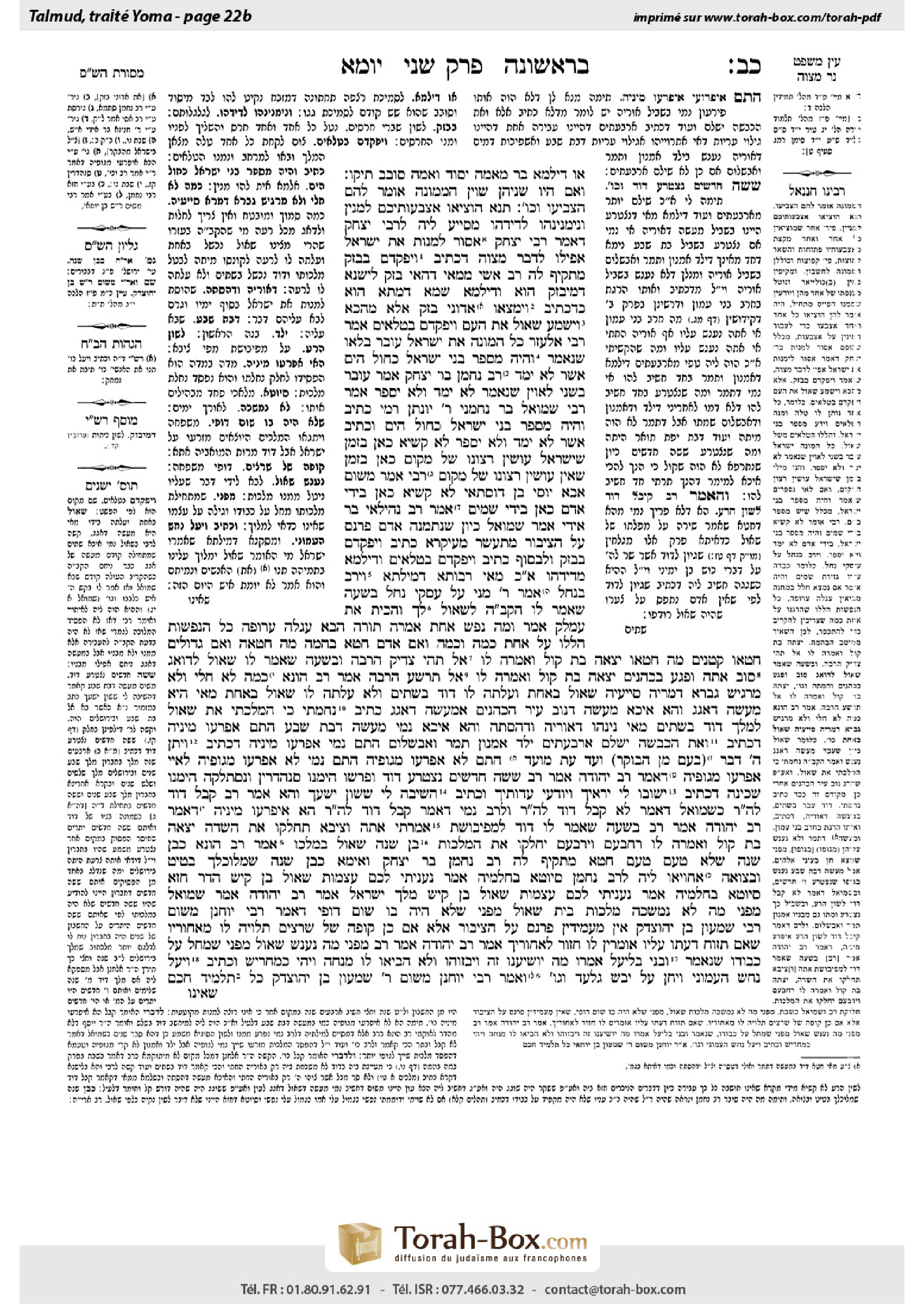
Yoma 22b: Talmud study for Daf Yomi
Daf Yomi is the daily study of one Talmud folio. Explore 37 tractates with scans, Hebrew text, Sefaria English and AI-generated French translations where annotated.
Passage selection and English or AI-generated French translation are available where the scan has annotations. Daf Study is independent of Torah-Box and Sefaria.
Browse Yoma · יומא · All tractatesYoma 22b text and translations
This page of Yoma includes the Aramaic text, an English translation and an AI-generated French translation, alongside the scan above.
יומא כ״ב ב · Aramaic and Hebrew text
אוֹ דִילְמָא בַּר מֵאַמָּה יְסוֹד וְאַמָּה סוֹבֵב? תֵּיקוּ.
וְאִם הָיוּ שְׁנֵיהֶן שָׁוִין, הַמְּמוּנֶּה אוֹמֵר לָהֶם הַצְבִּיעוּ וְכוּ׳. תָּנָא: הוֹצִיאוּ אֶצְבְּעוֹתֵיכֶם לְמִנְיָן. וְנִימְנִינְהוּ לְדִידְהוּ? מְסַיַּיע לֵיהּ לְרַבִּי יִצְחָק. דְּאָמַר רַבִּי יִצְחָק: אָסוּר לִמְנוֹת אֶת יִשְׂרָאֵל אֲפִילּוּ לִדְבַר מִצְוָה, דִּכְתִיב: ״וַיִּפְקְדֵם בְּבֶזֶק״.
מַתְקֵיף לַהּ רַב אָשֵׁי: מִמַּאי דְּהַאי ״בֶּזֶק״ לִישָּׁנָא דְּמִיבְזַק הוּא? וְדִילְמָא שְׁמָא דְמָתָא הוּא, כְּדִכְתִיב: ״וַיִּמְצְאוּ אֲדוֹנִי בֶזֶק״. אֶלָּא מֵהָכָא: ״וַיְשַׁמַּע שָׁאוּל אֶת הָעָם וַיִּפְקְדֵם בַּטְּלָאִים״.
אָמַר רַבִּי אֶלְעָזָר: כׇּל הַמּוֹנֶה אֶת יִשְׂרָאֵל עוֹבֵר בְּלָאו, שֶׁנֶּאֱמַר: ״וְהָיָה מִסְפַּר בְּנֵי יִשְׂרָאֵל כְּחוֹל הַיָּם אֲשֶׁר לֹא יִמַּד״. רַב נַחְמָן בַּר יִצְחָק אָמַר: עוֹבֵר בִּשְׁנֵי לָאוִין, שֶׁנֶּאֱמַר: ״לֹא יִמַּד וְלֹא יִסָּפֵר״.
אָמַר רַבִּי שְׁמוּאֵל בַּר נַחְמָנִי, רַבִּי יוֹנָתָן רָמֵי, כְּתִיב: ״וְהָיָה מִסְפַּר בְּנֵי יִשְׂרָאֵל כְּחוֹל הַיָּם״, וּכְתִיב ״אֲשֶׁר לֹא יִמַּד וְלֹא יִסָּפֵר״?
לָא קַשְׁיָא: כָּאן בִּזְמַן שֶׁיִּשְׂרָאֵל עוֹשִׂין רְצוֹנוֹ שֶׁל מָקוֹם, כָּאן בִּזְמַן שֶׁאֵין עוֹשִׂין רְצוֹנוֹ שֶׁל מָקוֹם. רַבִּי אָמַר מִשּׁוּם אַבָּא יוֹסֵי בֶּן דּוֹסְתַּאי, לָא קַשְׁיָא: כָּאן בִּידֵי אָדָם, כָּאן בִּידֵי שָׁמַיִם.
אָמַר רַב נְהִילַאי בַּר אִידִי אָמַר שְׁמוּאֵל: כֵּיוָן שֶׁנִּתְמַנָּה אָדָם פַּרְנָס עַל הַצִּיבּוּר — מִתְעַשֵּׁר. מֵעִיקָּרָא כְּתִיב: ״וַיִּפְקְדֵם בְּבֶזֶק״, וּלְבַסּוֹף כְּתִיב: ״וַיִּפְקְדֵם בַּטְּלָאִים״. וְדִילְמָא מִדִּידְהוּ? אִם כֵּן, מַאי רְבוּתָא דְמִילְּתָא?!
״וַיָּרֶב בַּנָּחַל״, אָמַר רַבִּי מָנִי: עַל עִסְקֵי נַחַל. בְּשָׁעָה שֶׁאָמַר לוֹ הַקָּדוֹשׁ בָּרוּךְ הוּא לְשָׁאוּל: ״לֵךְ וְהִכִּיתָ אֶת עֲמָלֵק״, אָמַר: וּמָה נֶפֶשׁ אַחַת אָמְרָה תּוֹרָה הָבֵא עֶגְלָה עֲרוּפָה — כׇּל הַנְּפָשׁוֹת הַלָּלוּ, עַל אַחַת כַּמָּה וְכַמָּה.
וְאִם אָדָם חָטָא, בְּהֵמָה מֶה חָטְאָה? וְאִם גְּדוֹלִים חָטְאוּ, קְטַנִּים מֶה חָטְאוּ? יָצְאָה בַּת קוֹל וְאָמְרָה לוֹ: ״אַל תְּהִי צַדִּיק הַרְבֵּה״. וּבְשָׁעָה שֶׁאָמַר לוֹ שָׁאוּל לְדוֹאֵג: ״סוֹב אַתָּה וּפְגַע בַּכֹּהֲנִים״, יָצְאָה בַּת קוֹל וְאָמְרָה לוֹ: ״אַל תִּרְשַׁע הַרְבֵּה״.
אָמַר רַב הוּנָא: כַּמָּה לָא חָלֵי וְלָא מַרְגֵּישׁ גַּבְרָא דְּמָרֵיהּ סַיְּיעֵיהּ, שָׁאוּל בְּאַחַת — וְעָלְתָה לוֹ. דָּוִד בִּשְׁתַּיִם — וְלֹא עָלְתָה לוֹ. שָׁאוּל בְּאַחַת מַאי הִיא? מַעֲשֶׂה דַּאֲגָג. וְהָא אִיכָּא מַעֲשֶׂה דְּנוֹב עִיר הַכֹּהֲנִים! אַמַּעֲשֶׂה דַּאֲגָג כְּתִיב: ״נִחַמְתִּי כִּי הִמְלַכְתִּי אֶת שָׁאוּל לְמֶלֶךְ״.
דָּוִד בִּשְׁתַּיִם מַאי נִינְהוּ — דְּאוּרִיָּה, וְדַהֲסָתָה.
וְהָא אִיכָּא נָמֵי מַעֲשֶׂה דְּבַת שֶׁבַע! הָתָם אִפְּרַעוּ מִינֵּיהּ, דִּכְתִיב: ״וְאֶת הַכִּבְשָׂה יְשַׁלֵּם אַרְבַּעְתָּיִם״, יֶלֶד, אַמְנוֹן, תָּמָר, וְאַבְשָׁלוֹם.
הָתָם נָמֵי אִפְּרַעוּ מִינֵּיהּ, דִּכְתִיב: ״וַיִּתֵּן ה׳ דֶּבֶר (בָּעָם מִן הַבּוֹקֶר) וְעַד עֵת מוֹעֵד״! הָתָם לָא אִפְּרַעוּ מִגּוּפֵיהּ.
הָתָם נָמֵי לָא אִפְּרַעוּ מִגּוּפֵיהּ! לָאיֵי אִפְּרַעוּ מִגּוּפֵיהּ, דְּאָמַר רַב יְהוּדָה אָמַר רַב: שִׁשָּׁה חֳדָשִׁים נִצְטָרַע דָּוִד וּפָרְשׁוּ הֵימֶנּוּ סַנְהֶדְרִין, וְנִסְתַּלְּקָה הֵימֶנּוּ שְׁכִינָה, דִּכְתִיב: ״יָשׁוּבוּ לִי יְרֵאֶיךָ וְיוֹדְעֵי עֵדוֹתֶיךָ״. וּכְתִיב: ״הָשִׁיבָה לִּי שְׂשׂוֹן יִשְׁעֶךָ״.
וְהָא אָמַר רַב: קִבֵּל דָּוִד לָשׁוֹן הָרָע! כִּשְׁמוּאֵל, דְּאָמַר: לֹא קִבֵּל דָּוִד לָשׁוֹן הָרָע.
וּלְרַב נָמֵי דְּאָמַר קִבֵּל דָּוִד לָשׁוֹן הָרָע, הָא אִיפְּרַעוּ מִינֵּיהּ, דְּאָמַר רַב יְהוּדָה אָמַר רַב: בְּשָׁעָה שֶׁאָמַר לוֹ דָּוִד לִמְפִיבוֹשֶׁת: ״אָמַרְתִּי אַתָּה וְצִיבָא תַּחְלְקוּ אֶת הַשָּׂדֶה״, יָצְאָה בַּת קוֹל וְאָמְרָה לוֹ: ״רְחַבְעָם וְיָרׇבְעָם יַחְלְקוּ אֶת הַמַּלְכוּת״.
״בֶּן שָׁנָה שָׁאוּל בְּמׇלְכוֹ״, אָמַר רַב הוּנָא: כְּבֶן שָׁנָה, שֶׁלֹּא טָעַם טַעַם חֵטְא.
מַתְקֵיף לַהּ רַב נַחְמָן בַּר יִצְחָק: וְאֵימָא ״כְּבֶן שָׁנָה״, שֶׁמְּלוּכְלָךְ בְּטִיט וּבְצוֹאָה? אַחְוִיאוּ לֵיהּ לְרַב נַחְמָן סִיּוּטָא בְּחֶלְמֵיהּ. אָמַר: נַעֲנֵיתִי לָכֶם עַצְמוֹת שָׁאוּל בֶּן קִישׁ. הֲדַר חֲזָא סִיּוּטָא בְּחֶלְמֵיהּ. אָמַר: נַעֲנֵיתִי לָכֶם עַצְמוֹת שָׁאוּל בֶּן קִישׁ מֶלֶךְ יִשְׂרָאֵל.
אָמַר רַב יְהוּדָה אָמַר שְׁמוּאֵל: מִפְּנֵי מָה לֹא נִמְשְׁכָה מַלְכוּת בֵּית שָׁאוּל — מִפְּנֵי שֶׁלֹּא הָיָה בּוֹ שׁוּם דּוֹפִי, דְּאָמַר רַבִּי יוֹחָנָן מִשּׁוּם רַבִּי שִׁמְעוֹן בֶּן יְהוֹצָדָק: אֵין מַעֲמִידִין פַּרְנָס עַל הַצִּיבּוּר אֶלָּא אִם כֵּן קוּפָּה שֶׁל שְׁרָצִים תְּלוּיָה לוֹ מֵאֲחוֹרָיו. שֶׁאִם תָּזוּחַ דַּעְתּוֹ עָלָיו אוֹמְרִין לוֹ: חֲזוֹר לַאֲחוֹרֶיךָ.
אָמַר רַב יְהוּדָה אָמַר רַב: מִפְּנֵי מָה נֶעֱנַשׁ שָׁאוּל — מִפְּנֵי שֶׁמָּחַל עַל כְּבוֹדוֹ, שֶׁנֶּאֱמַר: ״וּבְנֵי בְלִיַּעַל אָמְרוּ מַה יּוֹשִׁיעֵנוּ זֶה וַיִּבְזוּהוּ וְלֹא הֵבִיאוּ לוֹ מִנְחָה וַיְהִי כְּמַחֲרִישׁ״, וּכְתִיב: ״וַיַּעַל נָחָשׁ הָעַמּוֹנִי וַיִּחַן עַל יָבֵשׁ גִּלְעָד וְגוֹ׳״.
וְאָמַר רַבִּי יוֹחָנָן מִשּׁוּם רַבִּי שִׁמְעוֹן בֶּן יְהוֹצָדָק: כׇּל תַּלְמִיד חָכָם
Yoma 22b · English translation
or are they perhaps calculated excluding the cubit of the base of the altar and the cubit of its ledge? The altar’s edge can be considered to be at the end of the ramp, the point at which it meets the altar, or it can be considered the point on the ramp that is directly over the external base of the altar, which is two cubits away from the point where the ramp meets the altar. Which of these two calculations is the correct one? Rav Pappa’s question remains unanswered, and the Gemara concludes: The dilemma shall stand unresolved.
§ It was taught in the mishna that if both of them were equal and neither preceded the other, the appointed priest says to all the priests: Extend your fingers [hatzbiu], and a lottery was performed. A tanna taught the meaning of the unusual term hatzbiu: Put out your fingers for a count. The Gemara asks: Let him count the priests themselves directly, rather than counting their fingers. The Gemara answers: This is a support for a teaching of Rabbi Yitzḥak, as Rabbi Yitzḥak said: It is prohibited to count Jews directly, even for the purposes of a mitzva, as it is written concerning King Saul and his count of his soldiers: “And he numbered them with bezek” (I Samuel 11:8), meaning that he counted them through shards, one shard representing each man, rather than counting them directly.
Rav Ashi strongly objects to this interpretation of the verse: From where do you derive that this word bezek is a term related to the verb meaning to break apart, so that it means shards? Perhaps it is the name of a town, and it means that Saul counted them in Bezek, as it is written: “And they found Adoni-bezek in Bezek” (Judges 1:5), which shows that Bezek is the name of a place. The Gemara answers: Indeed, the proof is not from that verse but from here, where it says: “And Saul summoned the people and numbered them by sheep” (I Samuel 15:4), meaning that Saul tallied his soldiers by having each one take a sheep and put it aside to represent him in the count.
Rabbi Elazar said: Whoever counts a group of Jews violates a negative mitzva, as it is stated: “And the number of the children of Israel will be like the sand of the sea, which cannot be measured” (Hosea 2:1). Rabbi Elazar interprets the verse to be saying: Which may not be measured. Rav Naḥman bar Yitzḥak said: One who counts a group of Jews in fact violates two negative mitzvot, as it is stated in that verse: “Which cannot be measured and cannot be counted” (Hosea 2:1).
Rabbi Shmuel bar Naḥmani said that Rabbi Yonatan raised a contradiction: It is written in this verse: “And the number of the children of Israel will be like the sand of the sea,” suggesting that they will have a specific number, though it will be very large. On the other hand, it continues and says: “Which cannot be measured and cannot be counted,” which means they will not be countable at all. How can these two statements be reconciled?
It is not difficult: Here, in the second statement, it is referring to a time when the Jewish people fulfill the will of God; then they will be innumerable. There, in the first statement, it is referring to a time when the Jewish people do not fulfill the will of God; then they will be like the sand of the sea, having a specific number. Rabbi Yehuda HaNasi said a different resolution in the name of Abba Yosei ben Dostai: It is not difficult: Here, in the second statement, it is referring to counting by the hand of man; the Jewish people will be too numerous to count by man. There, in the first statement, it is referring to counting by the hand of God, and He will find that they are like the number of the grains of the sand of the sea.
Rav Nehilai bar Idi said that Shmuel said: Once a man is appointed as a leader of the community, he becomes wealthy. This is derived from the verses cited above. Initially, it is written with regard to Saul: “And he numbered them with bezek,” meaning pottery shards, and in the end it is written: “And he numbered them with sheep,” indicating that he was able to provide enough of his own sheep to use them in counting the people. The Gemara asks: But perhaps the people provided these sheep from their own flocks. The Gemara rejects this: If so, what is the novelty in the matter? Why would the text tell us that the people were counted with sheep if not to illustrate incidentally the great wealth of Saul?
§ Having mentioned the verse about Saul, the Gemara proceeds to interpret more of that passage: “And Saul came to the city of Amalek and he strove in the valley” (I Samuel 15:5). Rabbi Mani said: This means that Saul strove with God, as it were, concerning the matter of the valley. At the time when the Holy One, Blessed be He, said to Saul: “Now go and attack Amalek and proscribe all that belongs to him; do not pity him, but kill men and women alike, infants and sucklings alike, oxen and sheep alike, camel and donkey alike” (I Samuel 15:3), Saul countered and said: Now, if on account of one life that is taken, in a case where a slain person’s body is found and the murderer is unknown, the Torah said to bring a heifer whose neck is broken to a barren valley, in the atonement ritual described in Deuteronomy 21:1–9, all the more so must I have pity and not take all these Amalekite lives.
And he further reasoned: If the men have sinned, in what way have the animals sinned? Why, then, should the Amalekites’ livestock be destroyed? And if the adults have sinned, in what way have the children sinned? A Divine Voice then came forth and said to him: “Do not be overly righteous” (Ecclesiastes 7:16). That is to say: Do not be more merciful than the Creator Himself, Who has commanded you to do this, for to do so would not be an indication of righteousness but of weakness. At a later time, when Saul said to Doeg: “Turn around and strike down the priests, and Doeg the Edomite turned around and struck down the priests, and he killed on that day eighty-five men who wore the linen ephod, and he struck Nob the city of priests by the sword, man and woman alike, infants and sucklings alike, oxen and donkeys and sheep, by the sword” (I Samuel 22:18–19), a Divine Voice came forth and said to him: “Do not be overly wicked” (Ecclesiastes 7:17).
Apropos Saul’s contravention of God’s command to obliterate Amalek, the Gemara observes that Rav Huna said: How little does a person who has the support of his Lord have to worry or be concerned. The proof for this assertion is a comparison between Saul and David. Saul failed with one single sin and it was counted against him, costing him the throne. David, however, failed with two sins and they were not counted against him, as he retained his position. The Gemara asks: What was Saul’s one sin? The incident with Agag, king of Amalek, whom Saul spared in defiance of God’s command (see I Samuel 15:9). But was this his sole sin? There is also the incident of Nob, the city of priests, in which Saul later slew many innocent people, as cited above. The Gemara answers: It was after the incident with Agag, and even before the incident at Nob, that God said: “I regret that I have crowned Saul to be king” (I Samuel 15:11).
Rav Huna stated above that David failed with two sins. What were they? One was the incident in which he had Uriah killed. The other was the matter of the incitement of David to conduct a census of the Jewish people (see II Samuel 24:1), which led to many deaths in a plague.
The Gemara asks: But were these his only two sins? There is also the incident of Bathsheba, in which he took another man’s wife as his own. The Gemara answers: There, in that case, punishment was exacted from him separately, so the matter is no longer listed among his sins, as it is written with regard to this incident: “And he shall restore the lamb fourfold” (II Samuel 12:6). The lamb was a metaphor for Bathsheba, and ultimately David was indeed given a fourfold punishment for taking Bathsheba: The first child born to Bathsheba and David died (see II Samuel 12:13–23); David’s son Amnon was killed; Tamar, his daughter, was raped by Amnon (see II Samuel 13); and his son Avshalom rebelled against him and was ultimately killed (see II Samuel 15–18).
The Gemara asks: If sins for which David was punished separately are not counted, one could ask: There, too, with regard to the sin of the census, he was punished separately, as it is written: “And the Lord sent a plague against Israel from the morning until the appointed time” (II Samuel 24:15). The Gemara responds: There, David was not punished personally, in his own body; rather, the punishment was inflicted on the Jewish people.
The Gemara challenges this: There, too, in the incident with Bathsheba, David was not punished personally, in his own body; rather, it was his children who suffered punishment. The Gemara answers: That is not so; he was punished personally, in his own body, for that sin, as Rav Yehuda said that Rav said: David was stricken with leprosy for six months after that incident, and the Sanhedrin withdrew from him in protest over his behavior, and the Divine Presence also left him. As it is written that David prayed: “May those who fear You return to me, and they who know Your testimonies” (Psalms 119:79). Since he prayed for the return of those who fear God and who know His testimonies, referring to the Sages of the Sanhedrin, it can be inferred that they had withdrawn from him. And it is written as well: “Restore to me the joy of Your salvation, let a vigorous spirit support me” (Psalms 51:14), where David asks for the return of the Divine Spirit, which had left him.
The Gemara asks: And didn’t David commit other sins? Didn’t Rav say: David accepted a slanderous report from Ziba about Mephibosheth, son of Jonathan, stating that the latter was pleased with David’s downfall? There was, in that case, this additional sin. The Gemara responds: Consequently, it is necessary to follow the approach of Shmuel, who said: David did not accept a slanderous report, because Ziba’s claim was true.
The Gemara continues: And even according to Rav, who said that David accepted a slanderous report, one could answer that that sin is not counted, as was he not punished for it? As Rav Yehuda said that Rav said: At the time when David said to Mephibosheth: “I say that you and Ziba should divide the field” (II Samuel 19:30), a Divine Voice came forth and said to him: Rehoboam and Jeroboam will divide the kingship. Because David believed Ziba’s slanderous report and awarded him half of Mephibosheth’s field, David was punished by having his kingdom divided into two. Following King Solomon’s death the Jewish people split into two kingdoms, Israel to the north and Judea to the south (see I Kings 12). Therefore, David was punished for that sin too.
§ The Gemara continues its discussion of Saul and David. It is written: “Saul was one year old when he began to reign” (I Samuel 13:1), which cannot be understood literally, as Saul was appointed king when he was a young man. Rav Huna said: The verse means that when he began to reign he was like a one-year–old, in that he had never tasted the taste of sin but was wholly innocent and upright.
Rav Naḥman bar Yitzḥak strongly objects to this interpretation of the verse, saying: You could just as well say that he was like a one-year-old in that he was always filthy with mud and excrement. Rav Naḥman was shown a frightful dream that night, and he understood it as a punishment for having disparaged Saul. He said: I humbly submit myself to you, O bones of Saul, son of Kish, and beg your forgiveness. But once again he was shown a frightful dream, and he understood that he had not shown enough deference in his first apology. He therefore said this time: I humbly submit myself to you, O bones of Saul, son of Kish, king of Israel, and beg your forgiveness. Subsequently, the nightmares ceased.
Rav Yehuda said that Shmuel said: Why did the kingship of the house of Saul not continue on to succeeding generations? It is because there was no flaw in his ancestry; he was of impeccable lineage. As Rabbi Yoḥanan said in the name of Rabbi Shimon ben Yehotzadak: One appoints a leader over the community only if he has a box full of creeping animals hanging behind him, i.e., he has something inappropriate in his ancestry that preceded him. Why is that? It is so that if he exhibits a haughty attitude toward the community, one can say to him: Turn and look behind you and be reminded of your humble roots. This is why David’s kingdom lasted while Saul’s did not, as David descended from a family with problematic ancestry, namely Tamar (see Genesis, chapter 38) and Ruth the Moabite (see Ruth 4:18–22).
Rav Yehuda said that Rav said: Why was Saul punished in that he was ultimately led to commit the sins described above? Because at the very outset of his reign he inappropriately forwent his royal honor, as it is stated with regard to Saul’s inauguration: “And some base fellows said: How can this man save us? So they disparaged him and brought him no present. But he made himself as if he did not hear” (I Samuel 10:27). And it is stated immediately afterward: “And Nahash the Ammonite marched up and encamped against Jabesh-gilead” (I Samuel 11:1). The implication is that if Saul had forcefully assumed his throne, Nahash would not have dared to attack the people of Jabesh-gilead. In this way, his humility led to the crisis.
And Rabbi Yoḥanan said in the name of Rabbi Shimon ben Yehotzadak: Any Torah scholar
Yoma 22b · Traduction française (IA)
Ou bien le calcul se fait-il sans compter la coudée de la base de l’autel ni celle de son rebord ? On peut considérer que le bord de l’autel se trouve à l’extrémité de la rampe, au point où celle-ci rejoint l’autel, ou bien au point de la rampe situé directement au-dessus de la base extérieure de l’autel, soit à deux coudées du point où la rampe rejoint l’autel. Laquelle de ces deux méthodes de calcul est correcte ? La question de Rav Pappa reste sans réponse, et la Guemara conclut : le dilemme demeure sans solution.
§ La Michna enseignait que, si les deux prêtres étaient à égalité et qu’aucun n’avait devancé l’autre, le prêtre chargé de la nomination disait à tous les prêtres : « Tendez vos doigts [hatzbiu] », puis on procédait à un tirage au sort. Un tanna enseigna le sens de ce terme inhabituel, hatzbiu : « Présentez vos doigts pour le décompte. » La Guemara demande : Pourquoi ne pas compter directement les prêtres eux-mêmes, au lieu de compter leurs doigts ? La Guemara répond : Cela appuie un enseignement de Rabbi Yitzḥak, car Rabbi Yitzḥak a dit : Il est interdit de compter directement les Juifs, même pour les besoins d’une mitsva, comme il est écrit au sujet du roi Saül et du décompte de ses soldats : « Et il les dénombra avec bezek » (I Samuel 11:8), c’est-à-dire qu’il les compta au moyen de tessons, un tesson représentant chaque homme, au lieu de les compter directement.
Rav Ashi s’oppose vivement à cette interprétation du verset : D’où déduisez-vous que le mot bezek est lié au verbe signifiant « briser », et qu’il désigne donc des tessons ? Il s’agit peut-être du nom d’une ville, auquel cas cela signifie que Saül les compta à Bezek, comme il est écrit : « Ils trouvèrent Adoni-Bezek à Bezek » (Juges 1:5), ce qui montre que Bezek est le nom d’un lieu. La Guemara répond : En effet, la preuve ne vient pas de ce verset, mais de celui-ci, où il est dit : « Saül convoqua le peuple et le dénombra au moyen de moutons » (I Samuel 15:4), ce qui signifie que Saül compta ses soldats en faisant prendre à chacun un mouton et en le mettant à part pour le représenter dans le décompte.
Rabbi Elazar a dit : Quiconque dénombre un groupe de Juifs transgresse une mitsva négative, comme il est dit : « Le nombre des enfants d’Israël sera comme le sable de la mer, qui ne peut être mesuré » (Osée 2:1). Rabbi Elazar interprète le verset ainsi : « Qui ne doit pas être mesuré. » Rav Naḥman bar Yitzḥak a dit : Celui qui dénombre un groupe de Juifs transgresse en réalité deux mitsvot négatives, comme il est dit dans ce verset : « Qui ne peut être mesuré ni dénombré » (Osée 2:1).
Rabbi Shmuel bar Naḥmani a rapporté que Rabbi Yonatan a soulevé une contradiction : Le verset dit : « Le nombre des enfants d’Israël sera comme le sable de la mer », ce qui laisse entendre qu’ils auront un nombre précis, même s’il est très grand. Mais il poursuit en disant : « Qui ne peut être mesuré ni dénombré », ce qui signifie qu’ils ne pourront pas être dénombrés du tout. Comment concilier ces deux affirmations ?
Il n’y a pas de difficulté : ici, dans la seconde affirmation, il est question d’une époque où le peuple juif accomplit la volonté de Dieu ; alors, il sera innombrable. Là, dans la première affirmation, il est question d’une époque où le peuple juif n’accomplit pas la volonté de Dieu ; alors, il sera comme le sable de la mer, c’est-à-dire qu’il aura un nombre précis. Rabbi Yehuda HaNasi a proposé une autre résolution au nom d’Abba Yosei ben Dostai : Il n’y a pas de difficulté : ici, dans la seconde affirmation, il s’agit d’un décompte effectué par la main de l’homme ; le peuple juif sera trop nombreux pour qu’un homme puisse le dénombrer. Là, dans la première affirmation, il s’agit d’un décompte effectué par la main de Dieu, et Il constatera qu’ils sont aussi nombreux que les grains de sable de la mer.
Rav Nehilai bar Idi a rapporté que Shmuel a dit : Dès qu’un homme est nommé dirigeant de la communauté, il s’enrichit. Cela se déduit des versets cités plus haut. Au début, il est écrit au sujet de Saül : « Et il les dénombra avec bezek », c’est-à-dire des tessons de poterie ; à la fin, il est écrit : « Et il les dénombra au moyen de moutons », ce qui indique qu’il pouvait fournir suffisamment de moutons de son propre troupeau pour les utiliser afin de compter le peuple. La Guemara demande : Mais peut-être les gens ont-ils fourni ces moutons de leurs propres troupeaux. La Guemara rejette cette possibilité : Si tel était le cas, quelle serait la nouveauté ? Pourquoi le texte nous dirait-il que les gens furent dénombrés au moyen de moutons, sinon pour indiquer incidemment la grande richesse de Saül ?
§ Après avoir mentionné le verset au sujet de Saül, la Guemara poursuit l’interprétation de ce passage : « Saül vint à la ville d’Amalek et lutta dans la vallée » (I Samuel 15:5). Rabbi Mani a dit : Cela signifie que Saül lutta, pour ainsi dire, avec Dieu au sujet de la vallée. Lorsque le Saint, béni soit-Il, dit à Saül : « Va maintenant, attaque Amalek et voue à l’interdit tout ce qui lui appartient ; ne l’épargne pas, mais tue hommes et femmes, enfants et nourrissons, bœufs et moutons, chameaux et ânes » (I Samuel 15:3), Saül répliqua : « Si, pour une seule vie ôtée, lorsque le corps d’un homme assassiné est retrouvé et que le meurtrier est inconnu, la Torah ordonne d’apporter une génisse dont on brise la nuque dans une vallée inculte, dans le rite d’expiation décrit en Deutéronome 21:1–9, à plus forte raison dois-je avoir pitié et ne pas ôter toutes ces vies amalécites. »
Il raisonna en outre ainsi : Si les hommes ont péché, en quoi les animaux ont-ils péché ? Pourquoi, alors, détruire le bétail des Amalécites ? Et si les adultes ont péché, en quoi les enfants ont-ils péché ? Une voix divine se fit alors entendre et lui dit : « Ne sois pas trop juste » (Ecclésiaste 7:16). Autrement dit : ne sois pas plus miséricordieux que le Créateur Lui-même, qui t’a ordonné de faire cela, car agir ainsi ne serait pas une marque de justice, mais de faiblesse. Plus tard, lorsque Saül dit à Doeg : « Retourne-toi et frappe les prêtres », Doeg l’Édomite se retourna et frappa les prêtres ; il tua ce jour-là quatre-vingt-cinq hommes qui portaient l’éphod de lin, puis frappa par l’épée Nob, la ville des prêtres, hommes et femmes, enfants et nourrissons, bœufs, ânes et moutons (I Samuel 22:18–19). Une voix divine se fit alors entendre et lui dit : « Ne sois pas trop méchant » (Ecclésiaste 7:17).
À propos de la désobéissance de Saül à l’ordre de Dieu d’anéantir Amalek, la Guemara rapporte que Rav Huna a dit : Celui qui bénéficie du soutien de son Seigneur a bien peu à craindre ou à se soucier. La preuve en est une comparaison entre Saül et David. Saül commit un seul péché, qui lui fut imputé et lui coûta le trône. David, en revanche, commit deux péchés qui ne lui furent pas imputés, puisqu’il conserva sa position. La Guemara demande : Quel fut l’unique péché de Saül ? L’affaire d’Agag, roi d’Amalek, que Saül épargna au mépris de l’ordre de Dieu (voir I Samuel 15:9). Mais fut-ce son seul péché ? Il y eut aussi l’affaire de Nob, la ville des prêtres, où Saül tua plus tard de nombreuses personnes innocentes, comme cité plus haut. La Guemara répond : C’est après l’affaire d’Agag, mais avant même celle de Nob, que Dieu dit : « Je regrette d’avoir fait régner Saül » (I Samuel 15:11).
Rav Huna a dit plus haut que David commit deux péchés. Quels furent-ils ? L’un était l’affaire où il fit tuer Urie. L’autre était le fait que David fut incité à procéder au recensement du peuple juif (voir II Samuel 24:1), ce qui entraîna de nombreux morts lors d’une épidémie.
La Guemara demande : Mais ces deux péchés furent-ils les seuls ? Il y eut aussi l’affaire de Bethsabée, où David prit pour femme celle d’un autre homme. La Guemara répond : Dans ce cas, le châtiment lui fut infligé séparément ; cette affaire ne figure donc plus parmi ses péchés, comme il est écrit à ce sujet : « Il rendra l’agneau au quadruple » (II Samuel 12:6). L’agneau était une métaphore de Bethsabée et, en fin de compte, David reçut bien un châtiment quadruple pour l’avoir prise : le premier enfant né de Bethsabée et de David mourut (voir II Samuel 12:13–23) ; Amnon, le fils de David, fut tué ; Tamar, sa fille, fut violée par Amnon (voir II Samuel 13) ; et son fils Avshalom se révolta contre lui et fut finalement tué (voir II Samuel 15–18).
La Guemara demande : Si les péchés pour lesquels David fut puni séparément ne sont pas comptés, on peut poser la question suivante : dans le cas du péché du recensement aussi, il fut puni séparément, comme il est écrit : « Le Seigneur envoya une épidémie contre Israël, depuis le matin jusqu’au moment fixé » (II Samuel 24:15). La Guemara répond : Dans ce cas, David ne fut pas puni personnellement, dans son propre corps ; c’est le peuple juif qui subit le châtiment.
La Guemara objecte : Dans l’affaire de Bethsabée aussi, David ne fut pas puni personnellement, dans son propre corps ; ce sont ses enfants qui subirent le châtiment. La Guemara répond : Ce n’est pas le cas ; il fut puni personnellement, dans son propre corps, pour ce péché, car Rav Yehuda a dit que Rav a dit : Après cette affaire, David fut atteint de lèpre pendant six mois, le Sanhédrin se retira de lui pour protester contre son comportement, et la Présence divine le quitta également. Il est en effet écrit que David pria : « Que ceux qui Te craignent reviennent vers moi, ceux qui connaissent Tes témoignages » (Psaumes 119:79). Puisqu’il pria pour le retour de ceux qui craignent Dieu et connaissent Ses témoignages, c’est-à-dire les Sages du Sanhédrin, on peut en déduire qu’ils s’étaient retirés de lui. Il est également écrit : « Rends-moi la joie de Ton salut, qu’un esprit généreux me soutienne » (Psaumes 51:14), où David demande le retour de l’Esprit divin, qui l’avait quitté.
La Guemara demande : David n’a-t-il pas commis d’autres péchés ? Rav n’a-t-il pas dit que David avait accepté les propos calomnieux de Ziba au sujet de Mephibosheth, fils de Jonathan, selon lesquels celui-ci se réjouissait de la chute de David ? Il y avait donc là un péché supplémentaire. La Guemara répond : Par conséquent, il faut suivre l’approche de Shmuel, qui a dit : David n’a pas accepté de propos calomnieux, car l’accusation de Ziba était vraie.
La Guemara poursuit : Même selon Rav, qui a dit que David avait accepté des propos calomnieux, on pourrait répondre que ce péché ne doit pas être compté, car n’a-t-il pas été puni pour cela ? Rav Yehuda a en effet dit que Rav a dit : Lorsque David dit à Mephibosheth : « Je dis que toi et Ziba vous partagerez le champ » (II Samuel 19:30), une voix divine se fit entendre et lui dit : « Rehoboam et Jeroboam se partageront la royauté. » Parce que David avait cru les propos calomnieux de Ziba et lui avait attribué la moitié du champ de Mephibosheth, il fut puni par la division de son royaume en deux. Après la mort du roi Salomon, le peuple juif se scinda en deux royaumes, Israël au nord et Juda au sud (voir I Rois 12). David fut donc aussi puni pour ce péché.
§ La Guemara poursuit son examen de Saül et de David. Il est écrit : « Saül avait un an lorsqu’il commença à régner » (I Samuel 13:1), ce qui ne peut être compris littéralement, puisque Saül fut nommé roi alors qu’il était un jeune homme. Rav Huna a dit : Le verset signifie qu’au début de son règne, il était comme un enfant d’un an, en ce sens qu’il n’avait jamais goûté au péché et qu’il était parfaitement innocent et droit.
Rav Naḥman bar Yitzḥak s’oppose vivement à cette interprétation du verset et dit : On pourrait tout aussi bien dire qu’il était comme un enfant d’un an en ce qu’il était toujours couvert de boue et d’excréments. Cette nuit-là, Rav Naḥman eut un rêve effrayant et comprit qu’il était puni pour avoir dénigré Saül. Il dit : Je me soumets humblement à toi, ô ossements de Saül, fils de Qish, et te demande pardon. Mais il eut de nouveau un rêve effrayant et comprit qu’il n’avait pas montré assez de déférence dans ses premières excuses. Il dit donc cette fois : Je me soumets humblement à toi, ô ossements de Saül, fils de Qish, roi d’Israël, et te demande pardon. Par la suite, les cauchemars cessèrent.
Rav Yehuda a rapporté que Shmuel a dit : Pourquoi la royauté de la maison de Saül ne s’est-elle pas poursuivie dans les générations suivantes ? Parce qu’il n’y avait aucune tare dans sa lignée : ses origines étaient irréprochables. Rabbi Yoḥanan a en effet dit au nom de Rabbi Shimon ben Yehotzadak : On ne nomme un dirigeant à la tête de la communauté que s’il a derrière lui une boîte remplie de bestioles rampantes, c’est-à-dire si ses ascendants comportent un élément inapproprié. Pourquoi ? Afin que, s’il adopte une attitude hautaine envers la communauté, on puisse lui dire : « Retourne-toi, regarde derrière toi et souviens-toi de tes humbles origines. » Voilà pourquoi la royauté de David dura, tandis que celle de Saül ne dura pas : David descendait d’une famille dont les origines posaient problème, à savoir Tamar (voir Genèse, chapitre 38) et Ruth la Moabite (voir Ruth 4:18–22).
Rav Yehuda a dit que Rav a dit : Pourquoi Saül fut-il puni au point de finir par commettre les péchés décrits plus haut ? Parce qu’au tout début de son règne, il renonça indûment à l’honneur dû à sa royauté, comme il est dit à propos de l’intronisation de Saül : « Des vauriens dirent : “Comment cet homme pourrait-il nous sauver ?” Ils le méprisèrent et ne lui apportèrent aucun présent. Mais il fit comme s’il n’entendait pas » (I Samuel 10:27). Et il est dit immédiatement après : « Nahash l’Ammonite monta camper contre Yabesh-Guiléad » (I Samuel 11:1). Cela implique que si Saül s’était fermement imposé comme roi, Nahash n’aurait pas osé attaquer les habitants de Yabesh-Guiléad. C’est ainsi que son humilité conduisit à la crise.
Et Rabbi Yoḥanan a dit au nom de Rabbi Shimon ben Yehotzadak : Tout érudit en Torah
Traduction française générée par IA à partir de l’édition anglaise de Sefaria. Vérifie toujours un passage avec le texte source.
Text from Sefaria: William Davidson Edition - Vocalized Aramaic (CC BY NC); William Davidson Edition - English (CC BY NC).