Yoma 23a: Talmud study for Daf Yomi
Daf Yomi is the daily study of one Talmud folio. Explore 37 tractates with scans, Hebrew text, Sefaria English and AI-generated French translations where annotated.
Passage selection and English or AI-generated French translation are available where the scan has annotations. Daf Study is independent of Torah-Box and Sefaria.
Browse Yoma · יומא · All tractatesYoma 23a text and translations
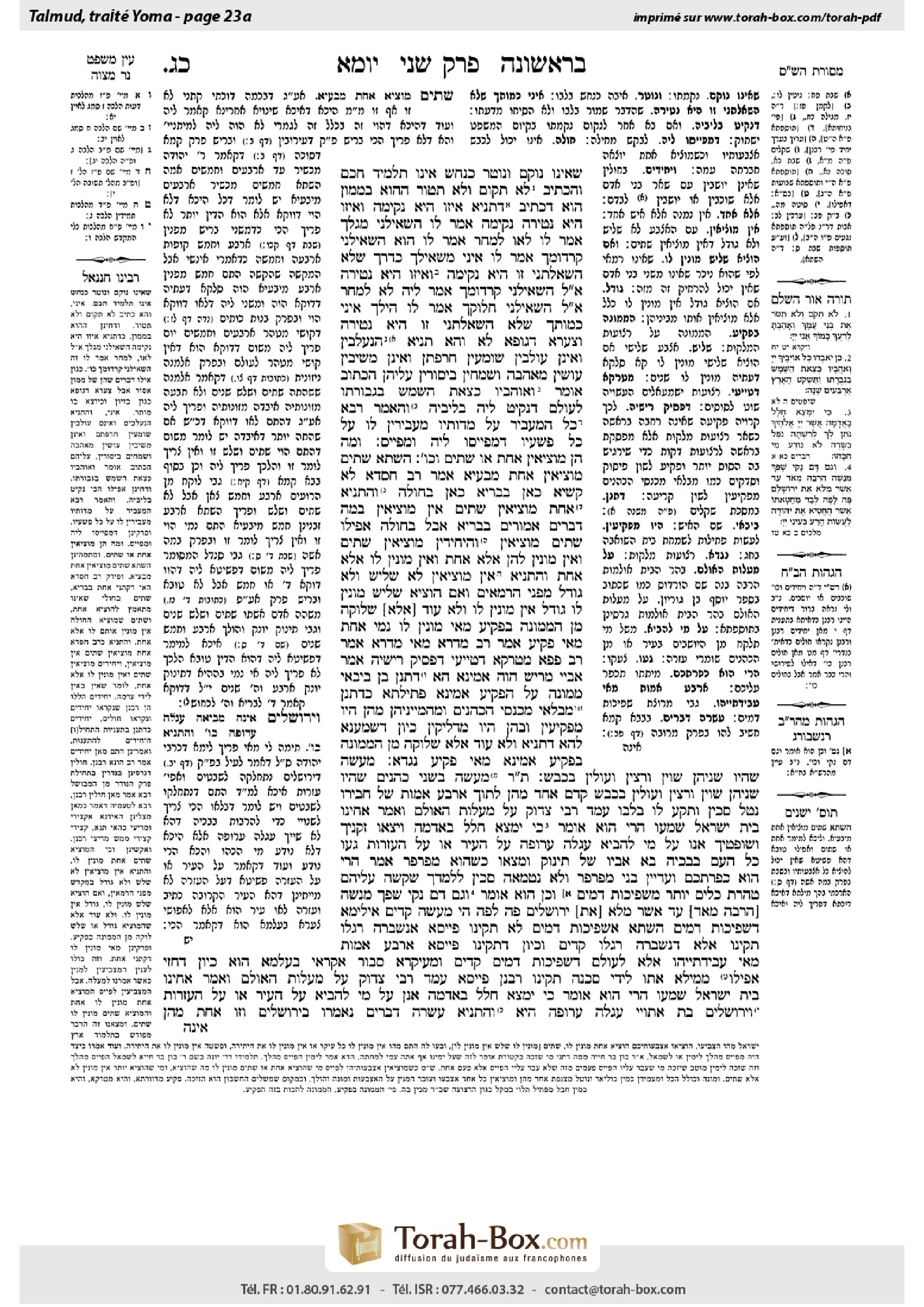
This page of Yoma includes the Aramaic text, an English translation and an AI-generated French translation, alongside the scan above.
יומא כ״ג א · Aramaic and Hebrew text
שֶׁאֵינוֹ נוֹקֵם וְנוֹטֵר כְּנָחָשׁ — אֵינוֹ תַּלְמִיד חָכָם. וְהָכְתִיב: ״לֹא תִקּוֹם וְלֹא תִטּוֹר״? הָהוּא, בְּמָמוֹן הוּא דִּכְתִיב, דְּתַנְיָא: אֵיזוֹ הִיא נְקִימָה וְאֵיזוֹ הִיא נְטִירָה? נְקִימָה — אָמַר לוֹ: הַשְׁאִילֵנִי מַגָּלְךָ, אָמַר לוֹ: לָאו. לְמָחָר אָמַר לוֹ הוּא: הַשְׁאִילֵנִי קַרְדּוּמְּךָ, אָמַר לוֹ: אֵינִי מַשְׁאִילְךָ, כְּדֶרֶךְ שֶׁלֹּא הִשְׁאַלְתַּנִי — זוֹ הִיא נְקִימָה.
וְאֵיזוֹ הִיא נְטִירָה? אָמַר לוֹ: הַשְׁאִילֵנִי קַרְדּוּמְּךָ, אָמַר לוֹ: לֹא. לְמָחָר אָמַר לוֹ: הַשְׁאִילֵנִי חֲלוּקְךָ! אָמַר לוֹ: הֵילָךְ, אֵינִי כְּמוֹתְךָ שֶׁלֹּא הִשְׁאַלְתַּנִי. זוֹ הִיא נְטִירָה.
וְצַעֲרָא דְגוּפָא לָא? וְהָא תַּנְיָא: הַנֶּעֱלָבִין וְאֵינָן עוֹלְבִין, שׁוֹמְעִין חֶרְפָּתָן וְאֵינָן מְשִׁיבִין, עוֹשִׂין מֵאַהֲבָה וּשְׂמֵחִין בְּיִסּוּרִין, עֲלֵיהֶן הַכָּתוּב אוֹמֵר: ״וְאוֹהֲבָיו כְּצֵאת הַשֶּׁמֶשׁ בִּגְבוּרָתוֹ״!
לְעוֹלָם דְּנָקֵיט לֵיהּ בְּלִיבֵּיהּ. וְהָאָמַר רָבָא: כׇּל הַמַּעֲבִיר עַל מִדּוֹתָיו — מַעֲבִירִין לוֹ עַל כׇּל פְּשָׁעָיו! דִּמְפַיְּיסוּ לֵיהּ וּמִפַּיַּיס.
וּמָה הֵן מוֹצִיאִין — אַחַת אוֹ שְׁתַּיִם וְכוּ׳. הַשְׁתָּא שְׁתַּיִם מוֹצִיאִין, אַחַת מִבַּעְיָא?
אָמַר רַב חִסְדָּא, לָא קַשְׁיָא: כָּאן בְּבָרִיא, כָּאן בְּחוֹלֶה. וְהָתַנְיָא: אַחַת — מוֹצִיאִין, שְׁתַּיִם — אֵין מוֹצִיאִין. בַּמֶּה דְּבָרִים אֲמוּרִים — בְּבָרִיא, אֲבָל בְּחוֹלֶה — אֲפִילּוּ שְׁתַּיִם מוֹצִיאִין. וְהַיְּחִידִין מוֹצִיאִין שְׁתַּיִם, וְאֵין מוֹנִין לָהֶן אֶלָּא אַחַת.
וְאֵין מוֹנִין לוֹ אֶלָּא אַחַת? וְהָתַנְיָא: אֵין מוֹצִיאִין לֹא שָׁלִישׁ וְלֹא גּוּדָל מִפְּנֵי הָרַמָּאִים. וְאִם הוֹצִיא שָׁלִישׁ — מוֹנִין לוֹ, גּוּדָל — אֵין מוֹנִין לוֹ, וְלֹא עוֹד, [אֶלָּא] שֶׁלּוֹקֶה מִן הַמְמוּנֶּה בַּפְּקִיעַ.
מַאי מוֹנִין לוֹ — נָמֵי אַחַת.
מַאי פְּקִיעַ? אָמַר רַב: מַדְרָא. מַאי מַדְרָא? אָמַר רַב פָּפָּא: מַטְרְקָא דְטַיָּיעֵי דִּפְסִיק רֵישֵׁיהּ.
אָמַר אַבָּיֵי: מֵרֵישׁ הֲוָה אָמֵינָא הָא דִּתְנַן: בֶּן בֵּיבַאי מְמוּנֶּה עַל הַפְּקִיעַ, אָמֵינָא פְּתִילָתָא. כְּדִתְנַן: מִבְּלָאֵי מִכְנְסֵי הַכֹּהֲנִים וּמֵהֶמְיָינֵיהֶן, מֵהֶן הָיוּ מַפְקִיעִין וּבָהֶן הָיוּ מַדְלִיקִין. כֵּיוָן דִּשְׁמַעְנָא לְהָא דְּתַנְיָא: וְלֹא עוֹד אֶלָּא שֶׁלּוֹקֶה מִן הַמְמוּנֶּה בַּפְּקִיעַ, אָמֵינָא: מַאי פְּקִיעַ — נַגְדָּא.
מַעֲשֶׂה שֶׁהָיוּ שְׁנֵיהֶן שָׁוִין וְרָצִין וְעוֹלִין בַּכֶּבֶשׁ. תָּנוּ רַבָּנַן: מַעֲשֶׂה בִּשְׁנֵי כֹהֲנִים שֶׁהָיוּ שְׁנֵיהֶן שָׁוִין, וְרָצִין וְעוֹלִין בַּכֶּבֶשׁ, קָדַם אֶחָד מֵהֶן לְתוֹךְ אַרְבַּע אַמּוֹת שֶׁל חֲבֵירוֹ, נָטַל סַכִּין וְתָקַע לוֹ בְּלִבּוֹ.
עָמַד רַבִּי צָדוֹק עַל מַעֲלוֹת הָאוּלָם, וְאָמַר: אָחִינוּ בֵּית יִשְׂרָאֵל שִׁמְעוּ! הֲרֵי הוּא אוֹמֵר ״כִּי יִמָּצֵא חָלָל בָּאֲדָמָה ... וְיָצְאוּ זְקֵנֶיךָ וְשׁוֹפְטֶיךָ״. אָנוּ, עַל מִי לְהָבִיא עֶגְלָה עֲרוּפָה? עַל הָעִיר, אוֹ עַל הָעֲזָרוֹת? גָּעוּ כׇּל הָעָם בִּבְכִיָּה.
בָּא אָבִיו שֶׁל תִּינוֹק וּמְצָאוֹ כְּשֶׁהוּא מְפַרְפֵּר. אָמַר: הֲרֵי הוּא כַּפָּרַתְכֶם, וַעֲדַיִין בְּנִי מְפַרְפֵּר, וְלֹא נִטְמְאָה סַכִּין. לְלַמֶּדְךָ שֶׁקָּשָׁה עֲלֵיהֶם טׇהֳרַת כֵּלִים יוֹתֵר מִשְּׁפִיכוּת דָּמִים. וְכֵן הוּא אוֹמֵר: ״וְגַם דָּם נָקִי שָׁפַךְ מְנַשֶּׁה [הַרְבֵּה מְאֹד] עַד אֲשֶׁר מִלֵּא [אֶת] יְרוּשָׁלִַים פֶּה לָפֶה״.
הַי מַעֲשֶׂה קָדֵים? אִילֵּימָא דִּשְׁפִיכוּת דָּמִים, הַשְׁתָּא אַשְּׁפִיכוּת דָּמִים לָא תַּקִּינוּ פַּיְיסָא, אַנִּשְׁבְּרָה רַגְלוֹ תַּקִּינוּ?! אֶלָּא, דְּנִשְׁבְּרָה רַגְלוֹ קָדֵים.
וְכֵיוָן דְּתַקִּינוּ פַּיְיסָא, אַרְבַּע אַמּוֹת מַאי עֲבִידְתַּיְיהוּ? אֶלָּא, לְעוֹלָם דִּשְׁפִיכוּת דָּמִים קָדֵים, וּמֵעִיקָּרָא סְבוּר אַקְרַאי בְּעָלְמָא הוּא. כֵּיוָן דַּחֲזוֹ אֲפִילּוּ מִמֵּילָא אָתוּ לִידֵי סַכָּנָה — תַּקִּינוּ רַבָּנַן פַּיְיסָא.
עָמַד רַבִּי צָדוֹק עַל מַעֲלוֹת הָאוּלָם וְאָמַר: אַחֵינוּ בֵּית יִשְׂרָאֵל שִׁמְעוּ! הֲרֵי הוּא אוֹמֵר: ״כִּי יִמָּצֵא חָלָל בָּאֲדָמָה״, אֲנַן, עַל מִי לְהָבִיא? עַל הָעִיר, אוֹ עַל הָעֲזָרוֹת? וִירוּשָׁלַיִם בַּת אֵתוֹיֵי עֶגְלָה עֲרוּפָה הִיא? וְהָתַנְיָא: עֲשָׂרָה דְּבָרִים נֶאֶמְרוּ בִּירוּשָׁלַיִם, וְזוֹ אַחַת מֵהֶן:
Yoma 23a · English translation
who does not avenge himself and bear a grudge like a snake when insulted is not considered a Torah scholar at all, as it is important to uphold the honor of Torah and its students by reacting harshly to insults. The Gemara asks: But isn’t it written explicitly in the Torah: “You shall not take vengeance nor bear any grudge against the children of your people” (Leviticus 19:18)? The Gemara responds: That prohibition is written with regard to monetary matters and not personal insults, as it was taught in a baraita: What is revenge and what is bearing a grudge? Revenge is illustrated by the following example: One said to his fellow: Lend me your sickle, and he said: No. The next day he, the one who had refused to lend the sickle, said to the other person: Lend me your ax. If he said to him: I will not lend to you, just as you did not lend to me, that is revenge.
And what is bearing a grudge? If one said to his fellow: Lend me your ax, and he said: No, and the next day he, the one who had refused to lend the ax, said to the other man: Lend me your robe; if the first one said to him: Here it is, as I am not like you, who would not lend to me, that is bearing a grudge. Although he does not respond to his friend’s inconsiderate behavior in kind, he still makes it known to his friend that he resents his inconsiderate behavior. This baraita shows that the prohibition relates only to monetary matters, such as borrowing and lending.
The Gemara asks: But does the prohibition against vengeance really not relate also to matters of personal anguish suffered by someone? Wasn’t it taught in a baraita: Those who are insulted but do not insult others, who hear themselves being shamed but do not respond, who act out of love for God, and who remain happy in their suffering, about them the verse states: “They that love Him be as the sun when it goes forth in its might” (Judges 5:31). This baraita shows that one should forgive personal insults as well as wrongs in monetary matters.
The Gemara responds that the prohibition against taking vengeance and bearing a grudge indeed applies to cases of personal anguish; however, actually, the scholar may keep resentment in his heart, though he should not act on it or remind the other person of his insulting behavior. The Gemara asks: But didn’t Rava say: With regard to whoever forgoes his reckonings with others for injustices done to him, the heavenly court in turn forgoes punishment for all his sins? The Gemara answers: Indeed, even a scholar who is insulted must forgive insults, but that is only in cases where his antagonist has sought to appease him, in which case he should allow himself to be appeased toward him. However, if no apology has been offered, the scholar should not forgive him, in order to uphold the honor of the Torah.
§ The mishna describes that the lottery between competing priests is conducted by the priests extending their fingers for a count. And the mishna elaborated: And what fingers do they extend for the lottery? They may extend one or two fingers, and the priests do not extend a thumb in the Temple. The Gemara asks: Now that the mishna states that the priest may extend two fingers, is it necessary to state that they may also extend one finger?
Rav Ḥisda said: This is not difficult. Here, when the mishna speaks of extending one finger, it is referring to a healthy person, who has no difficulty extending just one finger without extending a second one. There, when the mishna mentions two fingers, it is referring to a sick person, for whom it is difficult to extend a single finger at a time. And so it was taught in a baraita: They may extend one finger, but they may not extend two. In what case is this statement said? It is said in reference to a healthy person; however, a sick person may extend even two fingers. And the sick priests who sit or lie alone, separately from the other priests, extend two fingers, but their two fingers are counted only as one.
The Gemara asks: And are the sick priest’s two fingers really counted as only one? Wasn’t it taught in a baraita: The priests may not extend the third finger, i.e., the middle finger, or the thumb, together with the index finger, due to concern for cheaters. One who sees that the count is approaching him might intentionally extend or withdraw an extra finger so that the lottery will fall on him. But if he does extend the third finger it is counted for him. This is because the third finger cannot be stretched very far from the index finger, so that it is easily recognizable that both fingers are from the same person, and this is not taken as an attempt to cheat. If he extends his thumb, however, it is not counted for him, and moreover he is punished with lashes administered by the person in charge of the pakia. The implication of the baraita is that when the third finger is extended along with the index finger, both fingers are counted.
The Gemara answers: What does the baraita mean when it says that if the priest extended his middle finger along with his index finger, it is counted for him? It also means, as stated earlier, that the two fingers are counted as one.
The baraita mentions lashes administered by the person in charge of the pakia. What is a pakia? Rav said: It is a madra. However, the meaning of that term also became unclear over time, so the Gemara asks: What is a madra? Rav Pappa said: It is a whip [matraka] used by the Arabs, the end of which is split into several strands. That is the pakia mentioned above, which was used for punishing the priests.
Apropos this discussion, Abaye said: At first I would say as follows: When we learned in a mishna that ben Beivai was in charge of the pakia, I would say that it means that he was in charge of producing wicks, as we learned in another mishna: They would tear [mafkia] strips from the priests’ worn-out trousers and belts and make wicks out of them, with which they lit the lamps for the Celebration of Drawing Water. But once I heard that which is taught in the previously cited baraita: And moreover, he is punished with lashes administered by the person in charge of the pakia, I now say: What is a pakia? It is lashes. Ben Beivai was in charge of corporal punishment in the Temple.
§ It was taught in the mishna: An incident occurred where both of the priests were equal as they were running and ascending on the ramp, and one of them shoved the other and he fell and his leg was broken. The Sages taught in the Tosefta: An incident occurred where there were two priests who were equal as they were running and ascending the ramp. One of them reached the four cubits before his colleague, who then, out of anger, took a knife and stabbed him in the heart.
The Tosefta continues: Rabbi Tzadok then stood up on the steps of the Entrance Hall of the Sanctuary and said: Hear this, my brothers of the house of Israel. The verse states: “If one be found slain in the land... and it be not known who had smitten him; then your Elders and your judges shall come forth and they shall measure…and it shall be that the city which is nearest to the slain man…shall take a heifer” (Deuteronomy 21:1–3). And the Elders of that city took that heifer and broke its neck in a ritual of atonement. But what of us, in our situation? Upon whom is the obligation to bring the heifer whose neck is broken? Does the obligation fall on the city, Jerusalem, so that its Sages must bring the calf, or does the obligation fall upon the Temple courtyards, so that the priests must bring it? At that point the entire assembly of people burst into tears.
The father of the boy, i.e., the young priest who was stabbed, came and found that he was still convulsing. He said: May my son’s death be an atonement for you. But my son is still convulsing and has not yet died, and as such, the knife, which is in his body, has not become ritually impure through contact with a corpse. If you remove it promptly, it will still be pure for future use. The Tosefta comments: This incident comes to teach you that the ritual purity of utensils was of more concern to them than the shedding of blood. Even the boy’s father voiced more concern over the purity of the knife than over the death of his child. And similarly, it says: “Furthermore, Manasseh spilled innocent blood very much, till he had filled Jerusalem from one end to another” (II Kings 21:16), which shows that in his day as well people paid little attention to bloodshed.
The Gemara asks: Which incident came first, the one about the broken leg reported in the mishna or the one about the slain priest in the Tosefta? If we say that the incident of bloodshed came first, this raises a problem: Now, if in response to a case of bloodshed they did not establish a lottery but continued with the running competition, can it be that in response to an incident of a priest’s leg being broken they did establish a lottery? Rather, we must say that the case in which the priest’s leg was broken in the course of the race came first, and as the mishna states, the establishment of the lottery was in response to that incident.
The Gemara asks: If the running competition was abolished immediately after the incident of the broken leg and a lottery was instituted to replace it, once they established the lottery, what were they doing still running to within the four cubits in the incident that led to the priest’s murder? Rather, actually, it is necessary to return to the approach suggested earlier, that the case involving bloodshed came first. Initially, the Sages thought that it was merely a random, i.e., isolated, event, and because it was extremely unlikely for a murder to happen again they did not abolish the competition due to that incident. Then, once they saw that in any event the priests were coming to danger, as one of them was pushed and broke his leg, the Sages established a lottery.
The Gemara returns to the incident of the slain priest and discusses several details of it. It was related that Rabbi Tzadok stood up on the steps of the Entrance Hall of the Sanctuary and said: Hear this, my brothers of the house of Israel. The verse states: “If one be found slain in the land, etc.” But what of us, in our situation? Upon whom is the obligation to bring the heifer whose neck is broken? Does the obligation fall upon the city, Jerusalem, or does the obligation fall upon the Temple courtyards? The Gemara asks: Is Jerusalem subject to bringing a heifer whose neck is broken? Wasn’t it taught in a baraita: Ten things were said about Jerusalem to distinguish it from all other cities in Eretz Yisrael, and this is one of them:
Yoma 23a · Traduction française (IA)
Celui qui, lorsqu’on l’insulte, ne se venge pas et ne garde pas rancune comme un serpent n’est pas du tout considéré comme un érudit en Torah, car il importe de défendre l’honneur de la Torah et de ses étudiants en réagissant durement aux insultes. La Guemara demande : Mais n’est-il pas écrit explicitement dans la Torah : « Tu ne te vengeras pas et tu ne garderas pas rancune contre les enfants de ton peuple » (Lévitique 19,18) ? La Guemara répond : Cette interdiction concerne les questions d’argent, et non les insultes personnelles, comme il a été enseigné dans une baraïta : Qu’est-ce que la vengeance et qu’est-ce que garder rancune ? La vengeance est illustrée par l’exemple suivant : Quelqu’un dit à son compagnon : « Prête-moi ta faucille », et celui-ci répond : « Non. » Le lendemain, celui qui avait refusé de prêter sa faucille dit à l’autre : « Prête-moi ta hache. » Si l’autre lui répond : « Je ne te la prêterai pas, tout comme tu ne m’as pas prêté la tienne », c’est de la vengeance.
Et qu’est-ce que garder rancune ? Quelqu’un dit à son compagnon : « Prête-moi ta hache », et celui-ci répond : « Non. » Le lendemain, celui qui avait refusé de prêter sa hache dit à l’autre : « Prête-moi ton manteau. » Si le premier lui répond : « Le voici, car moi, je ne suis pas comme toi, qui as refusé de me prêter le tien », c’est garder rancune. Bien qu’il ne rende pas à son ami la pareille pour son comportement inconsidéré, il lui fait tout de même savoir qu’il lui en veut pour ce comportement. Cette baraïta montre que l’interdiction ne concerne que les questions d’argent, comme les emprunts et les prêts.
La Guemara demande : Mais l’interdiction de se venger ne concerne-t-elle vraiment pas aussi les souffrances personnelles subies par quelqu’un ? N’a-t-il pas été enseigné dans une baraïta : Ceux qui sont insultés mais n’insultent pas les autres, qui entendent qu’on les humilie mais ne répondent pas, qui agissent par amour pour Dieu et qui restent heureux dans leur souffrance, à leur sujet le verset dit : « Ceux qui t’aiment sont comme le soleil lorsqu’il se lève dans sa puissance » (Juges 5,31). Cette baraïta montre qu’il faut pardonner aussi bien les insultes personnelles que les torts liés à des questions d’argent.
La Guemara répond que l’interdiction de se venger et de garder rancune s’applique effectivement aux cas de souffrance personnelle ; cependant, l’érudit peut garder du ressentiment dans son cœur, sans toutefois agir en conséquence ni rappeler à l’autre son comportement insultant. La Guemara demande : Mais Rava n’a-t-il pas dit : Quiconque renonce à faire valoir ses griefs contre les autres pour les injustices qu’ils lui ont faites, la cour céleste renonce à son tour à le punir pour tous ses péchés ? La Guemara répond : En effet, même un érudit qui est insulté doit pardonner les insultes, mais seulement si son adversaire a cherché à se réconcilier avec lui ; dans ce cas, il doit accepter ses excuses. En revanche, si aucune excuse n’a été présentée, l’érudit ne doit pas lui pardonner, afin de préserver l’honneur de la Torah.
§ La Michna décrit le tirage au sort entre les prêtres qui se disputent une fonction : les prêtres tendent leurs doigts pour le décompte. La Michna précise : Quels doigts tendent-ils pour le tirage au sort ? Ils peuvent tendre un ou deux doigts, mais les prêtres ne tendent pas le pouce dans le Temple. La Guemara demande : Maintenant que la Michna indique qu’un prêtre peut tendre deux doigts, est-il nécessaire de préciser qu’il peut aussi n’en tendre qu’un seul ?
Rav Ḥisda dit : Il n’y a pas de difficulté. Ici, lorsque la Michna parle de tendre un doigt, elle se réfère à une personne bien portante, qui peut sans difficulté tendre un seul doigt sans en tendre un second. Là, lorsque la Michna mentionne deux doigts, elle se réfère à une personne malade, pour qui il est difficile de tendre un seul doigt à la fois. Et c’est ainsi qu’il a été enseigné dans une baraïta : Ils peuvent tendre un doigt, mais pas deux. Dans quel cas cette déclaration s’applique-t-elle ? Elle s’applique à une personne bien portante ; cependant, une personne malade peut en tendre même deux. Les prêtres malades, qui restent assis ou couchés à l’écart des autres prêtres, tendent deux doigts, mais ceux-ci ne sont comptés que pour un.
La Guemara demande : Les deux doigts du prêtre malade sont-ils vraiment comptés pour un seul ? N’a-t-il pas été enseigné dans une baraïta : Les prêtres ne peuvent pas tendre le troisième doigt, c’est-à-dire le majeur, ni le pouce avec l’index, de peur que certains ne trichent. Celui qui voit que le décompte approche de lui pourrait intentionnellement tendre ou retirer un doigt supplémentaire afin que le tirage au sort tombe sur lui. Mais s’il tend le troisième doigt, celui-ci est compté pour lui. En effet, le troisième doigt ne peut pas s’écarter beaucoup de l’index ; on reconnaît donc facilement que les deux doigts appartiennent à la même personne, et cela n’est pas considéré comme une tentative de tricherie. En revanche, s’il tend son pouce, celui-ci n’est pas compté pour lui ; de plus, il est puni de coups de fouet administrés par le responsable de la pakia. Il ressort de la baraïta que, lorsque le troisième doigt est tendu avec l’index, les deux doigts sont comptés.
La Guemara répond : Que signifie la baraïta lorsqu’elle dit que si le prêtre a tendu son majeur avec son index, celui-ci est compté pour lui ? Cela signifie également, comme indiqué plus haut, que les deux doigts sont comptés pour un seul.
La baraïta mentionne les coups de fouet administrés par le responsable de la pakia. Qu’est-ce qu’une pakia ? Rav dit : C’est une madra. Mais le sens de ce terme était lui aussi devenu obscur avec le temps ; la Guemara demande donc : Qu’est-ce qu’une madra ? Rav Pappa dit : C’est un fouet [matraka] utilisé par les Arabes, dont l’extrémité est fendue en plusieurs lanières. C’est la pakia mentionnée plus haut, qui servait à punir les prêtres.
À propos de cette discussion, Abaye dit : Au début, je pensais ceci : lorsque nous avons appris dans une Michna que ben Beivai était responsable de la pakia, je pensais que cela signifiait qu’il était chargé de fabriquer des mèches, car nous avons appris dans une autre Michna qu’ils arrachaient [mafkia] des bandes dans les pantalons et les ceintures usés des prêtres et en faisaient des mèches, avec lesquelles ils allumaient les lampes pour la Fête du puisage de l’eau. Mais après avoir entendu ce qui est enseigné dans la baraïta citée précédemment : « De plus, il est puni de coups de fouet administrés par le responsable de la pakia », je pense désormais ceci : Qu’est-ce qu’une pakia ? Ce sont des coups de fouet. Ben Beivai était chargé des châtiments corporels dans le Temple.
§ La Michna enseigne : Un incident se produisit lorsque deux prêtres, à égalité, couraient et montaient la rampe ; l’un d’eux poussa l’autre, qui tomba et se fractura la jambe. Les Sages enseignèrent dans la Tosefta : Un incident se produisit lorsque deux prêtres, à égalité, couraient et montaient la rampe. L’un d’eux parvint quatre coudées avant son collègue ; celui-ci, pris de colère, prit alors un couteau et le poignarda au cœur.
La Tosefta poursuit : Rabbi Tzadok se leva alors sur les marches du vestibule du Sanctuaire et dit : « Écoutez ceci, mes frères de la maison d’Israël. Le verset dit : “Si l’on trouve un homme tué dans le pays… et que l’on ne sache pas qui l’a frappé, tes anciens et tes juges sortiront et mesureront… et la ville la plus proche de l’homme tué… prendra une génisse” » (Deutéronome 21,1-3). Les anciens de cette ville prirent cette génisse et lui brisèrent la nuque dans un rite d’expiation. Mais qu’en est-il de nous, dans notre situation ? À qui incombe l’obligation d’apporter la génisse à la nuque brisée ? Incombe-t-elle à la ville, Jérusalem, de sorte que ses Sages doivent apporter la génisse, ou bien aux parvis du Temple, de sorte que les prêtres doivent l’apporter ? À cet instant, toute l’assemblée éclata en sanglots.
Le père du jeune homme, c’est-à-dire du jeune prêtre qui avait été poignardé, arriva et constata qu’il était encore agité de convulsions. Il dit : « Que la mort de mon fils vous serve d’expiation. Mais mon fils est encore agité de convulsions et n’est pas encore mort ; le couteau qui se trouve dans son corps n’est donc pas devenu rituellement impur au contact d’un cadavre. Si vous le retirez rapidement, il restera pur et pourra être réutilisé. » La Tosefta commente : Cet incident vient nous apprendre que la pureté rituelle des ustensiles les préoccupait davantage que l’effusion de sang. Même le père du jeune homme se souciait davantage de la pureté du couteau que de la mort de son enfant. De même, il est dit : « De plus, Manassé versa beaucoup de sang innocent, au point de remplir Jérusalem d’un bout à l’autre » (II Rois 21,16), ce qui montre qu’à son époque aussi, on prêtait peu d’attention aux effusions de sang.
La Guemara demande : Quel incident s’est produit en premier, celui de la jambe fracturée rapporté dans la Michna ou celui du prêtre tué dans la Tosefta ? Si l’on dit que l’effusion de sang a eu lieu en premier, un problème se pose : si, en réaction à un cas d’effusion de sang, ils n’ont pas institué de tirage au sort et ont poursuivi la compétition de course, se peut-il qu’en réaction à l’incident où un prêtre s’est fracturé la jambe, ils aient institué un tirage au sort ? Il faut plutôt dire que l’incident où le prêtre s’est fracturé la jambe pendant la course s’est produit en premier et, comme l’indique la Michna, que le tirage au sort fut institué en réaction à cet incident.
La Guemara demande : Si la compétition de course fut immédiatement abolie après l’incident de la jambe fracturée et remplacée par un tirage au sort, une fois celui-ci institué, pourquoi les prêtres continuaient-ils de courir jusqu’à quatre coudées dans l’incident qui aboutit au meurtre du prêtre ? En réalité, il faut revenir à l’explication suggérée précédemment, selon laquelle l’affaire de l’effusion de sang s’est produite en premier. Au début, les Sages pensèrent qu’il s’agissait simplement d’un événement fortuit, c’est-à-dire isolé ; comme il était extrêmement improbable qu’un meurtre se reproduise, ils n’abolirent pas la compétition à la suite de cet incident. Puis, lorsqu’ils virent que, de toute façon, les prêtres étaient exposés au danger, puisque l’un d’eux avait été poussé et s’était fracturé la jambe, les Sages instituèrent un tirage au sort.
La Guemara revient sur l’incident du prêtre tué et en examine plusieurs détails. Il a été rapporté que Rabbi Tzadok se leva sur les marches du vestibule du Sanctuaire et dit : « Écoutez ceci, mes frères de la maison d’Israël. Le verset dit : “Si l’on trouve un homme tué dans le pays, etc.” Mais qu’en est-il de nous, dans notre situation ? À qui incombe l’obligation d’apporter la génisse à la nuque brisée ? Incombe-t-elle à la ville, Jérusalem, ou aux parvis du Temple ? » La Guemara demande : Jérusalem est-elle soumise à l’obligation d’apporter une génisse à la nuque brisée ? N’a-t-il pas été enseigné dans une baraïta : Dix particularités ont été énoncées au sujet de Jérusalem pour la distinguer de toutes les autres villes d’Eretz Yisrael, et voici l’une d’elles :
Traduction française générée par IA à partir de l’édition anglaise de Sefaria. Vérifie toujours un passage avec le texte source.
Text from Sefaria: William Davidson Edition - Vocalized Aramaic (CC BY NC); William Davidson Edition - English (CC BY NC).