Yoma 23b: Talmud study for Daf Yomi
Daf Yomi is the daily study of one Talmud folio. Explore 37 tractates with scans, Hebrew text, Sefaria English and AI-generated French translations where annotated.
Passage selection and English or AI-generated French translation are available where the scan has annotations. Daf Study is independent of Torah-Box and Sefaria.
Browse Yoma · יומא · All tractatesYoma 23b text and translations
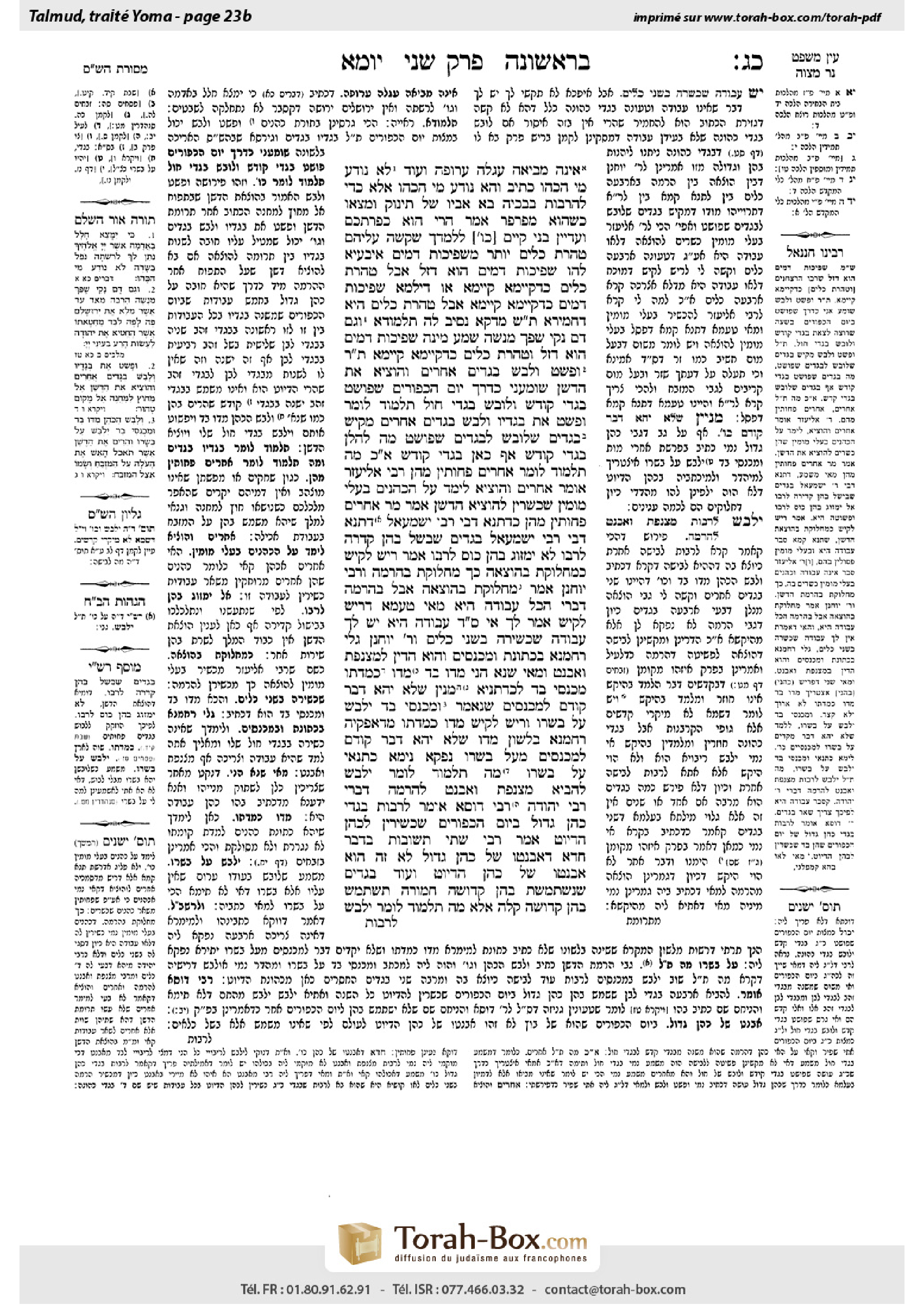
This page of Yoma includes the Aramaic text, an English translation and an AI-generated French translation, alongside the scan above.
יומא כ״ג ב · Aramaic and Hebrew text
אֵינָהּ מְבִיאָה עֶגְלָה עֲרוּפָה: וְעוֹד: ״לֹא נוֹדַע מִי הִכָּהוּ״ כְּתִיב, וְהָא נוֹדַע מִי הִכָּהוּ! אֶלָּא, כְּדֵי לְהַרְבּוֹת בִּבְכִיָּה.
בָּא אָבִיו שֶׁל תִּינוֹק וּמְצָאוֹ כְּשֶׁהוּא מְפַרְפֵּר, אָמַר: הֲרֵי הוּא כַּפָּרַתְכֶם וַעֲדַיִין בְּנִי קַיָּים [כּוּ׳]. לְלַמֶּדְךָ שֶׁקָּשָׁה עֲלֵיהֶם טׇהֳרַת כֵּלִים יוֹתֵר מִשְּׁפִיכוּת דָּמִים. אִיבַּעְיָא לְהוּ: שְׁפִיכוּת דָּמִים הוּא דְּזָל, אֲבָל טׇהֳרַת כֵּלִים — כִּדְקָיְימָא קָיְימָא. אוֹ דִילְמָא: שְׁפִיכוּת דָּמִים — כִּדְקָיְימָא קָיְימָא, אֲבָל טׇהֳרַת כֵּלִים הִיא דַּחֲמִירָא?
תָּא שְׁמַע, מִדְּקָא נָסֵיב לַהּ תַּלְמוּדָא: ״וְגַם דָּם נָקִי שָׁפַךְ מְנַשֶּׁה״, שְׁמַע מִינַּהּ שְׁפִיכוּת דָּמִים הוּא דְּזָל, וְטַהֲרַת כֵּלִים — כִּדְקָיְימָא קָיְימָא.
תָּנוּ רַבָּנַן: ״וּפָשַׁט ... וְלָבַשׁ בְּגָדִים אֲחֵרִים וְהוֹצִיא אֶת הַדֶּשֶׁן״, שׁוֹמְעַנִי כְּדֶרֶךְ יוֹם הַכִּפּוּרִים, שֶׁפּוֹשֵׁט בִּגְדֵי קוֹדֶשׁ וְלוֹבֵשׁ בִּגְדֵי חוֹל,
תַּלְמוּד לוֹמַר: ״וּפָשַׁט אֶת בְּגָדָיו וְלָבַשׁ בְּגָדִים אֲחֵרִים״, מַקִּישׁ בְּגָדִים שֶׁלּוֹבֵשׁ לִבְגָדִים שֶׁפּוֹשֵׁט, מָה לְהַלָּן בִּגְדֵי קוֹדֶשׁ, אַף כָּאן בִּגְדֵי קוֹדֶשׁ.
אִם כֵּן, מָה תַּלְמוּד לוֹמַר ״אֲחֵרִים״? פְּחוּתִין מֵהֶן. רַבִּי אֱלִיעֶזֶר אוֹמֵר: ״אֲחֵרִים וְהוֹצִיא״, לִימֵּד עַל הַכֹּהֲנִים בַּעֲלֵי מוּמִין שֶׁכְּשֵׁרִין לְהוֹצִיא הַדֶּשֶׁן.
אָמַר מָר: ״אֲחֵרִים״ — פְּחוּתִין מֵהֶן, כִּדְתָנָא דְּבֵי רַבִּי יִשְׁמָעֵאל. דְּתָנָא דְּבֵי רַבִּי יִשְׁמָעֵאל: בְּגָדִים שֶׁבִּשֵּׁל בָּהֶן קְדֵרָה לְרַבּוֹ — לֹא יִמְזוֹג בָּהֶן כּוֹס לְרַבּוֹ.
אָמַר רֵישׁ לָקִישׁ: כְּמַחְלוֹקֶת בְּהוֹצָאָה, כָּךְ מַחְלוֹקֶת בַּהֲרָמָה. וְרַבִּי יוֹחָנָן אָמַר: מַחְלוֹקֶת בְּהוֹצָאָה, אֲבָל בַּהֲרָמָה — דִּבְרֵי הַכֹּל עֲבוֹדָה הִיא.
מַאי טַעְמָא דְּרֵישׁ לָקִישׁ? אָמַר לָךְ: אִי סָלְקָא דַעְתָּךְ עֲבוֹדָה הִיא, יֵשׁ לְךָ עֲבוֹדָה שֶׁכְּשֵׁירָה בִּשְׁנֵי כֵלִים?
וְרַבִּי יוֹחָנָן: גַּלִּי רַחֲמָנָא בְּכֻתּוֹנֶת וּמִכְנָסַיִם, וְהוּא הַדִּין לְמִצְנֶפֶת וְאַבְנֵט.
וּמַאי שְׁנָא הָנֵי? ״מִדּוֹ בַּד״, מִדּוֹ — כְּמִדָּתוֹ. ״מִכְנְסֵי בַד״, לְכִדְתַנְיָא: מִנַּיִן שֶׁלֹּא יְהֵא דָּבָר קוֹדֶם לַמִּכְנָסַיִם, שֶׁנֶּאֱמַר: ״וּמִכְנְסֵי בַד יִלְבַּשׁ עַל בְּשָׂרוֹ״.
וְרֵישׁ לָקִישׁ? מִדּוֹ כְּמִדָּתוֹ — מִדְּאַפְּקֵיהּ רַחֲמָנָא בִּלְשׁוֹן ״מִדּוֹ״. שֶׁלֹּא יְהֵא דָּבָר קוֹדֶם לַמִּכְנָסַיִם — מֵ״עַל בְּשָׂרוֹ״ נָפְקָא.
נֵימָא כְּתַנָּאֵי: ״עַל בְּשָׂרוֹ״, מָה תַּלְמוּד לוֹמַר ״יִלְבַּשׁ״? לְהָבִיא מִצְנֶפֶת וְאַבְנֵט לַהֲרָמָה, דִּבְרֵי רַבִּי יְהוּדָה.
רַבִּי דּוֹסָא אוֹמֵר: לְרַבּוֹת בִּגְדֵי כֹּהֵן גָּדוֹל בְּיוֹם הַכִּפּוּרִים, שֶׁכְּשֵׁירִין לְכֹהֵן הֶדְיוֹט.
אָמַר רַבִּי: שְׁתֵּי תְשׁוּבוֹת בְּדָבָר, חֲדָא: דְּאַבְנֵטוֹ שֶׁל כֹּהֵן גָּדוֹל לֹא זֶה הוּא אַבְנֵטוֹ שֶׁל כֹּהֵן הֶדְיוֹט. וְעוֹד: בְּגָדִים שֶׁנִּשְׁתַּמַּשְׁתָּ בָּהֶן קְדוּשָּׁה חֲמוּרָה, תִּשְׁתַּמֵּשׁ בָּהֶן קְדוּשָּׁה קַלָּה?! אֶלָּא, מָה תַּלְמוּד לוֹמַר ״יִלְבַּשׁ״ —
Yoma 23b · English translation
Jerusalem does not bring a heifer whose neck is broken. The reason for this is that the halakha of the heifer whose neck is broken applies only to land that was apportioned to a specific tribe of the Jewish people. Jerusalem alone was not divided among the tribes, but was shared equally by the entire nation. And furthermore, it is written that the heifer whose neck is broken is brought when “it be not known who had smitten him,” and here, in the case of the slain priest, it was well known who had smitten him. Rather, one must conclude that Rabbi Tzadok invoked the halakha of the heifer whose neck is broken not because it actually applied in this case but only in order to arouse the people’s grief and to increase weeping.
In relating the above incident the Tosefta said: The father of the boy came and found that he was still convulsing. He said: May my son’s death be an atonement for you. But my son is still alive, etc. This incident comes to teach you that the ritual purity of utensils was of more concern to them than the shedding of blood. A dilemma was raised before the Sages: Should one conclude from this comment that bloodshed had become trivialized in their eyes but their concern for purity of utensils remained where it was originally, meaning that while they cared less than they should have about murder, they did not exaggerate the importance of purity of utensils; or perhaps their concern for bloodshed remained where it was originally, but their concern for purity of vessels had become too strict, to the extent that its importance was exaggerated beyond concern for human life?
The Gemara answers: Come and hear an answer to the dilemma: Since the Tosefta adduces a biblical teaching from the verse, “Furthermore, Manasseh spilled innocent blood,” conclude from this that it was bloodshed that had become trivialized, and the importance of purity of utensils remained where it had been.
§ The Gemara returns to the mitzva of removing the ashes from the altar and associated issues. The Sages taught in a baraita: The Torah states, after describing the removal of the ashes: “And he shall put off his garments, and put on other garments, and carry the ashes out of the camp to a clean place” (Leviticus 6:4). I might understand from here that this change of garments is a mitzva to change into a different kind of garment, similar to the change of garments performed on Yom Kippur, when the High Priest changes back and forth from gold clothes to white clothes. Here, too, the Torah requires that he remove his sacred garments and put on non-sacred garments.
The baraita continues: To teach us otherwise, the verse states: “And he shall put off his garments, and put on other garments,” thereby juxtaposing the garments he puts on to the garments he takes off. This indicates that just as there, the garments he removes, i.e., those in which he had performed the mitzva of removal of the ashes, are sacred garments, so too here, the clothes he puts on to take the ashes out of the camp are sacred garments.
If so, what is the meaning when the verse states: Other garments, which implies that the second set of garments is different from the first? It means they are of lower quality than the first set of garments. Rabbi Eliezer says a different interpretation of the words: Other garments. The verse states: “And put on other garments, and carry the ashes out of the camp,” in which the Hebrew juxtaposes the words “other” and “carry out.” This teaches that priests with physical blemishes, who are considered others in that they are not eligible to perform sacred tasks, are eligible to carry out the ashes.
The Gemara now explains the baraita in detail. The Master said in the baraita: The words: Other garments, teach that they are to be of lower quality than the garments worn during the removal of the ashes. This is in accordance with what was taught in the school of Rabbi Yishmael, as it was taught in the school of Rabbi Yishmael: Clothes worn by a servant as he was cooking food for his master that became soiled in the process should not be worn by him when he pours a cup for his master, which is a task that calls for the servant to present a dignified appearance. Similarly, one who performs the dirtying task of carrying out the ashes should not wear the same fine clothes worn to perform other services.
The baraita taught that Rabbi Eliezer derived from the word other that blemished priests are eligible for the task of carrying out the ashes, while the first tanna derived a different teaching from those words. The Gemara clarifies the scope of the dispute between the first tanna and Rabbi Eliezer. Reish Lakish said: Just as there is a dispute between Rabbi Eliezer and the first tanna with regard to carrying the ashes out of the camp, so too, there is a dispute with regard to the removal of the ashes from the altar. Rabbi Eliezer maintains that the removal of the ashes may also be performed by blemished priests, while the first tanna disagrees. But Rabbi Yoḥanan said: The dispute is only with regard to carrying the ashes out of the camp, but all agree that the removal of the ashes is a bona fide Temple service that cannot be performed by blemished priests.
The Gemara explains: What is the reason behind the opinion of Reish Lakish? Reish Lakish could have said to you: If it enters your mind that the removal of the ashes is a bona fide Temple service, you are faced with the following difficulty: Do you have any Temple service that may be performed with only two garments rather than the full set of four vestments worn by the priests? In the Torah’s description of the garments worn to remove the ashes it says: “And the priest shall put on his linen garment, and his linen trousers shall he put on his flesh” (Leviticus 6:3).
And what is the explanation for Rabbi Yoḥanan’s opinion? In fact, the priest is required to wear all four priestly garments. The Merciful One reveals in the Torah that the priest must wear the tunic and the trousers like any other service so that one would not think that taking out the ashes may be performed in regular, non-sacred clothes. Once the Torah has made this point and mentioned these two specific garments, the same is true for the other two garments as well, i.e., the mitre and the belt.
The Gemara asks: If the Torah requires all four garments and mentions the tunic and trousers only as examples, what is different about these two that the Torah mentioned them in particular? The Gemara answers that these two particular garments were mentioned in order to teach certain halakhot. The Torah refers to the tunic as “his linen garment,” with the words “his garment” [middo], indicating that the tunic must conform to his exact size [middato] and should fit the priest perfectly. As for the words “linen trousers,” they come to teach that which was taught in a baraita: From where is it derived that as the priest gets dressed no garment should precede the trousers? As it is stated: “And his linen trousers shall he put on his flesh,” which implies that the trousers should be donned when the priest has nothing but his flesh, i.e., when he has no other garments on him yet.
The Gemara asks: And with regard to Reish Lakish, who maintains that these two garments are mentioned because they are the only two that the priest wears when removing the ashes, from where does he derive these two halakhot? The Gemara answers: The halakha that his linen garment, i.e., the tunic, must be according to his size is derived the fact that the Merciful One uses the expression “his garment,” i.e., his fitted garment, in the Torah, rather than calling it by its usual name, tunic. And the halakha that no garment should precede the trousers when the priest dresses is derived from the fact that the Torah added the phrase “on his flesh.”
Let us say that the dispute between Rabbi Yoḥanan and Reish Lakish is parallel to a dispute between tanna’im. As it was taught in a baraita that the Torah states: “And the priest shall put on his linen garment, and his linen trousers shall he put on his flesh” (Leviticus 6:3). The words “shall he put on” seem superfluous, since these same words were already stated earlier in the verse. Therefore, the Torah could have sufficed with saying: “And linen trousers on his flesh.” What is the meaning when the verse states: “Shall he put on”? This extra expression comes to include the donning of the mitre and the belt, which are not mentioned here explicitly, for the removal of the ash; this is the statement of Rabbi Yehuda.
Rabbi Dosa says: The extra expression comes to include the permissibility of the High Priest’s clothes that he wears on Yom Kippur, which are linen garments identical to those of the common priest, to teach that they are acceptable to be used afterward by common priests in their service. In other words, the expression teaches that the High Priest’s garments need not be permanently retired from service after Yom Kippur, unlike the opinion of another Sage, as will be explained below.
Rabbi Yehuda HaNasi says: There are two refutations against Rabbi Dosa’s interpretation: One is that the belt of the High Priest that he wears on Yom Kippur is made only of linen and is not identical to the belt of the common priest, which, in Rabbi Yehuda HaNasi’s opinion, is made of wool and linen. Therefore, it is impossible for the High Priest’s Yom Kippur garments to be used by a common priest. And furthermore, with regard to garments that you used to perform the services of the most severe sanctity, i.e., the services performed by the High Priest on Yom Kippur, can it be that you will then use them to perform services of lesser sanctity by a common priest? Instead of this, a different interpretation must be said. What, then, is the meaning when the verse states the superfluous words “shall he put on”?
Yoma 23b · Traduction française (IA)
Jérusalem n’apporte pas de génisse dont on brise la nuque. En effet, la halakha de la génisse dont on brise la nuque ne s’applique qu’à un territoire attribué à une tribu précise du peuple juif. Or Jérusalem seule n’a pas été répartie entre les tribus : elle était partagée à égalité par l’ensemble du peuple. De plus, il est écrit que la génisse dont on brise la nuque est apportée lorsque « l’on ne sait pas qui l’a frappé », alors qu’ici, dans le cas du prêtre assassiné, on savait parfaitement qui l’avait frappé. Il faut donc conclure que Rabbi Tsadok a invoqué la halakha de la génisse dont on brise la nuque, non parce qu’elle s’appliquait réellement dans ce cas, mais uniquement pour susciter le chagrin du peuple et intensifier les lamentations.
En relatant l’incident ci-dessus, la Tosefta dit : Le père du garçon vint et constata qu’il était encore en train de convulser. Il dit : « Que la mort de mon fils soit une expiation pour vous. Mais mon fils est encore vivant, etc. » Cet incident vient t’enseigner que la pureté des ustensiles les préoccupait davantage que l’effusion de sang. Les Sages soulevèrent une question : faut-il conclure de cette remarque que l’effusion de sang était devenue à leurs yeux une chose banale, tandis que leur souci de la pureté des ustensiles était resté à son niveau initial — c’est-à-dire que, s’ils se souciaient du meurtre moins qu’ils n’auraient dû, ils n’exagéraient pas l’importance de la pureté des ustensiles ? Ou bien leur souci de l’effusion de sang était-il resté à son niveau initial, tandis que leur souci de la pureté des récipients était devenu excessif, au point d’en exagérer l’importance au-delà de celle de la vie humaine ?
La Guemara répond : voyons si l’on peut trouver une réponse à la question. Puisque la Tosefta invoque un enseignement biblique tiré du verset « De plus, Manassé répandit le sang innocent », il faut en conclure que c’est l’effusion de sang qui était devenue une chose banale, tandis que l’importance accordée à la pureté des ustensiles était restée inchangée.
§ La Guemara revient à la mitsva d’enlever les cendres de l’autel et aux questions qui s’y rapportent. Les Sages enseignèrent dans une baraïta : Après avoir décrit l’enlèvement des cendres, la Torah dit : « Il ôtera ses vêtements et en revêtira d’autres, puis il transportera les cendres hors du camp, dans un lieu pur » (Lévitique 6, 4). Je pourrais comprendre que ce changement de vêtements constitue une mitsva de se revêtir d’un autre type de vêtements, comme le changement de vêtements effectué à Yom Kippour, lorsque le grand prêtre passe des vêtements d’or aux vêtements blancs, puis inversement. Ici aussi, la Torah exigerait qu’il ôte ses vêtements sacrés et revête des vêtements profanes.
La baraïta poursuit : Pour nous enseigner le contraire, le verset dit : « Il ôtera ses vêtements et en revêtira d’autres », mettant ainsi en parallèle les vêtements qu’il revêt et ceux qu’il ôte. Cela indique que, de même que les vêtements qu’il ôte — c’est-à-dire ceux qu’il portait pour accomplir la mitsva d’enlever les cendres — sont des vêtements sacrés, de même les vêtements qu’il revêt pour transporter les cendres hors du camp sont des vêtements sacrés.
Si tel est le cas, que signifie l’expression « d’autres vêtements », qui implique que la seconde tenue est différente de la première ? Cela signifie que ces vêtements sont de moindre qualité que ceux de la première tenue. Rabbi Éliézer propose une autre interprétation des mots « d’autres vêtements ». Le verset dit : « Il revêtira d’autres vêtements et transportera les cendres hors du camp » ; en hébreu, les mots « autres » et « transporter » sont rapprochés. Cela enseigne que les prêtres atteints d’une infirmité physique, considérés comme des « autres » en ce qu’ils ne sont pas aptes à accomplir les tâches sacrées, sont habilités à transporter les cendres.
La Guemara explique maintenant la baraïta en détail. Le maître a dit dans la baraïta : les mots « d’autres vêtements » enseignent que ces vêtements doivent être de moindre qualité que ceux portés pour enlever les cendres. Cela concorde avec ce qui fut enseigné dans l’école de Rabbi Yichmaël : les vêtements qu’un serviteur porte lorsqu’il prépare à manger pour son maître et qui se salissent au cours de cette tâche ne doivent pas être portés lorsqu’il lui sert une coupe, tâche qui exige du serviteur qu’il présente une apparence digne. De même, celui qui accomplit la tâche salissante consistant à transporter les cendres ne doit pas porter les mêmes beaux vêtements que pour les autres services.
La baraïta enseignait que Rabbi Éliézer déduisait du mot « autre » que les prêtres atteints d’une infirmité étaient aptes à transporter les cendres, tandis que le premier tanna tirait de ces mots un autre enseignement. La Guemara précise la portée du désaccord entre le premier tanna et Rabbi Éliézer. Rech Lakich dit : de même qu’il existe un désaccord entre Rabbi Éliézer et le premier tanna au sujet du transport des cendres hors du camp, il en existe aussi un au sujet de l’enlèvement des cendres de l’autel. Selon Rabbi Éliézer, l’enlèvement des cendres peut également être effectué par des prêtres atteints d’une infirmité, tandis que le premier tanna n’est pas d’accord. Mais Rabbi Yoḥanan dit : le désaccord concerne uniquement le transport des cendres hors du camp ; tous conviennent que l’enlèvement des cendres est un véritable service du Temple, qui ne peut être accompli par des prêtres atteints d’une infirmité.
La Guemara explique : quelle est la raison de l’opinion de Rech Lakich ? Rech Lakich aurait pu te dire : si tu considères que l’enlèvement des cendres est un véritable service du Temple, tu te heurtes à la difficulté suivante : existe-t-il un service du Temple qui puisse être accompli avec seulement deux vêtements, au lieu des quatre vêtements sacerdotaux complets ? Dans la description que donne la Torah des vêtements portés pour enlever les cendres, il est dit : « Le prêtre revêtira sa tunique de lin, et il mettra sur sa chair ses caleçons de lin » (Lévitique 6, 3).
Et quelle est l’explication de l’opinion de Rabbi Yoḥanan ? En réalité, le prêtre doit porter les quatre vêtements sacerdotaux. Le Miséricordieux révèle dans la Torah que le prêtre doit porter la tunique et les caleçons comme pour tout autre service, afin qu’on ne pense pas que le transport des cendres puisse être effectué avec des vêtements ordinaires, non sacrés. Une fois que la Torah a établi ce point et mentionné précisément ces deux vêtements, il en va de même pour les deux autres, c’est-à-dire la tiare et la ceinture.
La Guemara demande : si la Torah exige les quatre vêtements et ne mentionne la tunique et les caleçons qu’à titre d’exemples, qu’ont donc ces deux vêtements de particulier pour que la Torah les mentionne expressément ? La Guemara répond que ces deux vêtements précis sont mentionnés afin d’enseigner certaines halakhot. La Torah désigne la tunique par l’expression « sa tunique de lin » ; le mot « son vêtement » [middo] indique que la tunique doit être à sa taille exacte [middato] et lui aller parfaitement. Quant aux mots « caleçons de lin », ils enseignent ce qui fut transmis dans une baraïta : d’où déduit-on qu’au moment où le prêtre s’habille, aucun vêtement ne doit précéder les caleçons ? Car il est dit : « Il mettra sur sa chair ses caleçons de lin », ce qui implique qu’il doit enfiler les caleçons alors qu’il n’a rien d’autre que sa chair, c’est-à-dire qu’il ne porte encore aucun autre vêtement.
La Guemara demande : et pour Rech Lakich, qui soutient que ces deux vêtements sont mentionnés parce que ce sont les deux seuls que le prêtre porte lorsqu’il enlève les cendres, d’où déduit-il ces deux halakhot ? La Guemara répond : la halakha selon laquelle sa tunique de lin doit être à sa taille est déduite du fait que le Miséricordieux emploie dans la Torah l’expression « son vêtement », c’est-à-dire un vêtement ajusté à lui, plutôt que son nom habituel, « tunique ». Quant à la halakha selon laquelle aucun vêtement ne doit précéder les caleçons lorsque le prêtre s’habille, elle est déduite du fait que la Torah a ajouté l’expression « sur sa chair ».
Disons que le désaccord entre Rabbi Yoḥanan et Rech Lakich correspond à un désaccord entre des tannaïm. En effet, il fut enseigné dans une baraïta que la Torah dit : « Le prêtre revêtira sa tunique de lin, et il mettra sur sa chair ses caleçons de lin » (Lévitique 6, 3). Les mots « il mettra » semblent superflus, puisqu’ils ont déjà été employés plus tôt dans le verset. La Torah aurait donc pu se contenter de dire : « Et des caleçons de lin sur sa chair. » Que signifie alors l’expression « il mettra » ? Cette expression supplémentaire inclut le port de la tiare et de la ceinture, qui ne sont pas mentionnées explicitement ici au sujet de l’enlèvement des cendres. Telle est la déclaration de Rabbi Yehouda.
Rabbi Dossa dit : l’expression supplémentaire inclut l’autorisation de réutiliser les vêtements que le grand prêtre porte à Yom Kippour, des vêtements de lin identiques à ceux du prêtre ordinaire, afin d’enseigner qu’ils peuvent ensuite servir aux prêtres ordinaires dans l’exercice de leur service. Autrement dit, cette expression enseigne que les vêtements du grand prêtre ne doivent pas nécessairement être définitivement retirés du service après Yom Kippour, contrairement à l’opinion d’un autre Sage, comme cela sera expliqué plus loin.
Rabbi Yehouda HaNassi dit : deux réfutations s’opposent à l’interprétation de Rabbi Dossa. Premièrement, la ceinture que le grand prêtre porte à Yom Kippour est faite uniquement de lin et n’est pas identique à celle du prêtre ordinaire, qui, selon Rabbi Yehouda HaNassi, est faite de laine et de lin. Il est donc impossible que les vêtements que le grand prêtre porte à Yom Kippour soient utilisés par un prêtre ordinaire. De plus, est-il possible d’utiliser ensuite, pour accomplir les services d’une sainteté moindre par un prêtre ordinaire, des vêtements qui ont servi aux services de la plus grande sainteté, c’est-à-dire ceux qu’accomplit le grand prêtre à Yom Kippour ? Il faut plutôt proposer une autre interprétation. Que signifie donc l’expression superflue « il mettra » ?
Traduction française générée par IA à partir de l’édition anglaise de Sefaria. Vérifie toujours un passage avec le texte source.
Text from Sefaria: William Davidson Edition - Vocalized Aramaic (CC BY NC); William Davidson Edition - English (CC BY NC).