Yoma 24a: Talmud study for Daf Yomi
Daf Yomi is the daily study of one Talmud folio. Explore 37 tractates with scans, Hebrew text, Sefaria English and AI-generated French translations where annotated.
Passage selection and English or AI-generated French translation are available where the scan has annotations. Daf Study is independent of Torah-Box and Sefaria.
Browse Yoma · יומא · All tractatesYoma 24a text and translations
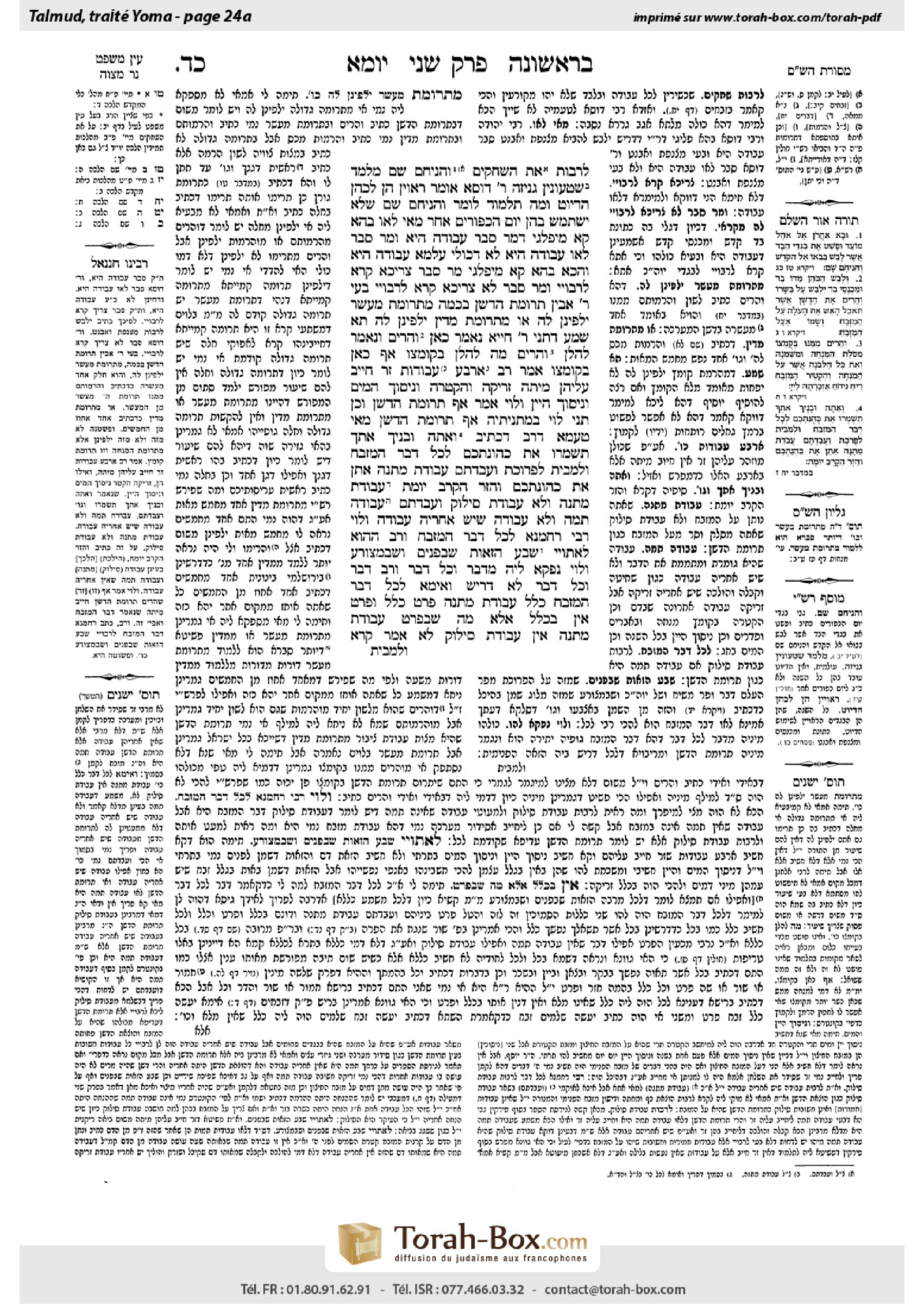
This page of Yoma includes the Aramaic text, an English translation and an AI-generated French translation, alongside the scan above.
יומא כ״ד א · Aramaic and Hebrew text
לְרַבּוֹת אֶת הַשְּׁחָקִים.
״וְהִנִּיחָם שָׁם״, מְלַמֵּד שֶׁטְּעוּנִין גְּנִיזָה. רַבִּי דּוֹסָא אוֹמֵר: רְאוּיִן הֵן לְכֹהֵן הֶדְיוֹט, וּמָה תַּלְמוּד לוֹמַר ״וְהִנִּיחָם שָׁם״ — שֶׁלֹּא יִשְׁתַּמֵּשׁ בָּהֶן יוֹם הַכִּפּוּרִים אַחֵר.
מַאי לָאו בְּהָא קָא מִיפַּלְגִי, דְּמָר סָבַר: עֲבוֹדָה הִיא, וּמָר סָבַר: לָאו עֲבוֹדָה הִיא.
לָא, דְּכוּלֵּי עָלְמָא עֲבוֹדָה הִיא, וְהָכָא בְּהָא קָא מִיפַּלְגִי, מָר סָבַר: צְרִיכָא קְרָא לְרַבּוֹיֵי, וּמָר סָבַר: לָא צְרִיכָא קְרָא לְרַבּוֹיֵי.
בָּעֵי רַבִּי אָבִין: תְּרוּמַת הַדֶּשֶׁן בְּכַמָּה? מִתְּרוּמַת מַעֲשֵׂר יָלְפִינַן לַהּ, אוֹ מִתְּרוּמַת מִדְיָן יָלְפִינַן לַהּ? תָּא שְׁמַע, דְּתָנֵי רַבִּי חִיָּיא: נֶאֱמַר כָּאן ״וְהֵרִים״, וְנֶאֱמַר לְהַלָּן ״וְהֵרִים״. מָה לְהַלָּן — בְּקוּמְצוֹ, אַף כָּאן — בְּקוּמְצוֹ.
אָמַר רַב: אַרְבַּע עֲבוֹדוֹת זָר חַיָּיב עֲלֵיהֶן מִיתָה: זְרִיקָה, וְהַקְטָרָה, וְנִיסּוּךְ הַמַּיִם, וְנִיסּוּךְ הַיַּיִן. וְלֵוִי אָמַר: אַף תְּרוּמַת הַדֶּשֶׁן. וְכֵן תָּנֵי לֵוִי בְּמַתְנִיתֵיהּ: אַף תְּרוּמַת הַדֶּשֶׁן.
מַאי טַעְמָא דְרַב — דִּכְתִיב: ״וְאַתָּה וּבָנֶיךָ אִתְּךָ תִּשְׁמְרוּ אֶת כְּהוּנַּתְכֶם לְכׇל דְּבַר הַמִּזְבֵּחַ וּלְמִבֵּית לַפָּרוֹכֶת וַעֲבַדְתֶּם עֲבוֹדַת מַתָּנָה אֶתֵּן אֶת כְּהוּנַּתְכֶם וְהַזָּר הַקָּרֵב יוּמָת״. ״עֲבוֹדַת מַתָּנָה״ — וְלֹא עֲבוֹדַת סִילּוּק, ״וַעֲבַדְתֶּם״ — עֲבוֹדָה תַּמָּה, וְלֹא עֲבוֹדָה שֶׁיֵּשׁ אַחֲרֶיהָ עֲבוֹדָה.
וְלֵוִי — רַבִּי רַחֲמָנָא ״לְכׇל דְּבַר הַמִּזְבֵּחַ״. וְרַב — הַהוּא לְאֵתוֹיֵי שֶׁבַע הַזָּאוֹת שֶׁבִּפְנִים וְשֶׁבִּמְצוֹרָע.
וְלֵוִי — נָפְקָא לֵיהּ מִ״דְּבַר״ וְ״כׇל דְּבַר״. וְרַב — ״דְּבַר״ וְ״כׇל דְּבַר״ לָא דָּרֵישׁ.
וְאֵימָא: ״לְכׇל דְּבַר הַמִּזְבֵּחַ״ — כָּלַל, ״עֲבוֹדַת מַתָּנָה״ — פָּרַט, כְּלָל וּפְרָט. אֵין בַּכְּלָל אֶלָּא מַה שֶּׁבַּפְּרָט: עֲבוֹדַת מַתָּנָה — אִין, עֲבוֹדַת סִילּוּק — לָא! אָמַר קְרָא:
Yoma 24a · English translation
The phrase comes to include worn out garments, teaching that as long as they have not become tattered they may be used for Temple services.
The Gemara continues with another baraita connected to this debate. With regard to the garments of the High Priest, the Torah states: “And Aaron shall go into the tent of meeting, and he shall take off the linen garments that he had put on when he went into the Sanctuary, and shall leave them there” (Leviticus 16:23). This verse teaches that the linen garments worn by the High Priest during the Yom Kippur service require storing away, i.e., they may not be used again. Rabbi Dosa says: They do not have to be stored away, because although they may not be used again by the High Priest on a subsequent Yom Kippur, they are acceptable for use for a common priest. And what, then, is the meaning when the verse states: “And shall leave them there,” which implies that they are not to be used again? It means that the High Priest himself may not use them on a subsequent Yom Kippur for service in the Holy of Holies; it does not mean that they may not be used at all.
The Gemara returns to the question of whether or not the removal of the ashes is considered a bona fide Temple service, requiring all four priestly garments, and whether or not this is the subject of debate between tanna’im. What, is it not with regard to this that Rabbi Yehuda and Rabbi Dosa disagree: One Sage, Rabbi Yehuda, who derives from the phrase “he shall wear” that all four garments are required, holds that the removal of the ashes is a bona fide service; and one Sage, Rabbi Dosa, who derives a different teaching from “he shall wear,” holds that it is not a bona fide service, and consequently only two of the four garments are required? Their dispute would therefore be identical to the dispute between Rabbi Yoḥanan and Reish Lakish.
The Gemara rejects this suggestion: It is possible to say that this is not the subject of debate between these two tanna’im. Rather, everyone agrees that the removal of ashes is a bona fide Temple service requiring all four garments, and here they disagree about a different point, which is this: One Sage, Rabbi Yehuda, holds that a derivation from the verse is necessary to include the mitre and belt, which are not mentioned explicitly in the verse. And one Sage, Rabbi Dosa, holds that since the removal of the ash is a bona fide Temple service it is obvious that all four garments are required, so a derivation from a verse to include the other two garments is not necessary. Accordingly, both tanna’im are in agreement that the removal of ash is a bona fide service and requires all four priestly garments.
§ Rabbi Avin raised a dilemma: How much ash must be removed in order to fulfill the mitzva of removal of the ashes? Do we derive it from the teruma of the tithe, the portion that the Levite sets aside for the priest, in which case one hundredth of the total is separated, or do we derive it from the donations that were set aside from the spoils of the war with Midian, where one five-hundredth was taken from the spoils of war (see Numbers 31:28)? Come and hear a teaching with regard to this dilemma. As Rabbi Ḥiyya taught in a baraita that it is stated here: “And he shall take up the ashes” (Leviticus 6:3), and it is said elsewhere, with regard to a meal-offering: “And he shall take up a handful of the choice flour of the meal-offering” (Leviticus 6:8). Just as there, the amount he removes is a handful of flour, so too, here, he removes a handful of ash. The amount of ashes removed from the altar is therefore not a fixed percentage of the total ash.
§ Rav said: Although a non-priest may not perform any Temple service, there are only four Temple services for which a non-priest is liable to receive the punishment of death by God’s hand for doing so. They are: Sprinkling sacrificial blood on the altar, and burning incense or parts of sacrificial animals on the altar, and pouring out the water libation on the altar on the festival of Sukkot, and pouring out the wine libation on the altar. And Levi said: This is true also for the removal of the ashes. And similarly, Levi taught in his collection of baraitot: The removal of ashes is also included among those services for which a non-priest incurs the death penalty if he performs them.
The Gemara explains: What is the reason for Rav’s opinion? As it is written: “And you and your sons with you shall keep your priesthood in everything pertaining to the altar and to that within the veil; and you shall serve; I give you the priesthood as a service of gift; and the common man that draws near shall be put to death” (Numbers 18:7). Rav interprets this verse as follows: “A service of gift” indicates a service that involves giving, i.e., placing something on the altar, and not a service that involves removal from the altar, to the exclusion of removing the ashes. “And you shall serve [va’avadtem]” is interpreted as referring to a service that is complete [avoda tamma] on its own, such as sprinkling the blood, and not a service that is not complete, i.e., a service that is only a preparatory step and has another service after it that completes its purpose, such as slaughtering the animal or collecting its blood, which are only preparatory steps leading up to the sprinkling of the blood on the altar.
And what is the reason for the opinion of Levi? Why does he include the removal of ashes? According to him, the Merciful One includes this service by adding “in everything pertaining to the altar,” which teaches that all actions performed on the altar, including the removal of ashes, are significant and are prohibited to a non-priest on pain of death. The Gemara asks: And what does Rav learn from the phrase “in everything pertaining to the altar”? The Gemara answers: According to him, the word “everything” in that phrase comes to include the seven sprinklings that are performed inside the Sanctuary, when the blood of certain offerings is sprinkled on the veil of the Holy of Holies, and the seven sprinklings of oil of the leper, which are also performed inside the Sanctuary. Rav learns from the word “everything” that if a non-priest were to perform any of these actions he would be liable to receive the death penalty, despite the fact that they are not performed on the altar.
The Gemara asks: And from where does Levi derive these cases? The Gemara answers: He derives them from the superfluous wording of the text. As the entire phrase “pertaining to the altar” is superfluous, he derives from this the inclusion of the removal of the ashes. Additionally, the expression “everything pertaining” implies a further inclusion, from which he derives the internal sprinklings mentioned above. And what does Rav learn from this superfluous wording? Rav does not derive anything particular from the distinction between the expressions “pertaining to the altar” and “everything pertaining to the altar.”
The Gemara asks about Levi’s position: But say that the verse should be interpreted as follows: “In everything pertaining” is a generalization, and “a service of gift” is a specification, indicating a case of a generalization followed by a specification. One of the principles of hermeneutics states that in such cases, the generalization includes only what is mentioned explicitly in the specification. Following that rule, one would conclude: A service of giving, i.e., placing on the altar, yes, this is included, but a service of removal is not included. This presents a difficulty for Levi. The Gemara responds that the verse states:
Yoma 24a · Traduction française (IA)
Cette expression vient inclure les vêtements usés : tant qu’ils ne sont pas en lambeaux, ils peuvent être utilisés pour le service du Temple.
La Guemara poursuit avec une autre baraïta liée à ce débat. À propos des vêtements du grand prêtre, la Torah dit : « Aaron entrera dans la tente d’assignation, il ôtera les vêtements de lin qu’il avait revêtus en entrant dans le Sanctuaire et les y laissera » (Lévitique 16,23). Ce verset enseigne que les vêtements de lin portés par le grand prêtre pendant le service de Yom Kippour doivent être mis de côté, c’est-à-dire qu’ils ne peuvent plus être utilisés. Rabbi Dossa dit : Il n’est pas nécessaire de les mettre de côté, car, même s’ils ne peuvent plus être utilisés par le grand prêtre lors d’un Yom Kippour ultérieur, ils conviennent à un prêtre ordinaire. Que signifie donc l’expression du verset « Il les y laissera », qui laisse entendre qu’ils ne seront plus utilisés ? Elle signifie que le grand prêtre lui-même ne peut pas les utiliser lors d’un Yom Kippour ultérieur pour le service dans le Saint des Saints ; elle ne signifie pas qu’ils ne peuvent plus être utilisés du tout.
La Guemara revient à la question de savoir si le retrait des cendres est considéré comme un véritable service du Temple, qui exige les quatre vêtements sacerdotaux, et si cette question fait l’objet d’un débat entre tannaïm. N’est-ce pas précisément sur ce point que Rabbi Yehouda et Rabbi Dossa sont en désaccord ? Un Sage, Rabbi Yehouda, qui déduit de l’expression « il portera » que les quatre vêtements sont requis, considère que le retrait des cendres est un véritable service ; l’autre Sage, Rabbi Dossa, qui tire une autre leçon de « il portera », considère que ce n’est pas un véritable service et que, par conséquent, seuls deux des quatre vêtements sont requis. Leur désaccord serait donc identique à celui de Rabbi Yoḥanan et de Reish Lakish.
La Guemara rejette cette proposition : on peut dire que ces deux tannaïm ne sont pas en désaccord sur ce point. Au contraire, tous reconnaissent que le retrait des cendres est un véritable service du Temple, qui exige les quatre vêtements ; leur désaccord porte ici sur un autre point : un Sage, Rabbi Yehouda, considère qu’il faut une déduction du verset pour inclure la tiare et la ceinture, qui ne sont pas explicitement mentionnées dans le verset. L’autre Sage, Rabbi Dossa, considère que, puisque le retrait des cendres est un véritable service du Temple, il va de soi que les quatre vêtements sont requis ; il n’est donc pas nécessaire de déduire d’un verset que les deux autres vêtements sont inclus. Ainsi, les deux tannaïm reconnaissent que le retrait des cendres est un véritable service qui exige les quatre vêtements sacerdotaux.
§ Rabbi Avin souleva une question : quelle quantité de cendres faut-il retirer pour accomplir la mitsva du retrait des cendres ? La déduisons-nous de la terouma de la dîme — la part que le Lévite prélève pour le prêtre — auquel cas un centième du total est séparé ? Ou la déduisons-nous des prélèvements effectués sur le butin de la guerre contre Midian, dont un cinq-centième fut prélevé (voir Nombres 31,28) ? Voici un enseignement qui répond à cette question. Rabbi Ḥiyya a enseigné dans une baraïta qu’il est dit ici : « Il enlèvera les cendres » (Lévitique 6,3), et qu’il est dit ailleurs, à propos d’une offrande végétale : « Il prélèvera une poignée de la fleur de farine de l’offrande végétale » (Lévitique 6,8). De même que là, la quantité prélevée est une poignée de farine, de même ici, il enlève une poignée de cendres. La quantité de cendres retirée de l’autel n’est donc pas un pourcentage fixe de la quantité totale de cendres.
§ Rav dit : bien qu’un non-prêtre ne puisse accomplir aucun service du Temple, seuls quatre services du Temple entraînent pour lui la peine de mort par la main de Dieu s’il les accomplit. Ce sont : l’aspersion du sang sacrificiel sur l’autel, la combustion de l’encens ou de parties des animaux sacrificiels sur l’autel, la libation d’eau sur l’autel pendant la fête de Soukkot et la libation de vin sur l’autel. Lévi dit : le retrait des cendres est également concerné. De même, Lévi enseigna dans son recueil de baraïtot que le retrait des cendres fait lui aussi partie des services dont l’accomplissement par un non-prêtre entraîne la peine de mort.
La Guemara explique : quelle est la raison de l’opinion de Rav ? Il est écrit : « Toi et tes fils avec toi, vous garderez votre sacerdoce pour tout ce qui concerne l’autel et ce qui se trouve derrière le voile ; vous accomplirez le service. Je vous donne le sacerdoce comme un service de don ; tout profane qui s’approchera sera mis à mort » (Nombres 18,7). Rav interprète ainsi ce verset : « Un service de don » désigne un service qui consiste à donner, c’est-à-dire à déposer quelque chose sur l’autel, et non un service qui consiste à retirer quelque chose de l’autel ; le retrait des cendres est donc exclu. L’expression « vous accomplirez le service » [va’avadtem] est interprétée comme désignant un service complet [avoda tamma] en soi, tel que l’aspersion du sang, et non un service incomplet, c’est-à-dire une étape préparatoire suivie d’un autre service qui en accomplit le but, comme l’abattage de l’animal ou le recueil de son sang, qui ne sont que des étapes préparatoires menant à l’aspersion du sang sur l’autel.
Et quelle est la raison de l’opinion de Lévi ? Pourquoi inclut-il le retrait des cendres ? Selon lui, le Miséricordieux inclut ce service en ajoutant l’expression « pour tout ce qui concerne l’autel », ce qui enseigne que toutes les actions accomplies sur l’autel, y compris le retrait des cendres, sont importantes et qu’il est interdit à un non-prêtre de les accomplir sous peine de mort. La Guemara demande : que déduit Rav de l’expression « pour tout ce qui concerne l’autel » ? La Guemara répond : selon lui, le mot « tout » dans cette expression vient inclure les sept aspersions accomplies à l’intérieur du Sanctuaire, lorsque le sang de certains sacrifices est aspergé sur le voile du Saint des Saints, ainsi que les sept aspersions d’huile du lépreux, qui sont elles aussi accomplies à l’intérieur du Sanctuaire. Rav déduit du mot « tout » qu’un non-prêtre qui accomplirait l’une de ces actions encourrait la peine de mort, bien qu’elles ne soient pas accomplies sur l’autel.
La Guemara demande : de quelle source Lévi déduit-il ces cas ? La Guemara répond : il les déduit des termes superflus du texte. Puisque toute l’expression « concernant l’autel » est superflue, il en déduit l’inclusion du retrait des cendres. De plus, l’expression « tout ce qui concerne » implique une inclusion supplémentaire, d’où il déduit les aspersions intérieures mentionnées ci-dessus. Et que déduit Rav de ces termes superflus ? Rav ne tire aucune conclusion particulière de la différence entre les expressions « concernant l’autel » et « tout ce qui concerne l’autel ».
La Guemara interroge la position de Lévi : mais ne pourrait-on pas interpréter le verset ainsi ? « Tout ce qui concerne » est une généralisation, et « un service de don » est une spécification, ce qui constitue le cas d’une généralisation suivie d’une spécification. L’un des principes herméneutiques enseigne que, dans de tels cas, la généralisation ne comprend que ce qui est explicitement mentionné dans la spécification. Selon cette règle, on conclurait : un service qui consiste à donner, c’est-à-dire à déposer sur l’autel, est inclus, mais un service de retrait ne l’est pas. Cela soulève une difficulté pour Lévi. La Guemara répond que le verset dit :
Traduction française générée par IA à partir de l’édition anglaise de Sefaria. Vérifie toujours un passage avec le texte source.
Text from Sefaria: William Davidson Edition - Vocalized Aramaic (CC BY NC); William Davidson Edition - English (CC BY NC).