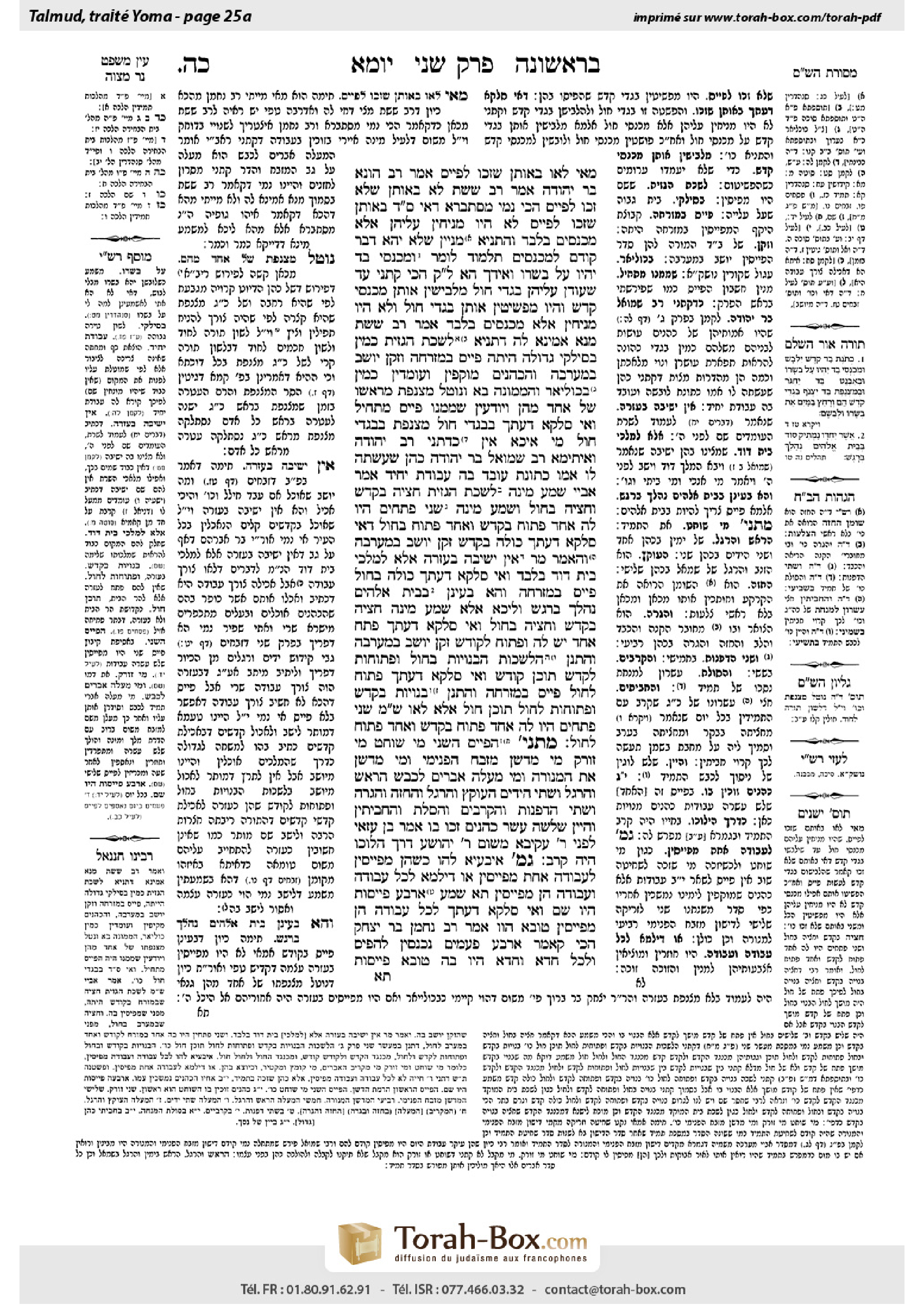
Yoma 25a: Talmud study for Daf Yomi
Daf Yomi is the daily study of one Talmud folio. Explore 37 tractates with scans, Hebrew text, Sefaria English and AI-generated French translations where annotated.
Passage selection and English or AI-generated French translation are available where the scan has annotations. Daf Study is independent of Torah-Box and Sefaria.
Browse Yoma · יומא · All tractatesYoma 25a text and translations
This page of Yoma includes the Aramaic text, an English translation and an AI-generated French translation, alongside the scan above.
יומא כ״ה א · Aramaic and Hebrew text
מַאי לָאו, בְּאוֹתָן שֶׁזָּכוּ לַפַּיִיס. אָמַר רַב הוּנָא בַּר יְהוּדָה אָמַר רַב שֵׁשֶׁת: לָא, בְּאוֹתָן שֶׁלֹּא זָכוּ לַפַּיִיס.
הָכִי נָמֵי מִסְתַּבְּרָא. דְּאִי סָלְקָא דַעְתָּךְ בְּאוֹתָן שֶׁזָּכוּ לַפַּיִיס, ״לֹא הָיוּ מַנִּיחִין עֲלֵיהֶן אֶלָּא מִכְנָסַיִם בִּלְבַד״? וְהָתַנְיָא: מִנַּיִין שֶׁלֹּא יְהֵא דָּבָר קוֹדֶם לַמִּכְנָסַיִם — תַּלְמוּד לוֹמַר: ״וּמִכְנְסֵי בַד יִהְיוּ עַל בְּשָׂרוֹ״!
וְאִידַּךְ? הָא לָא קַשְׁיָא, הָכִי קָתָנֵי: עַד שֶׁעוֹדָן עֲלֵיהֶן בִּגְדֵי חוֹל מַלְבִּישִׁין אוֹתָן מִכְנְסֵי קֹדֶשׁ, וְהָיוּ מַפְשִׁיטִין אוֹתָן בִּגְדֵי חוֹל וְלֹא הָיוּ מַנִּיחִין אֶלָּא מִכְנָסַיִם בִּלְבַד.
אָמַר רַב שֵׁשֶׁת, מְנָא אָמֵינָא לַהּ, דְּתַנְיָא: לִשְׁכַּת הַגָּזִית כְּמִין בָּסִילְקֵי גְּדוֹלָה הָיְתָה, פַּיִיס בְּמִזְרָחָהּ, וְזָקֵן יוֹשֵׁב בְּמַעֲרָבָהּ. וְהַכֹּהֲנִים מוּקָּפִין וְעוֹמְדִין כְּמִין (בְּ)כּוּלְיָאר, וְהַמְמוּנֶּה בָּא וְנוֹטֵל מִצְנֶפֶת מֵרֹאשׁוֹ שֶׁל אֶחָד מֵהֶן, וְיוֹדְעִין שֶׁמִּמֶּנּוּ פַּיִיס מַתְחִיל. וְאִי סָלְקָא דַעְתָּךְ בְּבִגְדֵי חוֹל — מִצְנֶפֶת בְּבִגְדֵי חוֹל מִי אִיכָּא.
אִין — כִּדְתָנֵי רַב יְהוּדָה וְאִיתֵּימָא רַב שְׁמוּאֵל בַּר יְהוּדָה: כֹּהֵן שֶׁעָשְׂתָה לוֹ אִמּוֹ כְּתוֹנֶת, עוֹבֵד בָּהּ עֲבוֹדַת יָחִיד.
אָמַר אַבָּיֵי: שְׁמַע מִינַּהּ לִשְׁכַּת הַגָּזִית חֶצְיָהּ בַּקֹּדֶשׁ וְחֶצְיָהּ בַּחוֹל, וּשְׁמַע מִינַּהּ שְׁנֵי פְתָחִים הָיוּ לָהּ, אֶחָד פָּתוּחַ בַּקֹּדֶשׁ, וְאֶחָד פָּתוּחַ בַּחוֹל. דְּאִי סָלְקָא דַעְתָּךְ כּוּלָּהּ בַּקֹּדֶשׁ — זָקֵן יוֹשֵׁב בְּמַעֲרָבָהּ? וְהָאָמַר מָר: אֵין יְשִׁיבָה בַּעֲזָרָה אֶלָּא לְמַלְכֵי בֵית דָּוִד בִּלְבַד.
וְאִי סָלְקָא דַעְתָּךְ כּוּלָּהּ בַּחוֹל — פַּיִיס בְּמִזְרָחָהּ? וְהָא בָּעֵינַן ״בְּבֵית אֱלֹהִים נְהַלֵּךְ בְּרָגֶשׁ״, וְלֵיכָּא. אֶלָּא שְׁמַע מִינַּהּ: חֶצְיָהּ בַּקֹּדֶשׁ וְחֶצְיָהּ בַּחוֹל.
וְאִי סָלְקָא דַעְתָּךְ פֶּתַח אֶחָד יֵשׁ לָהּ וּפָתוּחַ לַקּוֹדֶשׁ — זָקֵן יוֹשֵׁב בְּמַעֲרָבָהּ? וְהָתְנַן: הַלְּשָׁכוֹת הַבְּנוּיוֹת בַּחוֹל וּפְתוּחוֹת לַקֹּדֶשׁ — תּוֹכָן קוֹדֶשׁ. וְאִי סָלְקָא דַעְתָּךְ פָּתוּחַ לַחוֹל — פַּיִיס בְּמִזְרָחָהּ? וְהָתְנַן: בְּנוּיוֹת בַּקֹּדֶשׁ וּפְתוּחוֹת לַחוֹל — תּוֹכָן חוֹל. אֶלָּא לָאו שְׁמַע מִינַּהּ: שְׁנֵי פְתָחִים הָיוּ לָהּ, אֶחָד פָּתוּחַ בַּקֹּדֶשׁ וְאֶחָד פָּתוּחַ לַחוֹל.
מַתְנִי׳ הַפַּיִיס הַשֵּׁנִי: מִי שׁוֹחֵט, מִי זוֹרֵק, מִי מְדַשֵּׁן מִזְבֵּחַ הַפְּנִימִי, וּמִי מְדַשֵּׁן אֶת הַמְּנוֹרָה, וּמִי מַעֲלֶה אֵבָרִים לַכֶּבֶשׁ.
הָרֹאשׁ וְהָרֶגֶל, וּשְׁתֵּי הַיָּדַיִם, הָעוֹקֶץ וְהָרֶגֶל, וְהֶחָזֶה וְהַגֵּרָה, וּשְׁתֵּי הַדְּפָנוֹת, וְהַקְּרָבַיִם. וְהַסֹּלֶת, וְהַחֲבִיתִּין, וְהַיַּיִן. שְׁלֹשָׁה עָשָׂר כֹּהֲנִים זָכוּ בּוֹ.
אָמַר בֶּן עַזַּאי לִפְנֵי רַבִּי עֲקִיבָא מִשּׁוּם רַבִּי יְהוֹשֻׁעַ: דֶּרֶךְ הִלּוּכוֹ הָיָה קָרֵב.
גְּמָ׳ אִיבַּעְיָא לְהוּ: כְּשֶׁהֵן מְפַיְּיסִין — לַעֲבוֹדָה אַחַת מְפַיְּיסִין, אוֹ דִילְמָא — לְכׇל עֲבוֹדָה וַעֲבוֹדָה הֵן מְפַיְּיסִין? תָּא שְׁמַע: אַרְבַּע פְּיָיסוֹת הָיוּ שָׁם. וְאִי סָלְקָא דַעְתָּךְ לְכׇל עֲבוֹדָה הֵן מְפַיְּיסִין — טוּבָא הֲווֹ! אָמַר רַב נַחְמָן בַּר יִצְחָק, הָכִי קָאָמַר: אַרְבַּע פְּעָמִים נִכְנָסִין לְהָפִיס, וּלְכׇל חֲדָא וַחֲדָא הָיוּ בַּהּ טוּבָא פְּיָיסוֹת.
Yoma 25a · English translation
What, is this not talking about those priests who won the lottery, describing how their non-sacred garments were removed from them before they were dressed in the priestly garments? Rav Huna bar Yehuda said that Rav Sheshet said, rejecting that interpretation: No, it is possible to explain that all the priests at the lottery were wearing sacred garments and that, on the contrary, the mishna speaks about those priests who did not win the lottery. The text describes how the sacred garments they wore during the lottery were removed from them.
The Gemara supports this latter interpretation: So too, it is reasonable to follow Rav Sheshet’s interpretation of the mishna. As, if it were to enter your mind to say that the mishna is dealing with those who won the lottery and describes how their non-sacred garments were removed and sacred garments put on, how would one understand the statement: They would leave only their trousers on them? One would have to explain that the priests subsequently donned the sacred clothes on top of the non-sacred trousers; then they would remove the non-sacred trousers and replace them with the sacred trousers. But wasn’t it taught in a baraita: From where is it derived that nothing should precede the trousers when the priest dresses? The verse states: “And he shall have linen trousers upon his flesh” (Leviticus 16:4)? However, according to the proposed interpretation of the mishna, the priests donned the other sacred garments and put on the trousers after them.
The Gemara asks: And how would the other one, Rav Naḥman, resolve this difficulty? He would respond that this is not difficult, as this is what the mishna is teaching: While the non-sacred garments are still on them they put the sacred trousers on them, and then they remove from them the non-sacred clothes, and they left them wearing only the sacred trousers. Therefore, it is possible to interpret the mishna either way.
Rav Sheshet said: From where do I say that the priests wore sacred garments when the lottery was held? As it was taught in a baraita: The Chamber of Hewn Stone was built in the style of a large basilica [basileki]; the lottery is held in the east of the chamber, and an Elder of the court sits in its west to provide instruction and adjudicate any doubtful cases. And the priests stand in a circle in the shape of a bracelet [bekholyar], and the appointed priest comes and removes the mitre from the head of one of them, and everyone thereby knew that the count began from him. And if it were to enter your mind to say that the priests wore non-sacred garments during the lottery, is there such a thing as a mitre among one’s non-sacred garments? This shows that the priests were wearing their sacred garments when the lottery took place.
The Gemara rejects this reasoning: Yes, indeed, there is such a thing as a mitre that one wears as non-sacred apparel, as Rav Yehuda, and some say it was Rav Shmuel bar Yehuda, taught: A priest whose mother made a tunic for him, to show her love for her son and her love for mitzvot, may perform an individual service with it on, but not communal services. Therefore, it is possible that the priests had non-sacred mitres in the style of the sacred mitres, just as they sometimes had non-sacred tunics.
Apropos the baraita that was just cited, Abaye said: Conclude from this baraita that the Chamber of Hewn Stone was built half in the sacred area, within the consecrated Temple grounds, and half in the non-sacred part of the Temple grounds. And conclude from it as well that the chamber had two doorways, one that opened to the sacred area of the Temple and one that opened to the non-sacred area. Abaye explains these inferences: As, were it to enter your mind that the Chamber of Hewn Stone stood entirely in the sacred area, how could one say that an Elder sat in its west? Didn’t the Master say: There is no sitting allowed in the Temple courtyard except for kings of the house of David alone? The Elder must therefore have been sitting in an area external to the Temple courtyard area.
And if it were to enter your mind to say the opposite, that the chamber stood entirely in the non-sacred area, how could the lottery be held in the east? Aren’t we required to fulfill the verse: “In the House of God we walked with the throng” (Psalms 55:15), from where it was derived earlier that it is desirable that the lotteries cause a commotion in the House of God, i.e., in the sacred area of the Temple? If the lottery were held in a non-sacred area, there would not be a fulfillment of this verse. Rather, one must conclude from this baraita that the chamber was situated half in the sacred area of the Temple and half in the non-sacred area.
Abaye continues: And were it to enter your mind that the chamber had just one doorway, which opened to the sacred area, how could the Elder sit in its west? Didn’t we learn in a mishna: Chambers that are built in the non-sacred area of the Temple Mount, but that open up into the sacred area, their interior is considered entirely sacred, despite the fact that they also occupy land outside the sacred area? And if, on the other hand, it were to enter your mind that the chamber had just one doorway, which opened to the non-sacred area, how could the lottery be held in its east? Didn’t we learn in a mishna: With regard to chambers that are built in the sacred area but which open up into the non-sacred area, the space within them is considered entirely non-sacred, despite the chambers’ location on sacred territory. Rather, isn’t it correct to conclude from this that the Chamber of Hewn Stone had two doorways, one that opened up into the sacred area and one that opened into the non-sacred area?
MISHNA: The second lottery conducted daily among the priests determines the following: Who slaughters the daily morning offering, who sprinkles its blood, who removes the ashes from the inner altar, and who removes the ashes and burnt wicks from the candelabrum, and who takes the limbs of the daily offering up to the ramp to be burned later.
This is how the limbs were divided before taking them up to the altar: The head and the right leg were carried by one priest, and the two forelegs were carried by a second priest. The tail, including the lower vertebrae of the spinal column and the fat tail, and the left leg were carried by a third priest. And the breast and the throat and some of the inner organs attached to it were carried by a fourth priest. And the two flanks were taken by a fifth priest, and the intestines by a sixth priest. And the fine flour of the meal-offering accompanying the daily offering was carried by a seventh priest. And the High Priest’s daily griddle-cake offering was carried by an eighth priest, and the wine for libation was carried by a ninth priest. Altogether thirteen priests prevailed in this lottery: Nine priests who carried the daily offering and its accompanying elements, and four who performed the slaughter, sprinkling, and removal of ashes from the inner altar and the candelabrum.
Ben Azzai said before Rabbi Akiva in the name of Rabbi Yehoshua: That was not the sequence of taking the limbs up to the ramp; rather, the order in which it was sacrificed was according to the way it walks when alive, as will be explained in the Gemara.
GEMARA: A dilemma was raised before the Sages: When the priests performed the lottery, did they perform a lottery for just one service, such as the slaughtering, and the other twelve tasks were divided among the priests adjacent to the chosen one; or perhaps they performed a separate lottery for each and every service of the thirteen acts listed? The Gemara answers: Come and hear a proof from that which was taught in the mishna: There were four lotteries there. And if it were to enter your mind that they performed a lottery for each and every service separately, there would be many more than four lotteries. Rav Naḥman bar Yitzḥak said: That is not a conclusive proof, because one could argue that this is what the mishna is saying: The priests gathered four times for a lottery, but each gathering involved many lotteries for many individual services.
Yoma 25a · Traduction française (IA)
Quoi ? Ne s’agit-il pas ici des prêtres qui avaient gagné au tirage au sort, et la Michna ne décrit-elle pas comment on leur retirait leurs vêtements profanes avant de les revêtir des vêtements sacerdotaux ? Rav Houna bar Yehouda dit au nom de Rav Chéchet, rejetant cette interprétation : Non, on peut expliquer que tous les prêtres présents au tirage au sort portaient des vêtements sacrés et que, au contraire, la Michna parle des prêtres qui n’avaient pas gagné au tirage au sort. Le texte décrit comment on leur retirait les vêtements sacrés qu’ils portaient pendant le tirage.
La Guemara étaye cette dernière interprétation : il est également raisonnable de suivre l’interprétation de Rav Chéchet concernant la Michna. En effet, si l’on supposait que la Michna traite de ceux qui avaient gagné au tirage au sort et décrit comment on leur retirait leurs vêtements profanes pour les revêtir de vêtements sacrés, comment comprendre la déclaration : « On ne leur laissait que leurs pantalons » ? Il faudrait expliquer que les prêtres avaient ensuite revêtu les autres vêtements sacrés par-dessus leurs pantalons profanes, puis qu’ils avaient retiré ces pantalons profanes et les avaient remplacés par des pantalons sacrés. Or, n’a-t-il pas été enseigné dans une baraïta : D’où déduit-on que rien ne doit précéder les pantalons lorsque le prêtre s’habille ? Le verset dit : « Il aura des pantalons de lin sur sa chair » (Lévitique 16:4). Pourtant, selon l’interprétation proposée de la Michna, les prêtres revêtaient les autres vêtements sacrés et ne mettaient les pantalons qu’après.
La Guemara demande : Et comment l’autre, Rav Naḥman, résoudrait-il cette difficulté ? Il répondrait que ce n’est pas difficile, car voici ce qu’enseigne la Michna : alors qu’ils portent encore leurs vêtements profanes, on leur met les pantalons sacrés, puis on leur retire leurs vêtements profanes, de sorte qu’ils restent vêtus uniquement des pantalons sacrés. Il est donc possible d’interpréter la Michna dans les deux sens.
Rav Chéchet dit : D’où déduis-je que les prêtres portaient des vêtements sacrés lorsque le tirage au sort avait lieu ? De ce qui a été enseigné dans une baraïta : La Chambre de la Pierre taillée était construite à la manière d’une grande basilique [basileki] ; le tirage au sort avait lieu à l’est de la chambre, et un ancien du tribunal siégeait à l’ouest pour donner des instructions et trancher les cas douteux. Les prêtres se tenaient en cercle, en forme de bracelet [bekholyar], et le prêtre préposé venait retirer la tiare de la tête de l’un d’eux ; tous savaient ainsi que le décompte commençait par lui. Or, si l’on supposait que les prêtres portaient des vêtements profanes pendant le tirage au sort, pouvait-on trouver une tiare parmi leurs vêtements profanes ? Cela prouve que les prêtres portaient leurs vêtements sacrés au moment du tirage au sort.
La Guemara rejette ce raisonnement : Si, il existe bien une tiare que l’on porte comme vêtement profane, car Rav Yehouda, et certains disent qu’il s’agissait de Rav Chemouel bar Yehouda, enseigna : un prêtre dont la mère lui avait confectionné une tunique, pour témoigner de son amour pour son fils et de son amour des mitsvot, peut accomplir avec celle-ci un service individuel, mais non des services collectifs. Il est donc possible que les prêtres aient eu des tiares profanes semblables aux tiares sacrées, tout comme ils avaient parfois des tuniques profanes.
À propos de la baraïta qui vient d’être citée, Abayé dit : Déduis de cette baraïta que la Chambre de la Pierre taillée était construite pour moitié dans la partie sacrée, à l’intérieur de l’enceinte consacrée du Temple, et pour moitié dans la partie profane de l’enceinte du Temple. Déduis également de cette baraïta que la chambre avait deux portes : l’une donnant sur la partie sacrée du Temple, l’autre sur la partie profane. Abayé explique ces déductions : si l’on supposait que la Chambre de la Pierre taillée se trouvait entièrement dans la partie sacrée, comment pourrait-on dire qu’un ancien siégeait à l’ouest ? Le Maître n’a-t-il pas dit : Il est interdit de s’asseoir dans la cour du Temple, sauf pour les rois de la maison de David ? L’ancien devait donc être assis dans une zone située à l’extérieur de la cour du Temple.
Et si l’on supposait l’inverse, à savoir que la chambre se trouvait entièrement dans la partie profane, comment le tirage au sort aurait-il pu avoir lieu à l’est ? Ne devons-nous pas accomplir le verset : « Dans la maison de Dieu, nous marchions avec la foule » (Psaumes 55:15), dont on avait déduit précédemment qu’il est souhaitable que les tirages au sort provoquent une agitation dans la maison de Dieu, c’est-à-dire dans la partie sacrée du Temple ? Si le tirage au sort avait lieu dans une zone profane, ce verset ne serait pas accompli. Il faut donc conclure de cette baraïta que la chambre était située pour moitié dans la partie sacrée du Temple et pour moitié dans la partie profane.
Abayé poursuit : si l’on supposait que la chambre n’avait qu’une seule porte, donnant sur la partie sacrée, comment l’ancien aurait-il pu s’asseoir à l’ouest ? N’avons-nous pas appris dans une Michna : les chambres construites dans la partie profane du mont du Temple, mais dont l’ouverture donne sur la partie sacrée, sont considérées comme entièrement sacrées à l’intérieur, bien qu’elles occupent également un terrain situé hors de la partie sacrée ? Et si, à l’inverse, l’on supposait que la chambre n’avait qu’une seule porte, donnant sur la partie profane, comment le tirage au sort aurait-il pu avoir lieu à l’est ? N’avons-nous pas appris dans une Michna : les chambres construites dans la partie sacrée, mais dont l’ouverture donne sur la partie profane, sont considérées comme entièrement profanes à l’intérieur, bien que ces chambres se trouvent sur un territoire sacré. Ne faut-il pas plutôt conclure de là que la Chambre de la Pierre taillée avait deux portes, l’une donnant sur la partie sacrée et l’autre sur la partie profane ?
MICHNA : Le deuxième tirage au sort organisé chaque jour parmi les prêtres détermine les fonctions suivantes : qui égorge l’offrande quotidienne du matin, qui en asperge le sang, qui retire les cendres de l’autel intérieur, qui retire les cendres et les mèches brûlées du candélabre, et qui porte les membres de l’offrande quotidienne jusqu’à la rampe, où ils seront brûlés plus tard.
Voici comment les membres étaient répartis avant d’être portés jusqu’à l’autel : un prêtre portait la tête et la patte droite, et un deuxième les deux pattes avant. Un troisième portait la queue, y compris les vertèbres inférieures de la colonne vertébrale et la queue grasse, ainsi que la patte gauche. Un quatrième portait la poitrine, le cou et certains des organes internes qui y étaient attachés. Un cinquième prenait les deux flancs, et un sixième, les intestins. Un septième portait la fleur de farine de l’offrande de farine qui accompagnait l’offrande quotidienne. Un huitième portait l’offrande quotidienne de galettes à la poêle du Grand Prêtre, et un neuvième, le vin destiné à la libation. Au total, treize prêtres furent désignés lors de ce tirage au sort : neuf prêtres qui portaient l’offrande quotidienne et les éléments qui l’accompagnaient, et quatre qui accomplissaient l’égorgement, l’aspersion et le retrait des cendres de l’autel intérieur et du candélabre.
Ben Azaï dit devant Rabbi Akiva, au nom de Rabbi Yehoshoua : tel n’était pas l’ordre dans lequel les membres étaient portés jusqu’à la rampe ; l’ordre dans lequel l’offrande était sacrifiée suivait plutôt la façon dont l’animal marche lorsqu’il est vivant, comme l’expliquera la Guemara.
GUEMARA : Les Sages soulevèrent une question : lorsque les prêtres procédaient au tirage au sort, tiraient-ils au sort pour une seule fonction, par exemple l’égorgement, les douze autres tâches étant réparties entre les prêtres voisins de celui qui avait été désigné ? Ou bien procédaient-ils à un tirage au sort distinct pour chacune des treize fonctions énumérées ? La Guemara répond : Viens et entends une preuve de ce qui a été enseigné dans la Michna : il y avait là quatre tirages au sort. Or, si l’on supposait qu’ils procédaient à un tirage au sort distinct pour chacune des fonctions, il y aurait eu bien plus de quatre tirages au sort. Rav Naḥman bar Yitsḥak dit : ce n’est pas une preuve décisive, car on pourrait soutenir que voici ce que dit la Michna : les prêtres se rassemblaient quatre fois pour un tirage au sort, mais chaque rassemblement comportait de nombreux tirages au sort pour les nombreuses fonctions individuelles.
Traduction française générée par IA à partir de l’édition anglaise de Sefaria. Vérifie toujours un passage avec le texte source.
Text from Sefaria: William Davidson Edition - Vocalized Aramaic (CC BY NC); William Davidson Edition - English (CC BY NC).