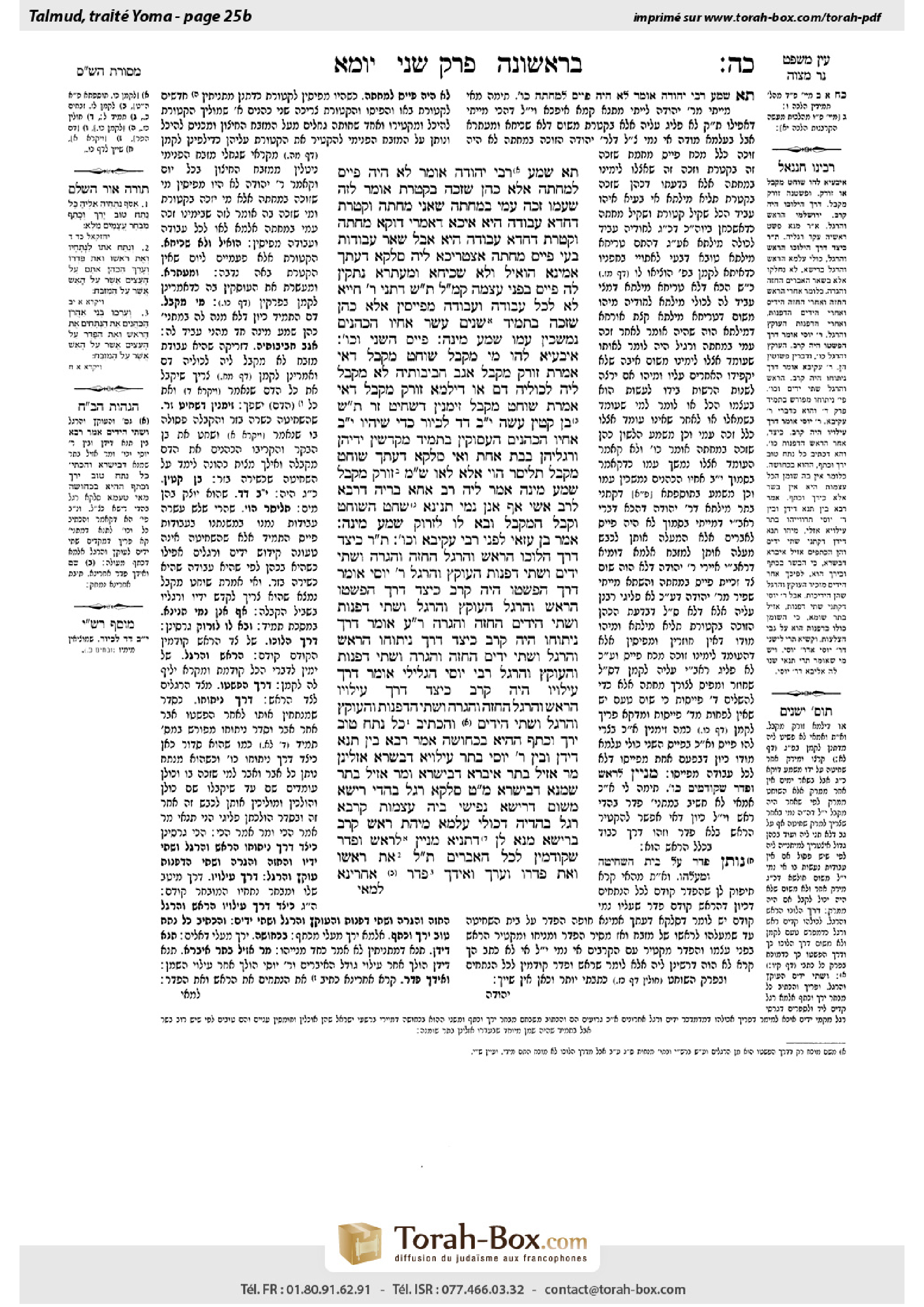
Yoma 25b: Talmud study for Daf Yomi
Daf Yomi is the daily study of one Talmud folio. Explore 37 tractates with scans, Hebrew text, Sefaria English and AI-generated French translations where annotated.
Passage selection and English or AI-generated French translation are available where the scan has annotations. Daf Study is independent of Torah-Box and Sefaria.
Browse Yoma · יומא · All tractatesYoma 25b text and translations
This page of Yoma includes the Aramaic text, an English translation and an AI-generated French translation, alongside the scan above.
יומא כ״ה ב · Aramaic and Hebrew text
תָּא שְׁמַע, רַבִּי יְהוּדָה אוֹמֵר: לֹא הָיָה פַּיִיס לַמַּחְתָּה, אֶלָּא כֹּהֵן שֶׁזָּכָה בִּקְטֹרֶת אוֹמֵר לָזֶה שֶׁעִמּוֹ ״זְכֵה עִמִּי בַּמַּחְתָּה״.
שָׁאנֵי מַחְתָּה וּקְטֹרֶת, דַּחֲדָא עֲבוֹדָה הִיא.
אִיכָּא דְּאָמְרִי: דַּוְקָא מַחְתָּה וּקְטֹרֶת דַּחֲדָא עֲבוֹדָה הִיא, אֲבָל שְׁאָר עֲבוֹדוֹת בָּעֵי פַּיִיס!
מַחְתָּה אִצְטְרִיכָא לֵיהּ, סָלְקָא דַּעְתָּךְ אָמֵינָא הוֹאִיל וְלָא שְׁכִיחָא, וּמְעַתְּרָא, נַתְקֵין לַהּ פַּיִיס בִּפְנֵי עַצְמָהּ. קָא מַשְׁמַע לַן.
תָּא שְׁמַע, דְּתָנֵי רַבִּי חִיָּיא: לֹא לְכׇל עֲבוֹדָה וַעֲבוֹדָה מְפַיְּיסִין, אֶלָּא כֹּהֵן שֶׁזָּכָה בְּתָמִיד, שְׁנֵים עָשָׂר אֶחָיו הַכֹּהֲנִים נִמְשָׁכִין עִמּוֹ. שְׁמַע מִינַּהּ.
פַּיִיס הַשֵּׁנִי וְכוּ׳. אִיבַּעְיָא לְהוּ: מִי מְקַבֵּל? שׁוֹחֵט מְקַבֵּל, דְּאִי אָמְרַתְּ זוֹרֵק מְקַבֵּל — אַגַּב חַבִּיבוּתֵיהּ, לָא מְקַבֵּל לֵיהּ לְכוּלֵּיהּ דָּם.
אוֹ דִילְמָא: זוֹרֵק מְקַבֵּל, דְּאִי אָמְרַתְּ שׁוֹחֵט מְקַבֵּל — זִימְנִין דְּשָׁחֵיט זָר.
תָּא שְׁמַע: בֶּן קָטִין עָשָׂה שְׁנֵים עָשָׂר דַּד לַכִּיּוֹר, כְּדֵי שֶׁיִּהְיוּ שְׁנֵים עָשָׂר אֶחָיו הַכֹּהֲנִים הָעֲסוּקִין בַּתָּמִיד מְקַדְּשִׁין יְדֵיהֶן וְרַגְלֵיהֶן בְּבַת אַחַת.
וְאִי סָלְקָא דַעְתָּךְ שׁוֹחֵט מְקַבֵּל, תְּלֵיסַר הָוֵי! אֶלָּא לָאו שְׁמַע מִינַּהּ: זוֹרֵק מְקַבֵּל. שְׁמַע מִינַּהּ.
אֲמַר לֵיהּ רַב אַחָא בְּרֵיהּ דְּרָבָא לְרַב אָשֵׁי, אַף אֲנַן נָמֵי תְּנֵינָא: שָׁחַט הַשּׁוֹחֵט, וְקִבֵּל הַמְקַבֵּל, וּבָא לוֹ לִזְרוֹק. שְׁמַע מִינַּהּ.
אָמַר בֶּן עַזַּאי לִפְנֵי רַבִּי עֲקִיבָא וְכוּ׳. תָּנוּ רַבָּנַן: כֵּיצַד דֶּרֶךְ הִלּוּכוֹ? הָרֹאשׁ וְהָרֶגֶל, הֶחָזֶה וְהַגֵּרָה, וּשְׁתֵּי יָדַיִם, וּשְׁתֵּי דְפָנוֹת, הָעוֹקֶץ וְהָרֶגֶל. רַבִּי יוֹסֵי אוֹמֵר: דֶּרֶךְ הֶפְשֵׁטוֹ הָיָה קָרֵב. כֵּיצַד דֶּרֶךְ הֶפְשֵׁטוֹ? הָרֹאשׁ וְהָרֶגֶל, הָעוֹקֶץ וְהָרֶגֶל, וּשְׁתֵּי דְפָנוֹת, וּשְׁתֵּי הַיָּדַיִם, הֶחָזֶה וְהַגֵּרָה.
רַבִּי עֲקִיבָא אוֹמֵר: דֶּרֶךְ נִיתּוּחוֹ הָיָה קָרֵב. כֵּיצַד דֶּרֶךְ נִיתּוּחוֹ? הָרֹאשׁ וְהָרֶגֶל, וּשְׁתֵּי יָדַיִם, הֶחָזֶה וְהַגֵּרָה, וּשְׁתֵּי דְפָנוֹת, וְהָעוֹקֶץ וְהָרֶגֶל. רַבִּי יוֹסֵי הַגְּלִילִי אוֹמֵר: דֶּרֶךְ עִילּוּיוֹ הָיָה קָרֵב. כֵּיצַד דֶּרֶךְ עִילּוּיוֹ? הָרֹאשׁ וְהָרֶגֶל, הֶחָזֶה וְהַגֵּרָה, וּשְׁתֵּי הַדְּפָנוֹת, וְהָעוֹקֶץ וְהָרֶגֶל, וּשְׁתֵּי הַיָּדַיִם.
וְהָכְתִיב: ״כׇּל נֵתַח טוֹב יָרֵךְ וְכָתֵף״? הָהִיא בִּכְחוּשָׁה.
אָמַר רָבָא: בֵּין תַּנָּא דִּידַן וּבֵין רַבִּי יוֹסֵי — בָּתַר עִילּוּיָא דְבִשְׂרָא אָזְלִינַן. מָר אָזֵיל בָּתַר אִיבְרָא דְבִישְׂרָא, וּמָר אָזֵיל בָּתַר שֻׁמְנָא דְבִישְׂרָא.
מַאי טַעְמָא סָלְקָא רֶגֶל בַּהֲדֵי רֵישָׁא? מִשּׁוּם דְּרֵישָׁא נְפִישִׁי בֵּיהּ עֲצָמוֹת, קָרְבָא רֶגֶל בַּהֲדֵיהּ.
דְּכוּלֵּי עָלְמָא מִיהַת רֹאשׁ קָרֵב בְּרֵישָׁא, מְנָא לַן? דְּתַנְיָא: מִנַּיִין לְרֹאשׁ וּפֶדֶר שֶׁקּוֹדְמִין לְכׇל הָאֵבָרִים — תַּלְמוּד לוֹמַר: ״אֶת רֹאשׁוֹ וְאֶת פִּדְרוֹ וְעָרַךְ״. וְאִידַּךְ: ״פָּדֶר״ אַחֲרִינָא.
Yoma 25b · English translation
Come and hear a proof from a baraita: Rabbi Yehuda says: When the third lottery was held to determine who would perform the burning of the incense, there was no separate lottery held for carrying the coal pan, although a second priest was required to rake up coals from the outer altar, carry them in a coal pan, and put them on the inner altar, where the priest assigned the task of burning the incense would then place the incense onto the coals. Rather, the priest who won the privilege of the incense said to the one who was next to him: Be privileged along with me with the task of carrying the coal pan. This shows that each individual service did not have its own lottery; rather, the other priests adjacent to the winner of the lottery were automatically chosen for the ancillary tasks.
The Gemara rejects this proof: The tasks of carrying the coal pan and burning the incense are different, because together they are considered as a single service, so that a single lottery determined the participants for the two tasks.
There are those who say that this baraita was brought to derive the opposite conclusion: It was specifically concerning the case of carrying the coal pan and burning the incense, which are considered as two parts of one and the same service, that Rabbi Yehuda said one lottery can be used to assign the two tasks. However, the implication is that other services, which are not interrelated in this manner, require a lottery for each and every separate task. If Rabbi Yehuda had meant this to be a general principle, why did he mention the specific example of the coal pan and the incense?
This argument is rejected: That is not a proof that other services require their own lotteries. The reason Rabbi Yehuda mentioned this specific example is that it was necessary for him to teach explicitly that the coal pan and the burning of the incense do not have separate lotteries but a single, combined lottery. It might have entered your mind to say that since the burning of incense is infrequent, being performed only twice a day, unlike other offerings, which may be donated by private individuals and brought many times a day, and also since it brings about wealth for whoever performs it, as the Gemara teaches later, we should institute a separate lottery for bringing in the coal pan itself, as many priests wished to perform this task. Therefore, Rabbi Yehuda teaches us that despite this, the bringing in of the coal pan does not have its own lottery. Consequently, there is no proof either way from this baraita.
Come and hear a proof from what Rabbi Ḥiyya taught explicitly in a baraita: A lottery is not held for each individual service; rather, beginning with the priest who won the lottery of the daily offering, twelve of his fellow priests, those standing next to him, are drawn in along with him to perform the other acts of the daily offering. The Gemara concludes: Learn from this that it is so.
§ It was taught in the mishna: The second lottery determines who slaughters, who sprinkles the blood, etc. The task of collecting the blood in a vessel, which is between slaughtering and sprinkling, is not mentioned. Therefore, it must be assumed that either the priest who slaughtered or the priest who sprinkled the blood was assigned this task as well. A dilemma was raised before the Sages: Who collects the blood? Is it the one who slaughters the offering who also collects the blood? The reason to support this conclusion is that if you say that the one who sprinkles the blood is the one who collects it, a situation might arise in which, due to his enthusiasm and his love for the mitzva of sprinkling, a service that is considered more important than collecting because it directly involves the altar, the priest might not collect all the blood as the halakha requires but would hurry to go on and sprinkle it after he has collected only some of the blood.
Or perhaps one should draw the opposite conclusion, that it is the one who sprinkles that collects the blood, as, if you say that the one who slaughters is the one who collects, this principle could not be universally applied, as sometimes a non-priest slaughters the offering. Slaughtering offerings is not a sacred service and may be performed by anyone, unlike the collection of the blood, which is performed by a priest. In those cases when a non-priest slaughtered the daily offering, he would not be able to collect the blood.
The Gemara cites a source as evidence for one side of the argument: Come and hear from that which was taught in a mishna: Ben Katin made twelve spigots for the large laver to replace the original two spouts that were there, so that his twelve fellow priests who were engaged in the sacrifice of the daily offering could all sanctify their hands and feet at one time. Although there are thirteen participants listed in the mishna, the slaughterer of the offering was not required to sanctify his hands and feet because, as mentioned above, slaughtering is not a sacred service. Therefore, only twelve spigots were needed.
And if it should enter your mind to say that the one who slaughters is the one who collects the blood, then there are sometimes thirteen participants, so thirteen spigots should be needed. On those occasions when a non-priest slaughtered the daily offering, an extra priest would be required to come and collect its blood. Since the collection of blood is a sacred service, it too requires sanctification of the hands and feet. Rather, since there were only twelve spigots, isn’t it correct to conclude from this that it is the one who sprinkles, and not the one who slaughters, who collects the blood? The Gemara concludes: Conclude from this that it is so.
Rav Aḥa, son of Rava, said to Rav Ashi: We too have learned a support for this conclusion in a mishna that gives the sequence of the services for the daily offering: The slaughterer of the offering slaughtered, the collector of its blood collected, and he then comes to sprinkle the blood. The wording indicates that the one who collects the blood is also the one who subsequently sprinkles it. The Gemara concludes: Conclude from this that it is so.
§ The mishna states that ben Azzai said before Rabbi Akiva in the name of Rabbi Yehoshua that the sequence for carrying up the animal’s limbs was based on the way it walks when alive, meaning that its front parts are taken up first. The Sages taught in the Tosefta: In what manner is the animal brought up according to the way it walks? It is in this manner: The head and the right hind leg are brought up first. The other parts follow this sequence: The breast and the neck, and then the two forelegs, and then the two flanks, then the tail and the left hind leg. Rabbi Yosei says: It was sacrificed according to the way it was skinned. In what manner is the animal brought up according to the way it was skinned? It is in this manner: The head and the right leg are brought first, then the tail and the left leg together, then the two flanks, and then the two forelegs, then the breast and the neck.
Rabbi Akiva says: It was sacrificed according to the way it was cut up into limbs after the skinning. In what manner is the animal brought up according to the way it was cut up? It is in this manner: The head and the right leg first, and then the two forelegs, then the breast and the neck, and then the two flanks, and then the tail and the left leg. Rabbi Yosei HaGelili says: It was sacrificed according to the quality of its various sections, so that the best pieces were taken up first. In what manner is the animal brought up according to the quality of the pieces? It is in this manner: The head and the right leg, then the breast and the neck, and then the two flanks, then the tail and the left leg, and then the two forelegs.
The Gemara poses a question with regard to Rabbi Yosei HaGelili’s position: But isn’t it written: “Every good piece, the thigh and the shoulder” (Ezekiel 24:4), indicating that these are the best cuts of the animal? Why doesn’t Rabbi Yosei HaGelili say that these are offered first (Rabbeinu Ḥananel)? The Gemara answers: That verse is speaking of a lean sheep, whose thigh and shoulder are indeed the best pieces. However, in the sheep brought for the daily offering, which were of the finest quality, there were other parts that were of higher quality.
The Gemara explains the reason behind the order of the pieces in the mishna. Rava said: Both the tanna of our mishna and Rabbi Yosei HaGelili agree that we follow the relative quality of the meat in the various pieces. The difference in opinion between them is that one Sage, the tanna of this mishna, follows the limb, i.e., the amount, of the meat; the other Sage, Rabbi Yosei, follows the fattiness of the meat.
The Gemara asks: According to all opinions, what is the reason that the right leg goes up to the altar together with the head? What is the connection between these two pieces? The Gemara explains: Because the head has much bone in it, the leg is offered with it.
The Gemara asks further: Although the Sages disagree as to the order of bringing up the various pieces, at any rate everyone agrees that the head is sacrificed first. From where do we derive this? As it was taught in a baraita: From where is it derived that when sacrificing an animal the head and the fat precede all the other limbs? The verse states: “And he shall cut it up into its pieces and its head and its fat, and the priest shall arrange them on the wood that is on the fire upon the altar” (Leviticus 1:12). The Gemara asks: And the other mention of fat before this, where the verse states: “The pieces, the head and the fat” (Leviticus 1:8),
Yoma 25b · Traduction française (IA)
Viens et entends une preuve tirée d’une baraïta : Rabbi Yehouda dit : Lors du troisième tirage au sort, destiné à déterminer qui brûlerait l’encens, on ne procédait pas à un tirage distinct pour le transport du brasero, bien qu’un second prêtre dût ratisser les braises de l’autel extérieur, les transporter dans un brasero et les déposer sur l’autel intérieur, où le prêtre chargé de brûler l’encens déposerait ensuite celui-ci sur les braises. Le prêtre qui avait obtenu le privilège d’offrir l’encens disait plutôt à celui qui se tenait à côté de lui : « Obtiens avec moi le privilège de transporter le brasero. » Cela montre que chaque service n’avait pas son propre tirage au sort ; les autres prêtres qui se tenaient près du gagnant étaient automatiquement choisis pour les tâches auxiliaires.
La Guemara rejette cette preuve : le transport du brasero et la combustion de l’encens sont des tâches différentes, mais elles sont considérées ensemble comme un seul service ; un seul tirage au sort déterminait donc qui accomplirait ces deux tâches.
Certains disent que cette baraïta a été citée pour tirer la conclusion inverse : c’est précisément au sujet du transport du brasero et de la combustion de l’encens, considérés comme deux parties d’un même service, que Rabbi Yehouda a dit qu’un seul tirage au sort pouvait attribuer les deux tâches. Cela implique toutefois que les autres services, qui ne sont pas liés de cette manière, nécessitent un tirage au sort pour chaque tâche distincte. Si Rabbi Yehouda avait voulu énoncer un principe général, pourquoi aurait-il mentionné précisément l’exemple du brasero et de l’encens ?
Cet argument est rejeté : cela ne prouve pas que les autres services nécessitent leurs propres tirages au sort. Rabbi Yehouda a mentionné précisément cet exemple parce qu’il devait enseigner explicitement que le transport du brasero et la combustion de l’encens ne faisaient pas l’objet de tirages séparés, mais d’un seul tirage commun. On aurait pu penser que, puisque la combustion de l’encens était peu fréquente — elle n’avait lieu que deux fois par jour, contrairement aux autres sacrifices, que des particuliers pouvaient offrir et qui pouvaient être apportés plusieurs fois par jour — et qu’elle procurait en outre la richesse à celui qui l’accomplissait, comme la Guemara l’enseignera plus loin, il fallait instituer un tirage distinct pour le transport du brasero lui-même, car de nombreux prêtres souhaitaient effectuer cette tâche. Rabbi Yehouda nous enseigne donc que, malgré cela, le transport du brasero ne faisait pas l’objet d’un tirage au sort propre. Cette baraïta ne prouve donc ni l’une ni l’autre des thèses.
Viens et entends une preuve de ce que Rabbi Ḥiyya a explicitement enseigné dans une baraïta : on ne procède pas à un tirage au sort pour chaque service séparément ; le prêtre qui a gagné le tirage au sort pour l’offrande quotidienne entraîne avec lui douze de ses collègues prêtres, ceux qui se tiennent à côté de lui, pour accomplir les autres actes liés à cette offrande. La Guemara conclut : Déduis-en que c’est bien ainsi.
§ Il est enseigné dans la Michna que le deuxième tirage au sort détermine qui égorge, qui asperge le sang, etc. La collecte du sang dans un récipient, qui s’effectue entre l’égorgement et l’aspersion, n’est pas mentionnée. Il faut donc supposer que cette tâche était également confiée soit au prêtre qui égorgeait, soit à celui qui aspergeait le sang. Une question fut posée aux Sages : qui recueille le sang ? Est-ce celui qui égorge l’offrande qui recueille également le sang ? Cette hypothèse est plausible pour la raison suivante : si l’on dit que c’est celui qui asperge le sang qui le recueille, il pourrait arriver que, emporté par son enthousiasme et son amour pour la mitsva d’aspersion — un service considéré comme plus important que la collecte parce qu’il implique directement l’autel —, le prêtre ne recueille pas tout le sang comme l’exige la halakha et se hâte de l’asperger après n’en avoir recueilli qu’une partie.
Ou peut-être faut-il tirer la conclusion inverse : c’est celui qui asperge le sang qui le recueille. En effet, si l’on dit que celui qui égorge recueille aussi le sang, ce principe ne pourrait pas s’appliquer dans tous les cas, car il arrive parfois qu’un non-prêtre égorge l’offrande. L’égorgement des sacrifices n’est pas un service sacré et peut être effectué par n’importe qui, contrairement à la collecte du sang, qui est accomplie par un prêtre. Lorsque l’offrande quotidienne était égorgée par un non-prêtre, celui-ci ne pouvait pas en recueillir le sang.
La Guemara cite une source à l’appui de l’un des avis : Viens et entends ce qui est enseigné dans une Michna : Ben Katin fabriqua douze robinets pour le grand bassin, en remplacement des deux becs qui s’y trouvaient auparavant, afin que ses douze collègues prêtres, chargés du sacrifice de l’offrande quotidienne, puissent tous se sanctifier les mains et les pieds en même temps. Bien que la Michna énumère treize participants, le prêtre qui égorgeait l’offrande n’avait pas à se sanctifier les mains et les pieds car, comme indiqué plus haut, l’égorgement n’est pas un service sacré. Il ne fallait donc que douze robinets.
Et si l’on devait penser que celui qui égorge recueille aussi le sang, il y aurait parfois treize participants et il faudrait donc treize robinets. Lorsque l’offrande quotidienne était égorgée par un non-prêtre, un prêtre supplémentaire devait venir en recueillir le sang. La collecte du sang étant un service sacré, elle exigeait elle aussi la sanctification des mains et des pieds. Mais puisqu’il n’y avait que douze robinets, n’est-il pas juste d’en conclure que c’est celui qui asperge le sang, et non celui qui égorge, qui le recueille ? La Guemara conclut : Déduis-en que c’est bien ainsi.
Rav Aḥa, fils de Rava, dit à Rav Ashi : Nous aussi, nous avons appris un argument à l’appui de cette conclusion dans une Michna qui donne l’ordre des services de l’offrande quotidienne : celui qui égorge l’offrande l’égorge, celui qui recueille son sang le recueille, puis il vient asperger le sang. La formulation indique que celui qui recueille le sang est aussi celui qui l’asperge ensuite. La Guemara conclut : Déduis-en que c’est bien ainsi.
§ La Michna rapporte que Ben Azaï dit devant Rabbi Akiva, au nom de Rabbi Yehoshoua, que l’ordre dans lequel les membres de l’animal étaient portés suivait sa manière de marcher de son vivant, c’est-à-dire que l’on portait d’abord ses parties antérieures. Les Sages enseignèrent dans la Tosefta : De quelle manière porte-t-on l’animal en suivant l’ordre de sa marche ? De la façon suivante : la tête et la patte arrière droite sont portées en premier. Les autres parties suivent cet ordre : la poitrine et le cou, puis les deux pattes avant, ensuite les deux flancs, puis la queue et la patte arrière gauche. Rabbi Yossei dit : On le sacrifiait dans l’ordre où il avait été dépouillé. De quelle manière porte-t-on l’animal selon l’ordre dans lequel il a été dépouillé ? De la façon suivante : on porte d’abord la tête et la patte droite, puis ensemble la queue et la patte gauche, ensuite les deux flancs, puis les deux pattes avant, et enfin la poitrine et le cou.
Rabbi Akiva dit : On le sacrifiait dans l’ordre où il avait été découpé en membres après avoir été dépouillé. De quelle manière porte-t-on l’animal selon l’ordre dans lequel il a été découpé ? De la façon suivante : la tête et la patte droite d’abord, puis les deux pattes avant, ensuite la poitrine et le cou, puis les deux flancs, et enfin la queue et la patte gauche. Rabbi Yossei HaGelili dit : On le sacrifiait selon la qualité de ses différentes parties, de sorte que les meilleurs morceaux étaient portés en premier. De quelle manière porte-t-on l’animal selon la qualité de ses morceaux ? De la façon suivante : la tête et la patte droite, puis la poitrine et le cou, ensuite les deux flancs, puis la queue et la patte gauche, et enfin les deux pattes avant.
La Guemara soulève une question concernant l’avis de Rabbi Yossei HaGelili : Pourtant, il est écrit : « Tout bon morceau, la cuisse et l’épaule » (Ézéchiel 24, 4), ce qui indique qu’il s’agit des meilleurs morceaux de l’animal. Pourquoi Rabbi Yossei HaGelili ne dit-il pas qu’on les offrait en premier (Rabbeinu Ḥananel) ? La Guemara répond : Ce verset parle d’un mouton maigre, dont la cuisse et l’épaule sont effectivement les meilleurs morceaux. Cependant, les moutons apportés pour l’offrande quotidienne étaient de la meilleure qualité, et certaines de leurs autres parties étaient encore meilleures.
La Guemara explique la raison de l’ordre des morceaux dans la Michna. Rava dit : Le tanna de notre Michna et Rabbi Yossei HaGelili s’accordent tous deux à suivre la qualité relative de la viande dans les différentes parties. Leur désaccord est le suivant : l’un des Sages, le tanna de cette Michna, tient compte du membre, c’est-à-dire de la quantité de viande ; l’autre Sage, Rabbi Yossei, tient compte de la teneur en graisse de la viande.
La Guemara demande : Selon tous les avis, pourquoi porte-t-on la patte droite à l’autel avec la tête ? Quel lien existe-t-il entre ces deux morceaux ? La Guemara explique : Comme la tête contient beaucoup d’os, on offre la patte avec elle.
La Guemara demande encore : Bien que les Sages soient en désaccord sur l’ordre dans lequel porter les différentes parties, tous conviennent que la tête est sacrifiée en premier. D’où le déduisons-nous ? Car il a été enseigné dans une baraïta : D’où déduit-on que, lorsqu’on sacrifie un animal, la tête et la graisse précèdent tous les autres membres ? Le verset dit : « Il le découpera en ses morceaux, avec sa tête et sa graisse, et le prêtre les disposera sur le bois qui est sur le feu, sur l’autel » (Lévitique 1, 12). La Guemara demande : Et l’autre mention de la graisse avant cela, là où le verset dit : « Les morceaux, la tête et la graisse » (Lévitique 1, 8),
Traduction française générée par IA à partir de l’édition anglaise de Sefaria. Vérifie toujours un passage avec le texte source.
Text from Sefaria: William Davidson Edition - Vocalized Aramaic (CC BY NC); William Davidson Edition - English (CC BY NC).