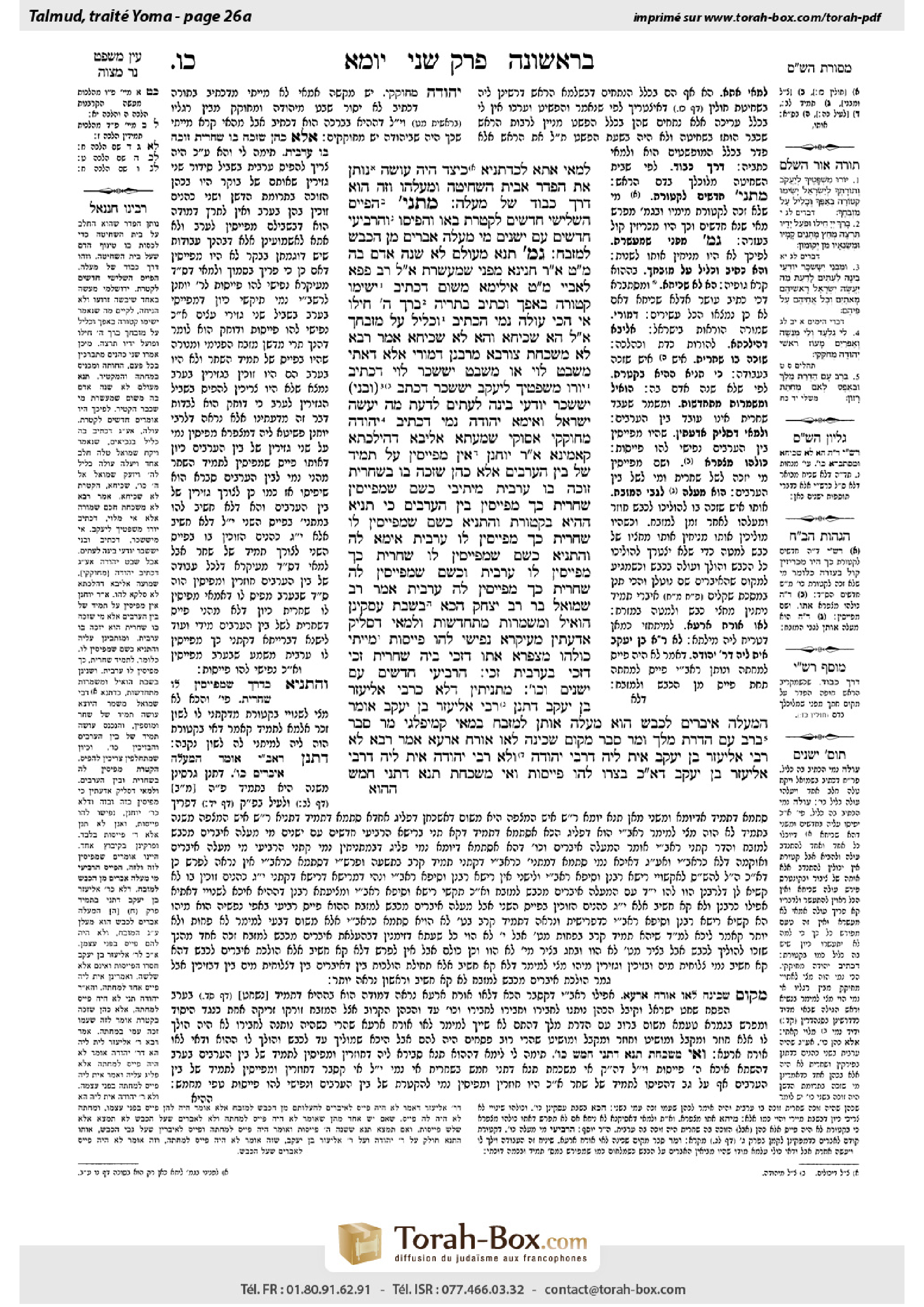
Yoma 26a: Talmud study for Daf Yomi
Daf Yomi is the daily study of one Talmud folio. Explore 37 tractates with scans, Hebrew text, Sefaria English and AI-generated French translations where annotated.
Passage selection and English or AI-generated French translation are available where the scan has annotations. Daf Study is independent of Torah-Box and Sefaria.
Browse Yoma · יומא · All tractatesYoma 26a text and translations
This page of Yoma includes the Aramaic text, an English translation and an AI-generated French translation, alongside the scan above.
יומא כ״ו א · Aramaic and Hebrew text
לְמַאי אֲתָא? לְכִדְתַנְיָא: כֵּיצַד הָיָה עוֹשֶׂה? נוֹתֵן אֶת הַפֶּדֶר אַבֵּית הַשְּׁחִיטָה וּמַעֲלֵהוּ, וְזֶה הוּא דֶּרֶךְ כָּבוֹד שֶׁל מַעְלָה.
מַתְנִי׳ הַפַּיִיס הַשְּׁלִישִׁי: חֲדָשִׁים לִקְטֹרֶת בֹּאוּ וְהָפִיסוּ. וְהָרְבִיעִי: חֲדָשִׁים עִם יְשָׁנִים — מִי מַעֲלֶה אֵבָרִים מִן הַכֶּבֶשׁ לַמִּזְבֵּחַ.
גְּמָ׳ תָּנָא: מֵעוֹלָם לֹא שָׁנָה אָדָם בָּהּ. מַאי טַעְמָא? אָמַר רַבִּי חֲנִינָא: מִפְּנֵי שֶׁמַּעֲשֶׁרֶת.
אֲמַר לֵיהּ רַב פָּפָּא לְאַבָּיֵי: מַאי טַעְמָא? אִילֵּימָא מִשּׁוּם דִּכְתִיב: ״יָשִׂימוּ קְטוֹרָה בְּאַפֶּךָ״, וּכְתִיב בָּתְרֵיהּ: ״בָּרֵךְ ה׳ חֵילוֹ״, אִי הָכִי עוֹלָה נָמֵי, הָכְתִיב: ״וְכָלִיל עַל מִזְבְּחֶךָ״!
אֲמַר לֵיהּ: הָא שְׁכִיחָא וְהָא לָא שְׁכִיחָא.
אָמַר רָבָא: לָא מַשְׁכַּחַתְּ צוּרְבָּא מֵרַבָּנַן דְּמוֹרֵי אֶלָּא דְּאָתֵי מִשֵּׁבֶט לֵוִי אוֹ מִשֵּׁבֶט יִשָּׂשכָר. לֵוִי, דִּכְתִיב: ״יוֹרוּ מִשְׁפָּטֶיךָ לְיַעֲקֹב״. יִשָּׂשכָר, דִּכְתִיב: ״(וּבְנֵי) יִשָּׂשכָר יוֹדְעֵי בִינָה לַעִתִּים לָדַעַת מַה יַּעֲשֶׂה יִשְׂרָאֵל״. וְאֵימָא יְהוּדָה נָמֵי, דִּכְתִיב: ״יְהוּדָה מְחוֹקְקִי״! אַסּוֹקֵי שְׁמַעְתָּא אַלִּיבָּא דְהִילְכְתָא קָאָמֵינָא.
אָמַר רַבִּי יוֹחָנָן: אֵין מְפַיְּיסִין עַל תָּמִיד שֶׁל בֵּין הָעַרְבָּיִם, אֶלָּא כֹּהֵן שֶׁזָּכָה בּוֹ בְּשַׁחֲרִית זוֹכֶה בּוֹ עַרְבִית, מֵיתִיבִי: כְּשֵׁם שֶׁמְּפַיְּיסִין שַׁחֲרִית כָּךְ מְפַיְּיסִין בֵּין הָעַרְבַּיִם! כִּי תַּנְיָא הָהִיא — בִּקְטוֹרֶת.
וְהָתַנְיָא: כְּשֵׁם שֶׁמְּפַיְּיסִין לוֹ שַׁחֲרִית כָּךְ מְפַיְּיסִין לוֹ עַרְבִית! אֵימָא ״לָהּ״.
וְהָתַנְיָא: כְּשֵׁם שֶׁמְּפַיְּיסִין לוֹ שַׁחֲרִית כָּךְ מְפַיְּיסִין לוֹ עַרְבִית, וּכְשֵׁם שֶׁמְּפַיְּיסִין לָהּ שַׁחֲרִית כָּךְ מְפַיְּיסִין לָהּ עַרְבִית!
אָמַר רַב שְׁמוּאֵל בַּר רַב יִצְחָק: הָכָא בְּשַׁבָּת עָסְקִינַן, הוֹאִיל וּמִשְׁמָרוֹת מִתְחַדְּשׁוֹת.
וּלְמַאי דִּסְלֵיק אַדַּעְתִּין מֵעִיקָּרָא, נְפִישִׁי לְהוּ פְּיָיסוֹת! מַיְיתֵי כּוּלְּהוּ מִצַּפְרָא אָתוּ, דְּזָכֵי בֵּיהּ שַׁחֲרִית — זָכֵי, דְּזָכֵי בְּעַרְבִית — זָכֵי.
הָרְבִיעִי חֲדָשִׁים עִם יְשָׁנִים וְכוּ׳. מַתְנִיתִין דְּלָא כְּרַבִּי אֱלִיעֶזֶר בֶּן יַעֲקֹב. דִּתְנַן, רַבִּי אֱלִיעֶזֶר בֶּן יַעֲקֹב אוֹמֵר: הַמַּעֲלֶה אֵיבָרִים לַכֶּבֶשׁ, הוּא מַעֲלֶה אוֹתָן לַמִּזְבֵּחַ.
בְּמַאי קָמִיפַּלְגִי? מָר סָבַר: ״בְּרׇב עָם הַדְרַת מֶלֶךְ״, וּמָר סָבַר: מְקוֹם שְׁכִינָה לָאו אוֹרַח אַרְעָא.
אָמַר רָבָא: לָא רַבִּי אֱלִיעֶזֶר בֶּן יַעֲקֹב אִית לֵיהּ דְּרַבִּי יְהוּדָה, וְלָא רַבִּי יְהוּדָה אִית לֵיהּ דְּרַבִּי אֱלִיעֶזֶר בֶּן יַעֲקֹב. דְּאִם כֵּן, בָּצְרוּ לְהוּ פְּיָיסוֹת.
וְאִי מַשְׁכַּחַתְּ תַּנָּא דְּתָנֵי חָמֵשׁ —
Yoma 26a · English translation
what does that come to teach us? The Gemara explains: As it was taught in a baraita: In what manner would the priest placing the pieces on the altar do so? He would place the fat right over the place of slaughter, that is, on the cut neck, and bring it up that way, and that is the most respectful way toward the Most High, that the bloody point of slaughter not be exposed.
MISHNA: Before the third lottery, the appointee declared: Let only those priests who are new to offering the incense come and participate in the lottery for the incense. The fourth lottery was open to those new to the service along with those old hands who had already performed it, to determine who would take the limbs up from the ramp, where they had been placed earlier, to the altar.
GEMARA: A Sage taught in the Tosefta: No person ever performed the service of the incense twice, as a new priest was always found for this service. The Gemara asks: What is the reason that they were insistent that no priest should be assigned this task more than once in his life? Rabbi Ḥanina said: It is because it brings wealth to the one who performs it. Since bringing the incense was a blessing for wealth, it was decided that as many different priests as possible should have an opportunity to do this service.
Rav Pappa said to Abaye: What is the reason for this assertion that the one who burns the incense becomes wealthy? If we say it is because it is written: “They shall put incense before You and whole burnt-offerings on Your altar” (Deuteronomy 33:10), and it is written immediately after that: “Bless, O Lord, his substance” (Deuteronomy 33:11), if so, we should also make the same assertion concerning those who perform the sacrifice of a burnt-offering, since it is written in that same verse: “And whole burnt-offerings on Your altar.”
Abaye said to him: There is a difference between the two: This, the sacrifice of a burnt-offering, is frequent, and that, the burning of incense, is infrequent. There were many burnt-offerings, both obligatory and voluntary, brought during the course of a day, whereas the incense was burned only twice a day. It is logical to assume that the blessing of riches was not extended to the many priests who participated in the burnt-offerings, but to the few priests who performed the burning of the incense.
Apropos this passage in Deuteronomy, Rava said: You do not find a young Torah scholar who gives halakhic instruction unless he comes from the tribe of Levi or from the tribe of Issachar. The assertion with regard to the tribe of Levi is as it is written: “They shall teach Jacob Your ordinances and Israel Your law” (Deuteronomy 33:10). And the assertion with regard to the tribe of Issachar is as it is written: “And of the children of Issachar, men that had understanding of the times, to know what Israel should do” (I Chronicles 12:33). The Gemara asks: And say that scholars come from the tribe of Judah also, as it is written: “Judah is my lawgiver” (Psalms 60:9). Rava answers: While it is true that the tribe of Judah also taught Torah, in my statement I was speaking only of those who can draw conclusions according to the halakha. Although Judah produces great scholars, men capable of translating abstract analysis of the Torah into legal principles come from the two tribes mentioned.
§ Rabbi Yoḥanan said: They did not hold a separate lottery for the slaughtering and sacrifice of the daily afternoon offering. Rather, the same priest who won a particular privilege for the morning offering wins the privilege for the corresponding task in the evening, i.e., for the afternoon service. In this way, the morning lottery covered both services. The Gemara raises an objection from a baraita: Just as they hold a lottery in the morning, so too, they hold a lottery in the afternoon. This shows that there was a separate lottery for the daily afternoon offering. The Gemara answers: When that baraita was taught, it referred only to the incense, which, as stated above, was given to a different priest each time it was offered.
The Gemara asks: But wasn’t it taught in a baraita: Just as they hold a lottery for it [lo] in the morning, so too, they hold a lottery for it [lo] in the afternoon. The masculine pronoun lo indicates that it is not referring to the incense, which is a feminine noun in Hebrew, but to the daily afternoon offering, which is described by a masculine noun. The Gemara answers: Change the wording of the baraita and say: Lah, using the feminine pronoun instead of the masculine lo, so that it is indeed referring to the incense.
The Gemara asks further: But wasn’t it taught in another baraita: Just as they hold a lottery for it [lo] the morning, so too, they hold a lottery for it [lo] in the afternoon; and just as they hold a lottery for it [lah] in the morning, so too, they hold a lottery for it [lah] in the afternoon. This baraita makes the statement twice, once using the masculine pronoun and once using the feminine pronoun, which shows that there was a separate lottery in the afternoon not only for the incense but also for the daily offering.
Rav Shmuel bar Rav Yitzḥak said: There is no contradiction. Here, in this last baraita, we are dealing with Shabbat, when a second lottery in the afternoon was necessary, since the priestly rotations are renewed each Shabbat. On Shabbat the outgoing watch of priests performs the morning service, and the incoming watch performs the afternoon service. Therefore, the same priest could not perform the service of both the morning and afternoon offerings, necessitating a second lottery on that day to designate priests for the various afternoon tasks.
The Gemara asks: And according to what we thought initially, that there was a separate lottery each day for the daily afternoon offering, there would be too many lotteries, as the mishna states that there were just four lotteries daily. How was it conceivable even to consider such a possibility? The Gemara answers: The thought was that all the priests would come and assemble just once, in the morning, for both lotteries, and the priest who would win the lottery for sacrificing the daily morning offering would win that privilege for the morning only, and the priest who would win the lottery for sacrificing the daily afternoon offering would win the privilege for the afternoon.
§ The mishna states: The fourth lottery was open to those new to the service along with those old hands who had already performed it, to determine who would take the limbs up from the ramp to the altar. The Gemara states: The mishna is not in accordance with the opinion of Rabbi Eliezer ben Ya’akov. As we learned in a mishna in tractate Tamid that Rabbi Eliezer ben Ya’akov says: The priest who takes the limbs up to the ramp is the one who takes them up from the ramp to the altar. In contrast, according to the mishna discussed here, it is implied that a different priest won the privilege for the latter service in the lottery.
The Gemara asks: With regard to what do they disagree? One Sage, the tanna of the mishna discussed here, holds that it is proper to follow the verse: “In the multitude of people is the king’s glory” (Proverbs 14:28). It is a glorification of God for many priests to participate in the service, so different priests were assigned the task of taking the limbs to the ramp, and others were tasked with carrying them up the ramp to the altar. And one Sage, Rabbi Eliezer ben Ya’akov, holds that it is not proper conduct in the place of the Divine Presence to have two sets of priests for these tasks, as it gives the appearance that the first set does not want to be bothered to take the limbs up to the altar.
Rava said: Rabbi Eliezer ben Ya’akov, who holds that the same priest who brought the limbs to the ramp also brought them up to the altar, is not of the same opinion as Rabbi Yehuda, who holds that there is no separate lottery for the privilege of carrying the coal pan for the incense. And conversely, Rabbi Yehuda is not of the same opinion as Rabbi Eliezer ben Ya’akov. As, if it would be so that these two Sages agreed with each other, there would be too few lotteries; there would be only three lotteries rather than four. Rather, one must say that according to Rabbi Eliezer ben Ya’akov, who maintains that there was no lottery held for taking the limbs up to the altar, there was a fourth lottery to determine who would carry the coal pan; and according to Rabbi Yehuda, who maintains that there was no lottery for carrying the coal pan, there must have been a lottery for carrying the limbs up to the ramp.
And if you find a tanna in a baraita who teaches that there were five lotteries for the Temple service,
Yoma 26a · Traduction française (IA)
À quoi cela vient-il nous enseigner ? La Guemara explique : comme il a été enseigné dans une baraïta : De quelle manière le prêtre disposait-il les morceaux sur l’autel ? Il plaçait la graisse juste au-dessus du lieu de l’égorgement, c’est-à-dire sur le cou tranché, puis la faisait monter ainsi. C’était la manière la plus respectueuse envers le Très-Haut : le point d’égorgement ensanglanté ne devait pas être exposé.
MICHNA : Avant le troisième tirage au sort, le préposé annonçait : « Que seuls les prêtres qui n’ont encore jamais offert l’encens viennent participer au tirage au sort pour l’encens. » Le quatrième tirage au sort était ouvert aussi bien aux prêtres novices dans le service qu’à ceux qui l’avaient déjà accompli, afin de déterminer qui ferait monter sur l’autel les membres qui avaient été déposés auparavant sur la rampe.
GUEMARA : Un Sage enseigna dans la Tosefta : Personne n’accomplit jamais deux fois le service de l’encens, car on trouvait toujours un nouveau prêtre pour ce service. La Guemara demande : Pourquoi tenait-on tant à ce qu’aucun prêtre ne se voie attribuer cette tâche plus d’une fois dans sa vie ? Rabbi Ḥanina dit : Parce que celui qui l’accomplit s’enrichit. Puisque l’offrande de l’encens était une source de richesse, on décida que le plus grand nombre possible de prêtres différents aurait l’occasion d’accomplir ce service.
Rav Pappa dit à Abaye : Pourquoi affirme-t-on que celui qui fait brûler l’encens s’enrichit ? Si l’on dit que c’est parce qu’il est écrit : « Ils placeront l’encens devant Toi et des holocaustes sur Ton autel » (Deutéronome 33, 10), puis immédiatement après : « Bénis, Seigneur, ses biens » (Deutéronome 33, 11), alors il faudrait également affirmer la même chose au sujet de ceux qui offrent un holocauste, puisqu’il est écrit dans ce même verset : « et des holocaustes sur Ton autel ».
Abaye lui dit : Il y a une différence entre les deux. L’holocauste est fréquent, tandis que l’encens est rare. De nombreux holocaustes, obligatoires comme volontaires, étaient offerts au cours de la journée, alors que l’encens ne brûlait que deux fois par jour. Il est logique de supposer que la bénédiction de la richesse n’était pas accordée aux nombreux prêtres qui participaient aux holocaustes, mais aux quelques prêtres qui faisaient brûler l’encens.
À propos de ce passage du Deutéronome, Rava dit : On ne trouve pas de jeune érudit en Torah qui enseigne la halakha s’il n’est pas issu de la tribu de Lévi ou de la tribu d’Issachar. L’affirmation concernant la tribu de Lévi s’appuie sur ce qui est écrit : « Ils enseigneront Tes lois à Jacob et Ta Torah à Israël » (Deutéronome 33, 10). Celle concernant la tribu d’Issachar s’appuie sur ce qui est écrit : « Parmi les fils d’Issachar, des hommes qui comprenaient les temps, sachant ce qu’Israël devait faire » (I Chroniques 12, 33). La Guemara demande : Pourquoi ne pas dire que les érudits viennent aussi de la tribu de Juda, puisqu’il est écrit : « Juda est mon législateur » (Psaumes 60, 9) ? Rava répond : Il est vrai que la tribu de Juda enseignait également la Torah, mais, dans ma déclaration, je parlais uniquement de ceux qui savent tirer des conclusions conformes à la halakha. Bien que Juda produise de grands érudits, les hommes capables de traduire l’analyse abstraite de la Torah en principes juridiques sont issus des deux tribus mentionnées.
§ Rabbi Yoḥanan dit : On ne procédait pas à un tirage au sort distinct pour l’égorgement et l’offrande du sacrifice quotidien de l’après-midi. Au contraire, le même prêtre qui avait obtenu le matin une tâche particulière pour le sacrifice quotidien du matin obtenait aussi la tâche correspondante le soir, c’est-à-dire pour le service de l’après-midi. Ainsi, le tirage au sort du matin couvrait les deux services. La Guemara soulève une objection à partir d’une baraïta : De même qu’on procède à un tirage au sort le matin, on en procède également l’après-midi. Cela montre qu’il y avait un tirage au sort distinct pour le sacrifice quotidien de l’après-midi. La Guemara répond : Lorsque cette baraïta fut enseignée, elle ne concernait que l’encens, qui, comme indiqué plus haut, était confié à un prêtre différent à chaque fois qu’il était offert.
La Guemara demande : Mais n’a-t-on pas enseigné dans une baraïta : « De même qu’on procède à un tirage au sort à son sujet [lo] le matin, on en procède également à son sujet [lo] l’après-midi » ? Le pronom masculin lo indique qu’il ne s’agit pas de l’encens, qui est un nom féminin en hébreu, mais du sacrifice quotidien de l’après-midi, désigné par un nom masculin. La Guemara répond : Modifie la formulation de la baraïta et lis : Lah, avec le pronom féminin à la place du pronom masculin lo, de sorte qu’il s’agisse bien de l’encens.
La Guemara poursuit sa question : Mais n’a-t-on pas enseigné dans une autre baraïta : « De même qu’on procède à un tirage au sort à son sujet [lo] le matin, on en procède également à son sujet [lo] l’après-midi ; et de même qu’on procède à un tirage au sort à son sujet [lah] le matin, on en procède également à son sujet [lah] l’après-midi » ? Cette baraïta énonce la chose deux fois, une fois avec le pronom masculin et une fois avec le pronom féminin, ce qui montre qu’il y avait l’après-midi un tirage au sort distinct non seulement pour l’encens, mais aussi pour le sacrifice quotidien.
Rav Shmuel bar Rav Yitzḥak dit : Il n’y a pas de contradiction. Ici, dans cette dernière baraïta, il s’agit du Chabbat, où un second tirage au sort l’après-midi était nécessaire, puisque les rotations sacerdotales étaient renouvelées chaque Chabbat. Le Chabbat, la garde sacerdotale sortante accomplissait le service du matin, et la garde entrante celui de l’après-midi. Le même prêtre ne pouvait donc pas accomplir le service des sacrifices du matin et de l’après-midi, ce qui nécessitait ce jour-là un second tirage au sort pour désigner les prêtres chargés des différentes tâches de l’après-midi.
La Guemara demande : Selon notre hypothèse initiale, d’après laquelle il y avait chaque jour un tirage au sort distinct pour le sacrifice quotidien de l’après-midi, il y aurait eu trop de tirages au sort, puisque la Michna dit qu’il n’y en avait que quatre par jour. Comment pouvait-on seulement envisager cette possibilité ? La Guemara répond : On pensait que tous les prêtres viendraient et se rassembleraient une seule fois, le matin, pour les deux tirages au sort ; le prêtre qui gagnerait le tirage au sort pour offrir le sacrifice quotidien du matin obtiendrait ce privilège pour le matin seulement, et celui qui gagnerait le tirage au sort pour offrir le sacrifice quotidien de l’après-midi obtiendrait ce privilège pour l’après-midi.
§ La Michna dit : Le quatrième tirage au sort était ouvert aussi bien aux prêtres novices dans le service qu’à ceux qui l’avaient déjà accompli, afin de déterminer qui ferait monter les membres depuis la rampe jusqu’à l’autel. La Guemara déclare : La Michna n’est pas conforme à l’opinion de Rabbi Eliezer ben Ya’akov. En effet, nous avons appris dans une Michna du traité Tamid que Rabbi Eliezer ben Ya’akov dit : Le prêtre qui fait monter les membres sur la rampe est celui qui les fait monter de la rampe jusqu’à l’autel. En revanche, selon la Michna examinée ici, il semble qu’un autre prêtre ait obtenu par tirage au sort le privilège d’accomplir ce dernier service.
La Guemara demande : Sur quoi porte leur désaccord ? Un Sage, le tanna de la Michna examinée ici, estime qu’il convient de suivre le verset : « Dans la multitude du peuple réside la gloire du roi » (Proverbes 14, 28). Il est glorieux pour Dieu qu’un grand nombre de prêtres participe au service ; différents prêtres étaient donc chargés de porter les membres jusqu’à la rampe, et d’autres, de les faire monter par la rampe jusqu’à l’autel. L’autre Sage, Rabbi Eliezer ben Ya’akov, estime qu’il n’est pas convenable, dans le lieu de la Présence divine, de confier ces tâches à deux groupes de prêtres, car cela donne l’impression que le premier groupe ne veut pas se donner la peine de faire monter les membres jusqu’à l’autel.
Rava dit : Rabbi Eliezer ben Ya’akov, qui estime que le même prêtre qui avait porté les membres jusqu’à la rampe les faisait également monter jusqu’à l’autel, n’est pas du même avis que Rabbi Yehuda, qui estime qu’il n’y avait pas de tirage au sort distinct pour désigner celui qui porterait la pelle à braises pour l’encens. Et, inversement, Rabbi Yehuda n’est pas du même avis que Rabbi Eliezer ben Ya’akov. En effet, si ces deux Sages étaient d’accord, il n’y aurait eu que trois tirages au sort au lieu de quatre. Il faut donc dire que, selon Rabbi Eliezer ben Ya’akov, qui soutient qu’il n’y avait pas de tirage au sort pour faire monter les membres jusqu’à l’autel, un quatrième tirage au sort désignait celui qui porterait la pelle à braises ; et que, selon Rabbi Yehuda, qui soutient qu’il n’y avait pas de tirage au sort pour porter la pelle à braises, il devait y avoir un tirage au sort pour porter les membres jusqu’à la rampe.
Et si tu trouves un tanna qui enseigne dans une baraïta qu’il y avait cinq tirages au sort pour le service du Temple,
Traduction française générée par IA à partir de l’édition anglaise de Sefaria. Vérifie toujours un passage avec le texte source.
Text from Sefaria: William Davidson Edition - Vocalized Aramaic (CC BY NC); William Davidson Edition - English (CC BY NC).