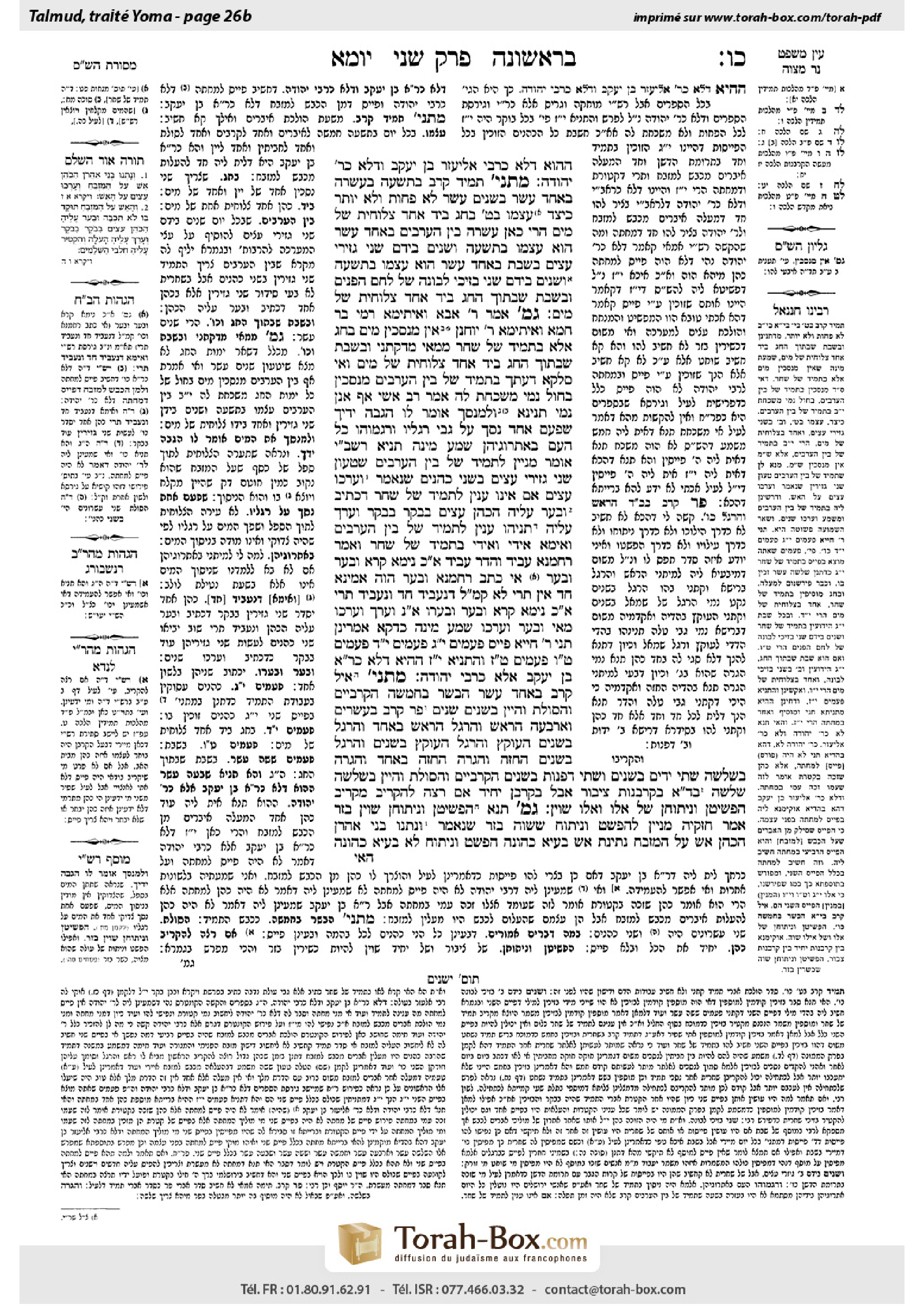
Yoma 26b: Talmud study for Daf Yomi
Daf Yomi is the daily study of one Talmud folio. Explore 37 tractates with scans, Hebrew text, Sefaria English and AI-generated French translations where annotated.
Passage selection and English or AI-generated French translation are available where the scan has annotations. Daf Study is independent of Torah-Box and Sefaria.
Browse Yoma · יומא · All tractatesYoma 26b text and translations
This page of Yoma includes the Aramaic text, an English translation and an AI-generated French translation, alongside the scan above.
יומא כ״ו ב · Aramaic and Hebrew text
הָהוּא דְּלָא כְּרַבִּי אֱלִיעֶזֶר בֶּן יַעֲקֹב וּדְלָא כְּרַבִּי יְהוּדָה.
מַתְנִי׳ תָּמִיד קָרֵב בְּתִשְׁעָה, בַּעֲשָׂרָה, בְּאַחַד עָשָׂר, בִּשְׁנֵים עָשָׂר. לֹא פָּחוֹת וְלֹא יוֹתֵר. כֵּיצַד? עַצְמוֹ בְּתִשְׁעָה. בֶּחָג, בְּיַד אֶחָד צְלוֹחִית שֶׁל מַיִם — הֲרֵי כָּאן עֲשָׂרָה.
בֵּין הָעַרְבַּיִם בְּאַחַד עָשָׂר: הוּא עַצְמוֹ בְּתִשְׁעָה, וּשְׁנַיִם בְּיָדָם שְׁנֵי גְּזִירֵי עֵצִים. בַּשַּׁבָּת בְּאַחַד עָשָׂר: הוּא עַצְמוֹ בְּתִשְׁעָה, וּשְׁנַיִם בְּיָדָם שְׁנֵי בְּזִיכֵי לְבוֹנָה שֶׁל לֶחֶם הַפָּנִים. וּבְשַׁבָּת שֶׁבְּתוֹךְ הַחַג בְּיַד אֶחָד צְלוֹחִית שֶׁל מַיִם.
גְּמָ׳ אָמַר רַבִּי אַבָּא וְאִיתֵּימָא רָמֵי בַּר חָמָא, וְאִיתֵּימָא רַבִּי יוֹחָנָן: אֵין מְנַסְּכִין מַיִם בֶּחָג אֶלָּא בְּתָמִיד שֶׁל שַׁחַר. מִמַּאי? מִדְּקָתָנֵי: וּבְשַׁבָּת שֶׁבְּתוֹךְ הֶחָג בְּיַד אֶחָד צְלוֹחִית שֶׁל מַיִם. וְאִי סָלְקָא דַּעְתָּךְ בְּתָמִיד שֶׁל בֵּין הָעַרְבַּיִם מְנַסְּכִין, בַּחוֹל נָמֵי מַשְׁכַּחַתְּ לַהּ.
אָמַר רַב אָשֵׁי, אַף אֲנַן נָמֵי תְּנֵינָא: וְלַמְנַסֵּךְ אוֹמֵר לוֹ ״הַגְבַּהּ יָדֶיךָ״, שֶׁפַּעַם אַחַת נִסֵּךְ עַל גַּבֵּי רַגְלָיו, וּרְגָמוּהוּ כׇּל הָעָם בְּאֶתְרוֹגֵיהֶן. שְׁמַע מִינַּהּ.
תַּנְיָא, רַבִּי שִׁמְעוֹן בֶּן יוֹחַאי אוֹמֵר: מִנַּיִין לְתָמִיד שֶׁל בֵּין הָעַרְבַּיִם שֶׁטָּעוּן שְׁנֵי גְּזִירֵי עֵצִים בִּשְׁנֵי כֹהֲנִים, שֶׁנֶּאֱמַר: ״וְעָרְכוּ עֵצִים״, אִם אֵינוֹ עִנְיָן לְתָמִיד שֶׁל שַׁחַר דִּכְתִיב: ״וּבִעֵר עָלֶיהָ הַכֹּהֵן עֵצִים בַּבֹּקֶר בַּבֹּקֶר וְעָרַךְ עָלֶיהָ״, תְּנֵיהוּ עִנְיָן לְתָמִיד שֶׁל בֵּין הָעַרְבַּיִם.
וְאֵימָא אִידֵּי וְאִידֵּי בְּתָמִיד שֶׁל שַׁחַר, וְאָמַר רַחֲמָנָא: עֲבֵיד וַהֲדַר עֲבֵיד! אִם כֵּן, נֵימָא קְרָא ״וּבִעֵר״ ״וּבִעֵר״.
אִי כְּתַב רַחֲמָנָא ״וּבִעֵר״, הֲוָה אָמֵינָא חַד — אִין, תְּרֵי — לָא, קָא מַשְׁמַע לַן דְּנַעְבֵּיד חַד וְנַעְבֵּיד תְּרֵי!
אִם כֵּן, נֵימָא קְרָא: ״וּבִעֵר״ ״וּבִעֲרוּ״, אִי נָמֵי: ״וְעָרַךְ״ ״וְעָרְכוּ״, מַאי ״וּבִעֵר״ ״וְעָרְכוּ״? שְׁמַע מִינַּהּ כִּדְקָא אָמְרִינַן.
תָּנֵי רַבִּי חִיָּיא: פַּיִיס פְּעָמִים שְׁלֹשָׁה עָשָׂר, פְּעָמִים אַרְבָּעָה עָשָׂר, פְּעָמִים חֲמִשָּׁה עָשָׂר, פְּעָמִים שִׁשָּׁה עָשָׂר.
וְהָתַנְיָא שִׁבְעָה עָשָׂר!
הָהִיא דְּלָא כְּרַבִּי אֱלִיעֶזֶר בֶּן יַעֲקֹב, אֶלָּא כְּרַבִּי יְהוּדָה.
מַתְנִי׳ אַיִל קָרֵב בְּאַחַד עָשָׂר: הַבָּשָׂר בַּחֲמִשָּׁה, הַקְּרָבַיִים וְהַסּוֹלֶת וְהַיַּיִן בִּשְׁנַיִם שְׁנַיִם. פַּר קָרֵב בְּעֶשְׂרִים וְאַרְבָּעָה: הָרֹאשׁ וְהָרֶגֶל, הָרֹאשׁ בְּאֶחָד וְהָרֶגֶל בִּשְׁנַיִם. הָעוֹקֶץ וְהָרֶגֶל, הָעוֹקֶץ בִּשְׁנַיִם וְהָרֶגֶל בִּשְׁנַיִם. הֶחָזֶה וְהַגֵּרָה, הֶחָזֶה בְּאֶחָד וְהַגֵּרָה בִּשְׁלֹשָׁה. שְׁתֵּי יָדַיִם בִּשְׁנַיִם, וּשְׁתֵּי דְפָנוֹת בִּשְׁנַיִם, הַקְּרָבַיִים וְהַסּוֹלֶת וְהַיַּיִן בִּשְׁלֹשָׁה שְׁלֹשָׁה.
בַּמֶּה דְּבָרִים אֲמוּרִים — בְּקׇרְבְּנוֹת צִיבּוּר. אֲבָל בְּקׇרְבַּן יָחִיד, אִם רָצָה לְהַקְרִיב — מַקְרִיב. הֶפְשֵׁיטָן וְנִיתּוּחָן שֶׁל אֵלּוּ וְאֵלּוּ שָׁוִין.
גְּמָ׳ תָּנָא: הֶפְשֵׁיטָן וְנִיתּוּחָן שָׁוִין בְּזָר.
אָמַר חִזְקִיָּה: מִנַּיִין לְהֶפְשֵׁט וְנִיתּוּחַ שֶׁשָּׁוֶה בְּזָר? שֶׁנֶּאֱמַר: ״וְנָתְנוּ בְּנֵי אַהֲרֹן הַכֹּהֵן אֵשׁ עַל הַמִּזְבֵּחַ״, נְתִינַת אֵשׁ בָּעֲיָא כְּהוּנָּה, הֶפְשֵׁט וְנִיתּוּחַ לָא בָּעֲיָא כְּהוּנָּה.
Yoma 26b · English translation
the opinion of that tanna would be in accordance with neither the opinion of Rabbi Eliezer ben Ya’akov nor the opinion of Rabbi Yehuda, as these five lotteries would include one for carrying the coal pan and another one for taking the limbs up to the altar.
MISHNA: The daily offering is sacrificed and its limbs are carried by nine priests, as mentioned in a previous mishna. These nine carry the limbs and the accompanying libations and meal-offerings. Occasionally, the service is performed by ten priests, occasionally by eleven, and sometimes by twelve priests; no fewer than nine and no more than twelve. How so? The daily offering itself is sacrificed by nine priests, as explained earlier. On the festival of Sukkot a priest in whose hand is a jug of water for the water libation is added, and there are ten priests. On Sukkot, a water libation is poured on the altar in addition to the standard wine libation.
In the daily afternoon offering, eleven priests participate in the service. How so? The daily offering itself is sacrificed by nine, and there are an additional two priests in whose hands are two logs that are placed on the altar. The mitzva of placing the two logs in the morning was assigned in the first lottery, as the Gemara explained earlier. On Shabbat, eleven priests participate. How so? The daily morning offering itself is performed by nine, and there are an additional two priests in whose hands are two vessels of frankincense that accompany the shewbread. This frankincense is burned on Shabbat. And on Shabbat that occurs within the festival of Sukkot there is an additional priest in whose hand is a jug of water for the water libation, for a total of twelve priests.
GEMARA: Rabbi Abba, and some say it was Rami bar Ḥama, and some say it was Rabbi Yoḥanan, said: On the festival of Sukkot they pour the water libation only during the sacrifice of the daily morning offering and not in the afternoon. From where is this derived? It is derived from the fact that it is taught in the mishna: And on Shabbat that occurs within the festival of Sukkot there is a priest in whose hand is a jug of water, bringing the number of participating priests to twelve. And if it should enter your mind to say that they pour water during the daily afternoon offering also, if so, you find that there were twelve priests on a weekday as well, that is, during the intermediate days of the Festival: Nine priests for the daily offering, two to carry the logs, and one to pour the water.
Rav Ashi said: We too have learned this in a different mishna, that the water libation was offered only in the morning, as it was taught: And they would say to the pourer: Raise your hand so everyone will see as you pour the water into the aperture on the altar, in accordance with the proper procedure. This was done because one time a Sadducee priest, who did not accept that there is a mitzva of water libation, poured the water onto his feet, whereupon all the people pelted him with their etrogim in anger. Since the episode involved etrogim, it is apparent that it took place in the morning, when people have their etrogim with them. Since the mishna mentions the fact that it was etrogim that were used to pelt the priest, it is apparently coming to teach that the water libation takes place only in the morning. The Gemara concludes: Indeed, learn from this that it is so.
It was taught in a baraita that Rabbi Shimon ben Yoḥai says: From where is it derived that the daily afternoon offering requires that two logs be brought along with it, and that they must be brought by two priests? As it is stated with regard to the burnt-offering: “The sons of Aaron the priest shall put fire on the altar and lay out wood [etzim] in order upon the fire” (Leviticus 1:7). The word etzim is plural, which teaches that two logs are called for. If this is not applicable to the daily morning offering, as it is already written about the morning offering explicitly: “And the priest shall burn wood on it every morning, and arrange the burnt-offering on it” (Leviticus 6:5), apply it to the daily afternoon offering. The verse therefore teaches us that two logs should be added before that offering.
But say that this and this, i.e., both verses cited above, are dealing with the daily morning offering, and that the Merciful One states in the Torah: Perform the arrangement of wood and then return and perform it again. In other words, perhaps the Torah’s intention is that two logs be arranged on the altar twice in the morning, and that accounts for the two verses. The Gemara rejects this possibility: If it were so, the text should use the same expression both times and say: “And he shall burn wood on it,” and again: “And he shall burn wood on it.” Since the text does not do so, but instead employs two different verbs, saying: “They shall lay out wood” once and: “He shall burn wood” the second time, this indicates that the Torah is describing two different times.
The Gemara rejects this inference: If the Merciful One had written in the Torah: “And he shall burn wood on it” twice, I would have said it means that one priest should arrange the wood, not two. The change of terminology to a plural verb is therefore necessary because it teaches us that one priest should perform it the first time and two priests should perform it the second time, but they are both performed in the morning.
The Gemara rejects this: If so, if this were what the Torah wished to indicate, the verse should say: “And he shall burn wood” in the singular, and then, in the second verse, say: And they shall burn wood, in the plural, using the same verb both times, changing only the number of the verb. Or, alternatively, the verse should say: And he shall lay out wood, in the singular, and then, in the second verse, say: “And they shall lay out wood,” in the plural. What is the reason the Torah uses two different verbs in the two verses, stating: “And he shall burn wood” and then: “And they shall lay out wood”? Learn from this as we have said, that the Torah in these two verses is referring to two separate times of day, and the verse: “They shall lay out wood [etzim]” is referring to the daily afternoon offering, mandating that at that time “they,” i.e., two priests, shall lay out etzim, the plural term for wood, referring to two logs.
Rabbi Ḥiyya taught: Sometimes thirteen priests were involved in sacrificing the daily offering, all these tasks being assigned in the second lottery, as the mishna taught earlier. But sometimes fourteen priests are chosen in this manner to participate, since on Sukkot an additional priest is chosen to pour the water libation. And sometimes fifteen priests are chosen, on Shabbat, when two priests are tasked with burning the frankincense in the vessels. And sometimes sixteen priests are chosen, on Shabbat that occurs during Sukkot, when three extra priests are added: One to pour the water and two to burn the frankincense.
The Gemara asks with regard to Rabbi Ḥiyya’s statement: But wasn’t it taught in a baraita that sometimes there are seventeen priests involved in the daily offering?
The Gemara responds: That baraita is not in accordance with the opinion of Rabbi Eliezer ben Ya’akov but is in accordance with the opinion of Rabbi Yehuda. The seventeenth task of the daily morning offering referred to in the baraita is taking up the pieces of the offering from the ramp to the altar. According to Rabbi Eliezer ben Ya’akov, this task was not assigned to a new priest but was performed by the same priests who had brought the pieces to the ramp. The baraita, which does assign this task to a seventeenth priest, is therefore not in accordance with the opinion of Rabbi Eliezer ben Ya’akov. As the Gemara explained earlier, the opinions of Rabbi Yehuda and Rabbi Eliezer ben Ya’akov are mutually exclusive; consequently, since the baraita contradicts the opinion of Rabbi Eliezer ben Ya’akov, it must be in accordance with the opinion of Rabbi Yehuda. Rabbi Ḥiyya, however, adopted the view of Rabbi Eliezer ben Yaakov, and for this reason he taught that the maximum number of tasks assigned through the second lottery is only sixteen.
MISHNA: A ram that is brought for a communal burnt-offering is sacrificed by eleven priests. The flesh on the various limbs is taken by five priests, as in the case of the sheep of the daily offering. The intestines, and the fine flour of the meal-offering, and the wine of the libation are carried by two priests each, because the meal-offering and wine libation that accompany a ram are larger than those that accompany a sheep. A bull is sacrificed by twenty-four priests. How so? The head and the right leg are sacrificed first, but due to its size the head is carried by one priest and the leg by two. The tail and the left leg are carried as follows: The tail is sacrificed by two and the leg by two. The breast and the neck are carried as follows: The breast is offered by one and the neck by three priests. The two forelegs are carried by two priests, and the two flanks are carried by two. The intestines and the fine flour and the wine are carried by three each, because the meal-offering and wine libation that accompany a bull are larger than those that accompany a ram.
In what case is this statement said, that this is the sequence followed? It is in the case of communal offerings. However, in the case of an individual offering brought to fulfill a vow or an obligation, if a single priest wishes to sacrifice it alone he may sacrifice it alone, or if he chooses he may include other priests in the service. With regard to the flaying and the cutting of both these, individual offerings, and those, communal offerings, they are equal, as will be explained in the Gemara.
GEMARA: A Sage taught in the Tosefta: The individual offerings and communal offerings are equal with regard to their flaying and cutting, in that these may be performed by a non-priest. They are not considered services that require priests.
Ḥizkiya said: From where is it derived that they are equal with regard to their flaying and cutting? From where is it derived that flaying and cutting of offerings, whether individual or communal, may be performed by a non-priest? At first it is stated with regard to the burnt-offering: “And he shall flay the burnt-offering and cut it into its pieces” (Leviticus 1:6), and following that it is stated: “The sons of Aaron the priest shall place fire on the altar” (Leviticus 1:7). The fact that the sons of Aaron are mentioned in the verse about putting fire on the altar but not in the verse about flaying and cutting teaches that placing fire on the altar requires priesthood, i.e., it must be performed by priests, but flaying and cutting do not require priesthood.
Yoma 26b · Traduction française (IA)
L’opinion de ce tanna ne serait conforme ni à celle de Rabbi Eliezer ben Ya’akov ni à celle de Rabbi Yehuda, car ces cinq tirages au sort comprendraient l’un pour porter la pelle à braises et un autre pour monter les membres sur l’autel.
MICHNA : Le sacrifice perpétuel est offert et ses membres sont portés par neuf prêtres, comme cela a été mentionné dans une Michna précédente. Ces neuf prêtres portent les membres, ainsi que les libations et les offrandes de farine qui les accompagnent. Parfois, le service est accompli par dix prêtres, parfois par onze, et parfois par douze prêtres : jamais par moins de neuf ni par plus de douze. Comment cela ? Le sacrifice perpétuel lui-même est offert par neuf prêtres, comme cela a été expliqué précédemment. À la fête de Soukkot, on ajoute un prêtre qui tient dans sa main une cruche d’eau pour la libation d’eau, ce qui fait dix prêtres. À Soukkot, on verse de l’eau sur l’autel en plus de la libation de vin habituelle.
Pour le sacrifice perpétuel de l’après-midi, onze prêtres participent au service. Comment cela ? Le sacrifice perpétuel lui-même est offert par neuf prêtres, auxquels s’ajoutent deux prêtres qui tiennent chacun l’une des deux bûches déposées sur l’autel. La mitsva de placer les deux bûches le matin a été attribuée lors du premier tirage au sort, comme la Guemara l’a expliqué précédemment. Le Chabbat, onze prêtres participent. Comment cela ? Le sacrifice perpétuel du matin lui-même est offert par neuf prêtres, auxquels s’ajoutent deux prêtres qui tiennent chacun l’un des deux récipients d’encens qui accompagnent les pains de proposition. Cet encens est brûlé le Chabbat. Et un Chabbat qui tombe pendant la fête de Soukkot, un prêtre supplémentaire tient une cruche d’eau pour la libation d’eau, ce qui fait en tout douze prêtres.
GUEMARA : Rabbi Abba — et certains disent que c’était Rami bar Ḥama, d’autres que c’était Rabbi Yoḥanan — a dit : À la fête de Soukkot, on ne verse la libation d’eau que pendant le sacrifice perpétuel du matin, et non celui de l’après-midi. D’où le déduit-on ? Du fait qu’il est enseigné dans la Michna : « Et un Chabbat qui tombe pendant la fête de Soukkot, un prêtre tient une cruche d’eau », ce qui porte à douze le nombre des prêtres participant au service. Et si l’on pensait que l’on verse aussi l’eau pendant le sacrifice perpétuel de l’après-midi, on constaterait alors qu’il y avait également douze prêtres un jour de semaine, c’est-à-dire pendant les jours intermédiaires de la fête : neuf prêtres pour le sacrifice perpétuel, deux pour porter les bûches et un pour verser l’eau.
Rav Ashi a dit : Nous avons nous aussi appris cela dans une autre Michna, selon laquelle la libation d’eau n’était offerte que le matin. En effet, il est enseigné : « On disait à celui qui versait l’eau : “Lève la main”, afin que tous puissent le voir verser l’eau dans l’orifice de l’autel, conformément à la procédure requise. » Cela se faisait parce qu’un jour, un prêtre sadducéen, qui n’admettait pas l’existence d’une mitsva de libation d’eau, versa l’eau sur ses pieds ; alors, furieux, tout le peuple le lapida avec ses étrogim. Puisque l’épisode concerne des étrogim, il est évident qu’il s’est déroulé le matin, quand les gens ont leurs étrogim avec eux. En mentionnant que les étrogim furent utilisés pour lapider le prêtre, la Michna entend apparemment enseigner que la libation d’eau a lieu uniquement le matin. La Guemara conclut : En effet, déduis de là qu’il en est ainsi.
Il a été enseigné dans une baraïta que Rabbi Shimon ben Yoḥai dit : D’où déduit-on que le sacrifice perpétuel de l’après-midi nécessite que deux bûches soient apportées avec lui et qu’elles doivent être apportées par deux prêtres ? Car il est dit au sujet de l’holocauste : « Les fils d’Aaron le prêtre mettront du feu sur l’autel et disposeront du bois [etzim] sur le feu » (Lévitique 1:7). Le mot etzim est au pluriel, ce qui enseigne qu’il faut deux bûches. Si cela ne s’applique pas au sacrifice perpétuel du matin, puisqu’il est déjà écrit explicitement au sujet du sacrifice du matin : « Le prêtre y brûlera du bois chaque matin et y disposera l’holocauste » (Lévitique 6:5), applique-le au sacrifice perpétuel de l’après-midi. Le verset nous enseigne donc qu’il faut ajouter deux bûches avant ce sacrifice.
Mais supposons que l’un et l’autre, c’est-à-dire les deux versets cités plus haut, traitent du sacrifice perpétuel du matin, et que le Miséricordieux dise dans la Torah : « Disposez le bois, puis revenez le disposer une nouvelle fois. » Autrement dit, peut-être la Torah entend-elle que deux bûches soient disposées deux fois sur l’autel le matin, ce qui expliquerait les deux versets. La Guemara rejette cette possibilité : si tel était le cas, le texte aurait employé la même expression les deux fois et aurait dit : « Et il brûlera du bois dessus », puis de nouveau : « Et il brûlera du bois dessus ». Puisque le texte ne le fait pas, mais emploie au contraire deux verbes différents, disant une fois : « Ils disposeront du bois » et la seconde fois : « Il brûlera du bois », cela indique que la Torah décrit deux moments distincts.
La Guemara rejette cette déduction : si le Miséricordieux avait écrit dans la Torah : « Et il brûlera du bois dessus » deux fois, j’aurais dit qu’un seul prêtre devait disposer le bois, et non deux. Le changement de formulation, avec un verbe au pluriel, est donc nécessaire : il nous enseigne qu’un prêtre doit accomplir cette tâche la première fois et deux prêtres la seconde fois, mais que les deux tâches ont lieu le matin.
La Guemara rejette cette possibilité : si tel était le sens que la Torah voulait indiquer, le verset aurait dû dire : « Et il brûlera du bois » au singulier, puis le second verset : « Et ils brûleront du bois » au pluriel, en employant le même verbe les deux fois et en ne changeant que le nombre du verbe. Ou bien, le verset aurait dû dire : « Et il disposera du bois » au singulier, puis le second verset : « Et ils disposeront du bois » au pluriel. Pourquoi la Torah emploie-t-elle deux verbes différents dans les deux versets, disant : « Et il brûlera du bois », puis : « Et ils disposeront du bois » ? Déduis-en, comme nous l’avons dit, que la Torah fait référence dans ces deux versets à deux moments distincts de la journée, et que le verset « Ils disposeront du bois [etzim] » concerne le sacrifice perpétuel de l’après-midi : il prescrit qu’à ce moment-là, « ils », c’est-à-dire deux prêtres, disposeront des etzim, le terme pluriel pour le bois, qui désigne ici deux bûches.
Rabbi Ḥiyya enseigna : Parfois, treize prêtres participaient à l’offrande du sacrifice perpétuel, toutes ces tâches étant attribuées lors du second tirage au sort, comme la Michna l’a enseigné précédemment. Mais parfois, quatorze prêtres sont désignés de cette manière pour participer, car à Soukkot, un prêtre supplémentaire est désigné pour verser la libation d’eau. Parfois, quinze prêtres sont désignés, le Chabbat, lorsque deux prêtres sont chargés de brûler l’encens dans les récipients. Et parfois, seize prêtres sont désignés, un Chabbat qui tombe pendant Soukkot, lorsque trois prêtres supplémentaires sont affectés : un pour verser l’eau et deux pour brûler l’encens.
La Guemara soulève une difficulté au sujet de la déclaration de Rabbi Ḥiyya : N’a-t-il pas été enseigné dans une baraïta que, parfois, dix-sept prêtres participent au sacrifice perpétuel ?
La Guemara répond : Cette baraïta ne suit pas l’opinion de Rabbi Eliezer ben Ya’akov, mais celle de Rabbi Yehuda. La dix-septième tâche du sacrifice perpétuel du matin mentionnée dans la baraïta consiste à porter les morceaux du sacrifice depuis la rampe jusqu’à l’autel. Selon Rabbi Eliezer ben Ya’akov, cette tâche n’était pas attribuée à un nouveau prêtre : elle était accomplie par les mêmes prêtres que ceux qui avaient apporté les morceaux jusqu’à la rampe. La baraïta, qui attribue cette tâche à un dix-septième prêtre, ne suit donc pas l’opinion de Rabbi Eliezer ben Ya’akov. Comme la Guemara l’a expliqué précédemment, les opinions de Rabbi Yehuda et de Rabbi Eliezer ben Ya’akov sont incompatibles ; par conséquent, puisque la baraïta contredit l’opinion de Rabbi Eliezer ben Ya’akov, elle doit suivre celle de Rabbi Yehuda. Rabbi Ḥiyya, en revanche, adopta l’opinion de Rabbi Eliezer ben Ya’akov, et c’est pour cette raison qu’il enseigna que le nombre maximal de tâches attribuées par le second tirage au sort n’est que de seize.
MICHNA : Un bélier offert comme holocauste communautaire est sacrifié par onze prêtres. La chair des différents membres est portée par cinq prêtres, comme dans le cas du mouton du sacrifice perpétuel. Les intestins, la farine fine de l’offrande de farine et le vin de la libation sont portés chacun par deux prêtres, car l’offrande de farine et la libation de vin qui accompagnent un bélier sont plus importantes que celles qui accompagnent un mouton. Un taureau est sacrifié par vingt-quatre prêtres. Comment cela ? La tête et la patte droite sont offertes en premier, mais, en raison de sa taille, la tête est portée par un prêtre et la patte par deux. La queue et la patte gauche sont portées ainsi : la queue est portée par deux prêtres et la patte par deux. La poitrine et le cou sont portés ainsi : la poitrine est portée par un prêtre et le cou par trois prêtres. Les deux pattes avant sont portées par deux prêtres, et les deux flancs par deux. Les intestins, la farine fine et le vin sont portés chacun par trois prêtres, car l’offrande de farine et la libation de vin qui accompagnent un taureau sont plus importantes que celles qui accompagnent un bélier.
Dans quel cas cette déclaration, selon laquelle on suit cet ordre, a-t-elle été faite ? Dans le cas des sacrifices communautaires. En revanche, dans le cas d’un sacrifice individuel apporté pour s’acquitter d’un vœu ou d’une obligation, si un seul prêtre souhaite l’offrir seul, il peut l’offrir seul ; s’il le souhaite, il peut faire participer d’autres prêtres au service. En ce qui concerne le dépouillement et le découpage de ces sacrifices individuels et de ceux-là, les sacrifices communautaires, ils sont égaux, comme cela sera expliqué dans la Guemara.
GUEMARA : Un Sage enseigna dans la Tosefta : Les sacrifices individuels et les sacrifices communautaires sont égaux en ce qui concerne leur dépouillement et leur découpage, en ce sens que ces opérations peuvent être effectuées par une personne qui n’est pas prêtre. Elles ne sont pas considérées comme des services réservés aux prêtres.
Ḥizkiya a dit : D’où déduit-on que les sacrifices individuels et communautaires sont égaux en ce qui concerne leur dépouillement et leur découpage ? D’où déduit-on que le dépouillement et le découpage des sacrifices, qu’ils soient individuels ou communautaires, peuvent être effectués par une personne qui n’est pas prêtre ? Il est d’abord dit au sujet de l’holocauste : « Il dépouillera l’holocauste et le découpera en ses morceaux » (Lévitique 1:6), puis il est dit : « Les fils d’Aaron le prêtre mettront du feu sur l’autel » (Lévitique 1:7). Le fait que les fils d’Aaron soient mentionnés dans le verset concernant le feu mis sur l’autel, mais non dans celui concernant le dépouillement et le découpage, enseigne que mettre le feu sur l’autel requiert le sacerdoce, c’est-à-dire que cela doit être effectué par des prêtres, mais que le dépouillement et le découpage ne le requièrent pas.
Traduction française générée par IA à partir de l’édition anglaise de Sefaria. Vérifie toujours un passage avec le texte source.
Text from Sefaria: William Davidson Edition - Vocalized Aramaic (CC BY NC); William Davidson Edition - English (CC BY NC).