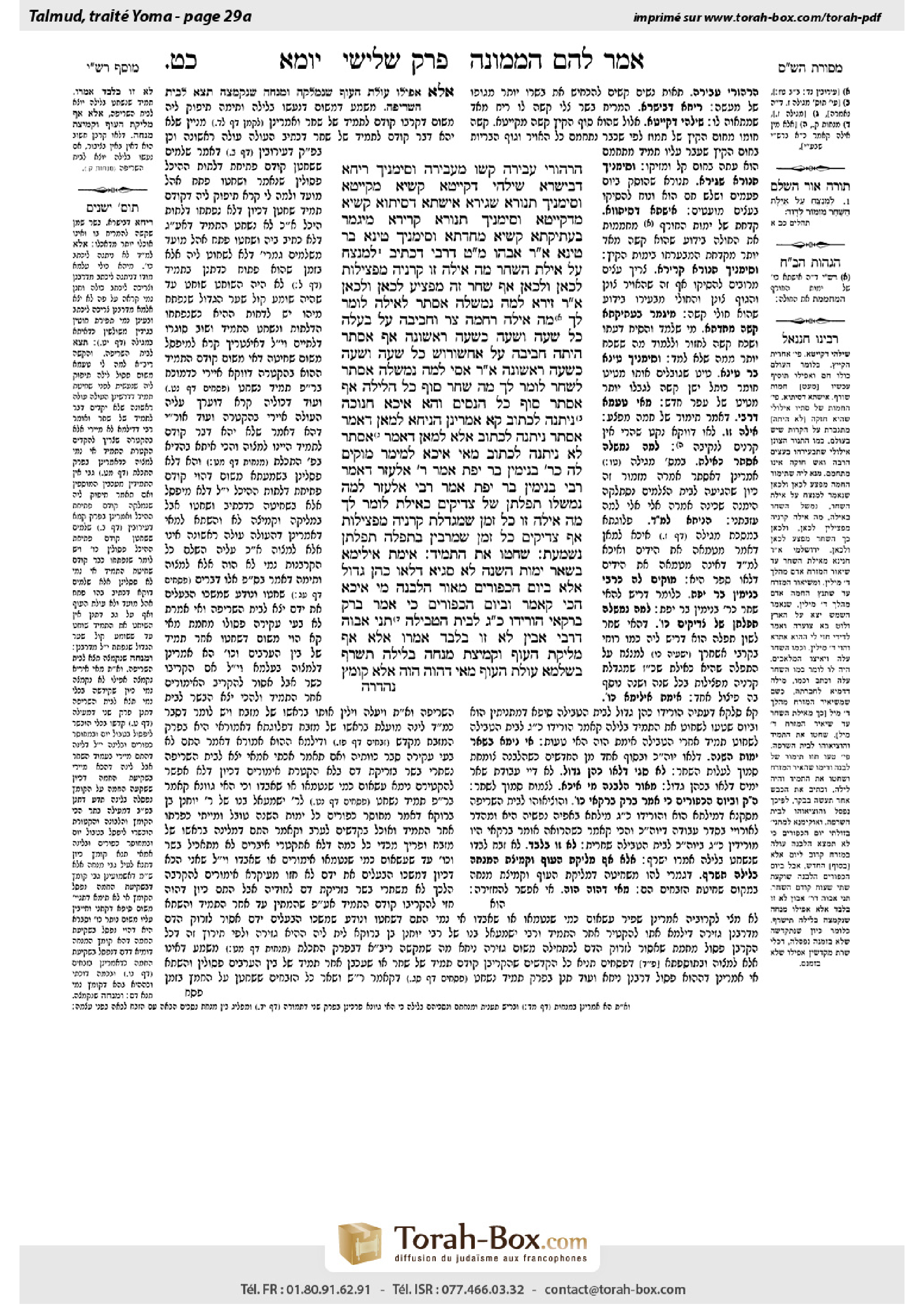
Yoma 29a: Talmud study for Daf Yomi
Daf Yomi is the daily study of one Talmud folio. Explore 37 tractates with scans, Hebrew text, Sefaria English and AI-generated French translations where annotated.
Passage selection and English or AI-generated French translation are available where the scan has annotations. Daf Study is independent of Torah-Box and Sefaria.
Browse Yoma · יומא · All tractatesYoma 29a text and translations
This page of Yoma includes the Aramaic text, an English translation and an AI-generated French translation, alongside the scan above.
יומא כ״ט א · Aramaic and Hebrew text
הִרְהוּרֵי עֲבֵירָה קָשׁוּ מֵעֲבֵירָה, וְסִימָנָיךְ: רֵיחָא דְבִישְׂרָא. שִׁילְהֵי דְקַיְיטָא קְשֵׁי מִקַּיְיטָא, וְסִימָנָיךְ: תַּנּוּרָא שְׁגִירָא.
אִישָּׁתָא דְסִיתְוָא קַשְׁיָא מִדְּקַיְיטָא, וְסִימָנָיךְ: תַּנּוּרָא קָרִירָא. מִיגְמָר בְּעַתִּיקְתָּא קַשְׁיָא מֵחַדְתָּא, וְסִימָנָיךְ: טִינָא בַּר טִינָא.
אָמַר רַבִּי אֲבָהוּ: מַאי טַעְמָא דְּרַבִּי, דִּכְתִיב: ״לַמְנַצֵּחַ עַל אַיֶּלֶת הַשַּׁחַר״, מָה אַיָּלָה זוֹ קַרְנֶיהָ מַפְצִילוֹת לְכָאן וּלְכָאן, אַף שַׁחַר זֶה מַפְצִיעַ לְכָאן וּלְכָאן.
אָמַר רַבִּי זֵירָא: לָמָּה נִמְשְׁלָה אֶסְתֵּר לְאַיָּלָה — לוֹמַר לָךְ: מָה אַיָּלָה רַחְמָהּ צַר וַחֲבִיבָה עַל בַּעְלָהּ כׇּל שָׁעָה וְשָׁעָה כְּשָׁעָה רִאשׁוֹנָה, אַף אֶסְתֵּר הָיְתָה חֲבִיבָה עַל אֲחַשְׁוֵרוֹשׁ כׇּל שָׁעָה וְשָׁעָה כְּשָׁעָה רִאשׁוֹנָה. אָמַר רַבִּי אַסִּי: לָמָּה נִמְשְׁלָה אֶסְתֵּר לְשַׁחַר — לוֹמַר לָךְ: מָה שַׁחַר סוֹף כׇּל הַלַּיְלָה, אַף אֶסְתֵּר סוֹף כׇּל הַנִּסִּים.
וְהָא אִיכָּא חֲנוּכָּה! נִיתְּנָה לִכְתּוֹב קָא אָמְרִינַן. הָנִיחָא לְמַאן דְּאָמַר אֶסְתֵּר נִיתְּנָה לִכְתּוֹב. אֶלָּא לְמַאן דְּאָמַר אֶסְתֵּר לֹא נִיתְּנָה לִכְתּוֹב, מַאי אִיכָּא לְמֵימַר?
מוֹקֵים לַהּ כְּרַבִּי בִּנְיָמִין בַּר יֶפֶת אָמַר רַבִּי אֶלְעָזָר. דְּאָמַר רַבִּי בִּנְיָמִין בַּר יֶפֶת אָמַר רַבִּי אֶלְעָזָר: לָמָּה נִמְשְׁלוּ תְּפִלָּתָן שֶׁל צַדִּיקִים כְּאַיֶּלֶת — לוֹמַר לָךְ: מָה אַיָּלָה זוֹ כׇּל זְמַן שֶׁמַּגְדֶּלֶת — קַרְנֶיהָ מַפְצִילוֹת, אַף צַדִּיקִים, כׇּל זְמַן שֶׁמַּרְבִּין בִּתְפִלָּה — תְּפִלָּתָן נִשְׁמַעַת.
שָׁחֲטוּ אֶת הַתָּמִיד. אֵימַת? אִילֵּימָא בִּשְׁאָר יְמוֹת הַשָּׁנָה, לָא סַגִּיא דְּלָאו כֹּהֵן גָּדוֹל? אֶלָּא בְּיוֹם הַכִּפּוּרִים, מְאוֹר הַלְּבָנָה מִי אִיכָּא?
הָכִי קָאָמַר: וּבְיוֹם הַכִּפּוּרִים כִּי אָמַר ״בָּרַק בַּרְקַאי״ הוֹרִידוּ כֹּהֵן גָּדוֹל לְבֵית הַטְּבִילָה.
תָּנֵי אֲבוּהּ דְּרַבִּי אָבִין: לֹא זוֹ בִּלְבַד אָמְרוּ, אֶלָּא אַף מְלִיקַת הָעוֹף וּקְמִיצַת מִנְחָה בַּלַּיְלָה תִּשָּׂרֵף. בִּשְׁלָמָא עוֹלַת הָעוֹף — מַאי דַהֲוָה הֲוָה. אֶלָּא קוֹמֶץ,
Yoma 29a · English translation
Thoughts of transgression are worse than transgression itself, and your mnemonic is the odor of meat. The smell of roasting meat is more appetizing than actually eating the meat. The heat of the end of summer is more oppressive than the heat of the summer itself, and your mnemonic is a heated oven. After an oven has been heated several times in the course of a day, lighting it again, even slightly, will produce powerful heat. So too, at the end of the summer, since everything is hot, the heat is more oppressive.
A fever in the winter is more powerful than a fever in the summer, and your mnemonic is a cold oven. Heating a cold oven requires greater heat than heating a hot oven. A fever that succeeds in raising the body temperature in the winter must be more powerful than a fever that raises the body temperature in the summer. Relearning old material that was known and forgotten is more difficult than learning from new material. And your mnemonic is mixing mortar from mortar. It is harder to take hardened mortar, crush it, and mix new mortar than it is to simply mix new mortar.
Apropos moonlight and sunlight discussed previously, Rabbi Abbahu said: What is the rationale for the statement of Rabbi Yehuda HaNasi that sunlight diffuses and in that sense is dissimilar to moonlight? It is as it is written: “For the leader, about the morning hind” (Psalms 22:1); just as the antlers of a hind branch out to here and to there, so too, the light of dawn diffuses to here and to there.
In tractate Megilla, the Gemara states that Queen Esther prophetically recited this Psalm in reference to her situation as she was about to come before King Ahasuerus without being summoned. Rabbi Zeira said: Why is Esther likened to a hind? It is to tell you: Just as in the case of a hind its womb is narrow and it is desirable to its mate at each and every hour like it is at the first hour, so too, Esther was desirable to Ahasuerus at each and every hour like she was at the first hour. Rabbi Asi said: Why was Esther likened to the dawn? It is to tell you: Just as the dawn is the conclusion of the entire night, so too, Esther was the conclusion of all miracles performed for the entire Jewish people.
The Gemara asks: But isn’t there the miracle of Hanukkah, which was performed many years later? The Gemara answers: It is true that additional miracles were performed after the miracle of Purim; however, it is with regard to miracles for which permission was granted to write them in the Bible that we are saying that the miracle of Purim was the last one. The Gemara asks: That works out well according to the one who said: Permission was granted to write the Scroll of Esther in the Bible as a book whose sanctity equals that of the other books of the Bible. However, according to the one who said: Permission was not granted to write the Scroll of Esther in the Bible, and its sanctity does not reach the level of the other books of the Bible, what can be said?
The Gemara answers: Actually, Purim was not the conclusion of all miracles performed for the entire Jewish people, and the one who holds that permission was not granted for the Scroll of Esther to be written establishes the analogy between Esther and the hind in accordance with the statement that Rabbi Binyamin bar Yefet said that Rabbi Elazar said; as Rabbi Binyamin bar Yefet said that Rabbi Elazar said: Why are the prayers of the righteous likened to a hind? It is to tell you: Just as with regard to a hind, as long as it grows its antlers they continue to branch out; so too, with regard to the righteous, as long as they engage more in prayer their prayer is heard.
§ The mishna relates that as a result of the confusion, they slaughtered the daily offering before dawn. The Gemara asks: When did this incident occur? If we say it occurred during the rest of the days of the year, is there no alternative to having the service performed by the High Priest? The mishna states that after slaughtering the daily offering, they led the High Priest down to the Hall of Immersion. On all the other days of the year, the High Priest need not perform the service and it may be performed by a common priest. Rather, it must be that this incident occurred on Yom Kippur, when the service is performed exclusively by the High Priest. However, in that case, is there moonlight? According to the lunar cycle, the moon never rises in the east adjacent to dawn on Yom Kippur.
The Gemara answers that this is what the mishna is saying: The incident occurred during the rest of the year, at which point they instituted that the appointed priest announce the arrival of dawn in the Temple. And on Yom Kippur, when the appointed priest said: The light flashed, they immediately led the High Priest down to the Hall of Immersion.
Apropos this fundamental halakha, the father of Rabbi Avin taught a baraita: Not only this, that a daily offering slaughtered before dawn is disqualified and burned, did they say; rather, even in the case of the pinching of the neck of a bird and the taking of the handful of a meal-offering that are performed at night, these items must be burned. The Gemara analyzes the baraita: Granted, a bird sacrificed as a burnt-offering is disqualified if pinched before dawn; what was, was. The situation can no longer be remedied, and the bird must be burned. However, why should the handful of a meal-offering be burned?
Yoma 29a · Traduction française (IA)
Les pensées de transgression sont pires que la transgression elle-même, et leur moyen mnémotechnique est l’odeur de la viande. L’odeur de la viande qui rôtit est plus appétissante que la viande elle-même lorsqu’on la mange. La chaleur de la fin de l’été est plus accablante que celle de l’été lui-même, et son moyen mnémotechnique est un four déjà chauffé. Après avoir chauffé plusieurs fois au cours d’une journée, un four dégage une chaleur intense même si on le rallume légèrement. De même, à la fin de l’été, comme tout est chaud, la chaleur est plus accablante.
Une fièvre en hiver est plus forte qu’une fièvre en été, et son moyen mnémotechnique est un four froid. Chauffer un four froid exige davantage de chaleur que chauffer un four chaud. Une fièvre qui parvient à élever la température du corps en hiver doit être plus forte qu’une fièvre qui l’élève en été. Réapprendre un ancien enseignement que l’on connaissait et que l’on a oublié est plus difficile qu’apprendre un nouvel enseignement. Son moyen mnémotechnique est de préparer du mortier à partir de mortier. Il est plus difficile de prendre du mortier durci, de le broyer et d’en préparer du nouveau que de simplement mélanger du mortier neuf.
À propos de la lumière de la lune et de celle du soleil évoquées précédemment, Rabbi Abbahou dit : Quelle est la raison de l’affirmation de Rabbi Yehouda HaNassi selon laquelle la lumière du soleil se diffuse et diffère ainsi de la lumière de la lune ? C’est ce qui est écrit : « Au chef de chœur, sur la biche de l’aube » (Psaumes 22,1). De même que les bois d’une biche se ramifient dans toutes les directions, de même la lumière de l’aube se diffuse dans toutes les directions.
Dans le traité Méguila, la Guemara rapporte que la reine Esther récita ce psaume par inspiration prophétique, en référence à sa situation, alors qu’elle s’apprêtait à se présenter devant le roi Assuérus sans y avoir été convoquée. Rabbi Zeïra dit : Pourquoi Esther est-elle comparée à une biche ? C’est pour t’enseigner que, de même que l’utérus de la biche est étroit et qu’elle est aussi désirable pour son partenaire à chaque instant qu’à la première heure, de même Esther était aussi désirable pour Assuérus à chaque instant qu’à la première heure. Rabbi Assi dit : Pourquoi Esther est-elle comparée à l’aube ? C’est pour t’enseigner que, de même que l’aube marque la fin de toute la nuit, de même Esther marqua la fin de tous les miracles accomplis pour l’ensemble du peuple juif.
La Guemara demande : Mais il y a le miracle de Hanoucca, qui eut lieu de nombreuses années plus tard. La Guemara répond : Il est vrai que d’autres miracles furent accomplis après celui de Pourim ; toutefois, nous parlons des miracles dont l’inscription dans la Bible fut autorisée : le miracle de Pourim fut le dernier d’entre eux. La Guemara demande : Cela convient selon celui qui dit que l’autorisation fut accordée d’inscrire le rouleau d’Esther dans la Bible comme un livre dont la sainteté égale celle des autres livres bibliques. Mais que peut-on dire selon celui qui affirme que l’autorisation ne fut pas accordée d’inscrire le rouleau d’Esther dans la Bible et que sa sainteté n’atteint pas le niveau de celle des autres livres bibliques ?
La Guemara répond : En réalité, Pourim ne marqua pas la fin de tous les miracles accomplis pour l’ensemble du peuple juif. Celui qui soutient que l’autorisation ne fut pas accordée d’inscrire le rouleau d’Esther établit l’analogie entre Esther et la biche conformément à l’enseignement rapporté par Rabbi Binyamin bar Yefet au nom de Rabbi Elazar. En effet, Rabbi Binyamin bar Yefet a dit au nom de Rabbi Elazar : Pourquoi les prières des justes sont-elles comparées à une biche ? C’est pour t’enseigner que, de même que les bois d’une biche continuent de se ramifier tant qu’ils poussent, de même, chez les justes, plus ils s’adonnent à la prière, plus leur prière est exaucée.
§ La Michna rapporte qu’à la suite de la confusion, ils égorgèrent le sacrifice quotidien avant l’aube. La Guemara demande : Quand cet incident eut-il lieu ? S’il eut lieu un autre jour de l’année, le service ne pouvait-il pas être accompli par un autre prêtre que le grand prêtre ? La Michna indique qu’après avoir égorgé le sacrifice quotidien, ils firent descendre le grand prêtre au pavillon des immersions. Les autres jours de l’année, le grand prêtre n’est pas tenu d’accomplir le service, et un prêtre ordinaire peut s’en charger. Il faut donc que cet incident ait eu lieu à Yom Kippour, où le service est accompli exclusivement par le grand prêtre. Mais, dans ce cas, y a-t-il de la lumière lunaire ? Selon le cycle lunaire, la lune ne se lève jamais à l’est, près de l’aube, à Yom Kippour.
La Guemara répond que voici ce que dit la Michna : l’incident eut lieu un autre jour de l’année ; c’est alors qu’ils instituèrent que le prêtre désigné annonce l’arrivée de l’aube dans le Temple. À Yom Kippour, lorsque le prêtre désigné disait : « La lumière a jailli », ils faisaient immédiatement descendre le grand prêtre au pavillon des immersions.
À propos de cette halakha fondamentale, le père de Rabbi Avin enseigna une baraïta : Ils n’ont pas seulement dit que le sacrifice quotidien égorgé avant l’aube est invalidé et doit être brûlé ; même dans le cas de la mélika d’un oiseau et du prélèvement de la poignée d’une offrande végétale, actes accomplis la nuit, ces éléments doivent être brûlés. La Guemara examine la baraïta : Il est évident qu’un oiseau offert en holocauste est invalidé si sa mélika est effectuée avant l’aube ; ce qui est fait est fait. La situation ne peut plus être corrigée, et l’oiseau doit être brûlé. Mais pourquoi la poignée de l’offrande végétale devrait-elle être brûlée ?
Traduction française générée par IA à partir de l’édition anglaise de Sefaria. Vérifie toujours un passage avec le texte source.
Text from Sefaria: William Davidson Edition - Vocalized Aramaic (CC BY NC); William Davidson Edition - English (CC BY NC).