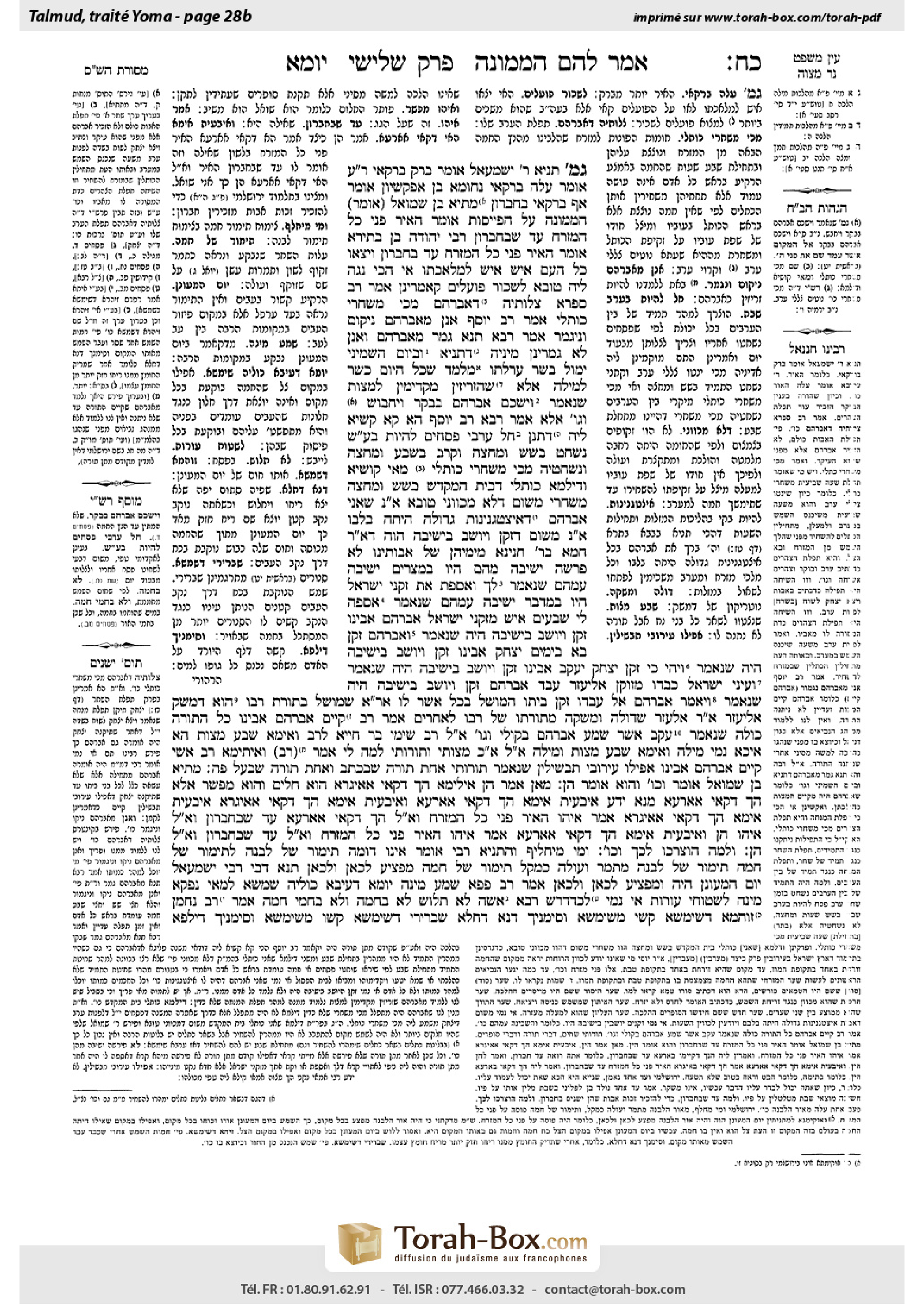
Yoma 28b: Talmud study for Daf Yomi
Daf Yomi is the daily study of one Talmud folio. Explore 37 tractates with scans, Hebrew text, Sefaria English and AI-generated French translations where annotated.
Passage selection and English or AI-generated French translation are available where the scan has annotations. Daf Study is independent of Torah-Box and Sefaria.
Browse Yoma · יומא · All tractatesYoma 28b text and translations
This page of Yoma includes the Aramaic text, an English translation and an AI-generated French translation, alongside the scan above.
יומא כ״ח ב · Aramaic and Hebrew text
גְּמָ׳ תַּנְיָא, רַבִּי יִשְׁמָעֵאל אוֹמֵר: ״בָּרַק בַּרְקַאי״. רַבִּי עֲקִיבָא אוֹמֵר: ״עָלָה בַּרְקַאי״. נְחוּמָא בֶּן אַפְקַשְׁיוֹן אוֹמֵר: ״אַף בַּרְקַאי בְּחֶבְרוֹן״. מַתְיָא בֶּן שְׁמוּאֵל (אוֹמֵר): הַמְמוּנֶּה עַל הַפְּיָיסוֹת אוֹמֵר: ״הֵאִיר פְּנֵי כׇּל הַמִּזְרָח עַד שֶׁבְּחֶבְרוֹן״. רַבִּי יְהוּדָה בֶּן בְּתֵירָא אוֹמֵר: ״הֵאִיר פְּנֵי כׇּל הַמִּזְרָח עַד בְּחֶבְרוֹן, וְיָצְאוּ כׇּל הָעָם אִישׁ אִישׁ לִמְלַאכְתּוֹ״.
אִי הָכִי, נְגַהּ לֵיהּ טוּבָא? לִשְׂכּוֹר פּוֹעֲלִים קָאָמְרִינַן.
אָמַר רַב סָפְרָא: צְלוֹתֵיהּ דְּאַבְרָהָם, מִכִּי מַשְׁחֲרִי כּוּתְלֵי.
אָמַר רַב יוֹסֵף: אֲנַן מֵאַבְרָהָם נֵיקוּם וְנִיגְמַר?! אָמַר רָבָא: תְּנָא גָּמַר מֵאַבְרָהָם וַאֲנַן לָא גָּמְרִינַן מִינֵּיהּ?! דְּתַנְיָא: ״וּבַיּוֹם הַשְּׁמִינִי יִמּוֹל בְּשַׂר עׇרְלָתוֹ״, מְלַמֵּד שֶׁכׇּל הַיּוֹם כָּשֵׁר לְמִילָה, אֶלָּא שֶׁהַזְּרִיזִין מַקְדִּימִין לְמִצְוֹת, שֶׁנֶּאֱמַר: ״וַיַּשְׁכֵּם אַבְרָהָם בַּבֹּקֶר וַיַּחֲבוֹשׁ וְגוֹ׳״.
אֶלָּא אָמַר רָבָא: רַב יוֹסֵף הָא קָא קַשְׁיָא לֵיהּ. דִּתְנַן: חָל עַרְבֵי פְּסָחִים לִהְיוֹת בְּעֶרֶב שַׁבָּת, נִשְׁחָט בְּשֵׁשׁ וּמֶחֱצָה, וְקָרֵב בְּשֶׁבַע וּמֶחֱצָה. וְנִשְׁחֲטֵיהּ מִכִּי מַשְׁחֲרִי כּוּתְלֵי!
מַאי קוּשְׁיָא? וְדִילְמָא כּוּתְלֵי דְּבֵית הַמִּקְדָּשׁ בְּשֵׁשׁ וּמֶחֱצָה מַשְׁחֲרִי, מִשּׁוּם דְּלָא מְכַוְּונִי טוּבָא. אִי נָמֵי, שָׁאנֵי אַבְרָהָם דְּאִיצְטַגְנִינוּת גְּדוֹלָה הָיְתָה בְּלִבּוֹ. אִי נָמֵי, מִשּׁוּם דְּזָקֵן וְיוֹשֵׁב בִּישִׁיבָה הֲוָה. דְּאָמַר רַבִּי חָמָא בְּרַבִּי חֲנִינָא: מִימֵיהֶן שֶׁל אֲבוֹתֵינוּ לֹא פָּרְשָׁה יְשִׁיבָה מֵהֶם.
הָיוּ בְּמִצְרַיִם — יְשִׁיבָה עִמָּהֶם, שֶׁנֶּאֱמַר: ״לֵךְ וְאָסַפְתָּ אֶת זִקְנֵי יִשְׂרָאֵל״. הָיוּ בַּמִּדְבָּר — יְשִׁיבָה עִמָּהֶם, שֶׁנֶּאֱמַר: ״אֶסְפָה לִּי שִׁבְעִים אִישׁ מִזִּקְנֵי יִשְׂרָאֵל״. אַבְרָהָם אָבִינוּ, זָקֵן וְיוֹשֵׁב בִּישִׁיבָה, שֶׁנֶּאֱמַר: ״וְאַבְרָהָם זָקֵן בָּא בַּיָּמִים״. יִצְחָק אָבִינוּ, זָקֵן וְיוֹשֵׁב בִּישִׁיבָה הָיָה, שֶׁנֶּאֱמַר: ״וַיְהִי כִּי זָקֵן יִצְחָק״. יַעֲקֹב אָבִינוּ, זָקֵן וְיוֹשֵׁב בִּישִׁיבָה הָיָה, שֶׁנֶּאֱמַר: ״וְעֵינֵי יִשְׂרָאֵל כָּבְדוּ מִזּוֹקֶן״.
אֱלִיעֶזֶר עֶבֶד אַבְרָהָם, זָקֵן וְיוֹשֵׁב בִּישִׁיבָה הָיָה, שֶׁנֶּאֱמַר: ״וַיֹּאמֶר אַבְרָהָם אֶל עַבְדּוֹ זְקַן בֵּיתוֹ הַמֹּשֵׁל בְּכׇל אֲשֶׁר לוֹ״, אָמַר רַבִּי אֶלְעָזָר: שֶׁמּוֹשֵׁל בְּתוֹרַת רַבּוֹ. ״הוּא דַּמֶּשֶׂק אֱלִיעֶזֶר״ — אָמַר רַבִּי אֶלְעָזָר: שֶׁדּוֹלֶה וּמַשְׁקֶה מִתּוֹרָתוֹ שֶׁל רַבּוֹ לַאֲחֵרִים.
אָמַר רַב: קִיֵּים אַבְרָהָם אָבִינוּ כָּל הַתּוֹרָה כּוּלָּהּ, שֶׁנֶּאֱמַר: ״עֵקֶב אֲשֶׁר שָׁמַע אַבְרָהָם בְּקוֹלִי וְגוֹ׳״. אֲמַר לֵיהּ רַב שִׁימִי בַּר חִיָּיא לְרַב: וְאֵימָא שֶׁבַע מִצְוֹת? הָא אִיכָּא נָמֵי מִילָה! וְאֵימָא שֶׁבַע מִצְוֹת וּמִילָה! אֲמַר לֵיהּ: אִם כֵּן ״מִצְוֹתַי וְתוֹרוֹתָי״ לְמָה לִי?
אָמַר (רַב), וְאִיתֵּימָא רַב אָשֵׁי: קִיֵּים אַבְרָהָם אָבִינוּ אֲפִילּוּ עֵירוּבֵי תַבְשִׁילִין, שֶׁנֶּאֱמַר: ״תּוֹרוֹתָי״, אַחַת תּוֹרָה שֶׁבִּכְתָב וְאַחַת תּוֹרָה שֶׁבְּעַל פֶּה.
מַתְיָא בֶּן שְׁמוּאֵל אוֹמֵר וְכוּ׳ וְהוּא אוֹמֵר הֵן. מַאן אָמַר ״הֵן״? אִילֵּימָא הָךְ דְּקָאֵי אַאִיגָּרָא — הוּא חָלֵים וְהוּא מְפַשַּׁר?! אֶלָּא הָךְ דְּקָאֵי אַאַרְעָא, מְנָא יָדַע?
אִיבָּעֵית אֵימָא — הָךְ דְּקָאֵי אַאַרְעָא, וְאִיבָּעֵית אֵימָא — הָךְ דְּקָאֵי אַאִיגָּרָא. אִיבָּעֵית אֵימָא הָךְ דְּקָאֵי אַאִיגָּרָא, אָמַר אִיהוּ: ״הֵאִיר פְּנֵי כׇּל הַמִּזְרָח!״, וְאָמַר לֵיהּ הָךְ דְּקָאֵי אַאַרְעָא: ״עַד שֶׁבְּחֶבְרוֹן?״, וְאָמַר לֵיהּ אִיהוּ: ״הֵן!״.
וְאִיבָּעֵית אֵימָא הָךְ דְּקָאֵי אַאַרְעָא, אָמַר אִיהוּ: ״הֵאִיר פְּנֵי כׇּל הַמִּזְרָח?״, וְאָמַר לֵיהּ: ״עַד שֶׁבְּחֶבְרוֹן?״, וְאָמַר לֵיהּ: ״הֵן!״.
וְלָמָּה הוּצְרְכוּ לְכָךְ וְכוּ׳. וּמִי מִיחַלַּף? וְהָתַנְיָא, רַבִּי אוֹמֵר: אֵינוֹ דּוֹמֶה תִּימּוּר שֶׁל לְבָנָה לְתִימּוּר שֶׁל חַמָּה. תִּימּוּר שֶׁל לְבָנָה מִתַּמֵּר וְעוֹלֶה כְּמַקֵּל, תִּימּוּר שֶׁל חַמָּה מַפְצִיעַ לְכָאן וּלְכָאן. תָּנָא דְּבֵי רַבִּי יִשְׁמָעֵאל: יוֹם הַמְעוּנָּן הָיָה, וּמַפְצִיעַ לְכָאן וּלְכָאן. אָמַר רַב פָּפָּא, שְׁמַע מִינַּהּ: יוֹמָא דְעֵיבָא כּוּלֵּיהּ שִׁמְשָׁא.
לְמַאי נָפְקָא מִינַּהּ? לְשַׁטּוֹחֵי עוֹרוֹת. אִי נָמֵי לְכִדְדָרֵשׁ רָבָא: אִשָּׁה לֹא תָּלוּשׁ לֹא בַּחַמָּה וְלֹא בְּחַמֵּי חַמָּה.
אָמַר רַב נַחְמָן: זוּהֲמָא דְשִׁימְשָׁא קְשֵׁי מִשִּׁימְשָׁא, וְסִימָנָיךְ: דַּנָּא דְחַלָּא. שַׁבְרִירֵי דְשִׁימְשָׁא קָשׁוּ מִשִּׁימְשָׁא, וְסִימָנָיךְ: דִּילְפָּא.
Yoma 28b · English translation
GEMARA: It was taught in a baraita that the Sages disputed the precise expression that was employed in the Temple. Rabbi Yishmael says that the formula is: The light flashed; Rabbi Akiva says: The light has risen, which is brighter than a mere flash. Naḥuma ben Apakshiyon says: There is even light in Hebron. Matya ben Shmuel says that the appointed priest in charge of the lotteries says: The entire eastern sky is illuminated all the way to Hebron. Rabbi Yehuda ben Beteira says that this is what the appointed priest said: The entire eastern sky is illuminated all the way to Hebron and the entire nation has gone out, each and every person to engage in his labor.
The Gemara questions Rabbi Yehuda ben Beteira’s version of the formula: If it is so that the people have gone to work, it has grown considerably lighter. People go to work after it is light. Apparently, Rabbi Yehuda ben Beteira is referring to a time after sunrise, not a time adjacent to dawn. The Gemara answers: It is that people have gone out to hire workers that we are saying. Owners of fields rose early, adjacent to dawn, to hire workers so that they could begin working when it is light.
§ Rav Safra said: The time for the afternoon prayer of Abraham begins from when the walls begin to blacken from shade. When the sun begins to descend from the middle of the sky, producing shadows on the walls, that marks the beginning of the setting of the sun and then the afternoon prayer may be recited.
Rav Yosef said: And will we arise and derive a halakha from Abraham? Didn’t Abraham live before the Torah was given to the Jewish people, and therefore halakhot cannot be derived from his conduct? Rava said: The tanna derived a halakha from Abraham’s conduct, and we do not derive a halakha from his conduct? As it was taught in a baraita with regard to the verse: “And on the eighth day the flesh of his foreskin shall be circumcised” (Leviticus 12:3), this verse teaches that the entire day is suitable for performance of the mitzva of circumcision. However, the vigilant are early in their performance of mitzvot and circumcise in the morning, as it is stated with regard to the binding of Isaac: “And Abraham arose early in the morning and saddled his donkey” (Genesis 22:3). He awakened early to fulfill the mitzva without delay. Apparently, halakha is derived from the conduct of Abraham.
Rather, Rava said: With regard to Rav Yosef, it was not the matter of deriving halakha from the conduct of Abraham that is difficult. Rather, this is difficult for him, as we learned in a mishna: When Passover eves occur on Shabbat eves, the daily afternoon offering is slaughtered at six and a half hours of the day and sacrificed on the altar at seven and a half hours. The afternoon offering was slaughtered as early as possible to enable all the Paschal lambs, which were slaughtered after the daily afternoon offering was sacrificed, to be slaughtered and roasted before sunset, so that no labor would be performed on Shabbat. Now, if indeed this halakha is derived from the conduct of Abraham, let us slaughter the offering even earlier, from when the walls begin to blacken, just after the end of the sixth hour of the day. Apparently, halakha is not derived from the conduct of Abraham.
The Gemara rejects this: What is the difficulty?
Perhaps the walls of the Temple begin to blacken only at six and a half hours of the day because they are not perfectly aligned. The Temple walls were broad at the bottom and gradually narrowed as they reached the top; therefore, the upper part of the wall did not cast a shadow on the wall opposite it until six and a half hours of the day.
Or, alternatively, it is different with regard to Abraham because there was great knowledge of astronomy [itztagninut] in his heart. He was able to precisely calculate the movements of the heavenly bodies and was therefore able to discern immediately after noon that the sun had begun its descent. Others require a half hour to be certain that the descent of the sun has begun.
Or, alternatively Abraham was different because he was an Elder and sat and studied Torah in a yeshiva, where the Divine Presence rests. There he developed the expertise to determine the precise hour. As Rabbi Ḥama, son of Rabbi Ḥanina, said: From the days of our ancestors, yeshiva never left them. Our ancestors were leaders of their generations, who taught Torah to students who came to them.
When they were in Egypt there was a yeshiva with them, as it is stated: “Go and gather the Elders of Israel” (Exodus 3:16), indicating that there were Sages among them who studied Torah. And similarly, when they were in the desert, there was a yeshiva with them, as it is stated: “Gather for me seventy men from the Elders of Israel” (Numbers 11:16). Abraham our Patriarch was himself an Elder and would sit in yeshiva, as it is stated: “And Abraham was old, advanced in years” (Genesis 24:1). From the apparent redundancy of the terms old and advanced in years, it is derived that old means that he was a wise Elder and prominent in Torah, and advanced in years means that he was elderly. Similarly, Isaac our Patriarch was an Elder and sat in yeshiva, as it is stated: “And it came to pass when Isaac was old and his eyes were dim” (Genesis 27:1). Similarly, Jacob our Patriarch was an Elder and sat in yeshiva, as it is stated: “And Israel’s eyes were heavy with age” (Genesis 48:10).
Eliezer, servant of Abraham, was an Elder and sat in yeshiva, as it is stated: “And Abraham said to his servant, the elder of his household, who ruled over all he had” (Genesis 24:2). Rabbi Elazar said: The verse means that he had mastery over the Torah of his master, having gained proficiency in all of the Torah of Abraham. That is the meaning of the verse: “He is Damascus [Dammesek] Eliezer” (Genesis 15:2). Rabbi Elazar said: The word Dammesek is a contraction of he who draws [doleh] and gives drink [mashke] to others from his master’s Torah.
Apropos the previous statement, the Gemara cites that Rav said: Abraham our Patriarch fulfilled the entire Torah before it was given, as it is stated: “Because [ekev] Abraham hearkened to My voice and kept My charge, My mitzvot, My statutes and My Torahs” (Genesis 26:5). Rav Shimi bar Ḥiyya said to Rav: And say that the verse means that he fulfilled only the seven Noahide mitzvot and not the entire Torah. The Gemara asks: But isn’t there also circumcision that Abraham clearly observed, which is not one of the Noahide laws? Apparently, Abraham fulfilled more than just those seven. The Gemara asks: And say that he fulfilled only the seven mitzvot and circumcision. Rav said to him: If so, why do I need the continuation of the verse, that Abraham kept: My mitzvot and My Torah? That is a clear indication that he fulfilled mitzvot beyond the seven Noahide mitzvot, and apparently fulfilled the entire Torah.
Rav said, and some say Rav Ashi said: Abraham our Patriarch fulfilled the entire Torah, even the mitzva of the joining of cooked foods, a rabbinic ordinance instituted later, as it is stated: My Torahs. Since the term is in the plural, it indicates that Abraham kept two Torahs; one, the Written Torah, and one, the Oral Torah. In the course of fulfilling the Oral Torah, he fulfilled all the details and parameters included therein.
§ It was taught in the mishna that Matya ben Shmuel says that the appointed priest asks: Is the entire eastern sky illuminated even to Hebron? And he says: Yes. The Gemara asks: Who said yes? If we say it is that person who is standing on the roof, does he dream and also interpret his dream? Is it reasonable that the one asking the question answers it? Rather, say that it was that person who is standing on the ground who said yes. From where does he know that the sky is illuminated such that he is able to answer yes?
The Gemara suggests two possible solutions: If you wish, say it was that person who is standing on the ground who answered yes, and if you wish, say it was that person who is standing on the roof who answered. If you wish, say that the person who is standing on the roof said: The entire eastern sky is illuminated. And that person who is standing on the ground said to him: Has it illuminated even to Hebron? And he who is standing on the roof said to him: Yes.
And if you wish, say instead that the person who is standing on the ground said: Is the entire eastern sky illuminated? And he who is standing on the roof said to him: Do you mean that it is illuminated even to Hebron? And he who is standing on the ground said to him: Yes, that is what I mean.
§ The mishna asks: And why did they need to ascertain this? The mishna answered that there was an incident where they confused the light of the moon with the light of the rising sun and slaughtered the daily morning offering too early. The Gemara asks: And are sunlight and moonlight mistaken for one another? Wasn’t it taught in a baraita that Rabbi Yehuda HaNasi says: A column of the light of the moon is not similar to a column of the light of the sun; a column of the light of the moon rises like a staff in one column while a column of the light of the sun diffuses to here and to there? The Gemara answers that the school of Rabbi Yishmael taught: It was a cloudy day, and then even the moonlight diffuses to here and to there, which caused them to err and believe that it was the rising sun. Rav Pappa said: Learn from this statement of Rabbi Yishmael that a cloudy day is similar to a completely sunny day because the sunlight is further diffused by the clouds.
The Gemara asks: What are the practical ramifications of the statement that a cloudy day is similar to a completely sunny day? The Gemara explains: The ramifications are with regard to spreading hides to dry them. On a cloudy day, wherever the hides are placed they will be exposed to sunlight. Alternatively, the ramifications are according to that which Rava taught with regard to matza: A woman may neither knead dough for matza for Passover in the light of the sun nor may she prepare the dough with hot water heated in the sun. On a cloudy day, one may not knead the dough anywhere outside since the light of the sun is diffused everywhere.
Apropos a cloudy day, the Gemara cites that Rav Naḥman said: The hazy light of the sun through the clouds is more damaging than the light of the sun itself. And your mnemonic is the cover of a jar of vinegar: As long as the jar is tightly closed, the odor of the vinegar does not spread and it intensifies. Even the slightest opening in the lid releases an odor more powerful than the odor generated by vinegar that was not sealed in a jar. The same is true with regard to the rays of the sun. With regard to sunlight that is obscured behind clouds, when it escapes through breaks in the clouds it is more powerful than direct sunlight. Dazzling sunlight, which shines through cracks in the clouds, is more harmful to the eyes than direct sunlight. And your mnemonic is a drip; water that drips on a person is more bothersome than water in which one completely immerses his body.
Yoma 28b · Traduction française (IA)
GUEMARA : Il a été enseigné dans une baraïta que les Sages étaient en désaccord sur la formulation exacte employée dans le Temple. Rabbi Yishmaël dit que la formule est : « La lumière a jailli » ; Rabbi Akiva dit : « La lumière s’est levée », ce qui indique une lumière plus vive qu’un simple éclat. Naḥuma ben Apakshiyon dit : « Il y a même de la lumière à Hébron. » Matya ben Shmuel dit que le prêtre préposé aux tirages au sort annonce : « Tout le ciel oriental est illuminé jusqu’à Hébron. » Rabbi Yehuda ben Beteira dit que voici ce qu’annonçait le prêtre préposé : « Tout le ciel oriental est illuminé jusqu’à Hébron, et tout le peuple est sorti, chacun pour vaquer à son travail. »
La Guemara met en question la version de la formule donnée par Rabbi Yehuda ben Beteira : si le peuple est déjà parti travailler, il fait considérablement plus clair. Les gens vont travailler une fois qu’il fait jour. Il semble donc que Rabbi Yehuda ben Beteira parle d’un moment après le lever du soleil, et non d’un moment proche de l’aube. La Guemara répond : nous parlons du fait que les gens sont sortis pour embaucher des ouvriers. Les propriétaires des champs se levaient tôt, à l’approche de l’aube, pour embaucher des ouvriers afin qu’ils puissent commencer à travailler lorsqu’il ferait jour.
§ Rav Safra dit : le moment de la prière de l’après-midi d’Abraham commence lorsque les murs commencent à s’assombrir sous l’effet de l’ombre. Quand le soleil commence à descendre du milieu du ciel et projette des ombres sur les murs, cela marque le début de son déclin ; on peut alors réciter la prière de l’après-midi.
Rav Yosef dit : Allons-nous donc nous lever et déduire une halakha du comportement d’Abraham ? Abraham n’a-t-il pas vécu avant que la Torah ne soit donnée au peuple juif, de sorte qu’on ne peut pas déduire de halakhot de son comportement ? Rava dit : Le tanna a déduit une halakha du comportement d’Abraham, et nous, nous ne pouvons pas en déduire une ? En effet, il a été enseigné dans une baraïta, au sujet du verset : « Le huitième jour, on circoncira la chair de son prépuce » (Lévitique 12, 3), que ce verset enseigne que toute la journée convient à l’accomplissement de la mitsva de la circoncision. Toutefois, les personnes zélées accomplissent les mitsvot de bonne heure et circoncisent le matin, comme il est dit à propos de la ligature d’Isaac : « Abraham se leva de bon matin et sella son âne » (Genèse 22, 3). Il se leva tôt afin d’accomplir la mitsva sans délai. Il semble donc qu’on déduise une halakha du comportement d’Abraham.
Rava dit plutôt : ce qui pose problème à Rav Yosef, ce n’est pas de déduire une halakha du comportement d’Abraham. C’est plutôt ceci qui lui pose problème, car nous avons appris dans une Michna : lorsque la veille de Pessa’h tombe un vendredi, l’offrande quotidienne de l’après-midi est égorgée à six heures et demie du jour et offerte sur l’autel à sept heures et demie. L’offrande de l’après-midi était égorgée aussi tôt que possible afin de permettre que tous les agneaux pascals, qui étaient égorgés après que l’offrande quotidienne de l’après-midi avait été offerte, soient égorgés et rôtis avant le coucher du soleil, afin qu’aucun travail ne soit effectué pendant Chabbat. Or, si cette halakha découle effectivement du comportement d’Abraham, égorgeons l’offrande encore plus tôt, dès que les murs commencent à s’assombrir, juste après la fin de la sixième heure du jour. Il semble donc qu’on ne déduise pas de halakha du comportement d’Abraham.
La Guemara rejette cette objection : en quoi cela pose-t-il problème ? Peut-être les murs du Temple ne commencent-ils à s’assombrir qu’à six heures et demie du jour parce qu’ils ne sont pas parfaitement alignés. Les murs du Temple étaient larges à la base et s’amincissaient progressivement vers le sommet ; par conséquent, la partie supérieure du mur ne projetait pas d’ombre sur le mur opposé avant six heures et demie du jour. Ou bien, le cas d’Abraham était différent, car il avait dans le cœur une grande connaissance de l’astronomie [itztagninut]. Il pouvait calculer avec précision le mouvement des corps célestes et discerner ainsi, immédiatement après midi, que le soleil avait commencé à descendre. D’autres ont besoin d’une demi-heure pour être certains que le soleil a commencé sa descente. Ou bien, Abraham était différent parce qu’il était un Ancien et s’asseyait pour étudier la Torah dans une yeshiva, où réside la Présence divine. C’est là qu’il avait acquis l’expertise nécessaire pour déterminer l’heure exacte. En effet, Rabbi Ḥama, fils de Rabbi Ḥanina, a dit : depuis l’époque de nos ancêtres, la yeshiva ne les a jamais quittés. Nos ancêtres étaient les dirigeants de leur génération et enseignaient la Torah aux élèves qui venaient à eux.
Lorsqu’ils étaient en Égypte, une yeshiva était avec eux, comme il est dit : « Va et rassemble les Anciens d’Israël » (Exode 3, 16), ce qui indique qu’il y avait parmi eux des Sages qui étudiaient la Torah. De même, lorsqu’ils étaient dans le désert, une yeshiva était avec eux, comme il est dit : « Rassemble pour moi soixante-dix hommes parmi les Anciens d’Israël » (Nombres 11, 16). Abraham, notre patriarche, était lui-même un Ancien et s’asseyait dans la yeshiva, comme il est dit : « Abraham était vieux, avancé en âge » (Genèse 24, 1). De la redondance apparente des termes « vieux » et « avancé en âge », on déduit que « vieux » signifie qu’il était un Ancien sage et éminent dans la Torah, tandis que « avancé en âge » signifie qu’il était âgé. De même, Isaac, notre patriarche, était un Ancien et s’asseyait dans la yeshiva, comme il est dit : « Et il advint qu’Isaac était vieux et que sa vue s’était obscurcie » (Genèse 27, 1). De même, Jacob, notre patriarche, était un Ancien et s’asseyait dans la yeshiva, comme il est dit : « Les yeux d’Israël étaient alourdis par l’âge » (Genèse 48, 10).
Éliézer, serviteur d’Abraham, était un Ancien et s’asseyait dans la yeshiva, comme il est dit : « Abraham dit à son serviteur, l’ancien de sa maison, qui gouvernait tout ce qui lui appartenait » (Genèse 24, 2). Rabbi Elazar dit : le verset signifie qu’il maîtrisait la Torah de son maître, car il avait acquis une parfaite connaissance de toute la Torah d’Abraham. C’est le sens du verset : « Il est Éliézer de Damas [Dammesek] » (Genèse 15, 2). Rabbi Elazar dit : le mot Dammesek est une contraction de « celui qui puise [doleh] » et « abreuve [mashke] » les autres de la Torah de son maître.
À propos de la déclaration précédente, la Guemara cite ce que Rav a dit : Abraham, notre patriarche, a accompli toute la Torah avant qu’elle ne soit donnée, comme il est écrit : « Parce que [ekev] Abraham a écouté ma voix et a observé mes prescriptions, mes mitsvot, mes décrets et mes Torah » (Genèse 26, 5). Rav Shimi bar Ḥiyya dit à Rav : Dis plutôt que le verset signifie qu’il a accompli seulement les sept mitsvot noahides, et non toute la Torah. La Guemara demande : Mais Abraham n’a-t-il pas également pratiqué la circoncision, qui ne fait pas partie des lois noahides ? Il semble donc qu’Abraham ait accompli davantage que ces sept mitsvot. La Guemara demande : Dis plutôt qu’il n’a accompli que les sept mitsvot et la circoncision. Rav lui répondit : Dans ce cas, pourquoi le verset ajoute-t-il qu’Abraham a observé « mes mitsvot et mes Torah » ? Cela indique clairement qu’il a accompli des mitsvot allant au-delà des sept mitsvot noahides et qu’il a, semble-t-il, accompli toute la Torah.
Rav a dit, et certains disent que c’est Rav Ashi qui a dit : Abraham, notre patriarche, a accompli toute la Torah, même la mitsva du mélange des plats cuits, une ordonnance rabbinique instituée plus tard, comme il est écrit : « mes Torah ». Puisque le terme est au pluriel, cela indique qu’Abraham a observé deux Torah : la Torah écrite et la Torah orale. En accomplissant la Torah orale, il en a observé tous les détails et tous les paramètres.
§ Il a été enseigné dans la Michna que Matya ben Shmuel dit que le prêtre préposé demande : « Tout le ciel oriental est-il illuminé jusqu’à Hébron ? » Et il répond : « Oui. » La Guemara demande : qui a dit oui ? Si l’on dit que c’est celui qui se tient sur le toit, répond-il aussi à sa propre question ? Est-il raisonnable que celui qui pose la question y réponde ? Dis plutôt que c’est celui qui se tient au sol qui a dit oui. Comment sait-il que le ciel est illuminé, au point de pouvoir répondre oui ?
La Guemara propose deux solutions possibles : si tu veux, dis que celui qui se tient au sol a répondu oui ; et si tu veux, dis que celui qui se tient sur le toit a répondu. Si tu veux, dis que celui qui se tient sur le toit a dit : « Tout le ciel oriental est illuminé. » Celui qui se tient au sol lui a alors demandé : « Est-il illuminé jusqu’à Hébron ? » Et celui qui se tient sur le toit lui a répondu : « Oui. »
Et si tu veux, dis plutôt que celui qui se tient au sol a demandé : « Tout le ciel oriental est-il illuminé ? » Celui qui se tient sur le toit lui a demandé : « Veux-tu dire qu’il est illuminé jusqu’à Hébron ? » Et celui qui se tient au sol lui a répondu : « Oui, c’est bien ce que je veux dire. »
§ La Michna demande : pourquoi fallait-il s’en assurer ? La Michna répond qu’un incident s’était produit : on avait confondu la lumière de la lune avec celle du soleil levant et égorgé l’offrande quotidienne du matin trop tôt. La Guemara demande : peut-on confondre la lumière du soleil et celle de la lune ? N’a-t-il pas été enseigné dans une baraïta que Rabbi Yehuda HaNassi dit : « Une colonne de lumière lunaire ne ressemble pas à une colonne de lumière solaire ; la colonne de lumière lunaire s’élève comme un bâton, en une seule colonne, tandis que la colonne de lumière solaire se diffuse ici et là » ? La Guemara répond que l’école de Rabbi Yishmaël a enseigné : c’était un jour nuageux et, alors, même la lumière de la lune se diffuse ici et là, ce qui les a induits en erreur et leur a fait croire qu’il s’agissait du soleil levant. Rav Pappa a dit : déduis de cette déclaration de Rabbi Yishmaël qu’un jour nuageux ressemble à un jour entièrement ensoleillé, car la lumière du soleil se diffuse davantage à travers les nuages.
La Guemara demande : quelles sont les conséquences pratiques de la déclaration selon laquelle un jour nuageux ressemble à un jour entièrement ensoleillé ? La Guemara explique : cela concerne l’étendage des peaux pour les faire sécher. Par temps nuageux, où que l’on place les peaux, elles seront exposées à la lumière du soleil. Autre possibilité : cela concerne ce que Rava a enseigné à propos de la matsa : une femme ne peut ni pétrir la pâte destinée à la matsa de Pessa’h à la lumière du soleil, ni préparer la pâte avec de l’eau chaude chauffée au soleil. Par temps nuageux, on ne peut pétrir la pâte nulle part à l’extérieur, puisque la lumière du soleil se diffuse partout.
À propos d’un jour nuageux, la Guemara cite ce que Rav Naḥman a dit : la lumière diffuse du soleil à travers les nuages est plus nocive que la lumière du soleil elle-même. Et le moyen de s’en souvenir est le couvercle d’un pot de vinaigre : tant que le pot est hermétiquement fermé, l’odeur du vinaigre ne se répand pas et s’intensifie. La moindre ouverture du couvercle libère une odeur plus puissante que celle du vinaigre qui n’a pas été enfermé dans un pot. Il en va de même des rayons du soleil. Lorsque la lumière du soleil est masquée par les nuages et qu’elle s’échappe par les trouées, elle est plus puissante que la lumière directe du soleil. La lumière éblouissante qui traverse les trouées des nuages est plus nocive pour les yeux que la lumière directe du soleil. Et le moyen de s’en souvenir est une goutte : l’eau qui goutte sur une personne est plus gênante que l’eau dans laquelle elle plonge tout son corps.
Traduction française générée par IA à partir de l’édition anglaise de Sefaria. Vérifie toujours un passage avec le texte source.
Text from Sefaria: William Davidson Edition - Vocalized Aramaic (CC BY NC); William Davidson Edition - English (CC BY NC).