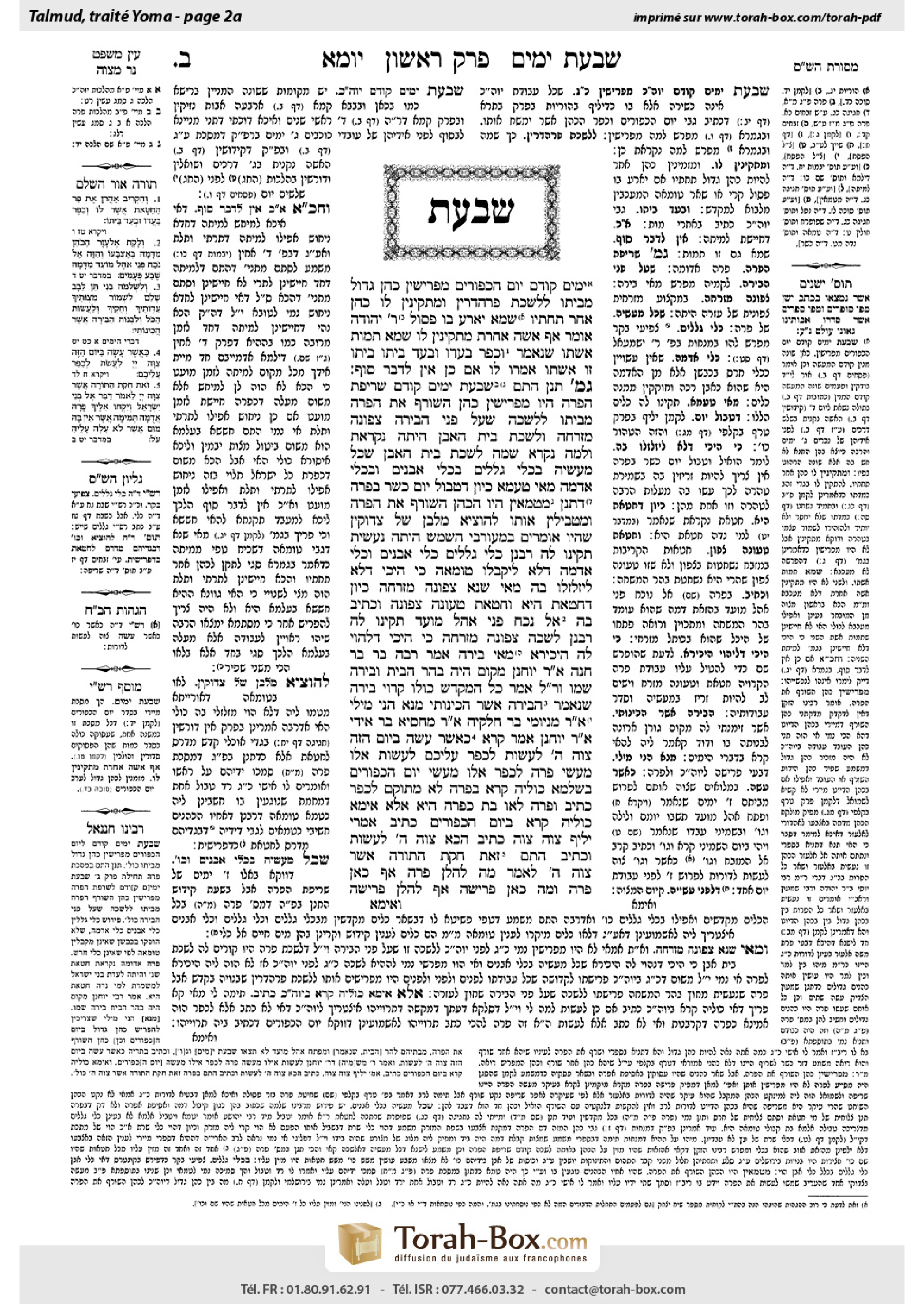
Yoma 2a: Talmud study for Daf Yomi
Daf Yomi is the daily study of one Talmud folio. Explore 37 tractates with scans, Hebrew text, Sefaria English and AI-generated French translations where annotated.
Passage selection and English or AI-generated French translation are available where the scan has annotations. Daf Study is independent of Torah-Box and Sefaria.
Browse Yoma · יומא · All tractatesYoma 2a text and translations
This page of Yoma includes the Aramaic text, an English translation and an AI-generated French translation, alongside the scan above.
יומא ב׳ א · Aramaic and Hebrew text
שִׁבְעַת יָמִים קוֹדֶם יוֹם הַכִּפּוּרִים מַפְרִישִׁין כֹּהֵן גָּדוֹל מִבֵּיתוֹ לְלִשְׁכַּת פַּרְהֶדְרִין. וּמַתְקִינִין לוֹ כֹּהֵן אַחֵר תַּחְתָּיו שֶׁמָּא יֶאֱרַע בּוֹ פְּסוּל.
רַבִּי יְהוּדָה אוֹמֵר: אַף אִשָּׁה אַחֶרֶת מַתְקִינִין לוֹ, שֶׁמָּא תָּמוּת אִשְׁתּוֹ, שֶׁנֶּאֱמַר: ״וְכִפֶּר בַּעֲדוֹ וּבְעַד בֵּיתוֹ״, ״בֵּיתוֹ״ — זוֹ אִשְׁתּוֹ. אָמְרוּ לוֹ: אִם כֵּן, אֵין לַדָּבָר סוֹף.
גְּמָ׳ תְּנַן הָתָם: שִׁבְעַת יָמִים קוֹדֶם שְׂרֵיפַת הַפָּרָה הָיוּ מַפְרִישִׁין כֹּהֵן הַשּׂוֹרֵף אֶת הַפָּרָה מִבֵּיתוֹ לַלִּשְׁכָּה שֶׁעַל פְּנֵי הַבִּירָה צָפוֹנָה מִזְרָחָה, וְלִשְׁכַּת בֵּית הָאֶבֶן הָיְתָה נִקְרֵאת. וְלָמָּה נִקְרָא שְׁמָהּ לִשְׁכַּת בֵּית הָאֶבֶן — שֶׁכׇּל מַעֲשֶׂיהָ בִּכְלֵי גְלָלִים, בִּכְלֵי אֲבָנִים, וּבִכְלֵי אֲדָמָה.
מַאי טַעְמָא? כֵּיוָן דִּטְבוּל יוֹם כָּשֵׁר בַּפָּרָה, דִּתְנַן: מְטַמְּאִין הָיוּ הַכֹּהֵן הַשּׂוֹרֵף אֶת הַפָּרָה וּמַטְבִּילִין אוֹתוֹ, לְהוֹצִיא מִלִּבָּן שֶׁל צַדּוּקִין, שֶׁהָיוּ אוֹמְרִים: בִּמְעוֹרְבֵי הַשֶּׁמֶשׁ הָיְתָה נַעֲשֵׂית.
תַּקִּינוּ לַהּ רַבָּנַן: כְּלֵי גְלָלִים, כְּלֵי אֲבָנִים, וּכְלֵי אֲדָמָה — דְּלָא לִיקַבְּלוּ טוּמְאָה, כִּי הֵיכִי דְּלָא לִיזַלְזְלוּ בַּהּ.
מַאי שְׁנָא צָפוֹנָה מִזְרָחָה? כֵּיוָן דְּחַטָּאת הִיא, וְחַטָּאת טְעוּנָה צָפוֹנָה. וּכְתִיב בָּהּ: ״אֶל נֹכַח פְּנֵי אֹהֶל מוֹעֵד״ — תַּקִּינוּ לַהּ רַבָּנַן לִשְׁכָּה צָפוֹנָה מִזְרָחָה, כִּי הֵיכִי דְּלֶהֱוֵי לַהּ הֶיכֵּירָא.
מַאי ״בִּירָה״? אָמַר רַבָּה בַּר בַּר חָנָה אָמַר רַבִּי יוֹחָנָן: מָקוֹם הָיָה בְּהַר הַבַּיִת וּ״בִירָה״ שְׁמוֹ. וְרֵישׁ לָקִישׁ אָמַר: כׇּל הַמִּקְדָּשׁ כּוּלּוֹ קָרוּי ״בִּירָה״, שֶׁנֶּאֱמַר: ״הַבִּירָה אֲשֶׁר הֲכִינוֹתִי״.
מְנָא הָנֵי מִילֵּי? אָמַר רַב מִנְיוֹמֵי בַּר חִלְקִיָּה אָמַר רַבִּי מַחְסֵיָא בַּר אִידִי אָמַר רַבִּי יוֹחָנָן, אָמַר קְרָא: ״כַּאֲשֶׁר עָשָׂה בַּיּוֹם הַזֶּה צִוָּה ה׳ לַעֲשׂוֹת לְכַפֵּר עֲלֵיכֶם״. ״לַעֲשׂוֹת״ — אֵלּוּ מַעֲשֵׂי פָרָה, ״לְכַפֵּר״ — אֵלּוּ מַעֲשֵׂי יוֹם הַכִּפּוּרִים.
בִּשְׁלָמָא, כּוּלֵּיהּ קְרָא בְּפָרָה לֹא מִתּוֹקַם — ״לְכַפֵּר״ כְּתִיב, וּפָרָה לָאו בַּת כַּפָּרָה הִיא. אֶלָּא, אֵימָא כּוּלֵּיהּ קְרָא בְּיוֹם הַכִּפּוּרִים כְּתִיב!
אָמְרִי: יָלֵיף ״צִוָּה״ ״צִוָּה״. כְּתִיב הָכָא: ״צִוָּה ה׳ לַעֲשׂוֹת״, וּכְתִיב הָתָם: ״זֹאת חֻקַּת הַתּוֹרָה אֲשֶׁר צִוָּה ה׳ לֵאמֹר״. מָה לְהַלָּן פָּרָה, אַף כָּאן פָּרָה. וּמָה כָּאן פְּרִישָׁה, אַף לְהַלָּן פְּרִישָׁה.
Yoma 2a · English translation
MISHNA: Seven days prior to Yom Kippur the Sages would remove the High Priest, who performs the entire Yom Kippur service, from his house to the Chamber of Parhedrin, a room in the Temple designated specifically for the High Priest during that period. And they would designate another priest in his stead to replace him lest a disqualification due to impurity or another circumstance beyond his control prevent him from entering the Temple on Yom Kippur.
Rabbi Yehuda says: The Sages would even designate another wife for him lest his wife die, as it is stated in the Torah portion of the Yom Kippur service: “And it will atone for him and for his house” (Leviticus 16:6); the Sages interpreted the term: His house, that is his wife. The priest must be married in order to fulfill this commandment. Due to the concern lest his wife die, another wife was designated to address that possibility. The Rabbis said to Rabbi Yehuda: If so, that this is a concern, there is no end to the matter, as what if the designated replacement wife dies? This possibility need not be a source of concern.
GEMARA: The halakha of sequestering the High Priest prior to his performance of the Temple service on Yom Kippur is comparable to the sequestering of the priest designated to burn the red heifer. Therefore, the Gemara cites that which we learned in a mishna there, in tractate Para: Seven days prior to the burning of the red heifer, the Sages would remove the priest who burns the heifer from his house to the chamber that was before the bira at the northeast corner of the courtyard on the Temple Mount. And that chamber was called the Chamber of the Stone House. The Gemara explains: And why was it called the Chamber of the Stone House? It is because all the actions associated with the red heifer were performed in dung vessels, stone vessels, and earth vessels, which are vessels that cannot become ritually impure.
The Gemara asks: What is the reason that they were so stringent with regard to the purity of the heifer? The Gemara explains: It is since a priest who immersed that day is fit for service and may perform the ritual of the heifer after immersion, even before sunset, as we learned in a mishna: They would intentionally render the priest who burns the heifer ritually impure and immerse him immediately, to remove a misconception from the hearts of the Sadducees by means of a public display of disregard for their ruling. As the Sadducees would say: Only by those for whom the sun set was the heifer ritual performed. The Sadducees believed that it is prohibited for priests who began the purification process with immersion during that day to burn the red heifer until sunset, when the purification process is completed.
That mishna continues: Since they would intentionally render the priest who burned the heifer ritually impure, the Sages in turn instituted the stringencies of utilizing dung vessels, stone vessels, and earth vessels, which do not have the capacity to become ritually impure, lest people come to treat the ritual with contempt and perform it in ritual impurity after seeing that the red heifer ritual was performed by one who immersed that day.
Apropos the mishna in tractate Para, the Gemara asks: What is different about the chamber located in the northeast corner of the Temple courtyard that led the Sages to house the priest performing the red heifer ritual specifically in that chamber? The Gemara answers: It is different since it is a sin-offering, as the red heifer is referred to as a sin-offering in the Torah, and the slaughter and sprinkling of the blood of a sin-offering must be performed north of the altar; and since it is written with regard to the red heifer: “And sprinkle it before the opening of the Tent of Meeting” (Numbers 19:4), and before the Tent of Meeting means on its eastern side. Therefore, the Sages established a chamber in the northeast so that the ritual of the red heifer will have a distinctive indicator; this will cause the administering priest to be vigilant in its performance.
The Gemara asks with regard to the terminology of the mishna: What is the meaning of the term bira cited there? Rabba bar bar Ḥana said that Rabbi Yoḥanan said: There was a place on the Temple Mount and its name is bira, and the Chamber of the Stone House was adjacent to it. And Reish Lakish said: The entire Temple is called bira, as it is stated in the prayer of David: “To Solomon my son grant a wholesome heart, to observe your commandments, your admonitions, and your statutes, to fulfill them all, and to build the bira for which I have made provision” (I Chronicles 29:19).
§ With regard to the halakhot of sequestering the High Priest prior to performance of the Yom Kippur service, and of sequestering the priest designated to burn the heifer prior to performance of the red heifer ritual, the Gemara asks: From where in the Torah are these matters derived? Rav Minyomi bar Ḥilkiya said that Rabbi Maḥseya bar Idi said that Rabbi Yoḥanan said they are derived from Aaron and his sons, who remained in the Tabernacle for seven days prior to performing the service in the Tabernacle on the eighth day of their inauguration, as the verse states: “As has been done this day, so the Lord has commanded to do, to make atonement for you” (Leviticus 8:34), meaning that this mitzva of sequestering was not limited to the days prior to the dedication of the Tabernacle; rather, it applies to future generations as well. The verse is interpreted homiletically: “To do”; these are the actions performed in the burning of the red heifer for which the priest performing the ritual is sequestered seven days in advance; “to make atonement”; these are the actions performed on Yom Kippur, before which the High Priest is sequestered seven days.
The Gemara asks: Granted, the entire verse is not established as referring exclusively to the red heifer, as: “To atone,” is written, and the heifer is not capable of facilitating atonement; rather, it facilitates ritual purity. Rather, say that the entire verse is written with regard to Yom Kippur, as the rites performed to achieve atonement on Yom Kippur are similar to those performed during the days of the inauguration. What, then, is the source for sequestering the priest who is to perform the red heifer ritual?
The Sages say in response: Derive it from a verbal analogy between the terms commanded and commanded. It is stated here, with regard to the days of the inauguration: “The Lord commanded to do,” and it is stated there, with regard to the red heifer: “This is the statute of the Torah that the Lord commanded, saying” (Numbers 19:2). Just as the term commanded there refers to the heifer, so too here, the phrase: “The Lord commanded to do” written in the context of the days of the inauguration refers to the heifer. And just as here, with regard to the inauguration, there is the principle of sequestering prior to performing the service, so too there, in the context of the halakhot of the heifer, sequestering is required prior to performance of the mitzva.
Yoma 2a · Traduction française (IA)
MICHNA : Sept jours avant Yom Kippour, les Sages faisaient quitter sa maison au grand prêtre, qui accomplit l’ensemble du service de Yom Kippour, pour le conduire à la chambre de Parhedrin, une pièce du Temple spécialement réservée au grand prêtre pendant cette période. Ils désignaient aussi un autre prêtre à sa place, pour le remplacer au cas où une impureté ou une autre circonstance indépendante de sa volonté l’empêcherait d’entrer dans le Temple le jour de Yom Kippour.
Rabbi Yehouda dit : Les Sages lui désignaient même une autre épouse, au cas où la sienne mourrait, comme il est dit dans le passage de la Torah relatif au service de Yom Kippour : « Il fera expiation pour lui et pour sa maison » (Lévitique 16:6). Les Sages interprétaient l’expression « sa maison » comme désignant son épouse. Le prêtre doit être marié pour accomplir cette mitsva. Par crainte que son épouse ne meure, on lui en désignait une autre afin de parer à cette éventualité. Les rabbins dirent à Rabbi Yehouda : Si tel est le cas, si c’est là une préoccupation, il n’y a pas de fin à la question, car que faire si l’épouse désignée en remplacement meurt ? Il n’est pas nécessaire de se préoccuper de cette éventualité.
GUEMARA : La halakha de l’isolement du grand prêtre avant qu’il accomplisse le service du Temple le jour de Yom Kippour est comparable à l’isolement du prêtre désigné pour brûler la vache rousse. La Guemara cite donc ce que nous avons appris dans une Michna du traité Para : Sept jours avant la combustion de la vache rousse, les Sages faisaient quitter sa maison au prêtre qui la brûlait pour le conduire dans la pièce située devant la bira, à l’angle nord-est de la cour du mont du Temple. Cette pièce était appelée la Chambre de la Maison de pierre. La Guemara explique : Pourquoi était-elle appelée la Chambre de la Maison de pierre ? Parce que toutes les opérations liées à la vache rousse étaient effectuées dans des récipients en fumier, des récipients en pierre et des récipients en terre, qui ne peuvent pas contracter l’impureté rituelle.
La Guemara demande : Pourquoi étaient-ils si stricts quant à la pureté de la vache ? La Guemara explique : C’est parce qu’un prêtre qui s’est immergé ce jour-là est apte au service et peut accomplir le rituel de la vache après l’immersion, même avant le coucher du soleil, comme nous l’avons appris dans une Michna : Ils rendaient délibérément impur le prêtre qui brûlait la vache, puis le faisaient immédiatement s’immerger, afin de dissiper une idée fausse dans l’esprit des sadducéens par une démonstration publique de mépris pour leur position. En effet, les sadducéens disaient que le rituel de la vache ne pouvait être accompli que par ceux pour qui le soleil s’était couché. Ils estimaient qu’il était interdit aux prêtres qui avaient commencé le processus de purification en s’immergeant ce jour-là de brûler la vache rousse avant le coucher du soleil, moment où le processus de purification s’achève.
Cette Michna poursuit : Puisqu’ils rendaient délibérément impur le prêtre qui brûlait la vache, les Sages instituèrent à leur tour des mesures de rigueur : utiliser des récipients en fumier, des récipients en pierre et des récipients en terre, qui ne peuvent pas contracter l’impureté rituelle. Ils craignaient que les gens ne finissent par traiter le rituel avec mépris et ne l’accomplissent en état d’impureté rituelle, après avoir vu que le rituel de la vache rousse avait été accompli par quelqu’un qui s’était immergé ce jour-là.
À propos de la Michna du traité Para, la Guemara demande : Qu’a-t-il de particulier, le local situé à l’angle nord-est de la cour du Temple, pour que les Sages aient logé le prêtre chargé du rituel de la vache rousse précisément dans cette pièce ? La Guemara répond : Il s’agit d’un sacrifice expiatoire, car la vache rousse est appelée sacrifice expiatoire dans la Torah, et l’abattage ainsi que l’aspersion du sang d’un sacrifice expiatoire doivent être effectués au nord de l’autel. En outre, il est écrit au sujet de la vache rousse : « On en fera l’aspersion devant l’entrée de la Tente d’assignation » (Nombres 19:4), et « devant la Tente d’assignation » signifie du côté est de celle-ci. Les Sages établirent donc une pièce au nord-est, afin que le rituel de la vache rousse ait un signe distinctif qui incite le prêtre officiant à l’accomplir avec vigilance.
La Guemara demande, à propos du terme employé dans la Michna : Que signifie le mot bira qui y est cité ? Rabba bar bar Ḥana dit au nom de Rabbi Yoḥanan : Il y avait un lieu sur le mont du Temple qui s’appelait bira, et la Chambre de la Maison de pierre lui était contiguë. Reish Lakish dit : Le Temple tout entier est appelé bira, comme il est dit dans la prière de David : « Accorde à mon fils Salomon un cœur intègre, afin qu’il observe tes commandements, tes avertissements et tes lois, qu’il les accomplisse tous et qu’il bâtisse la bira pour laquelle j’ai fait des provisions » (I Chroniques 29:19).
§ Concernant les halakhot de l’isolement du grand prêtre avant l’accomplissement du service de Yom Kippour et de l’isolement du prêtre désigné pour brûler la vache rousse avant l’accomplissement de son rituel, la Guemara demande : D’où ces dispositions sont-elles tirées de la Torah ? Rav Minyomi bar Ḥilkiya dit au nom de Rabbi Maḥseya bar Idi, qui le dit au nom de Rabbi Yoḥanan, qu’elles sont tirées de l’exemple d’Aaron et de ses fils, qui demeurèrent dans le Tabernacle pendant sept jours avant d’y accomplir le service le huitième jour de leur investiture. En effet, il est dit : « Comme cela a été fait aujourd’hui, ainsi l’Éternel a ordonné de faire, afin de faire expiation pour vous » (Lévitique 8:34). Cela signifie que cette mitsva d’isolement ne se limitait pas aux jours précédant l’inauguration du Tabernacle, mais s’applique aussi aux générations futures. Le verset est interprété par homélie : « De faire » désigne les actes accomplis lors de la combustion de la vache rousse, pour lesquels le prêtre chargé du rituel est isolé sept jours à l’avance ; « afin de faire expiation » désigne les actes accomplis à Yom Kippour, avant lequel le grand prêtre est isolé pendant sept jours.
La Guemara demande : Il est admis que le verset entier ne peut pas être interprété comme se rapportant exclusivement à la vache rousse, puisque l’expression « faire expiation » y figure, alors que la vache ne peut pas produire l’expiation ; elle permet plutôt d’obtenir la pureté rituelle. Il faut donc dire que le verset entier se rapporte à Yom Kippour, car les rites accomplis pour obtenir l’expiation à Yom Kippour sont semblables à ceux accomplis pendant les jours de l’investiture. Quelle est alors la source de l’isolement du prêtre qui doit accomplir le rituel de la vache rousse ?
Les Sages répondent : Déduisez-le par une analogie verbale entre les termes « ordonné » et « ordonné ». Il est dit ici, à propos des jours de l’investiture : « L’Éternel a ordonné de faire », et il est dit là, à propos de la vache rousse : « Voici la loi de la Torah que l’Éternel a ordonnée, en disant » (Nombres 19:2). De même que le terme « ordonné » désigne là la vache, de même, ici, l’expression « L’Éternel a ordonné de faire », écrite dans le contexte des jours de l’investiture, désigne la vache. Et de même qu’ici, dans le contexte de l’investiture, il y a le principe d’un isolement préalable à l’accomplissement du service, de même là, dans le contexte des halakhot de la vache, un isolement est exigé avant l’accomplissement de la mitsva.
Traduction française générée par IA à partir de l’édition anglaise de Sefaria. Vérifie toujours un passage avec le texte source.
Text from Sefaria: William Davidson Edition - Vocalized Aramaic (CC BY NC); William Davidson Edition - English (CC BY NC).