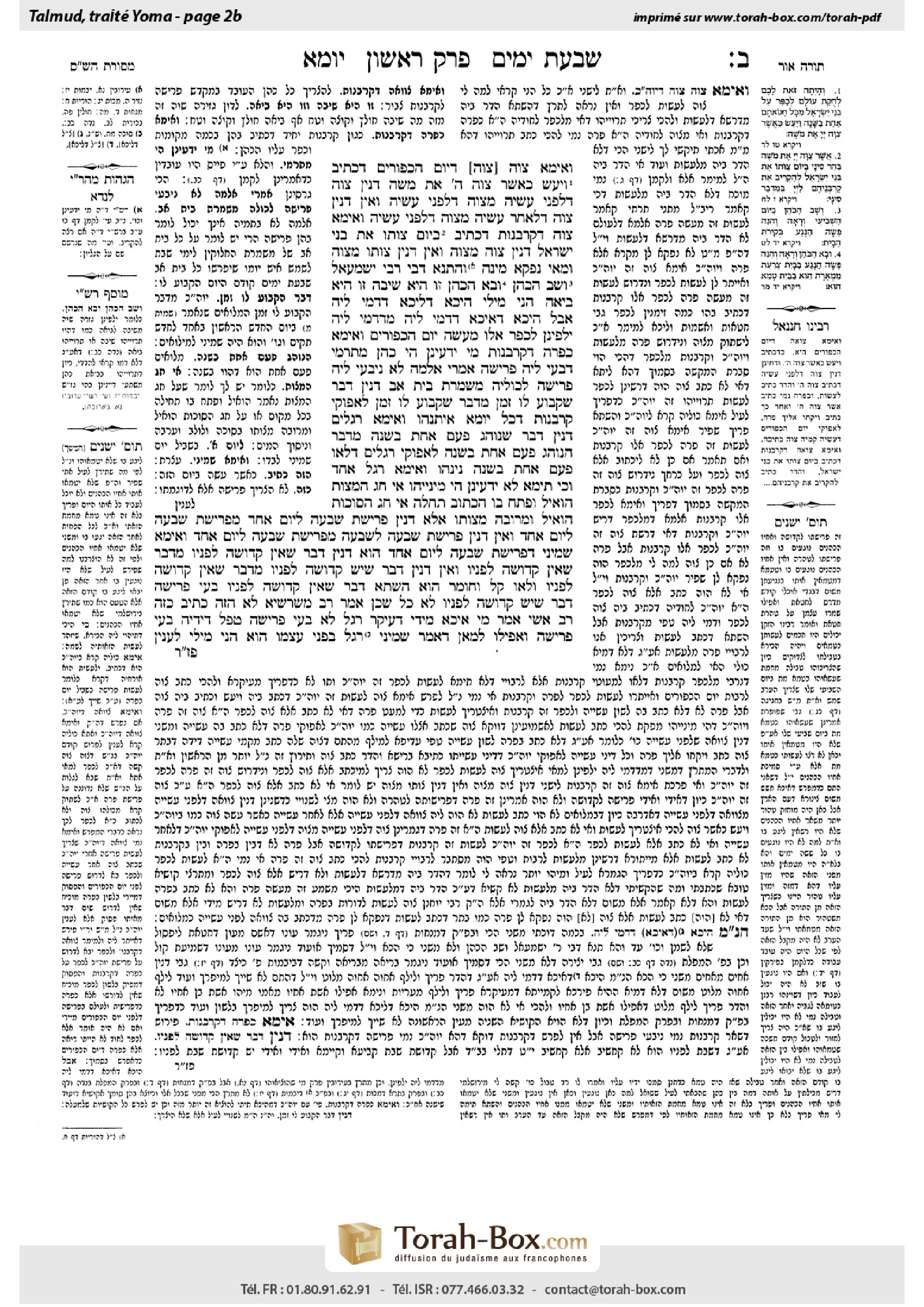
Yoma 2b: Talmud study for Daf Yomi
Daf Yomi is the daily study of one Talmud folio. Explore 37 tractates with scans, Hebrew text, Sefaria English and AI-generated French translations where annotated.
Passage selection and English or AI-generated French translation are available where the scan has annotations. Daf Study is independent of Torah-Box and Sefaria.
Browse Yoma · יומא · All tractatesYoma 2b text and translations
This page of Yoma includes the Aramaic text, an English translation and an AI-generated French translation, alongside the scan above.
יומא ב׳ ב · Aramaic and Hebrew text
וְאֵימָא, ״צִוָּה״ [״צִוָּה״] דְּיוֹם הַכִּפּוּרִים, דִּכְתִיב: ״וַיַּעַשׂ כַּאֲשֶׁר צִוָּה ה׳ אֶת מֹשֶׁה״? דָּנִין ״צִוָּה״ דְּלִפְנֵי עֲשִׂיָּה מִ״צִּוָּה״ דְּלִפְנֵי עֲשִׂיָּה, וְאֵין דָּנִין ״צִוָּה״ דִּלְאַחַר עֲשִׂיָּה מִ״צִּוָּה״ דְּלִפְנֵי עֲשִׂיָּה.
וְאֵימָא ״צִוָּה״ דְּקׇרְבָּנוֹת, דִּכְתִיב: ״בְּיוֹם צַוֹּתוֹ אֶת בְּנֵי יִשְׂרָאֵל״? דָּנִין ״צִוָּה״ מִ״צִּוָּה״ וְאֵין דָּנִין ״צַוֹּתוֹ״ מִ״צִּוָּה״.
וּמַאי נָפְקָא מִינַּהּ? וְהָתָנָא דְּבֵי רַבִּי יִשְׁמָעֵאל: ״וְשָׁב הַכֹּהֵן״ ״וּבָא הַכֹּהֵן״, זוֹ הִיא ״שִׁיבָה״, זוֹ הִיא ״בִּיאָה״!
הָנֵי מִילֵּי, הֵיכָא דְּלֵיכָּא דְּדָמֵי לֵיהּ. אֲבָל הֵיכָא דְּאִיכָּא דְּדָמֵי לֵיהּ — מִדְּדָמֵי לֵיהּ יָלְפִינַן.
״לְכַפֵּר״ אֵלּוּ מַעֲשֵׂה יוֹם הַכִּפּוּרִים. וְאֵימָא כַּפָּרָה דְּקׇרְבָּנוֹת!
מִי יָדְעִינַן הֵי כֹּהֵן מִתְרְמֵי, דְּבָעֵי לֵיהּ פְּרִישָׁה? אָמְרִי, אַלְּמָה לָא?! נִיבְעֵי לֵיהּ פְּרִישָׁה לְכוּלֵּיהּ מִשְׁמֶרֶת בֵּית אָב! דָּנִין דָּבָר שֶׁקָּבוּעַ לוֹ זְמַן מִדָּבָר שֶׁקָּבוּעַ לוֹ זְמַן, לְאַפּוֹקֵי קׇרְבָּנוֹת, דְּכׇל יוֹמָא אִיתַנְהוּ.
וְאֵימָא רְגָלִים! דָּנִין דָּבָר שֶׁנּוֹהֵג פַּעַם אַחַת בַּשָּׁנָה מִדָּבָר הַנּוֹהֵג פַּעַם אַחַת בַּשָּׁנָה, לְאַפּוֹקֵי רְגָלִים, דְּלָאו פַּעַם אַחַת בַּשָּׁנָה נִינְהוּ.
וְאֵימָא רֶגֶל אֶחָד! וְכִי תֵּימָא: לָא יָדְעִינַן הֵי מִינַּיְיהוּ, אִי חַג הַמַּצּוֹת, הוֹאִיל וּפָתַח בּוֹ הַכָּתוּב תְּחִלָּה, אִי חַג הַסּוּכּוֹת, הוֹאִיל וּמְרוּבָּה מִצְוָתוֹ!
אֶלָּא: דָּנִין פְּרִישַׁת שִׁבְעָה לְיוֹם אֶחָד, מִפְּרִישַׁת שִׁבְעָה לְיוֹם אֶחָד. וְאֵין דָּנִין פְּרִישַׁת שִׁבְעָה לְשִׁבְעָה, מִפְּרִישַׁת שִׁבְעָה לְיוֹם אֶחָד.
וְאֵימָא שְׁמִינִי, דִּפְרִישַׁת שִׁבְעָה לְיוֹם אֶחָד הוּא! דָּנִין דָּבָר שֶׁאֵין קְדוּשָּׁה לְפָנָיו מִדָּבָר שֶׁאֵין קְדוּשָּׁה לְפָנָיו, וְאֵין דָּנִין דָּבָר שֶׁיֵּשׁ קְדוּשָּׁה לְפָנָיו מִדָּבָר שֶׁאֵין קְדוּשָּׁה לְפָנָיו.
וְלָאו קַל וָחוֹמֶר הוּא? הַשְׁתָּא דָּבָר שֶׁאֵין קְדוּשָּׁה לְפָנָיו בָּעֵי פְּרִישָׁה, דָּבָר שֶׁיֵּשׁ קְדוּשָּׁה לְפָנָיו — לָא כׇּל שֶׁכֵּן! אָמַר רַב מְשַׁרְשְׁיָא: לָא, ״הַזֶּה״ כְּתִיב: כָּזֶה.
רַב אָשֵׁי אָמַר: מִי אִיכָּא מִידֵּי דְּעִיקַּר רֶגֶל לָא בָּעֵי פְּרִישָׁה, טָפֵל דִּידֵיהּ בָּעֵי פְּרִישָׁה? וַאֲפִילּוּ לְמַאן דְּאָמַר שְׁמִינִי רֶגֶל בִּפְנֵי עַצְמוֹ הוּא, הָנֵי מִילֵּי לְעִנְיַן
Yoma 2b · English translation
The Gemara asks: And say that there is indeed a verbal analogy; however, it is not between the red heifer and the inauguration of the priests, but between the term commanded in the context of the inauguration and the term commanded in the context of Yom Kippur, as it is written: “And this will be an everlasting statute for you, to atone for the children of Israel for all their sins once a year; and he did as the Lord commanded Moses” (Leviticus 16:34). In that case, only the sequestering prior to Yom Kippur can be derived. The Gemara rejects this, as a verbal analogy is derived only between functionally similar phrases. One derives commanded that is stated before performance, as in the portion of the heifer, from commanded that is stated before performance in the portion of the inauguration; and one does not derive commanded that is stated after performance in the portion of Yom Kippur from commanded that is stated before performance.
Again the Gemara asks: And say that there is a verbal analogy between the term commanded in the context of the inauguration and the term commanded with regard to offerings, as it is written: “On the day that He commanded [tzavoto] the children of Israel to sacrifice their offerings” (Leviticus 7:38). The result would be that any priest sacrificing a communal offering would require sequestering for seven days. The Gemara rejects this: One derives the term commanded from the identical term commanded, and one does not derive the term that he commanded [tzavoto] from the term commanded [tziva].
The Gemara raises a difficulty: What is the practical difference between the two terms? Didn’t the school of Rabbi Yishmael teach a verbal analogy with regard to leprosy of houses between the verse: “And the priest shall return [veshav]” (Leviticus 14:39) and the verse: “And the priest shall come [uva]” (Leviticus 14:44)? From that verbal analogy it is derived that this is the halakha with regard to returning, i.e., it is after seven days; and this is the same halakha with regard to coming, i.e., it is also after seven days. Obviously, the less pronounced difference in grammatical forms between tziva and tzavoto should not prevent the teaching of a verbal analogy.
The Gemara rejects this argument: This applies only where there are no terms that are identical to it; however, where there are terms that are identical to it, we derive the verbal analogy from terms that are identical to it, rather than from terms that are merely similar.
§ The Gemara analyzes the verbal analogy from which the sequestering of the High Priest is derived. The Gemara states with regard to the phrase “to make atonement,” written in the context of the inauguration: These are the actions performed on Yom Kippur. The Gemara suggests: And say that it refers to the atonement of offerings in general, such that any priest engaged in sacrificing atonement offerings must be sequestered seven days beforehand.
The Gemara seeks to reject this suggestion from a practical perspective. Do we know in advance which priest will happen to sacrifice a given offering, and who would consequently require sequestering? The Sages say: Why not? There are certainly ways to do so. Each of the twenty-four priestly watches has set weeks during which it serves in the Temple, and the patrilineal families that constitute that watch have set days during that week on which each serves in the Temple. We could require sequestering for the entire patrilineal family of the priestly watch designated to serve on that day the following week. The Gemara rejects the suggestion that all priests should be sequestered prior to sacrificing an atonement offering. We derive a matter that has a fixed time during the year, Yom Kippur, from a matter that also has a fixed time, the inauguration of the priests for service in the Tabernacle, to the exclusion of offerings that are sacrificed every day.
Again the Gemara asks: And say that one derives from the phrase “to make atonement” the principle of sequestering prior to sacrificing atonement offerings on the Festivals, which have fixed times. The Gemara rejects this: We derive a matter that is performed once a year, the service of Yom Kippur, from a matter that is performed once a year, like the inauguration, which was a one-time event, to the exclusion of the service on the Festivals, which is not performed once a year; rather, it is performed three times a year.
The Gemara asks: And say that the service on one Festival of the three, which is performed once a year, should require sequestering. And if you say: We do not know which of them is the most significant and requires sequestering, since one could suggest that it is Passover, with which the verse opened, as the Torah always lists it first among the Festivals; or one could suggest that it is Sukkot, since its mitzva is to bring numerous offerings, many more than the number brought on the other Festivals.
Rather, the Gemara rejects this possibility and explains: One derives sequestering for seven days prior to performing a service for one day, Yom Kippur, from sequestering for seven days prior to performing a service for one day, the inauguration. And one does not derive sequestering for seven days prior to performing a service for seven days, a Festival, from sequestering for seven days prior to performing a service for one day, the inauguration. Therefore, atonement offerings on Festivals are not derived from the inauguration.
The Gemara asks: And say that the sequestering for seven days is prior to the festival of the Eighth Day of Assembly, as that would also be sequestering for seven days prior to performing a service for one day. The Gemara rejects this: One derives a matter before which there is not sanctity, Yom Kippur, which is preceded by weekdays, from a matter before which there is not sanctity, the day of the inauguration, which was also preceded by weekdays. And we do not derive a matter before which there is sanctity, the Eighth Day of Assembly, which is preceded by the seven days of Sukkot, from a matter before which there is not sanctity.
The Gemara challenges this: And is it not an a fortiori inference? Now, if a matter before which there is not sanctity requires sequestering, due to its sanctity, then with regard to a matter before which there is sanctity, all the more so is it not clear that it should require sequestering? Rav Mesharshiyya said in rejection of this challenge: No, there is no a fortiori inference here, as the verse: “As has been done this day, so the Lord has commanded to do, to make atonement for you” (Leviticus 8:34), is written to emphasize specifically a day like this day; precisely as it was for the inauguration, and not in any other situation.
Rav Ashi said: There is another reason why it could not be that sequestering is required prior to the Eighth Day of Assembly. Is there any matter where the primary Festival, the first day of Sukkot, does not require sequestering, as was already proven, while that which is secondary to it requires sequestering? Since the Eighth Day of Assembly is an addendum to Sukkot, could its sanctity and stringency be greater than that which is associated with the primary Festival? And even according to the one who said: The Eighth Day of Assembly is a Festival in and of itself and is not part of the festival of Sukkot, that applies only to the matter of
Yoma 2b · Traduction française (IA)
La Guemara demande : Et disons qu’il existe effectivement une analogie verbale, mais non entre la vache rousse et l’inauguration des prêtres : elle relierait le terme « ordonné » dans le contexte de l’inauguration au terme « ordonné » dans celui de Yom Kippour, comme il est écrit : « Ce sera pour vous une loi perpétuelle, afin de faire expiation pour les enfants d’Israël de tous leurs péchés, une fois par an ; et il fit comme le Seigneur l’avait ordonné à Moïse » (Lévitique 16:34). Dans ce cas, on ne pourrait déduire que la mise à l’écart précédant Yom Kippour. La Guemara rejette cette possibilité, car une analogie verbale ne s’établit qu’entre des expressions ayant une fonction similaire. On déduit le terme « ordonné », écrit avant l’accomplissement dans le passage de la vache, du terme « ordonné », lui aussi écrit avant l’accomplissement, dans le passage de l’inauguration ; mais on ne déduit pas le terme « ordonné », écrit après l’accomplissement dans le passage de Yom Kippour, du terme « ordonné », écrit avant l’accomplissement.
La Guemara demande de nouveau : Et disons qu’il existe une analogie verbale entre le terme « ordonné » dans le contexte de l’inauguration et le terme « ordonné » à propos des offrandes, comme il est écrit : « Le jour où Il ordonna [tzavoto] aux enfants d’Israël de sacrifier leurs offrandes » (Lévitique 7:38). Il en résulterait que tout prêtre sacrifiant une offrande communautaire devrait être mis à l’écart pendant sept jours. La Guemara rejette cette possibilité : on déduit le terme « ordonné » d’un terme identique, et non le terme « Il ordonna » [tzavoto] du terme « ordonné » [tziva].
La Guemara soulève une difficulté : quelle différence pratique y a-t-il entre ces deux termes ? L’école de Rabbi Yishmael n’a-t-elle pas enseigné, à propos de la lèpre des maisons, une analogie verbale entre le verset « Et le prêtre reviendra [veshav] » (Lévitique 14:39) et le verset « Et le prêtre viendra [uva] » (Lévitique 14:44) ? Cette analogie verbale permet de déduire que la halakha relative au retour est qu’il a lieu après sept jours ; et que la même halakha s’applique à la venue, qui a donc également lieu après sept jours. De toute évidence, la différence moins marquée entre les formes grammaticales tziva et tzavoto ne devrait pas empêcher l’établissement d’une analogie verbale.
La Guemara rejette cet argument : cela ne s’applique que lorsqu’il n’existe pas de termes identiques. Mais lorsqu’il existe des termes identiques, on établit l’analogie verbale à partir de ces termes identiques plutôt qu’à partir de termes simplement similaires.
§ La Guemara analyse l’analogie verbale dont on déduit la mise à l’écart du grand prêtre. À propos de l’expression « pour faire expiation », écrite dans le contexte de l’inauguration, la Guemara affirme qu’elle désigne les actes accomplis à Yom Kippour. La Guemara propose : Et disons qu’elle se rapporte à l’expiation liée aux offrandes en général, de sorte que tout prêtre chargé de sacrifier des offrandes expiatoires devrait être mis à l’écart pendant les sept jours précédents.
La Guemara cherche à rejeter cette proposition d’un point de vue pratique. Sait-on à l’avance quel prêtre sera amené à sacrifier une offrande donnée et devra, par conséquent, être mis à l’écart ? Les Sages répondent : Pourquoi pas ? Il existe certainement un moyen de procéder ainsi. Chacune des vingt-quatre gardes sacerdotales a des semaines déterminées durant lesquelles elle officie dans le Temple, et les familles patrilinéaires qui composent chaque garde ont des jours déterminés de cette semaine où elles y officient. On pourrait imposer la mise à l’écart à toute la famille patrilinéaire de la garde sacerdotale désignée pour officier ce jour-là la semaine suivante. La Guemara rejette l’idée que tous les prêtres doivent être mis à l’écart avant de sacrifier une offrande expiatoire. On déduit une situation dont le moment est fixé dans l’année, Yom Kippour, d’une situation dont le moment est également fixé, l’inauguration des prêtres au service dans le Tabernacle ; cela exclut les offrandes sacrifiées chaque jour.
La Guemara demande de nouveau : Et disons qu’on déduit de l’expression « pour faire expiation » le principe d’une mise à l’écart avant de sacrifier des offrandes expiatoires lors des fêtes, dont les dates sont fixées. La Guemara rejette cette possibilité : on déduit une situation qui a lieu une fois par an, le service de Yom Kippour, d’une situation qui a également lieu une fois par an, comme l’inauguration, qui fut un événement unique ; cela exclut le service des fêtes, qui n’a pas lieu une fois par an, mais trois fois par an.
La Guemara demande : Et disons que le service accompli lors de l’une des trois fêtes, qui a lieu une fois par an, nécessite une mise à l’écart. Et si tu dis : nous ne savons pas laquelle d’entre elles est la plus importante et exige une mise à l’écart, on pourrait proposer qu’il s’agisse de Pessa’h, que le verset mentionne en premier, puisque la Torah le cite toujours en premier parmi les fêtes ; ou bien de Souccot, puisque la mitsva consiste à y apporter de nombreuses offrandes, bien plus que lors des autres fêtes.
La Guemara rejette plutôt cette possibilité et explique : on déduit une mise à l’écart de sept jours avant un service d’un jour, celui de Yom Kippour, d’une mise à l’écart de sept jours avant un service d’un jour, celui de l’inauguration. On ne déduit pas une mise à l’écart de sept jours avant un service de sept jours, celui d’une fête, d’une mise à l’écart de sept jours avant un service d’un jour, celui de l’inauguration. Par conséquent, on ne déduit pas de l’inauguration les offrandes expiatoires sacrifiées lors des fêtes.
La Guemara demande : Et disons que la mise à l’écart de sept jours précède la fête du Huitième Jour d’Assemblée, car il s’agirait également d’une mise à l’écart de sept jours avant un service d’un jour. La Guemara rejette cette possibilité : on déduit une situation qui n’est précédée d’aucune période de sainteté — Yom Kippour, précédé de jours ordinaires — d’une situation qui n’est pas non plus précédée d’une période de sainteté — le jour de l’inauguration, lui aussi précédé de jours ordinaires. Mais on ne déduit pas une situation précédée d’une période de sainteté — le Huitième Jour d’Assemblée, précédé des sept jours de Souccot — d’une situation qui n’est précédée d’aucune période de sainteté.
La Guemara objecte : N’est-ce pas un raisonnement a fortiori ? Si une situation qui n’est précédée d’aucune période de sainteté exige une mise à l’écart en raison de sa sainteté, alors, à plus forte raison, une situation précédée d’une période de sainteté ne devrait-elle pas l’exiger ? Rav Mesharshiyya répond à cette objection : non, il n’y a pas ici de raisonnement a fortiori, car le verset « Comme cela a été fait aujourd’hui, ainsi le Seigneur a ordonné de faire, afin de faire expiation pour vous » (Lévitique 8:34) vise à souligner qu’il s’agit précisément d’un jour comme celui-ci, c’est-à-dire comme lors de l’inauguration, et non dans une autre situation.
Rav Ashi dit : Il existe une autre raison pour laquelle la mise à l’écart ne saurait être exigée avant le Huitième Jour d’Assemblée. Existe-t-il un cas où la fête principale, le premier jour de Souccot, n’exige pas de mise à l’écart, comme cela a déjà été démontré, alors que ce qui lui est secondaire en exigerait une ? Puisque le Huitième Jour d’Assemblée est un ajout à Souccot, sa sainteté et sa rigueur pourraient-elles être supérieures à celles de la fête principale ? Et même selon celui qui dit que le Huitième Jour d’Assemblée est une fête à part entière et ne fait pas partie de la fête de Souccot, cela ne vaut que pour la question de
Traduction française générée par IA à partir de l’édition anglaise de Sefaria. Vérifie toujours un passage avec le texte source.
Text from Sefaria: William Davidson Edition - Vocalized Aramaic (CC BY NC); William Davidson Edition - English (CC BY NC).