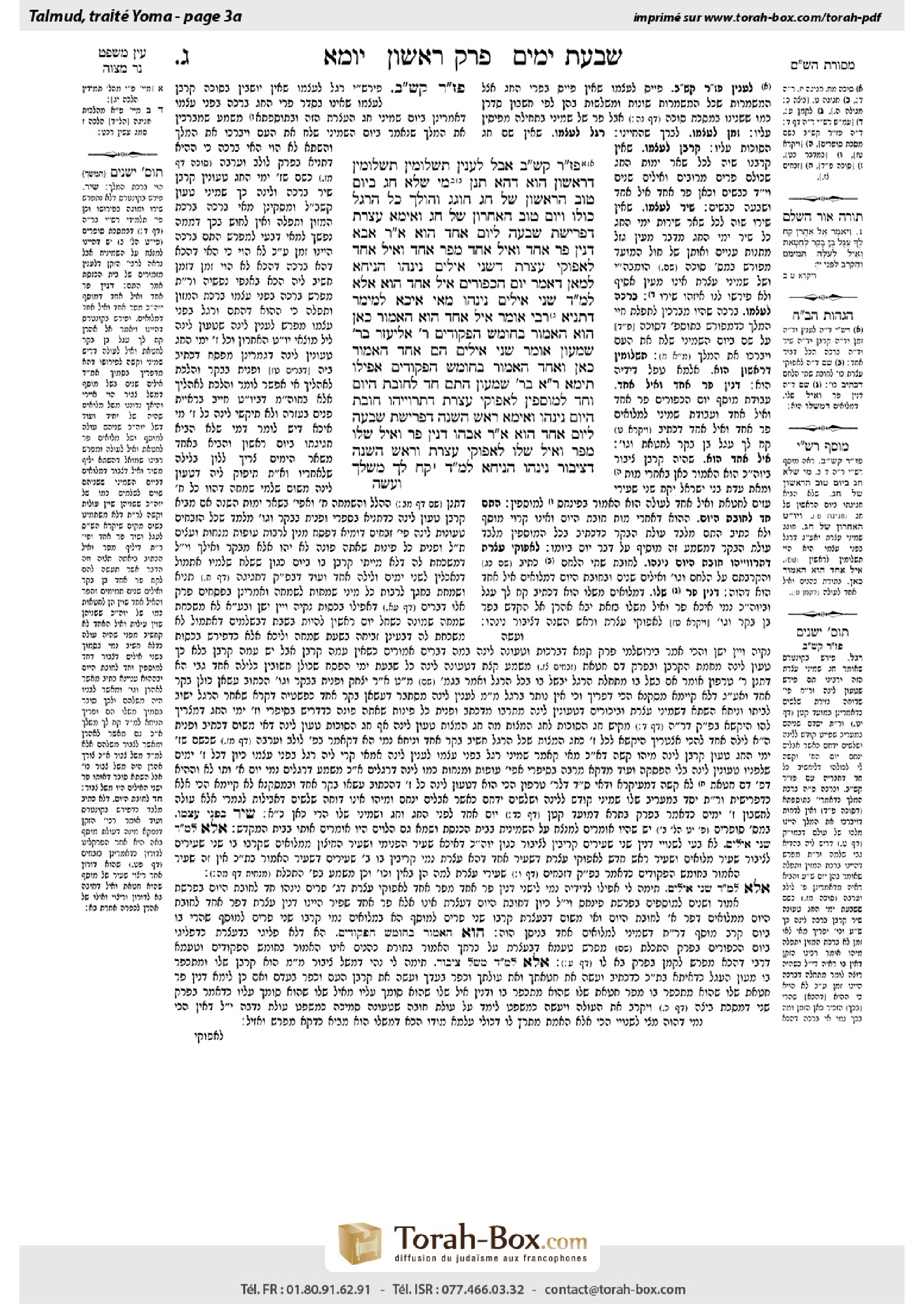
Yoma 3a: Talmud study for Daf Yomi
Daf Yomi is the daily study of one Talmud folio. Explore 37 tractates with scans, Hebrew text, Sefaria English and AI-generated French translations where annotated.
Passage selection and English or AI-generated French translation are available where the scan has annotations. Daf Study is independent of Torah-Box and Sefaria.
Browse Yoma · יומא · All tractatesYoma 3a text and translations
This page of Yoma includes the Aramaic text, an English translation and an AI-generated French translation, alongside the scan above.
יומא ג׳ א · Aramaic and Hebrew text
פָּזֵ״ר קֶשֶׁ״ב.
אֲבָל לְעִנְיַן תַּשְׁלוּמִין, תַּשְׁלוּמִין דְּרִאשׁוֹן הוּא, דְּהָא תְּנַן: מִי שֶׁלֹּא חָג בְּיוֹם טוֹב הָרִאשׁוֹן שֶׁל חַג — חוֹגֵג וְהוֹלֵךְ כָּל הָרֶגֶל כּוּלּוֹ, וְיוֹם טוֹב הָאַחֲרוֹן שֶׁל חַג.
וְאֵימָא עֲצֶרֶת, דִּפְרִישַׁת שִׁבְעָה לְיוֹם אֶחָד הוּא! אָמַר רַבִּי אַבָּא: דָּנִין פַּר אֶחָד וְאַיִל אֶחָד מִפַּר אֶחָד וְאַיִל אֶחָד, לְאַפּוֹקֵי עֲצֶרֶת דִּשְׁנֵי אֵילִים נִינְהוּ.
הָנִיחָא לְמַאן דְּאָמַר יוֹם הַכִּפּוּרִים אַיִל אֶחָד הוּא, אֶלָּא לְמַאן דְּאָמַר שְׁנֵי אֵילִים נִינְהוּ, מַאי אִיכָּא לְמֵימַר! דְּתַנְיָא, רַבִּי אוֹמֵר: אַיִל אֶחָד, הוּא הָאָמוּר כָּאן, הוּא הָאָמוּר בְּחוֹמֶשׁ הַפְּקוּדִים. רַבִּי אֱלִיעֶזֶר בְּרַבִּי שִׁמְעוֹן אוֹמֵר: שְׁנֵי אֵילִים הֵם, אֶחָד הָאָמוּר כָּאן, וְאֶחָד הָאָמוּר בְּחוֹמֶשׁ הַפְּקוּדִים!
אֲפִילּוּ תֵּימָא רַבִּי אֱלִיעֶזֶר בְּרַבִּי שִׁמְעוֹן: הָתָם חַד לְחוֹבַת הַיּוֹם, וְחַד לְמוּסָפִין. לְאַפּוֹקֵי עֲצֶרֶת, דְּתַרְוַיְיהוּ חוֹבַת הַיּוֹם נִינְהוּ.
וְאֵימָא רֹאשׁ הַשָּׁנָה, דִּפְרִישַׁת שִׁבְעָה לְיוֹם אֶחָד הוּא! אָמַר רַבִּי אֲבָהוּ: דָּנִין פָּר וָאַיִל שֶׁלּוֹ מִפָּר וָאַיִל שֶׁלּוֹ. לְאַפּוֹקֵי עֲצֶרֶת וְרֹאשׁ הַשָּׁנָה, דְּצִיבּוּר נִינְהוּ. הָנִיחָא לְמַאן דְּאָמַר ״קַח לְךָ״ — מִשֶּׁלְּךָ,
Yoma 3a · English translation
Peh, zayin, reish, kuf, shin, beit, an acronym for: Lottery [payis], as a new lottery is performed on that day to determine which priests will sacrifice the offerings that day, and the order established on Sukkot does not continue; the blessing of time [zeman]: Who has given us life, sustained us, and brought us to this time, is recited just as it is recited at the start of each Festival; Festival [regel], as it is considered a Festival in and of itself and there is no mitzva to reside in the sukka (see Tosafot); offering [korban], as the number of offerings sacrificed on the Eighth Day is not a continuation of the number offered on Sukkot but is part of a new calculation; song [shira], as the Psalms recited by the Levites as the offerings were sacrificed on the Eighth Day are not a continuation of those recited on Sukkot; blessing [berakha], as the addition to the third blessing of Grace after Meals and in the Amida prayer (see Tosafot) is phrased differently than the addition recited on Sukkot.
However, despite all these differences, with regard to compensation for failure to sacrifice the Festival offerings at the earliest opportunity, everyone agrees that it is a day of compensation for obligations not met during the first Festival, as didn’t we learn in the mishna: One who did not celebrate on the first Festival day of Sukkot by sacrificing the Festival offering may celebrate and sacrifice the Festival offering throughout the whole Festival in its entirety, including the last Festival day of the festival of Sukkot. Apparently, the Eighth Day of Assembly is considered the last Festival day of Sukkot and is appended to it with regard to its obligations.
The Gemara challenges further: And say that the priest should be sequestered before the festival of Shavuot, which is a Festival preceded by weekdays, as there too it is a matter of sequestering of seven days for one day. Rabbi Abba said: There is a distinction between the inauguration and Shavuot, as one derives an instance where the obligatory offering is one bull and one ram, Yom Kippur, from an instance where the obligatory offering is one bull and one ram, the inauguration, to the exclusion of Shavuot, when they are two rams that are offered.
The Gemara challenges: This works out well according to the one who said that the obligatory offering on Yom Kippur is one ram; however, according to the one who said that they are two rams that are sacrificed on Yom Kippur, what is there to say? According to that opinion, Yom Kippur is not comparable to the inauguration. As it was taught in a baraita: Rabbi Yehuda HaNasi says: One ram is the one that is mentioned here; as it is written: “With this Aaron will come into the Sanctuary, with a young bull for a sin-offering and a ram for a burnt-offering” (Leviticus 16:3), and it is the same one that is mentioned in the book of Numbers: “And on the tenth day of the seventh month you will have a sacred gathering when you will afflict your souls; you will not do any labor, and you will offer a burnt-offering to the Lord for a sweet aroma: One young bull, one ram…” (Numbers 29:7–8). Rabbi Eliezer, son of Rabbi Shimon, says: They are two rams offered on Yom Kippur, one mentioned here in the book of Leviticus and one mentioned in the book of Numbers.
The Gemara rejects this solution: Even if you say that it is in accordance with the opinion of Rabbi Eliezer, son of Rabbi Shimon, and two rams are brought on Yom Kippur, a distinction remains between Yom Kippur and Shavuot. There, with regard to Yom Kippur, one ram, mentioned in the book of Leviticus, is for the obligation of the day, the atonement of Yom Kippur; and one ram, mentioned in the book of Numbers, is for the additional offerings. This is to the exclusion of the halakha with regard to Shavuot, where both rams are obligations of the day. Therefore, there is no basis for deriving the halakha with regard to Shavuot from the inauguration.
The Gemara asks: And say that the requirement derived is to sequester the priest prior to Rosh HaShana, as there, too, it is sequestering of seven days for one day. The days before Rosh HaShana are weekdays, and as in the inauguration, a bull and a ram are sacrificed. Rabbi Abbahu said that this too is rejected: One derives a bull and a ram that the High Priest brings from his own property on Yom Kippur from a bull and a ram that Aaron brought from his own property at the inauguration. This is to the exclusion of Shavuot and Rosh HaShana, when the bull and the ram sacrificed are from community property and not owned by the priest. The Gemara asks: This works out well according to the one who said that every time the Torah utilizes the phrase: Take you, it means from your own property,
Yoma 3a · Traduction française (IA)
Peh, zayin, reish, kuf, shin, beit : un acronyme pour loterie [payis], car une nouvelle loterie a lieu ce jour-là afin de déterminer quels prêtres sacrifieront les offrandes du jour, et l’ordre établi à Souccot ne se poursuit pas ; bénédiction du temps [zeman] : « Qui nous a fait vivre, nous a soutenus et nous a fait parvenir à ce moment », récité comme au début de chaque fête ; fête [regel], car ce jour est considéré comme une fête à part entière et qu’il n’y a pas de mitsva de résider dans la soukka (voir Tosafot) ; offrande [korban], car le nombre d’offrandes sacrifiées le huitième jour ne prolonge pas celui des offrandes de Souccot, mais relève d’un nouveau décompte ; chant [shira], car les psaumes récités par les Lévites pendant le sacrifice des offrandes du huitième jour ne prolongent pas ceux récités à Souccot ; bénédiction [berakha], car l’ajout à la troisième bénédiction de la Grâce après le repas et à la prière de la Amida (voir Tosafot) est formulé différemment de celui récité à Souccot.
Cependant, malgré toutes ces différences, tous conviennent que, pour ce qui est de rattraper le sacrifice des offrandes de fête à la première occasion, ce jour permet de rattraper les obligations qui n’ont pas été accomplies pendant la première fête. N’avons-nous pas appris dans la Michna : Celui qui n’a pas célébré la fête le premier jour de Souccot en sacrifiant l’offrande de fête peut la célébrer et sacrifier cette offrande pendant toute la durée de la fête, y compris le dernier jour de fête de Souccot. Il apparaît que le Huitième Jour de l’Assemblée est considéré comme le dernier jour de fête de Souccot et lui est rattaché en ce qui concerne ses obligations.
La Guemara soulève une autre objection : et disons que le prêtre doit être mis à l’écart avant la fête de Chavouot, qui est une fête précédée de jours ordinaires, car là aussi, il s’agit de sept jours de mise à l’écart pour un seul jour. Rabbi Abba dit : Il existe une distinction entre l’inauguration et Chavouot : on déduit le cas où l’offrande obligatoire est un taureau et un bélier, Yom Kippour, du cas où l’offrande obligatoire est un taureau et un bélier, l’inauguration ; cela exclut Chavouot, où deux béliers sont offerts.
La Guemara objecte : cela convient selon celui qui dit que l’offrande obligatoire de Yom Kippour est un bélier ; mais, selon celui qui dit que deux béliers sont sacrifiés à Yom Kippour, que peut-on répondre ? Selon cette opinion, Yom Kippour n’est pas comparable à l’inauguration. Car il a été enseigné dans une baraïta : Rabbi Yehouda HaNassi dit : Il s’agit d’un seul et même bélier, celui qui est mentionné ici, ainsi qu’il est écrit : « C’est avec cela qu’Aaron entrera dans le Sanctuaire : avec un jeune taureau comme sacrifice expiatoire et un bélier comme holocauste » (Lévitique 16,3) ; c’est le même qui est mentionné dans le livre des Nombres : « Le dixième jour du septième mois, vous aurez une sainte assemblée ; vous vous affligerez et vous ne ferez aucun travail. Vous offrirez au Seigneur un holocauste d’agréable odeur : un jeune taureau, un bélier… » (Nombres 29,7-8). Rabbi Eliezer, fils de Rabbi Shimon, dit : Deux béliers sont offerts à Yom Kippour, l’un mentionné ici dans le livre du Lévitique et l’autre dans le livre des Nombres.
La Guemara rejette cette solution : même si l’on dit qu’elle suit l’opinion de Rabbi Eliezer, fils de Rabbi Shimon, selon laquelle deux béliers sont apportés à Yom Kippour, une distinction subsiste entre Yom Kippour et Chavouot. Dans le cas de Yom Kippour, l’un des béliers, mentionné dans le livre du Lévitique, relève de l’obligation propre à ce jour, à savoir l’expiation de Yom Kippour ; l’autre, mentionné dans le livre des Nombres, fait partie des offrandes supplémentaires. Cela distingue la halakha de Chavouot, où les deux béliers constituent des obligations propres au jour. Il n’y a donc aucun fondement pour déduire la halakha concernant Chavouot de l’inauguration.
La Guemara demande : et disons que l’exigence déduite consiste à mettre le prêtre à l’écart avant Roch Hachana, car là aussi, il s’agit de sept jours de mise à l’écart pour un seul jour. Les jours précédant Roch Hachana sont des jours ordinaires et, comme lors de l’inauguration, un taureau et un bélier sont sacrifiés. Rabbi Abbahou dit que cela aussi est rejeté : on déduit le taureau et le bélier que le Grand Prêtre apporte de ses propres biens à Yom Kippour du taureau et du bélier qu’Aaron apporta de ses propres biens lors de l’inauguration. Cela exclut Chavouot et Roch Hachana, où le taureau et le bélier sacrifiés proviennent des biens de la communauté et n’appartiennent pas au prêtre. La Guemara demande : cela convient selon celui qui dit que chaque fois que la Torah emploie l’expression « prends pour toi », cela signifie que cela provient de tes propres biens,
Traduction française générée par IA à partir de l’édition anglaise de Sefaria. Vérifie toujours un passage avec le texte source.
Text from Sefaria: William Davidson Edition - Vocalized Aramaic (CC BY NC); William Davidson Edition - English (CC BY NC).