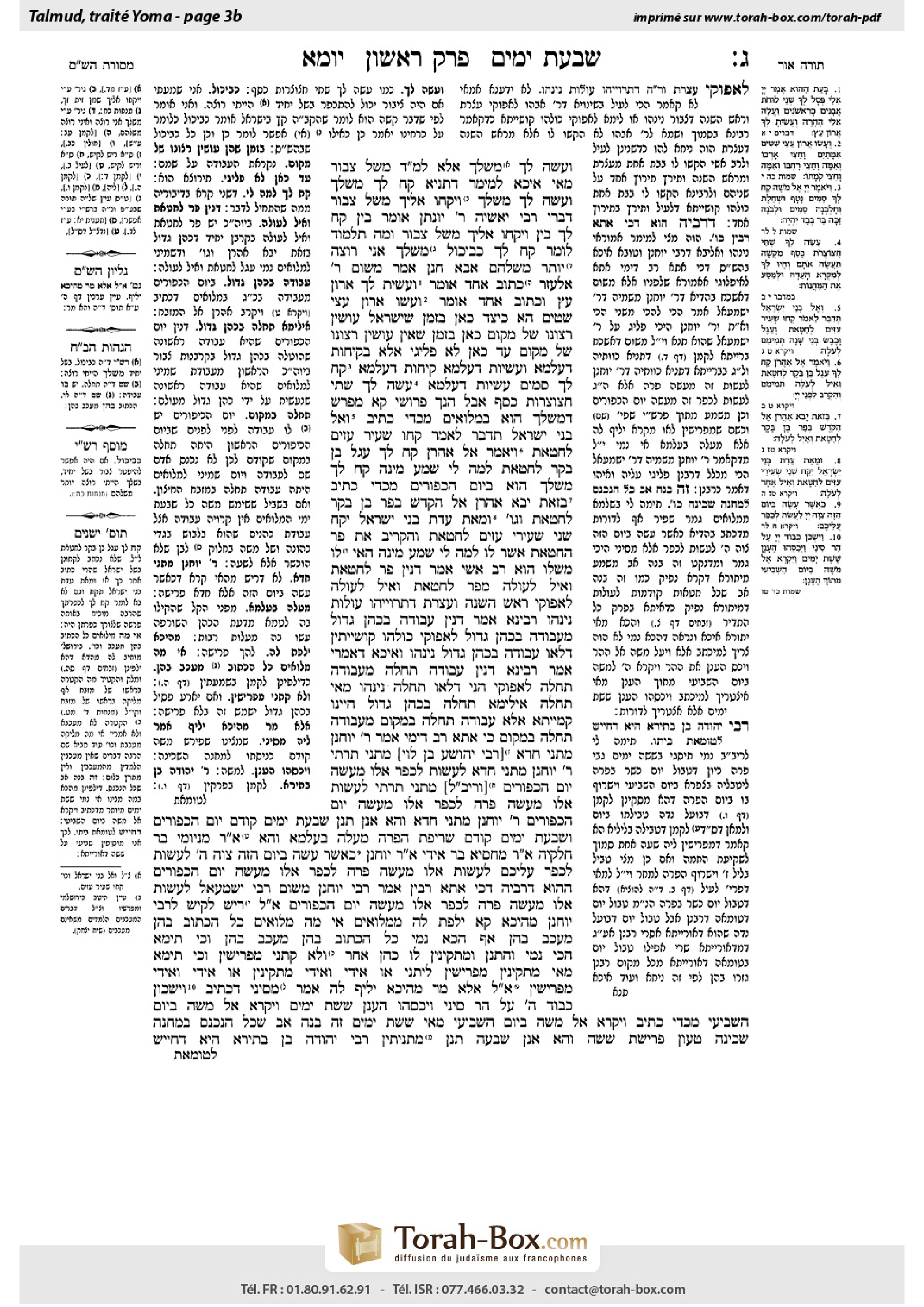
Yoma 3b: Talmud study for Daf Yomi
Daf Yomi is the daily study of one Talmud folio. Explore 37 tractates with scans, Hebrew text, Sefaria English and AI-generated French translations where annotated.
Passage selection and English or AI-generated French translation are available where the scan has annotations. Daf Study is independent of Torah-Box and Sefaria.
Browse Yoma · יומא · All tractatesYoma 3b text and translations
This page of Yoma includes the Aramaic text, an English translation and an AI-generated French translation, alongside the scan above.
יומא ג׳ ב · Aramaic and Hebrew text
״עֲשֵׂה לְךָ״ — מִשֶּׁלְּךָ, אֶלָּא לְמַאן דְּאָמַר מִשֶּׁל צִבּוּר, מַאי אִיכָּא לְמֵימַר?
דְּתַנְיָא: ״קַח לְךָ״ — מִשֶּׁלְּךָ, וַ״עֲשֵׂה לְךָ״ — מִשֶּׁלְּךָ, ״וְיִקְחוּ אֵלֶיךָ״ — מִשֶּׁל צִבּוּר, דִּבְרֵי רַבִּי יֹאשִׁיָּה. רַבִּי יוֹנָתָן אוֹמֵר: בֵּין ״קַח לְךָ״, בֵּין ״וְיִקְחוּ אֵלֶיךָ״ — מִשֶּׁל צִבּוּר, וּמָה תַּלְמוּד לוֹמַר ״קַח לְךָ״ — כִּבְיָכוֹל מִשֶּׁלְּךָ אֲנִי רוֹצֶה יוֹתֵר מִשֶּׁלָּהֶם.
אַבָּא חָנָן אָמַר מִשּׁוּם רַבִּי אֶלְעָזָר, כָּתוּב אֶחָד אוֹמֵר: ״וְעָשִׂיתָ לְּךָ אֲרוֹן עֵץ״, וְכָתוּב אֶחָד אוֹמֵר: ״וְעָשׂוּ אֲרוֹן עֲצֵי שִׁטִּים״, הָא כֵּיצַד? כָּאן בִּזְמַן שֶׁיִּשְׂרָאֵל עוֹשִׂין רְצוֹנוֹ שֶׁל מָקוֹם, כָּאן בִּזְמַן שֶׁאֵין עוֹשִׂין רְצוֹנוֹ שֶׁל מָקוֹם!
עַד כָּאן לָא פְּלִיגִי אֶלָּא בְּקִיחוֹת דְּעָלְמָא וַעֲשִׂיּוֹת דְּעָלְמָא. קִיחוֹת דְּעָלְמָא — ״קַח לְךָ סַמִּים״. עֲשִׂיּוֹת דְּעָלְמָא — ״עֲשֵׂה לְךָ שְׁתֵּי חֲצוֹצְרוֹת כֶּסֶף״. אֲבָל הָנָךְ פָּרוֹשֵׁי קָא מְפָרֵשׁ דְּמִשֶּׁלְּךָ הוּא. בְּמִלּוּאִים מִכְּדֵי כְּתִיב: ״וְאֶל בְּנֵי יִשְׂרָאֵל תְּדַבֵּר לֵאמֹר קְחוּ שְׂעִיר עִזִּים לְחַטָּאת״. ״וַיֹּאמֶר אֶל אַהֲרֹן קַח לְךָ עֵגֶל בֶּן בָּקָר לְחַטָּאת״ לְמָה לִי? שְׁמַע מִינַּהּ: ״קַח לְךָ״ — מִשֶּׁלְּךָ הוּא.
בְּיוֹם הַכִּפּוּרִים מִכְּדֵי כְּתִיב: ״בְּזֹאת יָבֹא אַהֲרֹן אֶל הַקֹּדֶשׁ בְּפַר בֶּן בָּקָר לְחַטָּאת וְגוֹ׳ ... וּמֵאֵת עֲדַת בְּנֵי יִשְׂרָאֵל יִקַּח שְׁנֵי שְׂעִירֵי עִזִּים לְחַטָּאת״. ״וְהִקְרִיב אֶת פַּר הַחַטָּאת אֲשֶׁר לוֹ״ לְמָה לִי? שְׁמַע מִינַּהּ: הַאי ״לוֹ״ — מִשֶּׁלּוֹ הוּא.
רַב אָשֵׁי אָמַר: דָּנִין פַּר לְחַטָּאת וְאַיִל לְעוֹלָה מִפַּר לְחַטָּאת וְאַיִל לְעוֹלָה, לְאַפּוֹקֵי רֹאשׁ הַשָּׁנָה וַעֲצֶרֶת — דְּתַרְוַיְיהוּ עוֹלוֹת נִינְהוּ.
רָבִינָא אָמַר: דָּנִין עֲבוֹדָה בְּכֹהֵן גָּדוֹל מֵעֲבוֹדָה בְּכֹהֵן גָּדוֹל, לְאַפּוֹקֵי כּוּלְּהוּ קוּשְׁיָיתִין — דְּלָאו עֲבוֹדָה בְּכֹהֵן גָּדוֹל נִינְהוּ.
וְאִיכָּא דְּאָמְרִי אָמַר רָבִינָא: דָּנִין עֲבוֹדָה תְּחִלָּה מֵעֲבוֹדָה תְּחִלָּה, לְאַפּוֹקֵי הָנֵי — דְּלָאו תְּחִלָּה נִינְהוּ. מַאי תְּחִלָּה? אִילֵּימָא תְּחִלָּה בְּכֹהֵן גָּדוֹל — הַיְינוּ קַמַּיְיתָא. אֶלָּא, עֲבוֹדָה תְּחִלָּה בַּמָּקוֹם מֵעֲבוֹדָה תְּחִלָּה בַּמָּקוֹם.
כִּי אֲתָא רַב דִּימִי, אָמַר: רַבִּי יוֹחָנָן מַתְנֵי חֲדָא, [רַבִּי יְהוֹשֻׁעַ בֶּן לֵוִי] מַתְנֵי תַּרְתֵּי. רַבִּי יוֹחָנָן מַתְנֵי חֲדָא: ״לַעֲשׂוֹת לְכַפֵּר״ — אֵלּוּ מַעֲשֵׂה יוֹם הַכִּפּוּרִים. [וִיהוֹשֻׁעַ בֶּן לֵוִי] מַתְנֵי תַּרְתֵּי: ״לַעֲשׂוֹת״ — אֵלּוּ מַעֲשֵׂה פָרָה, ״לְכַפֵּר״ — אֵלּוּ מַעֲשֵׂה יוֹם הַכִּפּוּרִים.
רַבִּי יוֹחָנָן מַתְנֵי חֲדָא? וְהָא אֲנַן תְּנַן: שִׁבְעַת יָמִים קוֹדֶם יוֹם הַכִּפּוּרִים, וְשִׁבְעַת יָמִים קוֹדֶם שְׂרֵיפַת הַפָּרָה! מַעֲלָה בְּעָלְמָא.
וְהָא אָמַר רַבִּי מִנְיוֹמֵי בַּר חִלְקִיָּה אָמַר רַבִּי מַחְסֵיָא בַּר אִידֵּי אָמַר רַבִּי יוֹחָנָן: ״כַּאֲשֶׁר עָשָׂה בַּיּוֹם הַזֶּה צִוָּה ה׳ לַעֲשׂוֹת לְכַפֵּר עֲלֵיכֶם״, ״לַעֲשׂוֹת״ — אֵלּוּ מַעֲשֵׂה פָרָה, ״לְכַפֵּר״ — אֵלּוּ מַעֲשֵׂה יוֹם הַכִּפּוּרִים! הָהוּא דְּרַבֵּיהּ. דְּכִי אֲתָא רָבִין, אָמַר רַבִּי יוֹחָנָן מִשּׁוּם רַבִּי יִשְׁמָעֵאל: ״לַעֲשׂוֹת״ — אֵלּוּ מַעֲשֵׂה פָרָה, ״לְכַפֵּר״ — אֵלּוּ מַעֲשֵׂה יוֹם הַכִּפּוּרִים.
אֲמַר לֵיהּ רֵישׁ לָקִישׁ לְרַבִּי יוֹחָנָן: מֵהֵיכָא קָא יָלְפַתְּ לַהּ — מִמִּלּוּאִים, אִי מָה מִלּוּאִים כׇּל הַכָּתוּב בָּהֶן מְעַכֵּב בָּהֶן, אַף הָכָא נָמֵי — כׇּל הַכָּתוּב בָּהֶן מְעַכֵּב בָּהֶן.
וְכִי תֵּימָא הָכִי נָמֵי, וְהָתְנַן: ״וּמַתְקִינִין לוֹ כֹּהֵן אַחֵר״, וְלָא קָתָנֵי ״מַפְרִישִׁין״! וְכִי תֵּימָא: מַאי ״מַתְקִינִין״ — ״מַפְרִישִׁין״, לִיתְנֵי אוֹ אִידֵּי וְאִידֵּי ״מַתְקִינִין״, אוֹ אִידֵּי וְאִידֵּי ״מַפְרִישִׁין״.
אֲמַר לֵיהּ: אֶלָּא מָר מֵהֵיכָא יָלֵיף לַהּ? אָמַר: מִסִּינַי, דִּכְתִיב: ״וַיִּשְׁכּוֹן כְּבוֹד ה׳ עַל הַר סִינַי וַיְכַסֵּהוּ הֶעָנָן שֵׁשֶׁת יָמִים וַיִּקְרָא אֶל מֹשֶׁה בַּיּוֹם הַשְּׁבִיעִי״, מִכְּדֵי כְּתִיב: ״וַיִּקְרָא אֶל מֹשֶׁה בַּיּוֹם הַשְּׁבִיעִי״, מַאי ״שֵׁשֶׁת יָמִים״? זֶה בָּנָה אָב: שֶׁכׇּל הַנִּכְנָס בְּמַחֲנֵה שְׁכִינָה, טָעוּן פְּרִישַׁת שִׁשָּׁה.
וְהָא אֲנַן שִׁבְעָה תְּנַן! מַתְנִיתִין רַבִּי יְהוּדָה בֶּן בְּתֵירָא הִיא, דְּחָיֵישׁ
Yoma 3b · English translation
and similarly, when the Torah states: Make you, it means from your own property. However, according to the one who said that when the Torah states both phrases it means from communal property, what is there to say to distinguish between Yom Kippur and the other days?
As it was taught in a baraita that when the Torah states: Take you, it means from your own property, and when it states: Make you, it means from your own property; however, when the Torah states: And they will bring to you, it means from community property. This is the statement of Rabbi Yoshiya. Rabbi Yonatan says that both when the Torah states: Take you, and when the Torah states: And they will bring to you, it means from community property. And for what purpose, then, does the verse state: Take you, which seems to mean from your own property? It should be understood, as it were, that God said to Moses: I desire that it come from your property more than I desire it from theirs. Therefore, the taking was attributed to Moses even though it was actually from community property.
Abba Ḥanan said in the name of Rabbi Elazar that one verse says: “And make you an ark of wood” (Deuteronomy 10:1), indicating that it should be from your own property; and one verse says on the same subject: “And they shall make an ark of acacia wood” (Exodus 25:10), meaning from the Jewish people. How can this contradiction be resolved? Here, the verse is referring to a time when the Jewish people perform the will of God and they are credited with building the Ark of the Covenant. There, it is referring to a time when the Jewish people do not perform the will of God, and construction of the Ark is attributed to Moses alone. According to that opinion, there is no difference between the offerings of Yom Kippur and other offerings.
The Gemara rejects this: They disagree only with regard to instances of taking in general and instances of making in general: Instances of taking in general are as in the verse: “Take you spices” (Exodus 30:34); and instances of making in general are as in the verse: “Make you two silver trumpets” (Numbers 10:2). However, in these cases of inauguration and of Yom Kippur the verses explicitly teach that the offerings must be from your own property. With regard to the inauguration, now, since it is written: “And to the children of Israel you will speak, saying: Take a goat kid for a sin-offering and an unblemished year-old calf and lamb for burnt-offerings” (Leviticus 9:3), with regard to the verse: “And he said to Aaron: Take you a young calf for a sin-offering” (Leviticus 9:2), why do I need this clear difference between the formulation of the command to the Jewish people and the formulation of the command to Aaron? Learn from it that in this context the phrase: Take you, means from your own property.
And with regard to Yom Kippur, now, since it is written: “With this Aaron will come into the Sanctuary, with a young bull for a sin-offering and a ram for a burnt-offering” (Leviticus 16:3), with regard to the verse: “And from the congregation of the children of Israel he will take two goat kids for a sin-offering and one ram for a burnt-offering and Aaron will offer his young bull as a sin-offering” (Leviticus 16:5–6), why do I need the emphasis that the goats come from the property of the children of Israel? Learn from it that this term: His, written with regard to the calf, means it is from his own property.
Rav Ashi stated another reason that distinguishes Yom Kippur from Rosh HaShana and Shavuot. One derives the bull for a sin-offering and ram for a burnt-offering written with regard to Yom Kippur from the bull for a sin-offering and ram for a burnt-offering written with regard to the inauguration, to the exclusion of Rosh HaShana and Shavuot, on which both of them, the bull and the ram, are burnt-offerings.
Ravina stated another distinction: One derives a matter that is restricted to the service performed by the High Priest, Yom Kippur, from a matter that is restricted to the service performed by the High Priest, the inauguration, which was performed by Aaron, to the exclusion of all the difficulties raised from the beginning of the discussion, as on the other potential days raised, they are not restricted to service performed by the High Priest; rather, the service on those days may be performed by any priest.
And some say that Ravina said: One derives a matter that is an initial service from an initial service, to the exclusion of all these that are not initial services. That statement of Ravina is unclear, and the Gemara asks: What is the meaning of initial service? If we say that initial service means one performed by the High Priest; that is identical to the first version of Ravina’s statement. Rather, it may be understood as follows: One derives the initial service performed in the place, the Holy of Holies, on Yom Kippur, from the initial service performed in the place, the Tabernacle, on the eighth day of the inauguration. Therefore, it is the service of Yom Kippur alone that is derived from the inauguration.
§ When Rav Dimi came from Eretz Yisrael to Babylonia he said: Rabbi Yoḥanan taught one case derived from the inauguration, while Rabbi Yehoshua ben Levi taught two. The Gemara elaborates. Rabbi Yoḥanan taught one: To do, to make atonement; these are the actions performed on Yom Kippur that require sequestering beforehand, like the inauguration. And Rabbi Yehoshua ben Levi taught two: To do, these are the actions performed in the burning of the red heifer; to atone, these are the actions performed on Yom Kippur. Both require sequestering.
The Gemara asks: And did Rabbi Yoḥanan teach only one case derived from the inauguration, i.e., Yom Kippur? Didn’t we learn explicitly in the mishna: Seven days prior to Yom Kippur, and in another mishna: Seven days prior to the burning of the heifer, the Sages would remove the priest from his home? Apparently, there are two cases in which the priest is sequestered. The Gemara answers: With regard to sequestering the priest prior to the burning of the heifer, the Sages merely established a higher standard. They issued a decree to underscore the sanctity of the ritual after they permitted its performance by a priest who immersed that day. There is no Torah source for the sequestering of the priest in that case.
The Gemara asks: But didn’t Rabbi Minyomi bar Ḥilkiya say that Rabbi Maḥseya bar Idi said that Rabbi Yoḥanan said that the verse states: “As has been done this day, so the Lord has commanded to do, to make atonement for you” (Leviticus 8:34), from which it is derived: To do, these are the actions performed in the burning of the red heifer; to make atonement, these are the actions performed on Yom Kippur? Apparently, even Rabbi Yoḥanan taught two cases derived from inauguration. The Gemara resolves the difficulty: That is the opinion of his teacher; however, he himself disagrees. As when Ravin came from Eretz Yisrael, he said that Rabbi Yoḥanan said in the name of Rabbi Yishmael: To do, these are the actions performed in the burning of the red heifer; to atone, these are the actions performed on Yom Kippur. That which Rabbi Manyumei cited in the name of Rabbi Yoḥanan was the opinion of his teacher, Rabbi Yishmael.
§ With regard to the sequestering of the priest, Reish Lakish said to Rabbi Yoḥanan: From where did you derive this principle of sequestering? You derived it from the inauguration. If so, just as with regard to the inauguration, failure to perform all the details that are written in its regard invalidates it, so too here, with regard to Yom Kippur, failure to perform all the details that are written in its regard invalidates the Yom Kippur service. All the halakhot of sequestering must be precisely observed.
And if you say: Indeed, that is so; didn’t we learn in the mishna: And they would designate another priest in his stead, and it is not taught with regard to the designated priest: Seven days before Yom Kippur they remove him from his house, although ultimately he may perform the Yom Kippur service. Apparently, failure to sequester the priest does not invalidate the service. And if you say in response: What is the meaning of: They would designate? It means: They would remove; that is implausible. Were that so, let the mishna teach either with regard to both this High Priest and that designated replacement: They would designate; or with regard to both this High Priest and that designated replacement: They would remove.
Rabbi Yoḥanan said to Reish Lakish: Rather, from where do you, Master, derive the halakha of sequestering before Yom Kippur? Reish Lakish said to him: I derive it from Sinai, as it is written: “And the glory of the Lord abode upon Mount Sinai and the cloud covered him [vaykhasehu] six days, and He called to Moses on the seventh day from the midst of the cloud” (Exodus 24:16). The masculine suffix hu in vaykhasehu can be interpreted either as him, referring to Moses, or as it, referring to the mountain. Now, since it states: “And He called to Moses on the seventh day,” what is derived from the previous explicit mention of six days? These six days are mentioned as a paradigm, from which a general principle is derived that anyone who enters the camp of the Divine Presence, the site of the revelation at Mount Sinai, or the place where the Divine Presence rests, the Holy of Holies, requires prior sequestering for six days of sanctification.
The Gemara asks: Wasn’t it seven, not six, days of sequestering that we learned in the mishna? Reish Lakish answered: The mishna that requires sequestering for seven days is the opinion of Rabbi Yehuda ben Beteira, who is concerned
Yoma 3b · Traduction française (IA)
Et de même, lorsque la Torah dit : « Faites pour vous », cela signifie que cela doit provenir de vos biens personnels. Cependant, selon celui qui affirme que lorsque la Torah emploie les deux expressions, cela signifie que cela doit provenir des biens de la communauté, que peut-on répondre pour distinguer Yom Kippour des autres jours ?
Comme il a été enseigné dans une baraïta : lorsque la Torah dit « Prenez pour vous », cela signifie que cela doit provenir de vos biens personnels, et lorsqu’elle dit « Faites pour vous », cela signifie que cela doit provenir de vos biens personnels. En revanche, lorsqu’elle dit « Ils apporteront pour vous », cela signifie que cela doit provenir des biens de la communauté. Telle est la déclaration de Rabbi Yoshiya. Rabbi Yonatan dit que, lorsque la Torah dit « Prenez pour vous » aussi bien que lorsqu’elle dit « Ils apporteront pour vous », cela signifie que cela doit provenir des biens de la communauté. À quoi sert donc le verset à dire « Prenez pour vous », ce qui semble signifier que cela doit provenir de vos biens personnels ? Il faut comprendre, pour ainsi dire, que Dieu dit à Moïse : « Je désire que cela provienne de tes biens plus que de leurs biens. » C’est pourquoi l’acte de prendre est attribué à Moïse, bien qu’en réalité cela provienne des biens de la communauté.
Abba Ḥanan a dit au nom de Rabbi Elazar qu’un verset dit : « Fais-toi une arche de bois » (Deutéronome 10:1), ce qui indique qu’elle doit provenir de tes biens personnels ; et un autre verset dit à propos du même sujet : « Ils feront une arche en bois d’acacia » (Exode 25:10), ce qui signifie qu’elle doit provenir du peuple juif. Comment résoudre cette contradiction ? Ici, le verset parle d’un moment où le peuple juif accomplit la volonté de Dieu et où la construction de l’Arche d’alliance lui est imputée. Là, il parle d’un moment où le peuple juif n’accomplit pas la volonté de Dieu, et la construction de l’Arche est imputée à Moïse seul. Selon cette opinion, il n’y a pas de différence entre les offrandes de Yom Kippour et les autres offrandes.
La Guemara rejette cette interprétation : leur désaccord ne concerne que les occurrences générales des termes « prendre » et « faire » : les occurrences générales de « prendre » sont celles du verset « Prends pour toi des aromates » (Exode 30:34), et celles de « faire » sont celles du verset « Fais-toi deux trompettes d’argent » (Nombres 10:2). Dans les cas présents, toutefois, ceux de l’inauguration et de Yom Kippour, les versets enseignent explicitement que les offrandes doivent provenir de tes biens personnels. En ce qui concerne l’inauguration, puisque le verset dit : « Tu parleras aux enfants d’Israël en ces termes : Prenez un chevreau pour sacrifice expiatoire, ainsi qu’un veau et un agneau âgés d’un an, sans défaut, pour holocaustes » (Lévitique 9:3), à quoi sert le verset : « Il dit à Aaron : Prends un jeune veau pour sacrifice expiatoire » (Lévitique 9:2), avec la nette différence entre la formulation de l’ordre adressé au peuple juif et celle de l’ordre adressé à Aaron ? Déduis-en que, dans ce contexte, l’expression « Prends pour toi » signifie que cela doit provenir de tes biens personnels.
Et en ce qui concerne Yom Kippour, puisque le verset dit : « C’est avec cela qu’Aaron entrera dans le Sanctuaire : avec un jeune taureau pour sacrifice expiatoire et un bélier pour holocauste » (Lévitique 16:3), à quoi sert le verset : « De la communauté des enfants d’Israël, il prendra deux chevreaux pour sacrifice expiatoire et un bélier pour holocauste, et Aaron offrira son jeune taureau comme sacrifice expiatoire » (Lévitique 16:5–6), qui souligne que les chevreaux proviennent des biens des enfants d’Israël ? Déduis-en que le terme « son », employé à propos du veau, signifie qu’il provient de ses biens personnels.
Rav Ashi a donné une autre raison de distinguer Yom Kippour de Roch Hachana et de Chavouot. On déduit le taureau pour sacrifice expiatoire et le bélier pour holocauste mentionnés à propos de Yom Kippour du taureau pour sacrifice expiatoire et du bélier pour holocauste mentionnés à propos de l’inauguration, à l’exclusion de Roch Hachana et de Chavouot, où les deux animaux, le taureau et le bélier, sont des holocaustes.
Ravina a proposé une autre distinction : on déduit une chose qui est réservée au service accompli par le Grand Prêtre — Yom Kippour — d’une chose qui est réservée au service accompli par le Grand Prêtre — l’inauguration, accomplie par Aaron — ce qui écarte toutes les difficultés soulevées depuis le début de la discussion, car les autres jours envisagés ne sont pas réservés au service du Grand Prêtre ; le service ces jours-là peut être accompli par n’importe quel prêtre.
Et certains disent que Ravina a dit : on déduit un service initial d’un service initial, à l’exclusion de tous les autres, qui ne sont pas des services initiaux. Cette déclaration de Ravina n’est pas claire, et la Guemara demande : que signifie « service initial » ? Si l’on dit qu’un service initial est un service accompli par le Grand Prêtre, cela revient exactement à la première version de la déclaration de Ravina. Il faut plutôt comprendre ainsi : on déduit le service initial accompli dans un lieu, le Saint des Saints, à Yom Kippour, du service initial accompli dans un lieu, le Tabernacle, le huitième jour de l’inauguration. C’est donc le service de Yom Kippour seul qui est déduit de l’inauguration.
§ Lorsque Rav Dimi vint d’Erets Israël en Babylonie, il dit : Rabbi Yoḥanan enseignait un cas déduit de l’inauguration, tandis que Rabbi Yehoshua ben Levi en enseignait deux. La Guemara précise. Rabbi Yoḥanan en enseignait un : « Pour agir, pour faire expiation » désigne les actes accomplis à Yom Kippour qui exigent une mise à l’écart préalable, comme lors de l’inauguration. Rabbi Yehoshua ben Levi en enseignait deux : « Pour agir » désigne les actes accomplis lors de la combustion de la vache rousse ; « pour faire expiation » désigne les actes accomplis à Yom Kippour. Dans les deux cas, une mise à l’écart est requise.
La Guemara demande : Rabbi Yoḥanan n’a-t-il enseigné qu’un seul cas déduit de l’inauguration, à savoir Yom Kippour ? N’avons-nous pas explicitement appris dans la Michna : « Sept jours avant Yom Kippour », et dans une autre Michna : « Sept jours avant la combustion de la vache », les Sages faisaient sortir le prêtre de sa maison ? Il semble donc qu’il existe deux cas où le prêtre est mis à l’écart. La Guemara répond : en ce qui concerne la mise à l’écart du prêtre avant la combustion de la vache rousse, les Sages ont simplement adopté une mesure de précaution plus rigoureuse. Ils ont décrété cette mesure pour souligner le caractère sacré du rite, après avoir autorisé son accomplissement par un prêtre qui s’était immergé le jour même. Dans ce cas, la mise à l’écart du prêtre ne repose sur aucune source dans la Torah.
La Guemara demande : Mais Rabbi Minyomi bar Ḥilkiya n’a-t-il pas dit que Rabbi Maḥseya bar Idi a dit que Rabbi Yoḥanan a dit que le verset déclare : « Comme cela a été fait aujourd’hui, ainsi le Seigneur a ordonné de le faire, pour faire expiation pour vous » (Lévitique 8:34), d’où l’on déduit : « Pour le faire » désigne les actes accomplis lors de la combustion de la vache rousse ; « pour faire expiation » désigne les actes accomplis à Yom Kippour ? Il semble donc que même Rabbi Yoḥanan ait enseigné deux cas déduits de l’inauguration. La Guemara résout la difficulté : c’est l’opinion de son maître ; lui-même, cependant, n’est pas d’accord. En effet, lorsque Ravin vint d’Erets Israël, il dit que Rabbi Yoḥanan a dit au nom de Rabbi Yishmael : « Pour le faire » désigne les actes accomplis lors de la combustion de la vache rousse ; « pour faire expiation » désigne les actes accomplis à Yom Kippour. Ce que Rabbi Manyumei a cité au nom de Rabbi Yoḥanan était l’opinion de son maître, Rabbi Yishmael.
§ Au sujet de la mise à l’écart du prêtre, Reish Lakish dit à Rabbi Yoḥanan : D’où déduisez-vous ce principe de mise à l’écart ? Vous le déduisez de l’inauguration. Si tel est le cas, de même que, pour l’inauguration, l’omission de l’un quelconque des détails prescrits à son sujet l’invalide, de même ici, à Yom Kippour, l’omission de l’un quelconque des détails prescrits à son sujet invalide le service de Yom Kippour. Toutes les halakhot relatives à la mise à l’écart doivent être observées avec précision.
Et si tu dis : en effet, c’est ainsi ; n’avons-nous pas appris dans la Michna : « Ils désignaient un autre prêtre à sa place », sans qu’il soit enseigné au sujet du prêtre désigné : « Sept jours avant Yom Kippour, ils le faisaient sortir de sa maison », bien qu’il puisse finalement accomplir le service de Yom Kippour ? Il semble donc que le défaut de mise à l’écart du prêtre n’invalide pas le service. Et si tu réponds : que signifie « ils désignaient » ? Cela signifie : « ils le faisaient sortir » ; cette interprétation est peu plausible. Si tel était le cas, que la Michna enseigne, soit à propos du Grand Prêtre et de son remplaçant désigné : « Ils désignaient », soit à propos des deux : « Ils les faisaient sortir ».
Rabbi Yoḥanan dit à Reish Lakish : Alors, d’où déduisez-vous, Maître, la halakha de la mise à l’écart avant Yom Kippour ? Reish Lakish lui dit : Je la déduis du Sinaï, comme il est écrit : « La gloire du Seigneur demeura sur le mont Sinaï et la nuée le couvrit [vaykhasehu] pendant six jours, puis Il appela Moïse le septième jour du milieu de la nuée » (Exode 24:16). Le suffixe masculin hu dans vaykhasehu peut être interprété soit comme « lui », en référence à Moïse, soit comme « le », en référence à la montagne. Or, puisque le texte dit : « Il appela Moïse le septième jour », que déduit-on de la mention explicite des six jours qui précède ? Ces six jours sont mentionnés comme modèle, dont on déduit un principe général : quiconque entre dans le camp de la Présence divine, le lieu de la révélation au mont Sinaï, ou dans le lieu où repose la Présence divine, le Saint des Saints, doit auparavant être mis à l’écart pendant six jours de sanctification.
La Guemara demande : N’avons-nous pas appris dans la Michna qu’il s’agissait de sept jours de mise à l’écart, et non de six ? Reish Lakish répondit : La Michna qui exige une mise à l’écart de sept jours suit l’opinion de Rabbi Yehuda ben Beteira, qui se montre préoccupé
Traduction française générée par IA à partir de l’édition anglaise de Sefaria. Vérifie toujours un passage avec le texte source.
Text from Sefaria: William Davidson Edition - Vocalized Aramaic (CC BY NC); William Davidson Edition - English (CC BY NC).