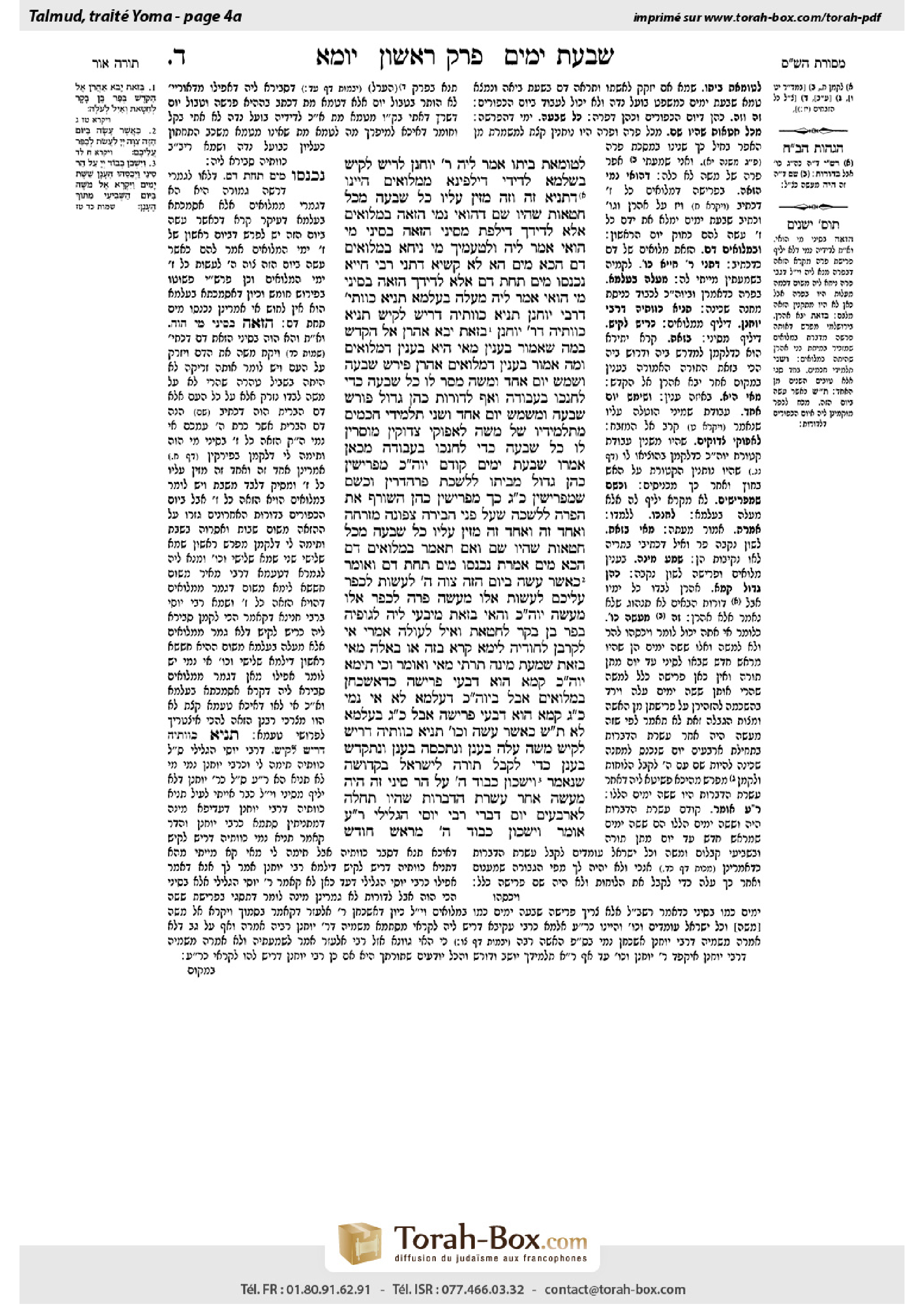
Yoma 4a: Talmud study for Daf Yomi
Daf Yomi is the daily study of one Talmud folio. Explore 37 tractates with scans, Hebrew text, Sefaria English and AI-generated French translations where annotated.
Passage selection and English or AI-generated French translation are available where the scan has annotations. Daf Study is independent of Torah-Box and Sefaria.
Browse Yoma · יומא · All tractatesYoma 4a text and translations
This page of Yoma includes the Aramaic text, an English translation and an AI-generated French translation, alongside the scan above.
יומא ד׳ א · Aramaic and Hebrew text
לְטוּמְאַת בֵּיתוֹ.
אֲמַר לֵיהּ רַבִּי יוֹחָנָן לְרֵישׁ לָקִישׁ: בִּשְׁלָמָא לְדִידִי דְּיָלֵיפְנָא מִמִּלּוּאִים, הַיְינוּ דְּתַנְיָא: זֶה וְזֶה מַזִּין עָלָיו כׇּל שִׁבְעָה מִכׇּל חַטָּאוֹת שֶׁהָיוּ שָׁם, דַּהֲוַאי נָמֵי הַזָּאָה בְּמִלּוּאִים. אֶלָּא לְדִידָךְ דְּיָלְפַתְּ מִסִּינַי, הַזָּאָה בְּסִינַי מִי הֲוַאי?
אֲמַר לֵיהּ: וּלְטַעְמָיךְ מִי נִיחָא? בְּמִלּוּאִים דָּם, הָכָא מַיִם! הָא לָא קַשְׁיָא, דְּתָנֵי רַבִּי חִיָּיא: נִכְנְסוּ מַיִם תַּחַת דָּם. אֶלָּא לְדִידָךְ, הַזָּאָה בְּסִינַי מִי הֲוַאי? אֲמַר לֵיהּ: מַעֲלָה בְּעָלְמָא.
תַּנְיָא כְּווֹתֵיהּ דְּרַבִּי יוֹחָנָן, תַּנְיָא כְּווֹתֵיהּ דְּרֵישׁ לָקִישׁ. תַּנְיָא כְּווֹתֵיהּ דְּרַבִּי יוֹחָנָן: ״בְּזֹאת יָבֹא אַהֲרֹן אֶל הַקֹּדֶשׁ״, בְּמַה שֶּׁאָמוּר בָּעִנְיָן, מַאי הִיא — בְּעִנְיָן דְּמִלּוּאִים. וּמָה אָמוּר בְּעִנְיָן דְּמִלּוּאִים — אַהֲרֹן פֵּירַשׁ שִׁבְעָה וְשִׁמֵּשׁ יוֹם אֶחָד, וּמֹשֶׁה מָסַר לוֹ כׇּל שִׁבְעָה כְּדֵי לְחַנְּכוֹ בָּעֲבוֹדָה.
וְאַף לְדוֹרוֹת כֹּהֵן גָּדוֹל פּוֹרֵשׁ שִׁבְעָה וּמְשַׁמֵּשׁ יוֹם אֶחָד, וּשְׁנֵי תַּלְמִידֵי חֲכָמִים מִתַּלְמִידָיו שֶׁל מֹשֶׁה — לְאַפּוֹקֵי צַדּוּקִין, מוֹסְרִין לוֹ כׇּל שִׁבְעָה כְּדֵי לְחַנְּכוֹ בָּעֲבוֹדָה.
מִכָּאן אָמְרוּ: שִׁבְעַת יָמִים קוֹדֶם יוֹם הַכִּפּוּרִים מַפְרִישִׁין כֹּהֵן גָּדוֹל מִבֵּיתוֹ לְלִשְׁכַּת פַּרְהֶדְרִין. וּכְשֵׁם שֶׁמַּפְרִישִׁין כֹּהֵן גָּדוֹל, כָּךְ מַפְרִישִׁין כֹּהֵן הַשּׂוֹרֵף אֶת הַפָּרָה לַלִּשְׁכָּה שֶׁעַל פְּנֵי הַבִּירָה צָפוֹנָה מִזְרָחָה. וְאֶחָד זֶה וְאֶחָד זֶה מַזִּין עָלָיו כׇּל שִׁבְעָה מִכׇּל חַטָּאוֹת שֶׁהָיוּ שָׁם.
וְאִם תֹּאמַר: בְּמִלּוּאִים דָּם, הָכָא מַיִם, אָמַרְתָּ: נִכְנְסוּ מַיִם תַּחַת דָּם. וְאוֹמֵר ״כַּאֲשֶׁר עָשָׂה בַּיּוֹם הַזֶּה צִוָּה ה׳ לַעֲשׂוֹת לְכַפֵּר עֲלֵיכֶם״. ״לַעֲשׂוֹת״ — אֵלּוּ מַעֲשֵׂה פָרָה, ״לְכַפֵּר״ — אֵלּוּ מַעֲשֵׂה יוֹם הַכִּפּוּרִים.
וְהַאי ״בְּזֹאת״ מִיבְּעֵי לֵיהּ לְגוּפֵיהּ, בְּפַר בֶּן בָּקָר לְחַטָּאת וְאַיִל לְעוֹלָה! אָמְרִי: אִי לְקׇרְבָּן לְחוֹדֵיהּ, לֵימָא קְרָא ״בְּזֶה״ אוֹ ״בְּאֵלֶּה״, מַאי ״בָּזֹאת״ — שָׁמְעַתְּ מִינַּהּ תַּרְתֵּי.
מַאי ״וְאוֹמֵר״? וְכִי תֵּימָא: יוֹם הַכִּפּוּרִים קַמָּא הוּא דְּבָעֵי פְּרִישָׁה, כִּדְאַשְׁכְּחַן בְּמִלּוּאִים אֲבָל בְּיוֹם הַכִּפּוּרִים דְּעָלְמָא לָא. אִי נָמֵי: כֹּהֵן גָּדוֹל קַמָּא הוּא דְּבָעֵי פְּרִישָׁה, אֲבָל כֹּהֵן גָּדוֹל בְּעָלְמָא לָא, תָּא שְׁמַע: ״כַּאֲשֶׁר עָשָׂה וְכוּ׳״.
תַּנְיָא כְּווֹתֵיהּ דְּרֵישׁ לָקִישׁ: מֹשֶׁה עָלָה בֶּעָנָן, וְנִתְכַּסָּה בֶּעָנָן, וְנִתְקַדֵּשׁ בֶּעָנָן, כְּדֵי לְקַבֵּל תּוֹרָה לְיִשְׂרָאֵל בִּקְדוּשָּׁה, שֶׁנֶּאֱמַר: ״וַיִּשְׁכּוֹן כְּבוֹד ה׳ עַל הַר סִינַי״ — זֶה הָיָה מַעֲשֶׂה אַחַר עֲשֶׂרֶת הַדִּבְּרוֹת, שֶׁהָיוּ תְּחִלָּה לְאַרְבָּעִים יוֹם, דִּבְרֵי רַבִּי יוֹסֵי הַגְּלִילִי.
רַבִּי עֲקִיבָא אוֹמֵר: ״וַיִּשְׁכּוֹן כְּבוֹד ה׳״ — מֵרֹאשׁ חוֹדֶשׁ.
Yoma 4a · English translation
about the ritual impurity of the priest’s home, i.e., his wife. This is done lest he become impure through relations with a menstruating woman, which is ritual impurity lasting seven days. Therefore, he is removed from his home for seven days.
Rabbi Yoḥanan said to Reish Lakish: Granted, according to my opinion, that I derive the halakha of sequestering from the inauguration, that explains that which is taught in the baraita: With regard to both this priest engaged in the burning of the red heifer and that High Priest prior to Yom Kippur, one sprinkles upon him for all seven days the purification water mixed with ashes from samples from all the previous red heifer sin-offerings that were safeguarded there in the Temple. The reason for this practice is that there was also sprinkling during the inauguration. However, according to your opinion, that you derive it from Sinai, was there in fact sprinkling at Sinai? According to your opinion, why are the priests sprinkled?
Reish Lakish said to him: And according to your reasoning, does it work out well? At the inauguration, the sprinkling was with blood; here, the sprinkling was with water. Rabbi Yoḥanan answered: That is not difficult, as Rabbi Ḥiyya taught: Water replaced blood, but both have the status of sprinkling. However, according to your reasoning, at Sinai, was there sprinkling at all? Reish Lakish said to him: The Sages merely established a higher standard, and this sprinkling is not a requirement.
§ The Gemara comments: A baraita was taught in accordance with the opinion of Rabbi Yoḥanan that the sequestering is derived from the inauguration; and a baraita was taught in accordance with the opinion of Reish Lakish that it is derived from Sinai. The Gemara elaborates: A baraita was taught in accordance with the opinion of Rabbi Yoḥanan: It was stated with regard to the inauguration: “With this Aaron will come into the Sanctuary, with a young bull for a sin-offering and a ram for a burnt-offering” (Leviticus 16:3). To what is the term: With this, referring? It is referring to that which is stated in the matter. What is the matter? It is the matter of the inauguration. In the manner that the priest was prepared for the inauguration, so too is he prepared for Yom Kippur. And what is stated in the matter of the inauguration? It is that Aaron the priest withdrew for seven days and served one day, and Moses transmitted the Torah guidelines to him all seven days in order to train him in the Sanctuary service.
And throughout the generations as well, the High Priest withdraws seven days prior to Yom Kippur and serves one day. And two Torah scholars from among the students of Moses, to the exclusion of Sadducees, who are not students of Moses, transmit the Torah guidelines to him all seven days in order to train him in the Sanctuary service.
From there the Sages said in the mishna: Seven days prior to Yom Kippur the Sages would remove the High Priest, who performs the entire Yom Kippur service, from his house to the Chamber of Parhedrin; and just as the Sages would remove the High Priest, so do they remove the priest who burns the heifer, from his house to the chamber that was before the bira at the northeast corner of the courtyard on the Temple Mount. And with regard to both this priest whom the Sages sequester prior to Yom Kippur and that priest whom the Sages sequester prior to engaging in the burning of the heifer, one sprinkles upon him, for all seven days of sequestering, the purification water with ashes from all the previous red heifer sin-offerings that were safeguarded there in the Temple.
And if you say that at the inauguration the sprinkling was with blood, and here the sprinkling was with water, you said: Water replaced blood. And it says in the verse: “As has been done this day, so the Lord has commanded to do, to make atonement for you” (Leviticus 8:34). To do, these are the actions performed in the burning of the red heifer; to make atonement, these are the actions performed on Yom Kippur. This baraita, then, is proof for the opinion of Rabbi Yoḥanan.
The Gemara analyzes the baraita. But the term: With this [bezot], is required for the meaning of the verse itself; the priest is required to bring a young bull for a sin-offering and a ram for a burnt-offering. The Sages say in response: If the term comes to teach only with regard to the offerings, let the verse say: With this [bezeh], in the masculine, referring to the bull, or: With these [be’elleh], referring to the bull and the ram. What, then, may be derived from the use of the feminine term bezot, which refers to neither the bull nor the ram? Learn from it two conclusions; one with regard to the offerings and one with regard to sequestering.
The Gemara continues its analysis of the baraita. What is the meaning of the term: And it says? Why does the baraita cite an additional proof from another verse? Why wasn’t the first proof sufficient? And if you say that it is on the first Yom Kippur when Aaron performed the service that the High Priest requires sequestering, as we find in the inauguration when the priests were sequestered before being consecrated as priests, but on Yom Kippur in general, no, subsequent High Priests do not require sequestering; or alternatively, if you say: It is the first High Priest who requires sequestering, as did all the priests during the inauguration, but subsequent High Priests in general, no, they do not require sequestering before Yom Kippur; then come and hear that which it says in the verse: “As has been done this day, so the Lord has commanded to do,” meaning that this is a mitzva for all generations.
§ And a baraita was taught in accordance with the opinion of Reish Lakish that sequestering is derived from Sinai: Moses ascended in the cloud, and was covered in the cloud, and was sanctified in the cloud, in order to receive the Torah for the Jewish people in sanctity, as it is stated: “And the glory of the Lord abode upon Mount Sinai and the cloud covered him six days, and He called to Moses on the seventh day from the midst of the cloud” (Exodus 24:16). This was an incident that occurred after the revelation of the Ten Commandments to the Jewish people, and these six days were the beginning of the forty days that Moses was on the mountain (see Exodus 24:18); this is the statement of Rabbi Yosei HaGelili. The opinion of Rabbi Yosei HaGelili corresponds to that of Reish Lakish; Moses withdrew for six days before receiving permission to stand in the presence of God.
Rabbi Akiva says: This incident occurred before the revelation of the Ten Commandments to the Jewish people, and when the Torah says: “And the glory of the Lord abode upon Mount Sinai,” it is referring to the revelation of the Divine Presence that began on the New Moon of Sivan, which was six days before the revelation of the Ten Commandments.
Yoma 4a · Traduction française (IA)
au sujet de l’impureté rituelle du foyer du prêtre, c’est-à-dire de son épouse. Cela vise à éviter qu’il ne devienne impur en ayant des relations avec une femme menstruée, dont l’impureté rituelle dure sept jours. Il est donc éloigné de son foyer pendant sept jours.
Rabbi Yoḥanan dit à Reish Lakish : « Certes, selon mon opinion, je déduis la halakha de la mise à l’écart de l’inauguration ; cela explique ce qui est enseigné dans la baraïta : pour ce prêtre chargé de brûler la vache rousse comme pour ce grand prêtre avant Yom Kippour, on fait sur lui, pendant les sept jours, l’aspersion de l’eau de purification mêlée aux cendres prélevées sur tous les sacrifices expiatoires de la vache rousse antérieurs, qui étaient conservés là dans le Temple. Cette pratique s’explique par le fait qu’il y eut également une aspersion pendant l’inauguration. Mais selon ton opinion, puisque tu déduis cette halakha du Sinaï, y eut-il réellement une aspersion au Sinaï ? Selon ton opinion, pourquoi asperge-t-on les prêtres ? »
Reish Lakish lui dit : « Et selon ton raisonnement, cela convient-il ? Pendant l’inauguration, l’aspersion se faisait avec du sang ; ici, elle se fait avec de l’eau. » Rabbi Yoḥanan répondit : « Cela ne pose pas de difficulté, car Rabbi Ḥiyya a enseigné que l’eau a remplacé le sang, mais que tous deux ont le statut d’aspersion. Cependant, selon ton raisonnement, y eut-il la moindre aspersion au Sinaï ? » Reish Lakish lui dit : « Les Sages ont simplement institué une mesure de précaution supplémentaire ; cette aspersion n’est pas obligatoire. »
§ La Guemara fait remarquer : une baraïta a été enseignée conformément à l’opinion de Rabbi Yoḥanan, selon laquelle la mise à l’écart se déduit de l’inauguration, et une baraïta a été enseignée conformément à l’opinion de Reish Lakish, selon laquelle elle se déduit du Sinaï. La Guemara précise : une baraïta a été enseignée conformément à l’opinion de Rabbi Yoḥanan : au sujet de l’inauguration, il est dit : « C’est avec cela qu’Aaron entrera dans le Sanctuaire, avec un jeune taureau comme sacrifice expiatoire et un bélier comme holocauste » (Lévitique 16, 3). À quoi renvoie l’expression « avec cela » ? À ce qui est énoncé dans le passage. De quel passage s’agit-il ? De celui de l’inauguration. De même que le prêtre a été préparé pour l’inauguration, ainsi est-il préparé pour Yom Kippour. Et que dit le passage de l’inauguration ? Qu’Aaron le prêtre s’est retiré pendant sept jours et a officié un jour, et que Moïse lui a transmis les directives de la Torah pendant ces sept jours afin de le former au service du Sanctuaire.
De même, au fil des générations, le grand prêtre se retire pendant sept jours avant Yom Kippour et officie un jour. Deux érudits de la Torah parmi les disciples de Moïse — à l’exclusion des Sadducéens, qui ne sont pas des disciples de Moïse — lui transmettent les directives de la Torah pendant ces sept jours afin de le former au service du Sanctuaire.
C’est de là que les Sages ont dit dans la Michna : sept jours avant Yom Kippour, les Sages faisaient quitter sa maison au grand prêtre, qui accomplit tout le service de Yom Kippour, pour l’installer dans la chambre de Parhedrin ; et, de même qu’ils faisaient quitter sa maison au grand prêtre, ils faisaient aussi quitter sa maison au prêtre qui brûle la vache rousse, pour l’installer dans la chambre située devant la bira, à l’angle nord-est de la cour, sur le mont du Temple. Quant au prêtre mis à l’écart par les Sages avant Yom Kippour et au prêtre mis à l’écart par les Sages avant de procéder à la combustion de la vache rousse, on fait sur chacun d’eux, pendant les sept jours de mise à l’écart, l’aspersion de l’eau de purification mêlée aux cendres de tous les sacrifices expiatoires de la vache rousse antérieurs, qui étaient conservés là dans le Temple.
Et si tu dis que, pendant l’inauguration, l’aspersion se faisait avec du sang, alors qu’ici elle se fait avec de l’eau, tu as répondu : l’eau a remplacé le sang. Il est également dit dans le verset : « Comme on l’a fait ce jour, ainsi le Seigneur a ordonné de le faire, afin de faire expiation pour vous » (Lévitique 8, 34). « Le faire » désigne les actes accomplis lors de la combustion de la vache rousse ; « faire expiation » désigne les actes accomplis à Yom Kippour. Cette baraïta constitue donc une preuve à l’appui de l’opinion de Rabbi Yoḥanan.
La Guemara analyse la baraïta. Mais l’expression « avec cela » [bezot] est nécessaire au sens même du verset : le prêtre doit apporter un jeune taureau comme sacrifice expiatoire et un bélier comme holocauste. Les Sages répondent : si l’expression ne visait qu’à enseigner quelque chose au sujet des offrandes, que le verset dise « avec celui-ci » [bezeh], au masculin, en référence au taureau, ou « avec ceux-ci » [be’elleh], en référence au taureau et au bélier. Que peut-on donc déduire de la forme féminine bezot, qui ne renvoie ni au taureau ni au bélier ? Il faut en tirer deux conclusions : l’une concernant les offrandes et l’autre concernant la mise à l’écart.
La Guemara poursuit son analyse de la baraïta. Que signifie l’expression « et il est dit » ? Pourquoi la baraïta cite-t-elle une preuve supplémentaire tirée d’un autre verset ? Pourquoi la première preuve ne suffisait-elle pas ? Et si tu dis que la mise à l’écart est requise lors du premier Yom Kippour où Aaron a officié, comme on le voit lors de l’inauguration, où les prêtres ont été mis à l’écart avant d’être consacrés comme prêtres, mais qu’en règle générale, lors de Yom Kippour, les grands prêtres des générations suivantes n’ont pas besoin d’être mis à l’écart ; ou bien si tu dis que seul le premier grand prêtre doit être mis à l’écart, comme tous les prêtres l’ont été pendant l’inauguration, mais qu’en règle générale, les grands prêtres des générations suivantes n’ont pas besoin d’être mis à l’écart avant Yom Kippour ; alors viens entendre ce que dit le verset : « Comme on l’a fait ce jour, ainsi le Seigneur a ordonné de le faire », ce qui signifie qu’il s’agit d’une mitsva pour toutes les générations.
§ Une baraïta a été enseignée conformément à l’opinion de Reish Lakish, selon laquelle la mise à l’écart se déduit du Sinaï : Moïse monta dans la nuée, fut enveloppé par la nuée et fut sanctifié dans la nuée, afin de recevoir la Torah pour le peuple juif dans la sainteté, comme il est dit : « La gloire du Seigneur demeura sur le mont Sinaï, et la nuée le couvrit pendant six jours ; le septième jour, Il appela Moïse du milieu de la nuée » (Exode 24, 16). Cet épisode eut lieu après la révélation des Dix Commandements au peuple juif, et ces six jours furent le début des quarante jours que Moïse passa sur la montagne (voir Exode 24, 18) ; telle est l’opinion de Rabbi Yosei HaGelili. L’opinion de Rabbi Yosei HaGelili correspond à celle de Reish Lakish : Moïse se retira pendant six jours avant de recevoir l’autorisation de se tenir en présence de Dieu.
Rabbi Akiva dit : cet épisode eut lieu avant la révélation des Dix Commandements au peuple juif. Lorsque la Torah dit : « La gloire du Seigneur demeura sur le mont Sinaï », elle fait référence à la révélation de la Présence divine, qui commença le premier jour du mois de Sivan, six jours avant la révélation des Dix Commandements.
Traduction française générée par IA à partir de l’édition anglaise de Sefaria. Vérifie toujours un passage avec le texte source.
Text from Sefaria: William Davidson Edition - Vocalized Aramaic (CC BY NC); William Davidson Edition - English (CC BY NC).