Yoma 4b: Talmud study for Daf Yomi
Daf Yomi is the daily study of one Talmud folio. Explore 37 tractates with scans, Hebrew text, Sefaria English and AI-generated French translations where annotated.
Passage selection and English or AI-generated French translation are available where the scan has annotations. Daf Study is independent of Torah-Box and Sefaria.
Browse Yoma · יומא · All tractatesYoma 4b text and translations
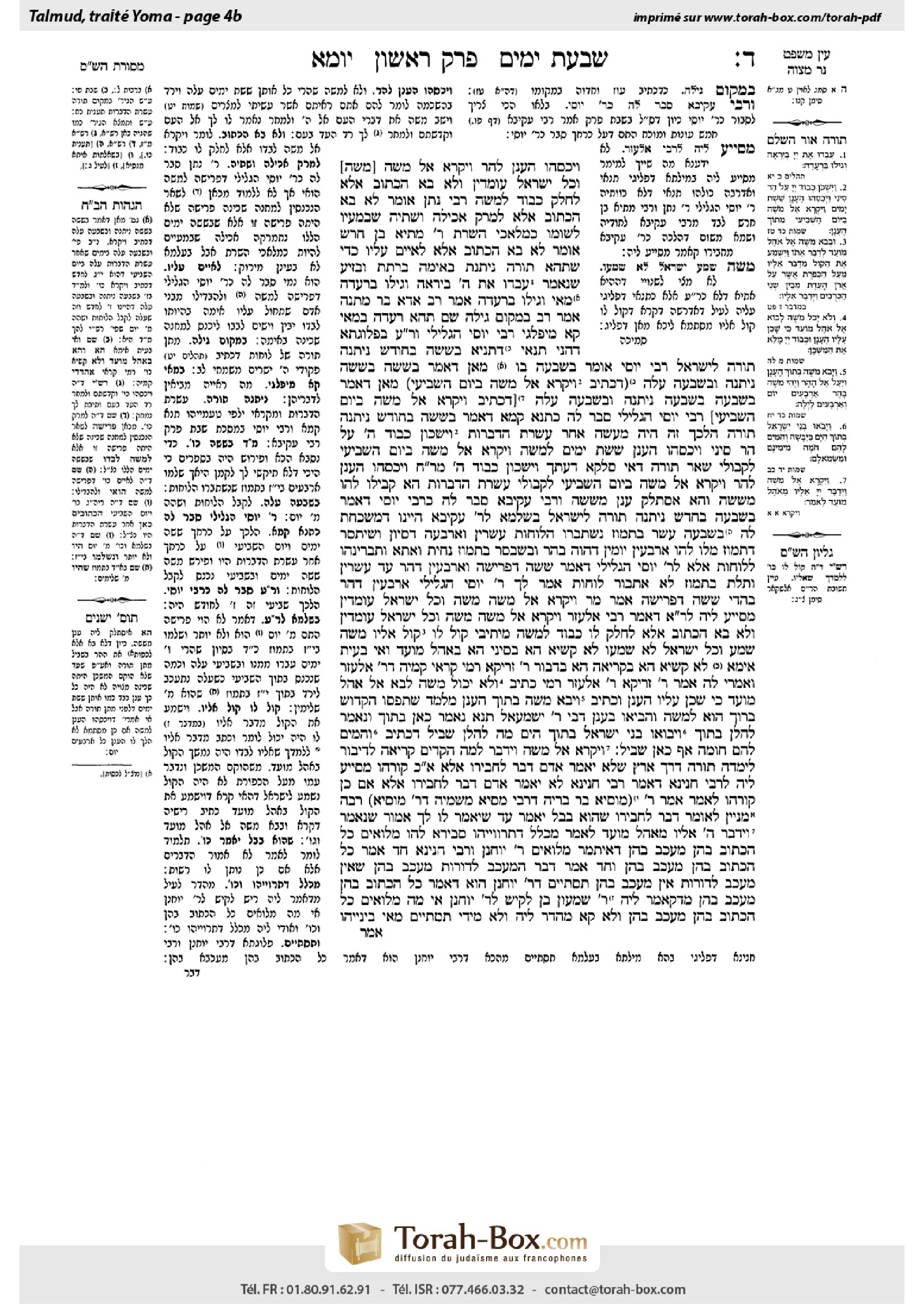
This page of Yoma includes the Aramaic text, an English translation and an AI-generated French translation, alongside the scan above.
יומא ד׳ ב · Aramaic and Hebrew text
״וַיְכַסֵּהוּ הֶעָנָן״, לָהָר. ״וַיִּקְרָא אֶל מֹשֶׁה״ — [מֹשֶׁה] וְכׇל יִשְׂרָאֵל עוֹמְדִין, וְלֹא בָּא הַכָּתוּב אֶלָּא לַחְלֹק כָּבוֹד לְמֹשֶׁה. רַבִּי נָתָן אוֹמֵר: לֹא בָּא הַכָּתוּב אֶלָּא לְמָרֵק אֲכִילָה וּשְׁתִיָּה שֶׁבְּמֵעָיו, לְשׂוּמוֹ כְּמַלְאֲכֵי הַשָּׁרֵת.
רַבִּי מַתְיָא בֶּן חָרָשׁ אוֹמֵר: לֹא בָּא הַכָּתוּב אֶלָּא לְאַיֵּים עָלָיו, כְּדֵי שֶׁתְּהֵא תּוֹרָה נִיתֶּנֶת בְּאֵימָה, בִּרְתֵת וּבְזִיעַ, שֶׁנֶּאֱמַר: ״עִבְדוּ אֶת ה׳ בְּיִרְאָה וְגִילוּ בִּרְעָדָה״. מַאי ״וְגִילוּ בִּרְעָדָה״? אָמַר רַב אַדָּא בַּר מַתְנָה אָמַר רַב: בִּמְקוֹם גִּילָה שָׁם תְּהֵא רְעָדָה.
בְּמַאי קָא מִיפַּלְגִי רַבִּי יוֹסֵי הַגְּלִילִי וְרַבִּי עֲקִיבָא? בִּפְלוּגְתָּא דְּהָנֵי תַּנָּאֵי, דְּתַנְיָא: בְּשִׁשָּׁה בַּחוֹדֶשׁ נִיתְּנָה תּוֹרָה לְיִשְׂרָאֵל, רַבִּי יוֹסֵי אוֹמֵר: בְּשִׁבְעָה בּוֹ. מַאן דְּאָמַר בְּשִׁשָּׁה: בְּשִׁשָּׁה נִיתְּנָה, וּבְשִׁבְעָה עָלָה (דִּכְתִיב: ״וַיִּקְרָא אֶל מֹשֶׁה בַּיּוֹם הַשְּׁבִיעִי״). מַאן דְּאָמַר בְּשִׁבְעָה: בְּשִׁבְעָה נִיתְּנָה, וּבְשִׁבְעָה עָלָה, [דִּכְתִיב: ״וַיִּקְרָא אֶל מֹשֶׁה בַּיּוֹם הַשְּׁבִיעִי״].
רַבִּי יוֹסֵי הַגְּלִילִי סָבַר לַהּ כְּתַנָּא קַמָּא, דְּאָמַר בְּשִׁשָּׁה בַּחוֹדֶשׁ נִיתְּנָה תּוֹרָה, הִלְכָּךְ זֶה הָיָה מַעֲשֶׂה אַחַר עֲשֶׂרֶת הַדִּבְּרוֹת. ״וַיִּשְׁכּוֹן כְּבוֹד ה׳ עַל הַר סִינַי וַיְכַסֵּהוּ הֶעָנָן שֵׁשֶׁת יָמִים״ — לְמֹשֶׁה, ״וַיִּקְרָא אֶל מֹשֶׁה בַּיּוֹם הַשְּׁבִיעִי״ — לְקַבּוֹלֵי שְׁאָר תּוֹרָה. דְּאִי סָלְקָא דַעְתָּךְ ״וַיִּשְׁכּוֹן כְּבוֹד ה׳״ מֵרֹאשׁ חוֹדֶשׁ, ״וַיְכַסֵּהוּ הֶעָנָן לָהָר וַיִּקְרָא אֶל מֹשֶׁה בַּיּוֹם הַשְּׁבִיעִי״ לְקַבּוֹלֵי עֲשֶׂרֶת הַדִּבְּרוֹת, הָא קַבִּילוּ לְהוּ מִשִּׁשָּׁה, וְהָא אִסְתַּלַּק עָנָן מִשִּׁשָּׁה!
וְרַבִּי עֲקִיבָא סָבַר לַהּ כְּרַבִּי יוֹסֵי, דְּאָמַר: בְּשִׁבְעָה בַּחֹדֶשׁ נִיתְּנָה תּוֹרָה לְיִשְׂרָאֵל. בִּשְׁלָמָא לְרַבִּי עֲקִיבָא, הַיְינוּ דְּמַשְׁכַּחַתְּ לַהּ בְּשִׁבְעָה עָשָׂר בְּתַמּוּז נִשְׁתַּבְּרוּ הַלּוּחוֹת: עֶשְׂרִין וְאַרְבְּעָה דְּסִיוָן, וְשִׁיתְּסַר דְּתַמּוּז, מָלוּ לְהוּ אַרְבְּעִין יוֹמִין דַּהֲוָה בָּהָר, וּבְשִׁבְסַר בְּתַמּוּז נְחֵית וַאֲתָא וְתַבְרִינְהוּ לְלוּחוֹת.
אֶלָּא לְרַבִּי יוֹסֵי הַגְּלִילִי, דְּאָמַר: שִׁשָּׁה דִפְרִישָׁה וְאַרְבְּעִין דְּהַר, עַד עֶשְׂרִין וּתְלָת בְּתַמּוּז לָא אִתַּבּוּר לוּחוֹת! אָמַר לְךָ רַבִּי יוֹסֵי הַגְּלִילִי: אַרְבְּעִין דְּהַר בַּהֲדֵי שִׁשָּׁה דִפְרִישָׁה.
אָמַר מָר: ״וַיִּקְרָא אֶל מֹשֶׁה״ — מֹשֶׁה וְכׇל יִשְׂרָאֵל עוֹמְדִין, מְסַיַּיע לֵיהּ לְרַבִּי אֶלְעָזָר. דְּאָמַר רַבִּי אֶלְעָזָר: ״וַיִּקְרָא אֶל מֹשֶׁה״ — מֹשֶׁה וְכׇל יִשְׂרָאֵל עוֹמְדִין, וְלֹא בָּא הַכָּתוּב אֶלָּא לַחְלֹק לוֹ כָּבוֹד לְמֹשֶׁה.
מֵיתִיבִי: ״קוֹל לוֹ״, ״קוֹל אֵלָיו״ — מֹשֶׁה שָׁמַע וְכׇל יִשְׂרָאֵל לֹא שָׁמְעוּ! לָא קַשְׁיָא: הָא — בְּסִינַי, הָא — בְּאֹהֶל מוֹעֵד. וְאִי בָּעֵית אֵימָא, לָא קַשְׁיָא: הָא — בִּקְרִיאָה, הָא — בְּדִבּוּר.
רַבִּי זְרִיקָא רָמֵי קְרָאֵי קַמֵּיהּ דְּרַבִּי אֶלְעָזָר, וְאָמְרִי לַהּ אָמַר רַבִּי זְרִיקָא: רַבִּי אֶלְעָזָר רָמֵי, כְּתִיב: ״וְלֹא יָכוֹל מֹשֶׁה לָבֹא אֶל אֹהֶל מוֹעֵד כִּי שָׁכַן עָלָיו הֶעָנָן״, וּכְתִיב: ״וַיָּבֹא מֹשֶׁה בְּתוֹךְ הֶעָנָן״! מְלַמֵּד שֶׁתְּפָסוֹ הַקָּדוֹשׁ בָּרוּךְ הוּא לְמֹשֶׁה וֶהֱבִיאוֹ בֶּעָנָן.
דְּבֵי רַבִּי יִשְׁמָעֵאל תָּנָא: נֶאֱמַר כָּאן ״בְּתוֹךְ״, וְנֶאֱמַר לְהַלָּן ״בְּתוֹךְ״ — ״וְיָבוֹאוּ בְנֵי יִשְׂרָאֵל בְּתוֹךְ הַיָּם״. מָה לְהַלָּן שְׁבִיל, דִּכְתִיב: ״וְהַמַּיִם לָהֶם חוֹמָה״, אַף כָּאן שְׁבִיל.
״וַיִּקְרָא אֶל מֹשֶׁה וַיְדַבֵּר״, לָמָּה הִקְדִּים קְרִיאָה לְדִיבּוּר? לִימְּדָה תּוֹרָה דֶּרֶךְ אֶרֶץ, שֶׁלֹּא יֹאמַר אָדָם דָּבָר לַחֲבֵירוֹ אֶלָּא אִם כֵּן קוֹרֵהוּ. מְסַיַּיע לֵיהּ לְרַבִּי חֲנִינָא. דְּאָמַר רַבִּי חֲנִינָא: לֹא יֹאמַר אָדָם דָּבָר לַחֲבֵירוֹ אֶלָּא אִם כֵּן קוֹרֵהוּ. ״לֵאמֹר״, אָמַר רַבִּי (מוּסְיָא בַּר בְּרֵיהּ דְּרַבִּי מַסְיָא מִשְּׁמֵיהּ דְּרַבִּי מוּסְיָא) רַבָּה: מִנַּיִין לָאוֹמֵר דָּבָר לַחֲבֵירוֹ שֶׁהוּא בְּבַל יֹאמַר עַד שֶׁיֹּאמַר לוֹ: לֵךְ אֱמוֹר — שֶׁנֶּאֱמַר: ״וַיְדַבֵּר ה׳ אֵלָיו מֵאֹהֶל מוֹעֵד לֵאמֹר״.
מִכְלָל דְּתַרְוַויְיהוּ סְבִירָא לְהוּ מִלּוּאִים כׇּל הַכָּתוּב בָּהֶן מְעַכֵּב בָּהֶן. דְּאִיתְּמַר: מִלּוּאִים, רַבִּי יוֹחָנָן וְרַבִּי חֲנִינָא, חַד אָמַר: כׇּל הַכָּתוּב בָּהֶן מְעַכֵּב בָּהֶן, וְחַד אָמַר: דָּבָר הַמְעַכֵּב לְדוֹרוֹת — מְעַכֵּב בָּהֶן, שֶׁאֵין מְעַכֵּב לְדוֹרוֹת — אֵין מְעַכֵּב בָּהֶן.
תִּסְתַּיֵּים דְּרַבִּי יוֹחָנָן הוּא דְּאָמַר כׇּל הַכָּתוּב בָּהֶן מְעַכֵּב בָּהֶן. מִדְּקָאָמַר לֵיהּ רַבִּי שִׁמְעוֹן בֶּן לָקִישׁ לְרַבִּי יוֹחָנָן: אִי מָה מִלּוּאִים כׇּל הַכָּתוּב בָּהֶן מְעַכֵּב בָּהֶן, וְלָא קָא מַהְדַּר לֵיהּ וְלָא מִידֵּי. תִּסְתַּיֵּים.
מַאי בֵּינַיְיהוּ?
Yoma 4b · English translation
And that which is written: “And the cloud covered him,” means the cloud covered it, the mountain, and not him, Moses. “And He called to Moses”; Moses and all of the Jewish people were standing at the foot of the mountain and listening, and if God did not mean that Moses was to climb the mountain, why did He call him? The verse comes only to accord deference to Moses, as the entire nation heard God address him. Rabbi Natan says: Moses was in fact called to enter the cloud; however, his entrance was not for the purpose of sequestering and purifying him, rather, the verse comes only to cleanse the food and drink that was in his intestines, to render him like the ministering angels who require neither food nor drink.
Rabbi Matya ben Ḥarash says: The verse calling Moses into the cloud comes only to intimidate Moses, to instill in him a sense of awe of the Creator, so that the Torah would be delivered with reverence, with quaking and with trembling, as it is stated: “Serve the Lord with awe, and rejoice with trembling” (Psalms 2:11). Apropos the end of the verse, the Gemara asks: What is the meaning of “and rejoice with trembling”? Joy and trembling seem contradictory. Rav Adda bar Mattana said that Rav said: Where there is the joy of fulfilling a mitzva, there will be the trembling of the awe of Heaven there.
§ Apropos the interpretation of the verse with regard to revelation, the Gemara asks: With regard to what do Rabbi Yosei HaGelili and Rabbi Akiva disagree? The Gemara explains that their dispute is parallel to the dispute between these other tanna’im, as it was taught in a baraita: On the sixth day of the month of Sivan, the Torah, the Ten Commandments, was given to the Jewish people. Rabbi Yosei says: It was on the seventh day of the month. According to the one who said that it was on the sixth, the Torah was given on the sixth, which is the day of the revelation of the Ten Commandments, and on the seventh day of the month Moses ascended the mountain, as it is written: “And He called to Moses on the seventh day” (Exodus 24:16). According to the one who said that the Torah was given on the seventh of the month, it was given on the seventh and Moses ascended on the seventh, as it is written: “And he called to Moses on the seventh day.”
The Gemara proceeds to link the two disputes. Rabbi Yosei HaGelili holds in accordance with the opinion of the first tanna in the baraita, who said that it was on the sixth of the month that the Torah was given; therefore, this incident occurred after the revelation of the Ten Commandments. That is why he explains the verse “And the glory of the Lord abode on Mount Sinai and the cloud covered him for six days” to mean that the cloud covered Moses, and He called to Moses on the seventh day to receive the rest of the Torah. As, should it enter your mind to interpret the verse as follows: “And the glory of the Lord abode” from the New Moon of Sivan; “And the cloud covered it,” the mountain; “And He called to Moses on the seventh day,” to receive only the Ten Commandments; didn’t they already receive the Ten Commandments on the sixth of the month, and the cloud that was on the mountain already departed on the sixth of the month?
And Rabbi Akiva holds in accordance with the opinion of Rabbi Yosei, who said that on the seventh of the month the Torah was given to the Jewish people. That is why Moses was summoned on the seventh of the month immediately after the revelation of the Ten Commandments. The Gemara asks: Granted, according to the opinion of Rabbi Akiva that the Torah was given on the seventh of Sivan and Moses then proceeded to climb the mountain and remain there for forty days, that explains the calculation that you find: On the seventeenth of Tammuz the tablets were shattered, according to the standard tradition. How so? Calculate twenty-four days until the end of Sivan and sixteen days of Tammuz; they total the forty days that he was on the mountain. On the seventeenth of Tammuz he descended from the mountain and came and shattered the tablets.
However, according to Rabbi Yosei HaGelili, who said: There were six days of sequestering after the Torah was given and an additional forty days that Moses was on the mountain, the tablets were not shattered until the twenty-third of Tammuz, contrary to the standard tradition. Rabbi Yosei HaGelili could have said to you: The forty days that Moses was on the mountain include the six days of sequestering.
§ The Master said in that baraita cited above that when the Torah says: “And He called to Moses,” it means that Moses and all of the Jewish people were standing and listening. The Gemara suggests that this supports the opinion of Rabbi Elazar, as Rabbi Elazar said that when the Torah says: “And He called to Moses,” it means that Moses and all of the Jewish people were standing and listening and the verse comes only to accord deference to Moses. From Rabbi Elazar’s statement it is clear that all of Israel heard the voice of God.
The Gemara raises an objection: The Torah states: “And when Moses went into the Tent of Meeting that He might speak with him, then he heard the voice speaking unto him from above the Ark cover that was upon the Ark of the Testimony, from between the two cherubs; and He spoke unto him” (Numbers 7:89). The Torah could have said: He heard the voice speaking to him; however, instead the verse said: He heard the voice speaking unto him, indicating that the voice reached him alone. Moses alone heard God’s voice and all of the Jewish people did not hear it. The Gemara answers: This is not difficult. This case, where everyone heard God’s voice, was at Sinai. That case, where Moses alone heard God’s voice, was at the Tent of Meeting. Or if you wish, say instead an alternative resolution. This is not difficult; when God addressed Moses by calling to him, everyone heard; that which God subsequently communicated by speaking, Moses alone heard.
Rabbi Zerika raised a contradiction between verses before Rabbi Elazar, and some say that Rabbi Zerika said that Rabbi Elazar raised a contradiction: It is written in one place: “And Moses was not able to enter into the Tent of Meeting because the cloud dwelt on it” (Exodus 40:35), as Moses was unable to enter the cloud. And it is written elsewhere: “And Moses came into the cloud” (Exodus 24:18). This teaches that the Holy One, Blessed be He, grabbed Moses and brought him into the cloud since he could not enter on his own.
The school of Rabbi Yishmael taught: There is a verbal analogy that resolves this contradiction. It is stated here: “And Moses came into the cloud,” and it is stated below, in another verse: “And the children of Israel went into the sea on dry land” (Exodus 14:22); Just as below, there was a path within the sea, as it is written: “And the water was a wall for them” (Exodus 14:22), here too, there was a path through the cloud, but Moses did not actually enter the cloud.
The verse says: “And He called unto Moses, and the Lord spoke unto him from within the Tent of Meeting, saying” (Leviticus 1:1). Why does the verse mention calling before speaking, and God did not speak to him at the outset? The Torah is teaching etiquette: A person should not say anything to another unless he calls him first. This supports the opinion of Rabbi Ḥanina, as Rabbi Ḥanina said: A person should not say anything to another unless he calls him first. With regard to the term concluding the verse: “Saying,” Rabbi Musya, grandson of Rabbi Masya, said in the name of Rabbi Musya the Great: From where is it derived with regard to one who tells another some matter, that it is incumbent upon the latter not to say it to others until the former explicitly says to him: Go and tell others? As it is stated: “And the Lord spoke to him from within the Tent of Meeting, saying [lemor].” Lemor is a contraction of lo emor, meaning: Do not say. One must be given permission before transmitting information.
§ After digressing to interpret the verses with regard to Mount Sinai, the Gemara resumes its discussion of the statements of Rabbi Yoḥanan and Reish Lakish. Based on the question Reish Lakish addressed to Rabbi Yoḥanan and the fact that Rabbi Yoḥanan accepted the premise of that question, we learn by inference that both maintain that with regard to the inauguration, failure to perform all the details that are written in its regard invalidates the inauguration. As it is stated: Rabbi Yoḥanan and Rabbi Ḥanina disagree. One said: Failure to perform all the details that are written in its regard invalidates the inauguration. And one said: A matter that invalidates offerings throughout the generations invalidates the inauguration; a matter that does not invalidate offerings throughout the generations does not invalidate the inauguration.
Conclude that Rabbi Yoḥanan is the one who said: Failure to perform all the details that are written in its regard invalidates the inauguration. This may be concluded from the fact that Rabbi Shimon ben Lakish says to Rabbi Yoḥanan: Just as with regard to the inauguration, failure to perform all the details that are written in its regard invalidates the inauguration, so too is the halakha with regard to Yom Kippur, and Rabbi Yoḥanan did not respond and did not say anything, indicating that he agreed. The Gemara states: Conclude that this indeed is the opinion of Rabbi Yoḥanan.
The Gemara asks: What is the practical halakhic difference between the opinions of Rabbi Yoḥanan and Rabbi Ḥanina?
Yoma 4b · Traduction française (IA)
Et ce qui est écrit : « Et la nuée le couvrit » signifie que la nuée couvrit la montagne, et non Moïse. « Et Il appela Moïse » : Moïse et tout le peuple juif se tenaient au pied de la montagne et écoutaient. Si Dieu ne voulait pas que Moïse monte sur la montagne, pourquoi l’appela-t-Il ? Le verset vient seulement témoigner de la considération envers Moïse, puisque toute la nation entendit Dieu s’adresser à lui. Rabbi Natan dit : Moïse fut effectivement appelé à entrer dans la nuée ; cependant, il n’y entra pas pour être mis à l’écart et purifié. Le verset vient seulement purifier les aliments et les boissons qui se trouvaient dans ses intestins, afin de le rendre semblable aux anges du Service, qui n’ont besoin ni de nourriture ni de boisson.
Rabbi Matya ben Ḥarash dit : Le verset qui appelle Moïse dans la nuée vient seulement l’intimider et lui inspirer la crainte du Créateur, afin que la Torah soit transmise avec révérence, frayeur et tremblement, comme il est dit : « Servez le Seigneur avec crainte, et réjouissez-vous avec tremblement » (Psaumes 2:11). À propos de la fin du verset, la Guemara demande : Que signifie « et réjouissez-vous avec tremblement » ? La joie et le tremblement semblent contradictoires. Rav Adda bar Mattana a dit au nom de Rav : Là où se trouve la joie d’accomplir une mitsva, s’y trouve aussi le tremblement inspiré par la crainte du Ciel.
§ À propos de l’interprétation du verset concernant la révélation, la Guemara demande : Sur quoi Rabbi Yosei HaGelili et Rabbi Akiva sont-ils en désaccord ? La Guemara explique que leur désaccord est parallèle à celui de ces autres tannaïm, comme il a été enseigné dans une baraïta : La Torah, c’est-à-dire les Dix Commandements, fut donnée au peuple juif le sixième jour du mois de Sivan. Rabbi Yosei dit : C’était le septième jour du mois. Selon celui qui dit que c’était le sixième, la Torah fut donnée le sixième, jour de la révélation des Dix Commandements, et Moïse monta sur la montagne le septième jour du mois, comme il est écrit : « Et Il appela Moïse le septième jour » (Exode 24:16). Selon celui qui dit que la Torah fut donnée le septième jour du mois, elle fut donnée le septième et Moïse monta sur la montagne le même jour, comme il est écrit : « Et Il appela Moïse le septième jour. »
La Guemara établit ensuite un lien entre les deux désaccords. Rabbi Yosei HaGelili suit l’opinion du premier tanna de la baraïta, qui a dit que la Torah fut donnée le sixième jour du mois ; cet épisode eut donc lieu après la révélation des Dix Commandements. C’est pourquoi il explique que le verset « Et la gloire du Seigneur demeura sur le mont Sinaï et la nuée le couvrit pendant six jours » signifie que la nuée couvrit Moïse, et qu’Il appela Moïse le septième jour pour recevoir le reste de la Torah. Car, si l’on envisageait d’interpréter le verset ainsi : « Et la gloire du Seigneur demeura » depuis la nouvelle lune de Sivan ; « Et la nuée la couvrit », c’est-à-dire la montagne ; « Et Il appela Moïse le septième jour », afin qu’il reçoive seulement les Dix Commandements, ne les avait-on pas déjà reçus le sixième jour du mois ? Et la nuée qui se trouvait sur la montagne ne s’était-elle pas déjà dissipée le sixième jour du mois ?
Rabbi Akiva, lui, suit l’opinion de Rabbi Yosei, qui a dit que la Torah fut donnée au peuple juif le septième jour du mois. C’est pourquoi Moïse fut convoqué le septième jour du mois, immédiatement après la révélation des Dix Commandements. La Guemara demande : Il est compréhensible que, selon l’opinion de Rabbi Akiva, la Torah fut donnée le septième jour de Sivan et que Moïse monta ensuite sur la montagne pour y rester quarante jours : cela explique le calcul qui aboutit au bris des Tables le dix-sept Tammouz, conformément à la tradition courante. Comment ? Comptez vingt-quatre jours jusqu’à la fin de Sivan et seize jours de Tammouz ; ils totalisent les quarante jours qu’il passa sur la montagne. Le dix-sept Tammouz, il descendit de la montagne et vint briser les Tables.
Cependant, selon Rabbi Yosei HaGelili, qui a dit qu’il y eut six jours de mise à l’écart après le don de la Torah, puis quarante jours supplémentaires pendant lesquels Moïse se trouvait sur la montagne, les Tables ne furent brisées que le vingt-trois Tammouz, contrairement à la tradition courante. Rabbi Yosei HaGelili aurait pu te répondre : les quarante jours que Moïse passa sur la montagne comprennent les six jours de mise à l’écart.
§ Le Maître a dit, dans la baraïta citée plus haut, que lorsque la Torah dit : « Et Il appela Moïse », cela signifie que Moïse et tout le peuple juif se tenaient là et écoutaient. La Guemara suggère que cela appuie l’opinion de Rabbi Elazar, car Rabbi Elazar a dit que lorsque la Torah dit : « Et Il appela Moïse », cela signifie que Moïse et tout le peuple juif se tenaient là et écoutaient, et que le verset vient seulement témoigner de la considération envers Moïse. La déclaration de Rabbi Elazar montre clairement que tout Israël entendit la voix de Dieu.
La Guemara soulève une objection : La Torah dit : « Lorsque Moïse entrait dans la Tente d’assignation pour qu’Il lui parle, il entendait la voix qui s’adressait à lui depuis le dessus du propitiatoire placé sur l’Arche du Témoignage, d’entre les deux chérubins ; et Il lui parlait » (Nombres 7:89). La Torah aurait pu dire : « Il entendait la voix qui lui parlait » ; pourtant, le verset dit : « Il entendait la voix qui s’adressait à lui », ce qui indique que la voix ne lui parvenait qu’à lui seul. Moïse seul entendait la voix de Dieu, et tout le peuple juif ne l’entendait pas. La Guemara répond : Il n’y a pas de difficulté. Le cas où tous entendirent la voix de Dieu se déroula au Sinaï. L’autre cas, où Moïse seul entendit la voix de Dieu, se déroula dans la Tente d’assignation. Ou bien, si tu préfères, voici une autre résolution : il n’y a pas de difficulté ; lorsque Dieu appela Moïse pour s’adresser à lui, tous entendirent ; mais ce que Dieu lui communiqua ensuite en parlant, Moïse seul l’entendit.
Rabbi Zerika a relevé une contradiction entre des versets devant Rabbi Elazar ; certains disent que Rabbi Zerika a dit que Rabbi Elazar avait relevé une contradiction : il est écrit à un endroit : « Et Moïse ne put entrer dans la Tente d’assignation, parce que la nuée reposait sur elle » (Exode 40:35), ce qui signifie que Moïse ne pouvait pas entrer dans la nuée. Et il est écrit ailleurs : « Et Moïse entra dans la nuée » (Exode 24:18). Cela enseigne que le Saint, béni soit-Il, saisit Moïse et le fit entrer dans la nuée, puisqu’il ne pouvait y entrer de lui-même.
L’école de Rabbi Yishmael enseigna : Une analogie verbale permet de résoudre cette contradiction. Il est dit ici : « Et Moïse entra dans la nuée », et il est dit plus loin, dans un autre verset : « Et les enfants d’Israël entrèrent dans la mer à pied sec » (Exode 14:22). De même que, dans ce dernier cas, il y avait un chemin au milieu de la mer, comme il est écrit : « Et l’eau était pour eux comme une muraille » (Exode 14:22), de même ici, il y avait un chemin à travers la nuée ; Moïse n’entra toutefois pas réellement dans la nuée.
Le verset dit : « Il appela Moïse, et le Seigneur lui parla depuis la Tente d’assignation, en disant » (Lévitique 1:1). Pourquoi le verset mentionne-t-il l’appel avant la parole ? Dieu ne lui parla-t-Il pas dès le début ? La Torah enseigne ici les règles de savoir-vivre : une personne ne doit rien dire à une autre sans l’avoir d’abord appelée. Cela appuie l’opinion de Rabbi Ḥanina, car Rabbi Ḥanina a dit : une personne ne doit rien dire à une autre sans l’avoir d’abord appelée. Concernant le terme qui conclut le verset, « en disant », Rabbi Musya, petit-fils de Rabbi Masya, a dit au nom de Rabbi Musya le Grand : D’où déduit-on que celui qui confie une information à autrui est tenu de ne pas la répéter à d’autres tant que le premier ne lui a pas explicitement dit : « Va le dire aux autres » ? Comme il est écrit : « Et le Seigneur lui parla depuis la Tente d’assignation, en disant [lemor]. » Lemor est une contraction de lo emor, qui signifie : « Ne dis pas. » Il faut recevoir l’autorisation avant de transmettre une information.
§ Après cette digression consacrée à l’interprétation des versets concernant le mont Sinaï, la Guemara reprend l’examen des déclarations de Rabbi Yoḥanan et de Reish Lakish. À partir de la question que Reish Lakish posa à Rabbi Yoḥanan et du fait que Rabbi Yoḥanan accepta la prémisse de cette question, nous déduisons que tous deux soutiennent que, pour l’inauguration, le fait de ne pas accomplir tous les détails prescrits à son sujet invalide l’inauguration. En effet, il est rapporté que Rabbi Yoḥanan et Rabbi Ḥanina sont en désaccord. L’un dit : Le fait de ne pas accomplir tous les détails prescrits à son sujet invalide l’inauguration. L’autre dit : Un élément dont l’omission invalide les offrandes à toutes les générations invalide l’inauguration ; un élément dont l’omission n’invalide pas les offrandes à toutes les générations n’invalide pas l’inauguration.
Concluez que Rabbi Yoḥanan est celui qui a dit que le fait de ne pas accomplir tous les détails prescrits à son sujet invalide l’inauguration. On peut le conclure du fait que Rabbi Shimon ben Lakish dit à Rabbi Yoḥanan : De même que, pour l’inauguration, le fait de ne pas accomplir tous les détails prescrits à son sujet invalide l’inauguration, de même en va-t-il de la halakha concernant Yom Kippour. Rabbi Yoḥanan ne répondit pas et ne dit rien, ce qui indique qu’il était d’accord. La Guemara affirme : Concluez que telle est bien l’opinion de Rabbi Yoḥanan.
La Guemara demande : Quelle différence pratique, du point de vue de la halakha, y a-t-il entre les opinions de Rabbi Yoḥanan et de Rabbi Ḥanina ?
Traduction française générée par IA à partir de l’édition anglaise de Sefaria. Vérifie toujours un passage avec le texte source.
Text from Sefaria: William Davidson Edition - Vocalized Aramaic (CC BY NC); William Davidson Edition - English (CC BY NC).