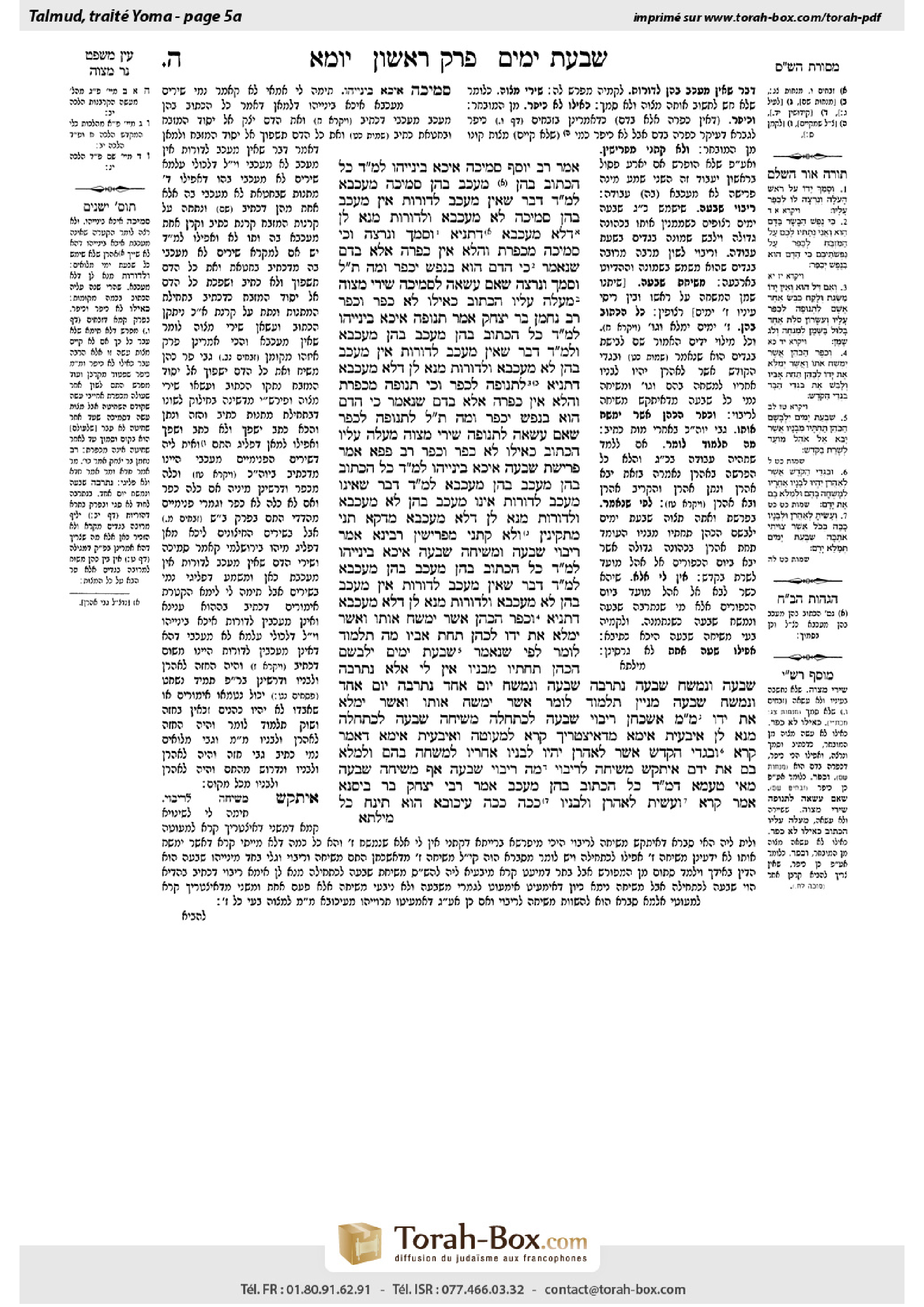
Yoma 5a: Talmud study for Daf Yomi
Daf Yomi is the daily study of one Talmud folio. Explore 37 tractates with scans, Hebrew text, Sefaria English and AI-generated French translations where annotated.
Passage selection and English or AI-generated French translation are available where the scan has annotations. Daf Study is independent of Torah-Box and Sefaria.
Browse Yoma · יומא · All tractatesYoma 5a text and translations
This page of Yoma includes the Aramaic text, an English translation and an AI-generated French translation, alongside the scan above.
יומא ה׳ א · Aramaic and Hebrew text
אָמַר רַב יוֹסֵף: סְמִיכָה אִיכָּא בֵּינַיְיהוּ. לְמַאן דְּאָמַר כׇּל הַכָּתוּב בָּהֶן מְעַכֵּב בָּהֶן — סְמִיכָה מְעַכְּבָא, לְמַאן דְּאָמַר דָּבָר שֶׁאֵין מְעַכֵּב לְדוֹרוֹת אֵין מְעַכֵּב בָּהֶן — סְמִיכָה לָא מְעַכְּבָא.
וּלְדוֹרוֹת מְנָא לַן דְּלָא מְעַכְּבָא? דְּתַנְיָא: ״וְסָמַךְ״ ״וְנִרְצָה״. וְכִי סְמִיכָה מְכַפֶּרֶת? וַהֲלֹא אֵין כַּפָּרָה אֶלָּא בְּדָם, שֶׁנֶּאֱמַר: ״כִּי הַדָּם הוּא בַּנֶּפֶשׁ יְכַפֵּר״!
וּמָה תַּלְמוּד לוֹמַר ״וְסָמַךְ״ ״וְנִרְצָה״? שֶׁאִם עֲשָׂאָהּ לִסְמִיכָה שְׁיָרֵי מִצְוָה — מַעֲלֶה עָלָיו הַכָּתוּב כְּאִילּוּ לֹא כִּפֵּר, וְכִפֵּר!
רַב נַחְמָן בַּר יִצְחָק אָמַר: תְּנוּפָה אִיכָּא בֵּינַיְיהוּ. לְמַאן דְּאָמַר כׇּל הַכָּתוּב בָּהֶן מְעַכֵּב בָּהֶן — מְעַכְּבָא. וּלְמַאן דְּאָמַר דָּבָר שֶׁאֵין מְעַכֵּב לְדוֹרוֹת אֵין מְעַכֵּב בָּהֶן — לָא מְעַכְּבָא.
וּלְדוֹרוֹת מְנָא לַן דְּלָא מְעַכְּבָא? דְּתַנְיָא: ״לִתְנוּפָה לְכַפֵּר״. וְכִי תְּנוּפָה מְכַפֶּרֶת? וַהֲלֹא אֵין כַּפָּרָה אֶלָּא בְּדָם, שֶׁנֶּאֱמַר: ״כִּי הַדָּם הוּא בַּנֶּפֶשׁ יְכַפֵּר״! וּמָה תַּלְמוּד לוֹמַר ״לִתְנוּפָה לְכַפֵּר״? שֶׁאִם עֲשָׂאָהּ לִתְנוּפָה שְׁיָרֵי מִצְוָה — מַעֲלֶה עָלָיו הַכָּתוּב כְּאִילּוּ לֹא כִּפֵּר, וְכִפֵּר.
רַב פָּפָּא אָמַר: פְּרִישַׁת שִׁבְעָה אִיכָּא בֵּינַיְיהוּ. לְמַאן דְּאָמַר כׇּל הַכָּתוּב בָּהֶן מְעַכֵּב בָּהֶן — מְעַכְּבָא. לְמַאן דְּאָמַר דָּבָר שֶׁאֵינוֹ מְעַכֵּב לְדוֹרוֹת אֵינוֹ מְעַכֵּב בָּהֶן — לָא מְעַכְּבָא.
וּלְדוֹרוֹת מְנָא לַן דְּלָא מְעַכְּבָא? מִדְּקָא תָנֵי ״מַתְקִינִין״, וְלָא קָתָנֵי ״מַפְרִישִׁין״.
רָבִינָא אָמַר: רִיבּוּי שִׁבְעָה וּמְשִׁיחָה שִׁבְעָה, אִיכָּא בֵּינַיְיהוּ. לְמַאן דְּאָמַר כׇּל הַכָּתוּב בָּהֶן מְעַכֵּב בָּהֶן — מְעַכְּבָא. לְמַאן דְּאָמַר דָּבָר שֶׁאֵין מְעַכֵּב לְדוֹרוֹת אֵין מְעַכֵּב בָּהֶן — לָא מְעַכְּבָא.
וּלְדוֹרוֹת מְנָא לַן דְּלָא מְעַכְּבָא? דְּתַנְיָא: ״וְכִפֵּר הַכֹּהֵן אֲשֶׁר יִמְשַׁח אוֹתוֹ וַאֲשֶׁר יְמַלֵּא אֶת יָדוֹ לְכַהֵן תַּחַת אָבִיו״, מָה תַּלְמוּד לוֹמַר?
לְפִי שֶׁנֶּאֱמַר: ״שִׁבְעַת יָמִים יִלְבָּשָׁם הַכֹּהֵן תַּחְתָּיו מִבָּנָיו״, אֵין לִי אֶלָּא נִתְרַבָּה שִׁבְעָה וְנִמְשַׁח שִׁבְעָה. נִתְרַבָּה שִׁבְעָה וְנִמְשַׁח יוֹם אֶחָד, נִתְרַבָּה יוֹם אֶחָד וְנִמְשַׁח שִׁבְעָה מִנַּיִין? תַּלְמוּד לוֹמַר: ״אֲשֶׁר יִמְשַׁח אוֹתוֹ וַאֲשֶׁר יְמַלֵּא אֶת יָדוֹ״ — מִכׇּל מָקוֹם.
אַשְׁכְּחַן רִיבּוּי שִׁבְעָה לְכַתְּחִלָּה, מְשִׁיחָה שִׁבְעָה לְכַתְּחִלָּה מְנָא לַן?
אִיבָּעֵית אֵימָא מִדְּאִיצְטְרִיךְ קְרָא לְמַעוֹטַהּ. וְאִיבָּעֵית אֵימָא דְּאָמַר קְרָא: ״וּבִגְדֵי הַקֹּדֶשׁ אֲשֶׁר לְאַהֲרֹן יִהְיוּ לְבָנָיו אַחֲרָיו לְמׇשְׁחָה בָהֶם וּלְמַלֵּא בָם אֶת יָדָם״, אִיתַּקַּשׁ מְשִׁיחָה לְרִיבּוּי: מָה רִיבּוּי שִׁבְעָה, אַף מְשִׁיחָה שִׁבְעָה.
מַאי טַעְמָא דְּמַאן דְּאָמַר כׇּל הַכָּתוּב בָּהֶן מְעַכֵּב? אָמַר רַבִּי יִצְחָק בַּר בִּיסְנָא, אָמַר קְרָא: ״וְעָשִׂיתָ לְאַהֲרֹן וּלְבָנָיו כָּכָה״. ״כָּכָה״ עִיכּוּבָא הוּא. תִּינַח כֹּל
Yoma 5a · English translation
Rav Yosef said: The practical difference between them relates to the question of placing hands on the head of an animal brought as an offering. According to the one who said: Failure to perform all the details that are written in its regard, including details that do not invalidate offerings throughout the generations, invalidates the inauguration, failure to perform the placing of hands on the head of the animal also invalidates the inauguration. According to the one who said: A matter that does not invalidate offerings throughout the generations does not invalidate the inauguration, failure to perform the placing of hands on the head of the animal does not invalidate the inauguration.
And with regard to the halakhot of offerings that apply throughout the generations the Gemara asks: From where do we derive that failure to place hands on the head of the animal does not invalidate the offering? The Gemara answers: As it was taught in a baraita that the verse states: “And he shall place his hand on the head of the burnt-offering, and it shall be accepted for him to atone on his behalf” (Leviticus 1:4). Does the placing of hands atone for one’s sins? Isn’t atonement accomplished only by the sprinkling of the blood, as it is stated: “For it is the blood that makes atonement by reason of the life” (Leviticus 17:11)?
And for what purpose, then, does the verse state: “And he shall place…and it shall be accepted”? It teaches that if one deemed the ritual of placing hands to be a peripheral aspect of the mitzva and consequently failed to perform it, the verse ascribes to him status as though he did not achieve optimal atonement; and nevertheless, the offering atones for his sins. Apparently, failure to lay hands on the head of the offering does not invalidate the offering throughout the generations, as atonement can be achieved without it. Nevertheless, according to the opinion of Rabbi Yoḥanan, failure to lay hands on the offering invalidates the offerings brought during the inauguration.
Rav Naḥman bar Yitzḥak said: The issue of waving the offering is the practical difference between the opinions of Rabbi Yoḥanan and Rabbi Ḥanina. According to the one who said: Failure to perform all the details that are written in its regard invalidates the inauguration, failure to wave the offering also invalidates the inauguration. And according to the one who said: A matter that does not invalidate offerings throughout the generations does not invalidate the inauguration, failure to wave the offering does not invalidate the inauguration.
And with regard to the halakhot of offerings throughout the generations, the Gemara asks: From where do we derive that failure to wave the offering does not invalidate the offering? The Gemara answers: As it was taught in a baraita that the verse says: “He shall take one male lamb as a guilt-offering to be waved to make atonement for him” (Leviticus 14:21). Does waving the offering atone for one’s sins? Isn’t atonement accomplished only by the sprinkling of the blood, as it is stated: “For it is the blood that makes atonement by reason of the life” (Leviticus 17:11)? And for what purpose, then, does the verse state: To be waved to make atonement? It teaches that if one deemed the ritual of waving to be a peripheral aspect of the mitzva and therefore failed to perform it, the verse ascribes to him status as though he did not achieve optimal atonement; and nevertheless, the offering atones for his sins on his behalf.
Rav Pappa said: The issue of sequestering the priest for seven days is the practical difference between the opinions of Rabbi Yoḥanan and Rabbi Ḥanina. According to the one who said: Failure to perform all the details that are written in its regard invalidates the inauguration, failure to sequester the priest for seven days also invalidates the inauguration. And according to the one who said: A matter that does not invalidate offerings throughout the generations does not invalidate the inauguration, failure to sequester the priest for seven days does not invalidate the inauguration.
And with regard to the halakhot of offerings throughout the generations, the Gemara asks: From where do we derive that failure to sequester the priest for seven days does not invalidate the offering? The Gemara answers: It is derived from the fact that it is taught in the mishna: And they would designate another priest in his stead, and it is not taught: The Sages remove the designated priest from his house, despite the possibility that ultimately he might replace the High Priest and perform the Yom Kippur service. Apparently, sequestering is not essential.
Ravina said: The issue of the priest performing the service with the multiple garments of the High Priest for seven days and serving with anointment for seven days is the practical difference between the opinions of Rabbi Yoḥanan and Rabbi Ḥanina. According to the one who said: Failure to perform all the details that are written in its regard invalidates the inauguration, failure to serve with multiple garments and anointment for seven days also invalidates the inauguration. And according to the one who said: A matter that does not invalidate offerings throughout the generations does not invalidate the inauguration, failure to serve with multiple garments and anointment for seven days does not invalidate the inauguration.
And with regard to the halakhot of offerings throughout the generations, the Gemara asks: From where do we derive that failure to serve with multiple garments and anointment for seven days does not invalidate the offering? The Gemara answers: As it was taught in a baraita: For what purpose does the verse state: “And the priest who shall be anointed and who shall be consecrated to serve in his father’s stead shall make the atonement” (Leviticus 16:32)? If it comes to teach that all service must be performed by the High Priest, it is already written with regard to the Yom Kippur service that it must be performed by Aaron, the High Priest.
Since it is stated: “Seven days shall the son that is priest in his stead don them” (Exodus 29:30), I derive only that one who donned the multiple garments of the High Priest for seven days and was anointed seven days assumes the position of High Priest and may perform the service on Yom Kippur. However, with regard to whether one who donned the multiple garments for seven days and was anointed for one day, or one who donned the multiple garments for one day and was anointed for seven days is thereby inaugurated as High Priest, from where are those cases derived? Therefore, the verse states: “Who shall be anointed and who shall be consecrated”; in any case he is appointed High Priest, even if either anointment or donning the garments did not continue for seven days.
The Gemara asks: We found a source for the fact that when the High Priest is appointed, there is a requirement of donning multiple garments for seven days ab initio; however, from where do we derive the requirement of anointment for seven days ab initio? According to Ravina, there is a requirement to anoint the priest on each of the seven days ab initio, even though failure to do so does not invalidate the offering throughout the generations. From where is that requirement derived?
If you wish, say: It is derived from the fact that the verse: “And the priest who shall be anointed and who shall be consecrated to serve in his father’s stead shall make the atonement,” is necessary to exclude requirements derived from other sources, i.e., that both donning multiple garments and anointment must be for seven days. Apparently, anointment for seven days is required ab initio. And if you wish, say instead that it is derived from that which the verse states: “And the sacred garments of Aaron shall be for his sons after him, to be anointed in them and to be consecrated in them” (Exodus 29:29). Anointment is juxtaposed in this verse to donning multiple garments: Just as donning multiple garments is required for seven days ab initio, so too, anointment is required for seven days ab initio.
§ After ascertaining the halakhic distinctions between the opinions of Rabbi Yoḥanan and Rabbi Ḥanina with regard to the inauguration, the Gemara proceeds to analyze the rationales for those opinions. What is the reason for the opinion of the one who said: Failure to perform all the details that are written in its regard invalidates the inauguration? Rabbi Yitzḥak bar Bisna said that the verse states: “And so shall you do to Aaron and to his sons according to all that I have commanded you, seven days shall you consecrate them” (Exodus 29:35). The term: So, teaches that failure to perform the ritual precisely in this manner invalidates the inauguration. The Gemara asks: That works out well as a source that all
Yoma 5a · Traduction française (IA)
Rav Yosef dit : La différence pratique entre eux concerne l’imposition des mains sur la tête de l’animal offert en sacrifice. Selon celui qui affirme que l’omission de tous les détails prescrits à son sujet, y compris ceux dont l’omission n’invalide pas les offrandes au fil des générations, invalide l’inauguration, l’omission de l’imposition des mains sur la tête de l’animal invalide également l’inauguration. Selon celui qui affirme qu’un élément dont l’omission n’invalide pas les offrandes au fil des générations n’invalide pas l’inauguration, l’omission de l’imposition des mains sur la tête de l’animal n’invalide pas l’inauguration.
Et concernant les halakhot des offrandes applicables au fil des générations, la Guemara demande : D’où déduit-on que l’omission de l’imposition des mains sur la tête de l’animal n’invalide pas l’offrande ? La Guemara répond : Comme il a été enseigné dans une baraïta, le verset dit : « Il posera sa main sur la tête de l’holocauste, et celui-ci sera agréé pour lui afin de faire expiation pour lui » (Lévitique 1:4). L’imposition des mains expie-t-elle les péchés ? L’expiation ne s’accomplit-elle pas uniquement par l’aspersion du sang, comme il est dit : « Car c’est le sang qui fait expiation par la vie » (Lévitique 17:11) ?
Dans quel but, alors, le verset dit-il : « Il posera… et celui-ci sera agréé » ? Il enseigne que si quelqu’un considérait le rite de l’imposition des mains comme un aspect secondaire de la mitsva et omettait par conséquent de l’accomplir, le verset lui attribue le statut de quelqu’un qui n’a pas obtenu une expiation optimale ; néanmoins, l’offrande expie ses péchés. Il apparaît donc que l’omission de l’imposition des mains sur la tête de l’offrande n’invalide pas celle-ci au fil des générations, puisque l’expiation peut être obtenue sans ce rite. Néanmoins, selon l’opinion de Rabbi Yoḥanan, l’omission de l’imposition des mains sur l’offrande invalide les offrandes apportées lors de l’inauguration.
Rav Naḥman bar Yitzḥak dit : La question de l’ondoiement de l’offrande constitue la différence pratique entre les opinions de Rabbi Yoḥanan et de Rabbi Ḥanina. Selon celui qui affirme que l’omission de tous les détails prescrits à son sujet invalide l’inauguration, l’omission de l’ondoiement de l’offrande invalide également l’inauguration. Et selon celui qui affirme qu’un élément dont l’omission n’invalide pas les offrandes au fil des générations n’invalide pas l’inauguration, l’omission de l’ondoiement de l’offrande n’invalide pas l’inauguration.
Et concernant les halakhot des offrandes applicables au fil des générations, la Guemara demande : D’où déduit-on que l’omission de l’ondoiement n’invalide pas l’offrande ? La Guemara répond : Comme il a été enseigné dans une baraïta, le verset dit : « Il prendra un agneau mâle comme sacrifice de culpabilité, pour qu’il soit agité afin de faire expiation pour lui » (Lévitique 14:21). L’ondoiement de l’offrande expie-t-il les péchés ? L’expiation ne s’accomplit-elle pas uniquement par l’aspersion du sang, comme il est dit : « Car c’est le sang qui fait expiation par la vie » (Lévitique 17:11) ? Dans quel but, alors, le verset dit-il : « Pour qu’il soit agité afin de faire expiation » ? Il enseigne que si quelqu’un considérait le rite de l’ondoiement comme un aspect secondaire de la mitsva et omettait par conséquent de l’accomplir, le verset lui attribue le statut de quelqu’un qui n’a pas obtenu une expiation optimale ; néanmoins, l’offrande expie ses péchés en sa faveur.
Rav Pappa dit : La question de la mise à l’écart du prêtre pendant sept jours constitue la différence pratique entre les opinions de Rabbi Yoḥanan et de Rabbi Ḥanina. Selon celui qui affirme que l’omission de tous les détails prescrits à son sujet invalide l’inauguration, l’omission de la mise à l’écart du prêtre pendant sept jours invalide également l’inauguration. Et selon celui qui affirme qu’un élément dont l’omission n’invalide pas les offrandes au fil des générations n’invalide pas l’inauguration, l’omission de la mise à l’écart du prêtre pendant sept jours n’invalide pas l’inauguration.
Et concernant les halakhot des offrandes applicables au fil des générations, la Guemara demande : D’où déduit-on que l’omission de la mise à l’écart du prêtre pendant sept jours n’invalide pas l’offrande ? La Guemara répond : On le déduit du fait que la Michna enseigne : « Et ils désignaient un autre prêtre à sa place », et non : « Les Sages retirent le prêtre désigné de sa maison », bien qu’il soit possible qu’il remplace finalement le grand prêtre et accomplisse le service de Yom Kippour. Il apparaît donc que la mise à l’écart n’est pas indispensable.
Ravina dit : La question de savoir si le prêtre a accompli le service pendant sept jours en portant les vêtements supplémentaires du grand prêtre et a été oint pendant sept jours constitue la différence pratique entre les opinions de Rabbi Yoḥanan et de Rabbi Ḥanina. Selon celui qui affirme que l’omission de tous les détails prescrits à son sujet invalide l’inauguration, l’omission du service en vêtements supplémentaires et de l’onction pendant sept jours invalide également l’inauguration. Et selon celui qui affirme qu’un élément dont l’omission n’invalide pas les offrandes au fil des générations n’invalide pas l’inauguration, l’omission du service en vêtements supplémentaires et de l’onction pendant sept jours n’invalide pas l’inauguration.
Et concernant les halakhot des offrandes applicables au fil des générations, la Guemara demande : D’où déduit-on que l’omission du service en vêtements supplémentaires et de l’onction pendant sept jours n’invalide pas l’offrande ? La Guemara répond : Comme il a été enseigné dans une baraïta : Dans quel but le verset dit-il : « Le prêtre qui aura été oint et consacré pour officier à la place de son père fera l’expiation » (Lévitique 16:32) ? S’il s’agit d’enseigner que tout le service doit être accompli par le grand prêtre, il est déjà écrit, au sujet du service de Yom Kippour, qu’il doit être accompli par Aaron, le grand prêtre.
Puisqu’il est dit : « Le fils qui est prêtre à sa place les portera pendant sept jours » (Exode 29:30), j’en déduis seulement que celui qui a porté les vêtements supplémentaires du grand prêtre pendant sept jours et a été oint pendant sept jours accède à la fonction de grand prêtre et peut accomplir le service de Yom Kippour. Mais d’où déduit-on que celui qui a porté les vêtements supplémentaires pendant sept jours et a été oint un jour, ou celui qui a porté les vêtements supplémentaires un jour et a été oint pendant sept jours, est ainsi consacré comme grand prêtre ? Le verset dit donc : « Qui aura été oint et consacré » ; dans tous les cas, il est nommé grand prêtre, même si l’onction ou le port des vêtements n’a pas duré sept jours.
La Guemara demande : Nous avons trouvé une source établissant que, lors de la nomination du grand prêtre, le port des vêtements supplémentaires pendant sept jours est requis a priori ; mais d’où déduit-on que l’onction pendant sept jours est requise a priori ? Selon Ravina, le prêtre doit être oint chacun des sept jours a priori, même si l’omission de cette pratique n’invalide pas l’offrande au fil des générations. D’où déduit-on cette exigence ?
Si tu le souhaites, dis : On le déduit du fait que le verset « Le prêtre qui aura été oint et consacré pour officier à la place de son père fera l’expiation » est nécessaire pour exclure des exigences déduites d’autres sources, à savoir que le port des vêtements supplémentaires et l’onction doivent tous deux durer sept jours. Il apparaît donc que l’onction pendant sept jours est requise a priori. Et si tu le souhaites, dis plutôt qu’on le déduit de ce que dit le verset : « Les vêtements sacrés d’Aaron seront pour ses fils après lui, afin qu’ils soient oints en eux et consacrés en eux » (Exode 29:29). Dans ce verset, l’onction est juxtaposée au port des vêtements supplémentaires : de même que le port des vêtements supplémentaires est requis pendant sept jours a priori, de même l’onction est requise pendant sept jours a priori.
§ Après avoir établi les distinctions halakhiques entre les opinions de Rabbi Yoḥanan et de Rabbi Ḥanina concernant l’inauguration, la Guemara examine les raisons de ces opinions. Quelle est la raison de l’opinion de celui qui affirme que l’omission de tous les détails prescrits à son sujet invalide l’inauguration ? Rabbi Yitzḥak bar Bisna dit que le verset énonce : « Vous agirez ainsi envers Aaron et ses fils, conformément à tout ce que je vous ai ordonné ; pendant sept jours, vous les consacrerez » (Exode 29:35). Le terme « ainsi » enseigne que l’omission de l’accomplissement du rite exactement de cette manière invalide l’inauguration. La Guemara demande : Cela permet bien d’établir que tout
Traduction française générée par IA à partir de l’édition anglaise de Sefaria. Vérifie toujours un passage avec le texte source.
Text from Sefaria: William Davidson Edition - Vocalized Aramaic (CC BY NC); William Davidson Edition - English (CC BY NC).