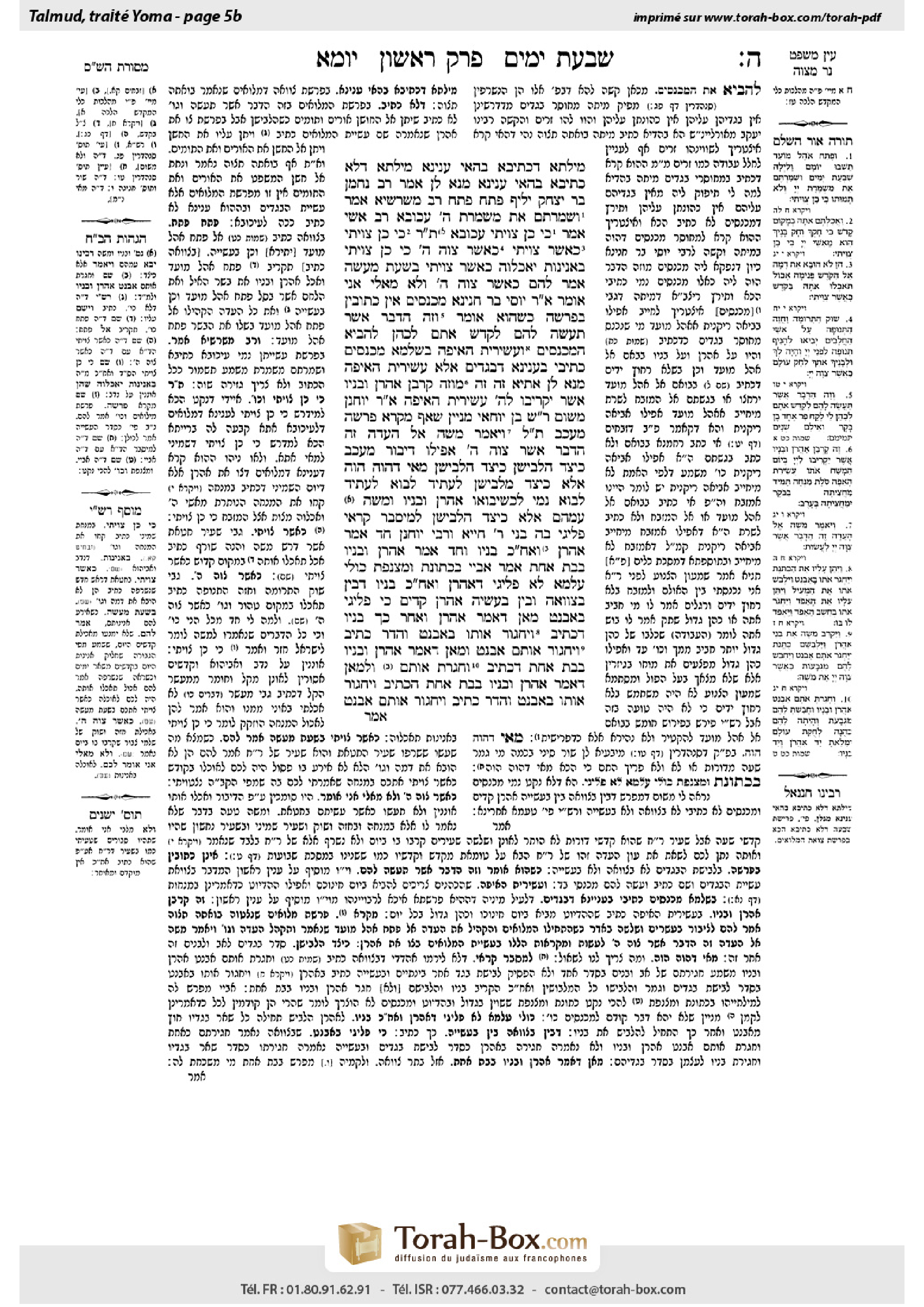
Yoma 5b: Talmud study for Daf Yomi
Daf Yomi is the daily study of one Talmud folio. Explore 37 tractates with scans, Hebrew text, Sefaria English and AI-generated French translations where annotated.
Passage selection and English or AI-generated French translation are available where the scan has annotations. Daf Study is independent of Torah-Box and Sefaria.
Browse Yoma · יומא · All tractatesYoma 5b text and translations
This page of Yoma includes the Aramaic text, an English translation and an AI-generated French translation, alongside the scan above.
יומא ה׳ ב · Aramaic and Hebrew text
מִילְּתָא דִּכְתִיבָא בְּהַאי עִנְיָנָא. מִילְּתָא דְּלָא כְּתִיבָא בְּהַאי עִנְיָנָא מְנָא לַן?
אָמַר רַב נַחְמָן בַּר יִצְחָק: יָלֵיף ״פֶּתַח״ ״פֶּתַח״. רַב מְשַׁרְשְׁיָא אָמַר: ״וּשְׁמַרְתֶּם אֶת מִשְׁמֶרֶת ה׳״ — עִכּוּבָא. רַב אָשֵׁי אָמַר: ״כִּי כֵן צֻוֵּיתִי״ — עִכּוּבָא.
תָּנוּ רַבָּנַן: ״כִּי כֵן צֻוֵּיתִי״, ״כַּאֲשֶׁר צִוֵּיתִי״, ״כַּאֲשֶׁר צִוָּה ה׳״. ״כִּי כֵן צֻוֵּיתִי״ — בַּאֲנִינוּת יֹאכְלוּהָ. ״כַּאֲשֶׁר צִוֵּיתִי״ — בִּשְׁעַת מַעֲשֶׂה אָמַר לָהֶם. ״כַּאֲשֶׁר צִוָּה ה׳״ — וְלֹא מֵאֵלַי אֲנִי אוֹמֵר.
אָמַר רַבִּי יוֹסֵי בַּר חֲנִינָא: מִכְנָסַיִם אֵין כְּתוּבִין בַּפָּרָשָׁה, כְּשֶׁהוּא אוֹמֵר ״וְזֶה הַדָּבָר אֲשֶׁר תַּעֲשֶׂה לָהֶם לְקַדֵּשׁ אֹתָם לְכַהֵן״ — לְהָבִיא הַמִּכְנָסַיִם וַעֲשִׂירִית הָאֵיפָה.
בִּשְׁלָמָא מִכְנָסַיִם כְּתִיבִי בְּעִנְיָנָא דִבְגָדִים, אֶלָּא עֲשִׂירִית הָאֵיפָה מְנָא לַן? אָתְיָא ״זֶה״ ״זֶה״ מִ״וְּזֶה קׇרְבַּן אַהֲרֹן וּבָנָיו אֲשֶׁר יַקְרִיבוּ לַה׳ עֲשִׂירִית הָאֵיפָה״.
אָמַר רַבִּי יוֹחָנָן מִשּׁוּם רַבִּי שִׁמְעוֹן בֶּן יוֹחַאי: מִנַּיִין שֶׁאַף מִקְרָא פָּרָשָׁה מְעַכֵּב, תַּלְמוּד לוֹמַר: ״וַיֹּאמֶר מֹשֶׁה אֶל הָעֵדָה זֶה הַדָּבָר אֲשֶׁר צִוָּה ה׳״ — אֲפִילּוּ דִּיבּוּר מְעַכֵּב.
כֵּיצַד הִלְבִּישָׁן? כֵּיצַד הִלְבִּישָׁן?! מַאי דַהֲוָה הֲוָה! אֶלָּא: כֵּיצַד מַלְבִּישָׁן לֶעָתִיד לָבוֹא? לֶעָתִיד לָבוֹא נָמֵי, לִכְשֶׁיָּבוֹאוּ אַהֲרֹן וּבָנָיו וּמֹשֶׁה עִמָּהֶם!
אֶלָּא: כֵּיצַד הִלְבִּישָׁן לְמִיסְבַּר קְרָאֵי. פְּלִיגִי בָּהּ בְּנֵי רַבִּי חִיָּיא וְרַבִּי יוֹחָנָן. חַד אָמַר: אַהֲרֹן וְאַחַר כָּךְ בָּנָיו, וְחַד אָמַר: אַהֲרֹן וּבָנָיו בְּבַת אַחַת.
אָמַר אַבָּיֵי: בְּכֻתּוֹנֶת וּמִצְנֶפֶת כּוּלֵּי עָלְמָא לָא פְּלִיגִי דְּאַהֲרֹן וְאַחַר כָּךְ בָּנָיו. דְּבֵין בְּצַוּוֹאָה וּבֵין בַּעֲשִׂיָּה אַהֲרֹן קָדֵים. כִּי פְּלִיגִי בְּאַבְנֵט. מַאן דְּאָמַר אַהֲרֹן וְאַחַר כָּךְ בָּנָיו, דִּכְתִיב: ״וַיַּחְגּוֹר אוֹתוֹ בָּאַבְנֵט״, וַהֲדַר כְּתִיב: ״וַיַּחְגּוֹר אוֹתָם אַבְנֵט״. וּמַאן דְּאָמַר אַהֲרֹן וּבָנָיו בְּבַת אַחַת, דִּכְתִיב: ״וְחָגַרְתָּ אוֹתָם״. וּלְמַאן דְּאָמַר אַהֲרֹן וּבָנָיו בְּבַת אַחַת, הָכְתִיב: ״וַיַּחְגּוֹר אוֹתוֹ בְּאַבְנֵט״ וַהֲדַר כְּתִיב: ״וַיַּחְגּוֹר אוֹתָם אַבְנֵט״!
Yoma 5b · English translation
matters that are written in the context of this topic of inauguration in the book of Exodus invalidate the inauguration. However, with regard to matters that are not written in that context, but are written in the portion of the inauguration in Leviticus, from where do we derive that they invalidate the inauguration?
Rav Naḥman bar Yitzḥak said: One derives a verbal analogy between the word opening that appears in the two portions of the inauguration. It is written in the command concerning the inauguration: “The opening of the Tent of Meeting” (Exodus 29:32), and in its fulfillment it is written: “The opening of the Tent of Meeting” (Leviticus 8:31). Failure to perform the matters written in both portions invalidates the inauguration.
Rav Mesharshiyya said: The verbal analogy is unnecessary, as the conclusion can be derived directly from the verse written with regard to the implementation of the inauguration: “And keep the charge of the Lord, that you not die, for so I am commanded” (Leviticus 8:35). The emphasis on this being the charge of the Lord comes to teach that failure to perform all the details mentioned in the implementation of the command invalidates the inauguration.
Rav Ashi says: The phrase: For so I am commanded, is the source from which it is derived that all the details written in both portions invalidate the inauguration.
Apropos that phrase, the Gemara cites a related halakhic midrash. The Sages taught: In the context of the implementation of the inauguration, three variations of the phrase appear: “For so I am commanded” (Leviticus 8:35); “as I commanded” (Leviticus 10:18); and “as God has commanded” (Leviticus 10:15). What does this repetition teach? From the phrase: “For so I am commanded,” it is derived that even in a state of acute mourning, on the first day after the death of a relative, one must eat the offering. God stated the verse: “As I commanded,” at the time of the incident just after the deaths of Nadav and Avihu, when Aaron and his sons were in a state of acute mourning. And when Moses states: “As God commanded,” he is saying: The command is from God and it is not from my own initiative that I am saying it.
Apropos the matters mentioned that are not explicit in the portion, the Gemara cites that which Rabbi Yosei bar Ḥanina said: Trousers are one of the priestly vestments worn during the inauguration, but they are not written in the Torah portion. When the verse says: “And this is the matter that you shall do for them to sanctify them for My service” (Exodus 29:1), the superfluous word: And, which appears at the beginning of the verse, comes to add to that which was written previously and to include trousers and the tenth of an ephah offered by a priest on the day that he begins his service.
The Gemara asks: Granted, trousers can be derived, as the verse is written in the context of the matter of priestly garments detailed adjacent to the portion of the inauguration. However, with regard to the tenth of an ephah, from where do we derive that there is an obligation to offer it during the inauguration? The Gemara answers: It is derived by means of a verbal analogy between the word this that appears in one verse and the word this that appears in another. It is written: “This is the offering of Aaron and of his sons, which they shall offer to the Lord in the day when he is anointed, a tenth of an ephah” (Leviticus 6:13). And in the verse cited above in the context of the inauguration it says: “And this is the matter that you shall do for them,” which teaches that there is an obligation to offer a tenth of an ephah during the inauguration.
Rabbi Yoḥanan said in the name of Rabbi Shimon ben Yoḥai: From where is it derived that even failure to read the Torah portion of the inauguration invalidates the inauguration? The verse states: “And Moses said to the assembly: This is the matter [davar] that God has commanded to be done” (Leviticus 8:5), teaching that even failure to perform the recitation [dibbur] of the Torah portion to the people invalidates the inauguration.
§ Apropos the inauguration of the priests, the Gemara asks: How, i.e., in what order, did Moses dress Aaron and his sons in the priestly vestments? The Gemara wonders: In what order did he dress them? That is an irrelevant question, as what was, was. The order in which Moses dressed the priests has no practical ramifications. Rather, the question must be: How will Moses dress the priests in the future, following the resurrection of the dead, when the Temple service will be restored? The Gemara rejects this question as well: In the future, too, when Aaron and his sons will come and Moses will be with them, he will know the proper sequence, and there is no point to raising the question.
Rather, the question is: How did Moses dress them? The Gemara seeks to explain the verses on this topic, as they appear somewhat contradictory. The Gemara responds: The sons of Rabbi Ḥiyya and Rabbi Yoḥanan disagree with regard to this matter. One said: Moses dressed Aaron first and afterward Moses dressed his sons; and one said: Moses dressed Aaron and his sons simultaneously, i.e., consecutively from one to the next, without interruption, to avoid changing the order prescribed in the verses.
Abaye said: With regard to the tunic and mitre everyone agrees that Moses dressed Aaron and afterward his sons, as both in the portion of the command concerning the inauguration and in the portion of the implementation, mention of Aaron precedes mention of his sons. When they disagree, it is with regard to the belt. The Gemara elaborates. The one who said: Moses dressed Aaron and afterward his sons derives it from that which is written: “And he girded him with the belt” (Leviticus 8:7), and then it is written: “And he girded them with belts” (Leviticus 8:13). Moses first dressed Aaron in all of the garments, including the belt, and then Moses dressed Aaron’s sons. And the one who said: Moses dressed Aaron and his sons, simultaneously derives it from that which is subsequently written: “And gird them with belts, Aaron and his sons” (Exodus 29:9), indicating that Moses girded them all with belts simultaneously. The Gemara asks: And according to the one who says: Moses dressed Aaron and his sons simultaneously, isn’t it written: He girded him with the belt, and then it is written: He girded them with belts, clearly indicating that he dressed Aaron and then his sons?
Yoma 5b · Traduction française (IA)
Les éléments qui sont écrits dans le contexte de l’inauguration dans le livre de l’Exode invalident celle-ci. Mais en ce qui concerne les éléments qui ne sont pas écrits dans ce contexte, mais figurent dans le passage de l’inauguration du Lévitique, d’où déduisons-nous qu’ils invalident l’inauguration ?
Rav Naḥman bar Yitzḥak dit : On établit une analogie verbale entre le mot « entrée », qui apparaît dans les deux passages de l’inauguration. À propos du commandement relatif à l’inauguration, il est écrit : « L’entrée de la Tente de la Rencontre » (Exode 29:32), et, à propos de sa mise en œuvre, il est écrit : « L’entrée de la Tente de la Rencontre » (Lévitique 8:31). Le défaut d’accomplissement des éléments écrits dans ces deux passages invalide l’inauguration. Rav Mesharshiyya dit : L’analogie verbale est inutile, car on peut tirer la conclusion directement du verset relatif à la mise en œuvre de l’inauguration : « Gardez la charge de l’Éternel, afin que vous ne mouriez pas, car c’est ainsi qu’il m’a été ordonné » (Lévitique 8:35). L’accent mis sur le fait qu’il s’agit de la charge de l’Éternel enseigne que le défaut d’accomplissement de tous les détails mentionnés dans la mise en œuvre du commandement invalide l’inauguration. Rav Ashi dit : L’expression « car c’est ainsi qu’il m’a été ordonné » est la source permettant de déduire que tous les détails écrits dans les deux passages invalident l’inauguration.
À propos de cette expression, la Guemara cite un midrach halakhique connexe. Les Sages ont enseigné : Dans le récit de la mise en œuvre de l’inauguration, trois formulations apparaissent : « Car c’est ainsi qu’il m’a été ordonné » (Lévitique 8:35), « comme j’en ai reçu l’ordre » (Lévitique 10:18) et « comme Dieu l’a ordonné » (Lévitique 10:15). Que nous enseigne cette répétition ? De l’expression « car c’est ainsi qu’il m’a été ordonné », on déduit que même en état de deuil aigu, le premier jour après la mort d’un proche, il faut manger le sacrifice. Dieu a formulé les mots « comme j’en ai reçu l’ordre » au moment de l’incident survenu juste après la mort de Nadav et Avihou, alors qu’Aaron et ses fils étaient en état de deuil aigu. Et lorsque Moïse dit : « comme Dieu l’a ordonné », il veut dire que le commandement vient de Dieu et qu’il ne parle pas de sa propre initiative.
À propos des éléments mentionnés qui ne sont pas explicitement indiqués dans le passage, la Guemara rapporte ce que Rabbi Yosei bar Ḥanina a dit : Les pantalons font partie des vêtements sacerdotaux portés lors de l’inauguration, mais ils ne sont pas mentionnés dans le passage de la Torah. Lorsque le verset dit : « Et voici ce que tu feras pour eux afin de les consacrer à Mon service » (Exode 29:1), le mot « et », qui apparaît au début du verset, est superflu. Il vient ajouter à ce qui précède et inclure les pantalons ainsi que le dixième d’épha que le prêtre offre le jour où il commence son service.
La Guemara demande : Certes, on peut déduire l’obligation de porter des pantalons, puisque le verset figure dans le contexte des vêtements sacerdotaux, détaillés juste avant le passage de l’inauguration. Mais en ce qui concerne le dixième d’épha, d’où déduisons-nous qu’il faut l’offrir lors de l’inauguration ? La Guemara répond : On le déduit au moyen d’une analogie verbale entre le mot « ceci », qui apparaît dans un verset, et le mot « ceci », qui apparaît dans un autre. Il est écrit : « Voici l’offrande d’Aaron et de ses fils, qu’ils offriront à l’Éternel le jour où il sera oint : un dixième d’épha » (Lévitique 6:13). Et dans le verset cité plus haut, à propos de l’inauguration, il est écrit : « Et voici ce que tu feras pour eux », ce qui enseigne qu’il est obligatoire d’offrir un dixième d’épha lors de l’inauguration.
Rabbi Yoḥanan a dit au nom de Rabbi Shimon ben Yoḥai : D’où déduit-on que même le défaut de lecture du passage de la Torah relatif à l’inauguration invalide celle-ci ? Le verset dit : « Moïse dit à l’assemblée : Voici la chose [davar] que l’Éternel a ordonné de faire » (Lévitique 8:5). Cela enseigne que même le défaut de récitation [dibbur] du passage de la Torah devant le peuple invalide l’inauguration.
§ À propos de l’inauguration des prêtres, la Guemara demande : Comment, c’est-à-dire dans quel ordre, Moïse a-t-il revêtu Aaron et ses fils des vêtements sacerdotaux ? La Guemara s’interroge : Dans quel ordre les a-t-il revêtus ? Cette question n’est pas pertinente, car ce qui est arrivé est arrivé. L’ordre dans lequel Moïse a revêtu les prêtres n’a aucune conséquence pratique. La question doit plutôt être : Comment Moïse revêtira-t-il les prêtres à l’avenir, après la résurrection des morts, lorsque le service du Temple sera rétabli ? La Guemara rejette également cette question : À l’avenir aussi, quand Aaron et ses fils viendront et que Moïse sera avec eux, il connaîtra l’ordre approprié ; il n’y a donc aucune raison de poser la question.
La question est plutôt : Comment Moïse les a-t-il revêtus ? La Guemara cherche à expliquer les versets à ce sujet, car ils semblent quelque peu contradictoires. La Guemara répond : Les fils de Rabbi Ḥiyya et Rabbi Yoḥanan sont en désaccord à ce sujet. L’un a dit : Moïse a d’abord revêtu Aaron, puis ses fils ; l’autre a dit : Moïse a revêtu Aaron et ses fils simultanément, c’est-à-dire l’un après l’autre, sans interruption, afin de ne pas modifier l’ordre prescrit par les versets.
Abaye dit : En ce qui concerne la tunique et la tiare, tous conviennent que Moïse a d’abord revêtu Aaron, puis ses fils, car tant dans le passage du commandement relatif à l’inauguration que dans celui de sa mise en œuvre, Aaron est mentionné avant ses fils. Leur désaccord porte sur la ceinture. La Guemara développe : Celui qui dit que Moïse a d’abord revêtu Aaron, puis ses fils, le déduit de ce qui est écrit : « Il le ceignit de la ceinture » (Lévitique 8:7), puis : « Il les ceignit de ceintures » (Lévitique 8:13). Moïse a d’abord revêtu Aaron de tous ses vêtements, y compris la ceinture, puis il a revêtu les fils d’Aaron. Celui qui dit que Moïse a revêtu Aaron et ses fils simultanément le déduit de ce qui est écrit ensuite : « Ceins-les de ceintures, Aaron et ses fils » (Exode 29:9), ce qui indique que Moïse les a tous ceints de ceintures simultanément. La Guemara demande : Et selon celui qui dit que Moïse a revêtu Aaron et ses fils simultanément, n’est-il pas écrit : « Il le ceignit de la ceinture », puis : « Il les ceignit de ceintures », ce qui indique clairement qu’il a revêtu Aaron, puis ses fils ?
Traduction française générée par IA à partir de l’édition anglaise de Sefaria. Vérifie toujours un passage avec le texte source.
Text from Sefaria: William Davidson Edition - Vocalized Aramaic (CC BY NC); William Davidson Edition - English (CC BY NC).