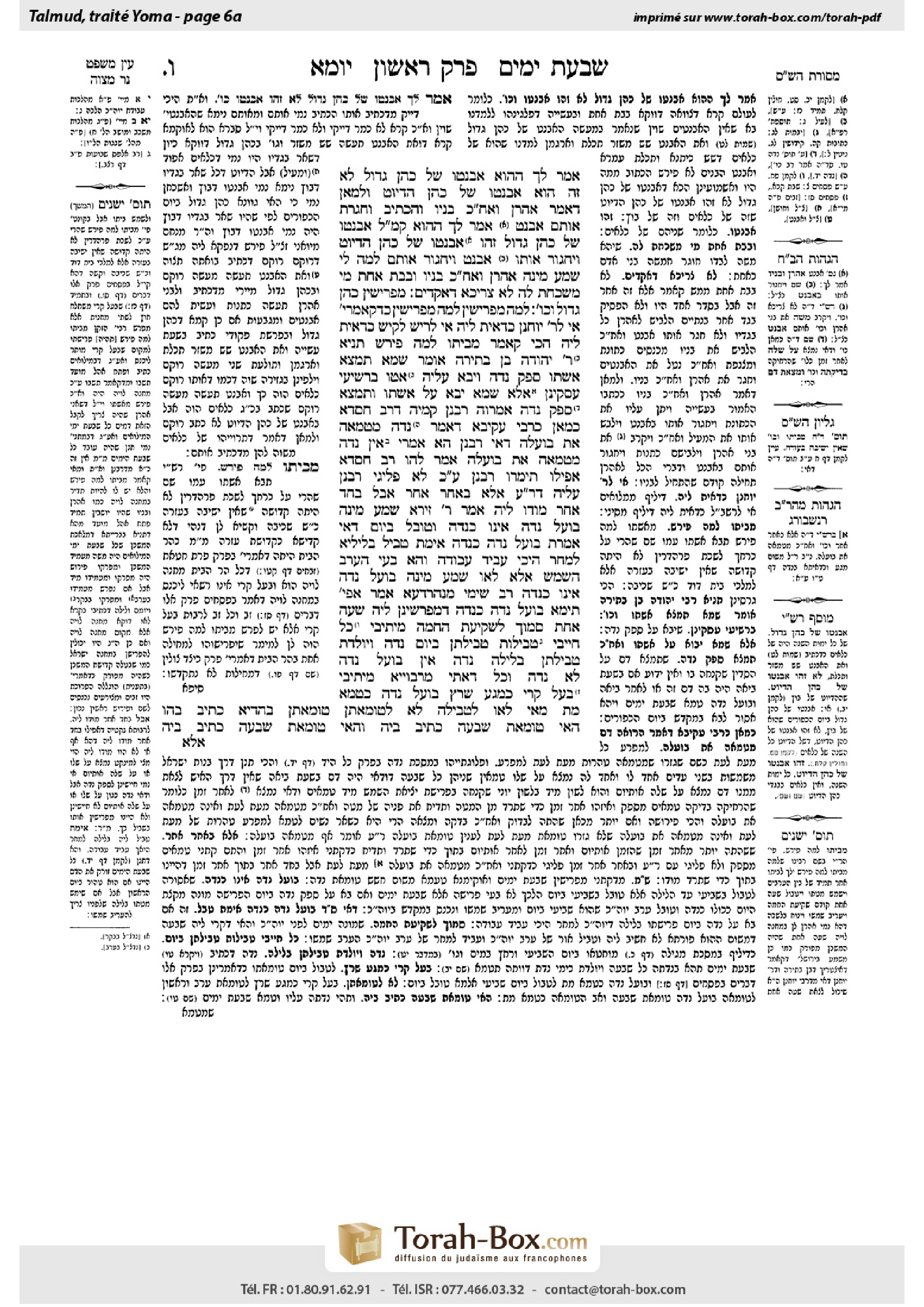
Yoma 6a: Talmud study for Daf Yomi
Daf Yomi is the daily study of one Talmud folio. Explore 37 tractates with scans, Hebrew text, Sefaria English and AI-generated French translations where annotated.
Passage selection and English or AI-generated French translation are available where the scan has annotations. Daf Study is independent of Torah-Box and Sefaria.
Browse Yoma · יומא · All tractatesYoma 6a text and translations
This page of Yoma includes the Aramaic text, an English translation and an AI-generated French translation, alongside the scan above.
יומא ו׳ א · Aramaic and Hebrew text
אָמַר לָךְ: הַהוּא אַבְנֵטוֹ שֶׁל כֹּהֵן גָּדוֹל לֹא זֶה הוּא אַבְנֵטוֹ שֶׁל כֹּהֵן הֶדְיוֹט.
וּלְמַאן דְּאָמַר אַהֲרֹן וְאַחַר כָּךְ בָּנָיו, וְהָכְתִיב: ״וְחָגַרְתָּ אוֹתָם אַבְנֵט״! אָמַר לָךְ: הַהוּא קָא מַשְׁמַע לַן, אַבְנֵטוֹ שֶׁל כֹּהֵן גָּדוֹל זֶהוּ אַבְנֵטוֹ שֶׁל כֹּהֵן הֶדְיוֹט.
״וַיַּחְגּוֹר אוֹתוֹ אַבְנֵט״ ״וַיַּחְגּוֹר אוֹתָם״ לְמָה לִי? שְׁמַע מִינַּהּ אַהֲרֹן וְאַחַר כָּךְ בָּנָיו. וּבְבַת אַחַת מִי מַשְׁכַּחַתְּ לַהּ? לָא צְרִיכָא, דְּאַקְדֵּים.
מַפְרִישִׁין כֹּהֵן גָּדוֹל וְכוּ׳. לָמָּה מַפְרִישִׁין? לָמָּה מַפְרִישִׁין?! כִּדְקָאָמְרִינַן, אִי לְרַבִּי יוֹחָנָן כִּדְאִית לֵיהּ, אִי לְרֵישׁ לָקִישׁ כִּדְאִית לֵיהּ!
הָכִי קָאָמַר: מִבֵּיתוֹ לָמָּה פֵּירַשׁ? תַּנְיָא: רַבִּי יְהוּדָה בֶּן בְּתִירָה אוֹמֵר: שֶׁמָּא תִּמָּצֵא אִשְׁתּוֹ סָפֵק נִדָּה וְיָבֹא עָלֶיהָ.
אַטּוּ בְּרַשִּׁיעֵי עָסְקִינַן? אֶלָּא: שֶׁמָּא יָבֹא עַל אִשְׁתּוֹ וְתִמָּצֵא סָפֵק נִדָּה.
אַמְרוּהָ רַבָּנַן קַמֵּיהּ דְּרַב חִסְדָּא: כְּמַאן — כְּרַבִּי עֲקִיבָא, דְּאָמַר: נִדָּה מְטַמְּאָה אֶת בּוֹעֲלָהּ. דְּאִי רַבָּנַן, הָא אָמְרִי: אֵין נִדָּה מְטַמְּאָה אֶת בּוֹעֲלָהּ.
אֲמַר לְהוּ רַב חִסְדָּא: אֲפִילּוּ תֵּימְרוּ רַבָּנַן, עַד כָּאן לָא פְּלִיגִי רַבָּנַן עֲלֵיהּ דְּרַבִּי עֲקִיבָא אֶלָּא בְּאַחַר אַחַר, אֲבָל בְּחַד אַחַר — מוֹדוּ לֵיהּ.
אָמַר רַבִּי זֵירָא: שְׁמַע מִינַּהּ בּוֹעֵל נִדָּה אֵינוֹ כְּנִדָּה, וְטוֹבֵל בַּיּוֹם.
דְּאִי אָמְרַתְּ בּוֹעֵל נִדָּה כְּנִדָּה, אֵימַת טָבֵיל — בְּלֵילְיָא. לִמְחַר הֵיכִי עָבֵיד עֲבוֹדָה? וְהָא בָּעֵי הֶעֱרֵב הַשֶּׁמֶשׁ. אֶלָּא לָאו שְׁמַע מִינַּהּ בּוֹעֵל נִדָּה אֵינוֹ כְּנִדָּה.
רַב שִׁימִי מִנְּהַרְדְּעָא אָמַר: אֲפִילּוּ תֵּימָא בּוֹעֵל נִדָּה כְּנִדָּה, דְּמַפְרְשִׁינַן לֵיהּ שָׁעָה אַחַת סָמוּךְ לִשְׁקִיעַת הַחַמָּה.
מֵיתִיבִי: כׇּל חַיָּיבֵי טְבִילוֹת טְבִילָתָן בַּיּוֹם, נִדָּה וְיוֹלֶדֶת טְבִילָתָן בַּלַּיְלָה. נִדָּה אִין, בּוֹעֵל נִדָּה לָא!
נִדָּה וְכׇל דְּאָתֵי מֵרִבּוּיָיא.
מֵיתִיבִי: בַּעַל קֶרִי כְּמַגַּע שֶׁרֶץ, בּוֹעֵל נִדָּה כִּטְמֵא מֵת. מַאי לָאו לִטְבִילָה? לֹא, לְטוּמְאָתָן.
טוּמְאָתָן?! בְּהֶדְיָא כְּתִיב בְּהוּ. הַאי טוּמְאַת שִׁבְעָה כְּתִיב בֵּיהּ, וְהַאי טוּמְאַת שִׁבְעָה כְּתִיב בֵּיהּ,
Yoma 6a · English translation
The Gemara answers that he could have said to you: That verse comes to teach that the belt of the High Priest is not the belt of the common priest. It is explicit in the Torah that the belt of the High Priest is made of fine blue and purple linen. On the other hand, the Torah does not state the materials used in the belt of the common priest, which was in fact linen like the rest of the garments of the common priest. And still one can say that Aaron and his sons were dressed simultaneously.
The Gemara asks: And according to the one who said that Moses dressed Aaron first and then his sons, is it not written: “And you will gird them with belts,” indicating that they were girded simultaneously? The Gemara responds that he could have said to you: That verse teaches us that the belt of the High Priest is identical to the belt of the common priest. Both of them were from fine blue and purple linen. Therefore, although the Torah distinguishes between the girding of the belts, as Moses dressed Aaron before he dressed Aaron’s sons, there was a common command to make both belts, indicating that they were made of the same material.
The Gemara asks: If they are identical, why do I need both the verse: “And he girded him with a belt,” and the verse: “And he girded them”? The Gemara explains: Learn from it that Moses dressed Aaron first and then dressed his sons. The Gemara asks: And can you find a situation where Moses could have girded Aaron and his sons simultaneously? The Gemara explains: It is necessary only to state that Moses girded Aaron first and then proceeded to gird his sons in order of their significance. After girding Aaron he did not dress Aaron in any other garments before girding his sons.
§ After a long digression in which many peripheral issues were addressed, the Gemara returns to interpreting the mishna. It was taught in the mishna: The Sages would remove the High Priest from his house to the Chamber of Parhedrin. The Gemara asks: Why do the Sages remove him? The Gemara asks in astonishment: Why do the Sages remove him? It is as we stated above: Whether it is according to Rabbi Yoḥanan, as per his opinion: Sequestering of the High Priest is derived from the sequestering prior to the inauguration; or whether it is according to Reish Lakish, as per his opinion: Sequestering of the High Priest is derived from sequestering at Sinai, the answer is clear. What is the point of the Gemara’s question?
The Gemara explains: This is what the Gemara is saying. Why did he withdraw from his house, i.e., his wife? The Gemara explained why he must be removed to a special location; but why doesn’t his wife join him? It was taught in a baraita: Rabbi Yehuda ben Beteira says: It is due to the concern lest his wife be found to be in a situation of uncertainty as to whether or not she has the halakhic status of a menstruating woman, and he will have relations with her and become impure.
The Gemara asks in astonishment: Is that to say that we are dealing with wicked people? Will the High Priest, aware of the uncertain status of his wife, have relations with her? Rather, rephrase the statement: It is due to the concern lest he have relations with his wife and then she be found to be in a situation of uncertainty as to whether or not she has the halakhic status of a menstruating woman. In a case where blood is found on the sheets after the couple engaged in relations, and there is uncertainty as to whether or not the High Priest had relations with his wife while she had the halakhic status of a menstruating woman, the status of the High Priest is one of uncertain impurity.
The Sages stated the following assumption before Rav Ḥisda: In accordance with whose opinion is that a reason for concern? It is in accordance with the opinion of Rabbi Akiva, who said: A menstruating woman who found blood on the sheets within twenty-fours after having relations, creating uncertainty with regard to her status when she engaged in relations, renders the man who had with relations with her retroactively impure. As, if it were in accordance with the opinion of the Rabbis, it is difficult: Didn’t they say that a woman with regard to whom there is uncertainty as to whether or not she has the halakhic status of a menstruating woman does not render the man who had with relations with her retroactively impure. Therefore, the High Priest need not leave his wife during the week prior to Yom Kippur.
Rav Ḥisda said to the Sages: Even if you say that the mishna is in accordance with the opinion of the Rabbis, the Rabbis disagree with Rabbi Akiva with regard to retroactive impurity only in a case where blood was discovered on the sheets long afterward, after there was time for the woman to leave the bed and bathe and only then discover the blood. Due to the time that elapsed, the Rabbis hold that there is no way to prove a connection between when the woman menstruated and when they engaged in relations. However, if the blood was found merely afterward, the Rabbis concede to Rabbi Akiva that she renders the man retroactively impure.
Rabbi Zeira said: Learn from it that one who is impure because he had relations with a menstruating woman is unlike a menstruating woman in terms of the time of immersion. Unlike the woman, who immerses after nightfall following the seventh day after her menstruation ceased, such a man may immerse on the seventh day and need not wait for nightfall. Therefore, if a High Priest has relations with his wife just before he is sequestered and there is uncertainty as to whether she has the halakhic status of a menstruating woman, the seventh day of his impurity occurs on Yom Kippur eve. He immerses himself that day and completes the purification process at nightfall. This allows him to enter the Temple to perform the Yom Kippur service.
As, if you say that one who is impure because he had relations with a menstruating woman is like a menstruating woman in terms of the time of immersion, when does he immerse? He may immerse only at night after seven complete days. Since that night is Yom Kippur, how can he perform the Yom Kippur service the next day? Isn’t he required to wait for sunset following his immersion to complete the purification process? Until then his status is that of one who immersed that day, who may not serve in the Temple until the nightfall following his immersion. Rather, must one not conclude from it that one who is impure because he had relations with a menstruating woman is unlike a menstruating woman in terms of the time of immersion? He immerses on the seventh day, Yom Kippur eve, and at nightfall he may serve in the Temple.
Rav Shimi from Neharde’a says: Even if you say that one who is impure because he had relations with a menstruating woman is like a menstruating woman with regard to the time of immersion, the High Priest is not removed from his house at night. Rather, we sequester him one hour just before sunset on the eighth day prior to Yom Kippur, slightly before the start of the seven-day period, leaving seven full days to count prior to Yom Kippur. Although he is removed from his house more than seven days prior to Yom Kippur, that slight addition is not sufficient to have the period considered eight days.
The Gemara raises an objection to the opinion that one who is impure because he had relations with a menstruating woman immerses at night: With regard to all those obligated in immersions, their immersion is during the day. The exceptions are a menstruating woman and a woman after childbirth, whose immersion is at night. It can be learned by inference: With regard to a menstruating woman, yes, she immerses at night; with regard to one who is impure because he had relations with a menstruating woman, no, he does not immerse at night.
The Gemara rejects that proof because the term menstruating woman in that baraita includes the woman and everyone whose inclusion in the impurity is derived from her status. The understanding is that a man who has relations with a menstruating woman assumes her impurity, and therefore his immersion would be identical to hers.
The Gemara raises another objection: The halakhic status of one who is ritually impure due to a seminal emission is like that of one who came into contact with a creeping animal, whereas the legal status of one who is ritually impure because he had relations with a menstruating woman is like that of one who became impure with ritual impurity imparted by a corpse. The Gemara asks: What, does the baraita not mean that one who had relations with a menstruating woman is like one impure with impurity imparted by a corpse in terms of immersion, which he may perform during the day? The Gemara rejects that conclusion. No, the baraita is merely comparing the duration of their impurity. One who experiences a seminal emission is impure for one day, like one who came into contact with a creeping animal; one who has relations with a menstruating woman is impure for seven days, like one impure with impurity imparted by a corpse.
The Gemara wonders: For what purpose would the baraita come to teach the duration of their impurity? The Torah explicitly writes the durations of their impurity. This, one impure with impurity imparted by a corpse, has impurity of seven days written in his regard; and similarly, that, one who is impure because he had relations with a menstruating woman, has impurity of seven days written in his regard. There is no need for the baraita to derive a matter explicitly written in the Torah from another matter explicitly written in the Torah.
Yoma 6a · Traduction française (IA)
La Guemara répond qu’il aurait pu te dire : ce verset vient enseigner que la ceinture du grand prêtre n’est pas celle du prêtre ordinaire. La Torah précise que la ceinture du grand prêtre est faite de lin fin, bleu et pourpre. En revanche, elle ne précise pas les matériaux de la ceinture du prêtre ordinaire, qui était en réalité en lin, comme le reste de ses vêtements. On peut néanmoins dire qu’Aaron et ses fils furent habillés simultanément.
La Guemara demande : Et selon celui qui dit que Moïse habilla d’abord Aaron, puis ses fils, n’est-il pas écrit : « Tu les ceindras de ceintures », ce qui indique qu’ils furent ceints simultanément ? La Guemara répond qu’il aurait pu te dire : ce verset nous enseigne que la ceinture du grand prêtre était identique à celle du prêtre ordinaire. Toutes deux étaient en lin fin, bleu et pourpre. Ainsi, bien que la Torah distingue l’ordre dans lequel les ceintures furent mises, puisque Moïse habilla Aaron avant ses fils, elle donne un commandement commun de confectionner les deux ceintures, indiquant qu’elles étaient faites de la même matière.
La Guemara demande : Si elles sont identiques, pourquoi faut-il à la fois le verset « Il le ceignit d’une ceinture » et le verset « Il les ceignit » ? La Guemara explique : Apprends-en que Moïse habilla d’abord Aaron, puis ses fils. La Guemara demande : Peut-on imaginer une situation où Moïse aurait pu ceindre Aaron et ses fils simultanément ? La Guemara explique : Il s’agit seulement d’indiquer que Moïse ceignit d’abord Aaron, puis ses fils, selon leur rang. Après avoir ceint Aaron, il ne lui mit aucun autre vêtement avant de ceindre ses fils.
§ Après une longue digression consacrée à de nombreuses questions périphériques, la Guemara revient à l’interprétation de la Michna. La Michna enseignait : Les Sages faisaient quitter au grand prêtre sa maison pour l’emmener dans la Chambre de Parhedrin. La Guemara demande : Pourquoi les Sages le font-ils quitter sa maison ? Elle s’interroge avec étonnement : Pourquoi les Sages le font-ils quitter sa maison ? Comme nous l’avons indiqué plus haut, que l’on suive Rabbi Yoḥanan, selon qui la mise à l’écart du grand prêtre se déduit de la mise à l’écart précédant l’inauguration, ou Reish Lakish, selon qui elle se déduit de la mise à l’écart au Sinaï, la réponse est claire. À quoi sert donc la question de la Guemara ?
La Guemara explique : Voici ce qu’elle demande : Pourquoi devait-il s’éloigner de sa maison, c’est-à-dire de son épouse ? La Guemara a expliqué pourquoi il devait être conduit dans un lieu particulier ; mais pourquoi son épouse ne l’accompagnait-elle pas ? Il a été enseigné dans une baraïta : Rabbi Yehuda ben Beteira dit : C’est par crainte que son épouse se révèle être dans une situation où l’on ne sait pas avec certitude si elle a ou non le statut halakhique d’une femme menstruée, et qu’il ait des rapports avec elle et devienne impur.
La Guemara demande avec étonnement : Cela signifie-t-il que nous avons affaire à des hommes méchants ? Le grand prêtre, sachant que le statut de son épouse est incertain, aurait-il des rapports avec elle ? Reformulons plutôt l’énoncé : C’est par crainte qu’il ait des rapports avec son épouse, puis qu’on découvre qu’il est incertain si elle avait ou non le statut halakhique d’une femme menstruée. Si du sang est découvert sur les draps après leurs rapports, et qu’il est incertain si le grand prêtre a eu des rapports avec son épouse alors qu’elle avait le statut halakhique d’une femme menstruée, le grand prêtre est dans un état d’impureté incertaine.
Les Sages avancèrent devant Rav Ḥisda l’hypothèse suivante : Selon qui cette raison de craindre s’explique-t-elle ? Selon Rabbi Akiva, qui dit qu’une femme menstruée ayant découvert du sang sur les draps dans les vingt-quatre heures suivant des rapports, ce qui crée une incertitude quant à son statut au moment de ces rapports, rend rétroactivement impur l’homme qui a eu des rapports avec elle. En effet, si l’on suivait l’avis des Sages, une difficulté se poserait : n’ont-ils pas dit qu’une femme dont on ne sait pas avec certitude si elle a le statut halakhique d’une femme menstruée ne rend pas rétroactivement impur l’homme qui a eu des rapports avec elle ? Le grand prêtre n’aurait donc pas besoin de quitter son épouse durant la semaine précédant Yom Kippour.
Rav Ḥisda dit aux Sages : Même si vous dites que la Michna suit l’avis des Sages, ceux-ci ne sont en désaccord avec Rabbi Akiva au sujet de l’impureté rétroactive que dans un cas où le sang a été découvert sur les draps longtemps après, une fois que la femme a eu le temps de quitter le lit et de se laver, et qu’elle n’a découvert le sang qu’ensuite. En raison du temps écoulé, les Sages estiment qu’il est impossible d’établir un lien entre le moment où la femme a commencé à avoir ses règles et celui où le couple a eu des rapports. Toutefois, si le sang est découvert peu après, les Sages reconnaissent avec Rabbi Akiva qu’elle rend l’homme rétroactivement impur.
Rabbi Zeira dit : Apprends-en que celui qui est impur pour avoir eu des rapports avec une femme menstruée n’est pas soumis aux mêmes règles qu’elle en ce qui concerne le moment de l’immersion. Contrairement à la femme, qui s’immerge après la tombée de la nuit suivant le septième jour après la fin de ses règles, un tel homme peut s’immerger le septième jour et n’a pas besoin d’attendre la tombée de la nuit. Ainsi, si un grand prêtre a des rapports avec son épouse juste avant sa mise à l’écart, et qu’il est incertain si elle a le statut halakhique d’une femme menstruée, son septième jour d’impureté tombe la veille de Yom Kippour. Il s’immerge ce jour-là et achève le processus de purification à la tombée de la nuit. Cela lui permet d’entrer dans le Temple pour accomplir le service de Yom Kippour.
En effet, si tu dis que celui qui est impur pour avoir eu des rapports avec une femme menstruée est soumis aux mêmes règles qu’elle en ce qui concerne le moment de l’immersion, quand s’immerge-t-il ? Il ne peut s’immerger que la nuit, après sept jours complets. Puisque cette nuit est celle de Yom Kippour, comment pourrait-il accomplir le service de Yom Kippour le lendemain ? Ne doit-il pas attendre le coucher du soleil suivant son immersion pour achever le processus de purification ? Jusque-là, il a le statut de quelqu’un qui s’est immergé ce jour-là et ne peut pas officier dans le Temple avant la tombée de la nuit suivant son immersion. Faut-il donc en conclure que celui qui est impur pour avoir eu des rapports avec une femme menstruée n’est pas soumis aux mêmes règles qu’elle en ce qui concerne le moment de l’immersion ? Il s’immerge le septième jour, la veille de Yom Kippour, et peut officier dans le Temple à la tombée de la nuit.
Rav Shimi de Neharde’a dit : Même si tu dis que celui qui est impur pour avoir eu des rapports avec une femme menstruée est soumis aux mêmes règles qu’elle en ce qui concerne le moment de l’immersion, le grand prêtre ne quitte pas sa maison la nuit. On le met plutôt à l’écart une heure avant le coucher du soleil du huitième jour précédant Yom Kippour, un peu avant le début de la période de sept jours, de sorte qu’il lui reste sept jours entiers à compter avant Yom Kippour. Bien qu’il quitte sa maison plus de sept jours avant Yom Kippour, ce léger dépassement ne suffit pas à faire considérer que la période compte huit jours.
La Guemara soulève une objection contre l’opinion selon laquelle celui qui est impur pour avoir eu des rapports avec une femme menstruée s’immerge la nuit : Tous ceux qui sont tenus de s’immerger le font le jour. Les exceptions sont la femme menstruée et la femme après l’accouchement, dont l’immersion a lieu la nuit. On peut en déduire que la femme menstruée, oui, s’immerge la nuit ; mais celui qui est impur pour avoir eu des rapports avec une femme menstruée, non, ne s’immerge pas la nuit.
La Guemara rejette cette preuve, car le terme « femme menstruée » dans cette baraïta inclut la femme elle-même et tous ceux dont le statut d’impureté se déduit du sien. Selon cette interprétation, l’homme qui a des rapports avec une femme menstruée contracte son impureté ; son immersion aurait donc lieu comme la sienne.
La Guemara soulève une autre objection : Le statut halakhique d’une personne rituellement impure à la suite d’une émission séminale est semblable à celui d’une personne entrée en contact avec un animal rampant, tandis que le statut halakhique de celui qui est rituellement impur pour avoir eu des rapports avec une femme menstruée est semblable à celui de quelqu’un devenu impur par une impureté transmise par un cadavre. La Guemara demande : La baraïta ne veut-elle pas dire que celui qui a eu des rapports avec une femme menstruée est semblable à une personne impure par une impureté transmise par un cadavre en ce qui concerne l’immersion, qu’il peut effectuer le jour ? La Guemara rejette cette conclusion : Non, la baraïta compare simplement la durée de leur impureté. Celui qui a une émission séminale est impur un jour, comme celui qui est entré en contact avec un animal rampant ; celui qui a des rapports avec une femme menstruée est impur sept jours, comme celui qui est impur par une impureté transmise par un cadavre.
La Guemara s’interroge : Dans quel but la baraïta enseignerait-elle la durée de leur impureté ? La Torah précise explicitement la durée de leur impureté. Pour celui-ci, celui qui est impur par une impureté transmise par un cadavre, il est explicitement écrit que son impureté dure sept jours ; et, de même, pour celui-là, celui qui est impur pour avoir eu des rapports avec une femme menstruée, il est explicitement écrit que son impureté dure sept jours. Il n’est pas nécessaire que la baraïta déduise une règle explicitement écrite dans la Torah à partir d’une autre règle explicitement écrite dans la Torah.
Traduction française générée par IA à partir de l’édition anglaise de Sefaria. Vérifie toujours un passage avec le texte source.
Text from Sefaria: William Davidson Edition - Vocalized Aramaic (CC BY NC); William Davidson Edition - English (CC BY NC).