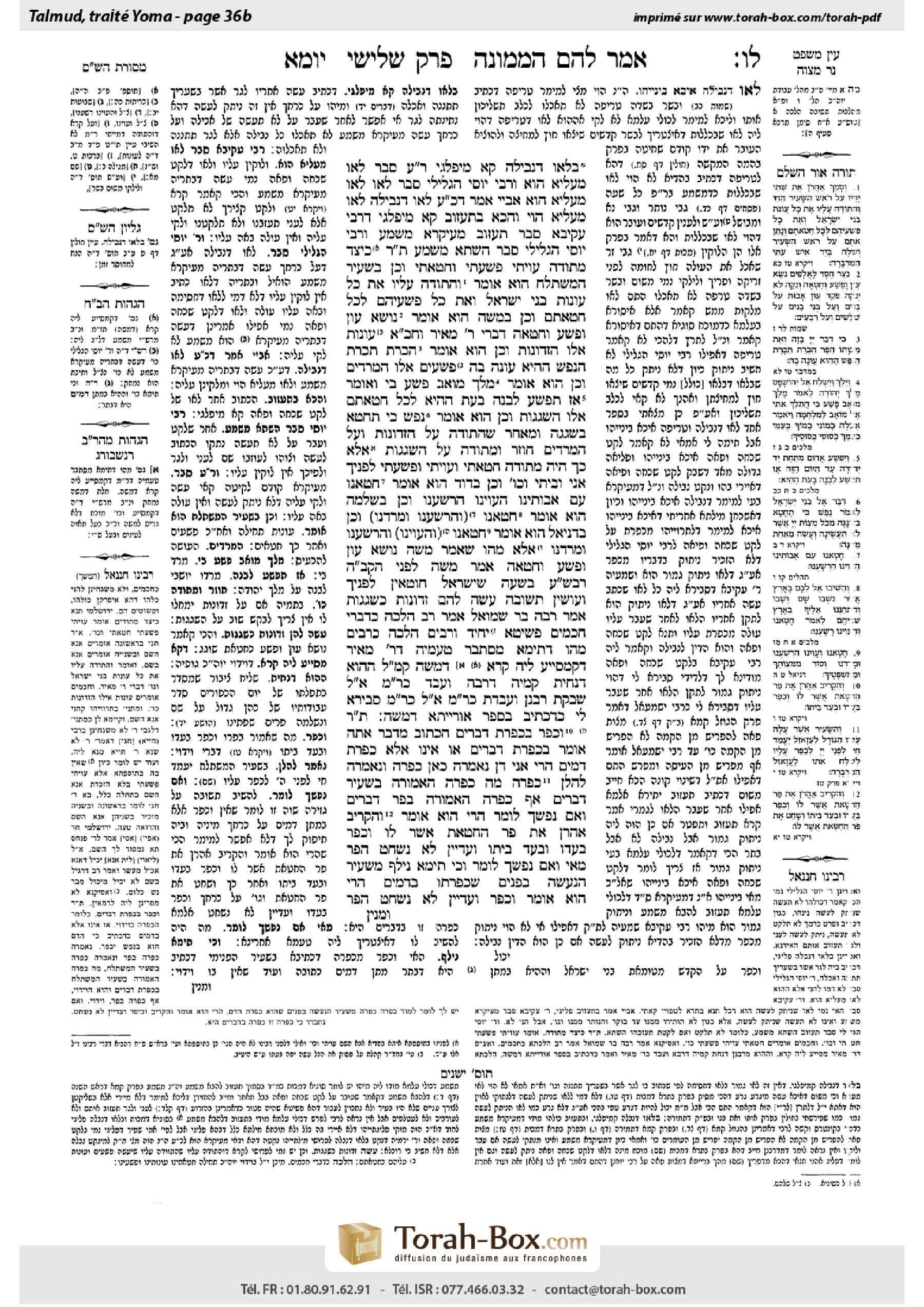
Yoma 36b: Talmud study for Daf Yomi
Daf Yomi is the daily study of one Talmud folio. Explore 37 tractates with scans, Hebrew text, Sefaria English and AI-generated French translations where annotated.
Passage selection and English or AI-generated French translation are available where the scan has annotations. Daf Study is independent of Torah-Box and Sefaria.
Browse Yoma · יומא · All tractatesYoma 36b text and translations
This page of Yoma includes the Aramaic text, an English translation and an AI-generated French translation, alongside the scan above.
יומא ל״ו ב · Aramaic and Hebrew text
בְּלָאו דִּנְבֵילָה קָא מִיפַּלְגִי:
רַבִּי עֲקִיבָא סָבַר: לָאו מְעַלְּיָא הוּא. וְרַבִּי יוֹסֵי הַגְּלִילִי סָבַר: לָאו לָאו מְעַלְּיָא הוּא.
אַבָּיֵי אָמַר: דְּכוּלֵּי עָלְמָא לָאו דִּנְבֵילָה — לָאו מְעַלְּיָא הָוֵי, וְהָכָא בְּ״תַעֲזוֹב״ קָא מִיפַּלְגִי,
דְּרַבִּי עֲקִיבָא סָבַר: ״תַּעֲזוֹב״ מֵעִיקָּרָא מַשְׁמַע, וְרַבִּי יוֹסֵי הַגְּלִילִי סָבַר: הַשְׁתָּא מַשְׁמַע.
תָּנוּ רַבָּנַן: כֵּיצַד מִתְוַדֶּה? ״עָוִיתִי פָּשַׁעְתִּי וְחָטָאתִי״, וְכֵן בְּשָׂעִיר הַמִּשְׁתַּלֵּחַ הוּא אוֹמֵר: ״וְהִתְוַדָּה עָלָיו אֶת כׇּל עֲוֹנוֹת בְּנֵי יִשְׂרָאֵל וְאֶת כׇּל פִּשְׁעֵיהֶם לְכׇל חַטֹּאתָם״, וְכֵן בְּמֹשֶׁה הוּא אוֹמֵר: ״נוֹשֵׂא עָוֹן וָפֶשַׁע וְחַטָּאָה״, דִּבְרֵי רַבִּי מֵאִיר. וַחֲכָמִים אוֹמְרִים: עֲוֹנוֹת אֵלּוּ הַזְּדוֹנוֹת, וְכֵן הוּא אוֹמֵר: ״הִכָּרֵת תִּכָּרֵת הַנֶּפֶשׁ הָהִיא עֲוֹנָה בָּהּ״.
פְּשָׁעִים אֵלּוּ הַמְּרָדִים, וְכֵן הוּא אוֹמֵר: ״מֶלֶךְ מוֹאָב פָּשַׁע בִּי״, וְאוֹמֵר: ״אָז תִּפְשַׁע לִבְנָה בָּעֵת הַהִיא״. ״לְכׇל חַטֹּאתָם״ אֵלּוּ הַשְּׁגָגוֹת, וְכֵן הוּא אוֹמֵר: ״נֶפֶשׁ כִּי תֶחֱטָא בִשְׁגָגָה״. וּמֵאַחַר שֶׁהִתְוַדָּה עַל הַזְּדוֹנוֹת וְעַל הַמְּרָדִים חוֹזֵר וּמִתְוַדֶּה עַל הַשְּׁגָגוֹת?!
אֶלָּא כָּךְ הָיָה מִתְוַדֶּה: חָטָאתִי וְעָוִיתִי וּפָשַׁעְתִּי לְפָנֶיךָ אֲנִי וּבֵיתִי וְכוּ׳. וְכֵן בְּדָוִד הוּא אוֹמֵר: ״חָטָאנוּ עִם אֲבוֹתֵינוּ הֶעֱוִינוּ הִרְשָׁעְנוּ״, וְכֵן בִּשְׁלֹמֹה הוּא אוֹמֵר: ״חָטָאנוּ (וְהִרְשַׁעְנוּ וּמָרָדְנוּ)״, וְכֵן בְּדָנִיֵּאל הוּא אוֹמֵר: ״חָטָאנוּ (וְהֶעֱוִינוּ) וְהִרְשַׁעְנוּ וּמָרָדְנוּ״. אֶלָּא מַהוּ שֶׁאָמַר מֹשֶׁה ״נוֹשֵׂא עָוֹן וָפֶשַׁע וְחַטָּאָה״? אָמַר מֹשֶׁה לִפְנֵי הַקָּדוֹשׁ בָּרוּךְ הוּא: רִבּוֹנוֹ שֶׁל עוֹלָם, בְּשָׁעָה שֶׁיִּשְׂרָאֵל חוֹטְאִין לְפָנֶיךָ וְעוֹשִׂין תְּשׁוּבָה עֲשֵׂה לָהֶם זְדוֹנוֹת כִּשְׁגָגוֹת.
אָמַר רַבָּה בַּר שְׁמוּאֵל אָמַר רַב: הֲלָכָה כְּדִבְרֵי חֲכָמִים. פְּשִׁיטָא: יָחִיד וְרַבִּים הֲלָכָה כְּרַבִּים! מַהוּ דְּתֵימָא, מִסְתַּבֵּר טַעְמֵיהּ דְּרַבִּי מֵאִיר דְּקָמְסַיַּיע לֵיהּ קְרָא דְּמֹשֶׁה, קָא מַשְׁמַע לַן.
הַהוּא דִּנְחֵית קַמֵּיהּ דְּרַבָּה וַעֲבַד כְּרַבִּי מֵאִיר, אֲמַר לֵיהּ: שָׁבְקַתְּ רַבָּנַן וְעָבְדַתְּ כְּרַבִּי מֵאִיר?! אֲמַר לֵיהּ: כְּרַבִּי מֵאִיר סְבִירָא לִי, כְּדִכְתִיב בְּסֵפֶר אוֹרָיְיתָא דְּמֹשֶׁה.
תָּנוּ רַבָּנַן: ״וְכִפֶּר״, בְּכַפָּרַת דְּבָרִים הַכָּתוּב מְדַבֵּר. אַתָּה אוֹמֵר בְּכַפָּרַת דְּבָרִים, אוֹ אֵינוֹ אֶלָּא כַּפָּרַת דָּמִים.
הֲרֵי אֲנִי דָּן: נֶאֶמְרָה כָּאן ״כַּפָּרָה״, וְנֶאֶמְרָה לְהַלָּן ״כַּפָּרָה״. מָה ״כַּפָּרָה״ הָאֲמוּרָה בַּשָּׂעִיר — דְּבָרִים, אַף ״כַּפָּרָה״ הָאֲמוּרָה בַּפָּר — דְּבָרִים.
וְאִם נַפְשְׁךָ לוֹמַר: הֲרֵי הוּא אוֹמֵר ״וְהִקְרִיב אַהֲרֹן אֶת פַּר הַחַטָּאת אֲשֶׁר לוֹ וְכִפֶּר בַּעֲדוֹ וּבְעַד בֵּיתוֹ״, וַעֲדַיִין לֹא נִשְׁחַט הַפָּר.
מַאי ״וְאִם נַפְשְׁךָ לוֹמַר״? וְכִי תֵּימָא נֵילַף מִשָּׂעִיר הַנַּעֲשֶׂה בִּפְנִים, שֶׁכַּפָּרָתוֹ בְּדָמִים, הֲרֵי הוּא אוֹמֵר ״וְכִפֶּר״, וַעֲדַיִין לֹא נִשְׁחַט הַפָּר.
Yoma 36b · English translation
It is with regard to the prohibition against eating an unslaughtered animal carcass, and similar prohibitions, that they disagree. The Torah says: “You shall not eat any unslaughtered animal carcass; give it to the stranger in your community to eat” (Deuteronomy 14:21). The dispute is whether this is a prohibition that after violation is transformed into a positive mitzva or whether it is a standard prohibition punishable by lashes.
Rabbi Akiva holds: It is a full-fledged prohibition, violators of which are flogged, as is the case with regard to violators of standard Torah prohibitions. In his opinion, this is not a case of a prohibition that after violation is transformed into a positive mitzva, as the positive mitzva: “Give it to the stranger in your community to eat,” in no way rectifies the prohibition that was violated. If the carcass was eaten, obviously it cannot then be given to the stranger. Apparently, the verse means that due to the prohibition against eating it, one should give it to the stranger. And Rabbi Yosei HaGelili holds: It is not a full-fledged prohibition; rather, it is a prohibition that after violation is transformed into a positive mitzva. Because the positive command appears after the prohibition, it is tantamount to a prohibition that can be rectified.
Abaye said that everyone agrees that the prohibition of eating an unslaughtered animal carcass is a full-fledged prohibition, and it is not a prohibition that after violation is transformed into a positive mitzva, and here, it is with regard to the positive mitzva written after the prohibitions with regard to gleanings, forgotten sheaves, and pe’a that they disagree. The verse states: “And when you reap the harvest of your land, you shall not wholly reap the corner of your field, neither shall you gather the gleaning of your harvest. And you shall not glean your vineyard, neither shall you gather the fallen fruit of your vineyard; you shall leave them for the poor and for the stranger, I am the Lord your God (Leviticus 19:9–10). After listing the prohibitions: You shall not wholly reap, you shall not glean, and you shall not gather, the Torah commands: You shall leave them.
Rabbi Akiva holds that the positive mitzva: You shall leave, indicates that one leaves gleanings, forgotten sheaves, and pe’a in the field from the outset, and is not in effect after he violates the prohibition of: You shall not wholly reap. If one fails to fulfill that mitzva, he violates full-fledged prohibitions punishable by lashes. However, Rabbi Yosei HaGelili holds that the positive mitzva: You shall leave, indicates now, after one violated the prohibition. Even if the individual violated the prohibitions and harvested those crops, there is an obligation to rectify his actions by leaving the produce he harvested for the poor. This is not a full-fledged prohibition; rather, it is a prohibition that after violation is transformed into a positive mitzva that rectifies the transgression.
§ The Sages taught in the Tosefta: How does he confess? What is the formula of the confession? It is: I have done wrong, I have rebelled, and I have sinned. And likewise, with regard to the scapegoat, it says that the confession is in that order: “And he shall confess over it all of the children of Israel’s wrongdoings and all their rebellions and all their sins” (Leviticus 16:21). And likewise, when God revealed Himself to Moses it says: “Forgiving wrongdoing and rebellion and sin” (Exodus 34:7). This is the statement of Rabbi Meir. And the Rabbis say that the meaning of these terms is: Wrongdoings are intentional transgressions, and likewise it says: “That soul shall be cut off, it bears its guilt” (Numbers 15:31). This refers to sins committed intentionally.
Rebellions are rebellious transgressions, when one not only intends to violate a prohibition but does so as an act of defiance against God. And likewise, it says: “The king of Moab rebelled [pasha] against me” (II Kings 3:7). And it is said: “Then Livna rebelled at that time” (II Kings 8:22). With regard to the phrase: All of their sins, these are unwitting sins. And it says: “If a soul should sin unwittingly” (Leviticus 4:2). In light of these definitions the sequence suggested by Rabbi Meir is unlikely, as once he confessed the wrongdoings and rebellions, does he then confess the unwitting sins?
Rather, this is the manner in which he confesses: I have sinned, I have done wrong, and I have rebelled before You, I and my household. And likewise, with regard to David it says in this sequence: “We have sinned along with our forefathers, we have done wrong, we have performed evil” (Psalms 106:6). And likewise, with regard to Solomon it says: “We have sinned, and we have done wrong, we have done evil” (I Kings 8:47). And likewise, with regard to Daniel it says: “We have sinned, and we have done wrong, and we have done evil, and we have rebelled” (Daniel 9:5). However, according to this interpretation, what is the rationale for the sequence of that which Moses said: Forgiving wrongdoing and rebellion and sin, where sin appears last? Moses said before the Holy One, Blessed be He: Master of the Universe, when the Jewish people sin before you and repent, render their intentional sins like unwitting ones, forgive wrongdoing and rebellion as if they were sin.
Rabba bar Shmuel said that Rav said: The halakha is in accordance with the statement of the Rabbis. The confession begins with the unwitting sins and concludes with the severe rebellions. The Gemara expresses surprise concerning the need for this ruling: It is obvious that the halakha is in accordance with the opinion of the Rabbis, based on the principle: In a dispute between an individual and the many, the halakha is in accordance with the opinion of the many. The Gemara answers: Lest you say in this case that the rationale for the opinion of Rabbi Meir is reasonable, as the verse with regard to Moses is written in the order stated by Rabbi Meir and supports his opinion, therefore Rabba bar Shmuel teaches us that the halakha is nevertheless in accordance with the opinion of the Rabbis.
The Gemara relates that there was a certain person who descended to lead the prayers before Rabba, and he performed the confession sequence in accordance with the opinion of Rabbi Meir. Rabba said to him: Have you forsaken the opinion of the Rabbis, who are the many, and performed the confession sequence in accordance with the opinion of Rabbi Meir? That person said to Rabba: I hold in accordance with the opinion of Rabbi Meir, as it is written explicitly in the Torah of Moses.
§ The Sages taught in a halakhic midrash that it is written: “And Aaron is to offer his own bull as a sin-offering and atone for himself and for his household” (Leviticus 16:6). Apparently, the verse is speaking of atonement achieved through words of confession. Do you say it is atonement achieved through words, or perhaps it is only atonement achieved through sprinkling blood, as each mention of atonement associated with an offering involves the sprinkling of blood on the altar?
I will infer via a verbal analogy: Atonement is stated here, with regard to the bull of the sin-offering, and atonement is stated there, with regard to the scapegoat: “And the goat designated by the lottery for Azazel shall be left standing alive before God, to atone with it” (Leviticus 16:10). Just as the atonement that is stated with regard to the goat is atonement achieved through words, as neither is the goat slaughtered nor is its blood sprinkled on the altar, so too, the atonement stated with regard to the bull refers to atonement achieved through words.
And if it is your wish to state a claim rejecting that proof, there is a different proof. It says: “And Aaron shall then offer his bull of sin-offering and atone for himself and his household. And he shall slaughter his bull of sin-offering” (Leviticus 16:11). Here, the term atonement is used despite the fact that the bull has not yet been slaughtered. Apparently, the atonement of the bull is achieved through confession and not through sprinkling the blood.
The Gemara seeks to clarify the midrash: What is the meaning of: And if it is your wish to say, which indicates that there is room to undermine the first source? Why is a second source required? The Gemara answers: And if you say that instead of deriving the atonement of the bull from the atonement of the scapegoat, let us derive it from the goat that is offered within, whose atonement is achieved through sprinkling its blood in the innermost sanctum; therefore, it was taught in the baraita that it says: And atone, and the bull has not yet been slaughtered.
Yoma 36b · Traduction française (IA)
C’est au sujet de l’interdiction de manger une carcasse d’animal qui n’a pas été abattu rituellement, et d’interdictions semblables, qu’ils sont en désaccord. La Torah dit : « Tu ne mangeras aucune carcasse ; donne-la à l’étranger qui réside dans ta communauté, pour qu’il la mange » (Deutéronome 14,21). Le débat porte sur la question de savoir s’il s’agit d’une interdiction qui, après avoir été transgressée, est assortie d’une mitsva positive, ou d’une interdiction ordinaire passible de flagellation.
Rabbi Akiva considère qu’il s’agit d’une interdiction à part entière, dont les transgresseurs sont passibles de flagellation, comme ceux qui transgressent les interdictions ordinaires de la Torah. Selon lui, il ne s’agit pas d’une interdiction qui, après avoir été transgressée, est assortie d’une mitsva positive, car la mitsva positive : « Donne-la à l’étranger qui réside dans ta communauté, pour qu’il la mange » ne répare en rien l’interdiction transgressée. Si la carcasse a été mangée, il est évident qu’on ne peut ensuite la donner à l’étranger. Le verset signifie apparemment qu’en raison de l’interdiction de la manger, il faut la donner à l’étranger. Rabbi Yosei HaGelili, lui, considère qu’il ne s’agit pas d’une interdiction à part entière, mais d’une interdiction assortie, après sa transgression, d’une mitsva positive. Puisque le commandement positif vient après l’interdiction, cela équivaut à une interdiction susceptible d’être réparée.
Abayé dit que tous conviennent que l’interdiction de manger une carcasse d’animal qui n’a pas été abattu rituellement est une interdiction à part entière, et non une interdiction qui, après avoir été transgressée, est assortie d’une mitsva positive. Ici, leur désaccord porte sur la mitsva positive énoncée après les interdictions concernant les glanures, les gerbes oubliées et le coin du champ. Le verset dit : « Quand vous moissonnerez la récolte de votre pays, tu ne moissonneras pas entièrement le coin de ton champ et tu ne ramasseras pas les glanures de ta récolte. Tu ne grappilleras pas non plus ta vigne et tu ne ramasseras pas les fruits tombés de ta vigne ; tu les laisseras au pauvre et à l’étranger. Je suis l’Éternel, votre Dieu » (Lévitique 19,9-10). Après avoir énuméré les interdictions — ne pas moissonner entièrement, ne pas grappiller et ne pas ramasser —, la Torah ordonne : « Tu les laisseras. »
Rabbi Akiva considère que la mitsva positive « Tu les laisseras » signifie qu’on laisse les glanures, les gerbes oubliées et le coin du champ dans le champ dès le départ ; elle ne s’applique pas après la transgression de l’interdiction de moissonner entièrement. Celui qui ne s’acquitte pas de cette mitsva transgresse des interdictions à part entière, passibles de flagellation. Rabbi Yosei HaGelili, en revanche, considère que la mitsva positive « Tu les laisseras » s’applique alors, après la transgression de l’interdiction. Même si la personne a transgressé les interdictions et récolté ces produits, elle a l’obligation de réparer ses actes en laissant aux pauvres les produits qu’elle a récoltés. Il ne s’agit pas d’une interdiction à part entière, mais d’une interdiction qui, après avoir été transgressée, est assortie d’une mitsva positive qui répare la transgression.
§ Les Sages ont enseigné dans la Tosefta : Comment confesse-t-il ? Quelle est la formule de la confession ? « J’ai commis une faute, j’ai transgressé délibérément et j’ai péché. » De même, au sujet du bouc émissaire, il est dit que la confession suit cet ordre : « Il confessera sur lui toutes les fautes des enfants d’Israël, toutes leurs transgressions délibérées et tous leurs péchés » (Lévitique 16,21). De même, lorsque Dieu se révéla à Moïse, il est dit : « Qui pardonne la faute, la transgression délibérée et le péché » (Exode 34,7). Telle est l’opinion de Rabbi Meïr. Les Rabbins disent que le sens de ces termes est le suivant : les fautes désignent les transgressions intentionnelles. De même, il est dit : « Cette personne sera retranchée ; elle porte sa faute » (Nombres 15,31). Cela désigne les péchés commis intentionnellement.
Les transgressions désignent les actes commis par défi : la personne ne se contente pas d’avoir l’intention de transgresser une interdiction, elle le fait pour défier Dieu. De même, il est dit : « Le roi de Moab s’est rebellé [pasha] contre moi » (II Rois 3,7). Et il est dit : « Alors Livna se rebella à cette époque » (II Rois 8,22). Quant à l’expression « tous leurs péchés », elle désigne les péchés involontaires. Il est dit : « Si une personne pèche involontairement » (Lévitique 4,2). À la lumière de ces définitions, l’ordre proposé par Rabbi Meïr paraît peu vraisemblable : après avoir confessé les fautes et les transgressions délibérées, confesserait-il ensuite les péchés involontaires ?
Mais voici comment il confesse : « J’ai péché, j’ai commis une faute et je me suis rebellé contre Toi, moi et ma maisonnée. » De même, au sujet de David, cet ordre est énoncé : « Nous avons péché avec nos ancêtres, nous avons commis une faute, nous avons agi avec perversité » (Psaumes 106,6). De même, au sujet de Salomon, il est dit : « Nous avons péché, nous avons commis une faute, nous avons agi avec perversité » (I Rois 8,47). Et de même, au sujet de Daniel, il est dit : « Nous avons péché, nous avons commis une faute, nous avons agi avec perversité et nous nous sommes rebellés » (Daniel 9,5). Mais, selon cette interprétation, quelle est la raison de l’ordre des termes employés par Moïse : « Qui pardonne la faute, la transgression délibérée et le péché », où le péché apparaît en dernier ? Moïse dit devant le Saint, béni soit-Il : « Maître de l’Univers, lorsque le peuple juif pèche devant Toi puis se repent, considère ses péchés intentionnels comme des péchés involontaires ; pardonne les fautes et les transgressions délibérées comme s’il s’agissait de péchés involontaires. »
Rabba bar Shmuel dit au nom de Rav : La halakha suit l’opinion des Rabbins. La confession commence par les péchés involontaires et s’achève par les transgressions délibérées, les plus graves. La Guemara s’étonne de la nécessité de cette décision : il est évident que la halakha suit l’opinion des Rabbins, selon le principe suivant : en cas de désaccord entre un individu et la majorité, la halakha suit la majorité. La Guemara répond : de peur que l’on dise ici que le raisonnement de Rabbi Meïr est convaincant, puisque le verset concernant Moïse est formulé dans l’ordre indiqué par Rabbi Meïr et soutient son opinion, Rabba bar Shmuel nous enseigne que la halakha suit néanmoins l’opinion des Rabbins.
La Guemara rapporte qu’un homme descendit devant Rabba pour diriger la prière et récita la confession selon l’opinion de Rabbi Meïr. Rabba lui dit : « As-tu abandonné l’opinion des Rabbins, qui sont la majorité, pour réciter la confession selon l’opinion de Rabbi Meïr ? » L’homme répondit à Rabba : « Je suis l’opinion de Rabbi Meïr, car cela est écrit explicitement dans la Torah de Moïse. »
§ Les Sages ont enseigné dans un midrach halakhique qu’il est écrit : « Aaron offrira son taureau en sacrifice expiatoire et fera expiation pour lui-même et pour sa maisonnée » (Lévitique 16,6). Apparemment, le verset parle d’une expiation obtenue par des paroles de confession. Peut-on dire qu’il s’agit d’une expiation obtenue par des paroles, ou bien s’agit-il seulement d’une expiation obtenue par aspersion du sang, puisque chaque mention d’expiation liée à une offrande implique l’aspersion du sang sur l’autel ?
Je déduirai cela par une analogie verbale : le terme « expiation » est énoncé ici, au sujet du taureau du sacrifice expiatoire, et le terme « expiation » est énoncé là, au sujet du bouc émissaire : « Le bouc désigné par tirage au sort pour Azazel sera laissé vivant devant l’Éternel, afin de faire expiation par son intermédiaire » (Lévitique 16,10). De même que l’expiation énoncée au sujet du bouc est une expiation obtenue par des paroles, puisque le bouc n’est ni égorgé ni aspergé de son sang sur l’autel, de même l’expiation énoncée au sujet du taureau désigne une expiation obtenue par des paroles.
Et si tu souhaites contester cette preuve, il existe une autre preuve. Il est dit : « Aaron offrira alors son taureau en sacrifice expiatoire et fera expiation pour lui-même et pour sa maisonnée. Puis il égorgera son taureau en sacrifice expiatoire » (Lévitique 16,11). Ici, le terme « expiation » est employé alors que le taureau n’a pas encore été égorgé. Apparemment, l’expiation du taureau est obtenue par la confession, et non par l’aspersion du sang.
La Guemara cherche à clarifier le midrach : que signifie « Et si tu souhaites contester cette preuve », expression qui indique qu’il y a matière à contester la première source ? Pourquoi une deuxième source est-elle nécessaire ? La Guemara répond : et si tu dis qu’au lieu de déduire l’expiation du taureau de celle du bouc émissaire, il faudrait la déduire du bouc offert à l’intérieur, dont l’expiation est obtenue par l’aspersion de son sang dans le sanctuaire le plus intérieur ; c’est pourquoi il a été enseigné dans la baraïta qu’il est dit : « Et il fera expiation », alors que le taureau n’a pas encore été égorgé.
Traduction française générée par IA à partir de l’édition anglaise de Sefaria. Vérifie toujours un passage avec le texte source.
Text from Sefaria: William Davidson Edition - Vocalized Aramaic (CC BY NC); William Davidson Edition - English (CC BY NC).