Yoma 36a: Talmud study for Daf Yomi
Daf Yomi is the daily study of one Talmud folio. Explore 37 tractates with scans, Hebrew text, Sefaria English and AI-generated French translations where annotated.
Passage selection and English or AI-generated French translation are available where the scan has annotations. Daf Study is independent of Torah-Box and Sefaria.
Browse Yoma · יומא · All tractatesYoma 36a text and translations
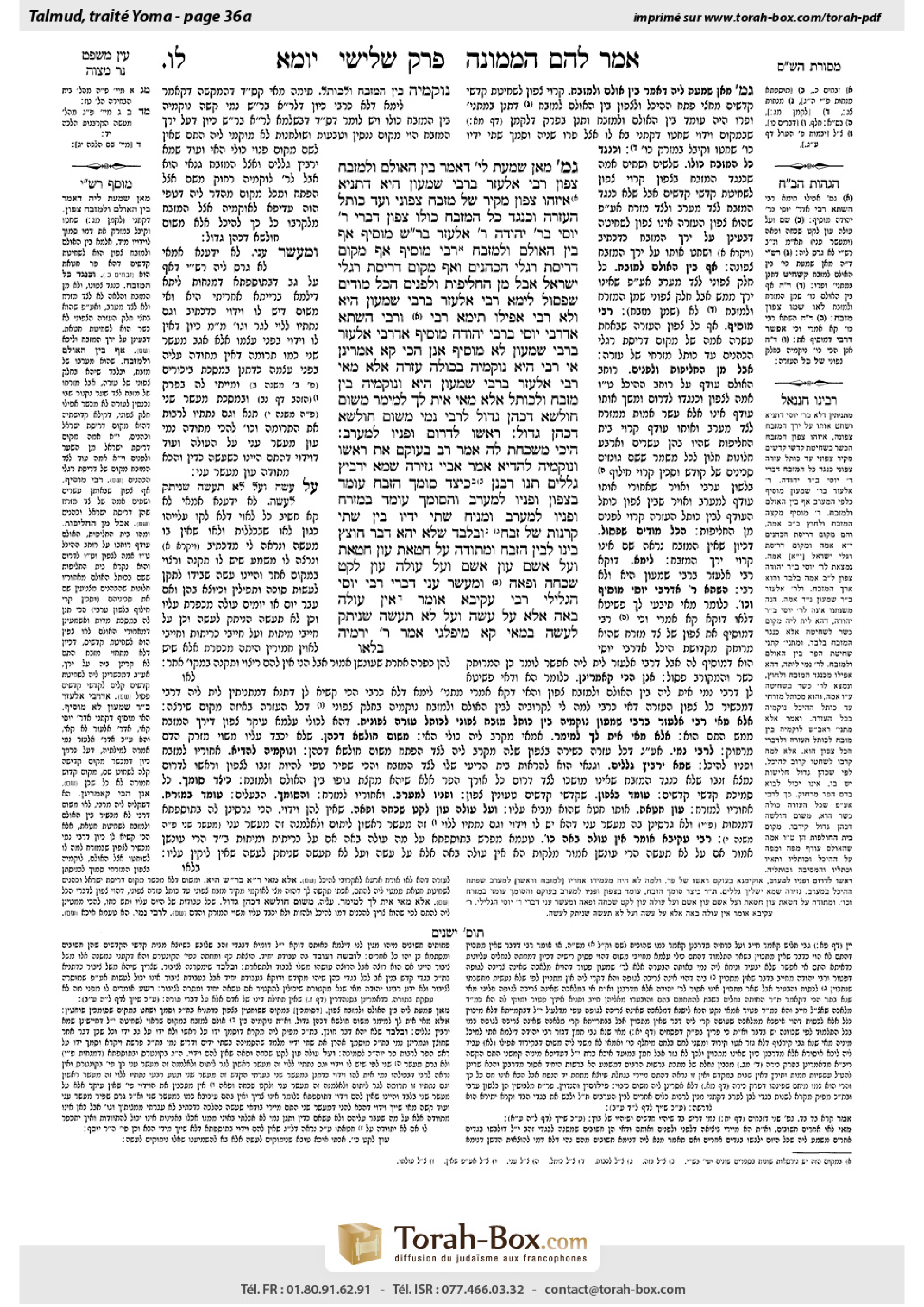
This page of Yoma includes the Aramaic text, an English translation and an AI-generated French translation, alongside the scan above.
יומא ל״ו א · Aramaic and Hebrew text
גְּמָ׳ מַאן שָׁמְעַתְּ לֵיהּ דְּאָמַר בֵּין הָאוּלָם וְלַמִּזְבֵּחַ צָפוֹן —
רַבִּי אֶלְעָזָר בְּרַבִּי שִׁמְעוֹן הִיא. דְּתַנְיָא: אֵיזֶהוּ צָפוֹן — מִקִּיר שֶׁל מִזְבֵּחַ צְפוֹנִי וְעַד כּוֹתֶל הָעֲזָרָה, וּכְנֶגֶד כׇּל הַמִּזְבֵּחַ כּוּלּוֹ צָפוֹן, דִּבְרֵי רַבִּי יוֹסֵי בְּרַבִּי יְהוּדָה. רַבִּי אֶלְעָזָר בְּרַבִּי שִׁמְעוֹן מוֹסִיף אַף בֵּין הָאוּלָם וְלַמִּזְבֵּחַ. רַבִּי מוֹסִיף אַף מְקוֹם דְּרִיסַת רַגְלֵי הַכֹּהֲנִים וְאַף מְקוֹם דְּרִיסַת רַגְלֵי יִשְׂרָאֵל. אֲבָל מִן הַחֲלִיפוֹת וְלִפְנִים הַכֹּל מוֹדִים שֶׁפָּסוּל.
לֵימָא רַבִּי אֶלְעָזָר בְּרַבִּי שִׁמְעוֹן הִיא וְלָא רַבִּי? אֲפִילּוּ תֵּימָא רַבִּי, וְרַבִּי הַשְׁתָּא אַדְּרַבִּי יוֹסֵי בְּרַבִּי יְהוּדָה מוֹסִיף, אַדְּרַבִּי אֶלְעָזָר בְּרַבִּי שִׁמְעוֹן לָא מוֹסִיף?!
אֲנַן הָכִי קָא אָמְרִינַן: אִי רַבִּי הִיא, נוֹקְמֵיהּ בְּכוּלַּהּ עֲזָרָה! אֶלָּא מַאי — רַבִּי אֶלְעָזָר בְּרַבִּי שִׁמְעוֹן הִיא? וְנוֹקְמֵיהּ בֵּין מִזְבֵּחַ וְלַכּוֹתֶל!
אֶלָּא מַאי אִית לָךְ לְמֵימַר — מִשּׁוּם חוּלְשָׁא דְּכֹהֵן גָּדוֹל, לְרַבִּי נָמֵי — מִשּׁוּם חוּלְשָׁא דְּכֹהֵן גָּדוֹל.
רֹאשׁוֹ לַדָּרוֹם וּפָנָיו לַמַּעֲרָב. הֵיכִי מַשְׁכַּחַתְּ לַהּ? אָמַר רַב: בְּעוֹקֵם אֶת רֹאשׁוֹ. וְנוֹקְמֵיהּ לְהֶדְיָא. אָמַר אַבָּיֵי: גְּזֵירָה שֶׁמָּא יַרְבִּיץ גְּלָלִים.
תָּנוּ רַבָּנַן: כֵּיצַד סוֹמֵךְ הַזֶּבַח? עוֹמֵד בַּצָּפוֹן וּפָנָיו לַמַּעֲרָב, וְהַסּוֹמֵךְ עוֹמֵד בַּמִּזְרָח וּפָנָיו לַמַּעֲרָב, וּמַנִּיחַ שְׁתֵּי יָדָיו בֵּין שְׁתֵּי קְרָנוֹת שֶׁל זֶבַח, וּבִלְבַד שֶׁלֹּא יְהֵא דָּבָר חוֹצֵץ בֵּינוֹ לְבֵין הַזֶּבַח, וּמִתְוַדֶּה. עַל חַטָּאת — עֲוֹן חַטָּאת, וְעַל אָשָׁם — עֲוֹן אָשָׁם, וְעַל עוֹלָה — עֲוֹן לֶקֶט שִׁכְחָה וּפֵאָה וּמַעְשַׂר עָנִי, דִּבְרֵי רַבִּי יוֹסֵי הַגְּלִילִי.
רַבִּי עֲקִיבָא אוֹמֵר: אֵין עוֹלָה בָּאָה אֶלָּא עַל עֲשֵׂה, וְעַל לֹא תַעֲשֶׂה שֶׁנִּיתַּק לַעֲשֵׂה.
בְּמַאי קָא מִיפַּלְגִי? אָמַר רַבִּי יִרְמְיָה:
Yoma 36a · English translation
GEMARA: The mishna states that when the High Priest recites his confession, the bull stands between the Entrance Hall to the Sanctuary and the altar, and elsewhere (41b) it is stated that the bull is slaughtered at the place where the confession is recited. Apparently, the place where the confession is recited must be considered north. The Gemara clarifies: About whom did you learn that he said that the area between the Entrance Hall and the altar is considered north and is therefore a valid location for slaughtering offerings of the most sacred order, based on the verse written with regard to the burnt-offering: “On the side of the altar northward” (Leviticus 1:11)?
It is Rabbi Elazar, son of Rabbi Shimon, as it was taught in a baraita: What is the north? It is the area from the northern wall of the altar until the wall of the Temple courtyard. And opposite the entire altar is also considered north; this is the statement of Rabbi Yosei, son of Rabbi Yehuda. And Rabbi Elazar, son of Rabbi Shimon, adds even the area between the Entrance Hall and the altar to the area that is considered north. Rabbi Yehuda HaNasi adds that even the areas to the north in the place where the priests walk, and even areas to the north in the place where the Israelites walk, are considered north in terms of the halakha of slaughtering offerings. However, everyone agrees that the area from the chamber of the knives and inward, which is an area off to the side, is unfit for slaughtering offerings of the most sacred order, as it is not visible from the altar.
The Gemara suggests: Let us say that the mishna is in accordance with the opinion of Rabbi Elazar, son of Rabbi Shimon, and not in accordance with the opinion of Rabbi Yehuda HaNasi. The Gemara rejects this: Even if you say that the mishna is in accordance with the opinion of Rabbi Yehuda HaNasi, now, does Rabbi Yehuda HaNasi add only to the statement of Rabbi Yosei, son of Rabbi Yehuda, but does not add to the statement of Rabbi Elazar, son of Rabbi Shimon? After all, the area deemed north according to Rabbi Elazar, son of Rabbi Shimon, is included in the area deemed north by Rabbi Yehuda HaNasi. Therefore, the mishna could be in accordance with the opinion of Rabbi Yehuda HaNasi as well.
The Gemara reformulates its suggestion: This is what we are saying: If the mishna were in accordance with the opinion of Rabbi Yehuda HaNasi, who holds that the entire courtyard is considered north, let us stand the bull anywhere in the entire courtyard and not necessarily between the Entrance Hall and the altar. The Gemara rejects this: Rather, what do you suggest? The mishna is only in accordance with the opinion of Rabbi Elazar, son of Rabbi Shimon? According to his opinion one could suggest: And let us stand the bull between the altar and the wall, as everyone agrees that this area is considered north.
Rather, what have you to say to explain why the bull is positioned specifically between the Entrance Hall and the altar? It is due to the weakness of the High Priest, so that he need not exert himself and walk long distances on Yom Kippur. According to Rabbi Yehuda HaNasi as well, it is due to the weakness of the High Priest that the bull is positioned specifically there, although it is permitted to position the bull anywhere in the courtyard.
§ The mishna continues: The head of the bull was facing to the south and its face was facing to the west. The Gemara asks: Under what circumstances can a case be found where its head is toward one direction and its face is toward another? Rav said: It is a case where the animal is standing north-south and it turns its head and faces west. The Gemara asks: And let us stand it straight east-west with its back to the altar and its head facing the Sanctuary. Abaye said: It is prohibited due to a decree lest the bull defecate opposite the altar, which is a display of contempt for the altar.
The Sages taught: How does the priest place his hands on the offering? In the offerings of the most sacred order, the animal stands in the north of the courtyard and its face is to the west, and the one who is placing his hands stands to the east of the offering and his face is to the west, and he places his two hands between the two horns of the offering, provided that nothing interposes between his hands and the offering. And he confesses his sins. If the confession is over a sin-offering, he confesses the transgression for which he is bringing the sin-offering, i.e., unwitting violation of a prohibition punishable by karet. And over a guilt-offering he confesses the transgression for which he is bringing the guilt-offering, e.g., theft or misuse of consecrated property. And over a burnt-offering, with regard to which the Torah does not specify for which transgressions it is brought, he confesses the sin of not leaving gleanings, forgotten sheaves, and produce of the corners [pe’a], as well as not separating poor man’s tithe. This is the statement of Rabbi Yosei HaGelili.
Rabbi Akiva says: A burnt-offering is brought only over the failure to fulfill a positive mitzva and over violation of a prohibition that after violation is transformed into a positive mitzva. This refers to all prohibitions followed by positive mitzvot intended to rectify them; e.g., the prohibition against robbery is followed in the Torah by a positive mitzva for the robber to return the object that he stole. These transgressions are not punishable by lashes nor does a human court administer any other form of penalty. However, a burnt-offering is required in order to gain divine atonement for the sinner.
The Gemara asks: With regard to what principle do they disagree? Rabbi Yirmeya said:
Yoma 36a · Traduction française (IA)
GUEMARA : La Michna enseigne que, lorsque le grand prêtre prononce sa confession, le taureau se tient entre le Vestibule du Sanctuaire et l’autel ; ailleurs (41b), il est indiqué que le taureau est égorgé à l’endroit où la confession est prononcée. Il semble donc que cet endroit soit considéré comme situé au nord. La Guemara précise : De qui as-tu appris que la zone située entre le Vestibule et l’autel est considérée comme faisant partie du nord et constitue donc un emplacement valable pour l’égorgement des offrandes de très haute sainteté, conformément au verset relatif à l’holocauste : « Du côté de l’autel, vers le nord » (Lévitique 1, 11) ?
C’est de Rabbi Eléazar, fils de Rabbi Chimon, comme cela a été enseigné dans une baraïta : Qu’est-ce que le nord ? C’est la zone qui s’étend du mur nord de l’autel jusqu’au mur de la cour du Temple. Toute la zone située en face de l’autel est également considérée comme faisant partie du nord ; telle est l’opinion de Rabbi Yossi, fils de Rabbi Yehouda. Rabbi Eléazar, fils de Rabbi Chimon, ajoute que la zone située entre le Vestibule et l’autel est elle aussi considérée comme faisant partie du nord. Rabbi Yehouda HaNassi ajoute que les zones situées au nord, là où les prêtres circulent, ainsi que celles situées au nord, là où les Israélites circulent, sont elles aussi considérées comme faisant partie du nord pour la halakha de l’égorgement des offrandes. Toutefois, tous conviennent que la zone allant de la chambre des couteaux vers l’intérieur, située sur le côté, ne convient pas à l’égorgement des offrandes de très haute sainteté, car elle n’est pas visible depuis l’autel.
La Guemara suggère : Disons que la Michna suit l’opinion de Rabbi Eléazar, fils de Rabbi Chimon, et non celle de Rabbi Yehouda HaNassi. La Guemara rejette cette hypothèse : Même si tu dis que la Michna suit l’opinion de Rabbi Yehouda HaNassi, celui-ci n’ajouterait-il qu’à l’opinion de Rabbi Yossi, fils de Rabbi Yehouda, sans rien ajouter à celle de Rabbi Eléazar, fils de Rabbi Chimon ? En effet, la zone considérée comme faisant partie du nord selon Rabbi Eléazar, fils de Rabbi Chimon, est incluse dans celle que Rabbi Yehouda HaNassi considère comme faisant partie du nord. La Michna pourrait donc également suivre l’opinion de Rabbi Yehouda HaNassi.
La Guemara reformule sa suggestion : Voici ce que nous voulons dire : si la Michna suivait l’opinion de Rabbi Yehouda HaNassi, selon laquelle toute la cour est considérée comme faisant partie du nord, le taureau pourrait être placé n’importe où dans la cour, et pas nécessairement entre le Vestibule et l’autel. La Guemara rejette cette objection : Alors, que proposes-tu ? Que la Michna suive uniquement l’opinion de Rabbi Eléazar, fils de Rabbi Chimon ? Selon son opinion, on pourrait suggérer de placer le taureau entre l’autel et le mur, puisque tous conviennent que cette zone est considérée comme faisant partie du nord.
Alors, que peux-tu répondre pour expliquer pourquoi le taureau est placé précisément entre le Vestibule et l’autel ? C’est en raison de la faiblesse du grand prêtre, afin qu’il n’ait pas à se fatiguer en parcourant de longues distances le jour de Yom Kippour. Selon Rabbi Yehouda HaNassi également, le taureau est placé précisément à cet endroit en raison de la faiblesse du grand prêtre, bien qu’il soit permis de le placer n’importe où dans la cour.
§ La Michna poursuit : La tête du taureau était tournée vers le sud et sa face vers l’ouest. La Guemara demande : Dans quelles circonstances peut-on trouver un cas où sa tête est dirigée dans une direction et sa face dans une autre ? Rav répond : L’animal se tient dans l’axe nord-sud, puis tourne la tête et regarde vers l’ouest. La Guemara demande : Pourquoi ne pas le placer dans l’axe est-ouest, le dos tourné vers l’autel et la tête vers le Sanctuaire ? Abayé répond : C’est interdit par décret, de peur que le taureau ne défèque en face de l’autel, ce qui manifesterait du mépris pour celui-ci.
Les Sages ont enseigné : Comment le prêtre pose-t-il ses mains sur l’offrande ? Pour les offrandes de très haute sainteté, l’animal se tient au nord de la cour, la face tournée vers l’ouest ; celui qui pose les mains se tient à l’est de l’offrande, la face tournée vers l’ouest, et pose ses deux mains entre les deux cornes de l’offrande, à condition que rien ne s’interpose entre ses mains et l’offrande. Puis il confesse ses péchés. Si sa confession porte sur un sacrifice expiatoire, il confesse la transgression pour laquelle il apporte ce sacrifice, c’est-à-dire la violation involontaire d’une interdiction passible de karet. Pour un sacrifice de culpabilité, il confesse la transgression pour laquelle il apporte ce sacrifice, par exemple un vol ou l’usage illicite de biens consacrés. Quant à l’holocauste, pour lequel la Torah ne précise pas quelles transgressions en motivent l’offrande, il confesse le péché consistant à ne pas laisser les glanures, les gerbes oubliées et les produits des coins [pe’a], ainsi qu’à ne pas prélever la dîme des pauvres. Telle est l’opinion de Rabbi Yossi HaGelili.
Rabbi Akiva dit : Un holocauste n’est apporté qu’en raison du manquement à une mitsva positive ou de la violation d’une interdiction qui, une fois transgressée, se transforme en mitsva positive. Cela désigne toutes les interdictions auxquelles succèdent des mitsvot positives destinées à les réparer ; par exemple, l’interdiction du vol est suivie dans la Torah d’une mitsva positive imposant au voleur de restituer l’objet volé. Ces transgressions ne sont passibles ni de coups de fouet ni d’aucune autre peine infligée par un tribunal humain. Toutefois, un holocauste est nécessaire pour que le pécheur obtienne l’expiation divine.
La Guemara demande : Sur quel principe portent leurs divergences ? Rabbi Yirmeya dit :
Traduction française générée par IA à partir de l’édition anglaise de Sefaria. Vérifie toujours un passage avec le texte source.
Text from Sefaria: William Davidson Edition - Vocalized Aramaic (CC BY NC); William Davidson Edition - English (CC BY NC).