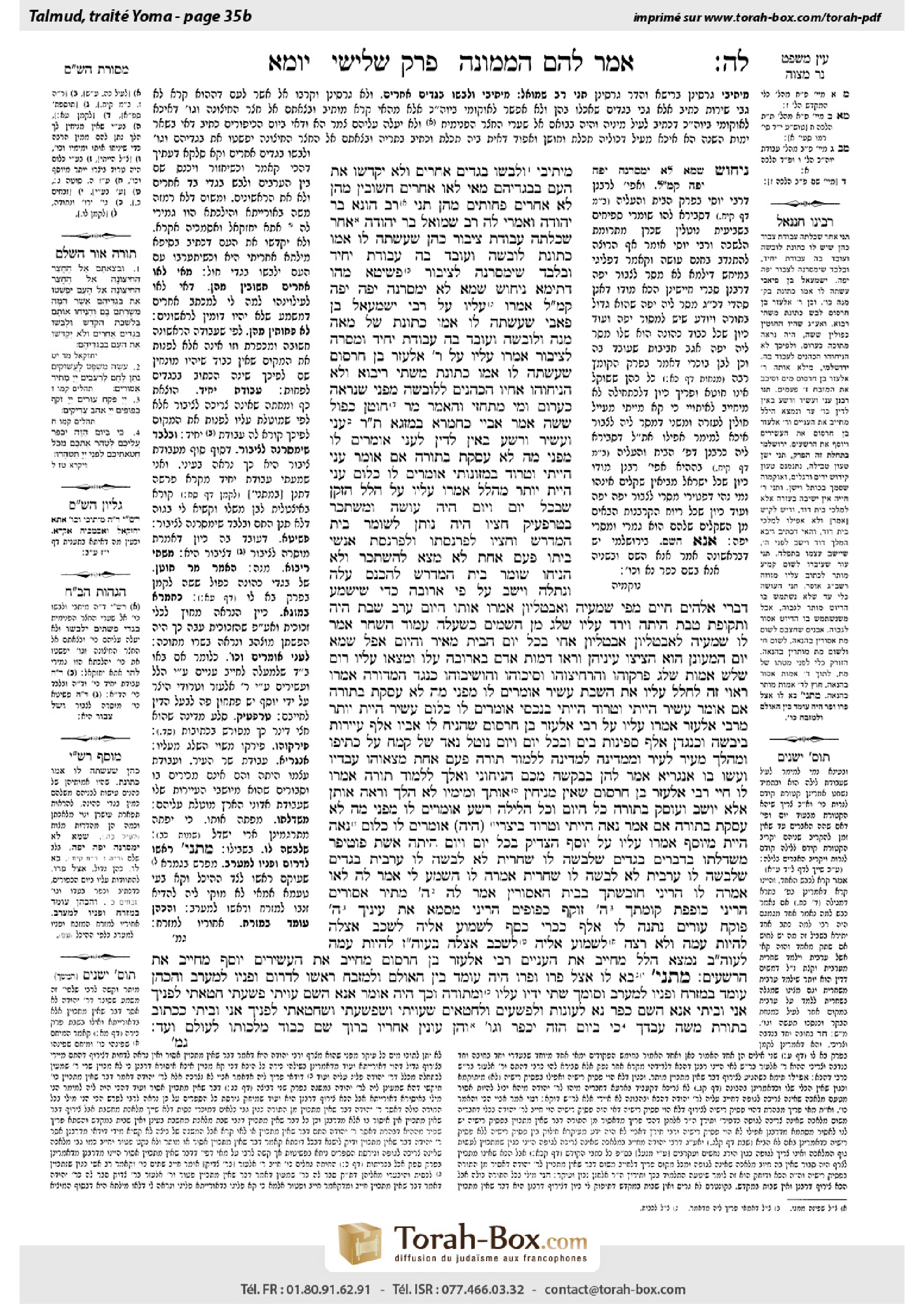
Yoma 35b: Talmud study for Daf Yomi
Daf Yomi is the daily study of one Talmud folio. Explore 37 tractates with scans, Hebrew text, Sefaria English and AI-generated French translations where annotated.
Passage selection and English or AI-generated French translation are available where the scan has annotations. Daf Study is independent of Torah-Box and Sefaria.
Browse Yoma · יומא · All tractatesYoma 35b text and translations
This page of Yoma includes the Aramaic text, an English translation and an AI-generated French translation, alongside the scan above.
יומא ל״ה ב · Aramaic and Hebrew text
מֵיתִיבִי: ״וְלָבְשׁוּ בְּגָדִים אֲחֵרִים וְלֹא יְקַדְּשׁוּ אֶת הָעָם בְּבִגְדֵיהֶם״,
מַאי לָאו ״אֲחֵרִים״ — חֲשׁוּבִין מֵהֶן! לֹא, ״אֲחֵרִים״ — פְּחוּתִים מֵהֶן.
תָּנֵי רַב הוּנָא בַּר יְהוּדָה, וְאָמְרִי לַהּ רַב שְׁמוּאֵל בַּר יְהוּדָה: אַחַר שֶׁכָּלְתָה עֲבוֹדַת צִיבּוּר, כֹּהֵן שֶׁעָשְׂתָה לוֹ אִמּוֹ כְּתוֹנֶת — לוֹבְשָׁהּ, וְעוֹבֵד בָּהּ עֲבוֹדַת יָחִיד, וּבִלְבַד שֶׁיִּמְסְרֶנָּה לַצִּיבּוּר. פְּשִׁיטָא?
מַהוּ דְּתֵימָא נֵיחוּשׁ שֶׁמָּא לֹא יִמְסְרֶנָּה יָפֶה יָפֶה, קָא מַשְׁמַע לַן. אָמְרוּ עָלָיו עַל רַבִּי יִשְׁמָעֵאל בֶּן פִּאָבִי שֶׁעָשְׂתָה לוֹ אִמּוֹ כְּתוֹנֶת שֶׁל מֵאָה מָנֶה, וְלוֹבְשָׁהּ וְעוֹבֵד בָּהּ עֲבוֹדַת יָחִיד, וּמְסָרָהּ לַצִּיבּוּר.
אָמְרוּ עָלָיו עַל רַבִּי אֶלְעָזָר בֶּן חַרְסוֹם שֶׁעָשְׂתָה לוֹ אִמּוֹ כְּתוֹנֶת מִשְׁתֵּי רִיבּוֹא, וְלֹא הֱנִיחוּהוּ אֶחָיו הַכֹּהֲנִים לְלוֹבְשָׁהּ מִפְּנֵי שֶׁנִּרְאָה כְּעָרוֹם. וּמִי מִתְחֲזֵי? וְהָאָמַר מָר: חוּטָן כָּפוּל שִׁשָּׁה! אָמַר אַבָּיֵי: כְּחַמְרָא בְּמִזְגָּא.
תָּנוּ רַבָּנַן: עָנִי וְעָשִׁיר וְרָשָׁע בָּאִין לַדִּין, לֶעָנִי אוֹמְרִים לוֹ: מִפְּנֵי מָה לֹא עָסַקְתָּ בַּתּוֹרָה? אִם אוֹמֵר: עָנִי הָיִיתִי, וְטָרוּד בִּמְזוֹנוֹתַי, אוֹמְרִים לוֹ: כְּלוּם עָנִי הָיִיתָ יוֹתֵר מֵהִלֵּל?
אָמְרוּ עָלָיו עַל הִלֵּל הַזָּקֵן שֶׁבְּכׇל יוֹם וָיוֹם הָיָה עוֹשֶׂה וּמִשְׂתַּכֵּר בִּטְרַפָּעִיק, חֶצְיוֹ הָיָה נוֹתֵן לְשׁוֹמֵר בֵּית הַמִּדְרָשׁ, וְחֶצְיוֹ לְפַרְנָסָתוֹ וּלְפַרְנָסַת אַנְשֵׁי בֵיתוֹ. פַּעַם אַחַת לֹא מָצָא לְהִשְׂתַּכֵּר, וְלֹא הִנִּיחוֹ שׁוֹמֵר בֵּית הַמִּדְרָשׁ לְהִכָּנֵס. עָלָה וְנִתְלָה וְיָשַׁב עַל פִּי אֲרוּבָּה כְּדֵי שֶׁיִּשְׁמַע דִּבְרֵי אֱלֹהִים חַיִּים מִפִּי שְׁמַעְיָה וְאַבְטַלְיוֹן.
אָמְרוּ: אוֹתוֹ הַיּוֹם עֶרֶב שַׁבָּת הָיָה, וּתְקוּפַת טֵבֵת הָיְתָה, וְיָרַד עָלָיו שֶׁלֶג מִן הַשָּׁמַיִם. כְּשֶׁעָלָה עַמּוּד הַשַּׁחַר אָמַר לוֹ שְׁמַעְיָה לְאַבְטַלְיוֹן: אַבְטַלְיוֹן אָחִי, בְּכׇל יוֹם הַבַּיִת מֵאִיר וְהַיּוֹם אָפֵל, שֶׁמָּא יוֹם הַמְעוּנָּן הוּא? הֵצִיצוּ עֵינֵיהֶן וְרָאוּ דְּמוּת אָדָם בַּאֲרוּבָּה. עָלוּ וּמָצְאוּ עָלָיו רוּם שָׁלֹשׁ אַמּוֹת שֶׁלֶג. פֵּרְקוּהוּ, וְהִרְחִיצוּהוּ וְסָכוּהוּ, וְהוֹשִׁיבוּהוּ כְּנֶגֶד הַמְּדוּרָה. אָמְרוּ: רָאוּי זֶה לְחַלֵּל עָלָיו אֶת הַשַּׁבָּת.
עָשִׁיר, אוֹמְרִים לוֹ: מִפְּנֵי מָה לֹא עָסַקְתָּ בַּתּוֹרָה? אִם אוֹמֵר: עָשִׁיר הָיִיתִי וְטָרוּד הָיִיתִי בִּנְכָסַי. אוֹמְרִים לוֹ: כְּלוּם עָשִׁיר הָיִיתָ יוֹתֵר מֵרַבִּי אֶלְעָזָר? אָמְרוּ עָלָיו עַל רַבִּי אֶלְעָזָר בֶּן חַרְסוֹם שֶׁהִנִּיחַ לוֹ אָבִיו אֶלֶף עֲיָירוֹת בַּיַּבָּשָׁה, וּכְנֶגְדָּן אֶלֶף סְפִינוֹת בַּיָּם. וּבְכׇל יוֹם וָיוֹם נוֹטֵל נֹאד שֶׁל קֶמַח עַל כְּתֵיפוֹ וּמְהַלֵּךְ מֵעִיר לְעִיר וּמִמְּדִינָה לִמְדִינָה לִלְמוֹד תּוֹרָה.
פַּעַם אַחַת מְצָאוּהוּ עֲבָדָיו, וְעָשׂוּ בּוֹ אַנְגַּרְיָא. אָמַר לָהֶן: בְּבַקָּשָׁה מִכֶּם, הַנִּיחוּנִי וְאֵלֵךְ לִלְמוֹד תּוֹרָה. אָמְרוּ לוֹ: חַיֵּי רַבִּי אֶלְעָזָר בֶּן חַרְסוֹם שֶׁאֵין מַנִּיחִין אוֹתְךָ. וּמִיָּמָיו לֹא הָלַךְ וְרָאָה אוֹתָן, אֶלָּא יוֹשֵׁב וְעוֹסֵק בַּתּוֹרָה כׇּל הַיּוֹם וְכׇל הַלַּיְלָה.
רָשָׁע, אוֹמְרִים לוֹ: מִפְּנֵי מָה לֹא עָסַקְתָּ בַּתּוֹרָה? אִם אָמַר: נָאֶה הָיִיתִי, וְטָרוּד בְּיִצְרִי, (הָיָה) אוֹמְרִים לוֹ: כְּלוּם נָאֶה הָיִיתָ מִיּוֹסֵף? אָמְרוּ עָלָיו עַל יוֹסֵף הַצַּדִּיק: בְּכׇל יוֹם וָיוֹם הָיְתָה אֵשֶׁת פּוֹטִיפַר מְשַׁדַּלְתּוֹ בִּדְבָרִים. בְּגָדִים שֶׁלָּבְשָׁה לוֹ שַׁחֲרִית לֹא לָבְשָׁה לוֹ עַרְבִית. בְּגָדִים שֶׁלָּבְשָׁה לוֹ עַרְבִית לֹא לָבְשָׁה לוֹ שַׁחֲרִית.
אָמְרָה לוֹ: הִשָּׁמַע לִי! אָמַר לָהּ: לָאו. אָמְרָה לוֹ: הֲרֵינִי חוֹבַשְׁתְּךָ בְּבֵית הָאֲסוּרִין! אָמַר לָהּ: ״ה׳ מַתִּיר אֲסוּרִים״. הֲרֵינִי כּוֹפֶפֶת קוֹמָתְךָ! ״ה׳ זוֹקֵף כְּפוּפִים״. הֲרֵינִי מְסַמָּא אֶת עֵינֶיךָ! ״ה׳ פּוֹקֵחַ עִוְרִים״. נָתְנָה לוֹ אֶלֶף כִּכְּרֵי כֶסֶף לִשְׁמוֹעַ אֵלֶיהָ ״לִשְׁכַּב אֶצְלָהּ לִהְיוֹת עִמָּהּ״, וְלֹא רָצָה לִשְׁמוֹעַ אֵלֶיהָ.
״לִשְׁכַּב אֶצְלָהּ״ בָּעוֹלָם הַזֶּה, ״לִהְיוֹת עִמָּהּ״ לָעוֹלָם הַבָּא. נִמְצָא: הִלֵּל מְחַיֵּיב אֶת הָעֲנִיִּים, רַבִּי אֶלְעָזָר בֶּן חַרְסוֹם מְחַיֵּיב אֶת הָעֲשִׁירִים, יוֹסֵף מְחַיֵּיב אֶת הָרְשָׁעִים.
מַתְנִי׳ בָּא לוֹ אֵצֶל פָּרוֹ, וּפָרוֹ הָיָה עוֹמֵד בֵּין הָאוּלָם וְלַמִּזְבֵּחַ, רֹאשׁוֹ לַדָּרוֹם וּפָנָיו לַמַּעֲרָב. וְהַכֹּהֵן עוֹמֵד בַּמִּזְרָח וּפָנָיו לַמַּעֲרָב. וְסוֹמֵךְ שְׁתֵּי יָדָיו עָלָיו, וּמִתְוַדֶּה.
וְכָךְ הָיָה אוֹמֵר: אָנָא הַשֵּׁם! עָוִיתִי, פָּשַׁעְתִּי, חָטָאתִי לְפָנֶיךָ אֲנִי וּבֵיתִי. אָנָא הַשֵּׁם! כַּפֶּר נָא לָעֲוֹנוֹת וְלַפְּשָׁעִים וְלַחֲטָאִים שֶׁעָוִיתִי וְשֶׁפָּשַׁעְתִּי וְשֶׁחָטָאתִי לְפָנֶיךָ אֲנִי וּבֵיתִי, כַּכָּתוּב בְּתוֹרַת מֹשֶׁה עַבְדֶּךָ: ״כִּי בַיּוֹם הַזֶּה יְכַפֵּר וְגוֹ׳״. וְהֵן עוֹנִין אַחֲרָיו: ״בָּרוּךְ שֵׁם כְּבוֹד, מַלְכוּתוֹ לְעוֹלָם וָעֶד״.
Yoma 35b · English translation
The Gemara raises an objection. It is stated: “And it shall be that when they enter in at the gates of the inner court, they shall be clothed with linen garments; and no wool shall come upon them, while they minister in the gates of the inner court, and within” (Ezekiel 44:17). This verse is referring to the Yom Kippur service, as during the year the High Priest performed the service in eight priestly vestments made partially of wool. Two verses later the prophet says: “And when they go forth into the outer court, into the outer court to the people, they shall remove their garments in which they serve, and lay them in the sacred chambers, and they shall put on other garments, so that they do not sanctify the people with their garments” (Ezekiel 44:19).
The Gemara infers: What, doesn’t “other” mean more important than the first set of linen garments? The Gemara rejects this: No, although “other” means different garments, it means garments inferior to them, the first set of linen garments. The High Priest does not don a second set of garments to effect atonement; rather, he dons them in deference to God to remove the spoon and the coal pan from the Holy of Holies.
Rav Huna bar Yehuda, and some say Rav Shmuel bar Yehuda, taught: After the public service concluded, a priest whose mother had made him a priestly tunic may wear it and perform an individual service while wearing it, such as removal of the spoon and the coal pan, which is not a service in and of itself, provided he transfers it to the possession of the public. All services performed by the priest must be performed while he is wearing sacred garments owned by the public, as all the Temple vessels are. The Gemara asks: This is obvious; once he transfers it to the possession of the public, it is Temple property like any other vessel that an individual donates to the Temple. What is novel in this statement?
The Gemara answers: Lest you say that the concern is that since he is the one wearing it perhaps he will intend to retain ownership and will not transfer it wholeheartedly; therefore, it teaches us that if he transfers possession to the public, that is not a concern. Apropos this halakha, the Gemara relates: They said about the High Priest Rabbi Yishmael ben Pabi that his mother made him a tunic worth one hundred maneh. He donned it and performed an individual service and transferred possession of it to the public.
And similarly, they said about the High Priest Rabbi Elazar ben Ḥarsum that his mother made him a tunic worth twenty thousand dinars, but his fellow priests did not allow him to wear it because it was transparent and he appeared as one who is naked. The Gemara asks: And could he be seen through a garment made to the specifications of the priestly vestments? Didn’t the Master say: The threads of the priestly vestments were six-fold? Since the clothes were woven from threads that thick, his body could not have been seen through them. Abaye said: It is like wine in a thick glass cup. His flesh could not actually be seen, but since it was very fine linen, it was somewhat translucent and his skin color was discernible.
§ Apropos the great wealth of Rabbi Elazar ben Ḥarsum, the Gemara cites that which the Sages taught: A poor person, and a wealthy person, and a wicked person come to face judgment before the Heavenly court for their conduct in this world. To the poor person, the members of the court say: Why did you not engage in Torah? If he rationalizes his conduct and says: I was poor and preoccupied with earning enough to pay for my sustenance and that is why I did not engage in Torah study, they say to him: Were you any poorer than Hillel, who was wretchedly poor and nevertheless attempted to study Torah?
They said about Hillel the Elder that each and every day he would work and earn a half-dinar, half of which he would give to the guard of the study hall and half of which he spent for his sustenance and the sustenance of the members of his family. One time he did not find employment to earn a wage, and the guard of the study hall did not allow him to enter. He ascended to the roof, suspended himself, and sat at the edge of the skylight in order to hear the words of the Torah of the living God from the mouths of Shemaya and Avtalyon, the spiritual leaders of that generation.
The Sages continued and said: That day was Shabbat eve and it was the winter season of Tevet, and snow fell upon him from the sky. When it was dawn, Shemaya said to Avtalyon: Avtalyon, my brother, every day at this hour the study hall is already bright from the sunlight streaming through the skylight, and today it is dark; is it perhaps a cloudy day? They focused their eyes and saw the image of a man in the skylight. They ascended and found him covered with snow three cubits high. They extricated him from the snow, and they washed him and smeared oil on him, and they sat him opposite the bonfire to warm him. They said: This man is worthy for us to desecrate Shabbat for him. Saving a life overrides Shabbat in any case; however, this great man is especially deserving. Clearly, poverty is no excuse for the failure to attempt to study Torah.
And if a wealthy man comes before the heavenly court, the members of the court say to him: Why did you not engage in Torah? If he says: I was wealthy and preoccupied with managing my possessions, they say to him: Were you any wealthier than Rabbi Elazar, who was exceedingly wealthy and nevertheless studied Torah? They said about Rabbi Elazar ben Ḥarsum that his father left him an inheritance of one thousand villages on land, and corresponding to them, one thousand ships at sea. And each and every day he takes a leather jug of flour on his shoulder and walks from city to city and from state to state to study Torah from the Torah scholars in each of those places.
One time as he passed through the villages in his estate and his servants found him, did not recognize him, and, thinking he was a resident of the town, they pressed him into service [angarya] for the master of the estate. He said to them: I beseech you; let me be and I will go study Torah. They said: We swear by the life of Rabbi Elazar ben Ḥarsum that we will not let you be. The Gemara comments: And in all his days, he never went and saw all his possessions and his property; rather, he would sit and engage in the study of Torah all day and all night.
And if a wicked man comes to judgment, the members of the court say to him: Why did you not engage in Torah? If he said: I was handsome and preoccupied with my evil inclination, as I had many temptations, they say to him: Were you any more handsome than Joseph, who did not neglect Torah despite his beauty? They said about Joseph the righteous: Each and every day, the wife of Potiphar seduced him with words. In addition, the clothes that she wore to entice him in the morning, she did not wear to entice him in the evening. The clothes that she wore to entice him in the evening, she did not wear to entice him in the morning of the next day.
One day she said to him: Submit to me and have relations with me.
He said to her: No.
She said to him: I will incarcerate you in the prison. He said to her: I do not fear you, as it is stated: “God releases prisoners” (Psalms 146:7).
She said to him: I will cause you to be bent over with suffering.
He said: “God straightens those who are bent over” (Psalms 146:8).
She said I will blind your eyes.
He said to her “God opens the eyes of the blind” (Psalms 146:8).
She gave him a thousand talents of silver to submit to her, “to lie with her and be with her” (Genesis 39:10), and he refused.
The Gemara elaborates: Had he submitted to her to lie with her in this world, it would have been decreed in Heaven that he would be with her in the World-to-Come. Therefore, he refused. Consequently, Hillel obligates the poor to study Torah, Rabbi Elazar ben Ḥarsum obligates the wealthy, and Joseph obligates the wicked. For each category of people, there is a role model who overcame his preoccupations and temptations to study Torah.
MISHNA: The High Priest comes and stands next to his bull, and his bull was standing between the Entrance Hall and the altar with its head facing to the south and its face to the west. And the priest stands to the east of the bull, and his face points to the west. And the priest places his two hands on the bull and confesses.
And this is what he would say in his confession: Please, God, I have sinned, I have done wrong, and I have rebelled before You, I and my family. Please, God, grant atonement, please, for the sins, and for the wrongs, and for the rebellions that I have sinned, and done wrong, and rebelled before You, I and my family, as it is written in the Torah of Moses your servant: “For on this day atonement shall be made for you to cleanse you of all your sins; you shall be clean before the Lord” (Leviticus 16:30). And the priests and the people who were in the courtyard respond after he recites the name of God: Blessed be the name of His glorious kingdom forever and all time.
Yoma 35b · Traduction française (IA)
La Guemara soulève une objection. Il est dit : « Lorsque les prêtres entreront par les portes de la cour intérieure, ils seront vêtus de vêtements de lin ; aucune laine ne devra venir sur eux lorsqu’ils officieront aux portes de la cour intérieure et à l’intérieur » (Ézéchiel 44, 17). Ce verset fait référence au service de Yom Kippour, car, au cours de l’année, le grand prêtre accomplissait le service avec huit vêtements sacerdotaux, dont certains étaient faits en partie de laine. Deux versets plus loin, le prophète dit : « Lorsqu’ils sortiront vers la cour extérieure, vers la cour extérieure destinée au peuple, ils retireront les vêtements avec lesquels ils officient et les déposeront dans les chambres sacrées ; puis ils revêtiront d’autres vêtements, afin de ne pas sanctifier le peuple par leurs vêtements » (Ézéchiel 44, 19).
La Guemara en déduit : le terme « autres » ne signifie-t-il pas des vêtements plus importants que le premier ensemble de vêtements de lin ? La Guemara rejette cette interprétation : non, bien que « autres » désigne des vêtements différents, il s’agit de vêtements inférieurs au premier ensemble de vêtements de lin. Le grand prêtre ne revêt pas un second ensemble de vêtements pour obtenir l’expiation ; il les revêt par déférence envers Dieu, afin de retirer la cuillère et le brasero du Saint des saints.
Rav Houna bar Yehouda — et certains disent Rav Chemouel bar Yehouda — enseigna : Une fois le service public achevé, un prêtre dont la mère lui a confectionné une tunique sacerdotale peut la porter et accomplir un service individuel vêtu de celle-ci, comme le retrait de la cuillère et du brasero, qui ne constitue pas un service en soi, à condition qu’il en transfère la propriété au public. Tous les services accomplis par le prêtre doivent l’être avec des vêtements sacrés appartenant au public, comme tous les ustensiles du Temple. La Guemara demande : Cela va de soi ; dès lors qu’il en transfère la propriété au public, elle devient un bien du Temple, comme tout autre ustensile qu’un particulier offre au Temple. Quelle nouveauté cette déclaration apporte-t-elle ?
La Guemara répond : On aurait pu penser que, puisqu’il la porte lui-même, il pourrait avoir l’intention d’en conserver la propriété et ne pas la transférer de tout son cœur. Cet enseignement nous apprend donc que, s’il en transfère la propriété au public, il n’y a pas lieu de s’inquiéter. À propos de cette halakha, la Guemara rapporte : On disait du grand prêtre Rabbi Yichmaël ben Pabi que sa mère lui avait confectionné une tunique valant cent maneh. Il la revêtit, accomplit un service individuel et en transféra la propriété au public.
De même, on disait du grand prêtre Rabbi Elazar ben Ḥarsoum que sa mère lui avait confectionné une tunique valant vingt mille dinars, mais ses collègues prêtres ne l’avaient pas laissé la porter, car elle était transparente et il semblait nu. La Guemara demande : Pouvait-on voir à travers un vêtement confectionné selon les spécifications des vêtements sacerdotaux ? Le Maître n’a-t-il pas enseigné que les fils des vêtements sacerdotaux étaient à six brins ? Comme les vêtements étaient tissés avec des fils aussi épais, on n’aurait pas pu voir son corps au travers. Abayé dit : C’est comme du vin dans une coupe de verre épais. On ne pouvait pas voir sa chair à proprement parler, mais, comme le lin était très fin, le vêtement était quelque peu translucide et la couleur de sa peau était perceptible.
§ À propos de la grande richesse de Rabbi Elazar ben Ḥarsoum, la Guemara cite ce que les Sages ont enseigné : Un pauvre, un riche et un méchant comparaissent devant le tribunal céleste pour répondre de leur conduite dans ce monde. Aux pauvres, les membres du tribunal disent : Pourquoi ne vous êtes-vous pas consacrés à la Torah ? S’il justifie sa conduite en disant : « J’étais pauvre et préoccupé par le fait de gagner suffisamment pour subvenir à mes besoins ; c’est pourquoi je ne me suis pas consacré à l’étude de la Torah », ils lui disent : « Étais-tu plus pauvre que Hillel, qui vivait dans une misère extrême et tentait néanmoins d’étudier la Torah ? »
On disait de Hillel l’Ancien que chaque jour, il travaillait et gagnait un demi-dinar ; il en donnait la moitié au gardien de la maison d’étude et consacrait l’autre moitié à sa subsistance et à celle des membres de sa famille. Un jour, il ne trouva pas de travail rémunéré, et le gardien de la maison d’étude ne le laissa pas entrer. Il monta sur le toit, se suspendit et s’assit au bord de la lucarne afin d’entendre les paroles de la Torah du Dieu vivant prononcées par Chemaya et Avtalyon, les dirigeants spirituels de cette génération.
Les Sages poursuivirent : Ce jour-là était la veille de Chabbat, en hiver, au mois de Tevet, et la neige tombait du ciel sur lui. À l’aube, Chemaya dit à Avtalyon : « Avtalyon, mon frère, chaque jour à cette heure, la maison d’étude est déjà éclairée par le soleil qui entre par la lucarne ; aujourd’hui, il fait sombre. Serait-ce un jour nuageux ? » Ils levèrent les yeux et aperçurent la silhouette d’un homme dans la lucarne. Ils montèrent et le trouvèrent recouvert de neige sur une hauteur de trois coudées. Ils le dégagèrent de la neige, le lavèrent, l’enduisirent d’huile, puis l’assirent en face du feu pour le réchauffer. Ils dirent : « Cet homme mérite que nous profanions Chabbat pour lui. » Sauver une vie l’emporte de toute façon sur Chabbat ; toutefois, cet homme éminent le mérite tout particulièrement. Il est donc clair que la pauvreté n’excuse pas de ne pas tenter d’étudier la Torah.
Et si un homme riche comparaît devant le tribunal céleste, les membres du tribunal lui disent : Pourquoi ne t’es-tu pas consacré à la Torah ? S’il répond : « J’étais riche et préoccupé par la gestion de mes biens », ils lui disent : « Étais-tu plus riche que Rabbi Elazar, qui était extrêmement riche et étudiait néanmoins la Torah ? » On disait de Rabbi Elazar ben Ḥarsoum que son père lui avait laissé en héritage mille villages sur la terre et, en correspondance, mille navires en mer. Chaque jour, il prenait sur son épaule une outre de cuir remplie de farine et allait de ville en ville et de province en province pour étudier la Torah auprès des érudits en Torah de chacun de ces endroits.
Un jour, alors qu’il traversait les villages de son domaine, ses serviteurs le trouvèrent, ne le reconnurent pas et, le prenant pour un habitant du village, le réquisitionnèrent [angarya] au service du maître du domaine. Il leur dit : « Je vous en prie, laissez-moi partir et j’irai étudier la Torah. » Ils lui répondirent : « Nous jurons par la vie de Rabbi Elazar ben Ḥarsoum que nous ne te laisserons pas partir. » La Guemara commente : De toute sa vie, il ne vint jamais voir l’ensemble de ses biens et de ses propriétés ; il s’asseyait plutôt pour étudier la Torah jour et nuit.
Et si un méchant comparaît devant le tribunal, les membres du tribunal lui disent : Pourquoi ne t’es-tu pas consacré à la Torah ? S’il répond : « J’étais beau et préoccupé par mon mauvais penchant, car j’étais en proie à de nombreuses tentations », ils lui disent : « Étais-tu plus beau que Joseph, qui ne négligea pas la Torah malgré sa beauté ? » On disait de Joseph le juste que, chaque jour, la femme de Potiphar le séduisait par ses paroles. De plus, les vêtements qu’elle portait le matin pour le tenter, elle ne les portait pas le soir pour le tenter. Et les vêtements qu’elle portait le soir pour le tenter, elle ne les portait pas le lendemain matin.
Un jour, elle lui dit : « Cède à mes avances et couche avec moi. » Il lui répondit : « Non. » Elle lui dit : « Je te ferai emprisonner. » Il lui répondit : « Je n’ai pas peur de toi, car il est dit : “L’Éternel délivre les prisonniers” » (Psaumes 146, 7). Elle lui dit : « Je te ferai plier sous la souffrance. » Il répondit : « “L’Éternel redresse ceux qui sont courbés” » (Psaumes 146, 8). Elle lui dit : « Je te rendrai aveugle. » Il lui répondit : « “L’Éternel ouvre les yeux des aveugles” » (Psaumes 146, 8). Elle lui offrit mille talents d’argent pour qu’il cède à ses avances, « pour coucher avec elle et être avec elle » (Genèse 39, 10), mais il refusa.
La Guemara développe : S’il avait cédé à ses avances et couché avec elle dans ce monde, il aurait été décrété dans le Ciel qu’il serait avec elle dans le Monde à venir. C’est pourquoi il refusa. Ainsi, Hillel rend les pauvres responsables, Rabbi Elazar ben Ḥarsoum rend les riches responsables, et Joseph rend les méchants responsables. Pour chacune de ces catégories de personnes, il existe un modèle qui a surmonté ses préoccupations et ses tentations afin d’étudier la Torah.
MICHNA : Le grand prêtre vient se tenir près de son taureau, qui se tient entre le Vestibule et l’autel, la tête tournée vers le sud et la face vers l’ouest. Le prêtre se tient à l’est du taureau, le visage tourné vers l’ouest. Il pose ses deux mains sur le taureau et se confesse.
Voici les paroles qu’il prononçait dans sa confession : « De grâce, Éternel, j’ai péché, j’ai commis une faute et je me suis rebellé devant Toi, moi et ma famille. De grâce, Éternel, accorde, je T’en prie, l’expiation pour les péchés, les fautes et les rébellions que j’ai commis, que j’ai fauté et pour lesquels je me suis rebellé devant Toi, moi et ma famille, comme il est écrit dans la Torah de Moïse, ton serviteur : “Car en ce jour, il sera fait expiation pour vous afin de vous purifier de tous vos péchés ; vous serez purs devant l’Éternel” » (Lévitique 16, 30). Les prêtres et le peuple présents dans la cour répondaient après qu’il avait prononcé le nom de Dieu : « Béni soit le nom de Son royaume glorieux à jamais et pour toute éternité. »
Traduction française générée par IA à partir de l’édition anglaise de Sefaria. Vérifie toujours un passage avec le texte source.
Text from Sefaria: William Davidson Edition - Vocalized Aramaic (CC BY NC); William Davidson Edition - English (CC BY NC).