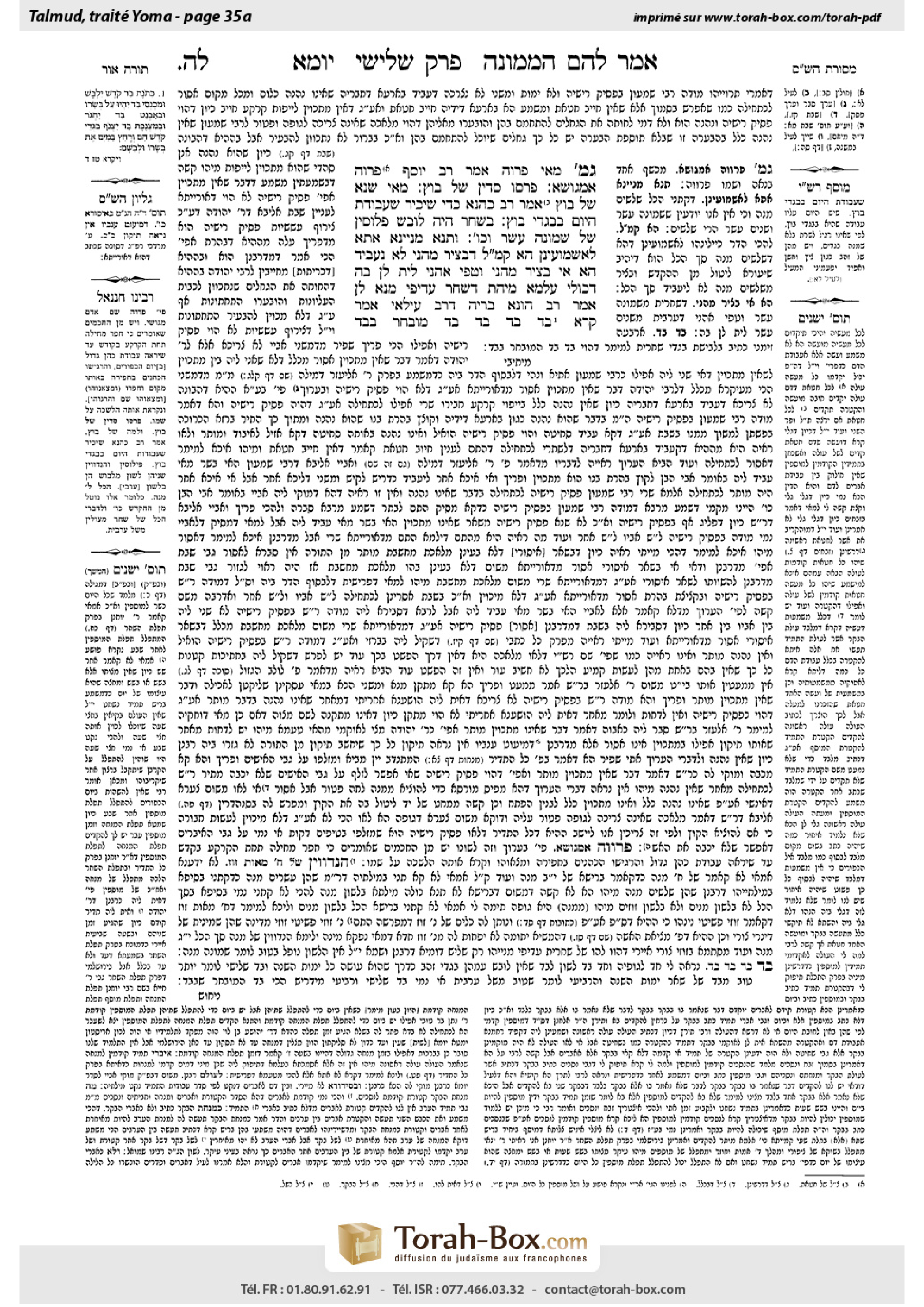
Yoma 35a: Talmud study for Daf Yomi
Daf Yomi is the daily study of one Talmud folio. Explore 37 tractates with scans, Hebrew text, Sefaria English and AI-generated French translations where annotated.
Passage selection and English or AI-generated French translation are available where the scan has annotations. Daf Study is independent of Torah-Box and Sefaria.
Browse Yoma · יומא · All tractatesYoma 35a text and translations
This page of Yoma includes the Aramaic text, an English translation and an AI-generated French translation, alongside the scan above.
יומא ל״ה א · Aramaic and Hebrew text
גְּמָ׳ מַאי ״פַּרְוָה״? אָמַר רַב יוֹסֵף: פַּרְוָה אַמְגּוּשָׁא.
פֵּרְסוּ סָדִין שֶׁל בּוּץ. מַאי שְׁנָא שֶׁל בּוּץ? אָמַר רַב כָּהֲנָא: כְּדֵי שֶׁיַּכִּיר שֶׁעֲבוֹדַת הַיּוֹם בְּבִגְדֵי בוּץ.
בַּשַּׁחַר הָיָה לוֹבֵשׁ פִּלּוּסִין שֶׁל שְׁמוֹנָה עָשָׂר וְכוּ׳. וְתַנָּא מִנְיָינָא אֲתָא לְאַשְׁמוֹעִינַן? הָא קָא מַשְׁמַע לַן דִּבְצִיר מֵהָנֵי לָא נֶעְבֵּיד. הָא אִי בָּצֵיר מֵהָנֵי וְטָפֵי אַהֲנִי — לֵית לַן בַּהּ.
דְּכוּלֵּי עָלְמָא מִיהַת דְּשַׁחַר עֲדִיפִי, מְנָא לַן? אָמַר רַב הוּנָא בְּרֵיהּ דְּרַב עִילָּאֵי: אָמַר קְרָא: ״בַּד״ ״בַּד״ ״בַּד״ ״בַּד״, מוּבְחָר בַּבַּד.
Yoma 35a · English translation
GEMARA: What is the meaning of the name Parva? Rav Yosef said: Parva is the name of a Persian sorcerer, whose name is associated with the chamber due to a particular incident.
§ It was stated in the mishna: They spread there a sheet of fine linen. The Gemara asks: What is different that the sheet that they spread was made of fine linen? Rav Kahana said: It was so that the High Priest will be aware and remember that the service of the day is performed in fine linen.
§ The mishna continues: In the morning, he would wear garments worth eighteen maneh, and in the afternoon he would wear garments worth twelve maneh. In total, the clothes were worth thirty maneh. The Gemara expresses surprise at the total in the mishna: Does the tanna come to tell us the tally that eighteen and twelve equal thirty? The Gemara answers: This comes to teach us that one may not fashion garments worth less than the total of these morning and afternoon garments. The Gemara elaborates: If one decreases the value of these morning garments, and raises the value of those afternoon garments, we have no problem with it. One can distribute the total of thirty maneh between the two sets of garments in any manner that he chooses.
The Gemara comments: However, everyone, both Rabbi Meir and the Rabbis, agrees that the clothes of the morning are superior and must be more valuable than those of the afternoon. From where do we derive this? Rav Huna, son of Rav Ilai, said that with regard to the linen garments donned by the High Priest in the morning, the verse states: “He shall be dressed in a sacred linen tunic, and with linen trousers next to his flesh, and he shall be girded with a linen belt, and he shall wear a linen mitre” (Leviticus 16:4). From the fact that the verse repeats the term linen four times it is derived that the choicest linen should be used for this purpose.
Yoma 35a · Traduction française (IA)
GUEMARA : Que signifie le nom Parva ? Rav Yossef dit : Parva est le nom d’un sorcier perse ; la chambre porte ce nom à la suite d’un incident particulier.
§ La Michna dit qu’on y étendait un drap de lin fin. La Guemara demande : Pourquoi le drap qu’on y étendait était-il en lin fin ? Rav Kahana dit : C’était pour que le grand prêtre sache et se rappelle que le service de ce jour s’accomplit en lin fin.
§ La Michna poursuit : Le matin, il portait des vêtements d’une valeur de dix-huit maneh et l’après-midi, des vêtements d’une valeur de douze maneh. Au total, les vêtements valaient trente maneh. La Guemara s’étonne du total indiqué dans la Michna : le tanna vient-il nous apprendre que dix-huit et douze font trente ? La Guemara répond : Cela vient nous enseigner qu’on ne peut pas confectionner des vêtements dont la valeur totale est inférieure à celle de ces vêtements du matin et de l’après-midi. La Guemara précise : Si l’on diminue la valeur des vêtements du matin et que l’on augmente celle des vêtements de l’après-midi, cela ne pose aucun problème. On peut répartir les trente maneh entre les deux ensembles de vêtements comme on le souhaite.
La Guemara fait remarquer : Toutefois, tous, Rabbi Meïr comme les Rabbins, conviennent que les vêtements du matin sont de meilleure qualité et doivent avoir plus de valeur que ceux de l’après-midi. D’où le déduisons-nous ? Rav Houna, fils de Rav Ilaï, dit qu’au sujet des vêtements de lin revêtus le matin par le grand prêtre, le verset énonce : « Il revêtira une tunique sacrée de lin, il portera des pantalons de lin contre sa chair, il sera ceint d’une ceinture de lin et il se couvrira d’une tiare de lin » (Lévitique 16,4). Le fait que le verset répète quatre fois le terme « lin » enseigne qu’il faut utiliser le lin de la meilleure qualité à cette fin.
Traduction française générée par IA à partir de l’édition anglaise de Sefaria. Vérifie toujours un passage avec le texte source.
Text from Sefaria: William Davidson Edition - Vocalized Aramaic (CC BY NC); William Davidson Edition - English (CC BY NC).