Yoma 34b: Talmud study for Daf Yomi
Daf Yomi is the daily study of one Talmud folio. Explore 37 tractates with scans, Hebrew text, Sefaria English and AI-generated French translations where annotated.
Passage selection and English or AI-generated French translation are available where the scan has annotations. Daf Study is independent of Torah-Box and Sefaria.
Browse Yoma · יומא · All tractatesYoma 34b text and translations
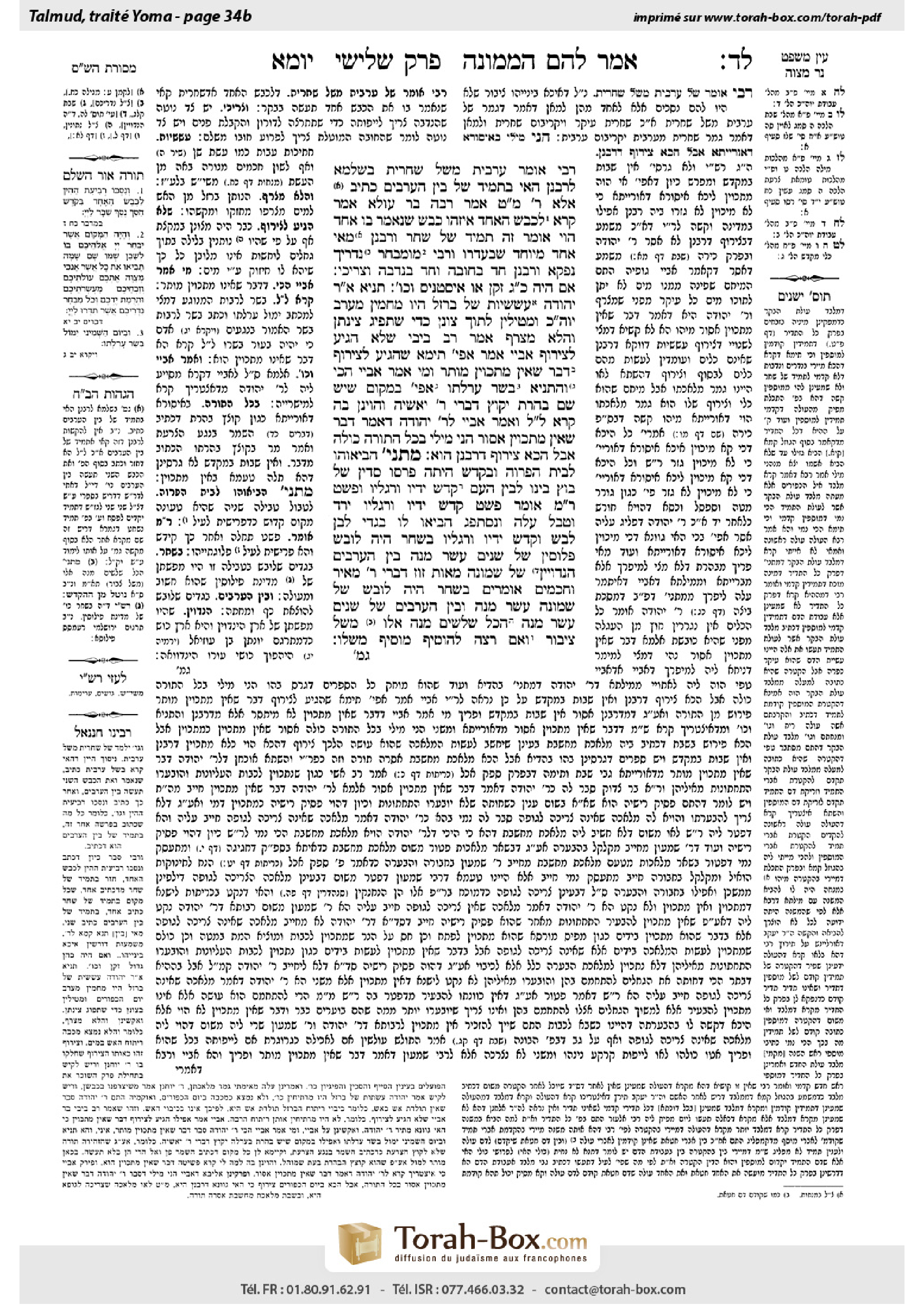
This page of Yoma includes the Aramaic text, an English translation and an AI-generated French translation, alongside the scan above.
יומא ל״ד ב · Aramaic and Hebrew text
רַבִּי אוֹמֵר: עַרְבִית מִשֶּׁל שַׁחֲרִית.
בִּשְׁלָמָא לְרַבָּנַן, הַאי בְּתָמִיד שֶׁל בֵּין הָעַרְבַּיִם כְּתִיב. אֶלָּא רַבִּי, מַאי טַעְמָא? אָמַר רַבָּה בַּר עוּלָּא, אָמַר קְרָא: ״לַכֶּבֶשׂ הָאֶחָד״, אֵיזֶהוּ כֶּבֶשׂ שֶׁנֶּאֱמַר בּוֹ ״אֶחָד״? הֱוֵי אוֹמֵר זֶה תָּמִיד שֶׁל שַׁחַר.
וְרַבָּנַן: מַאי ״אֶחָד״ — מְיוּחָד שֶׁבְּעֶדְרוֹ. וְרַבִּי: מִ״ומִּבְחַר נְדָרֶיךָ״ נָפְקָא. וְרַבָּנַן: חַד בְּחוֹבָה וְחַד בִּנְדָבָה, וּצְרִיכִי.
אִם הָיָה כֹּהֵן גָּדוֹל זָקֵן אוֹ אִיסְטְנִיס וְכוּ׳. תַּנְיָא, אָמַר רַבִּי יְהוּדָה: עֲשָׁשִׁיּוֹת שֶׁל בַּרְזֶל הָיוּ מְחַמִּין מֵעֶרֶב יוֹם הַכִּפּוּרִים וּמְטִילִין לְתוֹךְ צוֹנֵן, כְּדֵי שֶׁתָּפִיג צִינָּתָן. וַהֲלֹא מְצָרֵף! אָמַר רַב בִּיבִי: שֶׁלֹּא הִגִּיעַ לְצֵירוּף. אַבָּיֵי אָמַר: אֲפִילּוּ תֵּימָא שֶׁהִגִּיעַ לְצֵירוּף — דָּבָר שֶׁאֵין מִתְכַּוֵּין מוּתָּר.
וּמִי אָמַר אַבָּיֵי הָכִי? וְהָתַנְיָא: ״בְּשַׂר עׇרְלָתוֹ״, אֲפִילּוּ בִּמְקוֹם שֶׁיֵּשׁ שָׁם בַּהֶרֶת — יָקוֹץ, דִּבְרֵי רַבִּי יֹאשִׁיָּה. וְהָוֵינַן בָּהּ: קָרָא לְמָה לִי? וְאָמַר אַבָּיֵי: לְרַבִּי יְהוּדָה, דְּאָמַר: דָּבָר שֶׁאֵין מִתְכַּוֵּין אָסוּר.
הָנֵי מִילֵּי, בְּכׇל הַתּוֹרָה כּוּלָּהּ, אֲבָל הָכָא צֵירוּף דְּרַבָּנַן הוּא.
מַתְנִי׳ הֱבִיאוּהוּ לְבֵית הַפַּרְוָה, וּבַקֹּדֶשׁ הָיָתָה. פֵּרְסוּ סָדִין שֶׁל בּוּץ בֵּינוֹ לְבֵין הָעָם, קִדֵּשׁ יָדָיו וְרַגְלָיו וּפָשַׁט. רַבִּי מֵאִיר אוֹמֵר: פָּשַׁט, קִדֵּשׁ יָדָיו וְרַגְלָיו. יָרַד וְטָבַל, עָלָה וְנִסְתַּפָּג. הֵבִיאוּ לוֹ בִּגְדֵי לָבָן, לָבַשׁ וְקִדֵּשׁ יָדָיו וְרַגְלָיו.
בַּשַּׁחַר הָיָה לוֹבֵשׁ פִּלּוּסִין שֶׁל שְׁנֵים עָשָׂר מָנֶה. בֵּין הָעַרְבַּיִם הִנְדְּוִיִין שֶׁל שְׁמוֹנֶה מֵאוֹת זוּז, דִּבְרֵי רַבִּי מֵאִיר. וַחֲכָמִים אוֹמְרִים: בַּשַּׁחַר הָיָה לוֹבֵשׁ שֶׁל שְׁמוֹנָה עָשָׂר מָנֶה, וּבֵין הָעַרְבַּיִם שֶׁל שְׁנֵים עָשָׂר מָנֶה, הַכֹּל שְׁלֹשִׁים מָנֶה. אֵלּוּ מִשֶּׁל צִיבּוּר, וְאִם רָצָה לְהוֹסִיף — מוֹסִיף מִשֶּׁלּוֹ.
Yoma 34b · English translation
Rabbi Yehuda HaNasi says: The daily afternoon offering is derived from that of the morning. The phrase: “The one lamb,” refers to the lamb of the daily morning offering, and the daily afternoon offering is derived from it.
The Gemara asks: Granted, according to the opinion of the Rabbis who hold that this verse is written with regard to the daily afternoon offering based on the preceding verses, they can explain that the daily morning offering is derived from the daily afternoon offering. However, what is the rationale for the opinion of Rabbi Yehuda HaNasi, who holds that the afternoon offering is derived from the morning offering? Rabba bar Ulla said that the verse states: “For the one lamb.” Which is the lamb with regard to which it is previously stated: One? You must say: That is the lamb of the daily morning offering (see Exodus 29:39).
And according to the Rabbis, what is the meaning of the term: One? It means the special lamb that is one in his flock. The lamb for the daily offering should be of the highest quality.
And from where does Rabbi Yehuda HaNasi derive that principle? The Gemara answers that in his opinion, the principle is derived from that which is written: “And all the choicest of your vow-offerings” (Deuteronomy 12:11). One is required to fulfill his vow by offering the animal of the highest quality.
And how do the Rabbis interpret this verse? They interpret that one verse refers to the requirement to bring the animal of the highest quality for obligatory offerings and one verse refers to the requirement to bring the animal of the highest quality for gift-offerings. And both verses are necessary, as otherwise it would not have been clear that this requirement applies to both. On the one hand, one might think it is only with regard to obligatory offerings that the animal of the highest quality must be sacrificed. On the other hand, one might think it is only with regard to a gift-offering that the animal of the highest quality must be sacrificed, as if it is not of the highest quality, it is better not to sacrifice it at all.
§ The mishna continues: If the High Priest was old or delicate, they would heat hot water for him on Yom Kippur eve and place it into the cold water of the ritual bath in order to temper its chill. It was taught in a baraita that Rabbi Yehuda said: They would heat blocks of iron on Yom Kippur eve and cast them into the cold water of the ritual bath to temper its chill. The Gemara asks: But by doing so, doesn’t he harden the iron, which is a labor prohibited on Yom Kippur? Rav Beivai said: The temperature of the blocks of iron did not reach the hardening point. Abaye said: Even if you say that the temperature of the iron reached the hardening point, the fact that the iron hardened when he placed it in the water is an unintentional act, which is permitted. His intention was to temper the chill of the water, not to harden the iron.
And did Abaye actually say that an unintentional act is permitted? But wasn’t it taught in a baraita that it is written: “And on the eighth day the flesh of his foreskin shall be circumcised” (Leviticus 12:3), from which it is derived that one may cut the foreskin and circumcise the baby even if there is a white spot of leprosy there? He may do so even though the Torah prohibits excising a white spot of leprosy. This is the statement of Rabbi Yoshiya. And we discussed this matter: Why do I need a verse to permit it? His intention is not to excise the leprosy but to fulfill the mitzva of circumcision. And Abaye said: The statement of Rabbi Yoshiya is in accordance with the opinion of Rabbi Yehuda, who said that performing an unintentional act is prohibited. Therefore, a special verse is necessary to permit circumcision in that case. Apparently, Abaye holds that Rabbi Yehuda prohibits even unintentional acts. Why, then, does he explain that Rabbi Yehuda permits placing blocks of iron into the water if his intention is not to harden the iron?
The Gemara answers: When Abaye said that Rabbi Yehuda prohibits unintentional acts, that applies only to actions prohibited by Torah law that appear in the whole Torah in its entirety. However, here, hardening the blocks of iron is not a labor prohibited by Torah law but is prohibited by rabbinic law, as a decree intended to enhance the character of Shabbat as a day of rest. Rabbi Yehuda concedes that unintentional performance of prohibitions by rabbinic law is permitted.
MISHNA: They brought the High Priest to immerse a second time in the Hall of Parva, which was in the sacred area, the Temple courtyard. They spread a sheet of fine linen between him and the people in the interest of modesty. And he sanctified his hands and his feet and removed his garments. Rabbi Meir says that this was the sequence: He first removed his garments and then he sanctified his hands and his feet. He descended and immersed a second time. He ascended and dried himself. And they immediately brought him the white garments, in which he dressed, and he sanctified his hands and his feet.
In the morning he would wear linen garments from the Egyptian city of Pelusium worth twelve maneh, 1,200 dinars or zuz. These garments were very expensive due to their high quality. And in the afternoon he wore linen garments from India, which were slightly less expensive, worth eight hundred zuz. This is the statement of Rabbi Meir. And the Rabbis say: In the morning he would wear garments worth eighteen maneh, and in the afternoon he would wear garments worth twelve maneh. In total, the clothes were worth thirty maneh. These sums for the garments came from the community, and if the High Priest wished to add money to purchase even finer garments, he would add funding of his own.
Yoma 34b · Traduction française (IA)
Rabbi Yehuda HaNasi dit : L’offrande quotidienne de l’après-midi est déduite de celle du matin. L’expression « l’agneau » désigne l’agneau de l’offrande quotidienne du matin, et l’offrande quotidienne de l’après-midi est déduite de celle-ci.
La Guemara demande : Certes, selon l’opinion des Rabbins, qui considèrent que, d’après les versets précédents, ce verset concerne l’offrande quotidienne de l’après-midi, ils peuvent expliquer que l’offrande quotidienne du matin est déduite de celle de l’après-midi. Mais quel est le fondement de l’opinion de Rabbi Yehuda HaNasi, qui considère que l’offrande de l’après-midi est déduite de celle du matin ? Rabba bar Ulla dit que le verset énonce : « Pour l’agneau ». De quel agneau a-t-on déjà dit qu’il était « un » ? Il faut donc dire qu’il s’agit de l’agneau de l’offrande quotidienne du matin (voir Exode 29,39).
Et selon les Rabbins, que signifie le terme « un » ? Il désigne l’agneau d’exception, celui qui est unique dans son troupeau. L’agneau destiné à l’offrande quotidienne doit être de la meilleure qualité. Et d’où Rabbi Yehuda HaNasi déduit-il ce principe ? La Guemara répond que, selon lui, ce principe se déduit de ce qui est écrit : « Et toutes les meilleures de vos offrandes votives » (Deutéronome 12,11). On doit s’acquitter de son vœu en offrant un animal de la meilleure qualité. Et comment les Rabbins interprètent-ils ce verset ? Ils interprètent l’un des versets comme faisant référence à l’obligation d’apporter un animal de la meilleure qualité pour les offrandes obligatoires, et l’autre comme faisant référence à l’obligation d’apporter un animal de la meilleure qualité pour les offrandes volontaires. Les deux versets sont nécessaires, car autrement, il n’aurait pas été évident que cette obligation s’applique dans les deux cas. D’une part, on aurait pu penser qu’il fallait sacrifier un animal de la meilleure qualité uniquement pour les offrandes obligatoires. D’autre part, on aurait pu penser qu’il fallait sacrifier un animal de la meilleure qualité uniquement pour une offrande volontaire, car s’il n’est pas de la meilleure qualité, mieux vaut ne pas le sacrifier du tout.
§ La Michna poursuit : Si le grand prêtre était âgé ou de constitution délicate, on chauffait de l’eau pour lui la veille de Yom Kippour et on la versait dans l’eau froide du bain rituel afin d’en atténuer la froideur. Une baraïta enseigne que Rabbi Yehuda a dit : La veille de Yom Kippour, on chauffait des blocs de fer et on les jetait dans l’eau froide du bain rituel afin d’en atténuer la froideur. La Guemara demande : Mais en faisant cela, ne durcit-on pas le fer, ce qui constitue un travail interdit à Yom Kippour ? Rav Beivai dit : Les blocs de fer n’atteignaient pas la température nécessaire pour durcir. Abaye dit : Même si l’on admet que le fer atteignait cette température, le fait qu’il ait durci lorsqu’on l’a plongé dans l’eau est un acte involontaire, qui est permis. L’intention était d’atténuer la froideur de l’eau, et non de durcir le fer.
Abaye a-t-il réellement dit qu’un acte involontaire est permis ? N’a-t-il pas été enseigné dans une baraïta : il est écrit « Le huitième jour, on circoncira la chair de son prépuce » (Lévitique 12,3), d’où l’on déduit qu’on peut couper le prépuce et circoncire le bébé même s’il y a une tache blanche de lèpre à cet endroit ? Il peut le faire bien que la Torah interdise d’exciser une tache blanche de lèpre. Telle est la déclaration de Rabbi Yoshiya. Et nous avons examiné cette question : pourquoi faut-il un verset pour le permettre ? Son intention n’est pas d’exciser la lésion lépreuse, mais d’accomplir la mitsva de la circoncision. Abaye a dit : La déclaration de Rabbi Yoshiya est conforme à l’opinion de Rabbi Yehuda, qui a dit qu’accomplir involontairement un acte interdit est prohibé. Par conséquent, un verset particulier est nécessaire pour permettre la circoncision dans ce cas. Apparemment, Abaye estime que Rabbi Yehuda interdit même les actes involontaires. Pourquoi explique-t-il alors que Rabbi Yehuda permet de mettre les blocs de fer dans l’eau si l’intention n’est pas de durcir le fer ?
La Guemara répond : Quand Abaye a dit que Rabbi Yehuda interdit les actes involontaires, cela ne concerne que les actions interdites par la Torah, mentionnées dans la Torah écrite dans son ensemble. Ici, toutefois, le durcissement des blocs de fer n’est pas un travail interdit par la Torah ; il est interdit par décret rabbinique, destiné à renforcer le caractère du Chabbat comme jour de repos. Rabbi Yehuda admet que l’accomplissement involontaire d’actes interdits par décret rabbinique est permis.
MICHNA : On amena le grand prêtre pour qu’il s’immerge une deuxième fois dans la salle de Parva, qui se trouvait dans l’enceinte sacrée, la cour du Temple. On tendit un drap de lin fin entre lui et le peuple, par souci de pudeur. Il sanctifia ses mains et ses pieds, puis retira ses vêtements. Rabbi Meïr dit que l’ordre était le suivant : il retira d’abord ses vêtements, puis sanctifia ses mains et ses pieds. Il descendit et s’immergea une deuxième fois. Il remonta et se sécha. On lui apporta aussitôt les vêtements blancs, dont il se revêtit, puis il sanctifia ses mains et ses pieds.
Le matin, il portait des vêtements de lin de la ville égyptienne de Péluse, qui valaient douze maneh, soit 1 200 dinars ou zouz. Ces vêtements étaient très coûteux en raison de leur grande qualité. L’après-midi, il portait des vêtements de lin d’Inde, légèrement moins coûteux, qui valaient huit cents zouz. Telle est la déclaration de Rabbi Meïr. Les Rabbins disent : Le matin, il portait des vêtements valant dix-huit maneh et l’après-midi, des vêtements valant douze maneh. Au total, les vêtements valaient trente maneh. Ces sommes étaient prises en charge par la communauté et, si le grand prêtre souhaitait ajouter de l’argent pour acheter des vêtements encore plus raffinés, il complétait la somme sur ses propres fonds.
Traduction française générée par IA à partir de l’édition anglaise de Sefaria. Vérifie toujours un passage avec le texte source.
Text from Sefaria: William Davidson Edition - Vocalized Aramaic (CC BY NC); William Davidson Edition - English (CC BY NC).