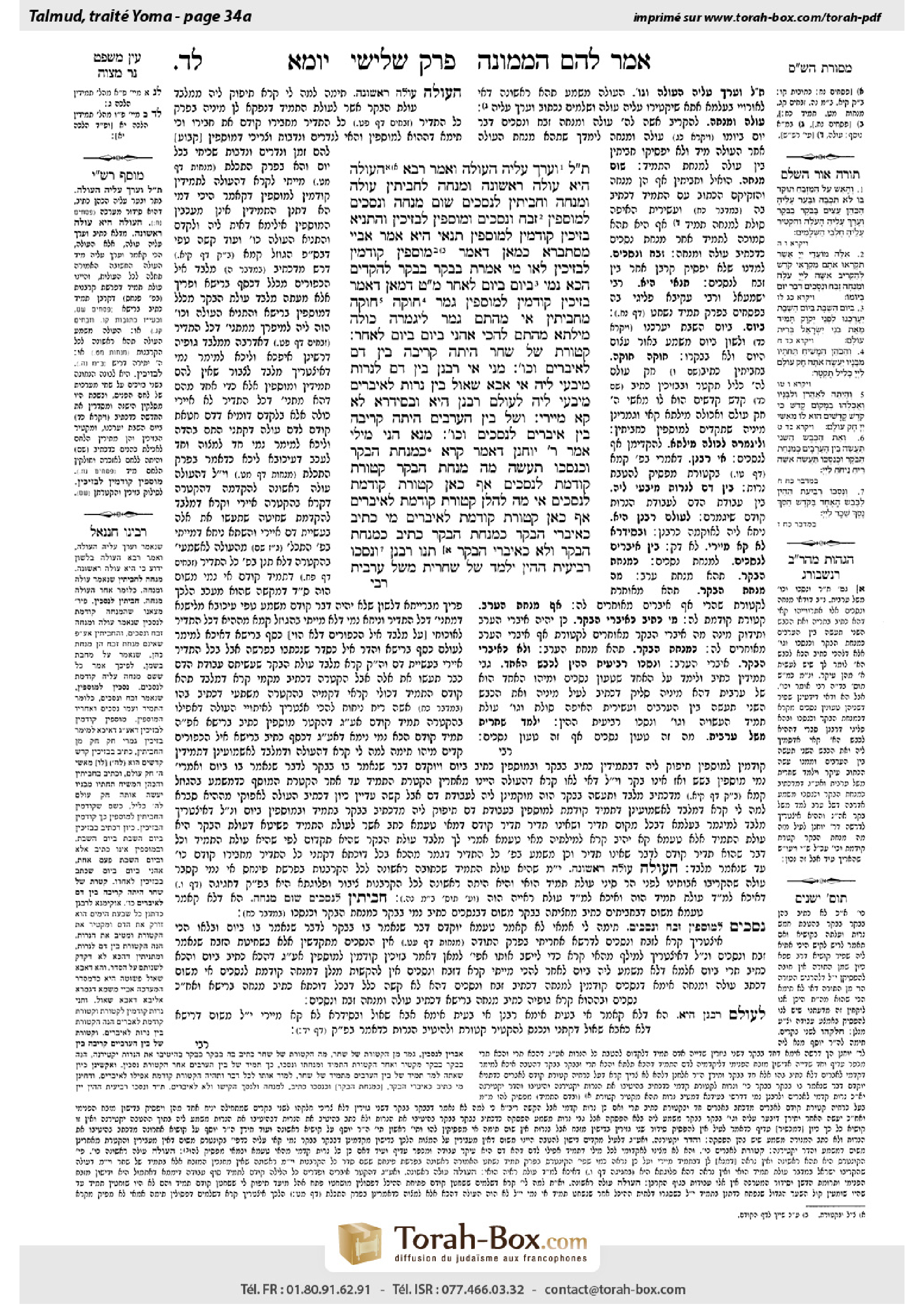
Yoma 34a: Talmud study for Daf Yomi
Daf Yomi is the daily study of one Talmud folio. Explore 37 tractates with scans, Hebrew text, Sefaria English and AI-generated French translations where annotated.
Passage selection and English or AI-generated French translation are available where the scan has annotations. Daf Study is independent of Torah-Box and Sefaria.
Browse Yoma · יומא · All tractatesYoma 34a text and translations
This page of Yoma includes the Aramaic text, an English translation and an AI-generated French translation, alongside the scan above.
יומא ל״ד א · Aramaic and Hebrew text
תַּלְמוּד לוֹמַר: ״וְעָרַךְ עָלֶיהָ הָעוֹלָה״, וְאָמַר רָבָא: ״הָעוֹלָה״ — הִיא עוֹלָה רִאשׁוֹנָה.
וּמִנְחָה לַחֲבִיתִּין, עוֹלָה וּמִנְחָה.
וַחֲבִיתִּין לִנְסָכִים, שׁוּם מִנְחָה.
וּנְסָכִים לְמוּסָפִין, זֶבַח וּנְסָכִים. וּמוּסָפִין לְבָזִיכִין, וְהָתַנְיָא: בָּזִיכִין קוֹדְמִין לְמוּסָפִין! תַּנָּאֵי הִיא.
אָמַר אַבָּיֵי: מִסְתַּבְּרָא כְּמַאן דְּאָמַר מוּסָפִין קוֹדְמִין לְבָזִיכִין — לָאו מִי אָמְרַתְּ ״בַּבֹּקֶר בַּבֹּקֶר״, לְהַקְדִּים? הָכָא נָמֵי: ״בַּיּוֹם״ ״בַּיּוֹם״, לְאַחֵר.
מַאי טַעְמָא דְּמַאן דְּאָמַר בָּזִיכִין קוֹדְמִין לְמוּסָפִין? גָּמַר ״חוּקָּה״ ״חוּקָּה״ מֵחֲבִיתִּין.
אִי מֵהָתָם גָּמַר, לִיגְמְרַהּ כּוּלַּהּ מִילְּתָא מֵהָתָם? לְהָכִי אַהֲנִי ״בַּיּוֹם״ ״בַּיּוֹם״, לְאַחֵר.
קְטוֹרֶת שֶׁל שַׁחַר הָיְתָה קְרֵיבָה בֵּין דָּם לְאֵיבָרִים וְכוּ׳. מַנִּי? אִי רַבָּנַן, בֵּין דָּם לְנֵרוֹת מִיבְּעֵי לֵיהּ. אִי אַבָּא שָׁאוּל, בֵּין נֵרוֹת לְאֵיבָרִים מִיבְּעֵי לֵיהּ!
לְעוֹלָם רַבָּנַן הִיא, וּבְסִידְרָא לָא קָא מַיְירֵי.
וְשֶׁל בֵּין הָעַרְבַּיִם הָיְתָה קְרֵיבָה בֵּין אֵיבָרִים לִנְסָכִים וְכוּ׳. מְנָא הָנֵי מִילֵּי? אָמַר רַבִּי יוֹחָנָן, דְּאָמַר קְרָא: ״כְּמִנְחַת הַבֹּקֶר וּכְנִסְכּוֹ תַּעֲשֶׂה״, מָה מִנְחַת הַבֹּקֶר — קְטוֹרֶת קוֹדֶמֶת לִנְסָכִים, אַף כָּאן — קְטוֹרֶת קוֹדֶמֶת לִנְסָכִים.
אִי מָה לְהַלָּן קְטוֹרֶת קוֹדֶמֶת לְאֵיבָרִים, אַף כָּאן קְטוֹרֶת קוֹדֶמֶת לְאֵיבָרִים! מִי כְּתִיב ״כְּאֵיבְרֵי הַבֹּקֶר״? ״כְּמִנְחַת הַבֹּקֶר״ כְּתִיב. כְּמִנְחַת הַבֹּקֶר, וְלֹא כְּאֵיבְרֵי הַבֹּקֶר.
תָּנוּ רַבָּנַן: ״וְנִסְכּוֹ רְבִיעִית הַהִין״ — יִלְמַד שֶׁל שַׁחֲרִית מִשֶּׁל עַרְבִית.
Yoma 34a · English translation
The verse states: “And the priest shall burn wood upon it in the morning, in the morning, and he shall place the burnt-offering upon it” (Leviticus 6:5), and Rava said: The verse could have simply said: And he shall place upon it, indicating that everything sacrificed on the altar is placed upon it; but instead, the verse states: “And he shall place the burnt-offering upon it,” to teach that it ascends the altar first.
Abaye continued: The sacrifice of the meal-offering precedes the sacrifice of the High Priest’s daily griddle-cake offering, half of which he sacrifices in the morning and half in the afternoon, as the verse states: “To bring offerings by fire to the Lord, burnt-offerings, meal-offerings, sacrifices, and libations, on each day what is proper to it” (Leviticus 23:37). Since the Torah states burnt-offerings and meal-offerings, apparently the daily burnt-offering precedes the meal-offering. And since the meal-offering is part of the burnt-offering sacrifice, it precedes the griddle-cake offering, which is a meal-offering unrelated to the burnt-offering.
Abaye continued: And the griddle-cake offering precedes the pouring of the libations of the daily offering. This is because it is in the category of meal-offering. Since it has been established that the meal-offering that accompanies the daily offering is sacrificed after the daily offering, all meal-offerings are sacrificed after the daily-offering prior to any other service.
Abaye continued: And the libations precede the sacrifice of the additional offerings, as it is written: Offerings and libations, from which it is derived that the libations are brought immediately after the daily offering, before any other offering is sacrificed. And the additional offerings precede the vessels of frankincense that are brought on Shabbat. The Gemara asks: But wasn’t it taught in a baraita: The vessels of frankincense precede the additional offerings? The Gemara answers: This is the subject of a dispute between the tanna’im Rabbi Yishmael and Rabbi Akiva (Pesaḥim 58a).
Abaye said: It is reasonable that the sequence should be in accordance with the opinion of the one who said the additional offerings precede the vessels of frankincense, as didn’t you say that the repetition of the term: In the morning, in the morning, comes to prioritize the daily offering? Here too, repetition within the clause: “He shall arrange them on Shabbat day, on Shabbat day” (Leviticus 24:8), with regard to the vessels of frankincense, comes to postpone that service until the peak of the day.
The Gemara asks: What is the rationale for the opinion of the one who said: The vessels of frankincense precede the additional offerings? The Gemara explains: By means of a verbal analogy he derives: Statute, written with regard to the vessels of frankincense: “A statute for all time” (Leviticus 24:9), from: Statute, written with regard to the griddle-cake offering: “A statute for all time” (Leviticus 6:15). Just as the griddle-cake offering precedes the additional offerings, so too, the vessels of frankincense precede the additional offerings.
The Gemara asks: If he derived it from there, let him derive the entire matter from there, and let the vessels of frankincense be burned immediately after the griddle-cake offering; why are the libations offered between them? The Gemara answers: It is to that end that the verse: “He shall arrange them on Shabbat day, on Shabbat day,” with regard to the vessels of frankincense, is effective, to postpone their offering until later.
§ After analyzing Abaye’s tradition with regard to the sequence of the daily service, the Gemara returns to analyzing the passage in the mishna: The morning incense was burned between the receiving and sprinkling of the blood and the burning of the limbs. The Gemara asks: In accordance with whose opinion is the mishna? If it is in accordance with the opinion of the Rabbis elsewhere (15a), the mishna should say that the incense was burned between the sprinkling of the blood and the removal of the ashes from the lamps. If it is in accordance with the opinion of Abba Shaul, the mishna should say that the incense was burned between the removal of the ashes from the lamps and the burning of the limbs.
The Gemara responds: Actually, the mishna is in accordance with the opinion of the Rabbis, but the mishna is not speaking of the sequence of the entire service. The mishna states that the incense was burned between the sprinkling of the blood and the burning of the limbs of the daily offering, although other services were performed then as well, including the removal of ashes from the lamps.
The mishna continues: The afternoon incense was burned between the taking of the limbs up to the altar and the pouring of its libations. The Gemara asks: From where are these matters derived? Rabbi Yoḥanan said that the verse states: “And the other lamb you shall present in the afternoon, as the meal-offering in the morning and its libation, you shall present it, an offering made by fire, of a sweet fragrance unto the Lord” (Numbers 28:8). Just as with regard to the morning meal-offering incense precedes libations, so too here, in the afternoon, incense precedes the libations.
The Gemara asks: If so, just as there, in the morning, incense even precedes limbs, so too here, in the afternoon, incense should precede limbs. The Gemara rejects this: Is it written: As the limbs in the morning? As the meal-offering in the morning, is written, indicating with regard to the daily afternoon offering that it is like the meal-offering in the morning, and not like the burning of the limbs of the morning.
The Sages taught in a baraita that it is written: “And its libation shall be a quarter-hin for the one lamb, in the sacred area it shall be poured as an offering of strong drink unto the Lord” (Numbers 28:7). The Sages understand this verse as referring to the daily afternoon offering; therefore, one will derive the manner and order of the daily morning offering from the manner and order of the daily afternoon offering. Just as libations are required for the daily afternoon offering, so too, they are required for the daily morning offering.
Yoma 34a · Traduction française (IA)
Le verset dit : « Et le prêtre y fera brûler du bois chaque matin, et il y déposera l’holocauste » (Lévitique 6:5). Rava dit : Le verset aurait pu simplement dire : « Et il y déposera », indiquant ainsi que tout ce qui est offert sur l’autel y est déposé. Mais il dit plutôt : « Et il y déposera l’holocauste », pour enseigner que celui-ci monte le premier sur l’autel.
Abayé poursuit : Le sacrifice de l’offrande de farine précède le sacrifice de l’offrande quotidienne de galettes du Grand Prêtre, dont il offre la moitié le matin et l’autre moitié l’après-midi, comme le dit le verset : « Pour présenter des offrandes consumées par le feu à l’Éternel : holocaustes, offrandes de farine, sacrifices et libations, chaque jour ce qui lui convient » (Lévitique 23:37). Puisque la Torah mentionne les holocaustes et les offrandes de farine, il semble que l’holocauste quotidien précède l’offrande de farine. Et puisque l’offrande de farine fait partie du sacrifice de l’holocauste, elle précède l’offrande de galettes, qui est une offrande de farine sans lien avec l’holocauste.
Abayé poursuit : L’offrande de galettes précède la présentation des libations de l’offrande quotidienne. En effet, elle relève de la catégorie des offrandes de farine. Puisqu’il a été établi que l’offrande de farine qui accompagne l’offrande quotidienne est sacrifiée après l’offrande quotidienne, toutes les offrandes de farine sont sacrifiées après l’offrande quotidienne et avant tout autre service.
Abayé poursuit : Les libations précèdent le sacrifice des offrandes supplémentaires, comme il est écrit : « Offrandes et libations », d’où l’on déduit que les libations sont présentées immédiatement après l’offrande quotidienne, avant le sacrifice de toute autre offrande. Les offrandes supplémentaires précèdent les vases d’encens présentés le Chabbat. La Guemara demande : Mais n’a-t-on pas enseigné dans une baraïta que les vases d’encens précèdent les offrandes supplémentaires ? La Guemara répond : C’est là une controverse entre les tannaïm Rabbi Ichmaël et Rabbi Akiva (Pessa’him 58a).
Abayé dit : Il est raisonnable que l’ordre suive l’opinion de celui qui dit que les offrandes supplémentaires précèdent les vases d’encens. N’as-tu pas dit que la répétition de l’expression « chaque matin » sert à donner la priorité à l’offrande quotidienne ? De même, ici, la répétition dans le passage « Il les disposera le jour du Chabbat, le jour du Chabbat » (Lévitique 24:8), à propos des vases d’encens, sert à reporter ce service jusqu’au milieu de la journée.
La Guemara demande : Quel est le raisonnement de celui qui dit que les vases d’encens précèdent les offrandes supplémentaires ? La Guemara explique : Au moyen d’une analogie verbale, il déduit la règle concernant les vases d’encens, où il est écrit : « Une règle perpétuelle » (Lévitique 24:9), de la règle concernant l’offrande de galettes, où il est écrit : « Une règle perpétuelle » (Lévitique 6:15). De même que l’offrande de galettes précède les offrandes supplémentaires, les vases d’encens précèdent eux aussi les offrandes supplémentaires.
La Guemara demande : S’il l’a déduit de là, qu’il en déduise toute la question, et que les vases d’encens soient brûlés immédiatement après l’offrande de galettes. Pourquoi les libations sont-elles présentées entre les deux ? La Guemara répond : Le verset « Il les disposera le jour du Chabbat, le jour du Chabbat », à propos des vases d’encens, sert précisément à reporter leur présentation à plus tard.
§ Après avoir analysé la tradition d’Abayé concernant l’ordre du service quotidien, la Guemara revient à l’analyse du passage de la Michna : l’encens du matin était brûlé entre la réception et l’aspersion du sang, d’une part, et la combustion des membres, d’autre part. La Guemara demande : Selon l’opinion de qui la Michna est-elle formulée ? Si elle suit l’opinion des Sages mentionnée ailleurs (15a), elle aurait dû dire que l’encens était brûlé entre l’aspersion du sang et le retrait des cendres des lampes. Si elle suit l’opinion d’Abba Chaoul, elle aurait dû dire que l’encens était brûlé entre le retrait des cendres des lampes et la combustion des membres.
La Guemara répond : En réalité, la Michna suit l’opinion des Sages, mais elle ne traite pas de l’ordre de l’ensemble du service. Elle indique que l’encens était brûlé entre l’aspersion du sang et la combustion des membres de l’offrande quotidienne, bien que d’autres services fussent également accomplis à ce moment-là, notamment le retrait des cendres des lampes.
La Michna poursuit : L’encens de l’après-midi était brûlé entre la montée des membres sur l’autel et la présentation de ses libations. La Guemara demande : D’où déduit-on ces choses ? Rabbi Yo’hanan dit que le verset enseigne : « Et tu présenteras l’autre agneau dans l’après-midi ; comme l’offrande de farine du matin et sa libation, tu le présenteras, offrande consumée par le feu, d’agréable odeur pour l’Éternel » (Nombres 28:8). De même que, le matin, l’encens précède les libations, de même ici, l’après-midi, l’encens précède les libations.
La Guemara demande : Si tel est le cas, de même que là, le matin, l’encens précède même les membres, de même ici, l’après-midi, l’encens devrait précéder les membres. La Guemara rejette cette déduction : Est-il écrit : « Comme les membres du matin » ? Il est écrit : « Comme l’offrande de farine du matin », ce qui indique que l’offrande quotidienne de l’après-midi est comparable à l’offrande de farine du matin, et non à la combustion des membres du matin.
Les Sages ont enseigné dans une baraïta qu’il est écrit : « Sa libation sera d’un quart de hin pour l’agneau ; dans le lieu saint, on versera une boisson forte en offrande à l’Éternel » (Nombres 28:7). Les Sages comprennent que ce verset se rapporte à l’offrande quotidienne de l’après-midi ; on déduira donc la manière et l’ordre de l’offrande quotidienne du matin de ceux de l’offrande quotidienne de l’après-midi. De même que les libations sont requises pour l’offrande quotidienne de l’après-midi, elles le sont également pour l’offrande quotidienne du matin.
Traduction française générée par IA à partir de l’édition anglaise de Sefaria. Vérifie toujours un passage avec le texte source.
Text from Sefaria: William Davidson Edition - Vocalized Aramaic (CC BY NC); William Davidson Edition - English (CC BY NC).