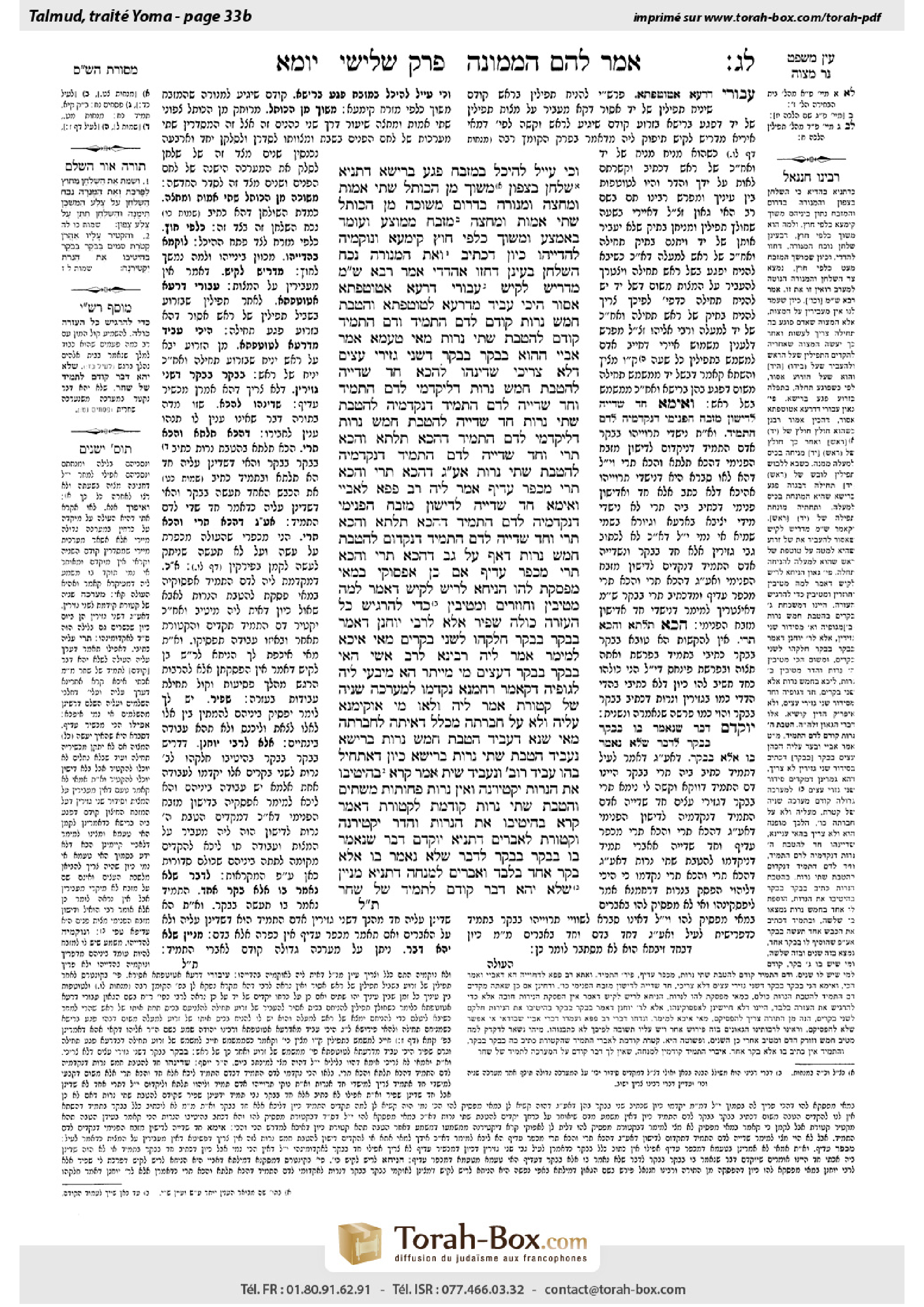
Yoma 33b: Talmud study for Daf Yomi
Daf Yomi is the daily study of one Talmud folio. Explore 37 tractates with scans, Hebrew text, Sefaria English and AI-generated French translations where annotated.
Passage selection and English or AI-generated French translation are available where the scan has annotations. Daf Study is independent of Torah-Box and Sefaria.
Browse Yoma · יומא · All tractatesYoma 33b text and translations
This page of Yoma includes the Aramaic text, an English translation and an AI-generated French translation, alongside the scan above.
יומא ל״ג ב · Aramaic and Hebrew text
וְכִי עָיֵיל לְהֵיכָל — בְּמִזְבֵּחַ פָּגַע בְּרֵישָׁא. דְּתַנְיָא: שֻׁלְחָן בַּצָּפוֹן מָשׁוּךְ מִן הַכּוֹתֶל שְׁתֵּי אַמּוֹת וּמֶחֱצָה, וּמְנוֹרָה בַּדָּרוֹם מְשׁוּכָה מִן הַכּוֹתֶל שְׁתֵּי אַמּוֹת וּמֶחֱצָה. מִזְבֵּחַ מְמוּצָּע וְעוֹמֵד בְּאֶמְצַע וּמָשׁוּךְ כְּלַפֵּי חוּץ קִימְעָא. וְנוֹקְמֵיהּ, לַהֲדַיְיהוּ? כֵּיוָן דִּכְתִיב: ״וְאֶת הַמְּנוֹרָה נֹכַח הַשֻּׁלְחָן״, בָּעֵינַן דְּחָזוּ אַהֲדָדֵי.
אָמַר רָבָא: שְׁמַע מִינַּהּ מִדְּרֵישׁ לָקִישׁ, עַבּוֹרֵי דְּרָעָא אַטּוֹטֶפְתָּא אָסוּר. הֵיכִי עָבֵיד? מִדְּרָעָא לְטוֹטֶפְתָּא.
וַהֲטָבַת חָמֵשׁ נֵרוֹת קוֹדֵם לְדַם הַתָּמִיד, וְדַם הַתָּמִיד קוֹדֵם לַהֲטָבַת שְׁתֵּי נֵרוֹת. מַאי טַעְמָא? אָמַר אַבָּיֵי: הָהוּא ״בַּבֹּקֶר בַּבֹּקֶר״ דִּשְׁנֵי גְּזִירֵי עֵצִים דְּלָא צְרִיכִי, שְׁדִינְהוּ לְהָכָא. חַד שִׁדְיֵיהּ לַהֲטָבַת חָמֵשׁ נֵרוֹת — דְּלִיקְדְּמֵיהּ לְדַם הַתָּמִיד, וְחַד שִׁדְיֵיהּ לְדַם הַתָּמִיד — דְּנִקְדְּמֵיהּ לַהֲטָבַת שְׁתֵּי נֵרוֹת.
חַד שִׁדְיֵיהּ לַהֲטָבַת חָמֵשׁ נֵרוֹת, דְּלִיקְדְּמֵיהּ לְדַם הַתָּמִיד — דְּהָכָא תְּלָתָא וְהָכָא תְּרֵי.
וְחַד שִׁדְיֵיהּ לְדַם הַתָּמִיד — דְּנִקְדְּמֵיהּ לַהֲטָבַת שְׁתֵּי נֵרוֹת. אַף עַל גַּב דְּהָכָא תְּרֵי וְהָכָא תְּרֵי — מְכַפֵּר עָדִיף.
אֲמַר לֵיהּ רַב פָּפָּא לְאַבָּיֵי, וְאֵימָא: חַד שִׁדְיֵיהּ לְדִישּׁוּן מִזְבֵּחַ הַפְּנִימִי, דְּנִקְדְּמֵיהּ לְדַם הַתָּמִיד — דְּהָכָא תְּלָתָא וְהָכָא תְּרֵי. וְחַד שִׁדְיֵיהּ לְדַם הַתָּמִיד, דְּנִקְדּוֹם לַהֲטָבַת חָמֵשׁ נֵרוֹת — דְּאַף עַל גַּב דְּהָכָא תְּרֵי וְהָכָא תְּרֵי, מְכַפֵּר עָדִיף! אִם כֵּן אַפְסוֹקֵי בְּמַאי מַפְסְקַתְּ לְהוּ?
הָנִיחָא לְרֵישׁ לָקִישׁ, דְּאָמַר: לָמָּה מְטִיבִין וְחוֹזְרִים וּמְטִיבִין — כְּדֵי לְהַרְגִּישׁ כׇּל הָעֲזָרָה כּוּלָּהּ, שַׁפִּיר.
אֶלָּא לְרַבִּי יוֹחָנָן, דְּאָמַר: ״בַּבֹּקֶר בַּבֹּקֶר״ — חַלְּקֵהוּ לִשְׁנֵי בְקָרִים, מַאי אִיכָּא לְמֵימַר?
אֲמַר לֵיהּ רָבִינָא לְרַב אָשֵׁי: הַאי ״בַּבֹּקֶר בַּבֹּקֶר״ דְּעֵצִים, מִי מְיַיתַּר? הָא מִיבְּעֵי לֵיהּ לְגוּפֵיהּ, דְּקָאָמַר רַחֲמָנָא — נִקְדְּמוּ לְמַעֲרָכָה שְׁנִיָּה שֶׁל קְטוֹרֶת! אֲמַר לֵיהּ: וְלָאו מִי אוֹקֵימְנָא ״עָלֶיהָ״ וְלֹא עַל חֲבֶרְתָּהּ, מִכְּלָל דְּאִיתַהּ לַחֲבֶרְתַּהּ.
מַאי שְׁנָא דְּעָבֵיד הֲטָבַת חָמֵשׁ נֵרוֹת בְּרֵישָׁא? נֶעְבֵּיד הֲטָבַת שְׁתֵּי נֵרוֹת בְּרֵישָׁא! כֵּיוָן דְּאַתְחֵיל בְּהוּ — עָבֵיד רוּבָּא. וְנֶעְבֵּיד שֵׁית! אָמַר קְרָא: ״בְּהֵיטִיבוֹ אֶת הַנֵּרוֹת יַקְטִירֶנָּה״, וְאֵין נֵרוֹת פְּחוּתוֹת מִשְּׁתַּיִם.
וַהֲטָבַת שְׁתֵּי נֵרוֹת קוֹדֶמֶת לִקְטוֹרֶת, דְּאָמַר קְרָא: ״בְּהֵיטִיבוֹ אֶת הַנֵּרוֹת״, וַהֲדַר ״יַקְטִירֶנָּה״.
וּקְטוֹרֶת לְאֵבָרִים, דְּתַנְיָא: יוּקְדַּם דָּבָר שֶׁנֶּאֱמַר בּוֹ ״בַּבֹּקֶר בַּבֹּקֶר״, לְדָבָר שֶׁלֹּא נֶאֱמַר בּוֹ אֶלָּא ״בֹּקֶר״ אֶחָד בִּלְבַד.
וְאֵבָרִים לְמִנְחָה, דְּתַנְיָא: מִנַּיִין שֶׁלֹּא יְהֵא דָּבָר קוֹדֵם לְתָמִיד שֶׁל שַׁחַר?
Yoma 33b · English translation
And when he enters the Sanctuary it is the altar that he encounters first, before reaching the candelabrum; therefore, he performs the service of the altar before removing the ashes from the lamps, as it was taught in a baraita: The table stood in the north of the Sanctuary, removed two and a half cubits from the wall. And the candelabrum stood in the south of the Sanctuary, removed two and a half cubits from the wall. The altar was centered and standing in the middle of the Sanctuary, removed a bit outward. Therefore, one encounters the altar first. The Gemara questions the essence of the matter: And let us stand the altar alongside the table and the candelabrum; why was it removed outward? The Gemara answers: It is because it is written: “And the candelabrum opposite the table” (Exodus 26:35); we require that they are visible to each other. Were the altar aligned with the table and the candelabrum, it would interpose between them.
Rava said: Conclude from the statement of Reish Lakish that one may not forego performance of any of the mitzvot, that it is prohibited to forego donning the phylacteries of the arm in order to don the phylacteries of the head, as when donning phylacteries, one encounters the arm first. How does he conduct himself? He proceeds from the phylacteries of the arm to the phylacteries of the head.
§ Abaye continued: And removal of ashes from five lamps precedes the slaughter and the receiving and sprinkling of the blood of the daily morning offering. The sprinkling of the blood of the daily offering precedes the removal of ashes from the two remaining lamps of the candelabrum. The Gemara asks: What is the reason for this? Abaye said: Take that phrase: In the morning, in the morning, written with regard to the two logs, which is unnecessary to establish the time for performance of that service, as its precedence was explained due to its association with the arrangement of wood. And cast that extraneous phrase to here, and apply it to other elements of the morning service. If the phrase is superfluous in its context, apply it elsewhere where a halakha can be derived. Cast one term: In the morning, and apply it to removal of ashes from five lamps so that it will precede the blood of the daily offering. And cast one term: In the morning, and apply it to the blood of the daily offering, so that it will precede the removal of ashes from the two additional lamps.
The Gemara elaborates: Cast one term: In the morning, and apply it to removal of ashes from five lamps so that it will precede the blood of the daily offering, as here, there are three instances of: In the morning; two instances are written explicitly with regard to removal of ashes from the lamps (see Exodus 30:7) and one is written with regard to the two logs. And here, with regard to the blood of the daily offering, there are two instances of the phrase; one explicit mention in the text (see Exodus 29:39) and one written with regard to the two logs.
And cast one term: In the morning, to the blood of the daily offering so that it will precede the removal of ashes from the two additional lamps. Although here, with regard to removal of ashes from the lamps, there are two instances of the phrase: In the morning, and here, with regard to the blood of the daily offering, there are two instances of the phrase: In the morning, one written and one cast from the portion of two logs, the blood of the daily offering takes precedence because an act that effects atonement, the sprinkling of blood, takes precedence.
Rav Pappa said to Abaye: And say instead, cast one of the extraneous phrases: In the morning, and apply it to the removal of ashes from the inner altar, so that it will precede the blood of the daily offering, as here there are three instances of the phrase and there there are two. And cast one of the extraneous phrases: In the morning, and apply it to the blood of the daily offering so that it will precede the removal of ashes from five lamps, and say that although here there are two instances of the phrase: In the morning, and here there are two instances of the phrase: In the morning, still an act that effects atonement, the sprinkling of blood, takes precedence. Abaye dismisses this question by saying: If the blood of the daily offering precedes the removal of ashes from five lamps, with what will you demarcate between the removal of ashes from five lamps and the removal of ashes from two lamps?
That works out well according to the opinion of Reish Lakish, who said: Why does the priest remove the ashes from five lamps of the candelabrum and then return and remove the ashes from two lamps of the candelabrum rather than arrange all seven lamps at once? It is in order to enliven those present in the entire Temple courtyard, since people are coming and going to fulfill this mitzva with great ceremony. It works out well according to the opinion of Reish Lakish, because he says there is no need for any other service to demarcate between removal of ashes from five lamps and removal of ashes from two.
However, according to Rabbi Yoḥanan, who said the following based on the verse: “And Aaron shall burn upon it incense of sweet spices; in the morning, in the morning, when he removes the ashes from the lamps” (Exodus 30:7); take the term in the morning, in the morning, and divide the service of removal of ashes from the lamps into two mornings, i.e., into two parts, by performing a service in between, what can be said? According to Rabbi Yoḥanan, since the result would be that there is no service demarcating between the five lamps and the two lamps, there is no alternative to interpreting the matter in accordance with the explanation of Abaye.
Ravina said to Rav Ashi with regard to the basis for Abaye’s argument: Is this term: In the morning, in the morning, written with regard to the two logs actually superfluous and therefore available to have other matters derived from it? Isn’t it necessary to teach its own basic halakha, as the Merciful One states in the Torah: Have it precede the second arrangement of wood, from which coals are taken for the incense? Rav Ashi said to him: And did we not establish that it is written: Upon it, underscoring the fact that wood is placed only on the large arrangement and not on the other arrangement from which coals are taken for the incense? From the fact that this exclusionary term is necessary, it can be derived by inference that there is another pile on the altar, meaning that when the new logs are placed on the altar, the two arrangements are already there.
The Gemara asks with regard to the sequence in which the priest removes the ashes from the lamps: What is different that he performs the removal of ashes from five lamps first? Let us perform the removal of ashes from two lamps first. The Gemara answers: Since he begins the service with them, he performs the service on a majority of the lamps. The Gemara asks: If so, let him perform the service on six lamps. The Gemara responds that the verse states: “When he removes the ashes from the lamps, he shall burn it” (Exodus 30:7), and lamps is plural, meaning no fewer than two. Apparently, removal of ashes from lamps must be performed on a minimum of two lamps.
Abaye continued: And the removal of ashes from two lamps precedes the burning of the incense, as the verse first states: “When he removes the ashes from the lamps,” and then states: “He shall burn it.” The removal of the ashes precedes the burning of the incense.
Abaye continued: And the burning of the incense on the inner altar precedes the burning of the limbs of the daily offering on the outer altar, as it was taught in a baraita: Let the matter with regard to which it is stated: In the morning, in the morning, i.e., the burning of the incense, precede the matter with regard to which only one: In the morning, is stated, i.e., the daily morning offering, in the verse: “You shall offer one lamb in the morning” (Exodus 29:39).
Abaye continued: The burning of the limbs precedes the sacrifice of the meal-offering that accompanies the daily offering, as it was taught in a baraita: From where is it derived that there may be no item placed on the arrangement of wood prior to the daily morning offering?
Yoma 33b · Traduction française (IA)
Lorsqu’il entre dans le Sanctuaire, il rencontre d’abord l’autel, avant d’atteindre le candélabre ; il accomplit donc le service de l’autel avant de retirer les cendres des lampes. Ainsi qu’il a été enseigné dans une baraïta : la table se trouvait au nord du Sanctuaire, à deux coudées et demie du mur. Le candélabre se trouvait au sud du Sanctuaire, à deux coudées et demie du mur. L’autel se tenait au centre du Sanctuaire, légèrement en retrait. On rencontre donc d’abord l’autel. La Guemara interroge le fondement de cette disposition : pourquoi ne pas placer l’autel à côté de la table et du candélabre ? Pourquoi le placer en retrait ? La Guemara répond : c’est parce qu’il est écrit : « Le candélabre en face de la table » (Exode 26:35) ; il faut qu’ils soient visibles l’un de l’autre. Si l’autel était aligné avec la table et le candélabre, il s’interposerait entre eux.
Rava dit : Déduis de la déclaration de Reish Lakish, selon laquelle on ne peut omettre l’accomplissement d’aucune mitsva, qu’il est interdit de renoncer à mettre les téfilines du bras pour mettre celles de la tête, car, lorsqu’on met les téfilines, on rencontre d’abord celles du bras. Comment procède-t-on ? On passe des téfilines du bras à celles de la tête.
§ Abaye poursuit : Le retrait des cendres de cinq lampes précède l’égorgement, la réception et l’aspersion du sang de l’offrande quotidienne du matin. L’aspersion du sang de l’offrande quotidienne précède le retrait des cendres des deux lampes restantes du candélabre. La Guemara demande : Quelle en est la raison ? Abaye dit : Prenez l’expression « le matin, le matin », écrite à propos des deux bûches, alors qu’elle n’est pas nécessaire pour établir le moment de l’accomplissement de ce service, puisque sa priorité a été expliquée par son lien avec la disposition du bois. Transférez cette expression superflue ici et appliquez-la à d’autres éléments du service du matin. Si elle est superflue dans son contexte, appliquez-la ailleurs, là où l’on peut en déduire une halakha. Transférez une occurrence de « le matin » et appliquez-la au retrait des cendres de cinq lampes, afin qu’il précède le sang de l’offrande quotidienne. Transférez une occurrence de « le matin » et appliquez-la au sang de l’offrande quotidienne, afin qu’il précède le retrait des cendres des deux autres lampes.
La Guemara développe : Transférez une occurrence de « le matin » et appliquez-la au retrait des cendres de cinq lampes, afin qu’il précède le sang de l’offrande quotidienne. En effet, ici, il y a trois occurrences de « le matin » : deux sont explicitement écrites à propos du retrait des cendres des lampes (voir Exode 30:7), et une est écrite à propos des deux bûches. Et ici, à propos du sang de l’offrande quotidienne, il y a deux occurrences de l’expression : une mention explicite dans le texte (voir Exode 29:39) et une autre écrite à propos des deux bûches.
Transférez une occurrence de « le matin » au sang de l’offrande quotidienne, afin qu’il précède le retrait des cendres des deux autres lampes. Bien qu’il y ait ici, à propos du retrait des cendres des lampes, deux occurrences de l’expression « le matin », et qu’il y en ait également deux ici, à propos du sang de l’offrande quotidienne — l’une écrite explicitement et l’autre transférée du passage des deux bûches —, le sang de l’offrande quotidienne a la priorité, car un acte qui produit l’expiation, l’aspersion du sang, a la priorité.
Rav Pappa dit à Abaye : Pourquoi ne pas plutôt transférer l’une des occurrences superflues de « le matin » au retrait des cendres de l’autel intérieur, afin qu’il précède le sang de l’offrande quotidienne, puisqu’il y a ici trois occurrences de l’expression et là deux ? Et transférer l’une des occurrences superflues de « le matin » au sang de l’offrande quotidienne, afin qu’il précède le retrait des cendres de cinq lampes ; on dirait alors que, bien qu’il y ait deux occurrences de « le matin » ici et deux là, l’acte qui produit l’expiation — l’aspersion du sang — a tout de même la priorité. Abaye écarte cette objection : si le sang de l’offrande quotidienne précède le retrait des cendres de cinq lampes, qu’est-ce qui distinguera le retrait des cendres de cinq lampes de celui des deux lampes ?
Cela convient selon l’opinion de Reish Lakish, qui a dit : pourquoi le prêtre retire-t-il les cendres de cinq lampes du candélabre, puis revient-il retirer celles de deux lampes, au lieu d’en traiter les sept d’un seul coup ? C’est afin d’animer toute l’assemblée dans la cour du Temple, puisque les gens vont et viennent pour accomplir cette mitsva avec une grande solennité. Cela convient selon l’opinion de Reish Lakish, car, selon lui, aucun autre service n’a besoin de distinguer le retrait des cendres de cinq lampes de celui des deux lampes.
Cependant, que peut-on dire selon Rabbi Yoḥanan, qui a dit, en s’appuyant sur le verset : « Aaron y fera brûler un encens de parfums odoriférants ; le matin, le matin, lorsqu’il retirera les cendres des lampes » (Exode 30:7) : il faut prendre l’expression « le matin, le matin » et diviser le service du retrait des cendres des lampes en deux matinées, c’est-à-dire en deux parties, en accomplissant un service entre les deux. Selon Rabbi Yoḥanan, puisqu’il en résulterait qu’aucun service ne sépare le retrait des cendres des cinq lampes de celui des deux lampes, il ne reste d’autre possibilité que d’interpréter la question conformément à l’explication d’Abaye.
Ravina dit à Rav Ashi, au sujet du fondement de l’argument d’Abaye : l’expression « le matin, le matin », écrite à propos des deux bûches, est-elle réellement superflue et donc disponible pour en déduire d’autres halakhot ? N’est-elle pas nécessaire pour enseigner sa halakha fondamentale, puisque le Miséricordieux dit dans la Torah : qu’on la fasse précéder le deuxième arrangement de bois, dont on prend les braises pour l’encens ? Rav Ashi lui dit : N’avons-nous pas établi qu’il est écrit « dessus », soulignant que le bois est placé uniquement sur le grand arrangement, et non sur l’autre arrangement, dont on prend les braises pour l’encens ? Puisque ce terme restrictif est nécessaire, on peut en déduire qu’il y a un autre tas sur l’autel ; autrement dit, lorsque les nouvelles bûches sont placées sur l’autel, les deux arrangements s’y trouvent déjà.
La Guemara demande, au sujet de l’ordre dans lequel le prêtre retire les cendres des lampes : pourquoi retire-t-il d’abord les cendres de cinq lampes ? Retirons d’abord celles de deux lampes. La Guemara répond : puisqu’il commence le service par elles, il l’accomplit sur la majorité des lampes. La Guemara demande : dans ce cas, qu’il l’accomplisse sur six lampes. La Guemara répond que le verset dit : « Lorsqu’il retirera les cendres des lampes, il la fera brûler » (Exode 30:7) ; le mot « lampes » est au pluriel, ce qui signifie au moins deux. Il apparaît donc que le retrait des cendres doit être effectué sur au moins deux lampes.
Abaye poursuit : le retrait des cendres de deux lampes précède la combustion de l’encens, car le verset dit d’abord : « Lorsqu’il retirera les cendres des lampes », puis : « Il la fera brûler. » Le retrait des cendres précède donc la combustion de l’encens.
Abaye poursuit : la combustion de l’encens sur l’autel intérieur précède la combustion des membres de l’offrande quotidienne sur l’autel extérieur, ainsi qu’il a été enseigné dans une baraïta : l’acte à propos duquel il est dit « le matin, le matin », c’est-à-dire la combustion de l’encens, doit précéder celui à propos duquel une seule occurrence de « le matin » est mentionnée, c’est-à-dire l’offrande quotidienne du matin, dans le verset : « Tu offriras un agneau le matin » (Exode 29:39).
Abaye poursuit : la combustion des membres précède l’offrande de farine qui accompagne l’offrande quotidienne, ainsi qu’il a été enseigné dans une baraïta : d’où déduit-on qu’aucun élément ne peut être placé sur l’arrangement de bois avant l’offrande quotidienne du matin ?
Traduction française générée par IA à partir de l’édition anglaise de Sefaria. Vérifie toujours un passage avec le texte source.
Text from Sefaria: William Davidson Edition - Vocalized Aramaic (CC BY NC); William Davidson Edition - English (CC BY NC).