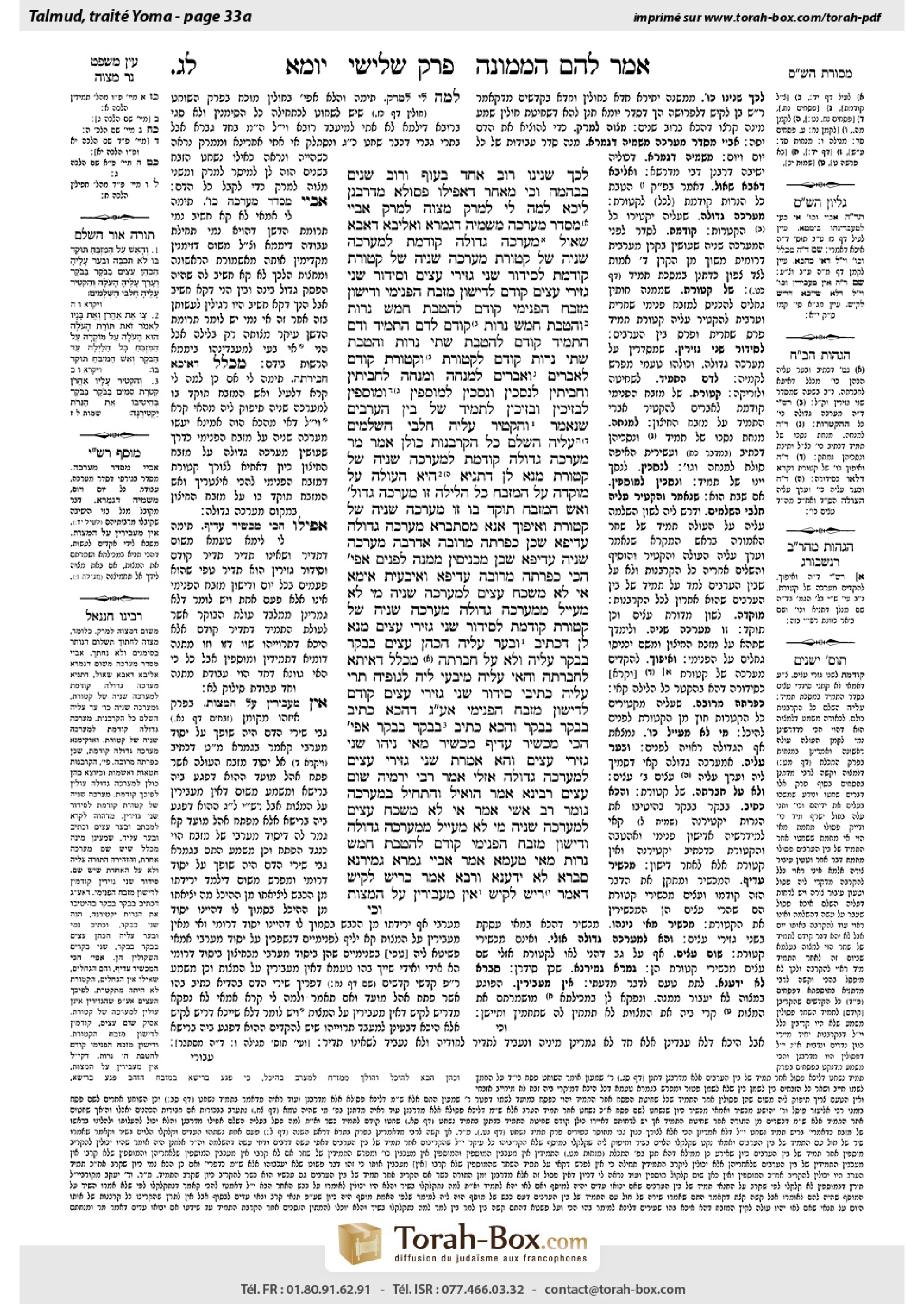
Yoma 33a: Talmud study for Daf Yomi
Daf Yomi is the daily study of one Talmud folio. Explore 37 tractates with scans, Hebrew text, Sefaria English and AI-generated French translations where annotated.
Passage selection and English or AI-generated French translation are available where the scan has annotations. Daf Study is independent of Torah-Box and Sefaria.
Browse Yoma · יומא · All tractatesYoma 33a text and translations
This page of Yoma includes the Aramaic text, an English translation and an AI-generated French translation, alongside the scan above.
יומא ל״ג א · Aramaic and Hebrew text
לְכָךְ שָׁנִינוּ: רוֹב אֶחָד בָּעוֹף וְרוֹב שְׁנַיִם בַּבְּהֵמָה. וְכִי מֵאַחַר דַּאֲפִילּוּ פְּסוּלָא מִדְּרַבָּנַן לֵיכָּא, לְמָה לִי לְמָרֵק! מִצְוָה לְמָרֵק.
אַבָּיֵי מְסַדֵּר מַעֲרָכָה מִשְּׁמֵיהּ דִּגְמָרָא וְאַלִּיבָּא דְּאַבָּא שָׁאוּל: מַעֲרָכָה גְּדוֹלָה קוֹדֶמֶת לְמַעֲרָכָה שְׁנִיָּה שֶׁל קְטוֹרֶת, מַעֲרָכָה שְׁנִיָּה שֶׁל קְטוֹרֶת קוֹדֶמֶת לְסִידּוּר שְׁנֵי גְּזִירֵי עֵצִים, וְסִידּוּר שְׁנֵי גְּזִירֵי עֵצִים קוֹדֵם לְדִישּׁוּן מִזְבֵּחַ הַפְּנִימִי, וְדִישּׁוּן מִזְבֵּחַ הַפְּנִימִי קוֹדֵם לַהֲטָבַת חָמֵשׁ נֵרוֹת,
וַהֲטָבַת חָמֵשׁ נֵרוֹת קוֹדֵם לְדַם הַתָּמִיד, וְדַם הַתָּמִיד קוֹדֵם לַהֲטָבַת שְׁתֵּי נֵרוֹת, וַהֲטָבַת שְׁתֵּי נֵרוֹת קוֹדֵם לִקְטוֹרֶת, וּקְטוֹרֶת קוֹדֵם לְאֵבָרִים, וְאֵבָרִים לְמִנְחָה, וּמִנְחָה לַחֲבִיתִּין, וַחֲבִיתִּין לִנְסָכִין,
וּנְסָכִין לְמוּסָפִין, וּמוּסָפִין לְבָזִיכִין, וּבָזִיכִין לְתָמִיד שֶׁל בֵּין הָעַרְבַּיִם, שֶׁנֶּאֱמַר: ״וְהִקְטִיר עָלֶיהָ חֶלְבֵי הַשְּׁלָמִים״, ״עָלֶיהָ״ הַשְׁלֵם כׇּל הַקָּרְבָּנוֹת כּוּלָּן.
אָמַר מָר: מַעֲרָכָה גְּדוֹלָה קוֹדֶמֶת לְמַעֲרָכָה שְׁנִיָּה שֶׁל קְטוֹרֶת. מְנָא לַן? דְּתַנְיָא: ״הִיא הָעוֹלָה עַל מוֹקְדָה עַל הַמִּזְבֵּחַ כׇּל הַלַּיְלָה״ — זוֹ מַעֲרָכָה גְּדוֹלָה. ״וְאֵשׁ הַמִּזְבֵּחַ תּוּקַד בּוֹ״ — זוֹ מַעֲרָכָה שְׁנִיָּה שֶׁל קְטוֹרֶת.
וְאֵיפוֹךְ אֲנָא! מִסְתַּבְּרָא מַעֲרָכָה גְּדוֹלָה עֲדִיפָא, שֶׁכֵּן כַּפָּרָתָהּ מְרוּבָּה.
אַדְּרַבָּה, מַעֲרָכָה שְׁנִיָּה עֲדִיפָא, שֶׁכֵּן מַכְנִיסִין מִמֶּנָּה לִפְנִים! אֲפִילּוּ הָכִי, כַּפָּרָתָהּ מְרוּבָּה עֲדִיפָא. וְאִיבָּעֵית אֵימָא: אִי לָא מַשְׁכַּח עֵצִים לְמַעֲרָכָה שְׁנִיָּה, מִי לָא מְעַיֵּיל מִמַּעֲרָכָה גְּדוֹלָה?!
מַעֲרָכָה שְׁנִיָּה שֶׁל קְטוֹרֶת קוֹדֶמֶת לְסִידּוּר שְׁנֵי גְּזִירֵי עֵצִים. מְנָא לַן? דִּכְתִיב: ״וּבִעֵר עָלֶיהָ הַכֹּהֵן עֵצִים בַּבֹּקֶר בַּבֹּקֶר״. ״עָלֶיהָ״, וְלֹא עַל חֲבֶרְתָּהּ. מִכְּלָל דְּאִיתָא לַחֲבֶרְתַּהּ.
וְהַאי ״עָלֶיהָ״ מִיבְּעֵי לֵיהּ לְגוּפֵיהּ! תְּרֵי ״עָלֶיהָ״ כְּתִיבִי.
סִידּוּר שְׁנֵי גְּזִירֵי עֵצִים קוֹדֵם לְדִישּׁוּן מִזְבֵּחַ הַפְּנִימִי. אַף עַל גַּב דְּהָכָא כְּתִיב ״בַּבֹּקֶר בַּבֹּקֶר״, וְהָכָא כְּתִיב ״בַּבֹּקֶר בַּבֹּקֶר״, אֲפִילּוּ הָכִי מַכְשִׁיר עָדִיף. מַכְשִׁיר מַאי נִיהוּ — שְׁנֵי גְּזִירֵי עֵצִים, וְהָא אָמְרַתְּ שְׁנֵי גְּזִירֵי עֵצִים לְמַעֲרָכָה גְּדוֹלָה אָזְלִי!
אָמַר רַבִּי יִרְמְיָה: שׁוּם עֵצִים. רָבִינָא אָמַר: הוֹאִיל וְהִתְחִיל בַּמַּעֲרָכָה, גּוֹמֵר. רַב אָשֵׁי אָמַר: אִי לָא מַשְׁכַּח עֵצִים לְמַעֲרָכָה שְׁנִיָּה מִי לָא מְעַיֵּיל מִמַּעֲרָכָה גְּדוֹלָה?!
וְדִישּׁוּן מִזְבֵּחַ הַפְּנִימִי קוֹדֵם לַהֲטָבַת חָמֵשׁ נֵרוֹת. מַאי טַעְמָא? אָמַר אַבָּיֵי: גְּמָרָא גְּמִירְנָא, סְבָרָא — לָא יָדַעְנָא. וְרָבָא אָמַר: כְּרֵישׁ לָקִישׁ. דְּאָמַר רֵישׁ לָקִישׁ: אֵין מַעֲבִירִין עַל הַמִּצְוֹת,
Yoma 33a · English translation
therefore, we learned again: The majority of one organ in a bird and the majority of each of two organs in an animal, to teach that slaughtering the majority of each of the signs is sufficient. The Gemara asks: And since there is not even an invalidation by rabbinic law, why do I need another priest to finish cutting the organs? Why not suffice with the High Priest’s slaughter of the majority of each of the two organs? The Gemara answers: It is nevertheless a mitzva to complete the slaughter ab initio to cause the blood to flow more freely.
§ Abaye arranged the sequence of the daily services in the Temple based on tradition and in accordance with the opinion of Abba Shaul: Setting up the large arrangement of wood on the altar on which the offerings were burned precedes the second arrangement of wood. This second arrangement was arranged separately near the southwest corner of the altar, and twice every day priests raked coals from it and placed them on the inner altar in order to burn the incense. The second arrangement for the incense precedes setting up the two logs of wood above the large arrangement to fulfill the mitzva of bringing wood. And the setting up of the two logs of wood precedes the removal of ashes from the inner altar. And the removal of ashes from the inner altar precedes the removal of ashes from five of the seven lamps of the candelabrum.
And removal of ashes from five lamps precedes the slaughter and the receiving and sprinkling of the blood of the daily morning offering. The sprinkling of the blood of the daily offering precedes the removal of ashes from the two remaining lamps of the candelabrum. And the removal of ashes from two lamps precedes the burning of the incense. The burning of the incense on the inner altar precedes the burning of the limbs of the daily offering on the outer altar. The burning of the limbs precedes the sacrifice of the meal-offering which accompanies the daily offering. The sacrifice of the meal-offering precedes the sacrifice of the High Priest’s daily griddle-cake offering, half of which he sacrificed in the morning and half in the afternoon. And the griddle-cake offering precedes the pouring of the libations of the daily offering.
And the libations precede the sacrifice of the additional offerings on days when the additional offerings are sacrificed. And the additional offerings precede the vessels of frankincense that are offered on Shabbat. And the vessels precede the sacrifice of the daily afternoon offering, as it is stated: “And he shall lay out the burnt-offering on it, and burn on it the fat parts of the peace-offerings” (Leviticus 6:5). The term on it, means complete sacrifice of all other offerings, i.e., after the daily morning offering rather than after the daily afternoon offering. In all cases, the daily afternoon offering is the final offering sacrificed.
The Gemara proceeds to analyze the items listed by Abaye and seeks biblical or logical sources for each. The Master said: Setting up the large arrangement of wood on the altar on which the offerings were burned precedes the second arrangement of wood for incense. The Gemara asks: From where do we derive this? The Gemara answers: As it was taught in a baraita: The verse states: “The burnt-offering itself shall go up on its bonfire upon the altar all night” (Leviticus 6:2); this is referring to the large arrangement of wood. “And the fire of the altar shall be kept burning on it” (Leviticus 6:2); this is referring to the second arrangement of wood near the corner of the altar, from which coals are taken for the incense.
The Gemara asks: And perhaps I should reverse them and say that the first verse refers to the arrangement of wood for the incense, and the second verse refers to the large arrangement of wood. The Gemara answers: It is reasonable that the large arrangement of wood takes precedence, as the atonement that it effects is extensive. All of the offerings are sacrificed on the large pile, not just the incense.
The Gemara rejects this: On the contrary, the second arrangement takes precedence, as unlike the large arrangement in which offerings are burned exclusively on the outer altar, coals from it are taken inside the Sanctuary. The Gemara answers: Even so, the contention that the atonement that it effects is extensive takes precedence. And if you wish, say instead: If one does not find wood for the second arrangement, wouldn’t he take coals from the large arrangement into the Sanctuary to burn the incense? There is no fundamental obligation to bring coals from a special arrangement, and the second arrangement is only an addition to the large arrangement on which all the offerings are burned.
Abaye continued and said that the second arrangement for incense precedes the setting up of the two logs. The Gemara asks: From where do we derive this? As it is written: “And the priest shall burn wood upon it in the morning, in the morning” (Leviticus 6:5); there is an obligation to place new logs upon the large arrangement. The term upon it underscores that the wood is placed only on the large arrangement, and not on the other arrangement from which coals are taken for the incense. From the fact that this exclusionary term is necessary, it can be derived by inference that there is another pile on the altar, meaning that when the new logs are placed on the altar, the two arrangements are already there.
The Gemara asks: But this term: Upon it, is needed for its own sake, to teach the obligation to place the logs on the altar; therefore, how can the timing of their placement be derived from that term? The Gemara answers: The term: Upon it, is written twice in that verse: “And the priest shall burn wood upon it in the morning, in the morning, and he shall place the burnt-offering upon it.” From one instance of this term the fundamental obligation to place the logs is derived, and from the other instance the order of their placement is derived.
Abaye continued: The setting up of the two logs precedes the removal of ashes from the inner altar. Although here, with regard to the two logs, it is written: In the morning, in the morning, meaning that the priest must arise early in the morning to perform this act, and here, with regard to removal of the ashes from the inner altar, it is also written: “In the morning, in the morning” (Exodus 30:7), even so, an action that facilitates another service takes precedence. Therefore, setting up the logs, from which coals are taken, facilitating the burning of the incense, precedes removal of ashes from the inner altar. The Gemara asks: What is the act that facilitates? It is the placement of the two logs. But didn’t you say that the two logs go to the large arrangement of wood and not to the arrangement of wood from which the coals are taken for the incense? These logs in no way facilitate the burning of the incense.
Rabbi Yirmeya said: The reference is to the category of wood. Although these logs do not facilitate the burning of the incense, wood facilitates its burning, and the two logs are wood. Therefore, they take precedence. Ravina said a different reason: Since he began with the service of setting up the arrangement, he completes it by placing two logs. Only then he moves on to perform a different service. Rav Ashi said: If one does not find wood for the second arrangement, won’t he take coals from the large arrangement into the Sanctuary to burn the incense? This demonstrates that there are circumstances in which placing the logs facilitates the burning of the incense. Therefore, it takes precedence.
Abaye continued: And removal of ashes from the inner altar precedes the removal of ashes from five of the seven lamps of the candelabrum. What is the reason for this? Abaye said: I learned this through tradition; however, I do not know the rationale behind it. And Rava said: The reason is in accordance with the statement of Reish Lakish, as Reish Lakish said: One may not forego performance of any of the mitzvot in order to perform another mitzva.
Yoma 33a · Traduction française (IA)
C’est pourquoi nous avons appris de nouveau : la majorité d’un organe chez un oiseau et la majorité de chacun des deux organes chez un animal, pour enseigner qu’il suffit d’égorger la majorité de chacun des signes. La Guemara demande : Puisqu’il n’y a même pas d’invalidation d’ordre rabbinique, pourquoi faut-il qu’un autre prêtre achève de sectionner les organes ? Pourquoi ne pas se contenter de l’égorgement par le Grand Prêtre de la majorité de chacun des deux organes ? La Guemara répond : Il reste néanmoins une mitsva d’achever l’égorgement a priori, afin de faire couler le sang plus librement.
§ Abayé établit l’ordre des services quotidiens dans le Temple d’après la tradition et conformément à l’opinion d’Abba Shaoul : l’installation du grand bûcher sur l’autel, où les sacrifices étaient brûlés, précède celle du second bûcher. Ce second bûcher était installé séparément près de l’angle sud-ouest de l’autel ; deux fois par jour, des prêtres en retiraient des braises et les plaçaient sur l’autel intérieur afin d’y brûler l’encens. Le second bûcher destiné à l’encens précède la mise en place des deux bûches au-dessus du grand bûcher, afin d’accomplir la mitsva d’apporter du bois. La mise en place des deux bûches précède le retrait des cendres de l’autel intérieur. Le retrait des cendres de l’autel intérieur précède celui des cendres de cinq des sept lampes du candélabre.
Le retrait des cendres de cinq lampes précède l’égorgement, la réception et l’aspersion du sang de l’offrande quotidienne du matin. L’aspersion du sang de l’offrande quotidienne précède le retrait des cendres des deux lampes restantes du candélabre. Le retrait des cendres de deux lampes précède la combustion de l’encens. La combustion de l’encens sur l’autel intérieur précède celle des membres de l’offrande quotidienne sur l’autel extérieur. La combustion des membres précède le sacrifice de l’offrande de farine qui accompagne l’offrande quotidienne. Le sacrifice de l’offrande de farine précède celui de l’offrande quotidienne du Grand Prêtre cuite sur une plaque, dont il sacrifiait la moitié le matin et l’autre moitié l’après-midi. Cette offrande cuite sur une plaque précède le versement des libations de l’offrande quotidienne.
Les libations précèdent le sacrifice des offrandes supplémentaires les jours où celles-ci sont offertes. Les offrandes supplémentaires précèdent les coupes d’encens offertes le Chabbat. Ces coupes précèdent le sacrifice de l’offrande quotidienne de l’après-midi, comme il est dit : « Il disposera dessus l’holocauste et y fera brûler les graisses des sacrifices de paix » (Lévitique 6, 5). L’expression « dessus » signifie que tous les autres sacrifices sont entièrement offerts après l’offrande quotidienne du matin, et non après celle de l’après-midi. Dans tous les cas, l’offrande quotidienne de l’après-midi est le dernier sacrifice offert.
La Guemara examine les éléments énumérés par Abayé et recherche pour chacun des sources bibliques ou logiques. Le Maître a dit : l’installation du grand bûcher sur l’autel, où les sacrifices étaient brûlés, précède celle du second bûcher destiné à l’encens. La Guemara demande : D’où le déduisons-nous ? La Guemara répond : Comme il a été enseigné dans une baraïta : le verset dit : « L’holocauste lui-même restera sur le foyer de l’autel toute la nuit » (Lévitique 6, 2) ; cela désigne le grand bûcher. « Le feu de l’autel y sera entretenu » (Lévitique 6, 2) ; cela désigne le second bûcher, près de l’angle de l’autel, d’où l’on prend les braises pour l’encens.
La Guemara demande : Peut-être faudrait-il inverser les interprétations et dire que le premier verset désigne le bûcher destiné à l’encens, et le second, le grand bûcher ? La Guemara répond : Il est logique que le grand bûcher soit prioritaire, car l’expiation qu’il produit est plus étendue. Tous les sacrifices sont offerts sur le grand bûcher, et pas seulement l’encens.
La Guemara rejette cette réponse : Au contraire, le second bûcher est prioritaire, car, contrairement au grand bûcher, sur lequel les sacrifices sont brûlés exclusivement sur l’autel extérieur, on prend des braises de ce second bûcher pour les apporter à l’intérieur du Sanctuaire. La Guemara répond : Malgré cela, l’argument selon lequel l’expiation produite par le grand bûcher est plus étendue prime. Et si tu veux, dis plutôt ceci : si l’on ne trouve pas de bois pour le second bûcher, ne prendrait-on pas des braises du grand bûcher pour les apporter dans le Sanctuaire afin d’y brûler l’encens ? Il n’y a pas d’obligation fondamentale d’apporter des braises provenant d’un bûcher spécial ; le second bûcher n’est qu’un ajout au grand bûcher, sur lequel tous les sacrifices sont brûlés.
Abayé poursuivit en disant que le second bûcher destiné à l’encens précède la mise en place des deux bûches. La Guemara demande : D’où le déduisons-nous ? Car il est écrit : « Le prêtre y fera brûler du bois chaque matin, chaque matin » (Lévitique 6, 5) ; il y a l’obligation de placer de nouvelles bûches sur le grand bûcher. L’expression « dessus » souligne que le bois est placé uniquement sur le grand bûcher, et non sur l’autre bûcher, d’où l’on prend les braises pour l’encens. Du fait qu’il est nécessaire d’employer cette expression restrictive, on peut déduire qu’il y a un autre tas de bois sur l’autel ; autrement dit, lorsque les nouvelles bûches sont placées sur l’autel, les deux bûchers s’y trouvent déjà.
La Guemara demande : Mais l’expression « dessus » est nécessaire en elle-même, pour enseigner l’obligation de placer les bûches sur l’autel ; comment peut-on donc en déduire le moment où elles doivent être placées ? La Guemara répond : L’expression « dessus » apparaît deux fois dans ce verset : « Le prêtre y fera brûler du bois chaque matin, chaque matin, et il y placera l’holocauste dessus. » Une occurrence de cette expression permet de déduire l’obligation fondamentale de placer les bûches, et l’autre, l’ordre de leur mise en place.
Abayé poursuivit : la mise en place des deux bûches précède le retrait des cendres de l’autel intérieur. Bien qu’à propos des deux bûches il soit écrit « chaque matin, chaque matin », ce qui signifie que le prêtre doit se lever tôt le matin pour accomplir cet acte, et qu’à propos du retrait des cendres de l’autel intérieur il soit également écrit « chaque matin, chaque matin » (Exode 30, 7), l’action qui facilite un autre service est néanmoins prioritaire. Par conséquent, la mise en place des bûches, dont on prend les braises pour faciliter la combustion de l’encens, précède le retrait des cendres de l’autel intérieur. La Guemara demande : Quel est l’acte qui facilite un autre service ? C’est la mise en place des deux bûches. Mais n’as-tu pas dit que les deux bûches vont sur le grand bûcher, et non sur le bûcher d’où l’on prend les braises pour l’encens ? Ces bûches ne facilitent en rien la combustion de l’encens.
Rabbi Yirmeya a dit : Il s’agit de la catégorie du bois. Bien que ces bûches ne facilitent pas la combustion de l’encens, le bois facilite cette combustion, et les deux bûches sont du bois. C’est pourquoi elles sont prioritaires. Ravina a donné une autre raison : puisqu’il a commencé par le service consistant à installer le bûcher, il l’achève en plaçant deux bûches. Ce n’est qu’ensuite qu’il passe à un autre service. Rav Achi a dit : si l’on ne trouve pas de bois pour le second bûcher, ne prendrait-on pas des braises du grand bûcher pour les apporter dans le Sanctuaire afin d’y brûler l’encens ? Cela montre qu’il existe des circonstances où la mise en place des bûches facilite la combustion de l’encens. C’est pourquoi elle est prioritaire.
Abayé poursuivit : le retrait des cendres de l’autel intérieur précède celui des cendres de cinq des sept lampes du candélabre. Quelle en est la raison ? Abayé a dit : Je l’ai appris par tradition, mais j’en ignore la raison. Rava a dit : la raison tient à l’enseignement de Reish Lakish, car Reish Lakish a dit : On ne doit renoncer à l’accomplissement d’aucune mitsva pour en accomplir une autre.
Traduction française générée par IA à partir de l’édition anglaise de Sefaria. Vérifie toujours un passage avec le texte source.
Text from Sefaria: William Davidson Edition - Vocalized Aramaic (CC BY NC); William Davidson Edition - English (CC BY NC).