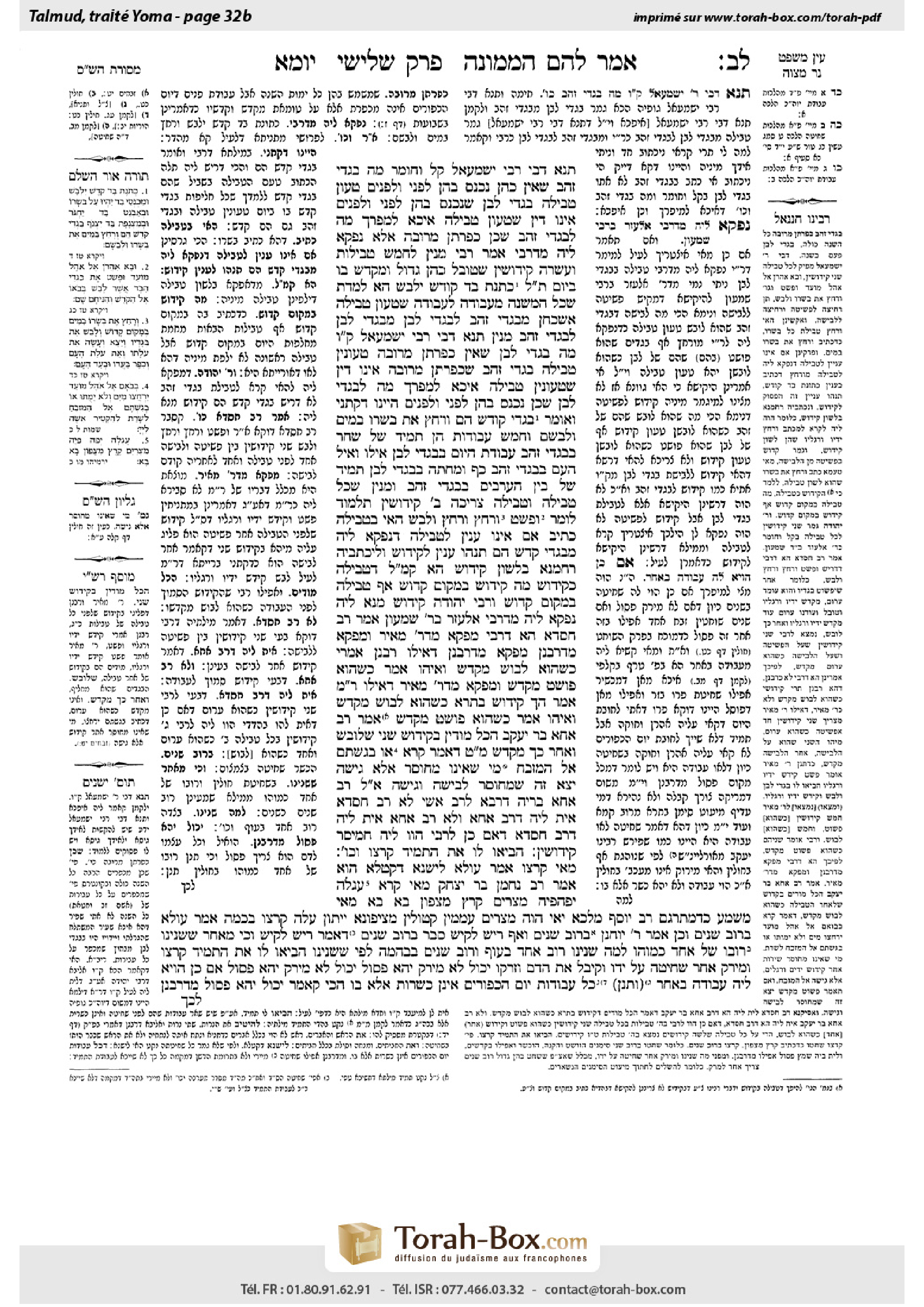
Yoma 32b: Talmud study for Daf Yomi
Daf Yomi is the daily study of one Talmud folio. Explore 37 tractates with scans, Hebrew text, Sefaria English and AI-generated French translations where annotated.
Passage selection and English or AI-generated French translation are available where the scan has annotations. Daf Study is independent of Torah-Box and Sefaria.
Browse Yoma · יומא · All tractatesYoma 32b text and translations
This page of Yoma includes the Aramaic text, an English translation and an AI-generated French translation, alongside the scan above.
יומא ל״ב ב · Aramaic and Hebrew text
תָּנָא דְּבֵי רַבִּי יִשְׁמָעֵאל, קַל וָחוֹמֶר: מָה בִּגְדֵי זָהָב שֶׁאֵין כֹּהֵן נִכְנָס בָּהֶן לִפְנַי וְלִפְנִים — טָעוּן טְבִילָה, בִּגְדֵי לָבָן שֶׁנִּכְנָס בָּהֶן לִפְנַי וְלִפְנִים — אֵינוֹ דִּין שֶׁטָּעוּן טְבִילָה! אִיכָּא לְמִפְרַךְ: מָה לְבִגְדֵי זָהָב שֶׁכֵּן כַּפָּרָתָן מְרוּבָּה! אֶלָּא, נָפְקָא לֵיהּ מִדְּרַבִּי.
אָמַר רַבִּי: מִנַּיִן לְחָמֵשׁ טְבִילוֹת וַעֲשָׂרָה קִידּוּשִׁין שֶׁטּוֹבֵל כֹּהֵן גָּדוֹל וּמְקַדֵּשׁ בּוֹ בַּיּוֹם, תַּלְמוּד לוֹמַר: ״כְּתֹנֶת בַּד קוֹדֶשׁ יִלְבָּשׁ״, הָא לָמַדְתָּ שֶׁכׇּל הַמְשַׁנֶּה מֵעֲבוֹדָה לַעֲבוֹדָה שֶׁטָּעוּן טְבִילָה. אַשְׁכְּחַן מִבִּגְדֵי זָהָב לְבִגְדֵי לָבָן, מִבִּגְדֵי לָבָן לְבִגְדֵי זָהָב מִנַּיִן?
תָּנָא דְּבֵי רַבִּי יִשְׁמָעֵאל, קַל וָחוֹמֶר: מָה בִּגְדֵי לָבָן שֶׁאֵין כַּפָּרָתָן מְרוּבָּה — טְעוּנִין טְבִילָה, בִּגְדֵי זָהָב שֶׁכַּפָּרָתָן מְרוּבָּה — אֵינוֹ דִּין שֶׁטְּעוּנִין טְבִילָה?
אִיכָּא לְמִפְרַךְ: מָה לְבִגְדֵי לָבָן שֶׁכֵּן נִכְנָס בָּהֶן לִפְנַי וְלִפְנִים! הַיְינוּ דְּקָתָנֵי, וְאוֹמֵר: ״בִּגְדֵי קוֹדֶשׁ הֵם וְרָחַץ אֶת בְּשָׂרוֹ בַּמַּיִם וּלְבֵשָׁם״.
וְחָמֵשׁ עֲבוֹדוֹת הֵן: תָּמִיד שֶׁל שַׁחַר בְּבִגְדֵי זָהָב, עֲבוֹדַת הַיּוֹם בְּבִגְדֵי לָבָן, אֵילוֹ וְאֵיל הָעָם בְּבִגְדֵי זָהָב, כַּף וּמַחְתָּה בְּבִגְדֵי לָבָן, תָּמִיד שֶׁל בֵּין הָעַרְבַּיִם בְּבִגְדֵי זָהָב.
וּמִנַּיִן שֶׁכׇּל טְבִילָה וּטְבִילָה צְרִיכָה שְׁנֵי קִידּוּשִׁין? תַּלְמוּד לוֹמַר: ״וּפָשַׁט ... וְרָחַץ״, ״וְרָחַץ ... וְלָבַשׁ״. הַאי בִּטְבִילָה כְּתִיב! אִם אֵינוֹ עִנְיָן לִטְבִילָה, דְּנָפְקָא לֵיהּ: מִ״בִּגְדֵי קֹדֶשׁ הֵם״, תְּנֵהוּ עִנְיָן לְקִידּוּשׁ.
וְלִיכְתְּבֵיהּ רַחֲמָנָא בִּלְשׁוֹן קִידּוּשׁ! הָא קָא מַשְׁמַע לַן דִּטְבִילָה כְּקִידּוּשׁ, מָה קִידּוּשׁ בְּמָקוֹם קָדוֹשׁ, אַף טְבִילָה בְּמָקוֹם קָדוֹשׁ.
וְרַבִּי יְהוּדָה, קִידּוּשׁ מְנָא לֵיהּ? נָפְקָא לֵיהּ מִדְּרַבִּי אֶלְעָזָר בְּרַבִּי שִׁמְעוֹן.
אָמַר רַב חִסְדָּא: הָא דְּרַבִּי מַפְּקָא מִדְּרַבִּי מֵאִיר, וּמַפְּקָא מִדְּרַבָּנַן. מַפְּקָא מִדְּרַבָּנַן, דְּאִילּוּ רַבָּנַן אָמְרִי: כְּשֶׁהוּא לָבוּשׁ מְקַדֵּשׁ, וְאִיהוּ אָמַר: כְּשֶׁהוּא פּוֹשֵׁט מְקַדֵּשׁ. וּמַפְּקָא מִדְּרַבִּי מֵאִיר: דְּאִילּוּ רַבִּי מֵאִיר אָמַר: הָךְ קִידּוּשׁ בָּתְרָא כְּשֶׁהוּא לָבוּשׁ מְקַדֵּשׁ, וְאִיהוּ אָמַר: כְּשֶׁהוּא פּוֹשֵׁט מְקַדֵּשׁ.
אָמַר רַב אַחָא בַּר יַעֲקֹב: הַכֹּל מוֹדִין בְּקִידּוּשׁ שֵׁנִי שֶׁלּוֹבֵשׁ וְאַחַר כָּךְ מְקַדֵּשׁ. מַאי טַעְמָא, דְּאָמַר קְרָא: ״אוֹ בְגִשְׁתָּם אֶל הַמִּזְבֵּחַ״, מִי שֶׁאֵינוֹ מְחוּסָּר אֶלָּא גִּישָׁה, יָצָא זֶה שֶׁמְחוּסָּר לְבִישָׁה וְגִישָׁה.
אֲמַר לֵיהּ רַב אַחָא בְּרֵיהּ דְּרָבָא לְרַב אָשֵׁי: לָא רַב חִסְדָּא אִית לֵיהּ דְּרַב אַחָא, וְלָא רַב אַחָא אִית לֵיהּ דְּרַב חִסְדָּא. דְּאִם כֵּן, לְרַבִּי הָווּ לְהוּ חֲמֵיסַר קִידּוּשִׁין.
הֵבִיאוּ לוֹ אֶת הַתָּמִיד קְרָצוֹ וְכוּ׳. מַאי קְרָצוֹ? אָמַר עוּלָּא: לִישָּׁנָא דִקְטָלָא הוּא. אָמַר רַב נַחְמָן בַּר יִצְחָק, מַאי קְרָא: ״עֶגְלָה יְפֵהפִיָּה מִצְרָיִם קֶרֶץ מִצָּפוֹן בָּא בָא״. מַאי מַשְׁמַע? כְּדִמְתַרְגֵּם רַב יוֹסֵף: ״מַלְכוּ יָאֲיָא הֲוָת מִצְרַיִם עַמְמִין קָטוֹלִין מִצִּיפּוּנָא יֵיתוֹן עֲלַהּ״. קְרָצוֹ בְּכַמָּה? אָמַר עוּלָּא: בְּרוֹב שְׁנַיִם.
וְכֵן אָמַר רַבִּי יוֹחָנָן: בְּרוֹב שְׁנַיִם. וְאַף רֵישׁ לָקִישׁ סָבַר בְּרוֹב שְׁנַיִם, דְּאָמַר רֵישׁ לָקִישׁ: וְכִי מֵאַחַר שֶׁשָּׁנִינוּ: רוּבּוֹ שֶׁל אֶחָד כָּמוֹהוּ, לָמָּה שָׁנִינוּ: רוֹב אֶחָד בָּעוֹף וְרוֹב שְׁנַיִם בַּבְּהֵמָה? לְפִי שֶׁשָּׁנִינוּ: הֵבִיאוּ לוֹ אֶת הַתָּמִיד, קְרָצוֹ וּמֵירַק אַחֵר שְׁחִיטָה עַל יָדוֹ, וְקִיבֵּל אֶת הַדָּם וּזְרָקוֹ. יָכוֹל לֹא מֵירַק — יְהֵא פָּסוּל.
יָכוֹל לֹא מֵירַק יְהֵא פָּסוּל?! אִם כֵּן הָוְיָא לֵיהּ עֲבוֹדָה בְּאַחֵר, (וּתְנַן): כׇּל עֲבוֹדוֹת יוֹם הַכִּפּוּרִים אֵינָן כְּשֵׁרוֹת אֶלָּא בּוֹ! הָכִי קָאָמַר: יָכוֹל יְהֵא פָּסוּל מִדְּרַבָּנַן,
Yoma 32b · English translation
The school of Rabbi Yishmael taught that it is derived by means of an a fortiori inference: Just as before donning golden garments, with which the High Priest does not enter the innermost sanctum, the Holy of Holies, the High Priest requires immersion, before donning white garments, with which the High Priest enters the innermost sanctum, is it not right that the High Priest require immersion? The Gemara asks: The a fortiori inference can be refuted: What is the comparison to golden garments, as the atonement that they effect is extensive? The High Priest serves in the golden garments throughout the year atoning for the sins of the Jewish people; he wears the white garments on just one Yom Kippur. Therefore, it is reasonable that before donning them, the High Priest would require immersion. Rather, it is derived from the verse cited by Rabbi Yehuda HaNasi.
The Gemara analyzes an additional clause from the baraita cited above. Rabbi Yehuda HaNasi said: From where are derived the five immersions and ten sanctifications that the High Priest immerses and sanctifies his hands and feet, respectively, on the day of Yom Kippur? They are derived from the verse that states: “He shall be dressed in a sacred linen tunic, and with linen trousers next to his flesh, and he shall be girded with a linen belt, and he shall wear a linen mitre; they are sacred garments, and he shall wash his flesh in water and then put them on” (Leviticus 16:4). From this you learned: Anyone who moves from an inner service, in the Holy of Holies, to an outer service, and vice versa, requires immersion. The Gemara asks: We found proof that the High Priest requires immersion when he changes from golden garments to white garments; however, from where is it derived that he requires immersion when he changes from white garments to golden garments?
The school of Rabbi Yishmael taught that it is derived by means of an a fortiori inference: Just as before donning white garments, with regard to which the atonement that they effect is minimal as the priest wears them only on one Yom Kippur, immersion is required, before donning golden garments, with regard to which the atonement that they effect is extensive throughout the year, is it not right that immersion should be required?
The Gemara asks: The a fortiori inference can be refuted: What is the comparison to white garments, as he enters with them to the innermost sanctum? As the High Priest does not enter the Holy of Holies with the golden garments, apparently the sanctity of the white garments is greater. The Gemara comments: The source for the requirement to immerse when changing from white garments to golden garments is that which is taught later in the baraita: The verse states: “They are sacred garments, and he shall wash his flesh in water and then put them on” (Leviticus 16:4), meaning immersion is required before donning all sacred garments.
And they are five services: The sacrifice of the daily morning offering, performed in golden garments; the service of the day, the bull and the goat, which is performed in white garments; the sacrifice of his ram guilt-offering and the ram of the people, performed in golden garments. After that the High Priest places the spoon and the coal pan into the Holy of Holies in white garments. He emerges from the Holy of Holies and sacrifices the daily afternoon offering in golden garments and then removes the spoon and the coal pan in white garments.
And from where is it derived that each and every immersion requires two sanctifications of the hands and the feet? It is derived from the verse that states: “And Aaron shall come into the Tent of Meeting and he shall remove the linen garments that he put on when he entered the Sanctuary and leave them there. And he shall wash his flesh in water” (Leviticus 16:23–24). And it says: “And he shall wash his flesh in water in a sacred place and put on his garments” (Leviticus 16:24). The Gemara asks: That is written with regard to immersion. The washing mentioned in this verse is not sanctification of the hands and feet but rather immersion. The Gemara answers: If it is not a matter relating to immersion, which is derived from the phrase: “They are sacred garments” (Leviticus 16:4), indicating that every change of clothes requires immersion, then render it a matter relating to sanctification.
The Gemara asks: And let the Merciful One write the obligation in the language of sanctification of the hands and feet rather than the language of immersion. The Gemara answers: This language comes to teach us that in this case, the legal status of immersion is like that of sanctification. Just as sanctification of the hands and feet is performed in a sacred area, as the basin used for sanctification is situated in the courtyard, so too, the immersion before donning garments must be performed in a sacred area, not outside the Temple.
The Gemara asks: And Rabbi Yehuda, who derives immersion before donning the golden garments from this verse and does not derive anything from the phrase: They are sacred garments, from where does he derive the obligation to perform sanctification of the hands and feet? The Gemara answers: He derives it as an a fortiori inference from the inference of Rabbi Elazar, son of Rabbi Shimon: In a place that the Torah does not require immersion it nevertheless requires sanctification of the hands and feet; therefore, in a place that the Torah requires immersion for all changes of garments, is it not right that it requires sanctification of the hands and feet?
Rav Ḥisda said: That statement of Rabbi Yehuda HaNasi with regard to immersion and sanctification is an original opinion to the exclusion of the opinion of Rabbi Meir with regard to sanctification, and to the exclusion of the opinion of the Rabbis. It is to the exclusion of the opinion of the Rabbis, as the Rabbis said that he sanctifies his hands and feet when he is dressed, and Rabbi Yehuda HaNasi said: He sanctifies them when he undresses. And it is to the exclusion of the opinion of Rabbi Meir, as Rabbi Meir said: With regard to this last sanctification that he performs after each immersion, he sanctifies his hands and feet when he is dressed. And Rabbi Yehuda HaNasi said: He sanctifies them when he undresses.
Rav Aḥa bar Ya’akov said: Everyone agrees with regard to the second sanctification that one dresses, and afterward sanctifies his hands and feet. What is the reason for this? It is as the verse states: “Or when they approach the altar to serve, to burn an offering by fire to God, they shall wash their hands and feet so that they do not die” (Exodus 30:20–21). This teaches that the priest who is obligated to sanctify his hands and feet is one who is lacking only the element of approach to the altar to begin performing the service, to the exclusion of that priest who has not yet donned the priestly vestments, who is lacking both the element of donning priestly vestments and the element of approach to the altar. Sanctification of the hands and feet prior to the service is performed when he is already dressed.
Rav Aḥa, son of Rava, said to Rav Ashi: Neither does Rav Ḥisda, who said that according to Rabbi Yehuda HaNasi the priest performs the two sanctifications before donning the garments, agree with Rav Aḥa, who said that according to Rabbi Yehuda HaNasi the sanctification is done after donning the garments; nor does Rav Aḥa, who said that according to Rabbi Yehuda HaNasi the sanctification must be performed directly prior to the service, agree with Rav Ḥisda, who said that according to Rabbi Yehuda HaNasi the two sanctifications are performed before donning the garments. As, if they do agree, according to Rabbi Yehuda HaNasi there are fifteen sanctifications. For each change of garments he would require three sanctifications: One when he undresses, one prior to dressing, and one after he is dressed.
§ It was taught in the mishna: They brought him the sheep for the daily morning offering, which he slaughtered [keratzo]. The Gemara asks: What is the meaning of keratzo? Ulla said: It is a term meaning killing. Rav Naḥman bar Yitzḥak said: What is the verse that indicates this meaning? It is stated: “Egypt is a very fair heifer, but the keretz out of north is come, it is come” (Jeremiah 46:20). The Gemara asks: From where may it be inferred that keretz means killing? The Gemara explains: It is as translated by Rav Yosef: Egypt is a fair kingdom, but murderous nations will come upon it from the north. The Gemara asks: When he slaughtered the sheep, to what extent did he do so? Ulla said: He slaughtered the animal with a cut through the majority of each of the two organs, the windpipe and the gullet, which is sufficient to render the animal ritually slaughtered.
And similarly, Rav Yoḥanan said: With the majority of each of the two organs. And Reish Lakish also held: With the majority of each of the two organs. This is indeed Reish Lakish’s opinion, as Reish Lakish said: Once we learned in the halakhot of ritual slaughter that the majority of one organ is like the whole, why was it necessary that we also learn there that in order for the slaughter to be valid it requires the majority of one organ in a bird and the majority of each of two organs in an animal? That is clear based on the principle that one organ is required in a bird and two in an animal. Rather, since we learned: They brought him the sheep for the daily morning offering, which he slaughtered by cutting most of the way through the gullet and the windpipe, and a different priest completed the slaughter on his behalf so that the High Priest could receive the blood in a vessel, and the High Priest received the blood in a vessel and sprinkled it on the altar; one might have thought that if the other priest did not complete cutting through the two organs, the slaughter would be invalid.
The Gemara asks: How is it possible that one might have thought that if the other priest did not complete cutting through the two organs, the slaughter would be invalid? If that is so, the completion of the slaughter is a Temple service performed by another on Yom Kippur. And it was taught in a baraita: All Yom Kippur services are valid only if performed by the High Priest. The Gemara answers that this is what Reish Lakish is saying: Clearly, there is no requirement by Torah law to complete the slaughter of the two organs. One might have thought that it would be invalid by rabbinic law;
Yoma 32b · Traduction française (IA)
L’école de Rabbi Yishmael enseignait que cela se déduit par un raisonnement a fortiori : de même qu’une immersion est requise avant de revêtir les vêtements d’or, avec lesquels le grand prêtre n’entre pas dans le sanctuaire le plus intérieur, le Saint des saints, n’est-il pas d’autant plus évident qu’une immersion est requise avant de revêtir les vêtements blancs, avec lesquels il entre dans le sanctuaire le plus intérieur ? La Guemara demande : On peut réfuter le raisonnement a fortiori : en quoi les vêtements d’or sont-ils comparables, puisque l’expiation qu’ils assurent est étendue ? Le grand prêtre officie toute l’année en vêtements d’or, expiant les péchés du peuple juif ; il ne porte les vêtements blancs qu’un seul jour de Yom Kippour. Il est donc raisonnable qu’une immersion soit requise avant de les revêtir. On le déduit plutôt du verset cité par Rabbi Yehuda HaNasi.
La Guemara examine une autre clause de la baraïta citée plus haut. Rabbi Yehuda HaNasi dit : D’où déduit-on les cinq immersions et les dix sanctifications que le grand prêtre accomplit le jour de Yom Kippour, en s’immergeant et en sanctifiant ses mains et ses pieds, respectivement ? On les déduit du verset qui dit : « Il revêtira une tunique de lin sacrée, portera un caleçon de lin sur sa chair, sera ceint d’une ceinture de lin et se couvrira d’une tiare de lin ; ce sont des vêtements sacrés, et il baignera sa chair dans l’eau, puis les revêtira » (Lévitique 16:4). On apprend de là que quiconque passe d’un service intérieur, dans le Saint des saints, à un service extérieur, et inversement, doit s’immerger. La Guemara demande : Nous avons trouvé une preuve que le grand prêtre doit s’immerger lorsqu’il passe des vêtements d’or aux vêtements blancs ; mais d’où déduit-on qu’il doit s’immerger lorsqu’il passe des vêtements blancs aux vêtements d’or ?
L’école de Rabbi Yishmael enseignait que cela se déduit par un raisonnement a fortiori : de même qu’une immersion est requise avant de revêtir les vêtements blancs, dont l’expiation est limitée puisqu’il ne les porte qu’un seul jour de Yom Kippour, n’est-il pas d’autant plus évident qu’une immersion est requise avant de revêtir les vêtements d’or, dont l’expiation s’étend à toute l’année ?
La Guemara demande : On peut réfuter le raisonnement a fortiori : en quoi les vêtements blancs sont-ils comparables, puisqu’il entre avec eux dans le sanctuaire le plus intérieur ? Puisque le grand prêtre n’entre pas dans le Saint des saints avec les vêtements d’or, il semble que la sainteté des vêtements blancs soit supérieure. La Guemara fait remarquer : La source de l’obligation de s’immerger en passant des vêtements blancs aux vêtements d’or est ce qui est enseigné plus loin dans la baraïta : le verset dit : « Ce sont des vêtements sacrés, et il baignera sa chair dans l’eau, puis les revêtira » (Lévitique 16:4), ce qui signifie qu’une immersion est requise avant de revêtir tous les vêtements sacrés.
Et il y a cinq services : le sacrifice de l’offrande quotidienne du matin, accompli en vêtements d’or ; le service du jour, avec le taureau et le bouc, accompli en vêtements blancs ; le sacrifice de son bélier en sacrifice de culpabilité et du bélier du peuple, accomplis en vêtements d’or. Ensuite, le grand prêtre dépose la cuillère et le brasier dans le Saint des saints, en vêtements blancs. Il sort du Saint des saints et offre le sacrifice quotidien de l’après-midi en vêtements d’or, puis retire la cuillère et le brasier en vêtements blancs.
Et d’où déduit-on que chacune des immersions exige deux sanctifications des mains et des pieds ? On le déduit du verset qui dit : « Aaron entrera dans la Tente d’assignation, retirera les vêtements de lin qu’il avait revêtus en entrant dans le Sanctuaire et les déposera là. Il baignera sa chair dans l’eau » (Lévitique 16:23–24). Et il est dit : « Il baignera sa chair dans l’eau, dans un lieu saint, et revêtira ses vêtements » (Lévitique 16:24). La Guemara demande : Cela est écrit à propos de l’immersion. Le bain mentionné dans ce verset ne désigne pas la sanctification des mains et des pieds, mais l’immersion. La Guemara répond : Si cela ne concerne pas l’immersion, qui est déduite de l’expression « ce sont des vêtements sacrés » (Lévitique 16:4), indiquant que chaque changement de vêtements exige une immersion, alors interprète-le comme concernant la sanctification.
La Guemara demande : Et pourquoi le Miséricordieux n’a-t-il pas formulé l’obligation en termes de sanctification des mains et des pieds plutôt qu’en termes d’immersion ? La Guemara répond : Cette formulation vient nous enseigner qu’en l’occurrence, le statut de l’immersion est semblable à celui de la sanctification. De même que la sanctification des mains et des pieds s’effectue dans un lieu saint, puisque la cuve utilisée à cette fin se trouve dans la cour, de même l’immersion précédant le port des vêtements doit s’effectuer dans un lieu saint, et non à l’extérieur du Temple.
La Guemara demande : Et Rabbi Yehuda, qui déduit de ce verset l’immersion avant de revêtir les vêtements d’or et ne déduit rien de l’expression « ce sont des vêtements sacrés », d’où déduit-il l’obligation de sanctifier les mains et les pieds ? La Guemara répond : Il la déduit par un raisonnement a fortiori, à partir du raisonnement de Rabbi Elazar, fils de Rabbi Shimon : dans un cas où la Torah n’exige pas l’immersion, elle exige néanmoins la sanctification des mains et des pieds ; à plus forte raison, dans un cas où la Torah exige l’immersion lors de tout changement de vêtements, n’exige-t-elle pas la sanctification des mains et des pieds ?
Rav Ḥisda dit : Cette déclaration de Rabbi Yehuda HaNasi au sujet de l’immersion et de la sanctification est une opinion originale, qui exclut l’opinion des Sages ainsi que celle de Rabbi Meir concernant la sanctification. Elle exclut l’opinion des Sages, car ceux-ci ont dit qu’il sanctifie ses mains et ses pieds lorsqu’il est habillé, tandis que Rabbi Yehuda HaNasi dit qu’il les sanctifie lorsqu’il se déshabille. Elle exclut aussi l’opinion de Rabbi Meir, car Rabbi Meir a dit que, pour cette dernière sanctification qu’il accomplit après chaque immersion, il sanctifie ses mains et ses pieds lorsqu’il est habillé. Rabbi Yehuda HaNasi, lui, dit qu’il les sanctifie lorsqu’il se déshabille.
Rav Aḥa bar Ya’akov dit : Tout le monde convient que, pour la seconde sanctification, le prêtre s’habille puis sanctifie ses mains et ses pieds. Pour quelle raison ? Comme le dit le verset : « Lorsqu’ils s’approcheront de l’autel pour officier, pour brûler une offrande consumée par le feu à Dieu, ils se laveront les mains et les pieds afin de ne pas mourir » (Exode 30:20–21). Cela enseigne que le prêtre tenu de sanctifier ses mains et ses pieds est celui auquel il ne manque que de s’approcher de l’autel pour commencer le service ; cela exclut le prêtre qui n’a pas encore revêtu les vêtements sacerdotaux, auquel il manque à la fois de revêtir ces vêtements et de s’approcher de l’autel. La sanctification des mains et des pieds qui précède le service s’effectue donc lorsqu’il est déjà habillé.
Rav Aḥa, fils de Rava, dit à Rav Ashi : Rav Ḥisda, qui dit que selon Rabbi Yehuda HaNasi le prêtre accomplit les deux sanctifications avant de revêtir les vêtements, n’est pas d’accord avec Rav Aḥa, qui dit que selon Rabbi Yehuda HaNasi la sanctification s’effectue après avoir revêtu les vêtements ; et Rav Aḥa, qui dit que selon Rabbi Yehuda HaNasi la sanctification doit être accomplie juste avant le service, n’est pas d’accord avec Rav Ḥisda, qui dit que selon Rabbi Yehuda HaNasi les deux sanctifications s’effectuent avant de revêtir les vêtements. Car s’ils étaient d’accord, il y aurait quinze sanctifications selon Rabbi Yehuda HaNasi : à chaque changement de vêtements, il faudrait trois sanctifications, l’une lorsqu’il se déshabille, l’une avant de s’habiller et l’une après s’être habillé.
§ Il a été enseigné dans la Michna : On lui apporta le mouton destiné à l’offrande quotidienne du matin, qu’il égorgea [keratzo]. La Guemara demande : Que signifie keratzo ? Ulla dit : C’est un terme qui signifie tuer. Rav Naḥman bar Yitzḥak dit : Quel verset indique ce sens ? Il est dit : « L’Égypte est une très belle génisse, mais le keretz venu du nord vient, il vient » (Jérémie 46:20). La Guemara demande : D’où peut-on déduire que keretz signifie tuer ? La Guemara explique : C’est ainsi que Rav Yosef traduit : « L’Égypte est un beau royaume, mais des nations meurtrières fondront sur elle depuis le nord. » La Guemara demande : Lorsqu’il égorgea le mouton, jusqu’à quel point le fit-il ? Ulla dit : Il trancha la majorité de chacun des deux organes, la trachée et l’œsophage, ce qui suffit à rendre l’animal rituellement égorgé.
De même, Rabbi Yoḥanan dit : la majorité de chacun des deux organes. Reish Lakish soutenait lui aussi qu’il fallait trancher la majorité de chacun des deux organes. C’est bien l’opinion de Reish Lakish, car il a dit : Puisque nous avons appris, dans les règles de l’abattage rituel, que la majorité d’un organe équivaut à son intégralité, pourquoi était-il nécessaire d’apprendre aussi qu’un abattage valide exige la majorité d’un organe chez un oiseau et la majorité de chacun des deux organes chez un animal ? Cela découle clairement du principe selon lequel un organe est requis pour un oiseau et deux pour un animal. Mais puisque nous avons appris : On lui apporta le mouton destiné à l’offrande quotidienne du matin, qu’il égorgea en tranchant la majorité de l’œsophage et de la trachée, puis un autre prêtre acheva l’égorgement à sa place afin que le grand prêtre puisse recueillir le sang dans un récipient ; le grand prêtre recueillit le sang dans un récipient et en aspergea l’autel, on aurait pu penser que si l’autre prêtre n’achevait pas de trancher les deux organes, l’abattage serait invalide.
La Guemara demande : Comment aurait-on pu penser que si l’autre prêtre n’achevait pas de trancher les deux organes, l’abattage serait invalide ? Si tel était le cas, l’achèvement de l’abattage constituerait un service du Temple accompli par un autre prêtre le jour de Yom Kippour. Or il a été enseigné dans une baraïta : tous les services de Yom Kippour ne sont valides que s’ils sont accomplis par le grand prêtre. La Guemara répond que voici ce que dit Reish Lakish : De toute évidence, la Torah n’exige pas que l’on achève de trancher les deux organes. On aurait pu penser que, selon la loi rabbinique, l’abattage serait invalide ;
Traduction française générée par IA à partir de l’édition anglaise de Sefaria. Vérifie toujours un passage avec le texte source.
Text from Sefaria: William Davidson Edition - Vocalized Aramaic (CC BY NC); William Davidson Edition - English (CC BY NC).