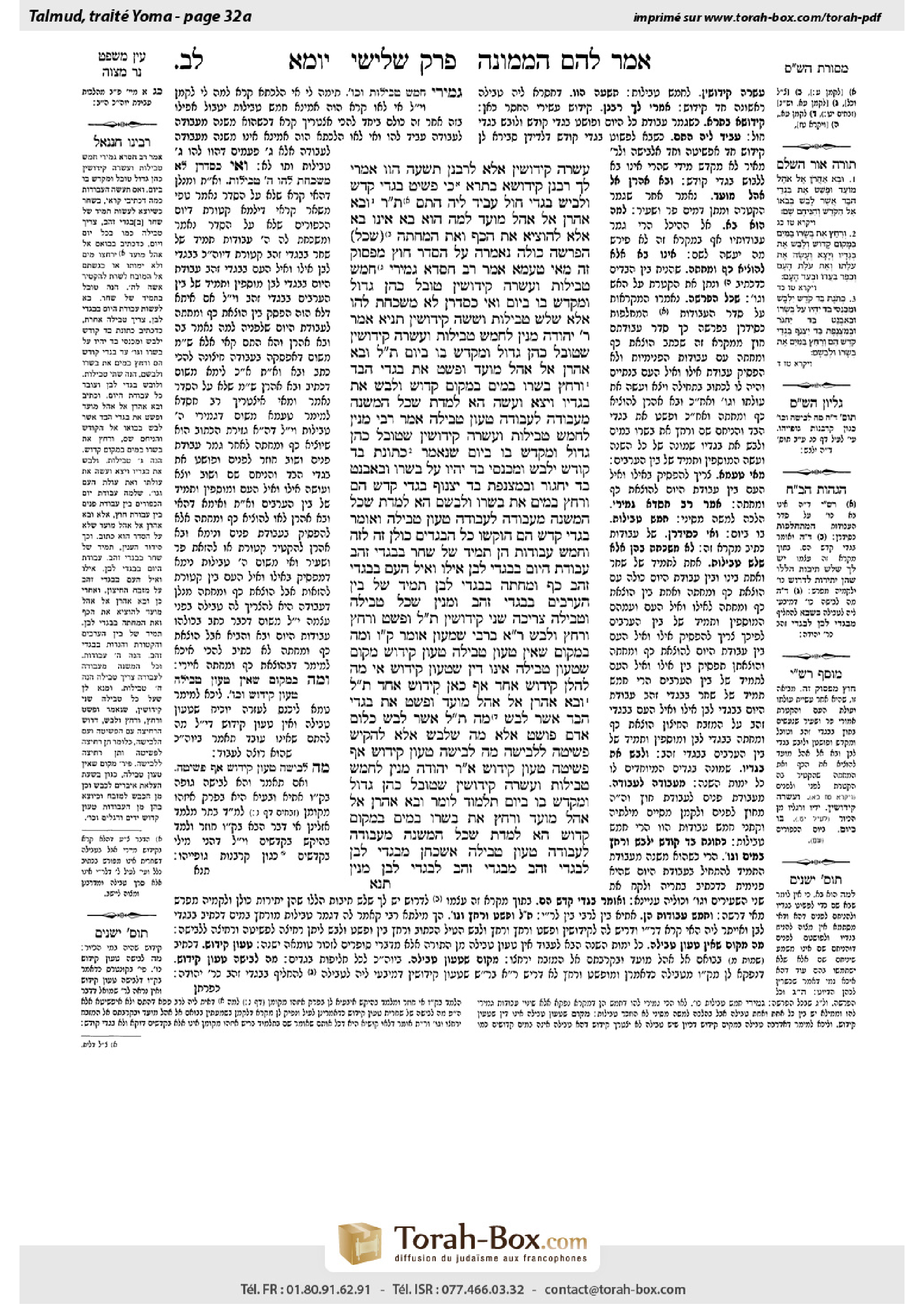
Yoma 32a: Talmud study for Daf Yomi
Daf Yomi is the daily study of one Talmud folio. Explore 37 tractates with scans, Hebrew text, Sefaria English and AI-generated French translations where annotated.
Passage selection and English or AI-generated French translation are available where the scan has annotations. Daf Study is independent of Torah-Box and Sefaria.
Browse Yoma · יומא · All tractatesYoma 32a text and translations
This page of Yoma includes the Aramaic text, an English translation and an AI-generated French translation, alongside the scan above.
יומא ל״ב א · Aramaic and Hebrew text
עֲשָׂרָה קִידּוּשִׁין. אֶלָּא לְרַבָּנַן, תִּשְׁעָה הֲווֹ! אָמְרִי לָךְ רַבָּנַן: קִידּוּשָׁא בָּתְרָא, כִּי פָּשֵׁיט בִּגְדֵי קֹדֶשׁ וְלָבֵישׁ בִּגְדֵי חוֹל, עָבֵיד לֵיהּ הָתָם.
תָּנוּ רַבָּנַן: ״וּבָא אַהֲרֹן אֶל אֹהֶל מוֹעֵד״, לָמָה הוּא בָּא? אֵינוֹ בָּא אֶלָּא לְהוֹצִיא אֶת הַכַּף וְאֶת הַמַּחְתָּה. (שֶׁכׇּל) הַפָּרָשָׁה כּוּלָּהּ נֶאֶמְרָה עַל הַסֵּדֶר, חוּץ מִפָּסוּק זֶה. מַאי טַעְמָא?
אָמַר רַב חִסְדָּא: גְּמִירִי, חָמֵשׁ טְבִילוֹת וַעֲשָׂרָה קִידּוּשִׁין טוֹבֵל כֹּהֵן גָּדוֹל וּמְקַדֵּשׁ בּוֹ בַּיּוֹם. וְאִי כְּסִדְרָן, לָא מַשְׁכַּחַתְּ לְהוּ אֶלָּא שָׁלֹשׁ טְבִילוֹת וְשִׁשָּׁה קִידּוּשִׁין.
תַּנְיָא, אָמַר רַבִּי יְהוּדָה: מִנַּיִן לְחָמֵשׁ טְבִילוֹת וַעֲשָׂרָה קִידּוּשִׁין שֶׁטּוֹבֵל כֹּהֵן גָּדוֹל וּמְקַדֵּשׁ בּוֹ בַּיּוֹם? תַּלְמוּד לוֹמַר: ״וּבָא אַהֲרֹן אֶל אֹהֶל מוֹעֵד וּפָשַׁט אֶת בִּגְדֵי הַבָּד וְרָחַץ בְּשָׂרוֹ בַמַּיִם בְּמָקוֹם קָדוֹשׁ וְלָבַשׁ אֶת בְּגָדָיו וְיָצָא וְעָשָׂה״. הָא לָמַדְתָּ שֶׁכׇּל הַמְשַׁנֶּה מֵעֲבוֹדָה לַעֲבוֹדָה טָעוּן טְבִילָה.
אָמַר רַבִּי: מִנַּיִן לְחָמֵשׁ טְבִילוֹת וַעֲשָׂרָה קִידּוּשִׁין שֶׁטּוֹבֵל כֹּהֵן גָּדוֹל וּמְקַדֵּשׁ בּוֹ בַּיּוֹם, שֶׁנֶּאֱמַר: ״כְּתוֹנֶת בַּד קוֹדֶשׁ יִלְבָּשׁ וּמִכְנְסֵי בַד יִהְיוּ עַל בְּשָׂרוֹ וּבְאַבְנֵט בַּד יַחְגּוֹר וּבְמִצְנֶפֶת בַּד יִצְנוֹף בִּגְדֵי קֹדֶשׁ הֵם וְרָחַץ בַּמַּיִם אֶת בְּשָׂרוֹ וּלְבֵשָׁם״, הָא לָמַדְתָּ שֶׁכׇּל הַמְשַׁנֶּה מֵעֲבוֹדָה לַעֲבוֹדָה — טָעוּן טְבִילָה. וְאוֹמֵר: ״בִּגְדֵי קֹדֶשׁ הֵם״, הוּקְשׁוּ כׇּל הַבְּגָדִים כּוּלָּן זֶה לָזֶה.
וְחָמֵשׁ עֲבוֹדוֹת הֵן: תָּמִיד שֶׁל שַׁחַר בְּבִגְדֵי זָהָב, עֲבוֹדַת הַיּוֹם בְּבִגְדֵי לָבָן, אֵילוֹ וְאֵיל הָעָם בְּבִגְדֵי זָהָב, כַּף וּמַחְתָּה בְּבִגְדֵי לָבָן, תָּמִיד שֶׁל בֵּין הָעַרְבַּיִם בְּבִגְדֵי זָהָב.
וּמִנַּיִן שֶׁכׇּל טְבִילָה וּטְבִילָה צְרִיכָה שְׁנֵי קִידּוּשִׁין? תַּלְמוּד לוֹמַר: ״וּפָשַׁט ... וְרָחַץ״, ״וְרָחַץ ... וְלָבַשׁ״
רַבִּי אֶלְעָזָר בְּרַבִּי שִׁמְעוֹן אוֹמֵר, קַל וָחוֹמֶר: וּמָה בִּמְקוֹם שֶׁאֵין טָעוּן טְבִילָה — טָעוּן קִידּוּשׁ, מְקוֹם שֶׁטָּעוּן טְבִילָה — אֵינוֹ דִּין שֶׁטָּעוּן קִידּוּשׁ.
אִי מָה לְהַלָּן קִידּוּשׁ אֶחָד, אַף כָּאן קִידּוּשׁ אֶחָד? תַּלְמוּד לוֹמַר: ״וּבָא אַהֲרֹן אֶל אֹהֶל מוֹעֵד וּפָשַׁט אֶת בִּגְדֵי הַבָּד אֲשֶׁר לָבַשׁ״, מָה תַּלְמוּד לוֹמַר: ״אֲשֶׁר לָבַשׁ״, כְּלוּם אָדָם פּוֹשֵׁט אֶלָּא מַה שֶּׁלָּבַשׁ! אֶלָּא לְהַקִּישׁ פְּשִׁיטָה לִלְבִישָׁה: מָה לְבִישָׁה טָעוּן קִידּוּשׁ — אַף פְּשִׁיטָה טָעוּן קִידּוּשׁ.
אָמַר רַבִּי יְהוּדָה: מִנַּיִן לְחָמֵשׁ טְבִילוֹת וַעֲשָׂרָה קִידּוּשִׁין שֶׁטּוֹבֵל כֹּהֵן גָּדוֹל וּמְקַדֵּשׁ בּוֹ בַּיּוֹם? תַּלְמוּד לוֹמַר: ״וּבָא אַהֲרֹן אֶל אֹהֶל מוֹעֵד וְרָחַץ אֶת בְּשָׂרוֹ בַמַּיִם בְּמָקוֹם קָדוֹשׁ״, הָא לָמַדְתָּ שֶׁכׇּל הַמְשַׁנֶּה מֵעֲבוֹדָה לַעֲבוֹדָה — טָעוּן טְבִילָה. אַשְׁכְּחַן מִבִּגְדֵי לָבָן לְבִגְדֵי זָהָב, מִבִּגְדֵי זָהָב לְבִגְדֵי לָבָן מִנַּיִן?
Yoma 32a · English translation
ten sanctifications, as according to his opinion each of the five immersions is accompanied by two sanctifications. However, according to the opinion of the Rabbis who do not require sanctification before donning the garments for the first time, only nine sanctifications are performed. The Gemara answers that The Rabbis could have said to you: With regard to the final sanctification, when he removes the sacred garments and dons non-sacred garments, he performs it there. According to the Rabbis’ opinion, he sanctifies his hands and his feet when he removes the sacred garments. Rabbi Meir holds that sanctification of his hands and feet is performed only before donning sacred garments.
§ The Sages taught the following with regard to the verse: “And Aaron shall come into the Tent of Meeting” (Leviticus 16:23). Why does he come there? He already completed the service in the Sanctuary. He comes only to remove the spoon and the coal pan that he left in the Holy of Holies, as the entire Torah portion in which the Yom Kippur service is discussed was stated in the order in which it is performed in the Temple except for this verse, which should have been written after the sacrifice of the burnt-offering in the following verse. The High Priest does not remove the spoon immediately after he places it in the Holy of Holies. Rather, after placing it there, he emerges and performs certain services outside the Sanctuary and changes his garments again. The Gemara asks: What is the reason that the High Priest interrupts the inner rite of the incense to offer his ram and the people’s ram before removing the spoon and the coal pan?
Rav Ḥisda said: We learned as a tradition that five immersions and ten sanctifications the High Priest immerses and sanctifies his hands and feet, respectively, on the day of Yom Kippur; and if the service is performed in the order that appears in the Torah, you find only three immersions and six sanctifications. The first immersion is before sacrifice of the daily morning offering; the second is between the daily offering and the rest of the service of the day, including the removal of the spoon and the coal pan from the Holy of Holies. The High Priest immerses a third time between removal of the ladle and the coal pan from the Holy of Holies and the sacrifice of his ram and the people’s ram, which were part of the additional offering and the daily afternoon offering that follow. According to the revised sequence, the High Priest performs a service outside the Sanctuary after placing the spoon and the coal pan in the Holy of Holies, and then he reenters the Holy of Holies to remove those vessels. The High Priest immersed and changed his garments both before entering and after exiting the Holy of Holies, for a total of five immersions.
It was taught in a baraita that Rabbi Yehuda said: From where are derived the five immersions and ten sanctifications that the High Priest immerses and sanctifies his hands and feet, respectively, on the day of Yom Kippur? They are derived from the verse that states: “And Aaron shall come into the Tent of Meeting and he shall remove the linen garments that he put on when he entered the Sanctuary and leave them there. And he shall wash his flesh in water in a sacred place and put on his garments, and he shall go out and perform his own burnt-offering and the burnt-offering of the people” (Leviticus 16:23–24). From this you learned: Anyone who moves from an inner service, in the Holy of Holies, to an outer service, and vice versa, requires immersion. According to the order of the services there are a total of five immersions.
Rabbi Yehuda HaNasi said: From where are derived the five immersions and ten sanctifications that the High Priest immerses and sanctifies his hands and feet, respectively, on the day of Yom Kippur? They are derived from that which is stated: “He shall be dressed in a sacred linen tunic, and with linen trousers next to his flesh, and he shall be girded with a linen belt, and he shall wear a linen mitre; they are sacred garments, and he shall wash his flesh in water and then put them on” (Leviticus 16:4). From this you learned: Anyone who moves from an inner service, in the Holy of Holies, to an outer service requires immersion. And the verse says: “They are sacred garments”; all of the garments are equated to one another. Just as the High Priest immerses when donning the linen garments, so he immerses when donning the golden garments.
And they are five services: The sacrifice of the daily morning offering, performed in golden garments; the service of the day, the sacrifice of the bull and the goat, which is performed in white garments; the sacrifice of his ram guilt-offering and the ram of the people in golden garments. After that he removes the spoon and the coal pan from the Holy of Holies in white garments. He emerges from the Holy of Holies and sacrifices the daily afternoon offering in golden garments.
And from where is it derived that each and every immersion requires two sanctifications of the hands and the feet? It is derived from the verse that states: “And Aaron shall come into the Tent of Meeting and he shall remove the linen garments that he put on when he entered the Sanctuary and leave them there. And he shall wash his flesh in water” (Leviticus 16:23–24). And it says: “And he shall wash his flesh in water in a sacred place and put on his garments” (Leviticus 16:24). This indicates that one sanctifies his hands and feet when he removes garments, and one likewise sanctifies his hands and feet when he dons garments.
Rabbi Elazar, son of Rabbi Shimon, says that it is derived by means of an a fortiori inference: Just as in a place where the Torah does not require immersion, i.e., for a priest before he enters the Temple to perform service, it nevertheless requires sanctification of the hands and feet; in a place where the Torah requires immersion for all changes of garments, i.e., on Yom Kippur, is it not right that it requires sanctification of the hands and feet?
If based on that inference the suggestion arises: Just as there, in the case of a priest entering to perform the Temple service, only one sanctification is required, so too here, on Yom Kippur, only one sanctification should be required for the changes of garments throughout all the services of the day. Therefore, the verse states: “And Aaron shall come into the Tent of Meeting and he shall remove the linen garments that he put on” (Leviticus 16:23). What is the meaning when the verse states: “That he put on”? Does a person remove any garments other than those that he put on? Rather, this phrase comes to equate removal of garments to donning of garments: Just as donning garments requires sanctification, so too, removal of garments requires sanctification.
The Gemara explains the position of Rabbi Yehuda that was mentioned earlier. Rabbi Yehuda said: From where are derived the five immersions and ten sanctifications that the High Priest immerses and sanctifies his hands and feet, respectively, on the day of Yom Kippur? They are derived from the verse that states: “And Aaron shall come into the Tent of Meeting and he shall remove the linen garments that he put on when he entered the Sanctuary and leave them there. And he shall wash his flesh in water in a sacred place” (Leviticus 16:23–24). From this you learned: Anyone who moves from an inner service, in the Holy of Holies, to an outer service, and vice versa, requires immersion. The Gemara asks: We found proof that the High Priest requires immersion when he changes from white garments to golden garments; however, from where is it derived that he requires immersion when he changes from golden garments to white garments?
Yoma 32a · Traduction française (IA)
dix sanctifications, puisque, selon son opinion, chacune des cinq immersions est accompagnée de deux sanctifications. Toutefois, selon l’opinion des Sages, qui n’exigent pas de sanctification avant le premier revêtement des vêtements, seules neuf sanctifications sont effectuées. La Guemara répond que les Sages auraient pu lui dire : « Quant à la sanctification finale, il l’effectue à ce moment-là, lorsqu’il retire les vêtements sacrés et revêt des vêtements profanes. » Selon l’opinion des Sages, il sanctifie ses mains et ses pieds lorsqu’il retire les vêtements sacrés. Rabbi Meïr estime que la sanctification des mains et des pieds n’a lieu qu’avant de revêtir les vêtements sacrés.
§ Les Sages ont enseigné ce qui suit au sujet du verset : « Aaron entrera dans la Tente d’assignation » (Lévitique 16,23). Pourquoi y entre-t-il ? Il a déjà achevé le service dans le Sanctuaire. Il n’y entre que pour retirer la cuillère et le brasier qu’il a laissés dans le Saint des saints, car toute la section de la Torah consacrée au service de Yom Kippour est rapportée dans l’ordre où celui-ci est accompli dans le Temple, à l’exception de ce verset, qui aurait dû être écrit après le sacrifice de l’holocauste mentionné au verset suivant. Le grand prêtre ne retire pas la cuillère immédiatement après l’avoir déposée dans le Saint des saints. Au contraire, après l’y avoir déposée, il ressort, accomplit certains services à l’extérieur du Sanctuaire, puis change de vêtements une nouvelle fois. La Guemara demande : Pourquoi le grand prêtre interrompt-il le rite intérieur de l’encens pour offrir son bélier et le bélier du peuple avant de retirer la cuillère et le brasier ?
Rav Hisda a dit : Nous avons reçu par tradition que le grand prêtre effectue cinq immersions et dix sanctifications de ses mains et de ses pieds, respectivement, le jour de Yom Kippour ; or, si le service est accompli dans l’ordre présenté dans la Torah, on ne trouve que trois immersions et six sanctifications. La première immersion a lieu avant le sacrifice de l’offrande quotidienne du matin ; la deuxième, entre l’offrande quotidienne et le reste du service de la journée, notamment le retrait de la cuillère et du brasier du Saint des saints. Le grand prêtre effectue une troisième immersion entre le retrait de la cuillère et du brasier du Saint des saints et le sacrifice de son bélier et du bélier du peuple, qui font partie de l’offrande supplémentaire et de l’offrande quotidienne de l’après-midi, accomplies ensuite. Selon l’ordre révisé, le grand prêtre accomplit un service à l’extérieur du Sanctuaire après avoir déposé la cuillère et le brasier dans le Saint des saints, puis il y retourne pour retirer ces ustensiles. Le grand prêtre s’immerge et change de vêtements avant d’entrer dans le Saint des saints, puis après en être sorti, ce qui fait cinq immersions en tout.
Il a été enseigné dans une baraïta que Rabbi Yehouda a dit : D’où déduit-on les cinq immersions et les dix sanctifications que le grand prêtre effectue, respectivement, pour ses mains et ses pieds le jour de Yom Kippour ? On les déduit du verset qui dit : « Aaron entrera dans la Tente d’assignation, retirera les vêtements de lin qu’il avait revêtus en entrant dans le Sanctuaire et les y laissera. Il lavera son corps dans l’eau, en un lieu saint, revêtira ses vêtements, puis sortira et offrira son holocauste et l’holocauste du peuple » (Lévitique 16,23-24). Vous apprenez de là que quiconque passe d’un service intérieur, dans le Saint des saints, à un service extérieur, et inversement, doit s’immerger. Selon l’ordre des services, il y a en tout cinq immersions.
Rabbi Yehouda HaNassi a dit : D’où déduit-on les cinq immersions et les dix sanctifications que le grand prêtre effectue, respectivement, pour ses mains et ses pieds le jour de Yom Kippour ? On les déduit de ce qui est dit : « Il sera vêtu d’une tunique sainte de lin, portera un pantalon de lin sur son corps, sera ceint d’une ceinture de lin et portera une mitre de lin ; ce sont des vêtements sacrés. Il lavera son corps dans l’eau, puis les revêtira » (Lévitique 16,4). Vous apprenez de là que quiconque passe d’un service intérieur, dans le Saint des saints, à un service extérieur doit s’immerger. Et le verset dit : « Ce sont des vêtements sacrés » ; tous les vêtements sont assimilés les uns aux autres. De même que le grand prêtre s’immerge lorsqu’il revêt les vêtements de lin, il s’immerge également lorsqu’il revêt les vêtements d’or.
Et il y a cinq services : le sacrifice de l’offrande quotidienne du matin, accompli avec les vêtements d’or ; le service de la journée — le sacrifice du taureau et du bouc —, accompli avec les vêtements blancs ; le sacrifice de son bélier en sacrifice de culpabilité et du bélier du peuple, accompli avec les vêtements d’or. Ensuite, il retire la cuillère et le brasier du Saint des saints avec les vêtements blancs. Il sort du Saint des saints et offre l’offrande quotidienne de l’après-midi avec les vêtements d’or.
Et d’où déduit-on que chaque immersion nécessite deux sanctifications des mains et des pieds ? On le déduit du verset qui dit : « Aaron entrera dans la Tente d’assignation, retirera les vêtements de lin qu’il avait revêtus en entrant dans le Sanctuaire et les y laissera. Il lavera son corps dans l’eau » (Lévitique 16,23-24). Et il est dit : « Il lavera son corps dans l’eau, en un lieu saint, et revêtira ses vêtements » (Lévitique 16,24). Cela indique qu’il sanctifie ses mains et ses pieds lorsqu’il retire ses vêtements, et également lorsqu’il les revêt.
Rabbi Elazar, fils de Rabbi Shimon, dit que cela se déduit au moyen d’un raisonnement a fortiori : de même que, dans un cas où la Torah n’exige pas d’immersion — celui d’un prêtre avant qu’il n’entre dans le Temple pour y accomplir le service —, elle exige néanmoins la sanctification des mains et des pieds, à plus forte raison l’exige-t-elle dans un cas où la Torah impose une immersion à chaque changement de vêtements, c’est-à-dire le jour de Yom Kippour.
Si l’on se fonde sur cette déduction, on pourrait suggérer : de même que là, dans le cas d’un prêtre qui entre pour accomplir le service du Temple, une seule sanctification est requise, de même ici, le jour de Yom Kippour, une seule sanctification devrait être requise pour les changements de vêtements au cours de tous les services de la journée. Le verset dit donc : « Aaron entrera dans la Tente d’assignation et retirera les vêtements de lin qu’il avait revêtus » (Lévitique 16,23). Que signifie l’expression « qu’il avait revêtus » ? Une personne retire-t-elle d’autres vêtements que ceux qu’elle a revêtus ? Cette expression vient plutôt assimiler le retrait des vêtements à leur revêtement : de même que le revêtement des vêtements exige une sanctification, leur retrait en exige également une.
La Guemara explique l’opinion de Rabbi Yehouda mentionnée précédemment. Rabbi Yehouda a dit : D’où déduit-on les cinq immersions et les dix sanctifications que le grand prêtre effectue, respectivement, pour ses mains et ses pieds le jour de Yom Kippour ? On les déduit du verset qui dit : « Aaron entrera dans la Tente d’assignation, retirera les vêtements de lin qu’il avait revêtus en entrant dans le Sanctuaire et les y laissera. Il lavera son corps dans l’eau, en un lieu saint » (Lévitique 16,23-24). Vous apprenez de là que quiconque passe d’un service intérieur, dans le Saint des saints, à un service extérieur, et inversement, doit s’immerger. La Guemara demande : Nous avons trouvé une preuve que le grand prêtre doit s’immerger lorsqu’il passe des vêtements blancs aux vêtements d’or ; mais d’où déduit-on qu’il doit s’immerger lorsqu’il passe des vêtements d’or aux vêtements blancs ?
Traduction française générée par IA à partir de l’édition anglaise de Sefaria. Vérifie toujours un passage avec le texte source.
Text from Sefaria: William Davidson Edition - Vocalized Aramaic (CC BY NC); William Davidson Edition - English (CC BY NC).