Yoma 31b: Talmud study for Daf Yomi
Daf Yomi is the daily study of one Talmud folio. Explore 37 tractates with scans, Hebrew text, Sefaria English and AI-generated French translations where annotated.
Passage selection and English or AI-generated French translation are available where the scan has annotations. Daf Study is independent of Torah-Box and Sefaria.
Browse Yoma · יומא · All tractatesYoma 31b text and translations
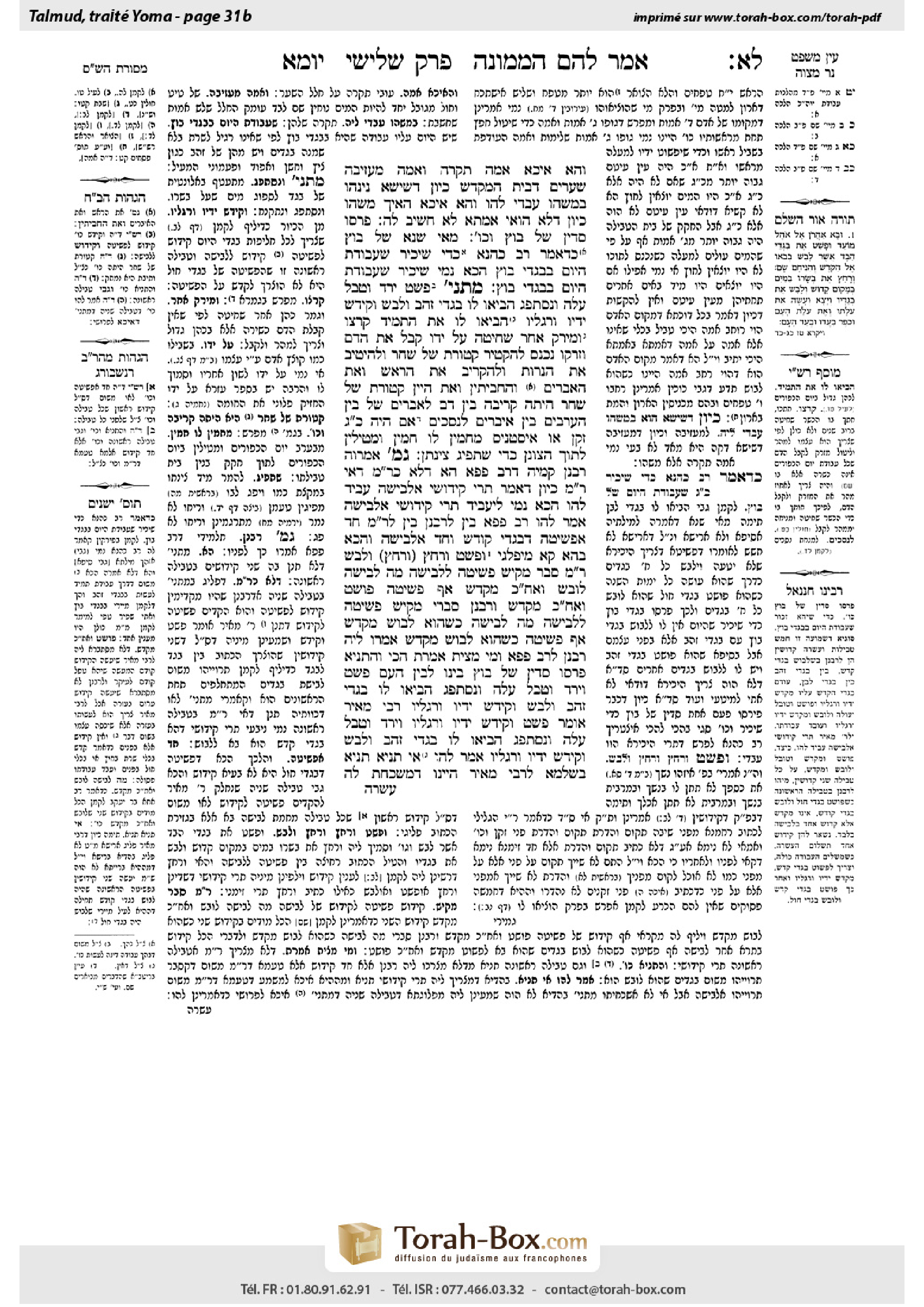
This page of Yoma includes the Aramaic text, an English translation and an AI-generated French translation, alongside the scan above.
יומא ל״א ב · Aramaic and Hebrew text
וְהָא אִיכָּא אַמָּה תִּקְרָה וְאַמָּה מַעֲזִיבָה! שְׁעָרִים דְּבֵית הַמִּקְדָּשׁ, כֵּיוָן דְּשֵׁישָׁא נִינְהוּ, בְּמַשֶּׁהוּ עָבְדִי לְהוּ. וְהָא אִיכָּא הַאיְךְ מַשֶּׁהוּ! כֵּיוָן דְּלָא הֲוַאי אַמְּתָא — לָא חָשֵׁיב לַהּ.
פֵּרְסוּ סָדִין שֶׁל בּוּץ וְכוּ׳. מַאי שְׁנָא שֶׁל בּוּץ? כִּדְאָמַר רַב כָּהֲנָא: כְּדֵי שֶׁיַּכִּיר שֶׁעֲבוֹדַת הַיּוֹם בְּבִגְדֵי בוּץ. הָכָא נָמֵי: שֶׁיַּכִּיר שֶׁעֲבוֹדַת הַיּוֹם בְּבִגְדֵי בוּץ.
מַתְנִי׳ פָּשַׁט יָרַד וְטָבַל, עָלָה וְנִסְתַּפָּג. הֵבִיאוּ לוֹ בִּגְדֵי זָהָב, וְלָבַשׁ, וְקִידֵּשׁ יָדָיו וְרַגְלָיו. הֵבִיאוּ לוֹ אֶת הַתָּמִיד, קְרָצוֹ וּמֵירַק אַחֵר שְׁחִיטָה עַל יָדוֹ. קִבֵּל אֶת הַדָּם וּזְרָקוֹ.
נִכְנַס לְהַקְטִיר קְטוֹרֶת שֶׁל שַׁחַר, וּלְהֵיטִיב אֶת הַנֵּרוֹת, וּלְהַקְרִיב אֶת הָרֹאשׁ וְאֶת הָאֵבָרִים וְהַחֲבִיתִּין וְאֶת הַיַּיִן. קְטוֹרֶת שֶׁל שַׁחַר הָיְתָה קְרֵיבָה בֵּין דָּם לְאֵבָרִים, שֶׁל בֵּין הָעַרְבַּיִם בֵּין אֵיבָרִים לִנְסָכִים.
אִם הָיָה כֹּהֵן גָּדוֹל זָקֵן אוֹ אִיסְטְנִיס מְחַמִּין לוֹ חַמִּין, וּמְטִילִין לְתוֹךְ הַצּוֹנֵן כְּדֵי שֶׁתָּפִיג צִינָּתָן.
גְּמָ׳ אַמְרוּהָ רַבָּנַן קַמֵּיהּ דְּרַב פָּפָּא: הָא דְּלָא כְּרַבִּי מֵאִיר. דְּאִי רַבִּי מֵאִיר, כֵּיוָן דְּאָמַר תְּרֵי קִידּוּשֵׁי אַלְּבִישָׁה עָבֵיד לְהוּ — הָכָא נָמֵי לֶיעְבֵּיד תְּרֵי קִידּוּשֵׁי אַלְּבִישָׁה!
אֲמַר לְהוּ רַב פָּפָּא: בֵּין לְרַבָּנַן בֵּין לְרַבִּי מֵאִיר חַד אַפְּשִׁיטָה דְּבִגְדֵי קוֹדֶשׁ, וְחַד אַלְּבִישָׁה, וְהָכָא בְּהָא קָא מִיפַּלְגִי: ״וּפָשַׁט וְרָחַץ (וְרָחַץ) וְלָבַשׁ״, רַבִּי מֵאִיר סָבַר: מַקִּישׁ פְּשִׁיטָה לִלְבִישָׁה, מָה לְבִישָׁה — לוֹבֵשׁ וְאַחַר כָּךְ מְקַדֵּשׁ, אַף פְּשִׁיטָה — פּוֹשֵׁט וְאַחַר כָּךְ מְקַדֵּשׁ.
וְרַבָּנַן סָבְרִי: מַקִּישׁ פְּשִׁיטָה לִלְבִישָׁה, מָה לְבִישָׁה — כְּשֶׁהוּא לָבוּשׁ מְקַדֵּשׁ, אַף פְּשִׁיטָה — כְּשֶׁהוּא לָבוּשׁ מְקַדֵּשׁ.
אֲמַרוּ לֵיהּ רַבָּנַן לְרַב פָּפָּא: וּמִי מָצֵית אָמְרַתְּ הָכִי? וְהָתַנְיָא: פֵּרְסוּ סָדִין שֶׁל בּוּץ בֵּינוֹ לְבֵין הָעָם, פָּשַׁט וְיָרַד וְטָבַל, עָלָה וְנִסְתַּפַּג. הֵבִיאוּ לוֹ בִּגְדֵי זָהָב וְלָבַשׁ, וְקִידֵּשׁ יָדָיו וְרַגְלָיו. רַבִּי מֵאִיר אוֹמֵר: פָּשַׁט וְקִידֵּשׁ יָדָיו וְרַגְלָיו, וְיָרַד וְטָבַל, עָלָה וְנִסְתַּפַּג, הֵבִיאוּ לוֹ בִּגְדֵי זָהָב, וְלָבַשׁ וְקִידֵּשׁ יָדָיו וְרַגְלָיו. אֲמַר לְהוּ: אִי תַּנְיָא תַּנְיָא.
בִּשְׁלָמָא לְרַבִּי מֵאִיר, הַיְינוּ דְּמַשְׁכַּחַתְּ לַהּ
Yoma 31b · English translation
As the gate is twenty cubits high, and the immersion chamber above it is at least three additional cubits high, the water was twenty-three cubits above the ground of the courtyard. The Gemara asks: How could it be only twenty-three cubits higher? Isn’t there the cubit of the thickness of the ceiling over the gate and the cubit of the thickness of the plaster sealing of the ritual bath floor for a total of at least twenty-five cubits? The Gemara answers: With regard to the Temple gates, since they were constructed of marble, they constructed them with minimal thickness. Neither the thickness of the ceiling nor the thickness of the plaster was a cubit. The Gemara asks: But isn’t there that minimal thickness of the ceiling and the plaster that would nevertheless total more than twenty-three cubits? The Gemara answers: Indeed; however, since the ceiling was not a whole cubit he does not consider it in his calculation.
§ We learned in the mishna: They spread a sheet of fine linen between the High Priest and the people in the interest of modesty. The Gemara asks: What is different that they specifically used a sheet of fine linen? The Gemara answers: It is as Rav Kahana said with regard to a related issue: So that he will be aware that the service of the day of Yom Kippur is performed in fine linen garments. Here, too, a linen sheet was used so that he will be aware that the service of the day of Yom Kippur is performed in fine linen garments.
MISHNA: The High Priest removed the white garments that he was wearing, descended to the ritual bath, and immersed. He ascended and dried himself with a towel. Then they brought him the golden garments of the High Priest, and he dressed in the garments, and he sanctified his hands and his feet. They brought him the sheep for the daily morning offering, which he slaughtered by cutting most of the way through the gullet and the windpipe. And a different priest completed the slaughter on his behalf so that the High Priest could receive the blood in a vessel and proceed with the order of the Yom Kippur service. As soon as the slaughter was completed, the High Priest received the blood in a vessel and sprinkled it on the altar.
He entered the Sanctuary to burn the morning incense and to remove the ashes from the lamps of the candelabrum; and he left the Sanctuary and returned to the courtyard to sacrifice the head and the limbs of the sheep sacrificed for the daily offering and the High Priest’s daily griddle-cake offering, and the wine libation of the daily offering. The Mishna comments: The morning incense was burned between the receiving and sprinkling of the blood and the burning of the limbs; and the afternoon incense was burned between the taking of the limbs up to the altar and the pouring of the libations that accompanied the offering.
With regard to the immersion, if the High Priest was old and found it difficult to immerse in cold water, or if he was delicate [istenis], they would heat hot water for him on Yom Kippur eve and place it into the cold water of the ritual bath in order to temper its chill so the High Priest could immerse without discomfort.
GEMARA: The Sages said this matter before Rav Pappa: This mishna is not in accordance with the opinion of Rabbi Meir, as, if it were in accordance with the opinion of Rabbi Meir, since he said: The High Priest performs two sanctifications of his hands and his feet upon each change of garments, once before donning the garments and once after donning them, here too, in the mishna, let him perform two sanctifications upon the change of garments. However, the description in the mishna indicates that he removes his garments and does not sanctify his hands and feet.
Rav Pappa said to them: Both according to the opinion of the Rabbis and according to the opinion of Rabbi Meir, there is one sanctification upon removal of sacred garments, and one sanctification upon donning other sacred garments. And here, it is with regard to this issue that they disagree. It is written: “And he shall remove the linen garments that he put on when he entered the Sanctuary and leave them there. And he shall wash his flesh in water in a sacred place and he shall put on his garments” (Leviticus 16:23–24). Rabbi Meir holds: The Torah juxtaposes removal of garments to donning of garments for the following reason: Just as when donning the garments, he dons the garments and afterward sanctifies his hands and feet, so too, with regard to removal of the garments, he removes the garments and afterward sanctifies his hands and feet.
And the Rabbis hold that the Torah juxtaposes removal of garments to donning of garments for the following reason: Just as when donning the garments, when he is dressed, he sanctifies his hands and feet; so too, for removal of the garments, he sanctifies his hands and feet when he is dressed. Therefore, when he completes the service he sanctifies his hands and feet and only then removes the garments. However, the first time that the High Priest dons the priestly vestments on Yom Kippur he certainly does not require two sanctifications, since at that point he does not remove any other garments.
The Sages said to Rav Pappa: And how can you say that according to Rabbi Meir the first time that the High Priest dons the garments he does not require two sanctifications? Wasn’t it taught in a baraita as follows? They spread a sheet of fine linen between him and the people, and he removed his garments and descended and immersed, and he ascended and dried himself. They brought him golden garments, and he donned them, and he sanctified his hands and his feet. Rabbi Meir says: He removed his garments and sanctified his hands and his feet and descended and immersed. He ascended and dried himself. They brought him golden garments and he donned them and sanctified his hands and his feet. Apparently, Rabbi Meir maintains that there is a special sanctification prior to donning the garments. He said to them: If it was taught, it was taught. I will retract my opinion, which was based on logical analysis, in favor of an explicit baraita that contradicts that opinion.
The Gemara asks: Granted, according to the approach of Rabbi Meir, that is how you find that possibility of
Yoma 31b · Traduction française (IA)
Comme la porte mesure vingt coudées de haut et que le bassin d’immersion situé au-dessus mesure au moins trois coudées supplémentaires, l’eau se trouvait à vingt-trois coudées au-dessus du sol de la cour. La Guemara demande : Comment pouvait-elle se trouver à seulement vingt-trois coudées de hauteur ? N’y avait-il pas une coudée correspondant à l’épaisseur du plafond au-dessus de la porte et une coudée correspondant à l’épaisseur de l’enduit qui scellait le fond du bain rituel, soit au moins vingt-cinq coudées au total ? La Guemara répond : Puisque les portes du Temple étaient en marbre, on les construisait avec une épaisseur minimale. Ni le plafond ni l’enduit n’avaient une coudée d’épaisseur. La Guemara demande : Mais cette épaisseur minimale du plafond et de l’enduit ne devait-elle pas tout de même porter la hauteur totale à plus de vingt-trois coudées ? La Guemara répond : En effet ; cependant, comme le plafond n’avait pas une coudée entière, il ne la compte pas dans son calcul.
§ Nous avons appris dans la Michna : On étendait une étoffe de lin fin entre le Grand Prêtre et le peuple, par souci de pudeur. La Guemara demande : Pourquoi utilisait-on précisément une étoffe de lin fin ? La Guemara répond : C’est comme l’a dit Rav Kahana à propos d’une question connexe : afin qu’il sache que le service de Yom Kippour s’accomplit avec des vêtements de lin fin. Ici aussi, on utilisait une étoffe de lin afin qu’il sache que le service de Yom Kippour s’accomplit avec des vêtements de lin fin.
MICHNA : Le Grand Prêtre retirait les vêtements blancs qu’il portait, descendait au bain rituel et s’immergeait. Il remontait et se séchait avec une serviette. On lui apportait alors les vêtements d’or du Grand Prêtre ; il les revêtait, puis sanctifiait ses mains et ses pieds. On lui amenait les moutons destinés à l’offrande quotidienne du matin ; il les égorgeait en sectionnant la gorge et la trachée presque entièrement. Un autre prêtre achevait l’égorgement à sa place, afin que le Grand Prêtre puisse recueillir le sang dans un récipient et poursuivre l’ordre du service de Yom Kippour. Dès que l’égorgement était achevé, le Grand Prêtre recueillait le sang dans un récipient et en faisait l’aspersion sur l’autel.
Il entrait dans le Sanctuaire pour brûler l’encens du matin et retirer les cendres des lampes du candélabre. Il sortait du Sanctuaire et retournait dans la cour pour offrir la tête et les membres du mouton sacrifié en offrande quotidienne, ainsi que l’offrande quotidienne de gâteaux à la poêle du Grand Prêtre et la libation de vin de l’offrande quotidienne. La Michna précise : L’encens du matin était brûlé entre la réception du sang et son aspersion, d’une part, et la combustion des membres, d’autre part ; l’encens de l’après-midi était brûlé entre le moment où les membres étaient portés à l’autel et le versement des libations qui accompagnaient l’offrande.
Quant à l’immersion, si le Grand Prêtre était âgé et avait du mal à s’immerger dans l’eau froide, ou s’il était délicat [istenis], on faisait chauffer de l’eau pour lui la veille de Yom Kippour et on la versait dans l’eau froide du bain rituel afin d’en tempérer le froid et de lui permettre de s’immerger sans inconfort.
GUEMARA : Les Sages exposèrent cette question devant Rav Pappa : Cette Michna ne suit pas l’opinion de Rabbi Meïr. En effet, si elle suivait l’opinion de Rabbi Meïr, puisque celui-ci dit que le Grand Prêtre sanctifie ses mains et ses pieds deux fois à chaque changement de vêtements, une fois avant de revêtir les vêtements et une fois après les avoir revêtus, ici aussi, dans la Michna, il devrait procéder à deux sanctifications lors du changement de vêtements. Or, la description de la Michna indique qu’il retire ses vêtements sans sanctifier ses mains et ses pieds.
Rav Pappa leur dit : Selon l’opinion des Rabbins comme selon celle de Rabbi Meïr, il y a une sanctification au moment de retirer les vêtements sacrés et une sanctification au moment de revêtir d’autres vêtements sacrés. C’est sur cette question qu’ils sont en désaccord. Il est écrit : « Il retirera les vêtements de lin qu’il avait revêtus en entrant dans le Sanctuaire et les laissera là. Il lavera sa chair dans l’eau, en un lieu saint, puis il revêtira ses vêtements » (Lévitique 16, 23-24). Rabbi Meïr considère que la Torah met en parallèle le retrait des vêtements et le fait de les revêtir pour la raison suivante : de même que, lorsqu’il revêt les vêtements, il les revêt puis sanctifie ses mains et ses pieds, de même, lorsqu’il retire les vêtements, il les retire puis sanctifie ses mains et ses pieds.
Les Rabbins considèrent que la Torah met en parallèle le retrait des vêtements et le fait de les revêtir pour la raison suivante : de même que, lorsqu’il revêt les vêtements, il sanctifie ses mains et ses pieds une fois habillé, de même, lorsqu’il retire les vêtements, il sanctifie ses mains et ses pieds alors qu’il est encore habillé. Ainsi, lorsqu’il achève le service, il sanctifie ses mains et ses pieds, puis seulement après retire les vêtements. Toutefois, la première fois que le Grand Prêtre revêt les habits sacerdotaux à Yom Kippour, il n’a certainement pas besoin de deux sanctifications, puisqu’à ce moment-là il ne retire aucun autre vêtement.
Les Sages dirent à Rav Pappa : Comment peux-tu dire que, selon Rabbi Meïr, la première fois que le Grand Prêtre revêt les vêtements, il n’a pas besoin de deux sanctifications ? N’a-t-il pas été enseigné dans une baraïta comme suit ? On étendait une étoffe de lin fin entre lui et le peuple ; il retirait ses vêtements, descendait et s’immergeait, puis remontait et se séchait. On lui apportait des vêtements d’or ; il les revêtait et sanctifiait ses mains et ses pieds. Rabbi Meïr dit : Il retirait ses vêtements, sanctifiait ses mains et ses pieds, puis descendait et s’immergeait. Il remontait et se séchait. On lui apportait des vêtements d’or ; il les revêtait et sanctifiait ses mains et ses pieds. Il apparaît donc que Rabbi Meïr soutient qu’il y a une sanctification particulière avant de revêtir les vêtements. Il leur dit : Si cela a été enseigné, cela a été enseigné. Je rétracte mon opinion, fondée sur un raisonnement logique, au profit d’une baraïta explicite qui la contredit.
La Guemara demande : Certes, selon l’approche de Rabbi Meïr, c’est ainsi que l’on peut trouver cette possibilité de
Traduction française générée par IA à partir de l’édition anglaise de Sefaria. Vérifie toujours un passage avec le texte source.
Text from Sefaria: William Davidson Edition - Vocalized Aramaic (CC BY NC); William Davidson Edition - English (CC BY NC).