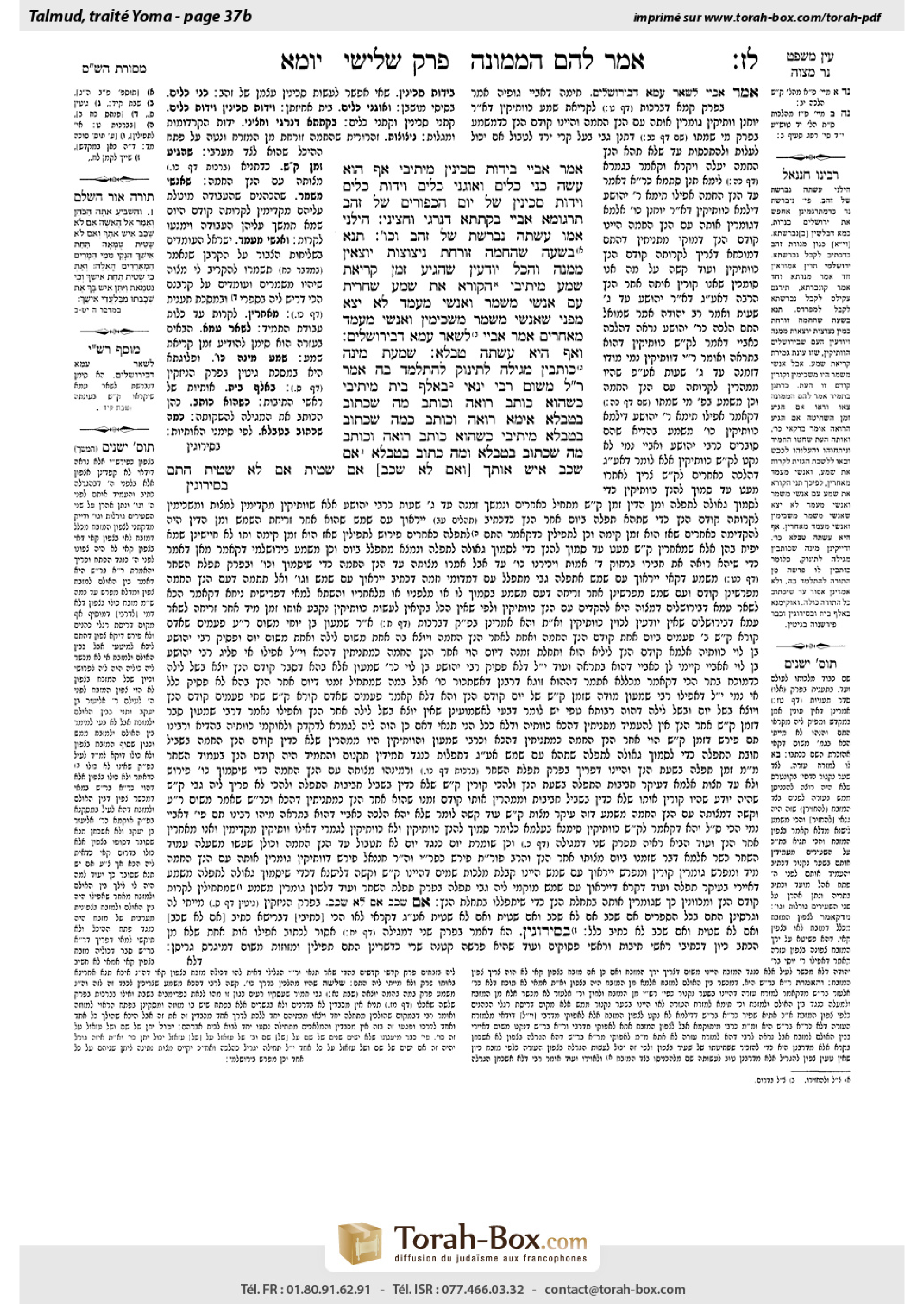
Yoma 37b: Talmud study for Daf Yomi
Daf Yomi is the daily study of one Talmud folio. Explore 37 tractates with scans, Hebrew text, Sefaria English and AI-generated French translations where annotated.
Passage selection and English or AI-generated French translation are available where the scan has annotations. Daf Study is independent of Torah-Box and Sefaria.
Browse Yoma · יומא · All tractatesYoma 37b text and translations
This page of Yoma includes the Aramaic text, an English translation and an AI-generated French translation, alongside the scan above.
יומא ל״ז ב · Aramaic and Hebrew text
אָמַר אַבָּיֵי: בִּידוֹת סַכִּינִין. מֵיתִיבִי: אַף הוּא עָשָׂה כַּנֵּי כֵלִים, וְאוֹגְנֵי כֵלִים, וִידוֹת כֵּלִים, וִידוֹת סַכִּינִין שֶׁל יוֹם הַכִּפּוּרִים שֶׁל זָהָב. תַּרְגְּמַהּ אַבָּיֵי: בְּקַתָּתָא דְּנַרְגֵי וַחֲצִינֵי.
הֵילֶנִי אִמּוֹ עָשְׂתָה נִבְרֶשֶׁת שֶׁל זָהָב וְכוּ׳. תָּנָא: בְּשָׁעָה שֶׁהַחַמָּה זוֹרַחַת נִיצוֹצוֹת יוֹצְאִין מִמֶּנָּה, וְהַכֹּל יוֹדְעִין שֶׁהִגִּיעַ זְמַן קְרִיאַת שְׁמַע.
מֵיתִיבִי: הַקּוֹרֵא אֶת שְׁמַע שַׁחֲרִית עִם אַנְשֵׁי מִשְׁמָר, וְאַנְשֵׁי מַעֲמָד — לֹא יָצָא, מִפְּנֵי שֶׁאַנְשֵׁי מִשְׁמָר מַשְׁכִּימִין וְאַנְשֵׁי מַעֲמָד מֵאֲחֵרִים! אָמַר אַבָּיֵי: לִשְׁאָר עַמָּא דְּבִירוּשְׁלֶם.
וְאַף הִיא עָשְׂתָה טַבְלָא. שָׁמְעַתְּ מִינַּהּ כּוֹתְבִין מְגִילָּה לְתִינוֹק לְהִתְלַמֵּד בָּהּ. אֲמַר רֵישׁ לָקִישׁ מִשּׁוּם רַבִּי יַנַּאי: בְּאָלֶף בֵּית.
מֵיתִיבִי: כְּשֶׁהוּא כּוֹתֵב רוֹאֶה וְכוֹתֵב מָה שֶׁכָּתוּב בַּטַּבְלָא! אֵימָא: רוֹאֶה וְכוֹתֵב כְּמָה שֶׁכָּתוּב בַּטַּבְלָא.
מֵיתִיבִי: כְּשֶׁהוּא כּוֹתֵב — רוֹאֶה וְכוֹתֵב מָה שֶׁכָּתוּב בַּטַּבְלָא, וּמָה כָּתוּב בַּטַּבְלָא — ״אִם שָׁכַב אִישׁ אוֹתָךְ״ [״וְאִם לֹא שָׁכַב״], ״אִם שָׂטִית״ ״אִם לֹא שָׂטִית״! הָתָם
Yoma 37b · English translation
Abaye said: Although gold is not suitable for knife blades, as it is too soft for use in slaughter, the mishna is referring to knife handles. The Gemara raises an objection from a different baraita: King Munbaz also made the bases of vessels, the grips of vessels, the handles of vessels, and the handles of knives of Yom Kippur of gold. Apparently, knives are not categorized as vessels; therefore, the handles of the Yom Kippur vessels that Munbaz donated were not knife handles. The Gemara answers: Abaye interpreted that Munbaz donated gold for the handles of axes and hatchets. The blades of these implements cannot be made of gold; rather, like knives, they require stronger material.
§ The mishna continues: Queen Helene, his mother, fashioned a decorative gold chandelier above the entrance of the Sanctuary. It was taught in a mishna: When the sun rose, sparks of light would emanate from the chandelier, which was polished, and everyone knew that the time to recite Shema had arrived. The ideal time to recite Shema is at the moment of sunrise.
The Gemara raises an objection: One who recites Shema in the morning with the men of the priestly watch, who served in the Temple during a given week, or with the men of the non-priestly watch, designated groups of Israelites who accompanied the priestly watch to Jerusalem that week, did not fulfill his obligation. That is because the men of the priestly watch recite Shema too early so that they will have sufficient time to perform the Temple service, and the men of the non-priestly watch, who recite lengthy prayers and stand over the daily morning offering when it is sacrificed, postpone reciting Shema. For whom, then, did the emanating sparks signal the time to recite Shema? Abaye said: It was an indicator for the rest of the people in Jerusalem, who recited Shema at the appropriate time to recite Shema.
§ The mishna relates: Queen Helene also fashioned a golden tablet on which the sota Torah portion was written. The Gemara comments: You learn from this that one may write a scroll that contains only several portions of the Torah, from which a child may be taught. The Sages disputed whether it is permitted to do so even for the purpose of education. Reish Lakish said in the name of Rabbi Yannai: There is no proof from this mishna, as the tablet prepared by Queen Helene consisted of the letters of the alef-beit, i.e., only the first letter of each word was written on the tablet, representing the word.
The Gemara raises an objection from the halakhot of sota: When the scribe writes the sota scroll, he looks and writes that which is written on the tablet. Apparently, the full text of the passage was written on the tablet. The Gemara rejects this: Emend the baraita and say: He looks and writes like that which is written on the tablet. The tablet aids the scribe in remembering the text that must be written.
The Gemara raises an objection from a different baraita: When he writes, he looks and writes that which is written on the tablet. And what is written on the tablet? If a man lay with you…and if he did not lay with you; if you strayed…if you did not stray (see Numbers 5:19–20). Apparently, the full text of the passage was written on the tablet. The Gemara answers: There, it was written
Yoma 37b · Traduction française (IA)
Abayé dit : Bien que l’or ne convienne pas aux lames de couteaux, car il est trop tendre pour servir à l’abattage rituel, la Michna parle des manches de couteaux. La Guemara soulève une objection à partir d’une autre baraïta : le roi Munbaz fit également en or les bases des ustensiles, leurs poignées, leurs manches et les manches des couteaux du Jour de Kippour. Il semble donc que les couteaux ne soient pas considérés comme des ustensiles ; les manches des ustensiles du Jour de Kippour que Munbaz avait offerts n’étaient donc pas des manches de couteaux. La Guemara répond : Abayé interprète que Munbaz avait offert de l’or pour les manches de haches et de hachettes. Les lames de ces outils ne peuvent pas être en or ; comme celles des couteaux, elles nécessitent un matériau plus résistant.
§ La Michna poursuit : la reine Hélène, sa mère, fit installer un candélabre décoratif en or au-dessus de l’entrée du Sanctuaire. Une Michna enseigne : lorsque le soleil se levait, des éclats de lumière jaillissaient du candélabre poli, et chacun savait que le moment de réciter le Chéma était arrivé. Le moment idéal pour réciter le Chéma est celui du lever du soleil.
La Guemara soulève une objection : celui qui récite le Chéma le matin avec les membres de la garde sacerdotale, qui officiaient au Temple pendant une semaine donnée, ou avec les membres de la garde non sacerdotale, groupes d’Israélites désignés qui accompagnaient la garde sacerdotale à Jérusalem cette semaine-là, ne s’est pas acquitté de son obligation. En effet, les membres de la garde sacerdotale récitent le Chéma trop tôt afin d’avoir suffisamment de temps pour accomplir le service du Temple, tandis que les membres de la garde non sacerdotale, qui récitent de longues prières et se tiennent auprès de l’holocauste quotidien du matin au moment où celui-ci est offert, retardent la récitation du Chéma. À qui donc les éclats lumineux indiquaient-ils le moment de réciter le Chéma ? Abayé dit : ils servaient de repère aux autres habitants de Jérusalem, qui récitaient le Chéma au moment approprié.
§ La Michna rapporte : la reine Hélène fit également fabriquer une tablette d’or sur laquelle était écrit le passage de la Torah relatif à la sota. La Guemara fait remarquer : on apprend de là qu’il est permis d’écrire un rouleau ne contenant que quelques passages de la Torah, afin qu’un enfant puisse l’étudier. Les Sages étaient en désaccord sur la question de savoir si cela était permis même à des fins d’enseignement. Rech Lakich dit au nom de Rabbi Yannai : il n’y a aucune preuve à tirer de cette Michna, car la tablette préparée par la reine Hélène ne portait que les lettres de l’alef-beit, c’est-à-dire que seule la première lettre de chaque mot y était inscrite pour représenter le mot.
La Guemara soulève une objection à partir des halakhot de la sota : lorsque le scribe écrit le rouleau de la sota, il regarde ce qui est écrit sur la tablette et le recopie. Il semble donc que le texte intégral du passage était inscrit sur la tablette. La Guemara rejette cette objection : corrigez la baraïta et dites : il regarde ce qui est écrit sur la tablette et écrit conformément à ce qui y figure. La tablette aide le scribe à se rappeler le texte qu’il doit écrire.
La Guemara soulève une objection à partir d’une autre baraïta : lorsqu’il écrit, il regarde ce qui est écrit sur la tablette et le recopie. Et qu’est-il écrit sur la tablette ? « Si un homme a couché avec toi… et s’il n’a pas couché avec toi ; si tu t’es égarée… si tu ne t’es pas égarée » (voir Nombres 5,19–20). Il semble donc que le texte intégral du passage était inscrit sur la tablette. La Guemara répond : là, il était écrit
Traduction française générée par IA à partir de l’édition anglaise de Sefaria. Vérifie toujours un passage avec le texte source.
Text from Sefaria: William Davidson Edition - Vocalized Aramaic (CC BY NC); William Davidson Edition - English (CC BY NC).