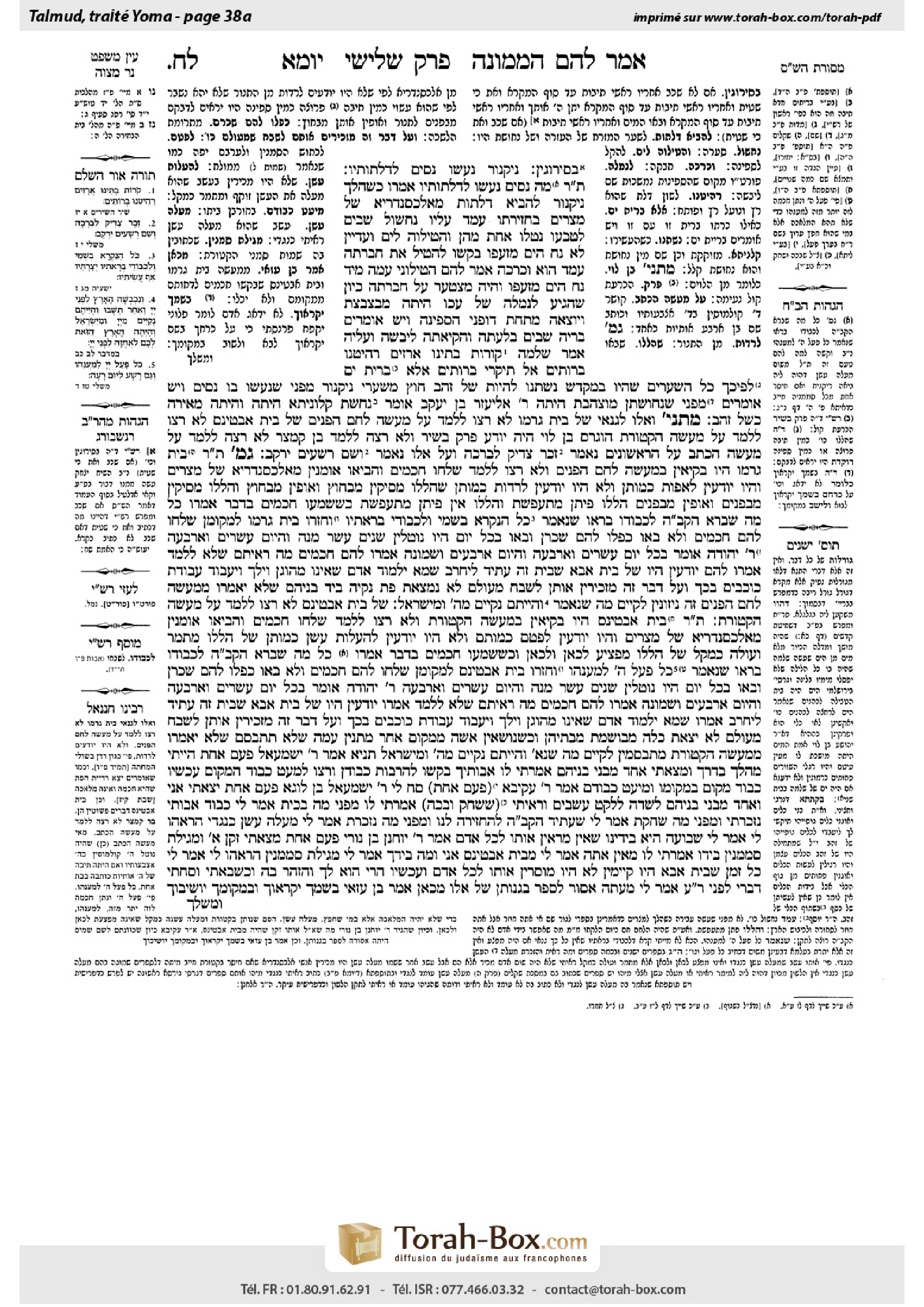
Yoma 38a: Talmud study for Daf Yomi
Daf Yomi is the daily study of one Talmud folio. Explore 37 tractates with scans, Hebrew text, Sefaria English and AI-generated French translations where annotated.
Passage selection and English or AI-generated French translation are available where the scan has annotations. Daf Study is independent of Torah-Box and Sefaria.
Browse Yoma · יומא · All tractatesYoma 38a text and translations
This page of Yoma includes the Aramaic text, an English translation and an AI-generated French translation, alongside the scan above.
יומא ל״ח א · Aramaic and Hebrew text
בְּסֵירוּגִין.
נִיקָנוֹר נַעֲשׂוּ נִסִּים לְדַלְתוֹתָיו. תָּנוּ רַבָּנַן: מָה נִסִּים נַעֲשׂוּ לְדַלְתוֹתָיו? אָמְרוּ: כְּשֶׁהָלַךְ נִיקָנוֹר לְהָבִיא דְּלָתוֹת מֵאֲלֶכְּסַנְדְּרִיָּא שֶׁל מִצְרַיִם, בַּחֲזִירָתוֹ עָמַד עָלָיו נַחְשׁוֹל שֶׁבַּיָּם לְטַבְּעוֹ, נָטְלוּ אַחַת מֵהֶן וֶהֱטִילוּהָ לַיָּם, וַעֲדַיִין לָא נָח הַיָּם מִזַּעְפּוֹ.
בִּקְּשׁוּ לְהָטִיל אֶת חֲבֶרְתָּהּ, עָמַד הוּא וּכְרָכָהּ, אָמַר לָהֶם: הֲטִילוּנִי עִמָּהּ. מִיָּד נָח הַיָּם מִזַּעְפּוֹ, וְהָיָה מִצְטַעֵר עַל חֲבֶרְתָּהּ. כֵּיוָן שֶׁהִגִּיעַ לִנְמֵלָהּ שֶׁל עַכּוֹ, הָיְתָה מְבַצְבֶּצֶת וְיוֹצְאָה מִתַּחַת דּוֹפְנֵי הַסְּפִינָה. וְיֵשׁ אוֹמְרִים בְּרִיָּה שֶׁבַּיָּם בְּלָעַתָּה, וֶהֱקִיאַתָּה לַיַּבָּשָׁה.
וְעָלֶיהָ אָמַר שְׁלֹמֹה: ״קוֹרוֹת בָּתֵּינוּ אֲרָזִים רַהִיטֵנוּ בְּרוֹתִים״, אַל תִּיקְרֵי ״בְּרוֹתִים״, אֶלָּא ״בְּרִית יָם״. לְפִיכָךְ, כׇּל הַשְּׁעָרִים שֶׁהָיוּ בַּמִּקְדָּשׁ נִשְׁתַּנּוּ לִהְיוֹת שֶׁל זָהָב, חוּץ מִשַּׁעֲרֵי נִיקָנוֹר מִפְּנֵי שֶׁנַּעֲשׂוּ בּוֹ נִסִּים. וְיֵשׁ אוֹמְרִים: מִפְּנֵי שֶׁנְּחוֹשְׁתָּן מוּצְהֶבֶת הָיְתָה. רַבִּי אֱלִיעֶזֶר בֶּן יַעֲקֹב אוֹמֵר: נְחֹשֶׁת קְלוֹנִיתָא הָיְתָה, וְהָיְתָה מְאִירָה כְּשֶׁל זָהָב.
מַתְנִי׳ וְאֵלּוּ לִגְנַאי: שֶׁל בֵּית גַּרְמוּ לֹא רָצוּ לְלַמֵּד עַל מַעֲשֵׂה לֶחֶם הַפָּנִים, שֶׁל בֵּית אַבְטִינָס לֹא רָצוּ לְלַמֵּד עַל מַעֲשֵׂה הַקְּטוֹרֶת.
הוּגְרַס בֶּן לֵוִי הָיָה יוֹדֵעַ פֶּרֶק בַּשִּׁיר וְלֹא רָצָה לְלַמֵּד, בֶּן קַמְצָר לֹא רָצָה לְלַמֵּד עַל מַעֲשֵׂה הַכְּתָב. עַל הָרִאשׁוֹנִים נֶאֱמַר: ״זֵכֶר צַדִּיק לִבְרָכָה״, וְעַל אֵלּוּ נֶאֱמַר: ״וְשֵׁם רְשָׁעִים יִרְקָב״.
גְּמָ׳ תָּנוּ רַבָּנַן: בֵּית גַּרְמוּ הָיוּ בְּקִיאִין בְּמַעֲשֵׂה לֶחֶם הַפָּנִים וְלֹא רָצוּ לְלַמֵּד. שָׁלְחוּ חֲכָמִים וְהֵבִיאוּ אוּמָּנִין מֵאֲלֶכְּסַנְדְּרִיָּא שֶׁל מִצְרַיִם. וְהָיוּ יוֹדְעִין לֶאֱפוֹת כְּמוֹתָן, וְלֹא הָיוּ יוֹדְעִין לִרְדּוֹת כְּמוֹתָן. שֶׁהַלָּלוּ מַסִּיקִין מִבַּחוּץ וְאוֹפִין מִבַּחוּץ, וְהַלָּלוּ מַסִּיקִין מִבִּפְנִים וְאוֹפִין מִבִּפְנִים. הַלָּלוּ פִּיתָּן מִתְעַפֶּשֶׁת, וְהַלָּלוּ אֵין פִּיתָּן מִתְעַפֶּשֶׁת.
כְּשֶׁשָּׁמְעוּ חֲכָמִים בַּדָּבָר, אָמְרוּ: כֹּל מַה שֶּׁבָּרָא הַקָּדוֹשׁ בָּרוּךְ הוּא לִכְבוֹדוֹ בְּרָאוֹ, שֶׁנֶּאֱמַר: ״כֹּל הַנִּקְרָא בִשְׁמִי וְלִכְבוֹדִי בְּרָאתִיו״. וְחָזְרוּ בֵּית גַּרְמוּ לִמְקוֹמָן. שָׁלְחוּ לָהֶם חֲכָמִים — וְלֹא בָּאוּ, כָּפְלוּ לָהֶם שְׂכָרָן וּבָאוּ. בְּכׇל יוֹם הָיוּ נוֹטְלִין שְׁנֵים עָשָׂר מָנֶה, וְהַיּוֹם עֶשְׂרִים וְאַרְבָּעָה. רַבִּי יְהוּדָה אוֹמֵר: בְּכׇל יוֹם עֶשְׂרִים וְאַרְבָּעָה, וְהַיּוֹם אַרְבָּעִים וּשְׁמוֹנָה.
אָמְרוּ לָהֶם חֲכָמִים: מָה רְאִיתֶם שֶׁלֹּא לְלַמֵּד? אָמְרוּ לָהֶם: יוֹדְעִין הָיוּ שֶׁל בֵּית אַבָּא שֶׁבַּיִת זֶה עָתִיד לֵיחָרֵב, שֶׁמָּא יִלְמוֹד אָדָם שֶׁאֵינוֹ מְהוּגָּן וְיֵלֵךְ וְיַעֲבוֹד עֲבוֹדָה זָרָה בְּכָךְ. וְעַל דָּבָר זֶה מַזְכִּירִין אוֹתָן לְשֶׁבַח: מֵעוֹלָם לֹא נִמְצֵאת פַּת נְקִיָּה בְּיַד בְּנֵיהֶם, שֶׁלֹּא יֹאמְרוּ מִמַּעֲשֵׂה לֶחֶם הַפָּנִים זֶה נִיזּוֹנִין, לְקַיֵּים מַה שֶּׁנֶּאֱמַר: ״וִהְיִיתֶם נְקִיִּים מֵה׳ וּמִיִּשְׂרָאֵל״.
שֶׁל בֵּית אַבְטִינָס לֹא רָצוּ לְלַמֵּד עַל מַעֲשֵׂה הַקְּטוֹרֶת. תָּנוּ רַבָּנַן: בֵּית אַבְטִינָס הָיוּ בְּקִיאִין בְּמַעֲשֵׂה הַקְּטוֹרֶת וְלֹא רָצוּ לְלַמֵּד, שָׁלְחוּ חֲכָמִים וְהֵבִיאוּ אוּמָּנִין מֵאֲלֶכְּסַנְדְּרִיָּא שֶׁל מִצְרַיִם. וְהָיוּ יוֹדְעִין לְפַטֵּם כְּמוֹתָם וְלֹא הָיוּ יוֹדְעִין לְהַעֲלוֹת עָשָׁן כְּמוֹתָן. שֶׁל הַלָּלוּ — מִתַּמֵּר וְעוֹלֶה כְּמַקֵּל, שֶׁל הַלָּלוּ — מַפְצִיעַ לְכָאן וּלְכָאן.
וּכְשֶׁשָּׁמְעוּ חֲכָמִים בַּדָּבָר, אָמְרוּ: כֹּל מַה שֶׁבָּרָא הַקָּדוֹשׁ בָּרוּךְ הוּא — לִכְבוֹדוֹ בְּרָאוֹ, שֶׁנֶּאֱמַר: ״כֹּל פָּעַל ה׳ לַמַּעֲנֵהוּ״, וְחָזְרוּ בֵּית אַבְטִינָס לִמְקוֹמָן. שָׁלְחוּ לָהֶם חֲכָמִים וְלֹא בָּאוּ, כָּפְלוּ לָהֶם שְׂכָרָן וּבָאוּ. בְּכׇל יוֹם הָיוּ נוֹטְלִין שְׁנֵים עָשָׂר מָנֶה, וְהַיּוֹם עֶשְׂרִים וְאַרְבָּעָה. רַבִּי יְהוּדָה אוֹמֵר: בְּכׇל יוֹם עֶשְׂרִים וְאַרְבָּעָה, וְהַיּוֹם אַרְבָּעִים וּשְׁמוֹנָה.
אָמְרוּ לָהֶם חֲכָמִים: מָה רְאִיתֶם שֶׁלֹּא לְלַמֵּד? אָמְרוּ: יוֹדְעִין הָיוּ שֶׁל בֵּית אַבָּא שֶׁבַּיִת זֶה עָתִיד לֵיחָרֵב, אָמְרוּ: שֶׁמָּא יִלְמוֹד אָדָם שֶׁאֵינוֹ מְהוּגָּן וְיֵלֵךְ וְיַעֲבוֹד עֲבוֹדָה זָרָה בְּכָךְ. וְעַל דָּבָר זֶה מַזְכִּירִין אוֹתָן לְשֶׁבַח: מֵעוֹלָם לֹא יָצָאת כַּלָּה מְבוּשֶּׂמֶת מִבָּתֵּיהֶן, וּכְשֶׁנּוֹשְׂאִין אִשָּׁה מִמָּקוֹם אַחֵר, מַתְנִין עִמָּהּ שֶׁלֹּא תִּתְבַּסֵּם, שֶׁלֹּא יֹאמְרוּ: מִמַּעֲשֵׂה הַקְּטוֹרֶת מִתְבַּסְּמִין, לְקַיֵּים מַה שֶּׁנֶּאֱמַר: ״וִהְיִיתֶם נְקִיִּים מֵה׳ וּמִיִּשְׂרָאֵל״.
תַּנְיָא, אָמַר רַבִּי יִשְׁמָעֵאל: פַּעַם אַחַת הָיִיתִי מְהַלֵּךְ בַּדֶּרֶךְ וּמָצָאתִי אֶחָד מִבְּנֵי בְנֵיהֶם, אָמַרְתִּי לוֹ: אֲבוֹתֶיךָ בִּקְּשׁוּ לְהַרְבּוֹת כְּבוֹדָן וְרָצוּ לְמַעֵט כְּבוֹד הַמָּקוֹם, עַכְשָׁיו כְּבוֹד מָקוֹם בִּמְקוֹמוֹ, וּמִיעֵט כְּבוֹדָם.
אָמַר רַבִּי עֲקִיבָא: (פַּעַם אַחַת) סָח לִי רַבִּי יִשְׁמָעֵאל בֶּן לוֹגָא: פַּעַם אַחַת יָצָאתִי אֲנִי וְאֶחָד מִבְּנֵי בְנֵיהֶם לַשָּׂדֶה לְלַקֵּט עֲשָׂבִים, וְרָאִיתִי (שֶׁשָּׂחַק וּבָכָה). אָמַרְתִּי לוֹ: מִפְּנֵי מָה בָּכִיתָ? אָמַר לִי: כְּבוֹד אֲבוֹתַי נִזְכַּרְתִּי. וּמִפְּנֵי מָה שָׂחַקְתְּ? אָמַר לִי: שֶׁעָתִיד הַקָּדוֹשׁ בָּרוּךְ הוּא לְהַחְזִירָהּ לָנוּ. וּמִפְּנֵי מָה נִזְכַּרְתָּ? אָמַר לִי: מַעֲלֶה עָשָׁן כְּנֶגְדִּי. הַרְאֵהוּ לִי! אָמַר לִי: שְׁבוּעָה הִיא בְּיָדֵינוּ שֶׁאֵין מַרְאִין אוֹתוֹ לְכׇל אָדָם.
אָמַר רַבִּי יוֹחָנָן בֶּן נוּרִי: פַּעַם אַחַת מָצָאתִי זָקֵן אֶחָד וּמְגִילַת סַמְמָנִין בְּיָדוֹ. אָמַרְתִּי לוֹ: מֵאַיִן אַתָּה? אָמַר לִי: מִבֵּית אַבְטִינָס אֲנִי. וּמָה בְּיָדֶךָ? אָמַר לִי: מְגִילַּת סַמְמָנִין. הַרְאֵהוּ לִי! אָמַר לִי: כׇּל זְמַן שֶׁבֵּית אַבָּא הָיוּ קַיָּימִין, לֹא הָיוּ מוֹסְרִין אוֹתוֹ לְכׇל אָדָם, וְעַכְשָׁיו הֲרֵי הוּא לְךָ, וְהִזָּהֵר בָּהּ. וּכְשֶׁבָּאתִי וְסַחְתִּי דְּבָרַי לִפְנֵי רַבִּי עֲקִיבָא, אָמַר לִי: מֵעַתָּה אָסוּר לְסַפֵּר בִּגְנוּתָן שֶׁל אֵלּוּ.
מִכָּאן אָמַר בֶּן עַזַּאי: בְּשִׁמְךָ יִקְרָאוּךְ, וּבִמְקוֹמְךָ יוֹשִׁיבוּךְ,
Yoma 38a · English translation
with alternating complete words and initials. The first words of each verse were written there, but the rest of the words in the verse were represented by initials. Therefore, this contribution of Queen Helene does not resolve the question of whether writing a scroll for a child is permitted.
§ The mishna related: For Nicanor, miracles were performed to his doors. The Sages taught in the Tosefta: What miracles occurred for his doors? They said: When Nicanor went to bring copper doors for the eastern gate of the Temple from Alexandria in Egypt, famous for its craftsmanship, on his return voyage by ship, a storm arose in the sea and threatened to drown him. The ship’s passengers took one of the doors, which were exceedingly heavy, and cast it into the sea, fearing that the weight of the doors would sink the ship. And still the sea did not rest from its rage.
They sought to cast the other door into the sea, at which point Nicanor stood and embraced it and said to them: Cast me into the sea with it. Immediately, the sea rested from its rage, and it was necessary to cast neither the door nor Nicanor into the sea. The ship continued its journey with one door and for the entire voyage, he regretted the fate of the other door that he allowed them to cast into the sea. When they arrived at the port of Akko and prepared to disembark, despite the fact that it was made of copper, the door that was thrown into the sea was poking out under the sides of the ship. And some say a sea creature swallowed it and spewed it onto the land.
And with regard to this, Solomon said: “The beams of our houses are cedars, and our doors are cypresses [berotim]” (Song of Songs 1:17), and the Sages interpreted it homiletically: Do not read it as berotim but as berit yam, covenant of the sea, meaning that the door forged a covenant with the sea for the sea to deliver it to its place. Therefore, when the nation prospered and the people replaced the doors made of various metals, the doors in all the gates in the Temple were altered to become doors of gold except the doors in the Gates of Nicanor because miracles were performed to them. And some say it was because their copper was brightly-colored and high quality. Rabbi Eliezer ben Ya’akov says it was refined [kelonita] copper, and it illuminated its surroundings like gold.
MISHNA: Apropos the mention in the mishna of people who took action in the Temple and were mentioned favorably, the mishna lists those who took action in the Temple and were mentioned unfavorably. The craftsmen of the House of Garmu did not want to teach the secret of the preparation of the shewbread and sought to keep the secret within their family. The craftsmen of the House of Avtinas did not want to teach the secret of the preparation of the incense.
Also, Hugras ben Levi knew a chapter in the art of music, as will be explained, and he did not want to teach it to others. And the scribe ben Kamtzar did not want to teach a special act of writing. He was expert at writing all four letters of a four-letter name simultaneously. About the first ones, who were mentioned favorably, it is stated: “The memory of the righteous shall be for a blessing” (Proverbs 10:7); and about these who were concerned only for themselves it is stated: “But the name of the wicked shall rot” (Proverbs 10:7).
GEMARA: The Sages taught in a baraita: The craftsmen of the House of Garmu were expert in the preparation of the shewbread, and they did not want to teach others the secret of its production. The Sages dismissed them and sent for and brought craftsmen from Alexandria in Egypt, a large city with many experts. And those craftsmen knew how to bake like the members of the House of Garmu did, but they did not know how to remove the bread from the oven like they did. The shewbread was baked in a complex shape, and it was difficult to place it in the oven and remove it without breaking it. The difference was that these Alexandrians light the fire outside the oven and bake it outside the oven; and these members of the House of Garmu light the fire inside the oven and bake it inside. In the case of these Alexandrians, their bread becomes moldy over the course of the week, and in the case of these members of the House of Garmu, their bread does not become moldy.
When the Sages heard of the matter that the bread of the imported craftsmen was of lower quality than before, they said: Whatever the Holy One, Blessed be He, created, He created in His honor, as it is stated: “Everyone who is called by My name, I have created for My glory” (Isaiah 43:7). In deference to God, the Sages should diminish their honor for the greater glory of God and let the House of Garmu return to their original station. The Sages sent for them to reassume their previous position, and they did not come. They doubled their wages and they came. Each day until then they would take wages of twelve maneh, and today they take wages of twenty-four maneh. Rabbi Yehuda says: Each day they took twenty-four maneh, and today they take forty-eight.
The Sages said to them: What did you see that led you not to teach others this craft? They said: The members of our father’s house knew that this house, the Temple, is destined to be destroyed, and they were concerned lest an unworthy man learn our skill of baking and go and engage in idol worship with that skill. Therefore, they attempted to prevent this skill from spreading beyond their family. The Gemara comments: And for this matter they are mentioned favorably: Never was refined bread of fine flour found in the hands of their descendants, so that people would not say that they are sustained from that technique of preparing the shewbread. They ate only bread made of coarse flour mixed with bran, to fulfill that which is stated: “And you shall be clear before the Lord and before Israel” (Numbers 32:22). Not only must one’s behavior be beyond reproach, he should also make certain to be beyond suspicion.
§ Similarly, the mishna related: The craftsmen of the House of Avtinas did not want to teach about the secret of the preparation of the incense, at which they were particularly adept. The Sages taught in a baraita: The members of the House of Avtinas were expert in the technique of preparing the incense, and they did not want to teach others. The Sages dismissed them and sent for and brought craftsmen from Alexandria in Egypt. And the Alexandrian craftsmen knew how to blend the spices like they did, but they did not know how to cause the smoke to rise like the House of Avtinas did. The smoke of the incense blended by these members of the House of Avtinas rises in a column like a stick; the smoke of the incense blended by these Alexandrians branched out to here and to there and did not rise in a straight line.
When the Sages heard of the matter, they said: Whatever the Holy One, Blessed be He, created, He created in His honor, as it is stated: “God made everything for His sake” (Proverbs 16:4), and they let the House of Avtinas return to their original station. The Sages sent for the members of the House of Avtinas to reassume their previous position, and they did not come. They doubled their wages and they came. Each day until then they would take wages of twelve maneh, and today they take wages of twenty-four maneh. Rabbi Yehuda says: Each day they took twenty-four maneh, and today they take forty-eight.
The Sages said to them: What did you see that led you not to teach others this craft? They said: The members of our father’s house knew that this house, the Temple, is destined to be destroyed, and they were concerned lest an unworthy man learn our skill of preparing incense and go and engage in idol worship with that skill. Therefore, they attempted to prevent this skill from spreading beyond their family. The Gemara comments: And for this matter they are mentioned favorably: Never did a perfumed bride emerge from their homes. And when they marry a woman from a different place, they stipulate with her that she will not perfume herself, so that cynics would not say that it is with the work of the incense that they perfume themselves, to fulfill that which is stated: “And you shall be clear before the Lord and before Israel” (Numbers 32:22).
It was taught in a baraita that Rabbi Yishmael said: One time I was walking along the road and I found one of the descendants of the House of Avtinas. I said to him: Your fathers sought to enhance their honor and sought to diminish God’s honor by not revealing their secret to others. Now, although the Temple was destroyed, the honor of God remains as it was, and He diminished their honor, as their significance stemmed from their Temple service.
Rabbi Akiva said: One time Rabbi Yishmael ben Loga related to me: One time I and one of the descendants of the House of Avtinas went out to the field to collect herbs, and I saw that he laughed and he cried. I said to him: Why did you cry? He said to me: I was reminded of the honor of my forefathers, how important they were in the Temple. I said to him: And why did you laugh? He said to me: The Holy One, Blessed be He, is going to restore it to us in the future and we will be honored again. I said to him: And why are you reminded of this now? He said to me: The smoke-raising herb is before me, here in the field, reminding me of the past. I said to him: Show it to me; which one is it? He said to me: We are bound by oath not to show it to any person other than the members of our family.
Rabbi Yoḥanan ben Nuri said: One time I found an old man who had in his hand a scroll with the location and formula for blending of spices. I said to him: Where are you from? What is your ancestry? He said to me: I am from the House of Avtinas. I asked him: And what is in your hand? He said to me: A scroll of spices. I said to him: Show it to me. He said to me: As long as the House of Avtinas, my forefathers, was extant, they would not pass it on to anyone. And now, here it is; and be careful with it not to give it to anyone. And when I came and related my statement before Rabbi Akiva, he said to me: And now that they have surrendered the scroll to worthy recipients since they are unable to maintain its sanctity, it is prohibited to mention them unfavorably, as even their earlier reticence was apparently for the glory of God.
From here, with regard to the cases of the Temple’s craftsmen whom the Sages restored to their posts, ben Azzai said: One should not be concerned that others might usurp his livelihood and success, since at the appropriate moment, by your name they shall call you to return to your previous position, and in your place, they shall seat you,
Yoma 38a · Traduction française (IA)
avec une alternance de mots écrits en toutes lettres et d’initiales. Les premiers mots de chaque verset y étaient écrits, tandis que les autres mots du verset étaient représentés par des initiales. Par conséquent, cette contribution de la reine Hélène ne tranche pas la question de savoir s’il est permis d’écrire un rouleau pour un enfant.
§ La Michna rapportait que des miracles s’étaient produits pour les portes de Nicanor. Les Sages enseignèrent dans la Tosefta : Quels miracles se produisirent pour ses portes ? Ils dirent : Lorsque Nicanor alla chercher à Alexandrie, en Égypte, ville réputée pour son savoir-faire, des portes de cuivre destinées à la porte orientale du Temple, une tempête se leva en mer pendant son voyage de retour en bateau et menaça de le noyer. Les passagers du bateau prirent l’une des portes, qui étaient extrêmement lourdes, et la jetèrent à la mer, de crainte que leur poids ne fasse couler le bateau. Pourtant, la mer ne cessa pas de se déchaîner.
Ils voulurent jeter l’autre porte à la mer. Alors Nicanor se dressa, l’étreignit et leur dit : « Jetez-moi à la mer avec elle. » Aussitôt, la mer se calma, et il ne fut nécessaire de jeter à la mer ni la porte ni Nicanor. Le bateau poursuivit sa route avec une seule porte et, pendant tout le voyage, Nicanor regretta le sort de l’autre porte, qu’il avait laissé jeter à la mer. Lorsqu’ils arrivèrent au port d’Akko et se préparèrent à débarquer, la porte jetée à la mer dépassait sous le flanc du bateau, bien qu’elle fût en cuivre. Selon certains, une créature marine l’avala puis la recracha sur la terre ferme.
À ce propos, Salomon dit : « Les poutres de nos maisons sont des cèdres, et nos portes des cyprès [berotim] » (Cantique des Cantiques 1:17). Les Sages l’interprétèrent par homilétique : ne lis pas berotim, mais berit yam, « alliance de la mer », ce qui signifie que la porte conclut une alliance avec la mer afin que celle-ci la ramène à sa place. Par conséquent, lorsque la nation prospéra et que le peuple remplaça les portes faites de divers métaux, les portes de toutes les entrées du Temple furent remplacées par des portes en or, à l’exception des portes des Portes de Nicanor, car des miracles s’étaient produits pour elles. Selon certains, c’était parce que leur cuivre était éclatant et de grande qualité. Rabbi Eliezer ben Ya’akov dit qu’il s’agissait de cuivre raffiné [kelonita], qui éclairait les alentours comme de l’or.
MICHNA : À propos des personnes mentionnées dans la Michna qui avaient agi dans le Temple et dont on avait fait l’éloge, la Michna énumère celles qui avaient agi dans le Temple et dont on avait parlé en termes défavorables. Les artisans de la maison de Garmu ne voulurent pas enseigner le secret de la préparation du pain de proposition et cherchèrent à le garder au sein de leur famille. Les artisans de la maison d’Avtinas ne voulurent pas enseigner le secret de la préparation de l’encens.
De plus, Hugras ben Levi connaissait un chapitre de l’art musical, comme cela sera expliqué, mais ne voulut pas l’enseigner aux autres. Quant au scribe ben Kamtzar, il ne voulut pas enseigner une technique particulière d’écriture. Il savait écrire simultanément les quatre lettres d’un Nom de quatre lettres. Au sujet des premiers, dont on avait fait l’éloge, il est dit : « La mémoire du juste est une bénédiction » (Proverbes 10:7) ; et au sujet de ceux-ci, qui ne se souciaient que de leur propre intérêt, il est dit : « Mais le nom des méchants pourrira » (Proverbes 10:7).
GUEMARA : Les Sages enseignèrent dans une baraïta : Les artisans de la maison de Garmu maîtrisaient la préparation du pain de proposition, mais ne voulurent pas en enseigner le secret aux autres. Les Sages les renvoyèrent et firent venir des artisans d’Alexandrie, en Égypte, grande ville qui comptait de nombreux experts. Ces artisans savaient cuire le pain comme les membres de la maison de Garmu, mais ne savaient pas le retirer du four comme eux. Le pain de proposition était cuit selon une forme complexe ; il était difficile de le mettre au four et de l’en retirer sans le briser. La différence était que les Alexandrins allumaient le feu à l’extérieur du four et y cuisaient le pain, tandis que les membres de la maison de Garmu allumaient le feu à l’intérieur du four et y cuisaient le pain. Le pain des Alexandrins moisissait au cours de la semaine, tandis que celui des membres de la maison de Garmu ne moisissait pas.
Lorsque les Sages apprirent que le pain des artisans venus d’ailleurs était de moindre qualité qu’auparavant, ils dirent : « Tout ce que le Saint, béni soit-Il, a créé, Il l’a créé pour Sa gloire », comme il est dit : « Quiconque est appelé de Mon nom, je l’ai créé pour Ma gloire » (Isaïe 43:7). Par égard pour Dieu, les Sages devaient renoncer à leur prestige pour la plus grande gloire de Dieu et permettre à la maison de Garmu de reprendre sa fonction initiale. Les Sages les firent appeler pour qu’ils reprennent leur poste précédent, mais ils ne vinrent pas. Ils doublèrent leur salaire, et ils vinrent. Jusqu’alors, ils recevaient chaque jour un salaire de douze maneh ; désormais, ils en recevaient vingt-quatre. Rabbi Yehuda dit : Chaque jour, ils recevaient vingt-quatre maneh, et désormais, ils en recevaient quarante-huit.
Les Sages leur dirent : « Qu’avez-vous vu qui vous a conduits à ne pas enseigner ce métier aux autres ? » Ils répondirent : « Les membres de la maison de notre père savaient que cette maison, le Temple, était destinée à être détruite, et ils craignaient qu’un homme indigne n’apprenne notre savoir-faire en matière de cuisson et ne s’en serve ensuite pour pratiquer l’idolâtrie. » C’est pourquoi ils tentèrent d’empêcher que ce savoir-faire se répande au-delà de leur famille. La Guemara commente : À ce sujet, on fait leur éloge : jamais on ne trouva chez leurs descendants de pain fin préparé avec de la farine raffinée, afin que personne ne dise qu’ils vivaient grâce à cette technique de préparation du pain de proposition. Ils ne mangeaient que du pain fait de farine grossière mélangée à du son, afin d’accomplir ce qui est dit : « Vous serez irréprochables devant le Seigneur et devant Israël » (Nombres 32:22). Il ne suffit pas que la conduite d’une personne soit au-dessus de tout reproche : elle doit aussi veiller à ne donner lieu à aucun soupçon.
§ De même, la Michna rapportait que les artisans de la maison d’Avtinas ne voulurent pas enseigner le secret de la préparation de l’encens, qu’ils maîtrisaient particulièrement bien. Les Sages enseignèrent dans une baraïta : Les membres de la maison d’Avtinas maîtrisaient la technique de préparation de l’encens, mais ne voulurent pas l’enseigner aux autres. Les Sages les renvoyèrent et firent venir des artisans d’Alexandrie, en Égypte. Les artisans alexandrins savaient mélanger les épices comme eux, mais ne savaient pas faire monter la fumée comme les membres de la maison d’Avtinas. La fumée de l’encens préparé par les membres de la maison d’Avtinas montait en colonne, droite comme un bâton ; celle de l’encens préparé par les Alexandrins se ramifiait dans toutes les directions et ne montait pas en ligne droite.
Lorsque les Sages apprirent cela, ils dirent : « Tout ce que le Saint, béni soit-Il, a créé, Il l’a créé pour Sa gloire », comme il est dit : « Dieu a tout fait pour Sa fin » (Proverbes 16:4), et ils permirent à la maison d’Avtinas de reprendre sa fonction initiale. Les Sages firent appeler les membres de la maison d’Avtinas pour qu’ils reprennent leur poste précédent, mais ils ne vinrent pas. Ils doublèrent leur salaire, et ils vinrent. Jusqu’alors, ils recevaient chaque jour un salaire de douze maneh ; désormais, ils en recevaient vingt-quatre. Rabbi Yehuda dit : Chaque jour, ils recevaient vingt-quatre maneh, et désormais, ils en recevaient quarante-huit.
Les Sages leur dirent : « Qu’avez-vous vu qui vous a conduits à ne pas enseigner ce métier aux autres ? » Ils répondirent : « Les membres de la maison de notre père savaient que cette maison, le Temple, était destinée à être détruite, et ils craignaient qu’un homme indigne n’apprenne notre savoir-faire en matière de préparation de l’encens et ne s’en serve ensuite pour pratiquer l’idolâtrie. » C’est pourquoi ils tentèrent d’empêcher que ce savoir-faire se répande au-delà de leur famille. La Guemara commente : À ce sujet, on fait leur éloge : jamais une mariée parfumée ne sortit de leur maison. Lorsqu’ils épousaient une femme venue d’un autre endroit, ils convenaient avec elle qu’elle ne se parfumerait pas, afin que les railleurs ne disent pas qu’ils se parfumaient avec le produit de leur travail sur l’encens, et pour accomplir ce qui est dit : « Vous serez irréprochables devant le Seigneur et devant Israël » (Nombres 32:22).
Il fut enseigné dans une baraïta que Rabbi Yishmael dit : « Un jour, je marchais sur la route et je rencontrai l’un des descendants de la maison d’Avtinas. Je lui dis : “Vos pères ont cherché à rehausser leur propre prestige et à diminuer la gloire de Dieu en ne révélant pas leur secret aux autres. Or, même si le Temple a été détruit, la gloire de Dieu demeure telle qu’elle était, tandis que leur prestige a diminué, puisque leur importance découlait de leur service au Temple.” »
Rabbi Akiva dit : « Un jour, Rabbi Yishmael ben Loga me raconta : “Un jour, l’un des descendants de la maison d’Avtinas et moi sommes allés dans un champ cueillir des herbes, et je l’ai vu rire puis pleurer. Je lui ai demandé : ‘Pourquoi pleures-tu ?’ Il m’a répondu : ‘Je me suis souvenu du prestige de mes ancêtres et de l’importance qu’ils avaient dans le Temple.’ Je lui ai demandé : ‘Et pourquoi as-tu ri ?’ Il m’a répondu : ‘À l’avenir, le Saint, béni soit-Il, nous rendra ce prestige, et nous serons de nouveau honorés.’ Je lui ai demandé : ‘Et pourquoi cela te revient-il à l’esprit maintenant ?’ Il m’a répondu : ‘L’herbe qui fait monter la fumée est devant moi, ici dans le champ, et me rappelle le passé.’ Je lui ai demandé : ‘Montre-la-moi ; laquelle est-ce ?’ Il m’a répondu : ‘Nous sommes liés par serment et ne devons la montrer à personne d’autre qu’aux membres de notre famille.’” »
Rabbi Yoḥanan ben Nuri dit : « Un jour, je rencontrai un vieil homme qui tenait un rouleau indiquant l’emplacement des épices et la formule de leur mélange. Je lui demandai : “D’où viens-tu ? Quelle est ta lignée ?” Il me répondit : “Je suis de la maison d’Avtinas.” Je lui demandai : “Et qu’as-tu dans la main ?” Il me répondit : “Un rouleau d’épices.” Je lui dis : “Montre-le-moi.” Il me répondit : “Tant que la maison d’Avtinas, celle de mes ancêtres, existait, ils ne le transmettaient à personne. Maintenant, le voici ; prends garde à ne le donner à personne.” Lorsque je vins rapporter mes propos devant Rabbi Akiva, il me dit : “À présent qu’ils ont remis le rouleau à des personnes dignes, puisqu’ils ne sont plus en mesure d’en préserver la sainteté, il est interdit de parler d’eux en termes défavorables, car leur réserve antérieure était apparemment au service de la gloire de Dieu.” »
De là, à propos des artisans du Temple que les Sages réintégrèrent dans leurs fonctions, ben Azzai dit : « Il ne faut pas craindre que d’autres usurpent ses moyens de subsistance et sa réussite, car, au moment opportun, on t’appellera par ton nom pour que tu reprennes ton poste précédent, et on te fera asseoir à ta place, »
Traduction française générée par IA à partir de l’édition anglaise de Sefaria. Vérifie toujours un passage avec le texte source.
Text from Sefaria: William Davidson Edition - Vocalized Aramaic (CC BY NC); William Davidson Edition - English (CC BY NC).