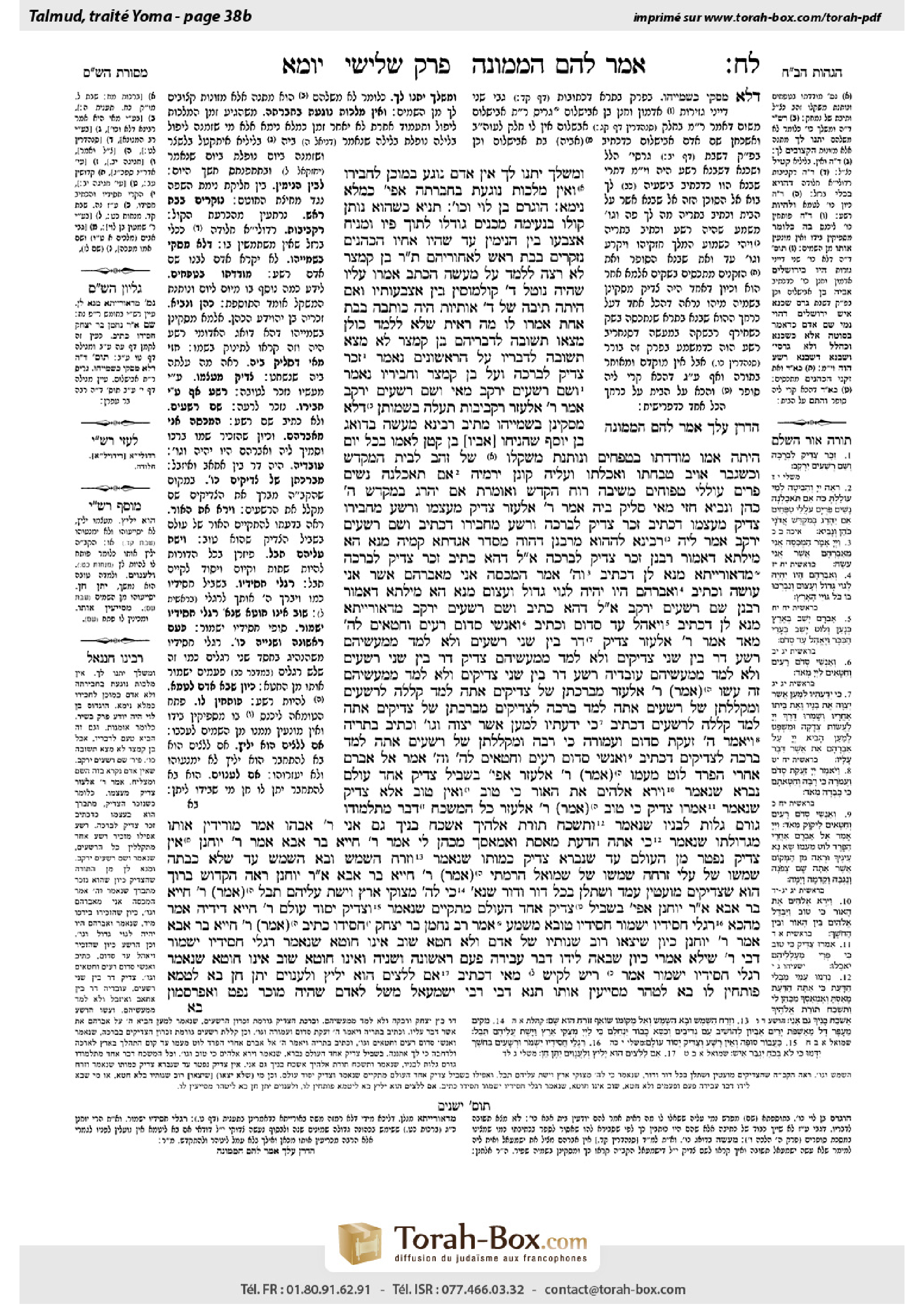
Yoma 38b: Talmud study for Daf Yomi
Daf Yomi is the daily study of one Talmud folio. Explore 37 tractates with scans, Hebrew text, Sefaria English and AI-generated French translations where annotated.
Passage selection and English or AI-generated French translation are available where the scan has annotations. Daf Study is independent of Torah-Box and Sefaria.
Browse Yoma · יומא · All tractatesYoma 38b text and translations
This page of Yoma includes the Aramaic text, an English translation and an AI-generated French translation, alongside the scan above.
יומא ל״ח ב · Aramaic and Hebrew text
וּמִשֶּׁלְּךָ יִתְּנוּ לְךָ. אֵין אָדָם נוֹגֵעַ בַּמּוּכָן לַחֲבֵירוֹ. וְאֵין מַלְכוּת נוֹגַעַת בַּחֲבֶרְתָּהּ אֲפִילּוּ כִּמְלֹא נִימָא.
הוּגְרַס בֶּן לֵוִי וְכוּ׳. תַּנְיָא: כְּשֶׁהוּא נוֹתֵן קוֹלוֹ בִּנְעִימָה, מַכְנִיס גּוּדָלוֹ לְתוֹךְ פִּיו, וּמַנִּיחַ אֶצְבָּעוֹ בֵּין הַנִּימִין, עַד שֶׁהָיוּ אֶחָיו הַכֹּהֲנִים נִזְקָרִים בְּבַת רֹאשׁ לַאֲחוֹרֵיהֶם.
תָּנוּ רַבָּנַן: בֶּן קַמְצָר לֹא רָצָה לְלַמֵּד עַל מַעֲשֵׂה הַכְּתָב. אָמְרוּ עָלָיו שֶׁהָיָה נוֹטֵל אַרְבָּעָה קוּלְמוֹסִין בֵּין אֶצְבְּעוֹתָיו, וְאִם הָיְתָה תֵּיבָה שֶׁל אַרְבַּע אוֹתִיּוֹת הָיָה כּוֹתְבָהּ בְּבַת אַחַת. אָמְרוּ לוֹ: מָה רָאִיתָ שֶׁלֹּא לְלַמֵּד? כּוּלָּן מָצְאוּ תְּשׁוּבָה לְדִבְרֵיהֶם, בֶּן קַמְצָר לֹא מָצָא תְּשׁוּבָה לִדְבָרָיו. עַל הָרִאשׁוֹנִים נֶאֱמַר: ״זֵכֶר צַדִּיק לִבְרָכָה״, וְעַל בֶּן קַמְצָר וַחֲבֵירָיו נֶאֱמַר: ״וְשֵׁם רְשָׁעִים יִרְקָב״.
מַאי ״וְשֵׁם רְשָׁעִים יִרְקָב״? אָמַר רַבִּי אֶלְעָזָר: רַקְבִּיבוּת תַּעֲלֶה בִּשְׁמוֹתָן, דְּלָא מַסְּקִינַן בִּשְׁמַיְיהוּ. מֵתִיב רָבִינָא. מַעֲשֶׂה בְּדוֹאֵג בֶּן יוֹסֵף, שֶׁהִנִּיחוֹ [אָבִיו] בֵּן קָטָן לְאִמּוֹ. בְּכׇל יוֹם הָיְתָה אִמּוֹ מוֹדַדְתּוֹ בִּטְפָחִים וְנוֹתֶנֶת מִשְׁקָלוֹ שֶׁל זָהָב לְבֵית הַמִּקְדָּשׁ, וּכְשֶׁגָּבַר אוֹיֵב טְבָחַתּוּ וַאֲכָלַתּוּ.
וְעָלֶיהָ קוֹנֵן יִרְמְיָה: ״אִם תֹּאכַלְנָה נָשִׁים פִּרְיָם עוֹלְלֵי טִפּוּחִים״, מְשִׁיבָה רוּחַ הַקֹּדֶשׁ וְאוֹמֶרֶת: ״אִם יֵהָרֵג בְּמִקְדַּשׁ ה׳ כֹּהֵן וְנָבִיא״, חֲזִי מַאי סְלֵיק בֵּיהּ.
אָמַר רַבִּי אֶלְעָזָר: צַדִּיק מֵעַצְמוֹ, וְרָשָׁע מֵחֲבֵירוֹ. צַדִּיק מֵעַצְמוֹ, דִּכְתִיב: ״זֵכֶר צַדִּיק לִבְרָכָה״, וְרָשָׁע מֵחֲבֵירוֹ, דִּכְתִיב: ״וְשֵׁם רְשָׁעִים יִרְקָב״.
אֲמַר לֵיהּ רָבִינָא לְהָהוּא מֵרַבָּנַן דַּהֲוָה מְסַדַּר אַגָּדָתָא קַמֵּיהּ: מְנַָא הָא מִילְּתָא דַאֲמוּר רַבָּנַן ״זֵכֶר צַדִּיק לִבְרָכָה״? אֲמַר לֵיהּ, דְּהָא כְּתִיב: ״זֵכֶר צַדִּיק לִבְרָכָה״! מִדְּאוֹרָיְיתָא מְנָא לַן? דִּכְתִיב: ״וַה׳ אָמָר הַמְכַסֶּה אֲנִי מֵאַבְרָהָם אֲשֶׁר אֲנִי עוֹשֶׂה״, וּכְתִיב: ״וְאַבְרָהָם הָיוֹ יִהְיֶה לְגוֹי גָּדוֹל וְעָצוּם״.
מְנַָא הָא מִילְּתָא דַאֲמוּר רַבָּנַן ״שֵׁם רְשָׁעִים יִרְקָב״? אֲמַר לֵיהּ, דְּהָא כְּתִיב: ״וְשֵׁם רְשָׁעִים יִרְקָב״. מִדְּאוֹרָיְיתָא מְנָא לַן? דִּכְתִיב: ״וַיֶּאֱהַל עַד סְדוֹם״, וּכְתִיב: ״וְאַנְשֵׁי סְדוֹם רָעִים וְחַטָּאִים לַה׳ מְאֹד״.
אָמַר רַבִּי אֶלְעָזָר: צַדִּיק דָּר בֵּין שְׁנֵי רְשָׁעִים וְלֹא לָמַד מִמַּעֲשֵׂיהֶם, רָשָׁע דָּר בֵּין שְׁנֵי צַדִּיקִים וְלֹא לָמַד מִמַּעֲשֵׂיהֶם. צַדִּיק דָּר בֵּין שְׁנֵי רְשָׁעִים וְלֹא לָמַד מִמַּעֲשֵׂיהֶם — עוֹבַדְיָה. רָשָׁע דָּר בֵּין שְׁנֵי צַדִּיקִים וְלֹא לָמַד מִמַּעֲשֵׂיהֶם — זֶה עֵשָׂו.
(אָמַר) רַבִּי אֶלְעָזָר: מִבִּרְכָתָן שֶׁל צַדִּיקִים אַתָּה לָמֵד קְלָלָה לָרְשָׁעִים, וּמִקִּלְלָתָן שֶׁל רְשָׁעִים אַתָּה לָמֵד בְּרָכָה לַצַּדִּיקִים. מִבִּרְכָתָן שֶׁל צַדִּיקִים אַתָּה לָמֵד קְלָלָה לָרְשָׁעִים, דִּכְתִיב: ״כִּי יְדַעְתִּיו לְמַעַן אֲשֶׁר יְצַוֶּה וְגוֹ׳״, וּכְתִיב בָּתְרֵיהּ: ״וַיֹּאמֶר ה׳ זַעֲקַת סְדוֹם וַעֲמוֹרָה כִּי רָבָּה״.
וּמִקִּלְלָתָן שֶׁל רְשָׁעִים אַתָּה לָמֵד בְּרָכָה לַצַּדִּיקִים, דִּכְתִיב: ״וְאַנְשֵׁי סְדוֹם רָעִים וְחַטָּאִים לַה׳. וַה׳ אָמַר אֶל אַבְרָם אַחֲרֵי הִפָּרֶד לוֹט מֵעִמּוֹ״. (אָמַר) רַבִּי אֶלְעָזָר: אֲפִילּוּ בִּשְׁבִיל צַדִּיק אֶחָד עוֹלָם נִבְרָא, שֶׁנֶּאֱמַר: ״וַיַּרְא אֱלֹהִים אֶת הָאוֹר כִּי טוֹב״, וְאֵין טוֹב אֶלָּא צַדִּיק, שֶׁנֶּאֱמַר: ״אִמְרוּ צַדִּיק כִּי טוֹב״.
(אָמַר) רַבִּי אֶלְעָזָר: כׇּל הַמְשַׁכֵּחַ דָּבָר מִתַּלְמוּדוֹ — גּוֹרֵם גָּלוּת לְבָנָיו, שֶׁנֶּאֱמַר: ״וַתִּשְׁכַּח תּוֹרַת אֱלֹהֶיךָ אֶשְׁכַּח בָּנֶיךָ גַּם אָנִי״. רַבִּי אֲבָהוּ אָמַר: מוֹרִידִין אוֹתוֹ מִגְּדוּלָּתוֹ, שֶׁנֶּאֱמַר: ״כִּי אַתָּה הַדַּעַת מָאַסְתָּ וְאֶמְאָסְךָ מִכַּהֵן לִי״.
אָמַר רַבִּי חִיָּיא בַּר אַבָּא אָמַר רַבִּי יוֹחָנָן: אֵין צַדִּיק נִפְטָר מִן הָעוֹלָם עַד שֶׁנִּבְרָא צַדִּיק כְּמוֹתוֹ, שֶׁנֶּאֱמַר: ״וְזָרַח הַשֶּׁמֶשׁ וּבָא הַשָּׁמֶשׁ״. עַד שֶׁלֹּא כָּבְתָה שִׁמְשׁוֹ שֶׁל עֵלִי, זָרְחָה שִׁמְשׁוֹ שֶׁל שְׁמוּאֵל הָרָמָתִי. (אָמַר) רַבִּי חִיָּיא בַּר אַבָּא אָמַר רַבִּי יוֹחָנָן: רָאָה הַקָּדוֹשׁ בָּרוּךְ הוּא שֶׁצַּדִּיקִים מוּעָטִין, עָמַד וּשְׁתָלָן בְּכׇל דּוֹר וָדוֹר, שֶׁנֶּאֱמַר: ״כִּי לַה׳ מְצוּקֵי אֶרֶץ וַיָּשֶׁת עֲלֵיהֶם תֵּבֵל״.
(אָמַר) רַבִּי חִיָּיא בַּר אַבָּא אָמַר רַבִּי יוֹחָנָן: אֲפִילּוּ בִּשְׁבִיל צַדִּיק אֶחָד הָעוֹלָם מִתְקַיֵּים, שֶׁנֶּאֱמַר: ״וְצַדִּיק יְסוֹד עוֹלָם״. רַבִּי חִיָּיא דִּידֵיהּ אָמַר, מֵהָכָא: ״רַגְלֵי חֲסִידָיו יִשְׁמוֹר״ — חֲסִידָיו טוּבָא מַשְׁמַע! אָמַר רַב נַחְמָן בַּר יִצְחָק: חֲסִידוֹ כְּתִיב.
(אָמַר) רַבִּי חִיָּיא בַּר אַבָּא אָמַר רַבִּי יוֹחָנָן: כֵּיוָן שֶׁיָּצְאוּ רוֹב שְׁנוֹתָיו שֶׁל אָדָם וְלֹא חָטָא — שׁוּב אֵינוֹ חוֹטֵא, שֶׁנֶּאֱמַר: ״רַגְלֵי חֲסִידָיו יִשְׁמוֹר״, דְּבֵי רַבִּי שֵׁילָא אָמְרִי: כֵּיוָן שֶׁבָּאָה לְיָדוֹ דְּבַר עֲבֵירָה פַּעַם רִאשׁוֹנָה וּשְׁנִיָּה וְאֵינוֹ חוֹטֵא — שׁוּב אֵינוֹ חוֹטֵא, שֶׁנֶּאֱמַר: ״רַגְלֵי חֲסִידָיו יִשְׁמוֹר״.
אָמַר רֵישׁ לָקִישׁ, מַאי דִּכְתִיב: ״אִם לַלֵּצִים הוּא יָלִיץ וְלַעֲנָוִים יִתֶּן חֵן״, בָּא לִטַּמֵּא — פּוֹתְחִין לוֹ. בָּא לִטָּהֵר — מְסַיְּיעִין אוֹתוֹ. תָּנָא דְּבֵי רַבִּי יִשְׁמָעֵאל: מָשָׁל לְאָדָם שֶׁהָיָה מוֹכֵר נֵפְטְ וַאֲפַרְסְמוֹן,
Yoma 38b · English translation
and from your own they shall give you. Everyone has a portion designated for him by God, and the individual is privileged to receive what is coming to him, as was the case with the House of Avtinas. The principle is: No person may touch that which is prepared for another by God; everyone receives what is designated for him. And one reign does not overlap with another and deduct from the time allotted it even a hairbreadth. When the time comes for one kingdom to fall, its successor takes over immediately, as no king rules during the time designated for another.
§ The mishna related that Hugras ben Levi knew a lesson in the art of music and he did not want to teach it to others. It was taught in a baraita: When Hugras ben Levi projects his voice in a sweet melody, he places his thumb into his mouth and places his finger between the strings of a lyre and sings. This produced a sound so sweet that his brethren the priests were abruptly taken aback.
The Sages taught: Ben Kamtzar did not want to teach others a special technique of writing. What was that technique? They said about him that he would take four quills between his fingers, and if there was a word consisting of four letters that he wanted to write, he could write it simultaneously. They said to him: What did you see that led you not to teach that technique? All the others with unique skills came up with a response to questions about the matter of their conduct, claiming that they sought to prevent their technique from being used in idol worship. However, ben Kamtzar did not come up with a response to questions about the matter of his conduct, and it was clear that his only motivation in preventing his skill from being disseminated was his own personal honor. With regard to the first people listed, it is stated: “The memory of the righteous shall be for a blessing” (Proverbs 10:7); and about ben Kamtzar and his counterparts it is stated: “But the name of the wicked shall rot” (Proverbs 10:7).
§ Apropos the verse cited, the Gemara asks: What is the meaning of: But the name of the wicked shall rot? How does a name rot? Rabbi Elazar said: It means that decay will spread on their names, meaning that we do not call others by their names, and the name will sink into oblivion. Ravina raised an objection from an incident that transpired during the Second Temple era. There was an incident involving Doeg ben Yosef, whose father died and left him as a young child to his mother, who loved him. Each day his mother measured his height in handbreadths and donated a measure of gold equivalent to the weight that he gained to the Temple. Later, when the enemy prevailed and there was a terrible famine in the city, she slaughtered and ate him.
And with regard to her and others like her Jeremiah lamented: “Shall the women eat their fruit, their children in their care [tipuḥim]?” (Lamentations 2:20). The Gemara interprets the term tipuḥim homiletically as referring to this baby, who was measured in handbreadths [tefaḥim]. Even he was eaten by his mother. And the Divine Spirit responds and says: Why did this happen? “Shall the priest and the prophet be slain in the Temple of the Lord?” (Lamentations 2:20). It is punishment for the murder of the priest Zechariah ben Jehoiada. This incident involves a boy named Doeg; even though the person with that name was wicked (see I Samuel, chapter 22), the boy was named for him. The Gemara responds: See what befell him. Clearly, his name was a bad omen.
Rabbi Elazar said: A righteous person is praised for his own actions, and a wicked person is cursed not only for his own actions but also for the actions of his wicked counterpart. A righteous person is praised for his actions, as it is written: “The memory of the righteous shall be for a blessing”; righteous is written in the singular. A wicked person is also cursed for the actions of his wicked counterpart, as it is written: “But the name of the wicked shall rot”; wicked is written in the plural. Once one wicked person is mentioned, his wicked counterparts are cursed as well.
Ravina said to one of the Sages who would organize aggadic statements before him: From where is this matter that the Sages stated: The memory of the righteous shall be for a blessing, derived? He said to him: As it is written explicitly in the book of Proverbs: “The memory of the righteous shall be for a blessing.” He then asked him: From where in the Torah do we derive this? He said to him: As it is written: “And God said: Shall I hide from Abraham that which I am doing?” (Genesis 18:17). And as soon as Abraham’s name is mentioned, it is written: “And Abraham shall surely become a great and mighty nation” (Genesis 18:18), although there is no clear connection to the previous verse. Apparently, once the name of a righteous person is mentioned, it is followed directly by praise of the individual. That is the Torah source for the statement that the mention of the righteous is for blessing.
Then he asked: From where is this matter that the Sages said: But the name of the wicked shall rot, derived? He said to him: As it is written explicitly in the book of Proverbs: “But the name of the wicked shall rot.” He then asked him: From where in the Torah do we derive this? He said to him: As it is written with regard to Lot: “And he moved his tent as far as Sodom” (Genesis 13:12). And as soon as Sodom is mentioned, it is written: “And the men of Sodom were exceedingly wicked and sinful to God” (Genesis 13:13).
Apropos these statements, the Gemara cites another statement that Rabbi Elazar said: There was a righteous person who lived between two wicked people and did not learn from their actions; there was a wicked person who lived between two righteous people and did not learn from their actions. How so? A righteous person lived between two wicked people and did not learn from their actions is Obadiah, who was a minister for Ahab and Jezebel and nevertheless remained God-fearing (see I Kings, chapter 18). A wicked person who lived between two righteous people and did not learn from their actions is Esau, who was born and raised in the house of Isaac and Rebecca and nevertheless remained wicked.
§ Rabbi Elazar said: From the blessing of the righteous you infer a curse for the wicked; and conversely, from the curse of the wicked you infer a blessing for the righteous. How so? From the blessing of the righteous you infer a curse for the wicked, as it is written with regard to Abraham: “For I have known him to the end that he will command his children and his household after him” (Genesis 18:19), and it is written thereafter: “The cry of Sodom and Gomorrah is very great” (Genesis 18:20). The righteousness of Abraham underscores the relative wickedness of Sodom and Gomorrah, exacerbating their punishment.
Conversely, from the curse of the wicked you infer a blessing for the righteous, as it is written: “And the men of Sodom were exceedingly wicked and sinful to God” (Genesis 13:13), after which it is written: “And God said to Abram, after that Lot had separated from him” (Genesis 13:14); God proceeds to bless him. And Rabbi Elazar said: Even for one righteous person an entire world is created, as it is stated: “And God saw the light, that it was good” (Genesis 1:4), and good means nothing other than righteous, as it is stated: “Say of the righteous that he is good” (Isaiah 3:10).
Rabbi Elazar further said: One who causes himself to forget a matter of his studies ultimately causes exile for his children, as it is stated: “Because you have forgotten the Torah of your God, I will also forget your children” (Hosea 4:6). Rabbi Abbahu said: With regard to he who causes his studies to be forgotten, one reduces him from his prominence, as it is stated: “Because you have rejected knowledge, I will also reject you; you shall not serve Me” (Hosea 4:6).
Apropos the righteous, Rabbi Ḥiyya bar Abba said that Rabbi Yoḥanan said: No righteous person departs from this world until another comparable righteous person is created, as it is stated: “And the sun rises and the sun sets” (Ecclesiastes 1:5); before the sun sets the new sun has already risen. Before the sun of Eli was extinguished, the sun of Samuel of Ramah had already shone (see I Samuel, chapter 3), and so on throughout the generations. And Rabbi Ḥiyya bar Abba said that Rabbi Yoḥanan said: The Holy One, Blessed be He, saw that righteous people were few, so He arose and planted some of them in each and every generation to ensure the presence of at least one righteous person in each generation. As it is stated: “For the pillars of the earth are the Lord’s, and He has set the world upon them” (I Samuel 2:8). Since the world rests upon the righteous, each generation requires the presence of a righteous person to provide that support.
Rabbi Ḥiyya bar Abba said that Rabbi Yoḥanan said: Even for one righteous person the world exists, as it is stated: “But the righteous is the foundation of the world” (Proverbs 10:25). Rabbi Ḥiyya himself said: The proof is from here, as it is stated: “He will keep the feet of His pious ones” (I Samuel 2:9), meaning that God maintains the world due to the pious people. The Gemara questions this proof; “pious ones” indicates many rather than a single righteous person. Rav Naḥman bar Yitzḥak said: Although the text is vocalized in the plural, it is written in the singular: “His pious one”; God maintains the world even for a single pious individual.
Rabbi Ḥiyya bar Abba said that Rabbi Yoḥanan said: Once most of a person’s years have passed and he did not sin, he will never sin, as it is stated: “He will keep the feet of His pious ones” (I Samuel 2:9). Once a person has established himself as righteous, God will keep him from failing thereafter. In the school of Rabbi Sheila they say: Once the opportunity to perform a sinful act presents itself to a person a first time and a second, and he does not sin, he will never sin, as it is stated: “He will keep the feet of His pious ones” (I Samuel 2:9). Once he has refrained from sin several times, he has established himself as pious and God will protect him thereafter.
Reish Lakish said: What is the meaning of that which is written: “If it concerns the scorners, He scorns them, but to the humble He gives grace” (Proverbs 3:34)? If one comes to impurify, they open before him the opportunity to exercise his free will and do as he pleases. If one comes to purify, they assist him. In the school of Rabbi Yishmael it was taught with regard to this verse: This is comparable to the case of a man who was selling both crude naphtha [neft], whose odor is vile, and balsam, whose fragrance is pleasant.
Yoma 38b · Traduction française (IA)
« Et de ce qui t’appartient, ils te donneront. » Chacun a une part que Dieu lui a destinée, et chacun a le privilège de recevoir ce qui lui revient, comme ce fut le cas pour la maison d’Avtinas. Le principe est le suivant : nul ne peut toucher à ce que Dieu a préparé pour un autre ; chacun reçoit ce qui lui est destiné. Un règne n’empiète pas sur un autre et ne lui retranche pas même l’épaisseur d’un cheveu du temps qui lui est alloué. Lorsque vient le moment où un royaume doit tomber, son successeur prend immédiatement le relais, car aucun roi ne règne pendant le temps destiné à un autre.
§ La Michna rapportait que Hugras ben Levi connaissait un art musical qu’il ne voulait pas enseigner aux autres. Une baraïta enseigne : lorsque Hugras ben Levi faisait résonner sa voix en une douce mélodie, il plaçait son pouce dans sa bouche et un doigt entre les cordes d’une lyre, puis il chantait. Le son ainsi produit était si doux que ses frères prêtres en étaient brusquement saisis.
Les Sages ont enseigné : ben Kamtzar ne voulait pas enseigner aux autres une technique d’écriture particulière. En quoi consistait-elle ? On disait de lui qu’il prenait quatre plumes entre ses doigts et que, s’il voulait écrire un mot de quatre lettres, il pouvait l’écrire tout entier en même temps. On lui demanda : « Qu’est-ce qui t’a conduit à ne pas enseigner cette technique ? » Tous les autres détenteurs de compétences particulières avaient répondu aux questions sur leur conduite en prétendant vouloir empêcher que leur technique soit utilisée pour le culte des idoles. Mais ben Kamtzar ne trouva pas de réponse aux questions sur sa conduite, et il était clair que son seul motif pour empêcher la diffusion de son savoir-faire était son honneur personnel. Au sujet des premiers hommes mentionnés, il est dit : « La mémoire du juste est une bénédiction » (Proverbes 10:7) ; et au sujet de ben Kamtzar et de ses semblables, il est dit : « Mais le nom des méchants pourrira » (Proverbes 10:7).
§ À propos du verset cité, la Guemara demande : que signifie « Mais le nom des méchants pourrira » ? Comment un nom peut-il pourrir ? Rabbi Elazar dit : cela signifie que la déchéance s’étendra à leurs noms, c’est-à-dire que nous ne donnerons pas leurs noms à d’autres et que leur nom sombrera dans l’oubli. Ravina soulève une objection à partir d’un épisode survenu à l’époque du Second Temple. Il s’agissait de Doeg ben Yosef, dont le père mourut en le laissant tout petit à sa mère, qui l’aimait. Chaque jour, sa mère mesurait sa taille en palmes et faisait don au Temple d’une quantité d’or équivalente au poids qu’il avait pris. Plus tard, lorsque l’ennemi prit le dessus et qu’une terrible famine sévit dans la ville, elle l’égorgea et le mangea.
À son sujet et au sujet d’autres femmes comme elle, Jérémie se lamenta : « Les femmes mangeront-elles leur fruit, les enfants qu’elles portent dans leurs bras [tipuḥim] ? » (Lamentations 2:20). La Guemara interprète de façon homilétique le terme tipuḥim comme désignant cet enfant, qui était mesuré en palmes [tefaḥim]. Lui aussi fut mangé par sa mère. Alors l’Esprit divin répond et dit : pourquoi cela s’est-il produit ? « Le prêtre et le prophète seront-ils tués dans le Temple du Seigneur ? » (Lamentations 2:20). C’est le châtiment du meurtre du prêtre Zechariah ben Jehoiada. Cet épisode concerne un garçon nommé Doeg ; bien que l’homme qui portait ce nom fût méchant (voir I Samuel, chapitre 22), le garçon fut nommé d’après lui. La Guemara répond : voyez ce qui lui est arrivé. Il est clair que son nom était de mauvais augure.
Rabbi Elazar dit : le juste est loué pour ses propres actes, tandis que le méchant est maudit non seulement pour ses propres actes, mais aussi pour ceux de son semblable méchant. Le juste est loué pour ses actes, comme il est écrit : « La mémoire du juste est une bénédiction » ; le mot « juste » est au singulier. Le méchant est aussi maudit pour les actes de son semblable méchant, comme il est écrit : « Mais le nom des méchants pourrira » ; le mot « méchants » est au pluriel. Dès qu’un méchant est mentionné, ses semblables sont eux aussi maudits.
Ravina dit à l’un des Sages qui lui exposaient des enseignements aggadiques : « D’où les Sages tirent-ils cette idée : “La mémoire du juste est une bénédiction” ? » Il lui répondit : « C’est écrit explicitement dans le livre des Proverbes : “La mémoire du juste est une bénédiction.” » Il lui demanda ensuite : « D’où le déduisons-nous de la Torah ? » Il lui répondit : « C’est écrit : “Et Dieu dit : Cacherai-je à Abraham ce que je vais faire ?” (Genèse 18:17). » Et dès qu’Abraham est mentionné, il est écrit : « Abraham deviendra certainement une nation grande et puissante » (Genèse 18:18), bien qu’il n’y ait aucun lien manifeste avec le verset précédent. Il ressort donc que, dès que le nom d’un juste est mentionné, sa louange suit immédiatement. Voilà la source dans la Torah de l’affirmation selon laquelle la mention du juste est une bénédiction.
Il lui demanda ensuite : « D’où les Sages tirent-ils cette idée : “Mais le nom des méchants pourrira” ? » Il lui répondit : « C’est écrit explicitement dans le livre des Proverbes : “Mais le nom des méchants pourrira.” » Il lui demanda ensuite : « D’où le déduisons-nous de la Torah ? » Il lui répondit : « C’est écrit au sujet de Lot : “Il déplaça sa tente jusqu’à Sodome” (Genèse 13:12). » Et dès que Sodome est mentionnée, il est écrit : « Les hommes de Sodome étaient extrêmement méchants et pécheurs envers Dieu » (Genèse 13:13).
À propos de ces enseignements, la Guemara rapporte une autre parole de Rabbi Elazar : un juste a vécu entre deux méchants sans imiter leur conduite ; un méchant a vécu entre deux justes sans imiter leur conduite. Comment cela ? Le juste qui vécut entre deux méchants sans imiter leur conduite est Obadiah, qui était un dignitaire au service d’Achab et de Jézabel, mais qui resta néanmoins craignant Dieu (voir I Rois, chapitre 18). Le méchant qui vécut entre deux justes sans imiter leur conduite est Ésaü, qui naquit et grandit dans la maison d’Isaac et de Rébecca, mais resta néanmoins méchant.
§ Rabbi Elazar dit : de la bénédiction des justes, on déduit une malédiction pour les méchants ; et inversement, de la malédiction des méchants, on déduit une bénédiction pour les justes. Comment cela ? De la bénédiction des justes, on déduit une malédiction pour les méchants, comme il est écrit au sujet d’Abraham : « Car je l’ai choisi afin qu’il ordonne à ses enfants et à sa maison après lui » (Genèse 18:19), puis il est écrit : « Le cri de Sodome et Gomorrhe est très grand » (Genèse 18:20). La droiture d’Abraham souligne la méchanceté relative de Sodome et Gomorrhe, aggravant ainsi leur châtiment.
Inversement, de la malédiction des méchants, on déduit une bénédiction pour les justes, comme il est écrit : « Les hommes de Sodome étaient extrêmement méchants et pécheurs envers Dieu » (Genèse 13:13), puis il est écrit : « Dieu dit à Abram, après que Lot se fut séparé de lui » (Genèse 13:14) ; Dieu entreprend alors de le bénir. Et Rabbi Elazar dit : le monde entier est créé même pour un seul juste, comme il est dit : « Dieu vit la lumière, et elle était bonne » (Genèse 1:4). Or, « bonne » ne désigne rien d’autre que le juste, comme il est dit : « Dites du juste qu’il est bon » (Isaïe 3:10).
Rabbi Elazar dit encore : celui qui s’amène à oublier un enseignement de ses études finit par entraîner l’exil de ses enfants, comme il est dit : « Puisque tu as oublié la Torah de ton Dieu, moi aussi, j’oublierai tes enfants » (Osée 4:6). Rabbi Abbahou dit : celui qui fait oublier ses études est déchu de sa prééminence, comme il est dit : « Puisque tu as rejeté la connaissance, moi aussi, je te rejetterai ; tu ne me serviras pas » (Osée 4:6).
À propos des justes, Rabbi Ḥiyya bar Abba dit au nom de Rabbi Yoḥanan : aucun juste ne quitte ce monde avant qu’un autre juste comparable à lui ne soit créé, comme il est dit : « Le soleil se lève et le soleil se couche » (Ecclésiaste 1:5) ; avant que le soleil se couche, un nouveau soleil s’est déjà levé. Avant que le soleil d’Éli ne s’éteigne, le soleil de Samuel de Rama avait déjà brillé (voir I Samuel, chapitre 3), et ainsi de suite au fil des générations. Et Rabbi Ḥiyya bar Abba dit au nom de Rabbi Yoḥanan : le Saint, béni soit-Il, vit qu’il y avait peu de justes ; il se leva donc et en planta quelques-uns dans chaque génération, afin d’assurer la présence d’au moins un juste dans chacune d’elles. Comme il est dit : « Les piliers de la terre sont au Seigneur, et c’est sur eux qu’il a établi le monde » (I Samuel 2:8). Puisque le monde repose sur les justes, chaque génération a besoin de la présence d’un juste pour lui servir de soutien.
Rabbi Ḥiyya bar Abba dit au nom de Rabbi Yoḥanan : le monde subsiste même pour un seul juste, comme il est dit : « Le juste est le fondement du monde » (Proverbes 10:25). Rabbi Ḥiyya lui-même dit : la preuve se trouve ici, comme il est dit : « Il gardera les pieds de ses fidèles » (I Samuel 2:9), ce qui signifie que Dieu maintient le monde grâce aux pieux. La Guemara conteste cette preuve : « Ses fidèles » indique plusieurs personnes, et non un seul juste. Rav Naḥman bar Yitzḥak dit : bien que le texte soit vocalisé au pluriel, il est écrit au singulier : « son fidèle » ; Dieu maintient le monde même pour un seul homme pieux.
Rabbi Ḥiyya bar Abba dit au nom de Rabbi Yoḥanan : une fois que la majeure partie des années d’une personne s’est écoulée sans qu’elle ait péché, elle ne péchera plus jamais, comme il est dit : « Il gardera les pieds de ses fidèles » (I Samuel 2:9). Une fois qu’une personne s’est établie dans la justice, Dieu la préservera de trébucher par la suite. À l’école de Rabbi Sheila, on enseigne : dès qu’une occasion de commettre un péché se présente à une personne une première fois, puis une deuxième fois, et qu’elle ne pèche pas, elle ne péchera plus jamais, comme il est dit : « Il gardera les pieds de ses fidèles » (I Samuel 2:9). Une fois qu’elle s’est abstenue de pécher à plusieurs reprises, elle s’est établie dans la piété et Dieu la protégera par la suite.
Reish Lakish dit : que signifie ce qui est écrit : « S’il s’agit de railleurs, il les raille ; mais aux humbles il accorde sa grâce » (Proverbes 3:34) ? Si quelqu’un vient se rendre impur, on lui ouvre la voie afin qu’il exerce son libre arbitre et fasse ce qui lui plaît. Si quelqu’un vient se purifier, on l’aide. À l’école de Rabbi Yishmael, on enseigna au sujet de ce verset : cela est comparable au cas d’un homme qui vendait à la fois du naphta brut [neft], dont l’odeur est infecte, et du baume, dont le parfum est agréable.
Traduction française générée par IA à partir de l’édition anglaise de Sefaria. Vérifie toujours un passage avec le texte source.
Text from Sefaria: William Davidson Edition - Vocalized Aramaic (CC BY NC); William Davidson Edition - English (CC BY NC).