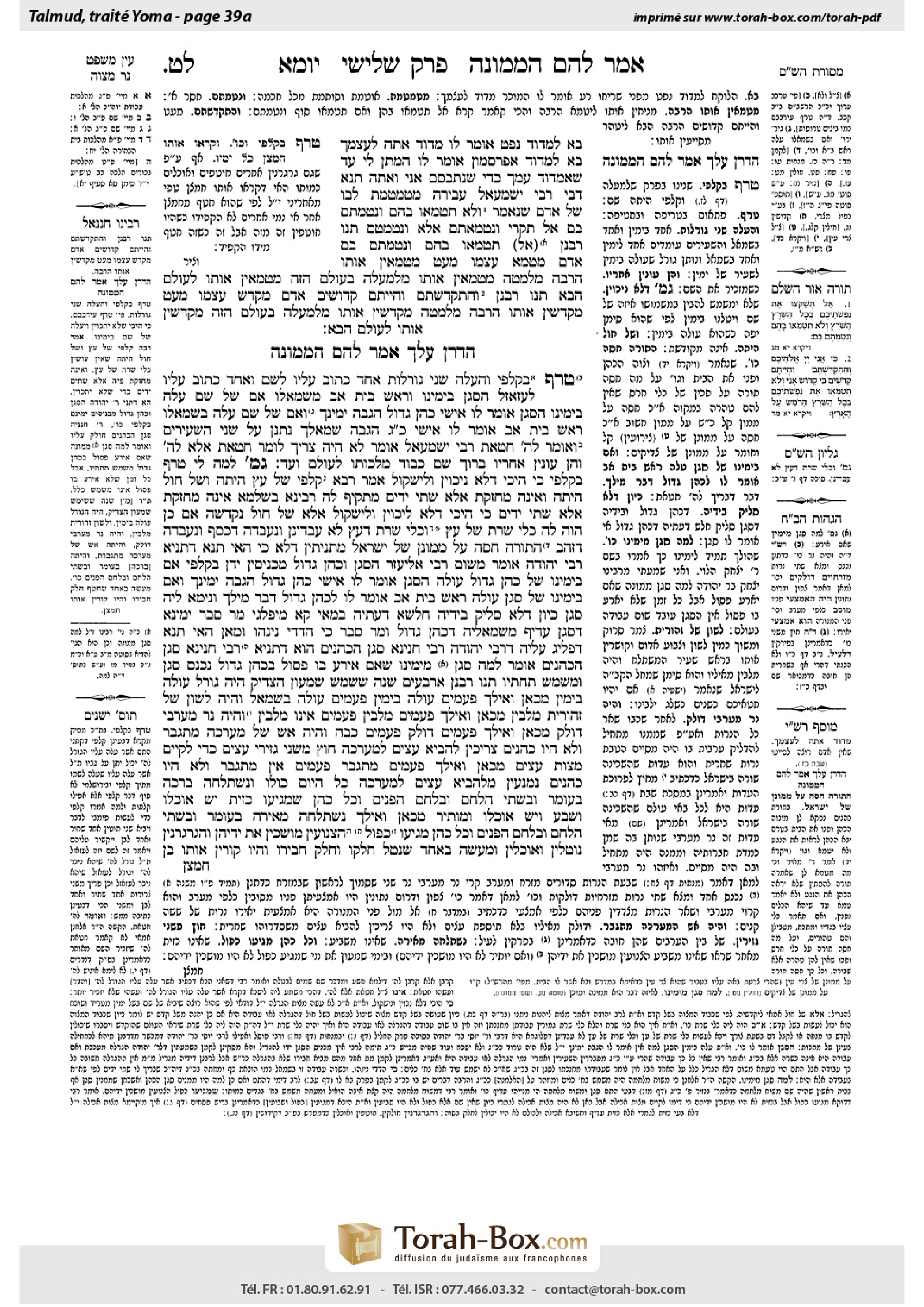
Yoma 39a: Talmud study for Daf Yomi
Daf Yomi is the daily study of one Talmud folio. Explore 37 tractates with scans, Hebrew text, Sefaria English and AI-generated French translations where annotated.
Passage selection and English or AI-generated French translation are available where the scan has annotations. Daf Study is independent of Torah-Box and Sefaria.
Browse Yoma · יומא · All tractatesYoma 39a text and translations
This page of Yoma includes the Aramaic text, an English translation and an AI-generated French translation, alongside the scan above.
יומא ל״ט א · Aramaic and Hebrew text
בָּא לִמְדּוֹד נֵפְטְ, אוֹמֵר לוֹ: מְדוֹד אַתָּה לְעַצְמְךָ. בָּא לִמְדּוֹד אֲפַרְסְמוֹן, אוֹמֵר לוֹ: הַמְתֵּן לִי עַד שֶׁאֶמְדּוֹד עִמְּךָ, כְּדֵי שֶׁנִּתְבַּסֵּם אֲנִי וְאַתָּה.
תָּנָא דְּבֵי רַבִּי יִשְׁמָעֵאל: עֲבֵירָה מְטַמְטֶמֶת לִבּוֹ שֶׁל אָדָם, שֶׁנֶּאֱמַר: ״וְלֹא תִטַּמְּאוּ בָּהֶם וְנִטְמֵתֶם בָּם״, אַל תִּקְרֵי ״וְנִטְמֵאתֶם״, אֶלָּא: ״וְנִטַּמְטֵם״.
תָּנוּ רַבָּנַן: ״(אַל) תִטַּמְּאוּ בָּהֶם וְנִטְמֵתֶם בָּם״, אָדָם מְטַמֵּא עַצְמוֹ מְעַט — מְטַמְּאִין אוֹתוֹ הַרְבֵּה. מִלְּמַטָּה — מְטַמְּאִין אוֹתוֹ מִלְּמַעְלָה. בָּעוֹלָם הַזֶּה — מְטַמְּאִין אוֹתוֹ לָעוֹלָם הַבָּא.
תָּנוּ רַבָּנַן: ״וְהִתְקַדִּשְׁתֶּם וִהְיִיתֶם קְדוֹשִׁים״, אָדָם מְקַדֵּשׁ עַצְמוֹ מְעַט — מְקַדְּשִׁין אוֹתוֹ הַרְבֵּה, מִלְּמַטָּה — מְקַדְּשִׁין אוֹתוֹ מִלְּמַעְלָה, בָּעוֹלָם הַזֶּה — מְקַדְּשִׁין אוֹתוֹ לָעוֹלָם הַבָּא.
הֲדַרַן עֲלָךְ אָמַר לָהֶם הַמְמוּנֶּה
טָרַף בְּקַלְפִּי, וְהֶעֱלָה שְׁנֵי גוֹרָלוֹת, אֶחָד כָּתוּב עָלָיו ״לַשֵּׁם״, וְאֶחָד כָּתוּב עָלָיו ״לַעֲזָאזֵל״. הַסְּגָן בִּימִינוֹ, וְרֹאשׁ בֵּית אָב מִשְּׂמֹאלוֹ. אִם שֶׁל שֵׁם עָלָה בִּימִינוֹ — הַסְּגָן אוֹמֵר לוֹ: אִישִׁי כֹּהֵן גָּדוֹל, הַגְבַּהּ יְמִינְךָ. וְאִם שֶׁל שֵׁם עָלָה בִּשְׂמֹאלוֹ — רֹאשׁ בֵּית אָב אוֹמֵר לוֹ: אִישִׁי כֹּהֵן גָּדוֹל, הַגְבַּהּ שְׂמֹאלְךָ.
נְתָנָן עַל שְׁנֵי הַשְּׂעִירִים, וְאוֹמֵר: ״לַה׳ חַטָּאת״. רַבִּי יִשְׁמָעֵאל אוֹמֵר: לֹא הָיָה צָרִיךְ לוֹמַר ״חַטָּאת״, אֶלָּא ״לַה׳״. וְהֵן עוֹנִין אַחֲרָיו: ״בָּרוּךְ שֵׁם כְּבוֹד מַלְכוּתוֹ לְעוֹלָם וְעַד״.
גְּמָ׳ לְמָה לִי טָרַף בְּקַלְפִּי? כִּי הֵיכִי דְּלָא נִיכַּוֵּין וְלִישְׁקוֹל.
אָמַר רָבָא: קַלְפִּי שֶׁל עֵץ הָיְתָה, וְשֶׁל חוֹל הָיְתָה, וְאֵינָהּ מַחְזֶקֶת אֶלָּא שְׁתֵּי יָדַיִם.
מַתְקֵיף לַהּ רָבִינָא: בִּשְׁלָמָא אֵינָהּ מַחְזֶקֶת אֶלָּא שְׁתֵּי יָדַיִם — כִּי הֵיכִי דְּלָא לִיכַּוֵּין וְלִישְׁקוֹל. אֶלָּא שֶׁל חוֹל? נַקְדְּשַׁהּ! אִם כֵּן הָוֵה לֵהּ כְּלִי שָׁרֵת שֶׁל עֵץ, וּכְלִי שָׁרֵת דְּעֵץ לָא עָבְדִינַן. וְנֶעְבְּדַהּ דְּכֶסֶף, וְנֶעְבְּדַהּ דְּזָהָב? הַתּוֹרָה חָסָה עַל מָמוֹנָן שֶׁל יִשְׂרָאֵל.
מַתְנִיתִין דְּלָא כִּי הַאי תַּנָּא דְּתַנְיָא, רַבִּי יְהוּדָה אוֹמֵר מִשּׁוּם רַבִּי אֱלִיעֶזֶר: הַסְּגָן וְכֹהֵן גָּדוֹל מַכְנִיסִין יָדָן בַּקַּלְפִּי, אִם בִּימִינוֹ שֶׁל כֹּהֵן גָּדוֹל עוֹלֶה — הַסְּגָן אוֹמֵר לוֹ: אִישִׁי כֹּהֵן גָּדוֹל, הַגְבַּהּ יְמִינֶךָ. וְאִם בִּימִינוֹ שֶׁל סְגָן עוֹלֶה — רֹאשׁ בֵּית אָב אוֹמֵר לוֹ לְכֹהֵן גָּדוֹל: דַּבֵּר מִילָּךְ.
וְנֵימָא לֵיהּ סְגָן? כֵּיוָן דְּלָא סָלֵיק בִּידֵיהּ חָלְשָׁא דַּעְתֵּיהּ.
בְּמַאי קָא מִיפַּלְגִי? מָר סָבַר: יַמִּינָא דִּסְגָן עֲדִיף מִשְּׂמָאלֵיהּ דְּכֹהֵן גָּדוֹל. וּמָר סָבַר: כִּי הֲדָדֵי נִינְהוּ.
וּמַאן הַאי תַּנָּא דִּפְלִיג עֲלֵיהּ דְּרַבִּי יְהוּדָה — רַבִּי חֲנִינָא סְגַן הַכֹּהֲנִים הוּא. דְּתַנְיָא, רַבִּי חֲנִינָא סְגַן הַכֹּהֲנִים אוֹמֵר: לָמָּה סְגָן מִימִינוֹ — שֶׁאִם אֵירַע בּוֹ פְּסוּל בְּכֹהֵן גָּדוֹל, נִכְנָס סְגָן וּמְשַׁמֵּשׁ תַּחְתָּיו.
תָּנוּ רַבָּנַן: אַרְבָּעִים שָׁנָה שֶׁשִּׁמֵּשׁ שִׁמְעוֹן הַצַּדִּיק, הָיָה גּוֹרָל עוֹלֶה בְּיָמִין. מִכָּאן וְאֵילָךְ, פְּעָמִים עוֹלֶה בְּיָמִין פְּעָמִים עוֹלֶה בִּשְׂמֹאל. וְהָיָה לָשׁוֹן שֶׁל זְהוֹרִית מַלְבִּין. מִכָּאן וְאֵילָךְ, פְּעָמִים מַלְבִּין פְּעָמִים אֵינוֹ מַלְבִּין. וְהָיָה נֵר מַעֲרָבִי דּוֹלֵק. מִכָּאן וְאֵילָךְ, פְּעָמִים דּוֹלֵק פְּעָמִים כָּבֶה.
וְהָיָה אֵשׁ שֶׁל מַעֲרָכָה מִתְגַּבֵּר, וְלֹא הָיוּ כֹּהֲנִים צְרִיכִין לְהָבִיא עֵצִים לְמַעֲרָכָה, חוּץ מִשְּׁנֵי גְּזִירֵי עֵצִים כְּדֵי לְקַיֵּים מִצְוַת עֵצִים. מִכָּאן וְאֵילָךְ, פְּעָמִים מִתְגַּבֵּר פְּעָמִים אֵין מִתְגַּבֵּר, וְלֹא הָיוּ כֹּהֲנִים נִמְנָעִין מִלְּהָבִיא עֵצִים לַמַּעֲרָכָה כׇּל הַיּוֹם כּוּלּוֹ.
וְנִשְׁתַּלְּחָה בְּרָכָה בָּעוֹמֶר, וּבִשְׁתֵּי הַלֶּחֶם, וּבְלֶחֶם הַפָּנִים. וְכׇל כֹּהֵן שֶׁמַּגִּיעוֹ כְּזַיִת, יֵשׁ אוֹכְלוֹ וְשָׂבֵעַ, וְיֵשׁ אוֹכְלוֹ וּמוֹתִיר. מִכָּאן וְאֵילָךְ, נִשְׁתַּלְּחָה מְאֵירָה בָּעוֹמֶר וּבִשְׁתֵּי הַלֶּחֶם וּבְלֶחֶם הַפָּנִים, וְכׇל כֹּהֵן מַגִּיעוֹ כְּפוּל. הַצְּנוּעִין מוֹשְׁכִין אֶת יְדֵיהֶן, וְהַגַּרְגְּרָנִין נוֹטְלִין וְאוֹכְלִין. וּמַעֲשֶׂה בְּאֶחָד שֶׁנָּטַל חֶלְקוֹ וְחֵלֶק חֲבֵירוֹ, וְהָיוּ קוֹרִין אוֹתוֹ ״בֶּן
Yoma 39a · English translation
In the case of one who comes to measure and purchase naphtha, the merchant says to him: Measure it for yourself, as I prefer to keep my distance from the foul odor. With regard to one who comes to measure and purchase balsam, the merchant says to him: Wait for me until I can measure it with you, so that you and I will both be perfumed. Similarly, with regard to sin God merely provides an opening, whereas with regard to mitzvot God assists the individual in their performance.
In the school of Rabbi Yishmael it was taught: Sin stupefies the heart of a person who commits it, as it is stated: “And do not impurify yourselves with them, so that you should not be thereby impurified” (Leviticus 11:43) Do not read that term as: “And be impurified [venitmetem]”; rather, read it as: And your hearts will be stupefied [venitamtem].
The Sages taught the following with regard to the verse: “And do not impurify yourselves with them, so that you should not be thereby impurified”; a person who impurifies himself a bit, they impurify him greatly. If a person impurifies himself of his own volition below, on earth, they impurify him even more so above, in Heaven. If a person impurifies himself in this world, they impurify him in the World-to-Come.
Conversely, the Sages taught the following with regard to the verse: “Sanctify yourselves and you will be sanctified” (Leviticus 11:44); a person who sanctifies himself a bit, they sanctify him and assist him greatly. If a person sanctifies himself below, they sanctify him above. If a person sanctifies himself in this world, they sanctify him in the World-to-Come.
MISHNA: The High Priest would mix the lots in the lottery receptacle used to hold them and draw the two lots from it, one in each hand. Upon one was written: For God. And upon the other one was written: For Azazel. The deputy High Priest would stand to the High Priest’s right, and the head of the patrilineal family would stand to his left. If the lot for the name of God came up in his right hand, the Deputy would say to him: My master, High Priest, raise your right hand so that all can see with which hand the lot for God was selected. And if the lot for the name of God came up in his left hand, the head of the patrilineal family would say to him: My master, High Priest, raise your left hand.
Then he would place the two lots upon the two goats, the lot that arose in his right hand on the goat standing to his right side and the lot in his left hand on the goat to his left. And upon placing the lot for God upon the appropriate goat, he would say: For God, as a sin-offering. Rabbi Yishmael says: He need not say: As a sin-offering. Rather, it is sufficient to say: For God. And upon saying the name of God, the priests and the people respond after him: Blessed be the name of His glorious kingdom forever and all time.
GEMARA: Why do I need the High Priest to have mixed the lots in a receptacle before he draws the lots? In order that he not be able to intentionally take the lot for God specifically with his right hand. Since it is a fortuitous omen for the lot for God to arise in his right hand, there is a concern that he might force the result, in contravention of the requirement that the designation of the goats be made through a random lottery.
Rava said: The receptacle was made out of wood and did not have the status of a sacred vessel. Rather, it was unconsecrated, and it had enough space inside only for the High Priest’s two hands.
Ravina strongly objects to this: Granted, it was constructed so that it had enough space inside it only for the High Priest’s two hands. This was done so that he could not maneuver his hands inside the box to feel and examine the lots, in order that he not be able to intentionally take the lot for God specifically with his right hand. But why was the receptacle unconsecrated? Let it be consecrated as a sacred vessel. If so, if it were to be consecrated, it would be a sacred vessel made of wood, and the halakha is that we do not make a sacred vessel from wood. But if this is the only issue, let it be made out of silver or let it be made out of gold. However, the Torah spared the money of the Jewish people and did not want to burden them with the expense of having to make the receptacle from expensive materials. Therefore, it is made from wood, and as such it is precluded from being a sacred vessel.
The Gemara comments: The mishna is not in accordance with the opinion of this tanna whose opinion was taught in a baraita: Rabbi Yehuda says in the name of Rabbi Eliezer: The Deputy and the High Priest insert their hands into the receptacle. If the lot for God comes up in the High Priest’s right hand, the Deputy says to him: My master, High Priest, raise your right hand. And if the lot for God comes up in the right hand of the Deputy, the head of the patrilineal family says to the High Priest: Speak your word and declare the goat to your left side to be the sin-offering for God.
The Gemara asks: Why should the head of the patrilineal family instruct the High Priest to speak? Let the Deputy say this to him. The Gemara answers: Since the lot for God did not come up in the High Priest’s hand, rather in the Deputy’s, he might be discouraged if the Deputy himself instructs him to speak, as it may appear that he is mocking him.
With regard to what do the tanna’im of the mishna and baraita disagree? One Sage, the tanna of the baraita, holds that the Deputy’s right hand is preferable to the High Priest’s left hand. As such, the ideal way for the lots to be drawn is for both the Deputy and High Priest to use their right hands. And the other Sage, the tanna of the mishna, holds they are equivalent. Therefore, there is no reason for the Deputy to be involved, and the entire process is performed by the High Priest.
And who is this tanna who argues with Rabbi Yehuda? It is Rabbi Ḥanina, the Deputy of the priests, as it was taught in a baraita: Rabbi Ḥanina, the Deputy of the priests, says: Why did the Deputy remain at the High Priest’s right side throughout the day’s service? Because if some disqualification befalls the High Priest, the Deputy can step in and serve in his stead. It is apparent from Rabbi Ḥanina’s statement that as long as the High Priest remains qualified, the Deputy has no role in the day’s service, which disputes Rabbi Yehuda’s opinion.
§ The Sages taught: During all forty years that Shimon HaTzaddik served as High Priest, the lot for God arose in the right hand. From then onward, sometimes it arose in the right hand and sometimes it arose in the left hand. Furthermore, during his tenure as High Priest, the strip of crimson wool that was tied to the head of the goat that was sent to Azazel turned white, indicating that the sins of the people had been forgiven, as it is written: “Though your sins be as crimson, they shall be white as snow” (Isaiah 1:18). From then onward, it sometimes turned white and sometimes it did not turn white. Furthermore, the western lamp of the candelabrum would burn continuously as a sign that God’s presence rested upon the nation. From then onward, it sometimes burned and sometimes it went out.
And during the tenure of Shimon HaTzaddik, the fire on the arrangement of wood on the altar kept going strongly, perpetually by itself, such that the priests did not need to bring additional wood to the arrangement on a daily basis, except for the two logs that were brought in order to fulfill the mitzva of placing wood upon the arrangement. From then onward, the fire sometimes kept going strongly and sometimes it did not, and so the priests could not avoid bringing wood to the arrangement throughout the entire day.
And a blessing was sent upon the offering of the omer; and to the offering of the two loaves from the new wheat, which was sacrificed on Shavuot; and to the shewbread, which was placed on the table in the Temple. And due to that blessing, each priest that received an olive-bulk of them, there were those who ate it and were satisfied, and there were those who ate only a part of it and left over the rest because they were already satisfied from such a small amount. From then onward, a curse was sent upon the omer, and to the two loaves, and to the shewbread, that there were not sufficient quantities to give each priest a full measure. Therefore, each priest received just an amount the size of a bean; the discreet, pious ones would withdraw their hands, a bean-bulk being less that the quantity needed to properly fulfill the mitzva, and only the voracious ones would take and eat it. And an incident occurred with one who took his portion and that of his fellow, and they called him: Son of
Yoma 39a · Traduction française (IA)
Dans le cas de celui qui vient mesurer et acheter du naphta, le marchand lui dit : « Mesure-le toi-même, car je préfère garder mes distances avec cette odeur nauséabonde. » En revanche, à celui qui vient mesurer et acheter du baume, le marchand dit : « Attends-moi, que je le mesure avec toi, afin que nous soyons tous deux parfumés. » De même, en matière de péché, Dieu se contente d’ouvrir une voie, tandis qu’en matière de mitsvot, Dieu aide la personne à les accomplir.
À l’école de Rabbi Yichmaël, on enseignait : Le péché hébète le cœur de celui qui le commet, comme il est dit : « Ne vous rendez pas impurs par eux, afin de ne pas être rendus impurs par eux » (Lévitique 11, 43). Ne lis pas ce terme comme « et vous serez rendus impurs » [venitmetem], mais plutôt comme « et vos cœurs seront hébétés » [venitamtem].
Les Sages enseignèrent ce qui suit au sujet du verset : « Ne vous rendez pas impurs par eux, afin de ne pas être rendus impurs par eux » : celui qui se rend un peu impur, on le rend grandement impur. Si une personne se rend impure de son propre gré ici-bas, on la rend d’autant plus impure là-haut, au Ciel. Si une personne se rend impure en ce monde, on la rend impure dans le Monde à venir.
À l’inverse, les Sages enseignèrent ce qui suit au sujet du verset : « Sanctifiez-vous et vous serez sanctifiés » (Lévitique 11, 44) : celui qui se sanctifie un peu, on le sanctifie et on l’aide grandement. Si une personne se sanctifie ici-bas, on la sanctifie là-haut. Si une personne se sanctifie en ce monde, on la sanctifie dans le Monde à venir.
MICHNA : Le Grand Prêtre mélangeait les lots dans le récipient qui les contenait, puis en tirait deux, un dans chaque main. Sur l’un était écrit : « Pour Dieu », et sur l’autre : « Pour Azazel ». Le Grand Prêtre adjoint se tenait à la droite du Grand Prêtre, et le chef de la famille paternelle se tenait à sa gauche. Si le lot portant le nom de Dieu sortait dans sa main droite, l’adjoint lui disait : « Mon maître, Grand Prêtre, lève ta main droite, afin que tous voient de quelle main le lot pour Dieu a été tiré. » Et si le lot portant le nom de Dieu sortait dans sa main gauche, le chef de la famille paternelle lui disait : « Mon maître, Grand Prêtre, lève ta main gauche. »
Il plaçait ensuite les deux lots sur les deux boucs : celui qui était sorti dans sa main droite sur le bouc qui se tenait à sa droite, et celui qui était sorti dans sa main gauche sur le bouc qui se tenait à sa gauche. Après avoir placé le lot pour Dieu sur le bouc correspondant, il disait : « Pour Dieu, comme sacrifice expiatoire. » Rabbi Yichmaël dit : Il n’a pas besoin de dire « comme sacrifice expiatoire » ; il suffit de dire : « Pour Dieu. » À l’énoncé du nom de Dieu, les prêtres et le peuple répétaient après lui : « Béni soit le nom de Son glorieux royaume à jamais et pour toute l’éternité. »
GUEMARA : Pourquoi fallait-il que le Grand Prêtre mélange les lots dans un récipient avant de les tirer ? Pour qu’il ne puisse pas prendre délibérément le lot pour Dieu précisément de sa main droite. Puisqu’il était de bon augure que le lot pour Dieu sorte dans sa main droite, on craignait qu’il ne force le résultat, contrairement à l’exigence selon laquelle les boucs devaient être désignés par un tirage au sort.
Rava dit : Le récipient était en bois et n’avait pas le statut de récipient sacré. Il n’était donc pas consacré, et son espace intérieur était juste assez grand pour contenir les deux mains du Grand Prêtre.
Ravina s’y oppose avec force : Certes, le récipient était conçu de façon que son espace intérieur soit juste assez grand pour contenir les deux mains du Grand Prêtre. Ainsi, il ne pouvait pas manœuvrer les mains dans la boîte pour palper et examiner les lots, afin de ne pas pouvoir prendre délibérément le lot pour Dieu précisément de sa main droite. Mais pourquoi le récipient n’était-il pas consacré ? Qu’il soit consacré comme récipient sacré ! Si on le consacrait, il serait alors un récipient sacré en bois, or la halakha interdit de fabriquer un récipient sacré en bois. Mais si c’est là le seul problème, qu’on le fabrique en argent ou en or. Toutefois, la Torah a épargné les dépenses du peuple juif et n’a pas voulu lui imposer le coût de la fabrication du récipient avec des matériaux précieux. Il était donc en bois et, de ce fait, ne pouvait pas être un récipient sacré.
La Guemara fait remarquer : La Michna n’est pas conforme à l’opinion de ce tanna, dont l’avis est enseigné dans une baraïta : Rabbi Yehouda dit au nom de Rabbi Éliézer : L’adjoint et le Grand Prêtre introduisent leurs mains dans le récipient. Si le lot pour Dieu sort dans la main droite du Grand Prêtre, l’adjoint lui dit : « Mon maître, Grand Prêtre, lève ta main droite. » Et si le lot pour Dieu sort dans la main droite de l’adjoint, le chef de la famille paternelle dit au Grand Prêtre : « Prononce ta parole et désigne le bouc qui se trouve à ta gauche comme sacrifice expiatoire pour Dieu. »
La Guemara demande : Pourquoi le chef de la famille paternelle devait-il demander au Grand Prêtre de parler ? Que l’adjoint le lui dise ! La Guemara répond : Puisque le lot pour Dieu n’était pas sorti dans la main du Grand Prêtre, mais dans celle de l’adjoint, le Grand Prêtre aurait pu se décourager si l’adjoint lui-même lui demandait de parler, car cela aurait pu sembler être une moquerie.
Sur quoi les tannaïm de la Michna et de la baraïta sont-ils en désaccord ? L’un des Sages, le tanna de la baraïta, estime que la main droite de l’adjoint est préférable à la main gauche du Grand Prêtre. Ainsi, la manière idéale de tirer les lots consiste à ce que l’adjoint comme le Grand Prêtre utilisent leur main droite. L’autre Sage, le tanna de la Michna, estime que ces deux possibilités sont équivalentes. Il n’y a donc aucune raison de faire intervenir l’adjoint, et toute la procédure est accomplie par le Grand Prêtre.
Et qui est ce tanna qui conteste Rabbi Yehouda ? C’est Rabbi Ḥanina, l’adjoint des prêtres, comme l’enseigne une baraïta : Rabbi Ḥanina, l’adjoint des prêtres, dit : Pourquoi l’adjoint restait-il à la droite du Grand Prêtre pendant tout le service de la journée ? Parce que si le Grand Prêtre devenait inapte, l’adjoint pourrait prendre sa place et officier à sa place. Il ressort des propos de Rabbi Ḥanina que tant que le Grand Prêtre reste apte, l’adjoint ne joue aucun rôle dans le service de la journée, ce qui contredit l’opinion de Rabbi Yehouda.
§ Les Sages enseignèrent : Pendant les quarante années où Chimon HaTsaddik exerça la fonction de Grand Prêtre, le lot pour Dieu sortit dans la main droite. À partir de là, il sortait parfois dans la main droite et parfois dans la main gauche. En outre, durant son mandat de Grand Prêtre, le fil de laine cramoisie attaché à la tête du bouc envoyé à Azazel devenait blanc, signe que les péchés du peuple avaient été pardonnés, comme il est écrit : « Même si vos péchés sont comme le cramoisi, ils deviendront blancs comme la neige » (Isaïe 1, 18). À partir de là, il devenait parfois blanc et parfois ne le devenait pas. De plus, la lampe occidentale du candélabre brûlait continuellement, signe que la Présence divine reposait sur le peuple. À partir de là, elle brûlait parfois et parfois s’éteignait.
Et pendant le mandat de Chimon HaTsaddik, le feu du bûcher de bois sur l’autel brûlait avec force, continuellement et de lui-même, si bien que les prêtres n’avaient pas besoin d’ajouter chaque jour du bois au bûcher, à l’exception des deux bûches apportées pour accomplir la mitsva de placer du bois sur le bûcher. À partir de là, le feu brûlait parfois avec force et parfois non, de sorte que les prêtres ne pouvaient éviter d’apporter du bois au bûcher tout au long de la journée.
Une bénédiction accompagnait l’offrande de l’omer, celle des deux pains faits de blé nouveau et offerts à Chavouot, ainsi que le pain de proposition placé sur la table dans le Temple. Grâce à cette bénédiction, chaque prêtre qui en recevait un volume égal à celui d’une olive pouvait être rassasié en le mangeant ; certains n’en mangeaient qu’une partie et laissaient le reste, car cette petite quantité leur suffisait déjà. À partir de là, une malédiction s’abattit sur l’omer, les deux pains et le pain de proposition : les quantités n’étaient pas suffisantes pour donner à chaque prêtre une mesure entière. Chaque prêtre ne recevait donc qu’une quantité de la taille d’une fève ; les hommes discrets et pieux retiraient leurs mains, car un volume égal à celui d’une fève était inférieur à la quantité nécessaire pour accomplir correctement la mitsva, et seuls les gloutons le prenaient et le mangeaient. Un incident se produisit avec un homme qui prit sa part ainsi que celle de son compagnon, et on l’appela : « Fils de
Traduction française générée par IA à partir de l’édition anglaise de Sefaria. Vérifie toujours un passage avec le texte source.
Text from Sefaria: William Davidson Edition - Vocalized Aramaic (CC BY NC); William Davidson Edition - English (CC BY NC).